Saturday, April 6, 2024

Friday, April 5, 2024
New nautical chart in West Australia paves the way for digital format

From SpatialSource by jnally
The navigation chart for Quinns Rocks in Perth has become the first to be converted to a new digital format under the WA Department of Transport’s (DoT) digital transformation of its nautical chart series.
The previous manually produced chart for Quinns Rocks was last re-issued in 2011.
The development comes after the successful completion of a pilot program, paving the way for more frequent updates of the state’s nautical charts and for future online interactive maps.
“The most beneficial change is the speed at which we can update a digital format chart; previously it took up to six months for a full chart revision, but now it will only take a couple of weeks, meaning skippers will have access to more up-to-date information more often, significantly enhancing safety on the water,” said DoT Maritime Executive Director, Chris Mather.
The navigation chart for Quinns Rocks in Perth has become the first to be converted to a new digital format under the WA Department of Transport’s (DoT) digital transformation of its nautical chart series.
The previous manually produced chart for Quinns Rocks was last re-issued in 2011.
The development comes after the successful completion of a pilot program, paving the way for more frequent updates of the state’s nautical charts and for future online interactive maps.
“The most beneficial change is the speed at which we can update a digital format chart; previously it took up to six months for a full chart revision, but now it will only take a couple of weeks, meaning skippers will have access to more up-to-date information more often, significantly enhancing safety on the water,” said DoT Maritime Executive Director, Chris Mather.
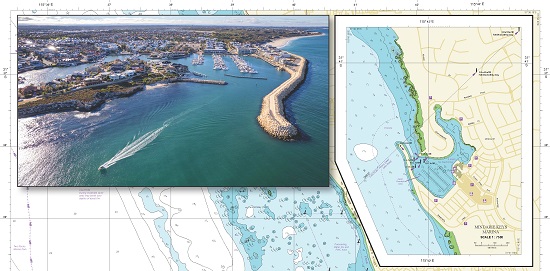


zoom on Quinns Rocks
The pilot digital program was the key recommendation of a review of the production and distribution of DoT’s nautical charts to provide a plan to best meet the future needs of the State’s boating community.
“This initial success lays the foundation for the conversion of the remaining 57 nautical charts for waters off the WA coastline and the future release of web-delivered dynamic maps with the most up-to-date information to keep mariners safe,” Mr Mather said.
“Significant work is involved in transforming DoT’s entire library of charts to the new format. DoT will soon begin work on the conversion of the neighbouring chart for waters off Trigg Beach, then move to areas where there have been recent changes to the sea floor such as Carnarvon.”
“This initial success lays the foundation for the conversion of the remaining 57 nautical charts for waters off the WA coastline and the future release of web-delivered dynamic maps with the most up-to-date information to keep mariners safe,” Mr Mather said.
“Significant work is involved in transforming DoT’s entire library of charts to the new format. DoT will soon begin work on the conversion of the neighbouring chart for waters off Trigg Beach, then move to areas where there have been recent changes to the sea floor such as Carnarvon.”

zoom on Fremantle
DoT-produced nautical charts are available for a large portion of the WA coastline and are free to download.
Links :
- MySailing : Digital chart for Quinns Rocks in WA

Polar vortex is 'spinning backwards' above Arctic after major reversal event
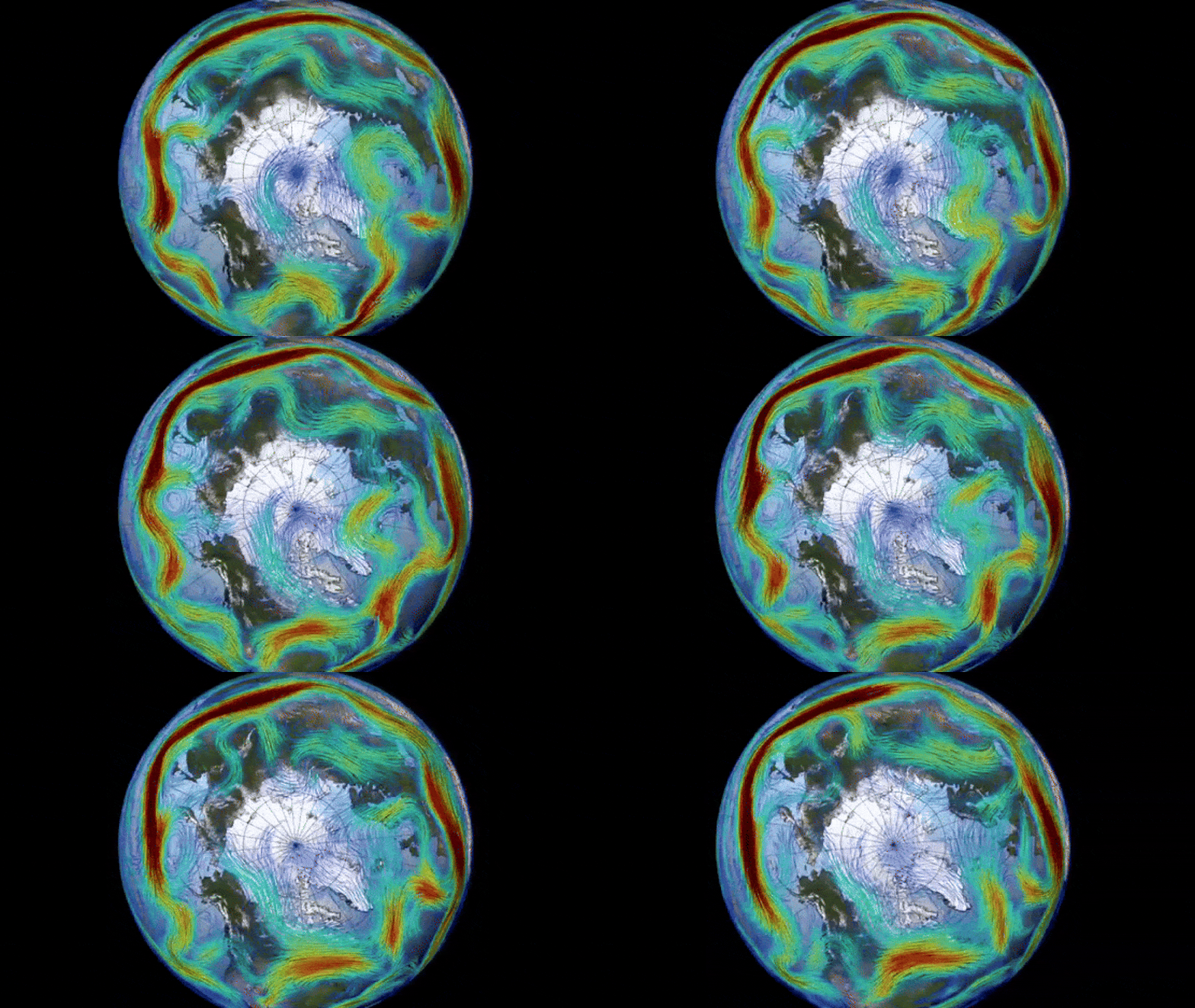
The polar vortex is a key driver of the polar jet stream (seen here).
(Image credit: NASA/Goddard Space Flight Center)
From LiveScience by Harry Baker
Earlier this month, a sudden atmospheric warming event caused the Arctic's polar vortex to reverse its trajectory. The swirling ring of cold air is now spinning in the wrong direction, which has triggered a record-breaking "ozone spike" and could impact global weather patterns.
The polar vortex circling the Arctic is swirling in the wrong direction after surprise warming in the upper atmosphere triggered a major reversal event earlier this month. It is one of the most extreme atmospheric U-turns seen in recent memory.
In the past, disruptions to the polar vortex — a rotating mass of cold air that circles the Arctic — have triggered extremely cold weather and storms across large parts of the U.S..
The current change in the vortex's direction probably won't lead to a similar "big freeze." But the sudden switch-up has caused a record-breaking "ozone spike" above the North Pole.
The polar vortex is most prominent during winter months and extends into the stratosphere — the second layer of the atmosphere up to around 30 miles (50 kilometers) above the surface. The vortex spins counterclockwise with wind speeds of around 155 mph (250 km/h), which is around the same speed as a Category 5 hurricane, according to the U.K. Met Office. A similar vortex also encircles Antarctica during the southern winter.
Polar vortices occasionally reverse temporarily. These events can last for days, weeks or months and are caused by sudden stratospheric warming (SSW), when the temperatures in the stratosphere climb by as much as 90 degrees Fahrenheit (50 degrees Celsius) in the space of a couple of days, according to the Met Office.
In the past, disruptions to the polar vortex — a rotating mass of cold air that circles the Arctic — have triggered extremely cold weather and storms across large parts of the U.S..
The current change in the vortex's direction probably won't lead to a similar "big freeze." But the sudden switch-up has caused a record-breaking "ozone spike" above the North Pole.
The polar vortex is most prominent during winter months and extends into the stratosphere — the second layer of the atmosphere up to around 30 miles (50 kilometers) above the surface. The vortex spins counterclockwise with wind speeds of around 155 mph (250 km/h), which is around the same speed as a Category 5 hurricane, according to the U.K. Met Office. A similar vortex also encircles Antarctica during the southern winter.
Polar vortices occasionally reverse temporarily. These events can last for days, weeks or months and are caused by sudden stratospheric warming (SSW), when the temperatures in the stratosphere climb by as much as 90 degrees Fahrenheit (50 degrees Celsius) in the space of a couple of days, according to the Met Office.
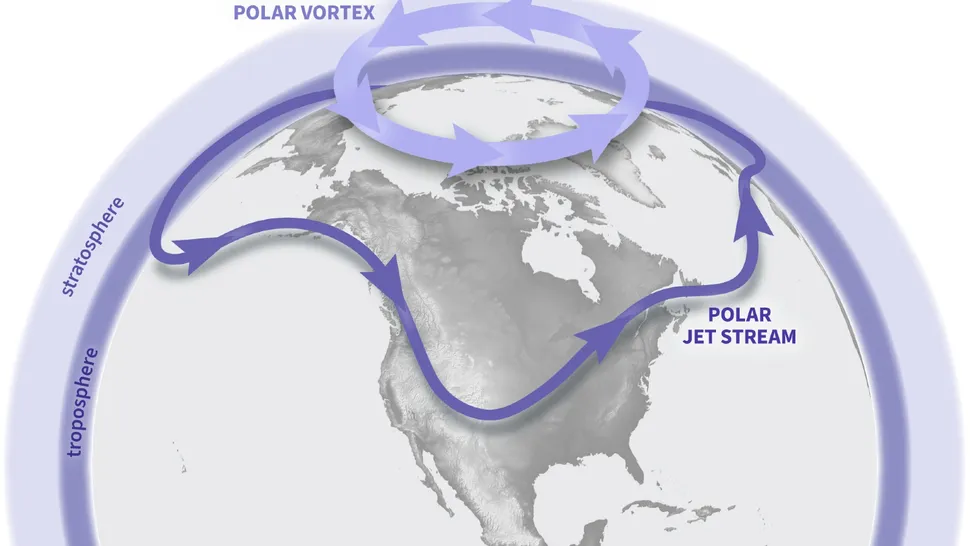
Changes to the polar vortex influence the jet stream, which can in turn impact weather across the Northern Hemisphere.
(Image credit: NOAA Climate.gov graphic)
The sudden warming is caused by "planetary waves" in the atmosphere — compression waves formed when air rises into a region of different density and is pushed back downward by the force of Earth's spin. This process disrupts or reverses the vortex flow.
Get the world’s most fascinating discoveries delivered straight to your inbox.Contact me with news and offers from other Future brandsReceive email from us on behalf of our trusted partners or sponsorsBy submitting your information you agree to the Terms & Conditions and Privacy Policyand are aged 16 or over.
The current reversal event in the Arctic began on March 4. However, the winds are starting to slow down, hinting that the vortex will return to its normal trajectory soon, Spaceweather.com reported.
"It was a substantial reversal," Amy Butler, a climate scientist at the National Oceanic and Atmospheric Administration (NOAA) and author of NOAA's new polar vortex blog, told Spaceweather.com. The speed of the reversed winds puts the event in the top six on record, she added.
Disruptions to the polar vortex can impact weather in the U.S., such as in 2019when a massive cold front descended across the Midwest. These extreme weather events occur when the polar vortex deforms the jet stream — an air current that surrounds the polar vortex — exposing lower latitudes to large blobs of icy Arctic air.
This month's disruption did not change the shape of the jet stream, so weather patterns are expected to remain largely unaffected, according to Spaceweather.com.
However, the change in air temperature around the Arctic has sucked up large amounts of ozone from lower latitudes, creating a temporary ozone spike — the opposite of an ozone hole. Currently, there is more ozone surrounding the Arctic than at this time during any other year on record, according to Spaceweather.com. However, this ozone spike will disappear after the polar vortex returns to normal
The current reversal is the second of its kind this year, following a smaller event in January that did cause a brief cold snap in some states, Butler wrote in NOAA's polar vortex blog.
Historical records show that SSW events are more likely to occur during El Niño or La Niña, the two contrasting phases of a natural cycle of planet-wide warming and cooling. During these phases, global weather systems become more unstable, which sets the stage for more frequent reversal events, Butler wrote in the NOAA blog.
We are currently in the midst of a major El Niño, which could make further reversals or disruptions more likely over the next year or so.
Links :
- LiveSciences : 'One of the biggest on record': Ozone hole bigger than North America opens above Antarctica / Big blob of hot water in Pacific may be making El Niño act weirdly / Deadly cyclone 'Freddy' may be the longest-lived and most energetic storm ever recorded / 'Gigantic jet' that shot into space may be the most powerful lightning bolt ever detected
Thursday, April 4, 2024
The Mozambique channel may become the next maritime security hotspot
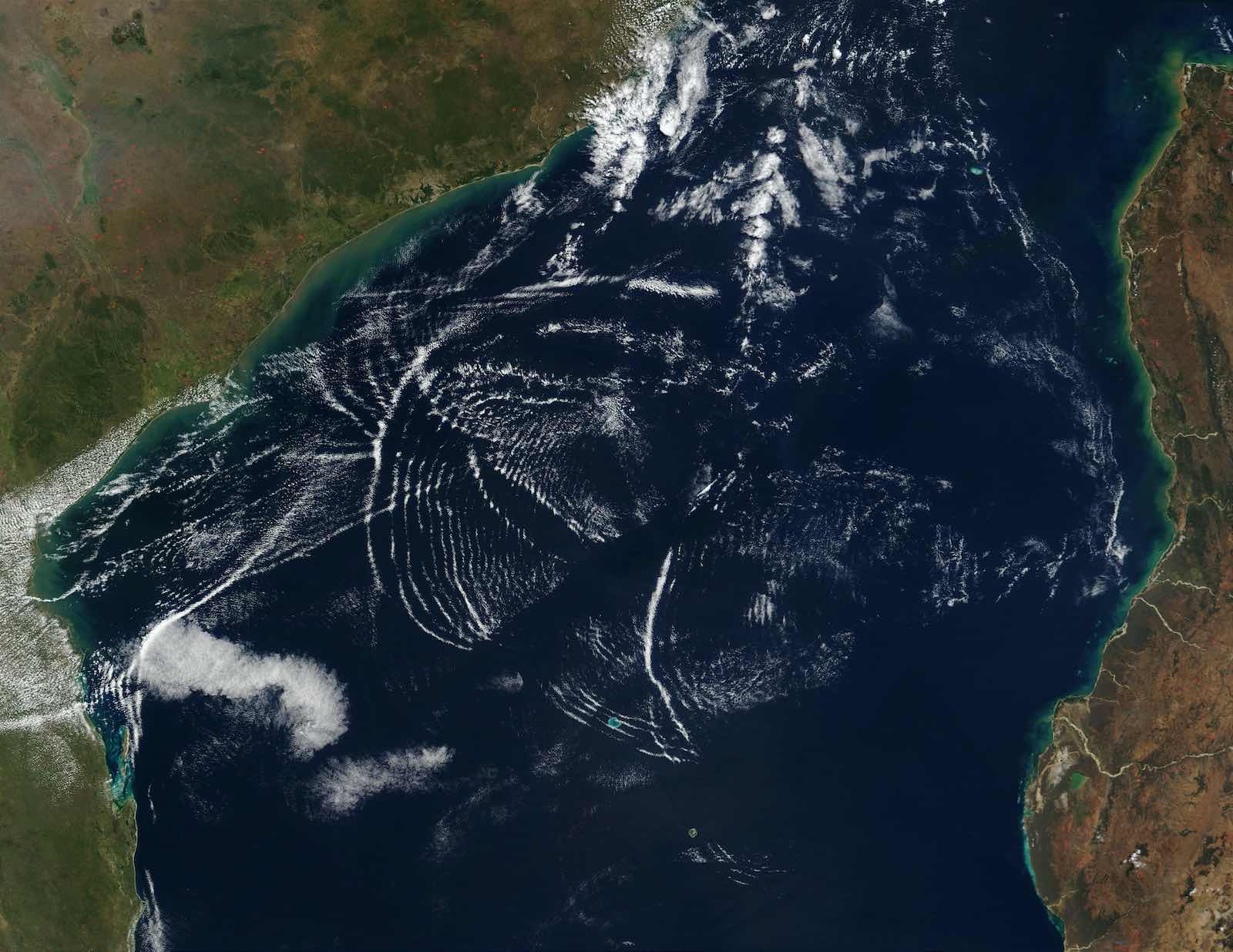
Mozambique Channel, between Madagascar and East Africa (NASA Visible Earth)
From Lowy Institute by David Brewster
The waters off Mozambique are becoming a major new security hotspot in the Indian Ocean.
An Islamist insurrection in northern Mozambique that the government seems powerless to suppress has also increasingly led to disruption in the Mozambique Channel, a key global shipping route.
The Quad countries and European partners must help contain the problem before other actors step into a regional vacuum.
The insurgency in Mozambique has the potential to destabilise Southern Africa and embolden Islamists throughout the region.
It threatens security in the Mozambique Channel, the 1800 kilometre long waterway between Madagascar and East Africa that carries some 30% of global tanker traffic.
It is also the location of some of the world’s largest gas reserves.
The insurgency was started in 2017 by groups drawn from Muslim communities on the so-called “Swahili coast”.
This has now included more than 800 separate attacks across northern Mozambique, resulting in at least 2600 deaths and more than 600,000 people displaced.
A report from the UN Secretary-General to the Security Council also pointed to transnational links, with Somali-based Islamists in Puntland acting as a “command centre” for Mozambique insurgents.
However, other analysts discount close operational links with Islamic State.

source Areion 24 news
Armed clashes escalated sharply in 2020, with attacks spilling over the border into Tanzania, where the government faces local Islamist extremists.
There are also growing attacks on maritime infrastructure.
In August, insurgents seized a key port in northern Mozambique from government forces, raising concerns that this is a first step in insurgents venturing into piracy, as occurred in the Horn of Africa.
Maritime drug smuggling is a key source of funds for insurgents.
The so-called “Smack Track” has long brought heroin grown in Afghanistan down the East African coast, where a substantial portion is now landed in northern Mozambique before being transported to Europe and elsewhere.
Heroin is also increasingly supplemented by crystal meth, produced in Afghanistan from local shrubs.
In August, insurgents seized a key port in northern Mozambique from government forces, raising concerns that this is a first step in insurgents venturing into piracy, as occurred in the Horn of Africa.
Maritime drug smuggling is a key source of funds for insurgents.
The so-called “Smack Track” has long brought heroin grown in Afghanistan down the East African coast, where a substantial portion is now landed in northern Mozambique before being transported to Europe and elsewhere.
Heroin is also increasingly supplemented by crystal meth, produced in Afghanistan from local shrubs.

Visualization of the Mozambique Canal with the GeoGarage platform (SHOM nautical raster chart)
Another big factor is the development of a major offshore gas industry in the Mozambique Channel off northern Mozambique.
This involves planned investments of some US$50 billion to extract an estimated 100 trillion cubic feet of gas, including a major onshore gas liquification plant.
France’s Total and US-based ExxonMobil are major investors.
In January 2021, following a series of escalating attacks, Total began to move part of its logistical operations from northern Mozambique to safety on the French-administered island of Mayotte in the Channel.
The Mozambique government, which is in severe debt distress, is unable to take effective action against the insurgency, and has increasingly relied on mercenaries.
But it has been somewhat reluctant to accept international assistance.
Russia has tried to promote itself as a partner, eyeing a share of Mozambique’s offshore gas reserves for Gazprom and Rosneft.
Moscow uses private security contractors as its proxies in many countries in Africa.
In September 2019, up to 200 mercenaries from the Russian Wagner group were deployed to Mozambique with equipment and logistical support from the Russian Air Force and, possibly, also the Russian Navy.
But the contractors suffered heavy casualties and were withdrawn from operations within months.
The Quad and like-minded partners have important interests in stopping the insurgency spilling further across Mozambique’s borders or into the maritime domain.
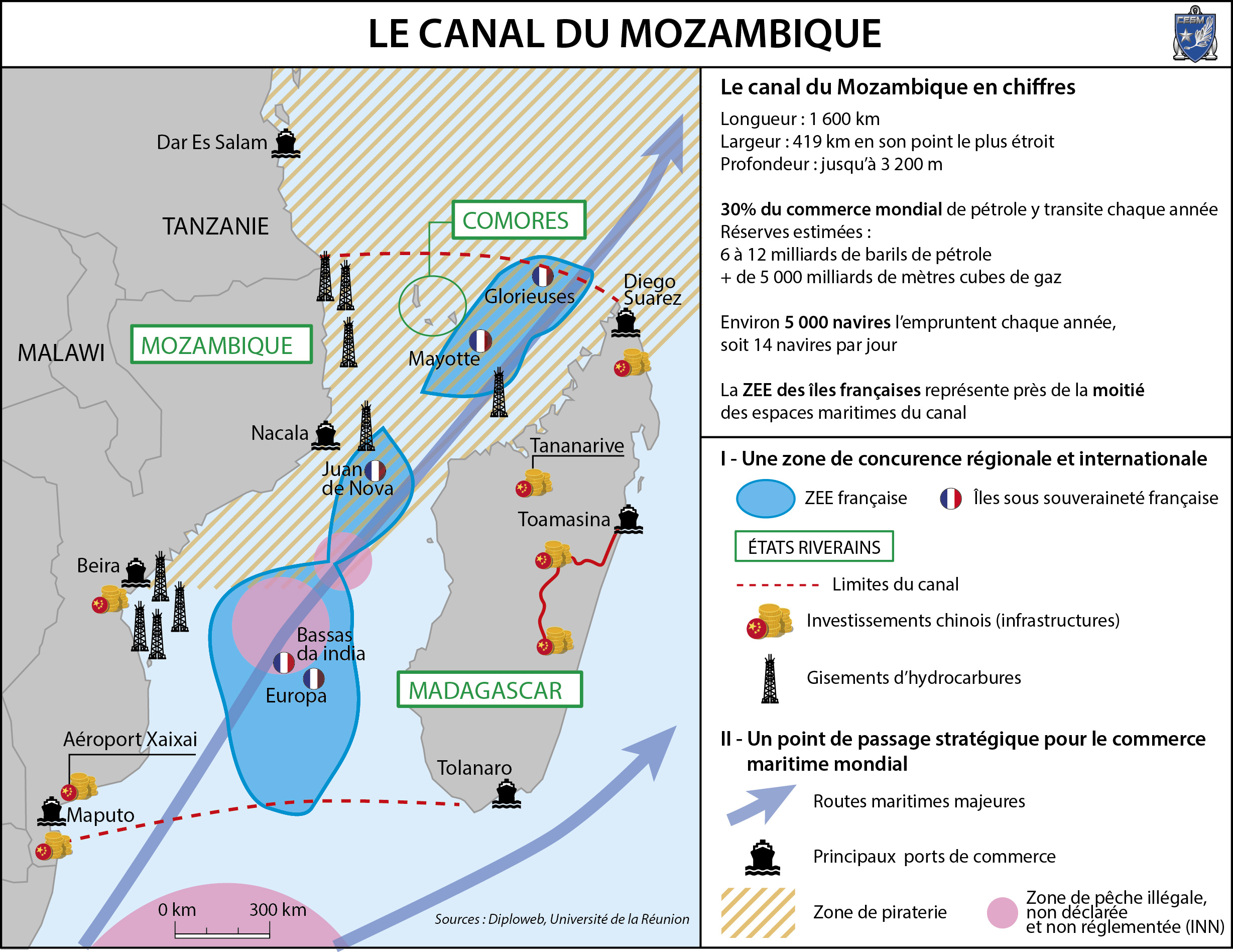
courtesy of CESM
France and other European partners are now stepping up efforts to contain the problem.
France is historically a leading maritime security provider in the southwest Indian Ocean, with two French frigates and patrol boats based in French Reunion.
But France lacks maritime patrol aircraft based in the region.
Portugal, the former colonial power in Mozambique, has agreed to send a training mission of more than 1400 troops.
Lisbon is also using its current Presidency of the European Union to lobby for the deployment of an EU military mission.
Spain has also offered military support.
The United States is also finalising an offer of counter-terrorism assistance.
The South African Navy has conducted intermittent anti-piracy patrols in the Mozambique Channel since 2011, and is now establishing a new forward operating base at Richards Bay in South Africa’s north in response to the insurgency.
South Africa and its Southern African Development Community (SADC) partners have offered naval and intelligence support.
But Mozambique appears reluctant to involve African partners.
India has also long positioned itself as a net security provider in the south-west Indian Ocean and as a security partner to Mozambique.
France is historically a leading maritime security provider in the southwest Indian Ocean, with two French frigates and patrol boats based in French Reunion.
But France lacks maritime patrol aircraft based in the region.
Portugal, the former colonial power in Mozambique, has agreed to send a training mission of more than 1400 troops.
Lisbon is also using its current Presidency of the European Union to lobby for the deployment of an EU military mission.
Spain has also offered military support.
The United States is also finalising an offer of counter-terrorism assistance.
The South African Navy has conducted intermittent anti-piracy patrols in the Mozambique Channel since 2011, and is now establishing a new forward operating base at Richards Bay in South Africa’s north in response to the insurgency.
South Africa and its Southern African Development Community (SADC) partners have offered naval and intelligence support.
But Mozambique appears reluctant to involve African partners.
India has also long positioned itself as a net security provider in the south-west Indian Ocean and as a security partner to Mozambique.
Since 2020, Indian Navy P8I maritime patrol aircraft, staging through Réunion, have conducted joint patrols with the French Navy in the Mozambique Channel.
India is also in the process of constructing an air and naval facility on Mauritius’ remote Agalega island, near the north end of the Channel, improving its ability to cover the region.
Australia will be wary of any new defence commitments in the western Indian Ocean.
India is also in the process of constructing an air and naval facility on Mauritius’ remote Agalega island, near the north end of the Channel, improving its ability to cover the region.
Australia will be wary of any new defence commitments in the western Indian Ocean.
The Royal Australian Navy has been deployed there for years, interdicting smugglers on the Smack Track.
But that presence is being reduced, following an increased focus on areas closer to home, including the Pacific.
Australia may need to consider what non-military assistance it can provide.
The Quad and like-minded partners have important interests in stopping the insurgency spilling further across Mozambique’s borders or into the maritime domain.
A decade ago, Somali-based piracy was the trigger for the international militarisation of the waters off the Horn of Africa.
There are good reasons to avoid a similar dynamic in southern Africa.
The crisis should also be seen an opportunity for countries such as France and India to demonstrate their value as security partners in the region.
It may also be an opportunity to build cooperation with South Africa, which is increasingly a “swing state” in geopolitical competition.
Failure to contain the conflict will leave a vacuum for other actors to fill.
But that presence is being reduced, following an increased focus on areas closer to home, including the Pacific.
Australia may need to consider what non-military assistance it can provide.
The Quad and like-minded partners have important interests in stopping the insurgency spilling further across Mozambique’s borders or into the maritime domain.
A decade ago, Somali-based piracy was the trigger for the international militarisation of the waters off the Horn of Africa.
There are good reasons to avoid a similar dynamic in southern Africa.
The crisis should also be seen an opportunity for countries such as France and India to demonstrate their value as security partners in the region.
It may also be an opportunity to build cooperation with South Africa, which is increasingly a “swing state” in geopolitical competition.
Failure to contain the conflict will leave a vacuum for other actors to fill.
Links :
- Revue Conflits (in French) : Canal du Mozambique : un enjeu de premier ordre pour l’Afrique, l’Europe et l’Asie
- LowyInstitute : Mapping the oceans is the new front in the battle for influence in the Indian Ocean
- GeoGarage blog : The strategic importance of the Indian Ocean: international ... / Rivalry between America and China has spread to the ... / The small islands holding the key to the Indian Ocean / The South China Sea moves to the Indian Ocean / Chinese Ships Seen Mapping Strategic Seabed In Indian ... / Monsoon: the Indian Ocean and the future of American power
Subscribe to:
Posts (Atom)