Saturday, November 15, 2025

U.S. military destroys 20th suspected drug boat

The US strikes four suspected drug boats in the eastern Pacific Ocean.
Defense Secretary Pete Hegseth released video of the strikes on X.
He says there were three strikes on the boats Monday, killing a total of 14 "narco-terrorists."
Mexico took over the search for one survivor.
President Donald Trump has been targeting drug-trafficking boats heading for the US off the coasts of Latin America since September.
 
 
 The U.S. military has killed another four suspects in its new airstrike campaign against suspected smuggling boats off Latin America, according to CBS and the New York Times.
The strike is the 20th in the series, and brings the total number of deceased to 80 people.

Pentagon officials confirmed the attack to both outlets, but a formal announcement of the action is still pending, reportedly because top officials are awaiting video footage.

The attacks are controversial in legal circles, both for its compliance with American law and for compliance with international human rights law, and have attracted scrutiny. 
"The US must halt such attacks and take all measures necessary to prevent the extrajudicial killing of people aboard these boats, whatever the criminal conduct alleged against them," said UN High Commissioner on Human Rights Volker Turk last week.

Colombia has ceased sharing intelligence with U.S. forces over its concerns about the strikes, and the United Kingdom has decided to stop reporting the movements of suspicious boats in the Caribbean to the U.S.-led counternarcotics consortium, Joint Interagency Task Force West. 
The family of one of the deceased, Colombian fisherman Alejandro Carranza, has promised to sue the administration in U.S. courts for wrongful death; they have already retained an American attorney.

Out of 20 strikes, only two survivors have been rescued, one Colombian and one Ecuadorian national. Both have been repatriated, and the Ecuadorian national has been released without charges because of lack of evidence.

The Pentagon has pledged that the attacks will continue.
In addition, it is building up a substantial task force near Venezuela's coast, consistent with a large-scale military action.
Sources within the department have told CBS that while no decision has been made to move ahead, the president has been briefed on possible strike options, to include attacks on land targets.
The carrier USS Gerald R. Ford is now approaching the staging area, bringing four squadrons of F/A-18 Super Hornet strike fighters and three additional destroyers - enough capacity to consider a sustained air campaign.


Friday, November 14, 2025

NOAA's new nautical chart numbering system

ENC US coverage on Google Earth with GeoGarage weekly updated kmz

Official US charts with chart numbers started with the founding of the US Coast Survey in 1807 that evolved through several forms into the modern NOAA.
Historic charts can be tracked down at historicalcharts.noaa.gov.

The first Boston Harbor chart, for example, was called No. 337 in 1836.

Boston Harbour N°337 / courtesy of old-maps.com
see 1864 version in high resolution with Oceangrafix 
 
It was then replaced with No. 246 in early 1900s, and then in 1974 the system many of us grew up with was established.


And then this chart was called 13270, a number that lasted until its final edition, when all paper charts were discontinued at the end of 2024.


That numbering system grouped charts using the first two digits as follows:

19xxx = Hawaii charts
18xxx = Pacific Coast and Salish Sea Charts
17xxx = SE Alaska
16xxx = Alaska 14xxx = Great Lakes
13xxx = Atlantic, Long Island to Maine
12xxx = Atlantic, Cape Hatteras to N end of Long Island
11xxx = Gulf Coast and Atlantic up to Cape Hatteras

To reminisce on this and learn all those chart numbers, see How to Get a Copy of a Discontinued NOAA Chart.

With the demise of the NOAA paper charts—which brought with it the end of all raster navigational charts (RNC)—the only official charts left were the electronic navigational charts (ENC).
The "sunsetting" of the paper charts should not have been a surprise; it was announced in 2019 and they began the process almost immediately.

Many mariners first confronted ENC this year, but they are not at all new.
They were defined by the IMO and IHO in 1990, approved for use in 2000, and they have been mandated to be used by all SOLAS vessels since 2018.

NOAA's first official ENC were published in 2003.
The original NOAA ENC (now called legacy), some of which are still in use, especially on the West Coast, have wildly irregular shapes, and multiple scales (over 100!), that come about from the strict IHO rules on how they must match up and not overlap, yet stemming from existing paper chart data.
Below is a sample from the Eastern Strait of Juan de Fuca.

Here we see legacy ENC along with the RNC (paper charts) they were based upon, plus the prominent lack of chart around Victoria BC, due to the IHO rule that no two nations can make an ENC of the same area.

The shapes and scales of the legacy ENC are chaotic, but the file names (chart numbers) are in fact fairly systematic.

The chart number starts with the originator's country code (US) followed by the scale band of the chart, which is the compilation chart-scale range for legacy ENC, followed by the state abbreviation (USPS conventions), followed by two digits which is the chart ID, and that is followed by an "M."
No one seems to know why this is an M.
We do know the full name according to IHO must be 8 characters, so they needed something.
Some have suggested it means metric, but we do not need to be told that because all ENC, worldwide, must be metric, plus others have said there is no evidence this means metric.
The "no one," "some," and "others" refer to NOAA personnel, over the years.

So, for example, chart number US5WA16M means:
US = United States made the chart
5 = scale band 5, which in legacy terms means 1:5,000 to 1:51,639
WA = Washington state chart
16 = chart ID
M = filler to make 8 characters

Note that ENC retain chart names (as opposed to chart numbers), similar to the paper chart names they were based upon.
US5WA16M, for example, has the name "Approaches to Admiralty Inlet, Dungeness to Oak Bay."

Here are the scales in use

There is a detailed explanation of the rescheming program on line at Rescheming and Improving Electronic Navigational Charts.

The rescheming began slowly in late 2019, early 2020, which introduced a new numbering system, but it was not described on a NOAA website till mid 2024.
I have since discovered that it was indeed presented on an IHO website in 2017 and then updated at the IHO in 2020.

The new chart numbering system was not noticed much because the rescheming was slow getting started, and we had most of the time just a few reschemed charts amid mostly legacy versions—as we have now in WA state.
But the rescheming is now nearly done elsewhere, and the new numbering has since been added to the latest rescheming overview.
Recent rescheming progress has been very good.

There are still 8 characters to the name of every ENC worldwide, and they still start with the national IHO Producers Code (US, CA, FR, GB...), followed by the scale band, but the meaning of the rest of the characters is new.

The regional code replaces the simple US state abbreviation, and the cell location within a matrix replaces the previous (chart number + M).


In principle, and in some cases, this is a simple system.

For example look at scale band 3 charts in Louisiana (LA).


The above are scale band 3 charts for LA with neighboring charts from TX, MS, AL, and FL.
Green ones are available now.
Red ones are planned.


Many states, such as LA, have only one regional code, which is the state abbreviation + 1, LA1 in this case.
So all charts in the state use regional code LA1.
Other states like CA, WA, NY have multiple regional codes, i.e., WA1, WA2, WA3, etc.

We see that the SW corner is cell location (A, A); they then increase to the north and east, ending when it reaches a neighboring regional code.

It would be nice to stop at this point saying that is the new system, but that would leave out some details that might confuse us when encountered.

First, we note that for scale band 5, the regional code based on state ID can be replaced in the vicinity of some specific ports with its United Nations Location Code (UN/LOCODE).
Also when multiple state codes are used, it is not always clear what the logic is for their specifications.
See for example, this plot of scale band 5 charts of NY.


These are scale band 5 for NY state, with some NJ, RI, and CT.
The sizes are all the same, but the scales vary—in principle either 1:12,000 or 1: 22,000, but some of these have not been updated so they are still 1:10,000 and 1:20,000.

But looking at how they are named, we see the influence of the new rules.


NY has more than 1 region code, and on scale band 5 they use NY1, NY2, and NY9.
In California, scale band 5 uses CA1, CA2, CA3, and CA4, which appears to be latitude and scale band dependent.
In NY, the codes seem to be longitude dependent, but not in sequence.

Also in NY we see the use of three UN/LOCODES: NYC (New York City), HEP (Hempstead), and PTJ (Port Jefferson).
The location code abbreviations are likely understood by local mariners, but likely less so by visitors.
Zoom in on the charts, and it should be clear what they refer to.

Just about every city in the world has a UN code, which mariners might be familiar with on some level, because the ones that are ports are used in Type-A AIS voyage data for the reported destination.
That AIS output is manually entered, and mariners can put what they want, but the intention is to use the UN codes, which is common.
Looking at the practical side, however, many ships forget to change this once they leave a port.
So often the destination broadcasted is actually where they just left from!

So the summary is, most ENC chart names still include the state, but it will be followed by a number whose whose meaning may not be obvious and may depend scale band.

The exceptions are the scale band 5 charts that instead of the state regional codes, will (on just a few charts) use UN codes for what NOAA refers to as "Principal ports (based on cargo, fisheries, and tourism)."
NY uses three of these, one of which is certainly more "principle" than the other two.
CA charts in production propose to use four of these: OAK (Oakland); NTD (Port Hueneme); LGB (Long Beach); and SAN (San Diego).
One might not have guessed that Port Hueneme (why-NEE-mee) made the list, but we probably learn more about this port because of this.

The UN/LOCODES are also used in principle for scale band 6 ENC, but NOAA does not yet have any of these—and the couple we used to have are now discontinued.

The last point to address is the cell location ID at the end of the file name.
It is based on a matrix, unique to the state and to the scale band, whose SW most cell is called AA.
In some cases, as above for LA scale band 3, the pattern is clear.
In other chart regions it is not clear, and what we see in the SW corner is a matrix location that is not easy to decipher.

Below is a sample of where the DE and NJ charts meet.

 
The NJ charts look fine with AA in the SW corner, but the DE charts start with DE in the SW corner—which is just a coincidence that is trying to fool us!
It has nothing to do with the state abbreviation.
This is the D row of the E column, with the location of the non existent AE chart indicated here in red.
This chart has not been created yet, but it might be once the legacy chart US5DE10M gets reschemed. 

And to see why this is AE instead of AA, we have to look to the NW.
Delaware has charts running up the Delaware Bay, as shown below.


Again, the sequence of DE charts (blue) runs into a legacy chart (USDE13M) that has not been reschemed.
Once that is done, we see where there might be a chart LA next to the existing LB, which would mark the A column that we can extend south to see the matrix location of a chart AA—if it were to exist.
A key to understanding this cell location system is to realize that there does not have to be an actual chart for every location in the grid.
Notice that FF is missing in the southern DE graphic.


So it seems that NOAA starts by defining an area that is going to be reschemed at, say, scale band 5.
Then they lay a rectangular grid of scale band 5 charts over that area, which are labeled starting with AA at the SW corner.
Then wherever they produce a chart within that grid, it gets the grid label for that specific location.
In some cases the AA location will be a real chart, but in many others it will not.

Hopefully this helps understand the intended matrix system.

So we have a new chart naming system that is better than the paper chart "eighteen-thousand means West Coast," and better than the legacy ENC system, which added a state designator, but the rest the name conveyed no information, and could be very misleading.

In US5DE13M, shown above, for example, the same chart covers three different locations, separated by as much as 20 nmi, and adjacent legacy chart numbers had no relationship to each other.
We knew that system had to go, and now it is nearly done. 


Links :

Thursday, November 13, 2025

‘Diamond Reef is no more’: clearing New York City’s harbor reefs


From NewYork Almanack

What follows is a article first published in Scientific American, December 23, 1871.
The removal of obstructive rocks from the narrow East River strait of Hell Gate began in 1849 and was accelerated in 1851 when the U.S. Army Corps of Engineers led by General John Newton began a blasting and dredging operation which lasted 70 years.

We give this week some engravings illustrating the operations now in progress for the removal of the obstructions at Hallett’s Point, East River.
Having often referred to this great work, our present notice will be rather historical and general than technical.
 

courtesy of Marinas
 
History of the Work

The following sketch of the origin and progress of the work is from The New York Times:

“Complete surveys of New York harbor have been made at different periods, as is well known, with the object of removing the obstructions to navigation, by Admirals [David Dixon] Porter and [Charles Henry] Davis, Commodore [Tunis] Craven, and the present able and successful topographical engineer General John Newton of the United States Army.

“In September, 1870, experimental blasts were made by General Newton,which proved to him beyond a doubt that the work he had undertaken, though a task of immense magnitude, could be accomplished, and at a comparatively trifling cost to the Government.
“Last May, General Newton commenced work with the steam drills on the dangerous rocks, in mid stream between Governor’s Island and the Battery, known as Diamond Reef.
After laboring assiduously for over five weeks, and making repeated blasts, between 700 and 800 yards square of the reef were blown away.
“Surveys were made of three blasts, which disclosed at the bottom of the river a mass of crushed rock, innumerable detached boulders, and huge hillocks of sand, lying around, and over which was once Diamond Reef.
“A contract was soon made to have the debris removed, a work which has almost been finished, and which has demonstrated the fact
that no additional blasts will be required, and that the dreaded Diamond Reef is no more.
“Soon after the work of the drills upon Diamond Reef was concluded, the drill scows were securely moored over Coenties Reef, and immediately commenced operations.
The number of cubic yards of rock to be removed at Coenties Reef is roughly estimated at over 3,000, and much of this has already been blasted out by General Newton’s indefatigable workmen.
“Besides at Coenties Reef, General Newton’s drills are now at work on the Shell Drake, Way’s Reef, Hog’s Back, Pot Rock, at the Hell Gate, or Horll Gatt [sic] as the old Dutch navigators termed it [Helle Gadt was a name the Dutch once applied to the entire East River], and at Willett’s Point.
“The operations at the Hell Gate are the most extensive, the most important, and decidedly the most interesting.

The Hell Gate, as every New Yorker knows, is a narrow, rocky passage in the East River, and in the old Knickerbocker times its raging current was the terror of the Dutch skippers and their heavy and unwieldy craft.
“Of late years, many improvements have been effected by blasting away the surface rock, and the most salient points of the jagged ridges; but only since August, 1869, has the United States Government commenced to deal with the dangers of Hell Gate in a measure corresponding with their importance.
“The operations undertaken by General Newton at Hallett’s Point, for the Hell Gate, involve the solution of an important problem of engineering as regards the most effective and economical process of submarine blasting.
The modus operandi employed at Hallett’s Point is entirely different from the manner in which the work of removing the obstruction has been accomplished at Diamond and Coenties Reefs, and is what is technically termed tunnel blasting.
“At Hallett’s Point, in August, 1869, a coffer dam was commenced under the superintendence of General Newton, and was completed in October.

The dam is an irregular polygon in shape, having a circumference of 443 feet and a mean interior diameter of about 100 feet.
The darn is built between low and high water marks.

“The excavation of the shaft immediately followed the construction of the dam, and during the spring of 1870 the shaft was sunk to the depth of twenty-two feet below water.
“The theory of the mining operations contemplates the removal of as much rock as can be excavated with safety previous to the final explosion, the result of which will be the sinking of the remaining mass into the deep pit excavated for its reception.
“The mass of rock remaining for the final explosion will be supported by piers, each of which will be charged with nitro glycerin.
These piers are simply a portion of the solid rock left still standing.


“From the bottom of the main shaft, tunnels proceed in all directions, and are ten in number.
Each of the tunnels extends from 150 feet to 350 feet outward, and they are all connected together by cross galleries at intervals of twenty-five feet.
The tunnels were begun towards the close of July, 1870, the shaft being at the same time sunk to a line nearly forty feet below low water mark.
“The tunneling is really an object of a great deal of interest, as much from the novelty as from any other feature.
The tunnels are of various cross sections, some over twenty feet in height, and varying in width from ten to fifteen feet.”

The “Improved Drill” of the American Diamond Drill Company, recently illustrated and described in the Scientific American, has been recently introduced into one of the headings, and, we are informed by General Newton, gives prospect of affording efficient aid in hastening the completion of the work, which will take probably two or three years more continuous labor.

As the work advances, room is made for more miners, and therefore the rate of advance may increase with the progress of the excavation.

The liberal views of the Engineer in Chief, General Newton, are rendering this work important in another respect.
He has made it a sort of engineering arena for the trial of different explosives and drilling machines; and the relative value of most of the mining appliances in market will be determined during the progress of the work.

In this way, important contributions to engineering science will be made, whose value will be second only to the splendid results anticipated by the removal of the obstructions from the Hell Gate passage.
These out of the way, the upper end of the island will become a scene of busy thrift, scarcely; less prosperous than that which fills with unintermitting hum the lower part of the city.

Although from Virginia, General John Newton (1823-1895) served in the United States Army during the Civil War, and later as Chief of the Corps of Engineers.
Newton oversaw improvements to the waterways around New York City, into Vermont, including the Hudson River above Albany.
This work is covered in detail in Thomas Barthel’s Opening the East River: John Newton and the Blasting of Hell Gate (McFarland, 2021).

Illustrations, from above: “Coffer Dam, Main Shaft, and Entrance to Heading, Hell Gate, East River”; Dimond Reef (Diamond Reef) and Coenties Reef shown on an 1866 US Coast Survey Nautical Chart; and “Section View of a Transverse Avenue, Hell Gate,” both from Scientific American, December 23, 1871.
 
Links :

Wednesday, November 12, 2025

Exploring the potential of fused imaging and Lidar data for seabed classification


3D model from airborne topo/bathy Lidar.
(Image courtesy: Leica Geosystems)
 
From GIM by Anders Ekelund

Large-area shallow water and coastal zone mapping opportunities

The exploration and classification of the seabed have always been crucial for various scientific, environmental and commercial purposes.
Traditional methods of seabed classification have relied heavily on sonar and direct sampling techniques.
However, recent advancements have opened up new possibilities, particularly through the fusion of airborne imaging and bathymetric Lidar data.
This article delves into the potential of these fused datasets for large-area shallow seabed classification.

Bathymetric Lidar (light detection and ranging) technology offers the ability to create precise 3D maps of the seabed, providing valuable data on its morphology.
Additionally, the radiometric properties of both the water volume and the seabed are recorded in the Lidar wavelength (515nm).
The Lidar laser pulses are typically emitted with a constant pulse energy from a constant altitude, ensuring that the radiometric response does not vary with sun angles, cloud shadows and atmospheric losses as it does with passive imaging.
Furthermore, the shape of the received reflection can provide information on whether the emitted beam has been reflected off high vegetation or a flat seabed, for example.
All this information can be used to aid a seabed classification algorithm.

Airborne imaging


Modern bathymetric Lidar systems also integrate airborne imaging in four bands: red, green, blue and near infrared (NIR delivering a resolution of typically 5cm).
This passive imaging primarily aids in seabed classification, as different materials reflect different wavelengths.
Unlike imaging over land, water significantly impacts the measured radiometry, which must be compensated for.
The water surface can cause specular reflections from the sun (sunglint), affecting certain sections of the image.
Additionally, the transmission varies for different wavelengths: water is almost opaque for NIR, the red band provides information for only a few metres even in clear waters, and the blue and green bands have significantly higher transmission.
Creating useful radiometric seabed information from airborne imaging typically requires advanced image normalization algorithms, including solar radiation and sun angle modelling, sunglint removal and compensation for water radiometric properties.
The depth measured from Lidar plays a significant role in aiding these normalization algorithms.

Airborne RGB image, co-collected with the bathy Lidar.
(Image courtesy: Leica Geosystems)

Airborne hyperspectral


Airborne hyperspectral imaging collects passive imaging with a lower spatial resolution but in many more and narrower bands than airborne imaging.
The additional bands offer more accurate modelling of water properties and seabed radiometry.
However, like airborne imaging, advanced algorithms are needed for data normalization for seabed classification use.

Fusing the datasets


The fusion of imaging and Lidar data combines the strengths of all technologies, resulting in a more comprehensive and accurate representation of the seabed.
By integrating passive imaging radiometric data with precise 3D bathymetric information, we can gain deeper insights into the seabed’s characteristics.
This fusion allows for the identification of subtle features that might be missed when using either technology alone.

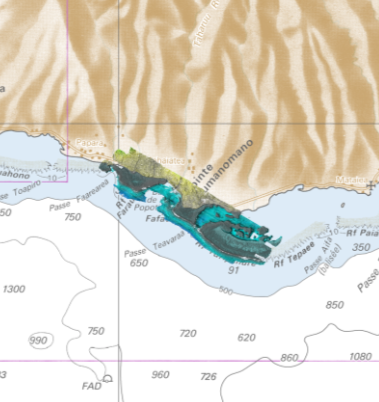
Taharuu (SHOM) 
 
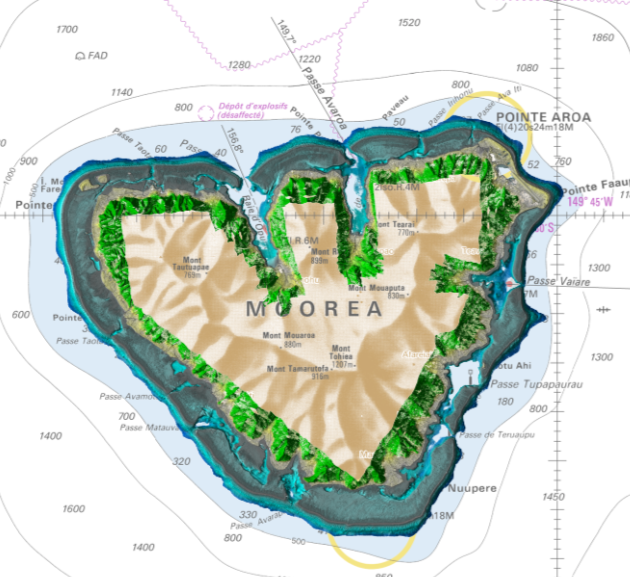
Moorea (SHOM)
  
Applications of fused data in seabed classification
 
Habitat mapping: 
Fused imaging and Lidar data can be used to create detailed habitat maps, identifying different types of seabed environments and the species that inhabit them.
This information is crucial for marine conservation efforts and the management of marine protected areas.
This can include additional factors such as seabed slope and roughness derived from the bathymetric information and ‘health’ metrics such as chlorophyll presence and algal blooms from the hyperspectral data.

River exploration: 
Bathymetric Lidar is heavily used for river mapping, primarily for the purpose of flood modelling and mitigation.
The radiometric information can however reveal important information, such as playgrounds for salmon habitats and the presence of run-off from adjacent land use.

Environmental monitoring: 
Fused data can be used to monitor changes in the seabed over time, as well as local pollution in the water, providing valuable information on the impacts of human activities such as trawling, dredging and sewage outlets and natural events such as storms and earthquakes.

Archaeological surveys: 
Underwater archaeology can also benefit from the fusion of imaging and Lidar data.
Detailed maps of the seabed can reveal the locations of shipwrecks, submerged settlements and other archaeological sites, aiding in their preservation and study.

Seabed classification based on fused airborne bathy Lidar and imaging data.
(Image courtesy: Leica Geosystems)

Comparison with other technologies
 
Sonar: Sonar technology is widely used, and significant advancements are taking place, particularly in utilizing sonar backscatter information for seabed classification.
Compared to airborne capture, sonar covers much smaller areas and its efficiency decreases with decreased depth, whereas airborne capture maintains constant efficiency.
Many bathymetric Lidar survey providers also capture shipborne sonar data and fuse the datasets to optimize collection efficiency.
It is important to note that sonar measures different properties compared to airborne data.
While sonar measures the ‘hardness’ of the seabed, airborne data collects ‘radiometric’ properties.

ROVs and direct underwater sampling: Equipping ROVs (remotely operated vehicles) and/or towed underwater devices with cameras and sonar technology allows for data capture very close to the seabed with remarkable resolution.
This high-resolution data enables detailed species recognition, classification and identification.
The primary disadvantage compared to airborne capture is the limited area coverage.
However, when used in combination with airborne capture, such datasets are ideal for creating training datasets for machine learning algorithms, enabling large-scale classification.

Satellite-based seabed classification: Satellite-captured multispectral data offers another method for seabed classification.

Unlike airborne data, satellite remote sensing is heavily affected by atmospheric conditions, where small errors in atmospheric correction can lead to significant errors in the measured radiometric properties of the seabed.
Additionally, cloud coverage can severely impact the capture of satellite images, making it challenging to find suitable images to be used, depending on the area of interest.
Compared to airborne imaging, satellite resolution is much lower, and compared to airborne Lidar, depth penetration and accuracy are significantly less.
However, combining airborne Lidar and satellite data can be an effective approach for scaling.
The potential of data fusion

Data fusion of multiple sensors offers large potential for enhanced seabed modelling.
These technologies provide different resolutions, measure multiple properties and cover different parts of the seabed.
By combining the strengths of multiple data sources, we can achieve a more complete, detailed and accurate understanding of the seabed’s characteristics.
This has far-reaching implications for habitat mapping, resource exploration, environmental monitoring and underwater archaeology.
As technology continues to advance, the possibilities for using fused data in seabed classification are bound to grow, paving the way for new discoveries and innovations in marine science.

Advancements in airborne topobathymetric Lidar and imaging


Airborne topobathymetric Lidar and imaging offer an unmatched combination of accuracy and resolution for nationwide coastal and inland water surveys in shallow waters.
Recent developments have increased collection efficiency by up to 250% compared to previous generations, enabling not only one-off collections but also repetitive surveys needed to monitor changes over time in a cost-efficient manner.
As about 40% of the world population lives in coastal zones, coastal nearshore information is highly valuable for maximizing the return on infrastructure investments, mitigating risks from coastal changes and preserving essential marine habitats.
More and more countries understand the value of an updated national coastal elevation model and the market for airborne bathymetric Lidar is therefore likely to continue to grow.

Modern freshwater pipeline and remains from Bronze Age construction on the seabed.
The Bronze Age construction is estimated at 3,300–3,500 years old, located at about four metres depth due to land mass elevation change.
(Image courtesy: Leica Geosystems)
 
Links :
 

Tuesday, November 11, 2025

School of sardines

Monday, November 10, 2025

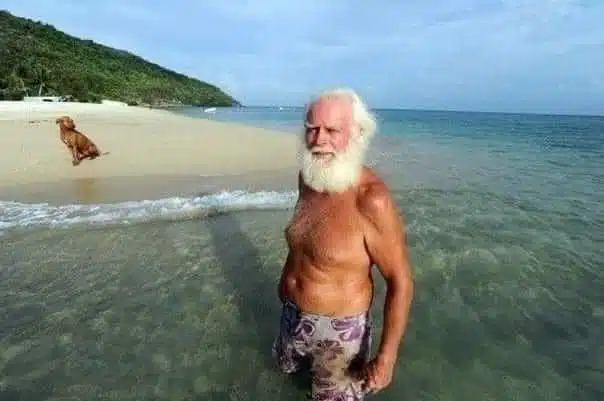
Brendon Grimshaw: the Englishman who bought an island at the end of the Earth and created paradise

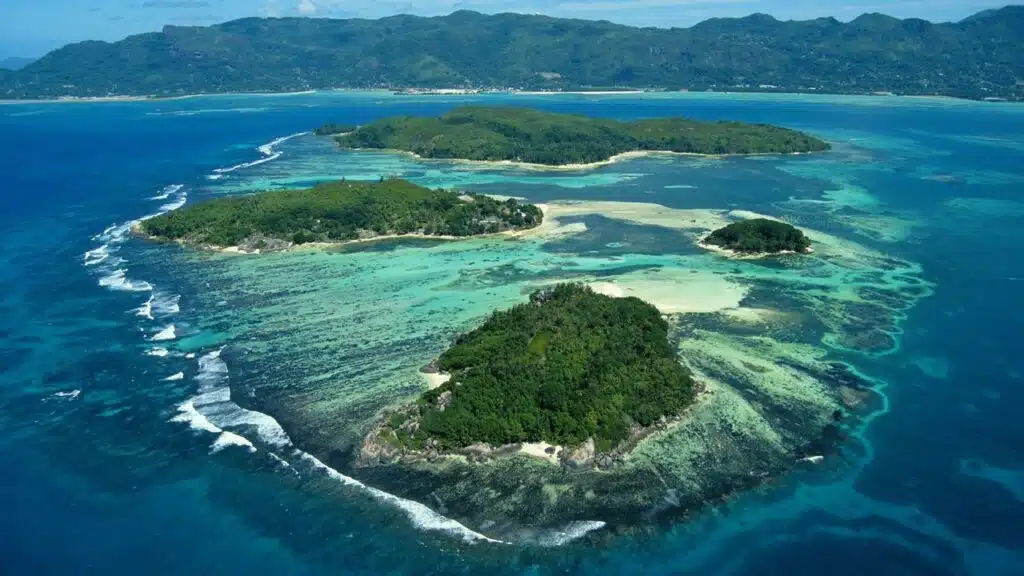
the island of Moyenne 
 
 From History Defined  by James R. Coffey
 
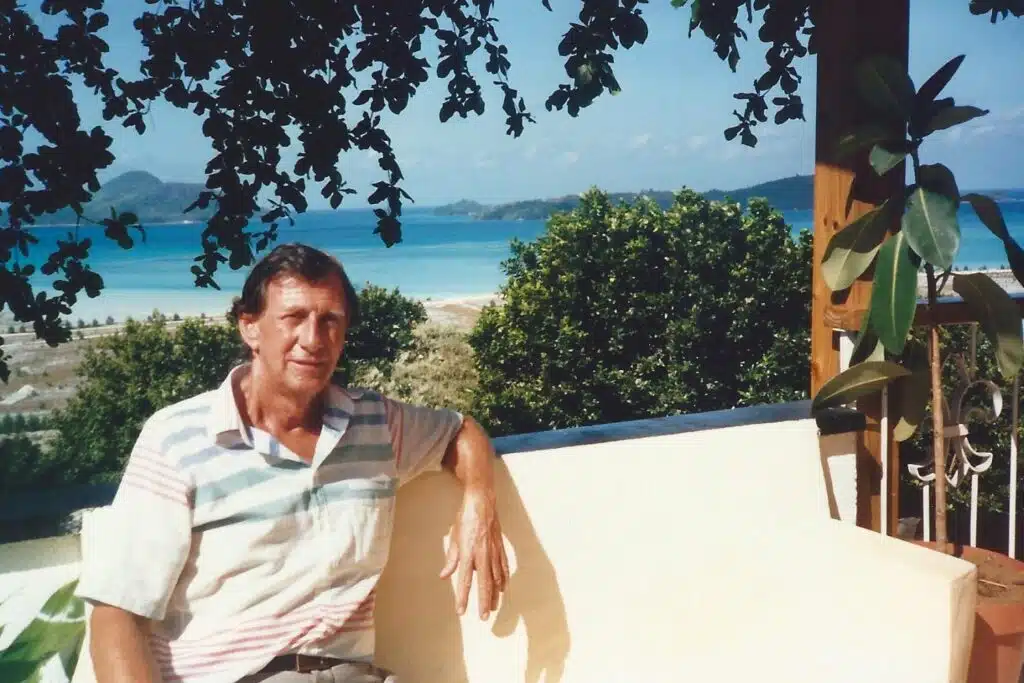
 In 1962, Brendon Grimshaw, a 37-year-old British newspaper editor working in Kenya, decided to go on holiday in the Seychelles, an archipelago of 115 (mostly uninhabited) islands in the Indian Ocean.
More than just a change of scenery, Grimshaw was looking for a change of life.   

As editor of some of the largest newspapers in East Africa, Grimshaw was aware of Africa’s changing sociopolitical scene: the United Republic of Tanzania (in East Africa) had declared its independence the year before, and Kenya was about to follow suit.
This meant that most jobs like his would soon pass to locals.
So, Grimshaw decided it was the perfect time to search for a new direction in life; one that would bring him closer to nature. 

Taken by the breathtaking natural beauty of the Seychelles during a previous visit, Grimshaw found himself daydreaming about owning land there.
But even the smallest deserted island would cost a small fortune.
Still, the longer he stayed, the more the idea grew on him. 


Then, fate stepped in. 

On the next-to-the-last day of his visit, a young man approached Grimshaw and asked if he was interested in buying an island.
Grimshaw’s interest was instantly piqued.

The man took Grimshaw to the island of Moyenne, an isolated .038 sq.
mile (24 acre) island off the northern coast of Mahé, Seychelles’ largest island; an island that hadn’t been occupied since 1915.
Moyenne was geographically close enough to Seychelles’ main island to be accessible–yet like a world away.
Though stiflingly over-grown and unkempt, Grimshaw decided he had to have it. 

Just hours later–four minutes to midnight on the last day of his stay, in fact–Grimshaw signed an agreement to pay £8,000 (about $10,000) to the current owner, one Philippe Georges, to take ownership of Moyenne. 

Though it would take nearly ten years of back-breaking work to make the island inhabitable, in 1972,  Grimshaw became the island’s only full-time resident, and remained so until his dead.
By that time, Moyenne had been transformed from a tiny over-grown jungle into an idyllic island paradise. 

Upbringing


Born on July 27, 1925, in Dewsbury, Metropolitan Borough of Kirklees, West Yorkshire, England, to Raymond and Kate “Kitty” (nee Coare) Grimshaw, Brendon Derek Grimshaw grew up in a modest home with his grandparents and father’s relatives as neighbors. 

While most of what is known of Grimshaw’s early years comes from Grimshaw himself, contained in his autobiography, A Grain of Sand, he credits his father for being a good provider (owner of a radio and television business), and his mother for teaching him the more refined things in life such as a love of books and theater.
He also credits her for the rebellious streak that sent him off on his own at the age of 15. 

Newspaperman

Having demonstrated a talent for writing by age 13, Grimshaw’s mother took it upon herself to arrange a meeting for her son with the editor of the Batley News, in West Yorkshire.
WWII had begun two years before and many local businesses (including the Batley News)were in need of employees.
When asked if he wanted to be a “newspaperman,” Grimshaw quickly said yes—and was hired on the spot.

Grimshaw started out in the front office–wrapping newspapers for delivery, operating the antiquated switchboard, and “totaling endless columns of figures”–but soon progressed to the printing department, becoming proficient on the “stone” (setting type by hand), the Linotype typesetting machine, and the newspaper printing machines.
Before long, he was promoted to reporter and given two districts to cover, and soon after, made film critic, responsible for writing two weekly columns. 

At age 23, Grimshaw had became the youngest chief reporter in Britain.
Two years later, he switched from the Batley News to The Star, in near-by Sheffield.
But reporting British news suddenly seemed less exciting than it once had.

Seeking a change, Grimshaw applied to International newspapers in the Near East and Africa.
In a matter of weeks, he was hired as Senior Sub-editor at the East African Standard in Nairobi, the capital of Kenya; a job that required him to carry a shoulder-holster gun (and sleep with it under his pillow) due to an uprising by the Mau Mau, a militant African nationalist movement. 

Over the next eight years, Grimshaw was promoted to Featured Editor, as well as drama and book critic–but his mind kept drifting off to more exotic locations.
Places surrounded by nature.
At 37 years of age, he’d seen enough of the world to know that there’s more to life than running a newspaper.

Robinson Crusoe and His Man Friday


Once the purchase of Moyenne was official, the daunting task of restoring it to its former beauty and making it inhabitable began. 

For the next nine years, Grimshaw continued to work as a journalist, working for the Tanganyika Standard and the Sunday News, in Dar es Salaam, Tanzania–becoming editor and director of both newspapers.
During these years he made frequent trips to Moyenne, slowly bringing the island back to life.

Invasive weeds had choked the native vegetation and the tiny island is said to have been so overgrown that falling coconuts never reached the ground.
The island floor had grown so dense and tangled that crossing the island was impossible; birds were noticeably absent and rats held dominion over the undergrowth. 

Once assessing the massive task at hand, Grimshaw made his initial goal not just to make the island fit for habitation, but to protect Moyenne from over-development.
At first, this meant uncovering the island’s raw beauty and building a humble island home where he could live out his days, but once the work was under way, his long-term dream became to create a natural paradise that would outlive him– and remain protected long after he was gone. 

As if fated to be part of Grimshaw’s ambitious undertaking, the 19-year-old son of a local fisherman named Antoine Lafortune agreed to help Grimshaw with his project.
Immediately setting out to transform the island, the two cleared scrubs, planted trees (palm, mango, and paw-paw), and blazed paths through the jungle. 

Then to make up for the lack of wildlife, Grimshaw brought 10 birds from a neighboring village and began feeding them in hopes of attracting more birds that would make the island their home.
And once sufficient space was cleared, Grimshaw arranged to reintroduce the once-native giant Aldabra tortoise to the island. 

Pirates and Buried Treasure


While taming the overgrown north-western corner of Moyenne, Grimshaw made an interesting discovery: two graves with tombstones that read, “Unhappily Unknown.” 

According to local legend, the graves belonged to a pair of lowly pirate deck hands killed by two infamous pirate captains, who sailed the Indian Ocean, so that the dead men’s spirits would protect their buried treasure and haunt the island.
(One of the beaches on the island’s north side had already been dubbed, “Pirate’s Cove.”) Grimshaw decided the pirate stories were likely true (or so he feigned) and seemed to enjoy entertaining the idea.

 
Whether Grimshaw (and Lafortune) actually believed the legend or not, the two took it seriously enough to excavate in two locations on the island to assuage their curiosity; the sites now indicated by skulls & crossbones on current maps.
And whether they found anything of value or not—will likely never be known. 

Tourism and Corporate Interference


About ten years after Grimshaw moved to the island permanently, the Seychelles became a tourist destination; the exotic archipelago having become synonymous with a tropical island paradise. 

Coming as no surprise, it wasn’t long before investors began eyeing-up idyllic Moyenne and began showing up wanting to buy it: a Saudi prince is said to have offered Grimshaw upwards of $50m for it.
But Grimshaw had no interest in wealth.
And no interest in seeing his beautiful paradise become a “luxury destination” for tourists. 

By this point, Grimshaw knew one thing for certain: it was only a matter of time before wealthy investors would find a way to destroy the peace and tranquility he’d devoted two decades of his life to creating.
As offers continued to pour in, Grimshaw began devising a scheme to keep investors out permanently.

Past, Present, and Future

In 1981, Grimshaw’s mother passed away, leaving no one to attend his aging father, Raymond.
To  Grimshaw’s surprise, the 88-year-old agreed to move to the island to live out his final years with his only son.
Grimshaw wrote of these years with his father, “We had a wonderful time together and became the best of friends.” 

In 1986, Grimshaw’s father passed away and was buried on the island; alongside the two unknown “pirates.”

In 1996, Grimshaw told his life story and his time on Moyenne in an autobiography titled, A Grain of Sand; a fascinating read that made him the subject of many newspaper travel articles and a television documentary (shortly before his death).   

In an effort to ensure that the island would be preserved in its unspoiled state in perpetuity (acknowledging that he was unmarried, had no heirs, and no one to take on custodianship of the island), in 1998, Grimshaw established the Moyenne Island Foundation Society. 

Though having no family to support his cause, Grimshaw earned the respect of the neighboring Seychelles people (and nature lovers all around the world) for his tireless devotion to restoring and conserving the island, and hoped that support would be enough to fend off outside interests.

In 2007, Grimshaw’s close companion of 45 years, Antoine Lafortune, passed away—but not before completing their plan to plant 16,000 trees—which included 700 exotic mahoganies.    

Knowing that his own time was limited, in 2009, Grimshaw met with the Seychelles’ Ministry of Environment (Marine and Parks Department) to set up a permanent trust to protect the island.
The agreement they signed made Moyenne part of Ste Anne Marine Park–but granted it its own unique status.
As Moyenne Island National Park, it is the smallest national park in the world. 

In 2010, Grimshaw permitted a film crew to visit the island to make a documentary about him and the incredible work he’d accomplished there; a film aptly titled, A Grain of Sand. 

The End

Brendon Derek Grimshaw died on July 3, 2012, at the age of 86, and was buried beside his father (and the two unknown “pirates”).
At his request, Grimshaw’s tombstone reads, “Brendon D. Grimshaw 1925-2012.
Moyenne taught him to open his eyes to the beauty around him and say thank you to God.” 

In his Last Will and Testament, Grimshaw expressed his final wishes: “Moyenne Island is to be maintained as a venue for prayer, peace, tranquillity, relaxation and knowledge for Seychellois and visitors from overseas of all nationalities, colours and creeds.” 

His wishes now rest in the hands of the Moyenne Island Foundation. 

Legacy

While it’s easy to label Grimshaw eccentric–or perhaps insane (he did, after all, buy a horribly overgrown island on the other side of the world, pick up and move there leaving everything behind, believed pirates once frequented his island [and possibly buried their treasure there], and spent 50 years of his life restoring what was a relatively inconsequential dot of land), by any measure, what Grimshaw accomplished was nothing short of miraculous.

Now part of Seychelles Ste. Anne Marine National Park, visitors from all around the world enjoy his creation: 16,000 indigenous trees (including a small hard-mahogany forest), over three miles of nature trails, more than 120 giant Aldabra tortoises and dozens of hawksbill turtles, and a vast menagerie of over 2000 exotic birds–including the Hollandais pigeon and Madagascar red fody weaver bird.
(By one estimate, Moyenne is home to more plant species per square mile than any other national park in the world.) And not to forget, the natural beauty of the surrounding Seychelles Islands themselves is nothing short of spectacular. 

Now more than a decade after Grimshaw’s death, the island of Moyenne remains just as he left it–undeveloped and teaming with nature’s diversity—thanks to his tremendous efforts.
(One visitor described Moyenne as, “a riot of green against cobalt skies and a sapphire sea, like a tiny rainforest erupting from the ocean.”) 

Most thoughtfully, according to regulations established by the Moyenne Island Foundation, no more than 50 visitors are allowed on the island at any one time–even during peak tourist season.
And although a rest-stop was erected for visitors, there is no hotel development or other forms of private land ownership. 

Links :

Sunday, November 9, 2025

Nature’s artistry from above

Today, the Copernicus Sentinel-2 satellite captured a crystal-clear image of the Erebus and Terror Gulf at the Antarctic Peninsula.
A dynamic mix of open water, newly forming sea ice, first-year and multi-year ice floes, and vast fast-ice regions beginning to break apart.
The spider web like patterns of cracks tell the story of a constantly changing polar landscape.
 
Localization with the GeoGarage platform (NGA nautical raster chart)