China has world's largest distant water fishing fleet, anywhere between 18000-20000 vessels.
— Isabella Anderson (@IsabellaAn67) May 15, 2026
These vessels, every single one of them, is more than just a fishing boat.
They are Chinese Communist Party's little warships, traversing global waters in the guise of fishing boats! pic.twitter.com/2zqRgdfy23
Saturday, June 20, 2026
China fishing fleet

Friday, June 19, 2026
GPS spoofing raises new questions for maritime digitalisation

GPS inteference resulted in tracking data showing clusters of commercial ships falsely positioned at a nuclear power plant, middle, and an airport, right.
Windward Maritime AI
As shipping adopts more connected and data-driven operations, concerns about the integrity of navigation and positioning data are attracting greater attention.
Recent reports of GPS interference in and around the Strait of Hormuz have renewed debate about the risks posed by spoofing attacks and the need for stronger verification systems.
According to Markus Levin, co-founder of XYO, GPS spoofing has evolved from a technical vulnerability into a tool capable of influencing operations across entire regions.
“GPS spoofing has become a useful geopolitical tool because it lets actors distort reality without crossing the threshold of a conventional attack,” Levin said.

Rather than targeting physical infrastructure, spoofing manipulates the information systems rely on to make decisions.
By feeding false location data to vessels, aircraft, or automated systems, operators can create confusion while maintaining a degree of deniability.
The recent disruptions reported in the Gulf suggest a level of sophistication that goes beyond isolated incidents.
“When disruption shows up consistently across a geography like that, it reflects a capability being applied in live environments to influence movement and decision-making,” Levin said.
The issue stems from a weakness built into GPS itself.
Developed at a time when accessibility was prioritised over security, the system was never designed to authenticate signals.
That legacy remains today.
Receivers can determine their location, but they have limited ability to verify whether the signal they are receiving is genuine or counterfeit.
Digital trust and the future of maritime data
False positioning data can affect route planning, collision avoidance systems, port scheduling, geofencing applications, insurance records and incident investigations.
“The obvious risk is navigational error, but the second-order effects are just as serious,” Levin said.
“In high-traffic chokepoints, even a short window of bad positioning data can trigger safety issues and commercial disruption.”
The challenge becomes more significant as supply chains adopt greater levels of automation and digital integration.
Location data now feeds directly into a wide range of operational systems, from cargo tracking and customs processing to inventory management and automated financial transactions.
Route optimisation platforms, smart port infrastructure, digital twins, and emerging autonomous systems all depend on trustworthy inputs.
When location data is compromised, the issue extends beyond navigation and begins affecting the decisions made by the wider digital ecosystem.
“Once location data feeds directly into software systems, errors propagate across the network,” Levin explained.
“A false position can affect routing, port sequencing, customs processing, inventory systems, and automated payments at the same time.”
Levin warns that inaccurate data can create a dangerous illusion of normality.
Systems continue operating, yet decisions are based on false assumptions.
“If location becomes unreliable, then the digital layer built on top of it starts producing false confidence, which is often more dangerous than an obvious outage.”
To address this challenge, XYO advocates a verification-based approach to location data.
Rather than accepting positioning information at face value, systems should be able to assess evidence supporting a location claim and validate its authenticity.
“A cryptographic verification model asks a different question: what evidence exists that this location claim is genuine, who observed it, and can that claim be independently checked later?” Levin said.
Such a verification layer would work alongside existing infrastructure rather than replacing it.
GPS and other sensors would continue providing location inputs, while additional checks would help confirm whether those inputs can be trusted.
Levin believes industries should prepare for a future where GPS interference is a routine feature of contested environments.
“When UN agencies, aviation regulators, and maritime security bodies are all issuing stronger warnings about jamming and spoofing, the direction is clear,” he said.
“Interference with positioning and timing is becoming a feature of how contested environments operate.”
Links :
- TheDigitalShip : Can anti-jamming technology change fleet security?
- Space : 'It's quite a bit more than we expected': Satellite reveals immense scale of GPS signal tampering
- Foreign Policy : The Epidemic of GPS Jamming
- Gizmodo : Russian Satellites Are Jamming GPS Signals, Study Says
- GPSWorld : Russian sabotage of Baltic Sea states is analyzed in a new white paper
- CNN : GPS jamming is emerging as an increasingly prevalent — and troubling — weapon of war
- GeoGarage blog : GPS jamming traced to Russian satellites in new ‘space interference’ concern
Thursday, June 18, 2026
France launches one of Europe’s largest offshore wind tenders
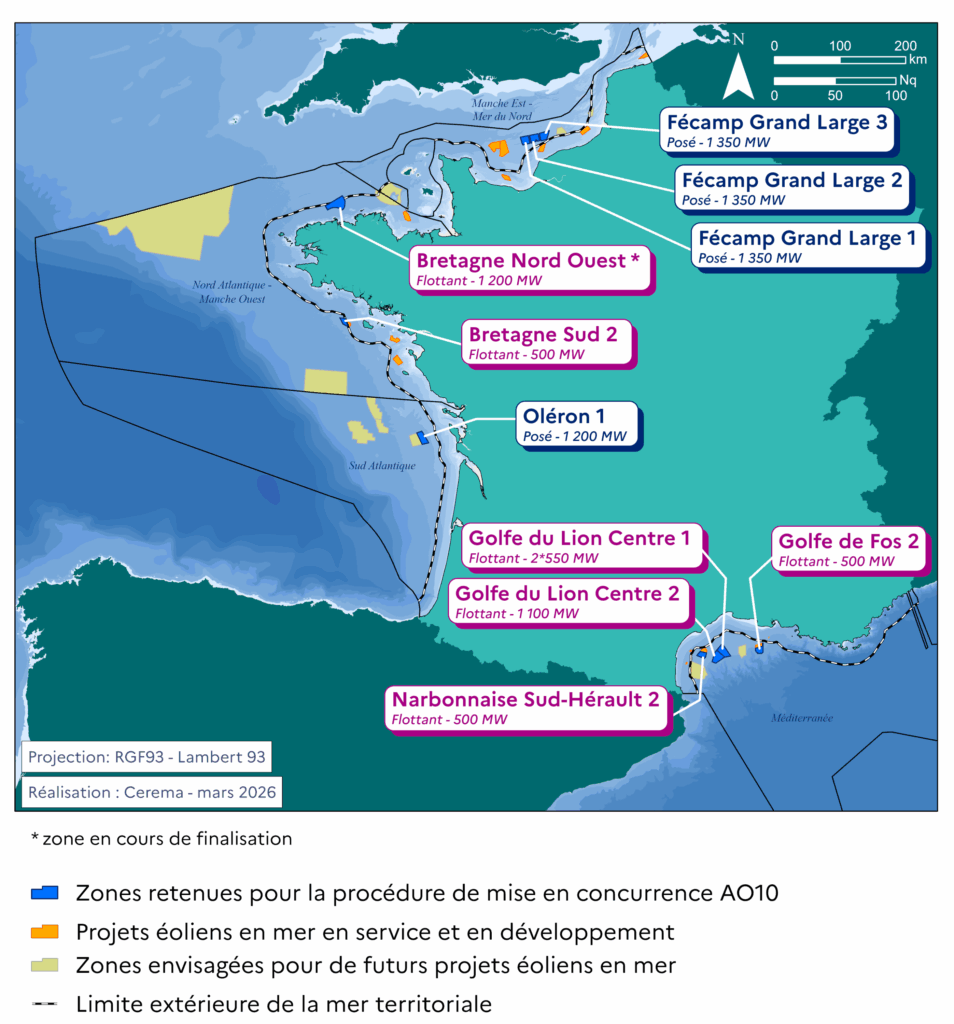
From MaritimeJournal
France has launched one of Europe’s largest offshore wind procurement rounds, opening the door to a decade of work for vessel operators, port infrastructure providers, equipment suppliers and marine contractors.
The French Government has published the specifications for its 10th offshore wind tender round (AO10), covering 11 projects with a combined capacity of around 10GW, evenly split between fixed-bottom and floating offshore wind developments.
The projects will be spread around France’s coastlines and represent a notable expansion of the country’s offshore market, with the government targeting around 15GW of installed offshore wind capacity by 2035, up from 2GW currently in operation and 4.8GW under development.
France has launched one of Europe’s largest offshore wind procurement rounds, opening the door to a decade of work for vessel operators, port infrastructure providers, equipment suppliers and marine contractors.
The French Government has published the specifications for its 10th offshore wind tender round (AO10), covering 11 projects with a combined capacity of around 10GW, evenly split between fixed-bottom and floating offshore wind developments.
The projects will be spread around France’s coastlines and represent a notable expansion of the country’s offshore market, with the government targeting around 15GW of installed offshore wind capacity by 2035, up from 2GW currently in operation and 4.8GW under development.
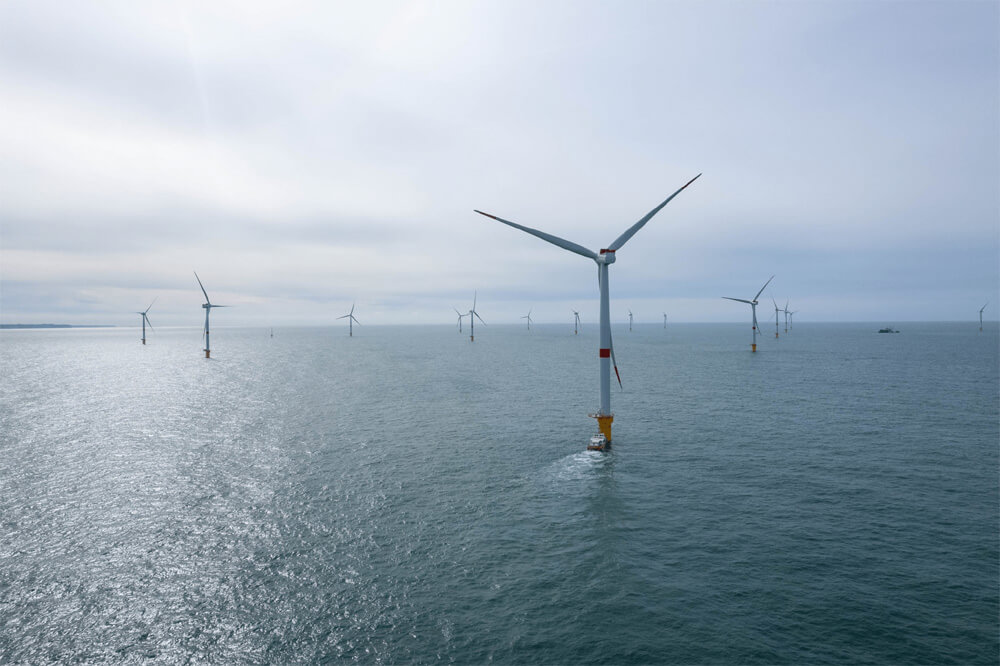 Fecamp launched in 2024 was among France's largest wind farms to date while TotalEnergies is now developing a massive 1.5 GW project near Le Havre (Fecamp)
The scale of the programme will create opportunities for crew transfer vessel (CTV) operators, service operation vessels (SOVs), heavy lift and installation vessels, cable-lay contractors, port operators and quayside logistics providers, particularly as France accelerates deployment of floating wind alongside traditional fixed-bottom projects.

The offshore jack-up installation vessel 'Vole au Vent' with a crane for assembling wind turbines is seen at the offshore wind farm located in the Atlantic Ocean, off the coasts of the Yeu and Noirmoutier islands, western France, April 2, 2026.
REUTERS/Stephane Mahe Purchase Licensing Rights
Floating projects typically require more complex towing, mooring installation, anchor handling and offshore support operations, potentially broadening demand beyond the traditional wind vessel fleet and into offshore energy tonnage.
The French Government said the tender marks a ‘change of scale’ in the country’s offshore wind ambitions and is intended to provide a more stable and predictable framework for industrial investment.
Bid evaluation will now place greater emphasis on industrial robustness and European supply capability, potentially benefiting manufacturers and suppliers with established regional operations.
For ports, the programme could trigger additional investment in marshalling facilities, heavy-lift quays, storage areas and fabrication capacity, particularly in regions positioned to support floating wind assembly.
Developers have four months to submit bids, with the French energy regulator expected to assess proposals in early 2027 ahead of contract awards planned for February 2027.
The French government will also hold technical webinars in the coming weeks covering wind measurements, geotechnical surveys and environmental baseline studies for prospective bidders.
The French Government said the tender marks a ‘change of scale’ in the country’s offshore wind ambitions and is intended to provide a more stable and predictable framework for industrial investment.
Bid evaluation will now place greater emphasis on industrial robustness and European supply capability, potentially benefiting manufacturers and suppliers with established regional operations.
For ports, the programme could trigger additional investment in marshalling facilities, heavy-lift quays, storage areas and fabrication capacity, particularly in regions positioned to support floating wind assembly.
Developers have four months to submit bids, with the French energy regulator expected to assess proposals in early 2027 ahead of contract awards planned for February 2027.
The French government will also hold technical webinars in the coming weeks covering wind measurements, geotechnical surveys and environmental baseline studies for prospective bidders.
Links :
Wednesday, June 17, 2026
Global seabed mapping reaches new milestone as five million square kilometres added in a year

From Seabed
The Nippon Foundation-GEBCO Seabed
2030 Project today announces that 28.7% of the world’s ocean floor has
now been mapped, with almost five million square kilometres of data
added over the past year.
The 2026 figure was announced by Mitsuyuki Unno, Executive Director
of The Nippon Foundation, at the Assembly of the International
Hydrographic Organization (IHO), currently underway in Monaco.
Bringing together delegations from 104 Member States, alongside observers from international organisations, maritime authorities and industry, the triennial Assembly provides an opportunity to review global progress in hydrography and set priorities for the years ahead.
The announcement also reflects a long-standing connection as the General Bathymetric Chart of the Oceans (GEBCO) was initiated in 1903 by Prince Albert I of Monaco – a pioneering oceanographer who recognised the need for a coordinated global effort to map the planet’s seafloor.
Established in 2017, Seabed 2030 is a collaborative project between The Nippon Foundation and GEBCO, which seeks to inspire and accelerate the complete mapping of the world’s ocean, and to compile all the data into the freely available GEBCO Ocean Map.
The Project is formally endorsed as a Decade Action of the UN Ocean Decade. GEBCO is a joint programme of the IHO and the Intergovernmental Oceanographic Commission (IOC) of UNESCO, and is the only organisation with a mandate to map the entire ocean floor.

The latest update represents approximately 104 million square kilometres of mapped seabed – an area equivalent to more than two-thirds of the Earth’s land surface.
Over the past year alone, a further five million square kilometres of data have been incorporated into the GEBCO Grid.
This progress reflects ongoing contributions from a growing and increasingly diverse global community. A total of 220 organisations have now contributed, including 15 new contributors over the past year, with first-time data contributions from countries including Malaysia, Morocco, Papua New Guinea and Saudi Arabia, among others.
Commenting on the announcement, Seabed 2030 Director Jamie McMichael-Phillips said: “This update reflects what the global community can achieve when data is shared openly and collaboratively. Seabed 2030 exists to help bring those contributions together, and we are seeing that collective effort translate into meaningful results. We are grateful to The Nippon Foundation and GEBCO for their ongoing support, which enables us to accelerate progress towards a complete map of the ocean floor.”
Announcing the update, Mitsuyuki Unno, Executive Director of The Nippon Foundation, said: “The progress reflected in the 2026 Grid demonstrates what can be achieved through sustained international collaboration. At The Nippon Foundation, we are committed to supporting people and organisations working to deepen our understanding of the ocean, and to strengthening the connections between them – helping to ensure that knowledge of the seabed can be built upon and passed on to future generations.”
Evert Flier, GEBCO Chair, added: “The GEBCO Grid is a global, collaborative dataset that brings together bathymetric data from a wide range of sources into a consistent and authoritative reference. This is the work of hundreds of people from around the world, working behind the scenes and forming an ever-growing GEBCO community. With each update, it provides an increasingly robust foundation for ocean science and related applications – and today’s announcement reflects the steady progress being made in building a more complete picture of the ocean floor.”
The 2026 update includes significant regional increases in mapped coverage.
The ROPME Sea Area more than tripled in coverage, increasing from approximately 6.4% to 20.5%.
Coverage also increased across the Eastern Atlantic, North Indian Ocean, Meso American and Caribbean Sea, and North Sea regions.
At the national level, substantial increases were recorded within several Exclusive Economic Zones (EEZs).
Further highlights from the past year include the incorporation of a wide range of new and previously unshared datasets, including:
- Significant contributions from major data repositories, including NOAA-NCEI and PANGAEA
- Expanded coastal mapping through datasets such as the Global Coastal SDB Dataset from Copernicus/EOMAP, adding new coverage in areas not represented in previous Grid releases
- Notable satellite-derived bathymetry from the Greenwater Foundation, in partnership with TCarta and Caladan Oceanic
- Additional bathymetric data from the Japan Agency for Marine-Earth Science and Technology (JAMSTEC), expanding coverage in the North Pacific
- Deep-water mapping data from NOAA-led Seascape Alaska campaigns
- Multibeam survey data contributed by the Directorate of Hydrography and Navigation of the Brazilian Navy
- Multibeam data around the Comoros, contributed by the Bureau de Recherches Géologiques et Minières (BRGM), marking a new contributing organisation
All data collected and shared with the Seabed 2030 project is included in the free and publicly available GEBCO global grid, supporting ocean science, policy and informed decision-making.
Links :
- CPG : Only 28% of the ocean floor has been accurately mapped, less than what is already known about the surface of Mars and the Moon, and scientists consider the topic strategic for Brazil, with a global goal to map everything by 2030.
- GeoGarage blog : GEBCO 2025 : Seabed 2030 announces millions of square kilometers of new seafloor data /
Monday, June 15, 2026
A record die-off of sea stars was followed by something that stunned biologists
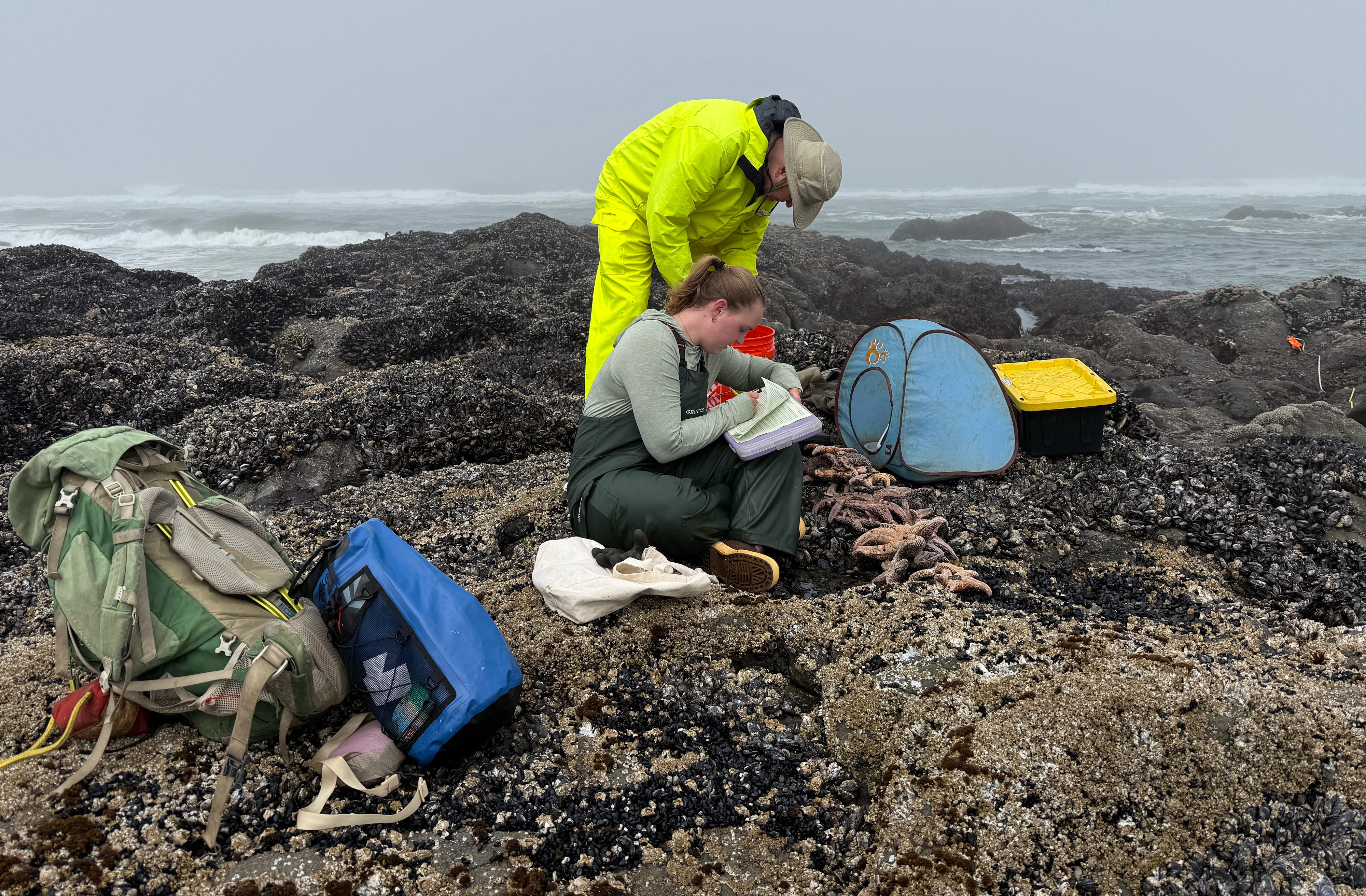
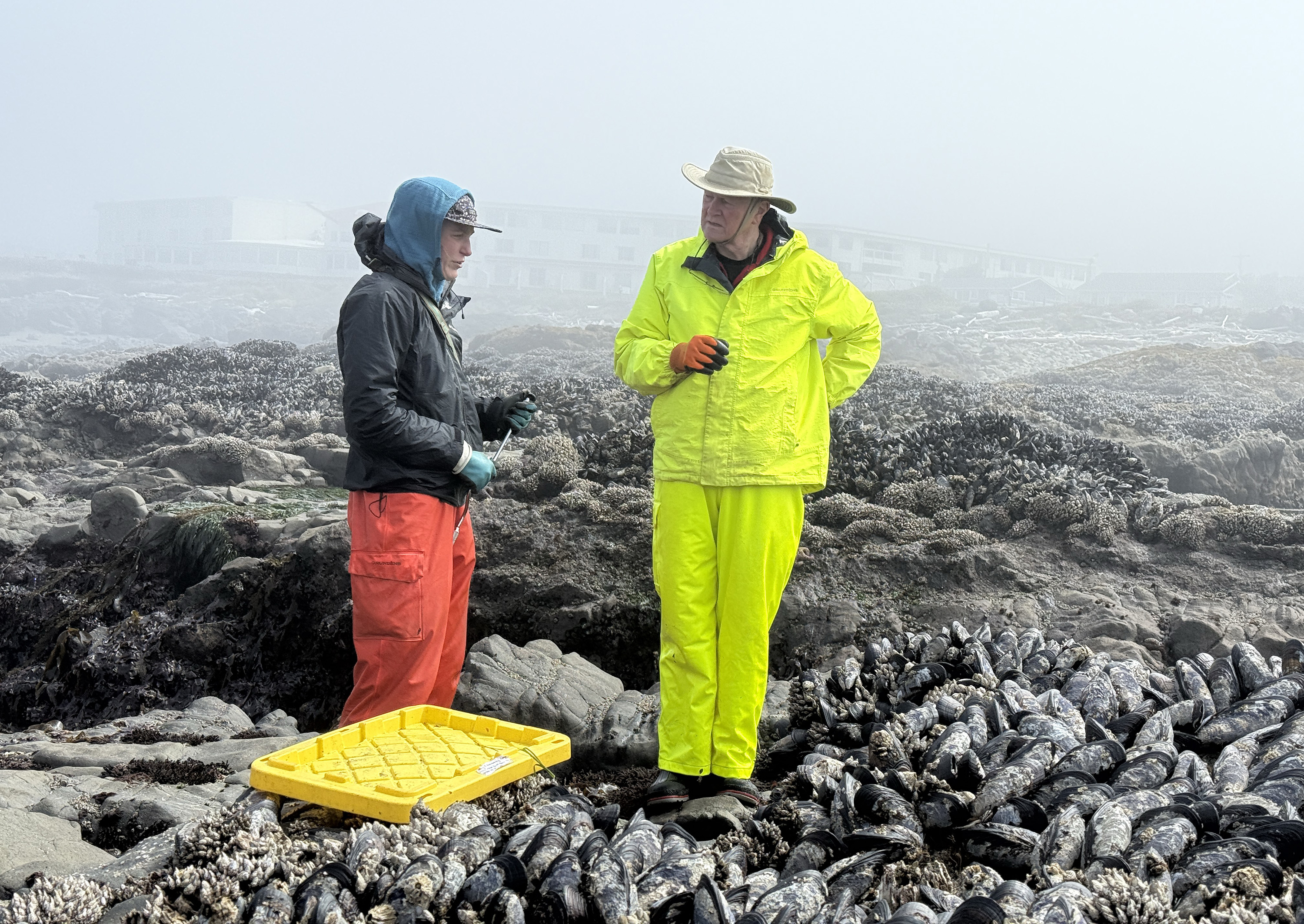
Katie Rumsy and Bruce Menge weigh and measure sea stars in Yachats, Oregon.
(Casey Parks/The Washington Post)
From Washington Post by Casey Parks
The creatures almost went extinct along the West Coast a decade ago.
Recently, they have been making a comeback.
For much of his career, Bruce Menge assumed he would conduct the same research until he died.
The marine biologist has studied sea stars since the 1970s, and the animals had always seemed more solid a bet than others in the ocean.
They have no natural enemies, regenerate limbs when they lose them and reproduce prolifically.
Then, just over a decade ago, a mysterious disease wiped out 90 percent of the West Coast’s sea star population.
Tide pools emptied, and Menge had no idea what might become of his work.
“I was upset,” Menge said.
“I thought these animals were immortal.”
Little did he know, some of the biggest and busiest days of his career were still ahead of him.
The marine biologist has studied sea stars since the 1970s, and the animals had always seemed more solid a bet than others in the ocean.
They have no natural enemies, regenerate limbs when they lose them and reproduce prolifically.
Then, just over a decade ago, a mysterious disease wiped out 90 percent of the West Coast’s sea star population.
Tide pools emptied, and Menge had no idea what might become of his work.
“I was upset,” Menge said.
“I thought these animals were immortal.”
Little did he know, some of the biggest and busiest days of his career were still ahead of him.
Menge is 82, but he clambered over a mussel bed one windy morning in mid-May faster than any of the biology students working alongside him.
He took a seat in a spot that would soon become part of the Pacific Ocean, and he peered down at something he hadn’t seen much of in the decades he’d been coming to this Oregon Coast tide pool — a teeny-tiny sea star, no bigger than his fingernail.
Six months ago, Menge’s team published exciting research — five-legged sea stars were undergoing a significant “baby boom.”
The tide pools were denser than they had been before the disease, and the juveniles were eating mussels and clearing space for other species.
In short, something rare and wonderful was happening on the Oregon Coast: One of the intertidal zone’s most important predators had returned from the brink.
In short, something rare and wonderful was happening on the Oregon Coast: One of the intertidal zone’s most important predators had returned from the brink.
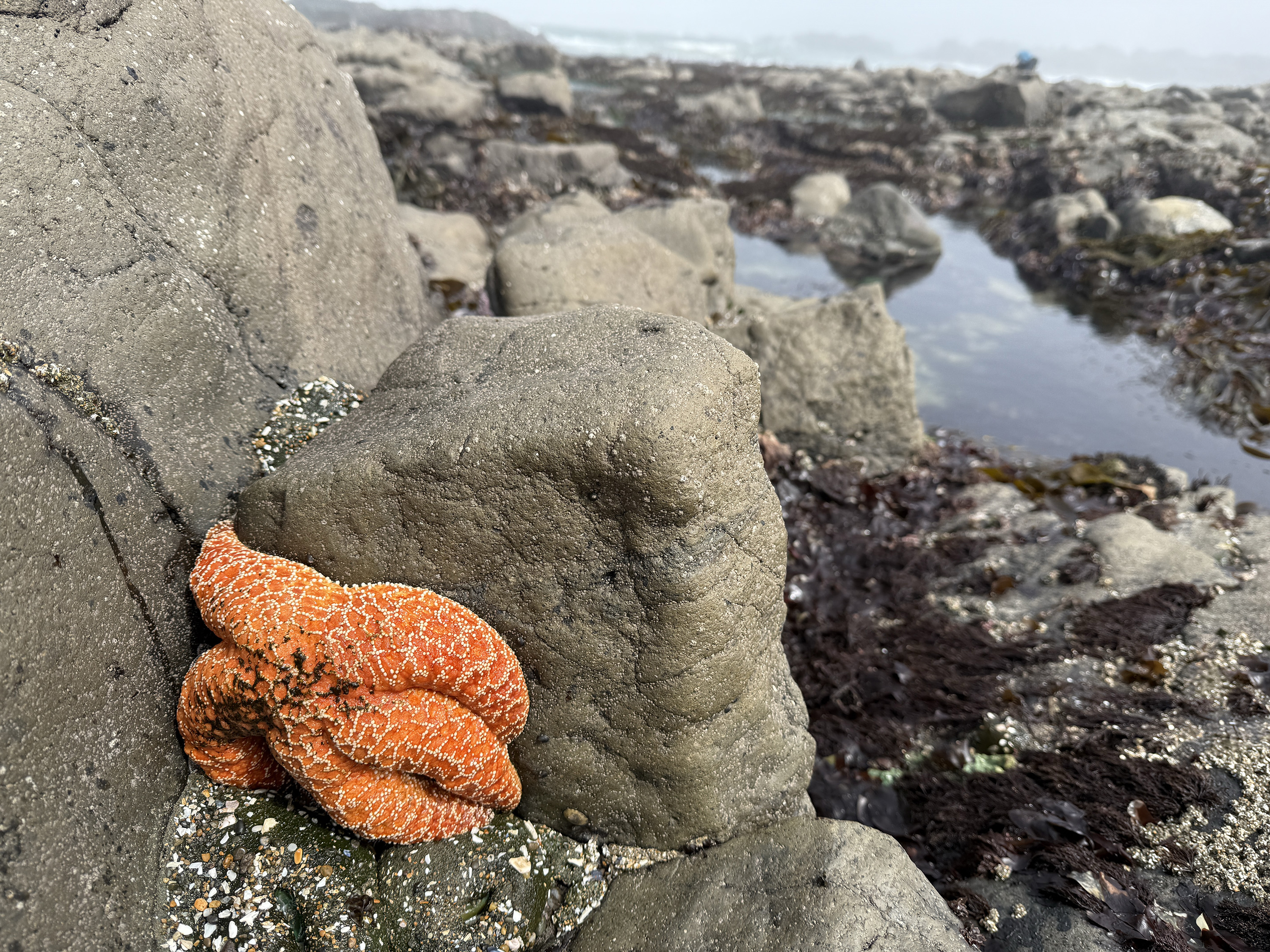
Before a wasting disease wiped out 90 percent of the West Coast’s ochre sea star population, researchers considered them one of the most resilient animals in the ocean.
(Casey Parks/The Washington Post)
(Casey Parks/The Washington Post)
As the oceans warm and species disappear, good news can feel increasingly rare for a biologist to come by.
The resurgence, Menge admitted, is “pretty cool.”
But he has no idea why Oregon’s sea stars rebounded or how long they might live.
Scientists are forecasting both a warm summer and an El Niño — either of which could spell trouble — and the last decade has taught Menge that disease can take out even the strongest beings.
But as Menge scrambled over barnacle-covered rocks this spring, he kept in mind another, more hopeful, possibility.
These new sea stars were growing despite the continued existence of the disease that killed an earlier generation.
If they made it to adulthood, they just might be as resilient and indestructible as Menge once believed their ancestors were.
Scientists are forecasting both a warm summer and an El Niño — either of which could spell trouble — and the last decade has taught Menge that disease can take out even the strongest beings.
But as Menge scrambled over barnacle-covered rocks this spring, he kept in mind another, more hopeful, possibility.
These new sea stars were growing despite the continued existence of the disease that killed an earlier generation.
If they made it to adulthood, they just might be as resilient and indestructible as Menge once believed their ancestors were.
Sunflower sea stars succumb to sea star wasting disease off the coast of Calvert Island, British Columbia.
(Video: Hakai Institute)
(Video: Hakai Institute)
Menge began to notice what came to be called “sea star wasting disease” in the spring of 2014.
He and a team of researchers had been doing what they’ve done twice a year since the 1990s — measuring and weighing sea stars — when he noticed an unusual development.
Menge’s research methods are old-school.
He uses a ruler and a small scale, then notes each star’s particulars in pencil.
(Menge never calls sea stars starfish, even though “quite a few great scientists do,” because “they are not fish.”)
Over the years, his team has compiled one of the most robust datasets in existence on the five-legged ochre sea star, which is known for its tenacious rock-clinging and its appetite for mussels.
They went back to the same sites so often, Menge says he began to recognize individual animals.
“There was one with a split, Y-shaped arm,” he said.
“I weighed that one many times.”
They went back to the same sites so often, Menge says he began to recognize individual animals.
“There was one with a split, Y-shaped arm,” he said.
“I weighed that one many times.”
A group of researchers have discovered the cause of sea star wasting disease (SSWD).
This discovery comes more than a decade after the start of the marine epidemic that has killed billions of sea stars—representing over 20 different species from Alaska to Mexico.
SSWD is considered the largest marine epidemic ever documented in the wild.
But in late April 2014, Menge observed that some of the sea stars at his sites had twisted arms.
Others had lost their grips on the rocks.
Something disturbing and novel was afoot.
Menge was disheartened, but he was also a scientist.
He began visiting 15 sites down the Oregon Coast and into Cape Mendocino, California, some as many as every two weeks.
Initially, less than 3 percent of the animals had twisted arms.
By late summer, 93 percent of the sea stars were affected.
Eventually, the Pacific Ocean lost billions of sea stars from 20 different species between Alaska and Baja California.
Others had lost their grips on the rocks.
Something disturbing and novel was afoot.
Menge was disheartened, but he was also a scientist.
He began visiting 15 sites down the Oregon Coast and into Cape Mendocino, California, some as many as every two weeks.
Initially, less than 3 percent of the animals had twisted arms.
By late summer, 93 percent of the sea stars were affected.
Eventually, the Pacific Ocean lost billions of sea stars from 20 different species between Alaska and Baja California.
Field technician Emma Neill and Menge talk about their latest sea star findings.
(Casey Parks/The Washington Post)
Scientists rarely have a chance to chronicle a population crash in real time, and the sea star die-off was the largest known decimation of a marine invertebrate.
As he and his team returned to their sites, they noticed trends.
After the sea stars’ arms began to curl, they would develop lesions.
Many flattened out “like pancakes.” Others began to liquefy into a pile of spines called ossicles.
Scientists tried out a number of theories.
The early days of the disease happened during a marine heat wave and El Niño that also killed off kelp species.
Sea stars in the warmest parts of the ocean did suffer more, but others died in cooler waters, so Menge wasn’t sure climate warming was the sole reason for the mass extinction.
For a while, some scientists thought a densovirus was to blame — something similar to parvo in dogs.
But they later found that hypothesis to be wrong.
Last summer, after four years of studying the sunflower sea star, scientists from Vancouver, British Columbia, and Washington state announced they had linked the mass extinction to Vibrio pectenicida, a strain of bacteria that once decimated scallops on the East Coast.
The researchers told journalists they “got chills” when they made the discovery.
The sunflower sea star is the world’s biggest.
Some are an entire yard wide and have up to 24 arms.
The scientists had all been heartbroken when they died, and hoped their findings might lead to a recovery.
But a known culprit is not yet a cure.
When they published their findings, the scientists also wrote that the sunflower star had never bounced back.
For now, the species is functionally extinct along most of the Pacific Coast.
Three months later, Menge published a dataset borne out of all his note-taking.
Yes, wasting disease was still killing the sunflower and other sea stars.
But the ochre sea stars that live on the rocks between the tidemarks had begun to rebound.
In fact, their populations were denser than he’d ever seen them.
Menge and a team of biology students resumed their studies last month during a series of low tides.
The fog was thick, and the wind strong in Yachats as Menge set up a research station on a rocky slope hidden behind vacation rentals.
The team had a “MacGyver” quality.
A field technician used a screwdriver and a Home Depot bucket to collect specimens, and Menge protected his scale with a pop-up tent meant for cats.
By 9 a.m., he had a pile of stars.
He reached into the tent and set a bright orange one on the scale.
It weighed just 11.5 grams — roughly the same as four pennies.
“Before the wasting event, you would almost never see these little guys,” he said.
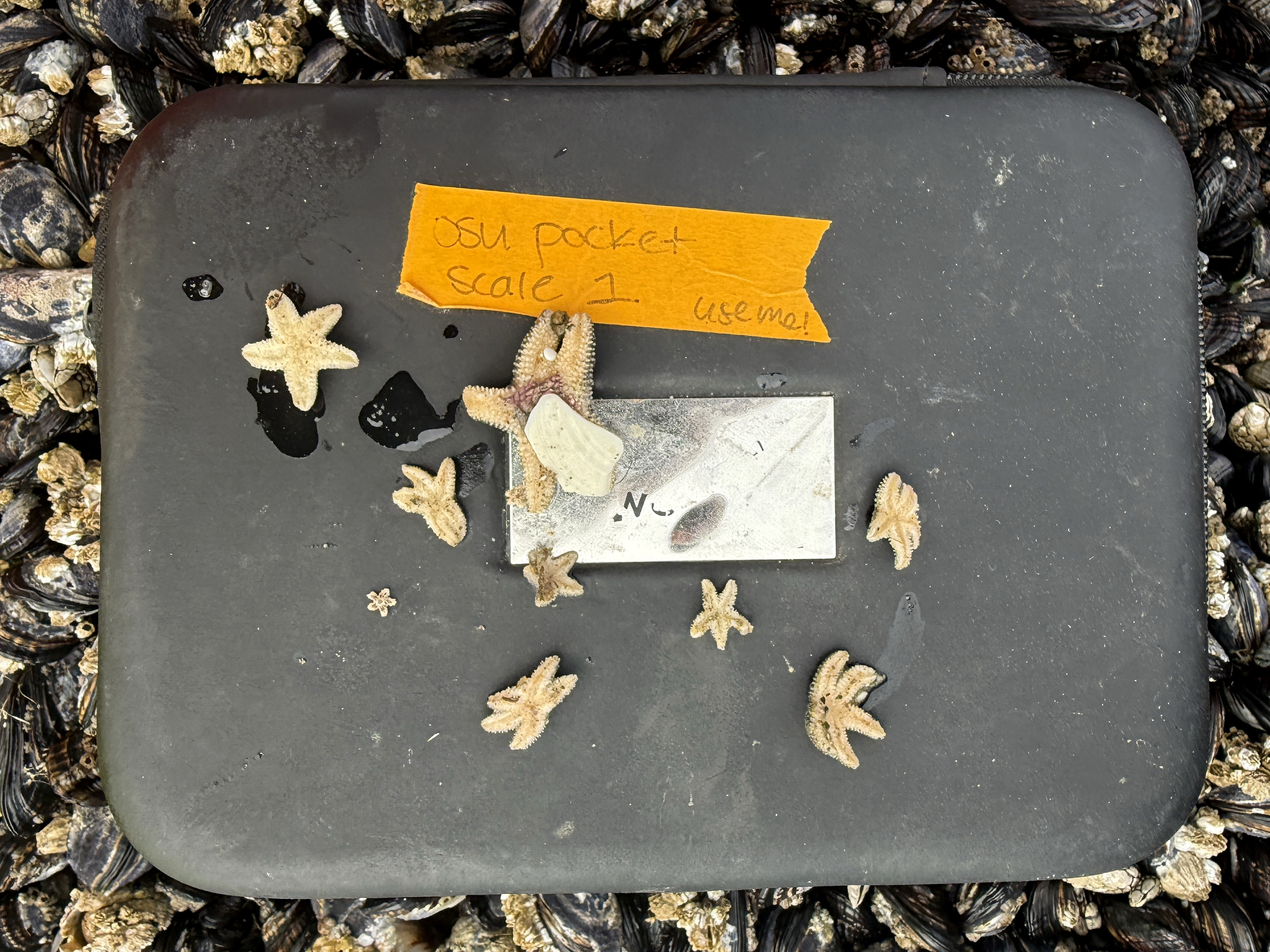 Before a bacteria killed off most of the West Coast’s sea stars in 2014, researchers almost never saw baby sea stars.
But scientists now regularly see “teeny-tiny” ones.
(Casey Parks/The Washington Post)
The year after the mass extinction, Menge found more babies than he’d ever seen.
At some sites, he calculated as much as an 8,100 percent increase in juvenile density.
Menge is still trying to discern what led to the baby boom.
One possibility is that the wasting disease triggered the resurgence, similar to the way wildfires spur new forest growth.
That initial discovery was exciting, but Menge had no idea if the babies would mature into adults.
Sea stars are slow-growing, and he would need years worth of data to say for certain whether the species was recovering.
All morning in Yachats, he held a ruler up to stars no longer than a few inches.
These were likely a few years old, a sign that was encouraging, if not quite definitive.
As Menge weighed and measured, field technician Emma Neill appeared with a heavy bucket.
“I come bearing more stars for you!” she said.
Menge peered in, then pulled out a purple star whose arms were about half a foot long.
“Oh, there’s a big one,” he said.
It weighed nearly a pound.
(Casey Parks/The Washington Post)
These days, big stars are the novelty.
Though the tide pools are rich with sea stars, most remain much smaller than the animals Menge used to see before the outbreak.
That can feel thrilling when it comes to cuteness, but troubling for the shore’s diversity.
The “little guys” that researchers call “recruits” can’t eat large mussels the same way bigger stars can.
That has all sorts of downstream effects.
If sea stars don’t eat mussels, the mussels blanket intertidal rocks and make life difficult for seaweeds and other invertebrates.
The more sea stars consume, the greater chance other species have to thrive.
Still, a decade in, Menge and a former postdoctoral student have been able to show that many stars are reaching adulthood — a fact that could indicate that this generation is somehow resistant to the wasting disease.
But some of the animals Menge weighed in mid-May had lesions, and he had no idea what the summer might hold.
Forecasters believe a super El Niño will bring elevated temperatures and unusually high tides to the Oregon Coast by July.
“We are sitting on the edge of our collective seats to see what might happen this year,” Menge said.
“All I can say is, ‘Stay tuned.’”
Oceans are warming, but scientists are concerned about this cold blob
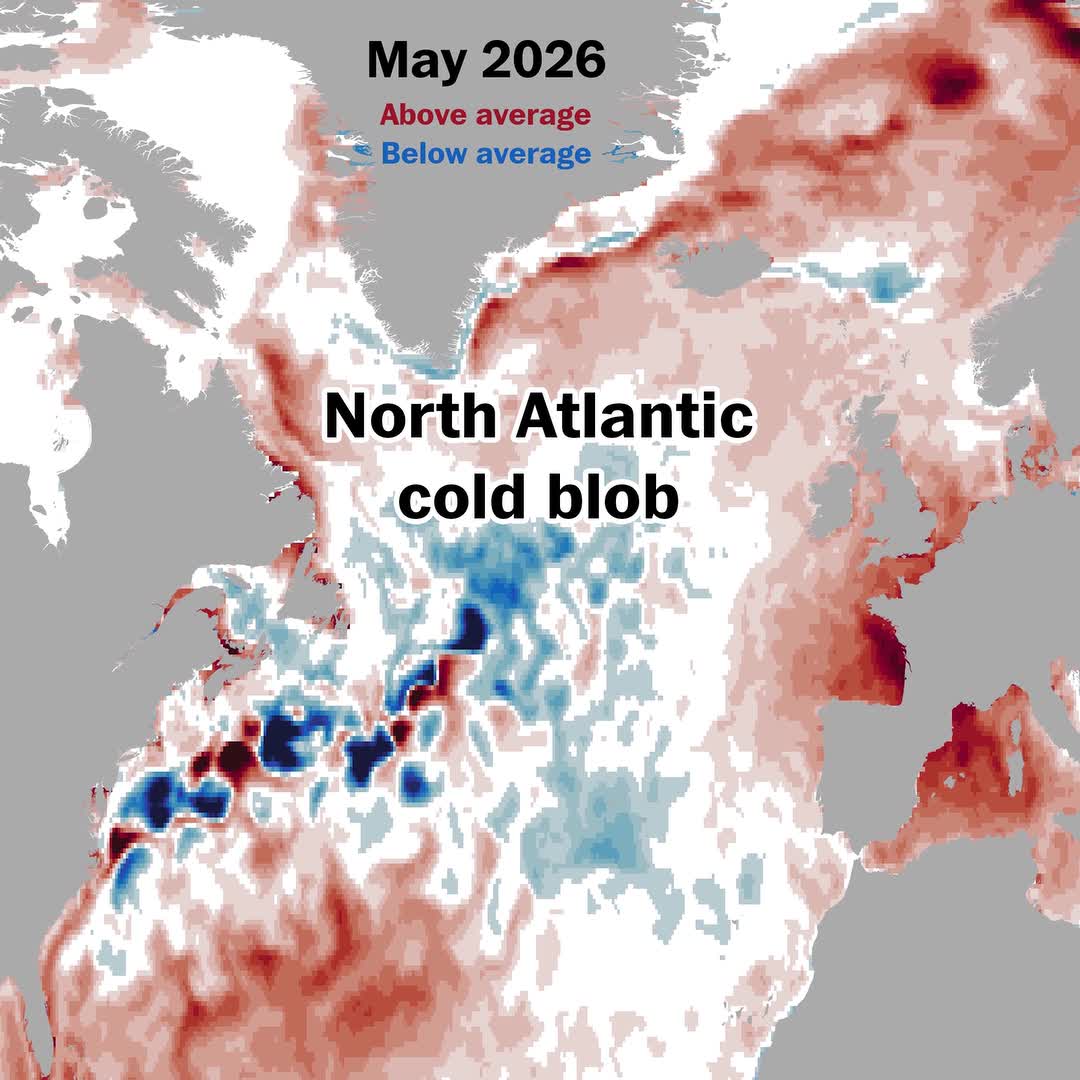
An unusual cold blob of water in the North Atlantic could signal changes in a key ocean current, which would have sweeping consequences for climate.
(Video: Ben Noll; ECMWF/ERA5)
From WP by Ben Noll
If the blob persists for years, it could eventually cool the climate around Greenland, Iceland and northern Europe.
As the planet warms, it’s becoming increasingly rare to see cooler than average conditions across vast stretches of the ocean, particularly as an expected super El Niño scorches parts of the Pacific.
But right now, an expansive area of well below-average ocean temperatures exists in the North Atlantic, to the east of Newfoundland.
There, unusually cool waters have lingered for the last year.
This patch of cool water is occurring in one of the few areas where the ocean hasn’t warmed in recent decades — and where scientists are closely monitoring for changes in the Atlantic meridional overturning circulation (AMOC).
The AMOC, which extends deep into the Atlantic Ocean, is a vital current that carries heat northward from the tropics toward the pole and plays a critical role in the climate around Greenland, Iceland and northern Europe.
If the cold blob persists for years, it could eventually cool the climate in these places — and signal this key current is weakening. Should it collapse, a massive cooling could occur in the Northern Hemisphere, while it warms in the south; sea levels could rise in some areas and seasons could flip in others.
As this conveyer belt of warm, salty water reaches the North Atlantic, it loses heat to the cold air above, becoming denser and sinking into the deep ocean.
As this conveyer belt of warm, salty water reaches the North Atlantic, it loses heat to the cold air above, becoming denser and sinking into the deep ocean.
But as ice in the Arctic melts, introducing more freshwater into the sea, it becomes harder for the water to sink, potentially slowing down the current.
Scientists have been monitoring the current’s behavior in the Irminger Sea, south of Greenland, where the U.S. National Science Foundation recently announced that it is dismantling its ocean monitoring equipment.
In Iceland, a collapse of the AMOC is considered a national security risk, since it would send winter temperatures plunging to minus-50 degrees Fahrenheit.
Recently published research from a team led by Stefan Rahmstorf of the Potsdam Institute concluded that “the strong evidence for a weakening AMOC is a serious concern for society and policy” and that it requires “urgent attention.”
Scientists have been monitoring the current’s behavior in the Irminger Sea, south of Greenland, where the U.S. National Science Foundation recently announced that it is dismantling its ocean monitoring equipment.
In Iceland, a collapse of the AMOC is considered a national security risk, since it would send winter temperatures plunging to minus-50 degrees Fahrenheit.
Recently published research from a team led by Stefan Rahmstorf of the Potsdam Institute concluded that “the strong evidence for a weakening AMOC is a serious concern for society and policy” and that it requires “urgent attention.”
However, other research published last year found no evidence of long-term weakening, but that it was still expected to slow some in the future.
There’s high confidence that the AMOC is weakening according to the U.N. Intergovernmental Panel on Climate Change.
There’s high confidence that the AMOC is weakening according to the U.N. Intergovernmental Panel on Climate Change.
The IPCC has indicated, with medium confidence, that it will not abruptly collapse before 2100.
But what about the recent cold blob?
But what about the recent cold blob?
Does it offer a sign of AMOC’s eventual collapse or can it be explained by a combination of forces?
Over the last week, the current cold blob has trended on social media, raising fresh concerns about the status of AMOC.
While stormy and windy weather in the North Atlantic have enhanced the cold blob this year, those factors don’t immediately describe why it has remained there for a year straight.
Other natural climate patterns, such as the Atlantic Multidecadal Oscillation (AMO), have affected the ocean’s conveyer belt.
Over the last week, the current cold blob has trended on social media, raising fresh concerns about the status of AMOC.
While stormy and windy weather in the North Atlantic have enhanced the cold blob this year, those factors don’t immediately describe why it has remained there for a year straight.
Other natural climate patterns, such as the Atlantic Multidecadal Oscillation (AMO), have affected the ocean’s conveyer belt.
When the AMO is in its positive phase, waters warm in the North Atlantic.
The opposite is generally true when it’s in its negative phase.
From mid-2023 to mid-2025, when the AMO was predominantly in its positive phase, the cold blob disappeared for extended periods.
From mid-2023 to mid-2025, when the AMO was predominantly in its positive phase, the cold blob disappeared for extended periods.
But when it became negative in mid-2026, the cold blob returned.

Based on this, a mix of climate forces — including human-driven warming as well as natural variability — appear to be contributing to the current conditions.
And climate models predict that the cold blob could linger for the rest of the year — and possibly expand and become more frigid.
What the current cold blob means for the future state of AMOC is uncertain, but models stop short of signaling widespread cooling across western Europe, Iceland or Greenland — the doomsday scenario that has so far been the stuff of movies.
What the current cold blob means for the future state of AMOC is uncertain, but models stop short of signaling widespread cooling across western Europe, Iceland or Greenland — the doomsday scenario that has so far been the stuff of movies.
Links :
Sunday, June 14, 2026
Point break
-"c'est un bon jour pour surfer"
— 🅶🅾🆁🅺 (@Raclure03) June 10, 2026
Point break ... pic.twitter.com/JkMOyBB3nX
-"c'est un bon jour pour surfer"
Point break ...Le meilleur spot 🤩 pic.twitter.com/Vm3WQ1PbZI
— 🅶🅾🆁🅺 (@Raclure03) June 8, 2026
Subscribe to:
Posts (Atom)