On a single breath of air, Guillaume Néry explores the deepest pool in the world in Italy: Y40.
The action is filmed on breath hold by his wife Julie Gautier.
"We are trying to have a new approach to underwater films. I like to play, walk, run, jump and fly underwater, you won't often see me just swimming and that's why I don't use fins," he confides.
"I feel like I'm floating in space, without gravity."
She's witnessed awe-inspiring sights at sea, but yachtswoman Dee Caffari has also been left "dumbfounded" by the vast floating islands of plastic and rubbish she has seen in the world's oceans.
As the first woman to have sailed single-handedly around the world in both directions, Caffari has seen up close the harmful effects of man's activities, from global warming and the northward drift of icebergs in the Southern Ocean to the plastic pollution that is threatening ecosystems and impacting on the human food chain.
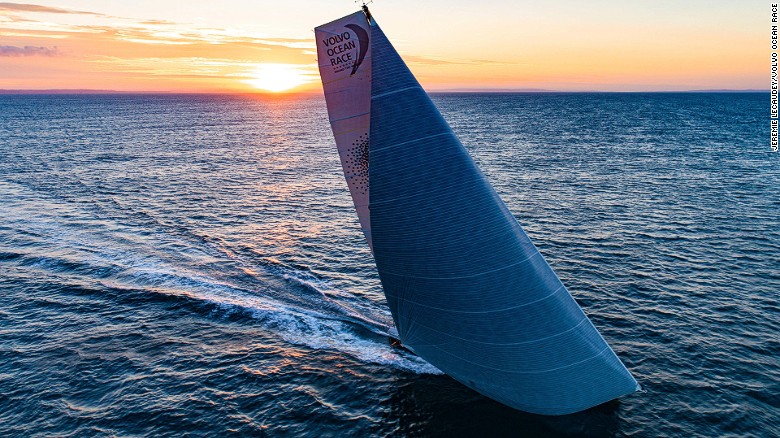
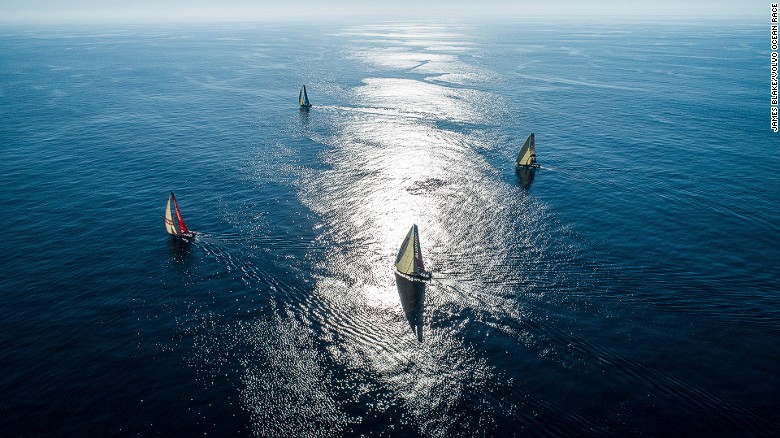
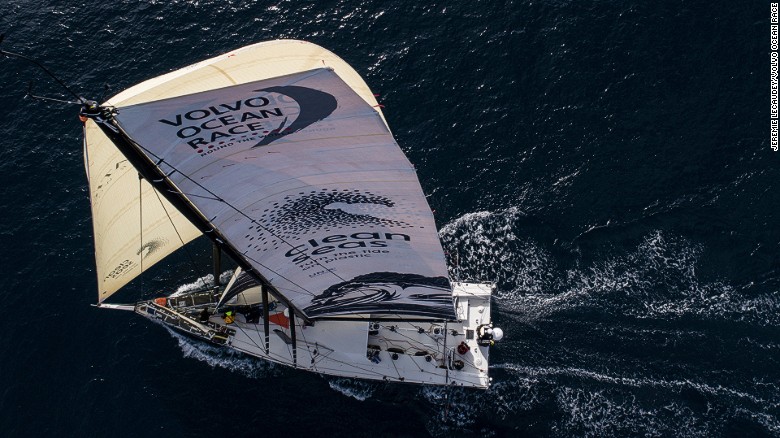
To help raise awareness of declining ocean health and add some science to the debate, Caffari is skippering the Turn the Tide on Plastic boat in this year's Volvo Ocean Race, sailing's premier around-the-world competition.
"I feel very privileged to have the ocean as a playground and a work office, and yet I can see first-hand some of the damage we're doing," Caffari told CNN Sport.
"It's a realization by so many more people now that it's critical. If we actually don't do anything about it our planet is doomed."
According to the Ellen MacArthur foundation,
8 million tonnes of plastic waste reaches our seas each year.
'Get worse'
According to the Plastic Oceans website, 550 million plastic straws are thrown away every day in the US and the UK, while worldwide more than 500 million plastic bottles are used every year and more than one trillion plastic bags are discarded.
More than eight million tonnes of plastic are dumped into the ocean every year, according to the Ellen MacArthur Foundation (EMF).
About 50% of it is used once and then discarded, and 91% never recycled.
"We've created this problem for our planet and unless we actively do something about it or stop using it or make manufacturing change it's only going to get worse," says the 44-year-old Caffari.
The 2016 report by the World Economic Forum (WEF) and the EMF said that if this trend continues at the same rate, there will be more plastic than fish in the ocean (by weight) by 2050.
Britains' Prince Charles told delegates at the recent Our Ocean summit in Malta it was crucial to create a circular economy that allows plastics to be "recovered, recycled and reused instead of created, used and then thrown away."
Caffari's team will monitor daily water quality and micro-plastic levels on their 45,000 nautical mile trip around the world
'Plastic is on the menu'
Much of the plastic waste in the world's seas tends to collect in one of five ocean gyres -- huge areas of circulating current and winds in which trash gathers.
During a recent race from Los Angeles to Hawaii, Caffari's boat skirted the edge of the North Pacific Gyre, known as the Great Pacific Garbage Patch.
"Every single day we were passing pollution, which was like having trash just thrown in the ocean, like fishing nets, floating crates, washing bowls, chairs, all sorts. It's sad," said Britain's Caffari.
"We're talking full islands worth, we're talking avoiding the area.
"The Americans with me were saying that it was better than it has been in the past but I was dumbfounded. It's ridiculous."
As well as the visible trash, scientists and environmentalists are worried about the level of micro-plastics in the ocean, minute pieces of plastic less than five millimeters in diameter.
These come from sources such as cosmetics, clothing and industrial processes as well as the breakdown of larger plastic items.
Fish, other sealife and birds mistake it for food. In turn, this plastic enters the human food chain and is ingested by us.
Micro-plastics are small (less than 5 mm in diameter) pieces of plastic which are eaten by fish and other sea life ad birds in mistake for food.
It eventually ends up in the human food chain.
By 2050, there could be more plastic in the sea than fish (by weight), according to the Ellen MacArthur Foundation.
"Plastic is on the menu," warned Prince Charles in his speech in Malta.
To collect new data, Caffari's team will take water samples each day as they race 45,000 miles around the world in 11 legs across four oceans.
The exact location of each sample will be pinpointed by GPS and the results analyzed to build up a global map of micro-plastic concentration levels in the oceans.
"This real data has to be acted up on," says Caffari.
"We often pay lip service to a lot of things, but hopefully this will be proactive and make change happen."
The Volvo Ocean Race boats are doing more than just racing around the planet – they’re dropping drifter buoys to facilitate the collection of valuable scientific data which will be used by experts around the planet to better understand the oceans and what’s happening in some of the world’s most isolated places.
It is one of three entries -- alongside Team Vestas 11th Hour Racing, a program of The Schmidt Family Foundation, and AkzoNobel -- that put sustainability at the heart of the race, say organizers.
"Highlighting it and raising awareness is one thing, driving industry and government to legislate to make differences is another aspect and then increasing people to raise awareness of their own behaviors and making simple changes such as don't use straws and refill water bottles -- that kind of simple action cumulatively makes the big impact," says Caffari.
The irony of a race sponsored by a car manufacturer -- which flies people and equipment around the world, and which builds boats made of carbon -- is not lost on Caffari.
But she maintains the race itself is working hard to minimize its impact and leave a legacy, from not having straws, single-use water bottles, plastic cutlery or cable ties in the various global race villages, and proper rubbish recycling, to Volvo using a proportion of each sale of its new hybrid car to funding the study of micro-plastics at sea.
The race has pledged to reduce single-use plastic at its race villages by 80% this edition and ban it completely by 2019/2020.
At the recent America's Cup, Ben Ainslie's Land Rover BAR, with 11th Hour Racing as a principle partner, were vociferous campaigners of the sustainability and clean seas message, but the disparate ambitions of the fiercely competitive teams meant the message was not broadcast on a united front, despite the high profile of one of sailing's most prestigious events.
Given the Volvo Ocean Race is something of a "closed environment," Caffari insists the sustainability message is easier to project.
"They risk being looked at very critically, so they have to deliver," she says.
"I feel very privileged to have the ocean as a playground and a work office, and yet I can see first-hand some of the damage we're doing" Caffari told CNN
Time to act
The seven teams entered in the race are made up of mixed crews after a new rule for this edition of the race handed a numerical advantage to line-ups including women.
Caffari's 10-person crew is the most cosmopolitan with a 50-50 split of men and women.
The focus is on youth, with six of the 10 never having sailed in the notorious Southern Ocean.
But for Caffari, who took part in the last edition of the race as part of the all-female crew on Team SAC, it is the youth of her team that is the most energizing, particularly in terms of raising awareness of ocean health.
"The synergy is very nice with this Turn The Tide on Plastic team with the focus on youth sailors," she says.
"They realise it's their generation and their children that are going to have to action something to make a difference for the future."
The Volvo Ocean Race began with leg one from Alicante, Spain to Lisbon in Portugal on October 22.There are also stopovers in Cape Town, Melbourne, Hong Kong, Auckland, Itajai in Brazil, Newport, Cardiff and Gothenburg with the finish in The Hague in June 2018. Links :
Inventing cities, mountains, and monsters to fill the empty spaces on maps is a centuries-old tradition in cartography.
The Indian Ocean is teeming with sea monsters in Caspar Vopel’s 1558 map of the world.
A giant swordfish-like creature looks to be on a collision course with a ship, while a walrus with frighteningly large tusks emerges from the water, and a king carrying a flag rides the waves on a hog-faced beast.
Ships and large boxes of text also help fill in the Indian Ocean on Vopel’s map.
COURTESY OF HOUGHTON LIBRARY, HARVARD UNIVERSITY
In contrast, the only real geographical information in the Indian Ocean on Vopel’s map are three groups of islands (but only the ones at the top actually exist).
COURTESY OF HOUGHTON LIBRARY, HARVARD UNIVERSITY
Vopel, a German cartographer, left behind no explanation of why he added these things to his map, but he may have been motivated by what art historians call horror vacui, the artist’s fear of leaving unadorned spaces on their work.
Chet Van Duzer, a historian of cartography, has found dozens of maps on which cartographers appear to have filled the empty spaces on their maps with non-existent mountains, monsters, cities, and other gratuitous illustrations.
Van Duzer, who presented some of his findings at a recent cartography conference at Stanford University, says that some scholars have been skeptical that this aversion to blank spaces has been an important influence on map design.
But Van Duzer argues that horror vacui was widespread among cartographers, especially during the 16th and 17th centuries.
Vopel’s map, for example, includes not only sea monsters and ships but also boxes of text describing features of the land.
Vopel could have put this information around the margins of the map, but he chose instead to use them to fill in the oceans.
All together these elements take up at least as much space as the part of the world that’s actually being mapped (the second image in the gallery above shows them all highlighted).
Decorative cartouches fill much of the Southern Ocean and the interior of North American on Pieter van den Keere’s 1611 map.
Compass roses, sailing ships, and cartouches are among the decorative elements on Pieter van den Keere’s 1611 map.
COURTESY OF SUTRO LIBRARY, CALIFORNIA STATE LIBRARY
One reason mapmakers may have done this is to hide their ignorance, says Van Duzer.
When the Dutch mapmaker Pieter van den Keere made a world map in 1611 (see above), the interior of North America had yet to be thoroughly mapped.
The cartouche covering most of North America is decorated with plants, animals, and famous explorers.
COURTESY OF SUTRO LIBRARY, CALIFORNIA STATE LIBRARY
Instead of leaving it blank, van den Keere filled the space with an elaborate cartouche, a decorative oval shape surrounded by alligators, birds, and foliage.
At the top of the cartouche, explorers Christopher Columbus, Ferdinand Magellan and Amerigo Vespucci pore over a map.
The interior of Africa was not well mapped either at the time, but there were texts available that described it in detail—albeit speculative and unreliable detail—and van den Keere likely relied on these to fill in the interior of that continent, Van Duzer says.
According to the map, for example, the Niger River flows underground for 60 miles and then re-emerges in a lake.
In reality it does no such thing.
Mapmakers may have also been motivated by the market for their work.
Aristocrats and other wealthy patrons who commissioned the most expensive maps would have expected lavish decoration.
On the Italian cartographer Giovanni Battista Cavallini’s 1640 colorful nautical chart of the Mediterranean sea below, the surrounding land is filled with cities, mountains, and far more scale bars and compass roses than necessary—or even helpful.
Giovanni Battista Cavallini’s 1640 map of the Mediterranean sea is filled with decorative elements, including 15 cities (circled in red), most of which don't represent real cities.
The map also includes 15 compass roses, added purely as decoration.
Cavallini also included scale bars, mountain ranges, and a couple palm trees—together these decorations take up most of the land area on the map.
COURTESY OF GEOGRAPHY AND MAP DIVISION, LIBRARY OF CONGRESS
Unfortunately, the real motivations of these mapmakers are mostly lost to time.
Van Duzer has so far found only one text by a cartographer that discusses horror vacui, although not by name.
It’s a small note on a 1592 world map by the Dutch cartographer Petrus Plancius, in which Plancius says, in effect, that he went out of his way to research the constellations of the southern sky for a small celestial map he drew in one corner, “Least the South part of this Hemispheare or halfe Globe, should remaine voide and emptie.”
“The stars of the southern hemisphere were not well known in Europe in the early seventeenth century, so he is proud that he has sources that will enable him to fill in what might otherwise be a blank area,” Van Duzer says.
Even in its heyday, horror vacui seems to have afflicted some cartographers more than others, Van Duzer says.
But by the middle of the 18th century, more and more mapmakers were keeping their embellishments to the margins and leaving the seas and unexplored continents unadorned, he says.
“Cartographers started to conceive of maps as something more purely scientific.”