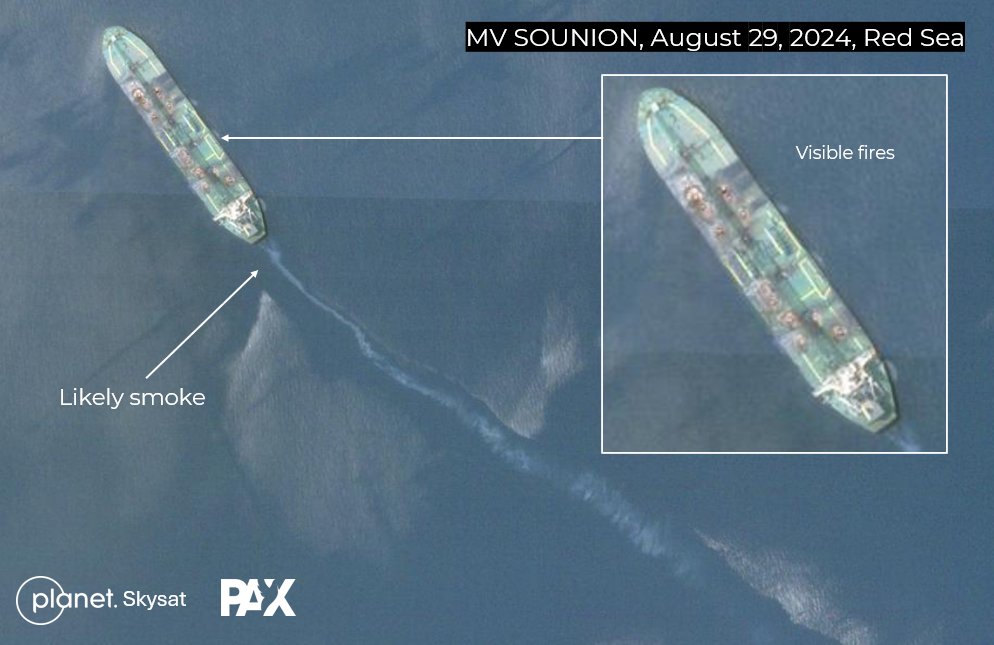
Two days after Houthi forces blew up the cargo tanks of the Greek-owned Suezmax Sounion, the flames emerging from the vessel's deck were still visible from space, based on imagery from the EU's Sentinel satellite system.
Western governments have warned that the terrorist group's action could cause a devastating oil spill in the Red Sea, up to four times larger than the Exxon Valdez disaster - with serious consequences for the environment and for subsistence fisheries.
A possible oil spill stretching 2.2 nautical miles in length was spotted in a location matching the Sounion tanker, after the vessel caught fire following an attack by Yemen’s Houthi rebels in the Red Sea earlier this month.
Bloomberg graphics
"While the crew has been evacuated, the Houthis appear determined to sink the ship and its cargo into the sea," said the U.S. State Department in a statement.
"Through these attacks, the Houthis have made clear they are willing to destroy the fishing industry and regional ecosystems that Yemenis and other communities in the region rely on for their livelihoods, just as they have undermined the delivery of vital humanitarian aid to the region through their reckless attacks."
New satellite imagery from @ESA_EO Sentinel-2 shows burning oil tanker SOUNION at the Red Sea. Unclear how much oil is spill due to sun glint on the water. pic.twitter.com/volel0BKmr
The European Union's naval mission in the Red Sea, EUNAVFOR Aspides, echoed these concerns.
"This situation underlines that these kinds of attacks pose not only a threat against the freedom of navigation but also to the lives of seafarers, the environment, and subsequently the life of all citizens living in that region," the EU mission said in a statement.
Before the blast, multiple Houthi observers aimed video cameras at the vessel from different angles (below).
Based on their footage, the tanker was wracked by three simultaneous explosions, and three fireballs erupted from the main deck level upwards.
The pattern suggests that after they disabled the Sounion, the Houthi attackers waited for Western defenders to leave, then boarded the tanker, placed explosive charges on deck, and recorded the ensuing detonation for public release - as they have done previously.
Pictured from the UN report on the FSO Safer, whose precarious circumstances were very similar to the Sounion’s, are maps showing the areas at risk by using colours to indicate how much oil is expected on the surface in different places and times. Ports are marked with black dots, and water treatment plants are marked with blue dots.
A spokesman for Houthi forces did not address potential environmental harm from the attack, and said only that the vessel was targeted because of the shipowner's alleged decision to continue sending vessels to Israeli seaports.
The Houthi militia has declared a naval blockade on Israeli-affiliated shipping because of the ongoing military operation in Gaza, though it has previously attacked vessels without any clear Israeli nexus - including vessels linked to Houthi allies.
This is an 1867 French Dépôt de la Marine nautical chart or maritime map of
Saint Martin Bay, Ile de Ré, France.
Depicting the north shore of the Ile de Ré from Loix to La Flotte in 21 panels, hundreds of depth soundings populate the bay.
Saint Martin appears at bottom center, with the city's fortifications illustrated in detail.
The Ile de Ré sits off the coast of France in the Bay of Biscay not far from La Rochelle.
The island changed hands several times between the English and French between 12th and 14th centuries. Ile de Ré commands coastal France from Nantes to Bordeaux, making it a prized possession, particularly during in the 17th century.
It was the center of a Huguenot revolt in 1625 and the English unsuccessfully laid siege to Saint-Martin-de-Ré in 1627.
Vauban fortified Saint Martin in 1681 and the city served as one of the depots through which convicts transited on their way to penal colonies in New Caledonia and French Guiana.
Alfred Dreyfus was one of the many prisoners to pass through Saint Martin.
The Nazis fortified the Ile de Ré during World War II, and some of the bunkers remain, which led to scenes from The Longest Day being filmed on the island's beaches.
Today, the Ile de Ré is popular as an elite vacation destination.
click on the picture to zoom (8500x5676) or view with Geographicus
Visualization with the GeoGarage platform (SHOM nautical raster chart)
Apparently, it can. Throughout the centuries, explorers have mapped thousands of islands, some of which turned out to never have existed. These glitches in the cartographical matrix are called phantom islands. Here, we explore five such elusive specks of land.
Elizabeth Island
From 1577 to 1580, Sir Francis Drake was circumnavigating the globe. Among many other achievements, he became the first Englishman to navigate the Strait of Magellan in southern Chile. While passing through this area in order to get to the Pacific, he and his men became caught in a tempest.
They took shelter on an unidentified island at 57° S for four days. The island had an ample supply of wood, a freshwater lake, herbs, and berries. After recuperating, they left, but not before claiming the island for the Queen and naming it Elizabeth Island. Drake also called the harbor in which he and his men anchored Port Sir Francis Drake.
Sir Francis Drake. Photo: German Vizulis/Shutterstock
Several historical documents, including those from the expedition’s chaplain and Drake’s colleague Richard Hawkins, speak of the island and its details. Maps showed its location until 1747. Subsequent voyages never came across the island, and many began to doubt its existence.
Historian Felix Riesenberg attempted to explain this vanishing act in his book, Cape Horn. He believes that Elizabeth Island disappeared in a volcanic eruption. After learning about the island’s features in the notes of Drake’s chaplain and contemporary maps, he found that the island had volcanic characteristics. He also noted the geology, earthquakes, and volcanism in that area. He concluded that “the island of Elizabeth might have been blown to kingdom come a year or so after Francis Drake left.”
Also backing up his claim is the existence of the Pactolus Bank, which he says is in the same position as Elizabeth Island. The bank, which is most likely a deposit of volcanic material, has disappeared and reappeared. Riesenberg suggests that the bank was initially part of Elizabeth Island.
Elizabeth Island lay in the Strait of Magellan. Map: World Atlas
Thule
Many sources from antiquity and the Middle Ages speak of a mysterious island in the far north. These classical scholars spoke of Thule as a place that lacked sunshine and experienced heavy rains but abounded in fruits, grain, and honey. Isidore of Seville and the historian Avienius claimed that Thule experienced a midnight sun.
Some linked Thule’s residents to the Scottish Picts, who painted their bodies blue. Thule was approximately a six-day sail from Britain over a frozen sea. According to wacky German occultists during the Second World War, Thule was the birthplace of the “superior” Aryan race.
Map including Thule. Photo: Olaus Magnus (1539)
Clearly, Thule was an arctic realm, but where? From Ireland to the Shetland Islands, to Scandinavia or the Estonian island of Saaremaa, the scholarly hunt for Thule continues. According to writer Rolf Gilberg, “As the frontiers of exploration gradually expanded, the legendary Ultima Thule acquired a more northerly location.”
The midnight sun detail is also very telling. A place needs to be north of the Arctic Circle to experience the midnight sun.
After referring to ancient maps and using modern geographic technology, geologists from the Technical University of Berlin determined that Thule might be the island of Smola in Norway.
The name Thule is not exclusive just to this legend. You can find several Scandinavian areas with the name, especially in Greenland. Famously, it refers to the place and culture of Northwest Greenland, the most northerly inhabited place on earth. But this name came long after the legend — Europeans did not discover Thule until 1818 — and the original Thule remains elusive.
Thule Air Base, Northwest Greenland. Photo: Jerry Kobalenko
Hy-Brasil
Do not confuse this phantom island with the South American country. According to some, the name Hy-Brasil is rooted in Irish myth and etymology, after the clan name Uí Breasail. It first appeared on maps in the 14th century under various spellings. Different versions include “Bracile,” “Illa de Brasil,” and “Brasil Rock”.
Supposedly, this mythical island lies a few hundred kilometers west of Ireland. Perpetually shrouded in thick mist, it revealed itself to onlookers just once every seven years. On maps, the island is circular with a river flowing straight across it.
Map of Hy Brasil. Photo: Diego Gutierrez, 1562
It also bears the nickname, Isle of the Blessed. The island acquired a magical connotation, not just because of its ability to vanish and reappear.
Some claimed to have set foot on the island. One famous report in 1674 from a Captain John Nisbet recalls the island housing strange black rabbits. He also met a resident necromancer who lived in a castle, he said. Nevertheless, maps began to phase the island out around 1873.
A shallows called the Porcupine Bank lies very close to Hy-Brasil’s former position on maps. Many cite this as the fabled island. It would certainly explain how it disappeared from the action of tides, waves, and erosion.
The supposed location of Hy-Brasil.
Nimrod Islands
Captain Eilbeck aboard his ship Nimrod first spotted and named the Nimrod Islands in 1828. According to maps, they lay southeast of New Zealand, between the Emerald and Dougherty Islands, which happen to be phantoms as well. There is not much information about their physical features or inhabitants. Strangely enough, it did not stop explorers from trying to find the unexplored place.
Nimrod Islands. Photo: J. K. Davis
English explorer John Biscoe, known for his 1830-3 Southern Ocean expedition, tried to find the elusive group of islands in 1831. Almost 80 years later, Australian explorer John King Davis launched his own expedition after serving as chief officer on Ernest Shackleton’s Antarctic Expedition of 1908-9. He found no sign of the group.
Norwegian Lars Christensen undertook the last search attempt in 1930. Still nothing. By 1940, mapmakers stopped including the Nimrod Islands on maps.
It is possible that the islands were a result of the Fata Morgana phenomenon, a common mirage in the polar regions. Arctic exploration likewise has illusory discoveries — the Croker Mountains and Crocker Land — pinned, perhaps spuriously, on mirages.
Mirage of land over the Arctic Ocean. Photo: Jerry Kobalenko
Kianida Island
Kianida or Cyanida Island lay off the coast of Thrace in the Black Sea, bordered by what is now Turkey and Bulgaria. It appeared on maps in ancient times, particularly Ptolemy’s Geography and Nicolaus Germanus’s 1467 version of that book. Much like the Nimrod Islands, we don’t know much about it except its large size depicted on maps.
Bulgarian geomorphologist Dinyo Kanev shed some light on what might have happened to it. He claims it might have sunk or been destroyed by earthquakes and erosion sometime around the late 1400s or early 1500s, based on geological evidence on the Black Sea coast.
China is not only the Superpower of Seafood across the high seas and on land.
It’s also, in a more hidden way, exerting unprecedented control over near-shore waters, especially those of global south countries.
In recent years, from South America to Africa to the far Pacific, China has been buying its way into restricted national fishing grounds, primarily using a process known as “flagging in.”
This method typically involves the use of business partnerships to register foreign ships under the flag of another country, thereby allowing those vessels to fish in that country’s territorial waters.
The Chinese fleet has long targeted other countries’ waters.
Typically that meant parking in international waters along sea borders, then running incursions across the line into domestic waters.
But China has more recently taken a “softer” approach, gaining control from the inside by paying to flag in their ships so they can fish in domestic waters.
Subtler than simply entering foreign coastal areas to fish illegally, the tactic – which is often legal – is less likely to result in political clashes, bad press, or sunken vessels.
Part of the reporting for this investigation was conducted by two fellows of the Outlaw Ocean Project Institute, Pete McKenzie and Milko Schvartzmann in Argentina.
The story, which took a year to produce, is running in over two dozen news outlets in 22 countries and 10 languages, thanks to an array of global publishing partners.
From The OutLawOcean by Ian Urbina, Pete McKenzie and Milko Schvartzman
The superpower of seafood dominates more than just the high seas.
ON MARCH 14, 2016, IN THE SQUID GROUNDS off the coast of Patagonia, a rusty Chinese squid jigger called the Lu Yan Yuan Yu 10 was fishing illegally in Argentina’s national waters. Spotted by an Argentine coast-guard patrol and ordered over the radio to halt, the specially designed squid-fishing ship known as a jigger fled the scene. The Argentinians gave chase and fired warning shots. The Lu Yan Yuan Yu 10 then tried to ram the coast-guard cutter, prompting it to open fire directly on the jigger, which soon sank.
Although the violent encounter at sea that day was unusual, the incursion into Argentine waters by a Chinese squid jigger was not. Owned by a state-run behemoth called the China National Fisheries Corporation, or CNFC, the Lu Yan Yuan Yu 10 was part of a fleet of several hundred Chinese jiggers that makes annual visits to the high-seas portion of the fishing grounds that lie beyond Argentina’s territorial waters. During their visits, many of these jiggers turn off their locational transponders and cross secretly into Argentine waters, where they are not permitted. Since 2010, the Argentine navy has chased at least 11 Chinese squid vessels out of Argentine waters for suspected illegal fishing, according to the government. This story was produced by The Outlaw Ocean Project with reporting contributed by Maya Martin, Jake Conley, Joe Galvin, Susan Ryan, Austin Brush and Teresa Tomassoni. Bellingcat also contributed reporting.
A year after the illegal incursion and sinking of the Lu Yan Yuan Yu 10, Argentina’s Federal Fishing Council issued a little-noticed announcement: it was granting fishing licenses to two foreign vessels that would allow them to operate within Argentine waters. Both would sail under the Argentine flag through a local front company, but their true “beneficial” owner was CNFC. This decision was noteworthy because it seemed to violate Argentine regulations that not only forbid foreign-owned ships from flying Argentina’s flag or fishing in its waters but also prohibit the granting of fishing licenses to ship operators with records of illegal fishing in Argentine waters. “The decision was a total contradiction,” said Eduardo Pucci, a former Argentine fisheries minister who now works as a fishing consultant.
The move by local authorities may have been a contradiction, but it is an increasingly common one in Argentina and elsewhere around the world. In recent years, from South America to Africa to the far Pacific, China has been buying its way into restricted national fishing grounds, primarily using a process known as “flagging in.” This method typically involves the use of business partnerships to register foreign ships under the flag of another country, thereby allowing those vessels to fish in that country’s territorial waters.
Chinese companies now control at least 62 industrial fishing vessels that fly the Argentine flag, including the majority of Argentina’s squid fleet. Many of these companies have been tied to a variety of crimes, including dumping fish at sea, turning off their transponders, and engaging in tax evasion and fraud. Trade records show that much of what is caught by these vessels is sent back to China, but some of the seafood is also exported to countries including the United States, Canada, Italy, and Spain.
China now operates almost 250 of these flagged-in vessels in the waters of countries including Micronesia, Kenya, Ghana, Senegal, Morocco, and Iran.
From South America to the Middle East and the far Pacific, China has flagged in its own fishing vessels into foreign waters, granting itself access to poorer global south countries’ fish stocks.
The size of this hidden fleet was not previously known. Nor was the extent of its illegal behavior, concentration in certain foreign waters or the amount of seafood coming from these ships that winds up in European and American markets. The scope of the armada matters because most countries require vessels to be owned locally to keep profits within the country and make it easier to enforce fishing regulations. Flagging-in undermines those aims, said Duncan Copeland, the former executive director of TMT, a non-profit research organization specializing in maritime crime. And aside from the sovereignty and financial concerns, food security is also undermined by the export of this vital source of affordable protein, added Dyhia Belhabib, a principal investigator at Ecotrust Canada, a charity focused on environmental activism.
These hundreds of industrial fishing ships also complicate China’s ocean conservation goals. In 2017, after pressure from environmental groups about overfishing, Beijing announced that it would cap the size of its distant-water fleet at 3,000 vessels. But that tally does not take into account the growing number of industrial ships that China owns and flags into other countries.
Over the past three decades, China has gained supremacy over global fishing by dominating the high seas with more than 6,000 distant-water ships, a fleet that is more than triple the size of the next largest national fleet. When it came to targeting other countries’ waters, Chinese fishing ships typically sat “on the outside,” parking in international waters along sea borders, then running incursions across the line into domestic waters. In recent years, China has increasingly taken a “softer” approach, gaining control from the inside by paying to flag in their ships so they can fish in domestic waters. Subtler than simply entering foreign coastal areas to fish illegally, the tactic—which is often legal—is less likely to result in political clashes, bad press, or sunken vessels.
China has not hidden how this approach factors into larger ambitions. In an academic paper published in 2023, Chinese fishery officials explained how they have relied extensively on Chinese companies, for example, to penetrate Argentina’s territorial waters through “leasing and transfer methods,” and how this is part of a global policy.
The trend is especially pronounced in Africa, where Chinese companies operate flagged-in ships in the national waters of at least nine countries on the continent—among them, notably, Ghana, where at least 70 Chinese fishing ships flying the Ghanaian flag are fishing in national waters, even though foreign investment in fishing is technically illegal. Nonetheless, up to 95 percent of Ghana’s industrial trawling fleet has some element of Chinese control, according to a 2018 report by the Environmental Justice Foundation, an advocacy group.
China has also displaced fishing vessels from the European Union, right on its doorstep, in the waters of Morocco. In the recent past, dozens of vessels, most of them from Spain, fished with the permission of the Moroccan government inside the African country’s exclusive economic zone. The agreement lapsed, however, in 2023 and China now operates at least six flagged-in vessels in Moroccan waters. China’s Flagged-in FleetAn interactive visualization of the almost 250 ships China has flagged into foreign waters globally.
China has also established a growing presence across the Pacific Ocean. Chinese ships comb the waters of Fiji, the Solomon Islands, and the Federated States of Micronesia, having flagged in or signed access agreements with those countries, according to a report released in 2022 by the Congressional Research Service in the U.S.
“Chinese fleets are active in waters far from China’s shores,” the report warned, “and the growth in their harvests threatens to worsen the already dire depletion in global fisheries.”
AS GLOBAL DEMAND FOR SEAFOOD HAS DOUBLED since the nineteen-sixties, the appetite for fish has outpaced what can be sustainably caught. Now, more than a third of the world’s stocks have been overfished. To feed the demand, the proliferation of foreign industrial fishing ships, especially from China, risks collapsing domestic fish stocks of countries in the global south while also jeopardizing local livelihoods and compromising food security by exporting an essential source of protein. Western consumers, particularly in Europe, the U.S. and Canada, are beneficiaries of this cheap and seemingly abundant seafood caught or processed by China.
In the past six years, more than 50 ships flagged to a dozen different countries but controlled by Chinese companies had engaged in crimes such as illegal fishing, unauthorized transshipments, and forced labor, according to an investigation by the Outlaw Ocean Project. In one instance, a fishing observer for Ghana’s Fisheries Commission called Emmanuel Essien disappeared without a trace from the Meng Xin 15, beneficially owned by the Chinese company Dalian Meng Xin Ocean Fisheries, on the night of July 5, 2019. The observer’s disappearance came a fortnight after he provided police with video evidence of crew on another ship transferring catch illegally between it and a second vessel, according to local investigative reporting. An investigation has been launched into the disappearance, but the lack of human remains has hindered its development. Four of the vessels showed a pattern of repeatedly turning off their automated tracking systems for longer than a day at a time while out on the Pacific, often at the edge of an exclusive economic zone. Vessels ‘going dark’ is a risk factor for illegal fishing and transshipment, marine researchers say, because it makes it harder for law enforcement to comprehensively track a vessel’s movement or see if it is likely engaged with other ships at sea.
“It’s a net transfer from poorer states who don’t have the capacity to protect their fisheries, to richer states who just want cheaper food products,” Isaac B. Kardon, Senior Fellow for China Studies at the Carnegie Endowment for International Peace, said. Of the 249 vessels identified in the investigation as part of China’s flagged-in fleet, 115 are currently approved by the relevant European agency to export to the E.U. (and over 70 of the vessels are ultimately owned by Chinese companies that have sent 17,000 tons of seafood to the United States since 2018)
But ocean sustainability and food security are by no means the only concern tied to the growth of China’s control of global seafood and penetration into foreign near-shore waters. Labor abuses and other crimes are a widespread problem with Chinese fishing ships.
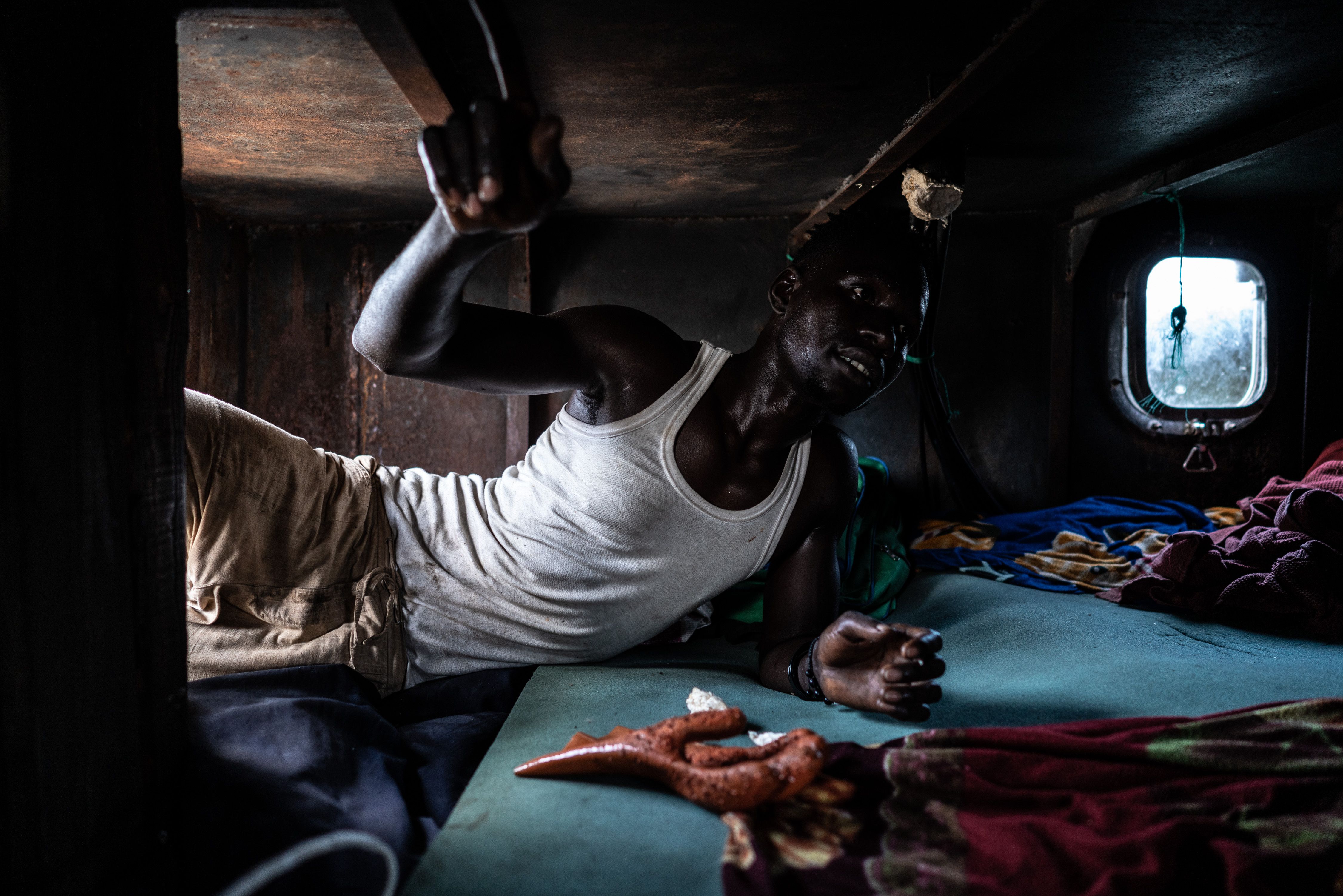
In January 2019, as part of a four-year investigation, a team of reporters from The Outlaw Ocean Project boarded a Chilean fishing ship in Punta Arenas, Chile, where the crew recounted recently watching a Chinese captain on a nearby squid ship punching and slapping deckhands. Later that year, the same team of journalists was reporting at sea off the coast of the West African nation of Gambia, where they boarded a Chinese ship called the Victory 205. There they found six African crew members sleeping on sea-soaked foam mattresses in a cramped and dangerously hot crawl space above the engine room. The ship was later detained by local authorities for these labor and other violations.
In September 2019 in the waters of Gambia, Outlaw Ocean Project reporters visited the Victory 205, a Chinese-owned ship that was caught fishing illegally and where workers faced decrepit conditions.
Fábio Nascimento / The Outlaw Ocean Project
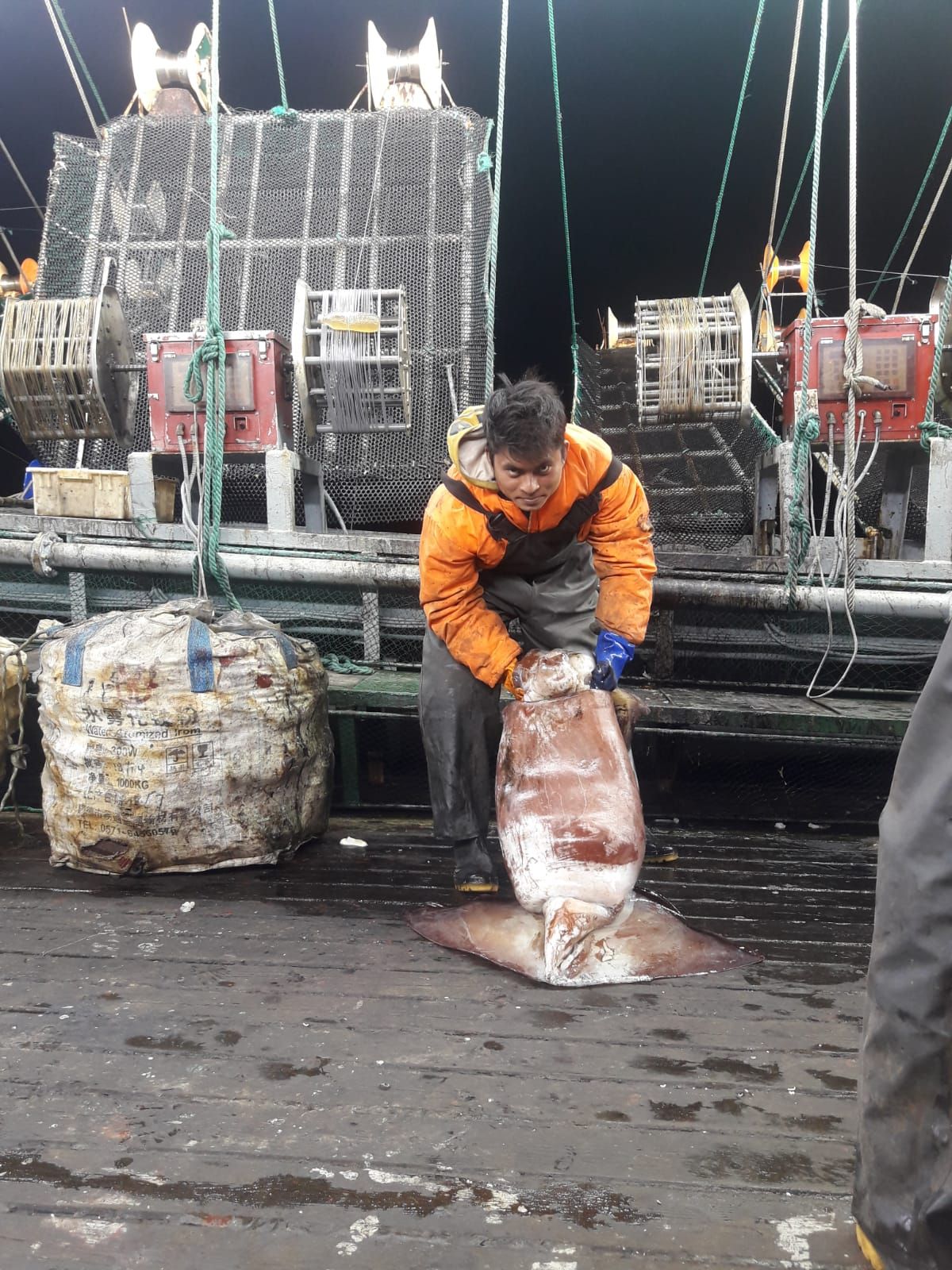
In February 2022, the reporters boarded a Chinese squid jigger on the high seas near the Falkland Islands, where an 18-year-old Chinese deckhand nervously begged to be rescued, explaining that his and the rest of the workers’ passports had been confiscated. “Can you take us to the embassy in Argentina?” he asked. Roughly four months later, the reporting team climbed onto another Chinese fishing ship in international waters near the Galapagos Islands, to document living conditions. As if in suspended animation, the crew of 30 men wore thousand yard stares. Their teeth were yellowed from smoking, their skin ashen, and their hands spongy from handling fresh squid. The walls and floors were covered in slippery ooze of squid ink. The deckhands said they worked 15-hour days, 6 days per week. Mostly, they stood shin deep in squid, monitoring the reels to ensure they did not jam, and tossing their catch into overflowing baskets for later sorting. Below deck, a cook stirred instant noodles and bits of squid in a rice cooker. He said the vessel had run out of vegetables and fruit — a common cause at sea of fatal malnutrition.
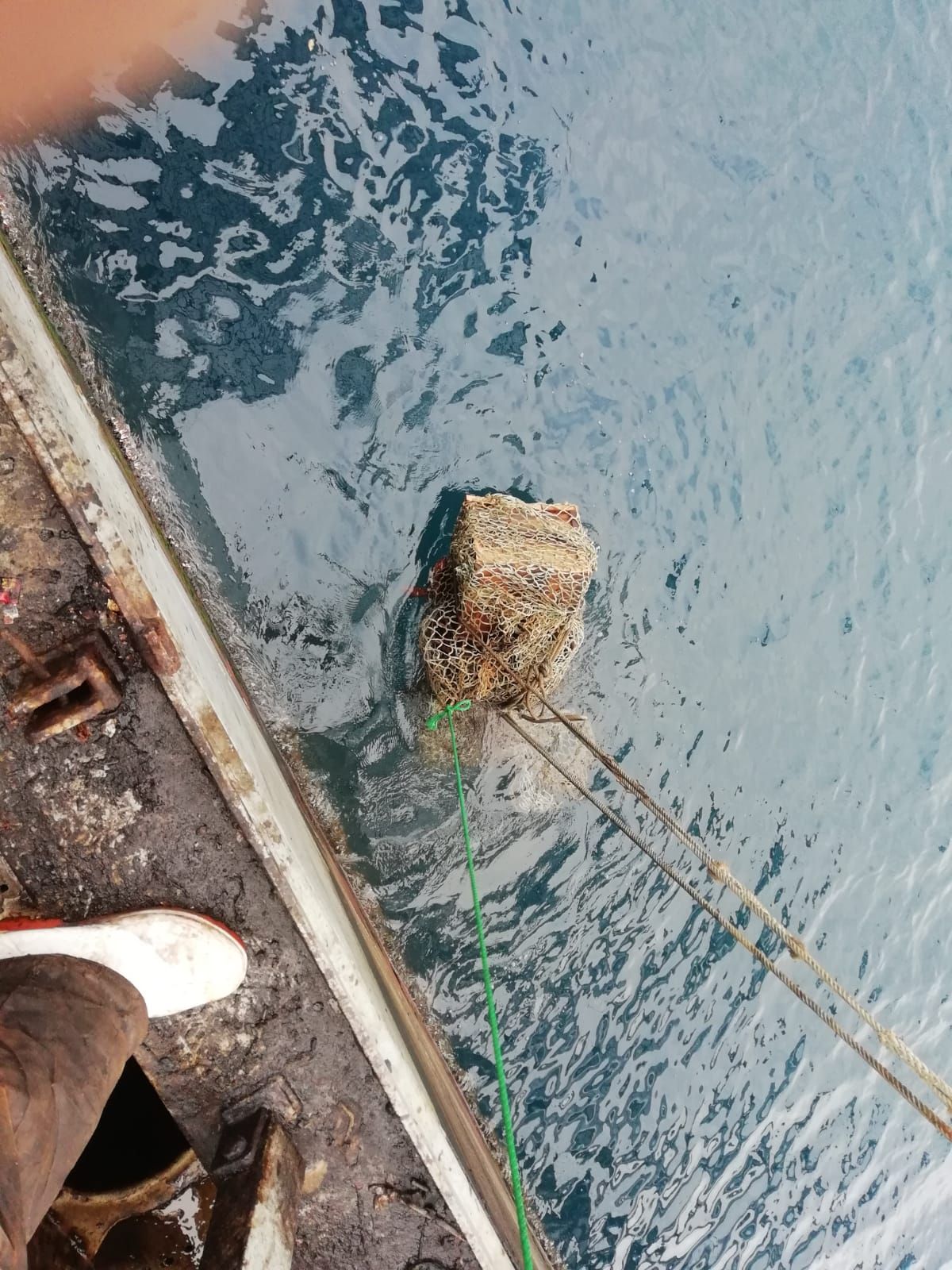
In June 2023, the same reporters were contacted by Uruguayan authorities seeking help after a local woman stumbled across a message in a bottle, washed ashore, apparently thrown from a Chinese squidder. “I am a crew member of the ship Lu Qing Yuan Yu 765 and I was locked up by the company,” the message said. “When you see this paper, please help me call the police! Help, help.” (When contacted for comment, the ship’s owner Qingdao Songhai Fishery said “it was completely fabricated by individual crew members” and that Uruguayan police had looked into the matter.)
For most of the past decade, one dead body has been dropped off every other month on average in the port of Montevideo, Uruguay, mostly from Chinese squid ships. Some of the workers on these ships have died from beriberi, an easily avoidable and reversible form of malnutrition caused by a B1 vitamin deficiency that experts say is a warning sign of criminal neglect, typically caused on ships by eating too much white rice or instant noodles, which lack the vitamin. At least 24 workers on 14 Chinese fishing ships suffered symptoms associated with beriberi between 2013 and 2021, according to a recent investigation by the Outlaw Ocean Project. Of those, at least 15 died. The investigation also documented dozens of cases of forced labor, wage theft, violence, the confiscation of passports and deprivation of medical care.
An Indonesian worker named Fadhil, who worked on the Chinese ship, Wei Yu 18, died from preventable disease beriberi in September 2019 and his body was eventually dumped at sea.Wei Yu 18 crew member / The Outlaw Ocean Project
Many of these crimes have taken place on the high seas, beyond any country’s territorial jurisdiction. But increasingly, Chinese-owned vessels are fishing in the local waters of nations where policing is little better because governments lack the finances, the coast-guard vessels, or the political will to board and spot-check the ships.
TO HELP CREATE JOBS, MAKE MONEY AND FEED its growing middle class, the Chinese government heavily supports its fishing industry with billions of dollars in subsidies for things like fuel discounts, ship building, or engine purchases. The Chinese fishing companies flagging into poorer countries’ waters are also eligible for these subsidies. “The reason why the Chinese subsidize these fleets could be not only for the fish,” said Fernando Rivera, chairman of the Argentine Fishing Industry Chamber. “It has a very important geopolitical aspect.”
As U.S. and European fishing fleets and navies have shrunk, so too has Western development funding and market investment in Latin America, Africa, and the Pacific. This has created a void that China is filling as part of its Belt and Road Initiative, Beijing’s global development program. Between 2000 and 2020, China’s trade with Latin America and the Caribbean grew from $12 billion to $315 billion, according to the World Economic Forum. China Development Bank and the Export-Import Bank of China, two major state-owned Chinese banks, provided $137 billion in loans to Latin American governments between 2005 and 2020. In exchange, China has at times received exclusive access to a wide range of resources, from oil fields to lithium mines. Chinese-owned vessels flagging in through the setup of joint ventures can serve as a source of self-enrichment for politically connected leaders in poorer countries who have a personal stake in the fisheries industry. On the other hand, if this foreign investment is responsibly managed, it can be a legitimate source of income for local economies.
The maritime domain is an important front in China’s growth plans, which includes exerting power not just over the high seas and contested waters like those in the South China Sea but also consolidating control over shipping, fishing in foreign coastal waters, and ports abroad. Chinese companies now operate dozens of overseas processing plants and cold-storage facilities, and terminals in more than 90 foreign fishing or shipping ports, according to research by Kardon.
Though most of these business ventures go unnoticed, some of them have sparked controversy. Starting in 2007, China extended more than a billion dollars worth of loans to Sri Lanka as part of a plan for a Chinese state-owned company to build a port and an airport. The deal was made based on the promise that the project would generate more than enough revenue for Sri Lanka to pay back these loans. By 2017, however, the port and airport had not recuperated the debt, and Sri Lanka had no way to pay back the loan. China struck a new deal extending credit further. The deal gave China majority control over the port and the surrounding area for 99 years.
In 2018, a Chinese company purchased a seventy-acre plot of land in Montevideo, Uruguay, to build a “megaport” consisting of two half-mile-long docks, a tax-exempt “free-trade zone,” a new ice factory, a ship-repair warehouse, a fuel depot, and dorms for staff. The plan was eventually canceled after local protests, but the Uruguayan government later announced that it would build the port itself, with foreign investment, and China’s ambassador, Wang Gang, expressed interest in managing the project.
More recently, in May 2021, Sierra Leone signed an agreement with China to build a new fishing harbor and fishmeal processing factory on a beach near a national park. In response, local organizations pushed for more transparency around the deal, which they said would harm the area’s biodiversity, according to a 2023 report by The Stimson Center.
IN ARGENTINA, CHINA HAS PROVIDED BILLIONS OF DOLLARS in currency swaps, providing a crucial lifeline amid skyrocketing domestic inflation and growing hesitancy from other international investment or lending organizations. China has also made or promised billion-dollar investments in Argentina’s railway system, hydroelectric dams, lithium mines, and solar and wind power plants.
For Beijing, this money has created a variety of business opportunities. But it has also bought the type of political influence that became crucially important for the crew of the Lu Yan Yuan Yu 10, which Argentine authorities sank in 2016 for illegal fishing. All 29 of the men on the Chinese jigger were rescued from the water that day. Most of the men were scooped up by another Chinese fishing ship, Zhong Yuan Yu 11, which was also owned by CNFC and had its own history of illegal fishing in Argentine waters. These men were immediately taken directly back to China. Four of the crew, however, including the captain, were rescued by the Argentine Coast Guard, brought to shore, and charged with a range of crimes including violating fishing laws, resisting arrest, and endangering a coast guard vessel, and put under house arrest.
Roberto Wyn Hughes, a lawyer who frequently defends Chinese fishing companies, said that in those years, Argentine authorities typically did not prosecute the companies involved. Instead, they normally allowed the Chinese companies to pay a fine, after which their crew would be released. The sinking of the Lu Yan Yuan Yu 10 was different, however, because it sparked a media storm in Argentina and could not be handled as discreetly. Local news outlets described the ramming by the Chinese and showed footage of the sinking.
The Prefecto Derbes, an Argentine Coast Guard vessel, shot at and sank the Lu Yan Yuan Yu 10 in March 2016 when it attempted to evade arrest for illegal fishing.
Argentine Coast Guard
Hugo Sastre, the judge handling the case, initially justified the charges filed. The Chinese officers had placed “both the life and property of the Chinese vessel itself and the personnel and ship of the Argentine Prefecture at risk,” he said. But China’s foreign ministry soon pushed back. On March 16, a spokesman told reporters that he had “serious concerns” about the sinking and that his government had been engaged on behalf of the crew.
Two days later, the posture from the Argentine government began to shift. Susana Malcorra, Argentina’s foreign minister, told reporters that the charges had “provoked a reaction of great concern from the Chinese government.” She explained that she had reassured China that Argentina would follow local and international laws. “We hope it will not impact bilateral relations,” she told reporters. Several weeks later, the Argentine judiciary also fell in line. “Given the doubt that weighs on the facts and criminal responsibility” of the captain, he and the three other sailors would be released without penalty, the court announced. On April 7, the four Chinese crew members were flown back to China.
By May, Argentina’s foreign minister was on a plane to Beijing to meet with the Chinese foreign minister, Wang Yi. After their meeting, China’s foreign minister hailed their countries’ “voyage of overall cooperation” and promised another surge of Chinese investment to Argentina. Wang added: “China will continue its support to the efforts made by Argentina in safeguarding its national sovereignty and territorial integrity.”
CHINESE POLITICAL INFLUENCE shows up on board the fishing vessels as well. In the Spring of 2021, an Argentinian crew member named Manuel Quiquinte, on a squid jigger called the Xin Shi Ji 89, contracted Covid while at sea. Owned by the Chinese, the ship was flagged to Argentina and jigging in Argentinian waters. Its crew was a mix of Argentinian and Chinese workers. Several days after Quiquinte fell ill, the Argentine captain called the Chinese owners to ask if the ship could go to shore in Argentina to get medical care. Company officials said no and to keep fishing. Quiquinte died on the ship shortly thereafter, in May.
In court papers tied to Quiquinte’s death, several of the ship’s Argentinian crew members explained that despite Argentine law forbidding non-Argentinians from being the captains or senior officers on these fishing ships, the reality is that the Chinese crew on board make the decisions. Even when they are designated on paper as lowly deckhands, the Chinese decide whether the ship will enter port to drop off a sick worker, like Quiquinte. The Argentinians might be designated as the engineers on board but they are not supposed to touch the machines when the vessel leaves port. “The only thing we do is to assume responsibility for any accident,” Fernando Daniel Marquez, the engineer on the Xin Shi Ji 89, said in the court documents.
When contacted by reporters about the death, the vessel’s parent company Zhejiang Ocean Family said that the crew member had tested negative for COVID-19 prior to working on board but had indeed contracted the illness on the vessel and died after his condition deteriorated rapidly. Ocean Family said the vessel belonged to a local Argentine company which Ocean Family has invested in, and it was this local company which handled the situation.
On land and at sea, the Chinese use a variety of approaches to gain access to foreign waters and circumvent rules meant to protect local interests. In some countries, they sell or lease their ships to locals but retain control over decisions and profits. In other places where the governments forbid foreigners from fishing their waters, Chinese companies pay fees through “access agreements.” Elsewhere, China has gone around the prohibitions on foreign shipowners by partnering with local residents and giving them a majority ownership stake.
Typically about a quarter of the workers on fishing ships owned by the Chinese operating in Argentinian waters are Chinese nationals, according to a review of about a dozen crew manifests published by local media. Jorge Frias, the secretary general of the Argentine fishing captains’ union, explained that on Argentine-flagged ships, the Chinese call the shots. The captains are Argentinians, but “fishing masters,” who are Chinese, decide where to go and when.
THE SCOURGE OF ILLEGAL AND OVERFISHING did not originate with China, of course. Western industrial fleets dominated the world’s oceans for much of the 20th century, fishing unsustainably in ways that have helped cause the current crisis, explained Daniel Pauly, a marine biologist at the University of British Columbia.
China’s expansionist methods are also not historically unique. The U.S. has a long and infamous record of intervening abroad when foreign leaders begin erecting highly protectionist laws. In the past several decades, the tactic of “flagging in” has been used by American and Icelandic fishing companies. More recently, as China has increased its control over global fishing, the U.S. and European nations have jumped at the opportunity to focus international attention on China’s misdeeds.
Still, China has a well-documented reputation for violating international fishing laws and standards, bullying other ships, intruding on the maritime territory of other countries and abusing its fishing workers. In 2021, the Global Initiative Against Transnational Organized Crime, a nonprofit research group, ranked China as the world’s biggest purveyor of illegal fishing. But even frequent culprits can also be easy scapegoats: a country that regularly flouts norms and breaks the law can also at times be a victim of misinformation. When criticized in the media, China typically pushes back, not without reason, by dismissing their criticism as politically motivated and by accusing its detractors of hypocrisy.
China’s sheer size, ubiquity and poor track record on labor and marine conservation is raising concerns. In Ghana, for instance, industrial trawlers, most of which are owned by China, catch over 100,000 metric tons of fish each year, according to the Environmental Justice Foundation in 2017, and the country’s fishing stocks are now in crisis, as local fishermen’s incomes have dropped by up to 40 percent over the past two decades. “Fishing vessel owners and operators exploit African flags to escape effective oversight and to fish unsustainably and illegally both in sovereign African waters,” wrote TMT, the nonprofit that tracks maritime crime, adding that the companies were creating “a situation where they can harness the resources of a State without any meaningful restrictions or management oversight.” In the Pacific, an inspection in 2024 by local police and the U.S. Coast Guard found that six Chinese flagged-in ships fishing in the waters of Vanuatu had violated regulations requiring them to record the amount of fish they catch.
And in South America, the increasingly foreign presence in territorial waters is stoking nationalist worry in places like Peru and Argentina. “China is becoming the only player, by displacing local companies or purchasing them,” said Alfonso Miranda Eyzaguirre, a former Peruvian minister of production. Pablo Isasa, a captain of an Argentinian hake trawler, added: “We have the enemy inside and out"


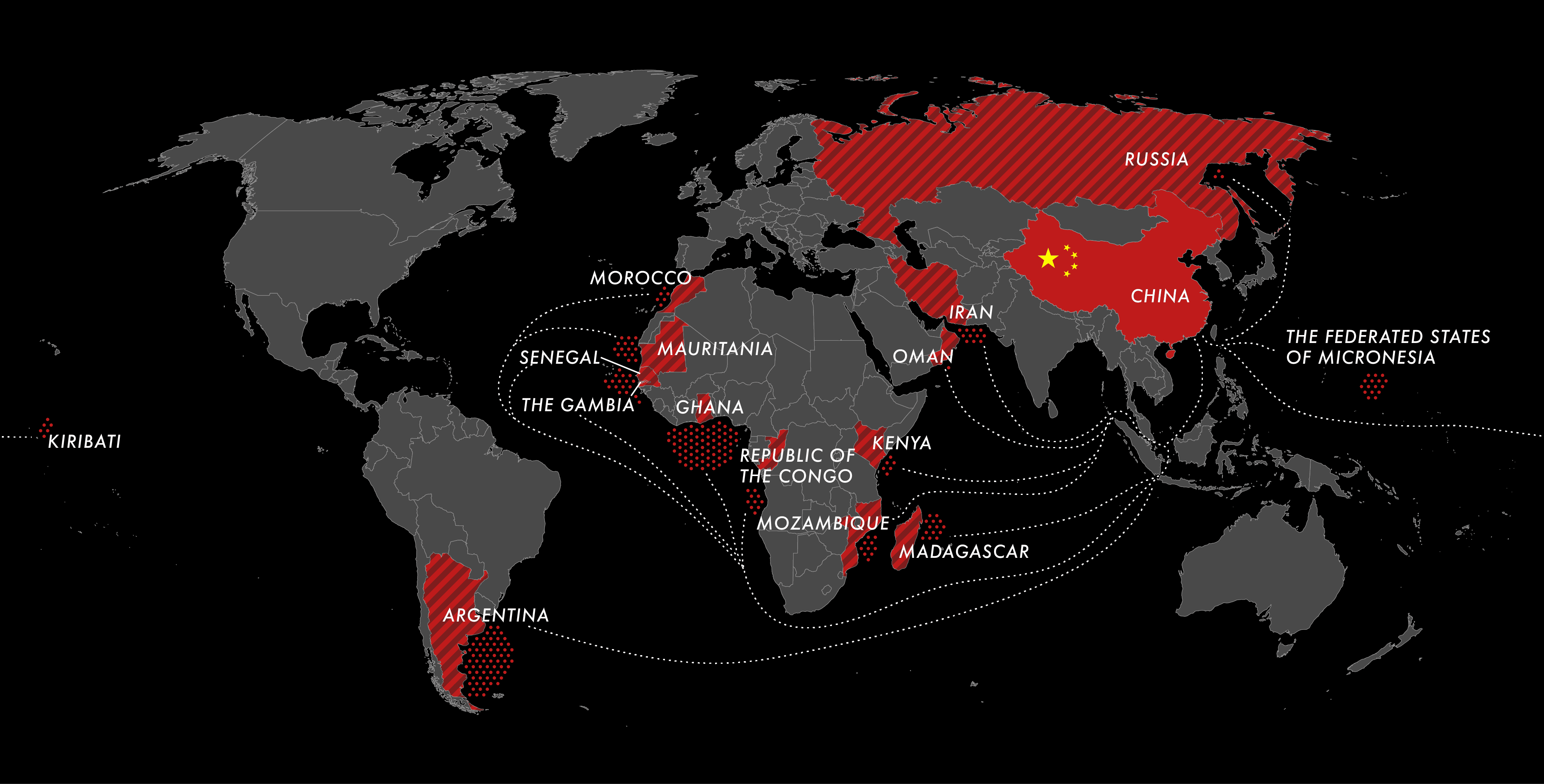 From South America to the Middle East and the far Pacific, China has flagged in its own fishing vessels into foreign waters, granting itself access to poorer global south countries’ fish stocks.