A group of white yachts — sails down, masts tall — float off the Greek island of Corfu, waiting to dock at the Gouvia marina in the late afternoon sun.
It is the first Friday in September and the weather is perfect for sailing — hot, with an occasional breeze.
The marina at Gouvia is one of about 400 premium marinas located in the Mediterranean, the global capital of the yachting industry, with around a thousand in total in the region.
It is in the same league as the likes of Port Hercule, host of September’s Monaco Yacht Show, and Porto Montenegro.
Yet while the number of yachts is flourishing, the number of marinas is not.
Port Hercule, Monaco with the GeoGarage platform (SHOM raster chart) Thanks to regulatory barriers, environmental restrictions and a limited supply of suitable locations, it remains difficult to build a port.
This mismatch is turning an overlooked sector into big business.
Earlier this year D-Marin was sold by its private equity owners, CVC, to the French investment group InfraVia for more than €1bn.
The sale auction drew interest from numerous companies, the latest deal to underscore the attraction of the business model.
Industry executives expect further acquisitions.
Marina mania is more than a business play, although it is certainly that.
The market is fragmented, with few large-scale players, and demand has grown from clients around the world.
But what gives the phenomenon its real spice is that it forces the super-wealthy into competition with each other for a defiantly limited, slowly expanding stock of berths.
They may have all the money in the world, but that does not mean they can dock where they please.
Josephine De Luca, who runs an independent consultancy representing boat owners, says that she never had trouble finding a berth at Port Vauban in Antibes for her clients before the pandemic ignited the yacht boom.
“It’s actually about scarcity now, for me that’s really key,” De Luca says.
“Berthing — it’s not just more expensive but because the yachts are bigger and there’s a finite amount of berths, the bigger change is being able to get the berth you want.”
Boating consultant Josephine De Luca says some berthing fees have doubled in 10 years
Difficulty finding ideal yacht mooring risks frustrating owners who are used to having their way.
“The egos are only getting bigger,” she says.
“Unfortunately there are some people in this industry that have come into a lot of money really quickly and perhaps they don’t quite get the nuances of decorum required.”
As the ranks of the ultra-rich have grown in the past decade, swollen by buoyant stock markets, their minds have turned to what they can spend that wealth on.
It never takes long to hit on a yacht.
The total number of yachts longer than 12 metres, which are too big to easily store on land, was set to reach about 210,000 last year, according to data compiled by consultancy McKinsey, rising by about 8,000 per year.
That compared with just 160,000 marina berths for such vessels.
The surge is even more pronounced at the top end of the market.
The global fleet of superyachts — longer than 30 metres — grew around 40 per cent to reach 6,239 in the decade to 2025, according to industry publication SuperYacht Times.
Oceanco and Feadship in the Netherlands and Benetti in Italy are among the top shipyards that have fulfilled orders for the likes of Amazon founder Jeff Bezos in recent years.
The pandemic helped — a cohort of consumers looked to the water for fresh air during government lockdowns — as has the rise of satellite internet.
It is now possible to work from anywhere including the most remote sailing locations, a trend branded “yacht-desking”.
“We’ve definitely seen a lot more younger people buying boats, and especially very big boats,” says Merijn de Waard, founder of SuperYacht Times.
“A lot of people realise now they can work remotely with Starlink, there’s very good internet.
And there’s just enormous wealth being created.”
Of about 6,000 global coastal marinas, 65 per cent are in the US, according to McKinsey.
The remainder are scattered elsewhere in Europe and in the Caribbean, with a nascent industry in Asia and the Middle East.
Meanwhile, about 6,500 yachts are delivered each year and a new marina typically takes between five and 10 years to build, adding on average only about 300 berths, McKinsey said.
“The fact that demand is outstripping supply is unquestionable,” says John Nery, managing partner at Squircle Capital, which owns the superyacht repair group MB92.
“Waterfront land is scarce and, wherever you are, [getting permits] is difficult.
You’ve got high barriers to entry.”
For example, at one marina near Seattle, more than 200 vessels are on the wait-list for berths stretching beyond 20 metres.
Two decades ago, De Luca got her start as a chartered accountant before she found her way to the yachting world, eventually leaving KPMG to work for Lukas Lundin, a Swedish-Canadian mining magnate who had owned the 80-metre superyacht Savannah.
Her first position was as the ship’s purser, an onboard administrative role, before becoming an executive officer — essentially the owner’s representative.
“I absolutely loved it.
You have to be a special type of person to enjoy living out of a suitcase, but it was a home,” she says.
The Savannah was the world’s first hybrid-engine superyacht when it launched in 2015, and includes an onboard pool, gym and elevator.
Its weekly charter fee was about €1.2mn, De Luca says.
During her time working with the yacht — she left in 2025 — the price of docking it had surged to about €3,500 per night during the peak summer months at top locations, De Luca estimates.
“It approximately doubled in the 10 years, specifically in the premier locations,” she says.
“That is scarcity pricing. You’re a yacht owner, you own a new 80-metre yacht, you want it sitting in the south of France.”
Bob Hoogendoorn, who led McKinsey’s yacht practice before this year becoming a founding partner of the marina group Balmaris, compared finding a good berth to getting seats at a top sports event.
“It’s almost a bit like Wimbledon, and then there isn’t even a shortcut,” he says.
“When you own a yacht, the last thing you want to compromise on is your boating spot.”
Bob Hoogendoorn, former head of McKinsey’s yacht practice and co-owner of marina group Balmaris
Where, when and how you berth is affected by the boat’s size.
A regular yacht — up to about 50 metres in length — is unable to cross the Atlantic or other oceans.
Such boats might pay for berths on an annual or even multiyear basis while roaming around their local region.
The largest superyachts can travel the world, by contrast.
A typical one might spend the summer in the Mediterranean, then head across the ocean to winter on a Caribbean tour.
In between, there can be a few weeks at a port for repairs and to give the crew a break.
They do not often dock — the point of owning a yacht is to be out on the water — so there is a premium on location and access to amenities, both for guests and crew, when they do.
At a marina, superyachts will often have their own quay, with restricted access.
At Port Vauban, its 1,500-berth marina has 18 for superyachts over 54 metres on their own quay, with tighter security including drone surveillance.
Customers can arrive by helipad and spend time in the new yacht club, while there is a dedicated crew centre for staff including a gym.
The crew — dozens on the largest yachts — are important in determining where yachts dock.
“You want the crew to have access to gyms, culture, sport etc,” says Tim Clarke, who runs the yacht staffing agency Quay Group.
“You don’t want to be in a location where the nightlife is too good because that can cause problems as well.”
For instance, docking in Ibiza raises the chance the crew will get into trouble at nightclubs or become victims of crime, as has happened in Barcelona.
Such stopovers must be planned at least three to four months in advance, says former superyacht captain Chris Durham, who piloted the Savannah for several years.
Even that may not be enough lead time.
“If it’s a really special trip like the Monaco Grand Prix or Cannes Film Festival, you’d need to think much more in advance,” he says.
“Relationships still are really important and the way in which you conduct yourself, the crew conduct themselves, and the way in which you operate still goes a long way . . . It’s a small industry.”
It might be a small industry, but it is a desirable one for investors.
“There are two factors that make the industry so attractive.
The first one is fundamental growth in demand for yachts, full stop.
And berthing space is characteristically limited,” says Squircle Capital’s Nery.
“You put all this together and it’s turning marinas into an infrastructure asset class; people didn’t think of it that way 10 or 20 years ago.”
Indeed, marinas appear to have all the traits of a strong business model suited to private capital investors — rising demand, constricted supply, recurring revenues, fragmentation ripe for consolidation.
The industry is a $15bn market that will grow about 8 per cent annually to 2030, said McKinsey.
A marina investor notes: “If an asset can continuously increase its prices and keep its occupancy high, that usually suggests that it is a defensive asset, so we thought the marina sector demonstrated those.”
In a major deal that underscored this investment desirability, Blackstone paid $5.7bn last year for Safe Harbor Marinas, the largest marina and superyacht servicing business in the US.
Then, this August, Blackstone’s Safe Harbor agreed to acquire MarineMax for $1.5bn, paying nearly a 100 per cent premium for the company’s share price before the disclosure of takeover interest in the group.
The big money comes with plans for expansion, through both further acquisitions of independent, often family-owned, marinas and investment in areas such as technology.
D-Marin’s story is a good illustration of the boom.
It was founded in 2003 by a Turkish conglomerate, with its first location on the Bodrum peninsula, and over the past five or six years has expanded to become one of the leading marina operators in the Mediterranean, with its nearly two dozen premium ports.
Chief commercial officer Matthias Gehring touts the ability to book berths online — a contrast to the analogue operations at most marinas — and other innovations such as remote monitoring of vessels’ heat, water intrusion and battery voltage, and augmented reality directions for how to navigate to a specific berth.
D-Marin’s model “enables us to build a platform and scale”, says COO Andrea De Santis.
D-Marin, owner of Gouvia marina in Corfu, was sold this year for more than €1bn
© Getty Images
 (Credit: Sir Francis Canker Photography)

 Seamounts are vital oases in the open sea.

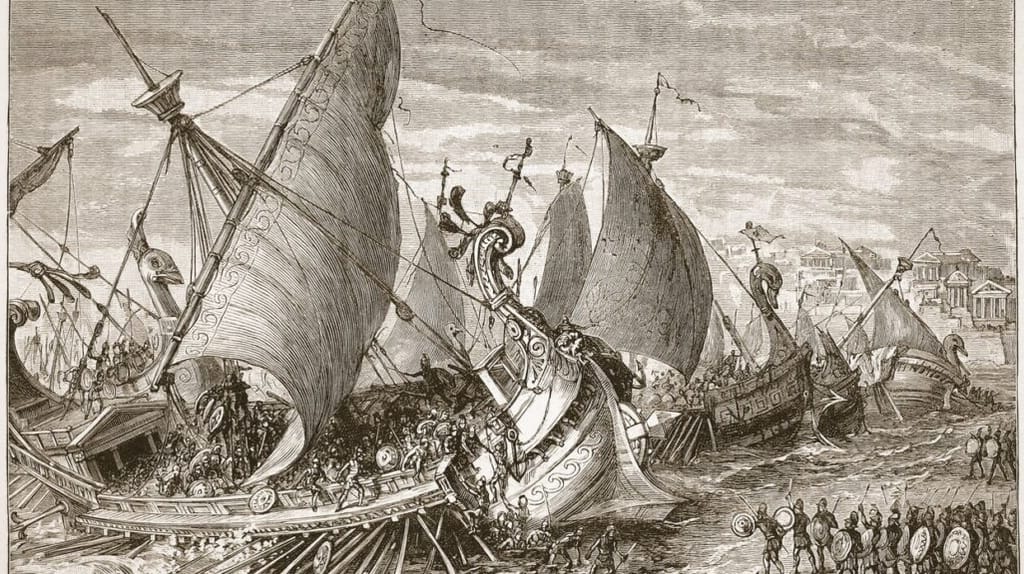 Naval battle at the harbor of Syracuse, illustration circa 1890 (artist unknown / public domain)
 . Mid Mediterranean map
 Where it started: the Western Indian Ocean Maritime Emergency Contact Map, Edition 1, July 2025.


 Example: Tunis MRCC, with its contact details
 Example of the operations layer: Frontex Themis drawn on the map, with its contact at the top of the screen.