Saturday, September 19, 2020

Image of the week : 5 tropical cyclones over the Atlantic basin

We are issuing advisories on five tropical cyclones over the Atlantic basin.This ties the record for the most number of tropical cyclones in that basin at one time, last set in Sept 1971.


See http://hurricanes.gov for the latest updates. #Paulette #Rene #Sally #Teddy #Vicky
https://www.nhc.noaa.gov/

Links :

Friday, September 18, 2020

Worst shipping crisis in decades puts lives and trade at risk


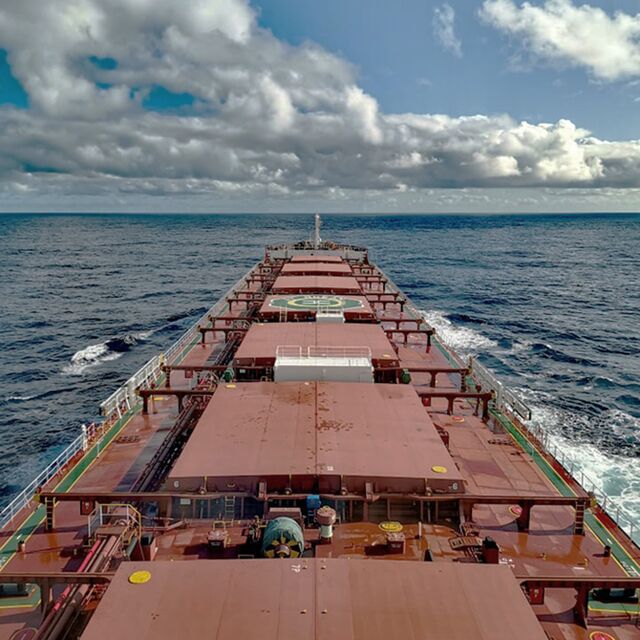
By August, almost half of the 20-person crew on-board the JY Ocean bulk carrier had been at sea for more than a year.
Source: Handout
 
From Bloomberg by K. Oanh Ha, Jack Wittels, Khine Lin Kyaw and Krystal Chia 
 
Note: Data as of Sept.17, 2020
Source: Wilhelmsen Ships Service AS

 
With 300,000 workers stranded on merchant ships, Bloomberg found dozens of labor violations that threaten seafarers’ safety, as well as the global supply chain.

On July 25, the Unison Jasper pulled into the Australian port of Newcastle carrying 31,000 tons of alumina bound for one of the country’s largest smelters.
The ship had traveled around the world in the seven months since the pandemic began, but in Australia, authorities found a problem serious enough to detain the vessel.

Seven of the 22-person crew had been on the ship for 14 months, beyond the end-date of their contracts and in breach of international maritime law, regulators and union officials said.
They were owed $64,000 in back pay, and there wasn’t enough fresh food.
There was also no valid plan to get them home to their families in Myanmar.
They wanted off.

“I’ve been on the sea for 14 months,” one of the sailors said in a video interview with an organizer for the International Transport Workers’ Federation, a union that represents seafarers.
“We are actually very tired. I want to go home.”

Ratified by more than 80 countries, the Maritime Labour Convention isn’t mere guidance—the agreement sets minimum working conditions for seafarers that underpin the insurance policies and global contracts that govern the transport of basically everything.
But the ongoing pandemic has shattered the norms of this highly fragmented industry, and with countries wary of relaxing port and border restrictions, violations of worker protections have become common.
Nearly 20% of the world’s 1.6 million seafarers are stranded at sea and, like those on the Unison Jasper, at the mercy of employers and shifting quarantine requirements to get them home.

In conversations with Bloomberg reporters, more than 40 seafarers on nearly as many ships described deteriorating conditions.
Most asked for anonymity given the fragility of their situations.
About half didn’t have current contracts and some said they hadn’t been paid in more than two months, meeting International Labour Organization's definition of forced labor.
Overtime pay, they said, was inconsistent, if their extra hours were logged at all.
Most haven’t left their ships in months after coronavirus outbreaks tied to cruise liners and merchant ships put an end to shore leave.
Seafarers with abscessed teeth haven’t been able to get dental care, and others say they’ve received stitches from crewmates in lieu of off-shore medical attention.
On one ship, the captain died of a heart attack, and the crew stored his corpse in the freezer for nearly two weeks before it found a port that would repatriate the body.

The past-due contracts and unpaid overtime are especially troubling, said Brandt Wagner, head of the transport and maritime sectoral policies unit at the ILO, which administers the Law of the Sea.
“These are violations of the Maritime Labour Convention,” he said.
“We should make sure that the Covid-19 pandemic isn’t used as an excuse to breach the law … Seafarers’ rights have to be upheld, even if it’s cumbersome or difficult.”


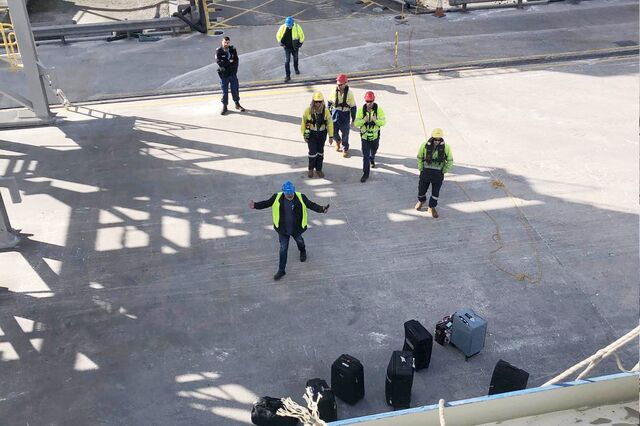
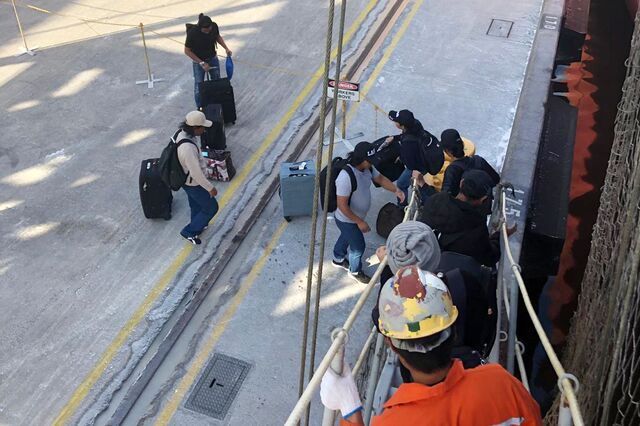
Burmese seafarers disembark from the Unison Jasper at the Port of Newcastle, Australia.
Seven of the ship's 22 crew sought the help of International Transport Workers’ Federation and have been repatriated.
Source: International Transport Workers’ Federation


The industry says the options are limited.
Changing immigration rules and limited air travel have made swapping workers more difficult and more expensive, said Esben Poulsson, chair of the International Chamber of Shipping, the industry’s principal trade group.
“The efforts that are being made by companies to take care of the seafarers and effect properly timed crew changes have been and continue to be tremendous,” he said.

“I haven’t seen any situations where you can’t get a crew home.
It just requires more time, more money and more effort.”

Many companies have rerouted ships and chartered flights to facilitate crew changes, and still some 300,000 seafarers are overdue for relief—a number that grows as the pandemic drags on.
The crisis has begun to reach shipping investors including global asset manager Fidelity International Ltd., American insurance giant Massachusetts Mutual Life Insurance Co., asset manager Oaktree Capital Group LLC and finance titan JPMorgan Chase & Co.
If it isn’t resolved soon, analysts say, it threatens to ripple up the supply chain, affecting commodities companies like Cargill Inc. and Glencore Plc. and retailers like Dick’s Sporting Goods Inc., just in time for the holiday shopping season.

“This is the most dire situation with vessels and crew that I’ve seen in many decades,” said Andrew Kinsey, a New York-based senior marine risk consultant at Allianz Global Corporate & Specialty.
At best, he says, expect more detentions and delays.
At worst, there will be disastrous mistakes—Allianz estimates that human error contributes to at least three-quarters of shipping industry accidents—and fatalities.

“The people who own the assets and make money off the assets need to come together to come up with a solution,” Kinsey said.
“They have to use their assets to get the crew off.
Each party needs to assume responsibility instead of passing it to the next party.”

The seafarers interviewed by Bloomberg represented more than a dozen nationalities, working on vessels that regularly cross the Pacific and Atlantic oceans, on global shipping lines like CMA CGM SA, Evergreen Line and other publicly traded companies.
The shipping industry typically recruits from poor countries where wages are low and complaining is discouraged.
Shipping lines and staffing agencies determine when and how workers will get home, down to holding their passports, and seafarers who spoke to Bloomberg asked to be anonymous because they feared speaking out would hurt future job prospects.

Shipping companies and regulators benefit from a complicated and fragmented system that rewards on-time shipments over the welfare of nearly invisible workers.
It’s hard to drum up public outrage, said Teresa Lloyd, chief executive officer of trade group Maritime Industry Australia Ltd.
“The consumer doesn’t know,” she said.
“It’s not like when a sweatshop in Bangladesh catches fire—that’s horrific, and we should all be appalled—we don’t have the same visibility of what’s happening to seafarers.”

Closed Due to Covid


More than 120 countries and territories have stopped or limited access to ships for seafarer crew changes to prevent the spread of coronavirus

Last month, French shipping behemoth CMA CGM sent one of its ships from Marseille to Beirut on a humanitarian mission to deliver medical supplies and goods to Lebanon after the deadly port explosion there.
From another ship in the CGM fleet, the APL Pusan, the crew looked on with confusion.
Some of them had been on board for more than 13 months, including a seafarer who was brought back to the ship after a hospital stay on shore for kidney stones.

The ship has even stopped several times in Singapore, a port that helps facilitate crew changes, and no one was swapped out, two seafarers on the ship said.
Their original employment contracts expired months ago.
If the company can undertake a humanitarian mission, they wondered, why couldn’t it let them go home?

“Many companies in the world are making crew changes.
But our CMA CGM, such a big company, can’t do a relief flight,” said one seafarer.
“We are forgotten lives in the sea.”

The company said in a statement that it is doing all it can for the workers aboard its ships and that the number of over-run contracts has been decreasing over the past three months.
In addition, the company said all its seafarers are working under labor contracts that meet legal rules.

“The situation remains very constrained and constantly challenged by regular changes in country rules with respect to the Covid situation,” the company said.
“Our teams are fully mobilized and we will not spare any efforts to facilitate seafarers’ transit and return home in accordance with the authorities, local rules and personal requests.”
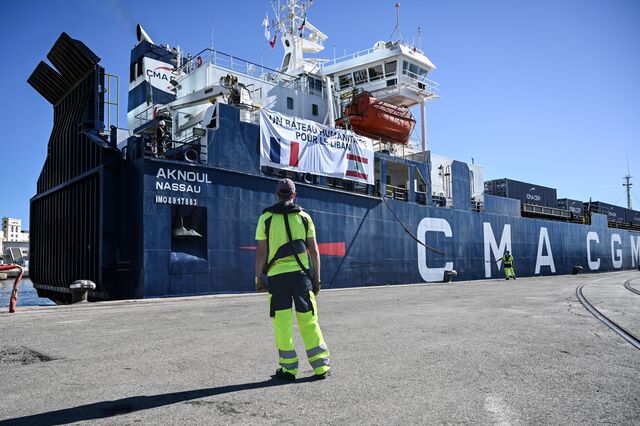

Bound for Lebanon, the CMA CGM container ship is loaded with humanitarian aid in Marseille, France, on Aug. 25.
Photographer: Christophe Simon/AFP via Getty Images


Since the very beginning, shipping companies and the moneymen behind them have held seafarers’ lives in the balance.
By one historian’s estimate, 10 sailors died for every 47 tons of Asian cargo shipped to Europe by the Dutch East India Company from 1580 to 1795, and it was common for Spanish galleons to start their journeys with surplus crew, knowing they’d lose some to starvation, disease or desertion.

Modernity has made shipping safer, but seafarers are still at the mercy of an industry that is opaque, deeply fragmented and bound by a patchwork of national and maritime laws.
Every ship is connected with a handful of separate entities.
Typically, there’s the ship’s owner, its operator, a staffing agency which recruits seafarers, and the charterer—the company that hires the boat to get its goods from point A to point B.

There are a few dominant players in the shipping industry, but much of the trade is made up of middle men upon middle men, connecting companies that have goods to ship with a vast network of owners, operators, staffing agencies and so on.
Those layers make it hard to hold anyone accountable for on-board working conditions, says Richard Meade, managing editor of U.K.
shipping researcher firm Lloyd’s List, or to solve problems when they arise.

At the furthest remove, investors and money managers have built lucrative portfolios out of shipping assets they almost never have to touch.
MassMutual owns ships, as does hedge fund Apollo Global Management Inc.; Oaktree Capital owns almost 41% of Star Bulk Carriers Corp.
and has three seats on the board.
The financing divisions of Citigroup, DNB ASA and JPMorgan Chase have made them among the industry’s most influential backers, according to Lloyd’s List.

But as in the subprime lending crisis, the financial titans have some distance from their underlying assets.
JPMorgan Asset Management, for example, barely blinked when, in 2019, one of its ships was seized by U.S.
customs after more than $1 billion in cocaine was found on board.
The firm declined to comment on the incident.

The Unison Jasper illustrates how thinly responsibility can be spread.
The ship is registered under the flag of Hong Kong, so the authorities there are responsible for the vessel’s seaworthiness and labor conditions on board.
Then there are at least four companies in three jurisdictions with at least a sliver of oversight:
  • Registered owner: Emerald Shipping (Hong Kong) declined to comment for this story.
  • Beneficial owner and operator: Unison Marine Corp.(Taiwan) didn't respond to emails and phone calls seeking comment.
  • Charterer: Lauritzen Bulkers A/S (Denmark) said it had continuously urged the owner to resolve the situation. “We find the situation entirely unacceptable and do not want to be associated with this kind of behavior,” CEO Niels Josefsen said in an email.
  • Sub-charterer: Pacific Basin Shipping Ltd. (Hong Kong) paid to transport the alumina. Said it knew nothing about the working conditions on board and wasn’t responsible.

Raft of Responsibility


The shipping industry is highly fragmented, rendering seafarers nearly invisible

Note: Diagram illustrates a typical staffing process in the shipping industry.

Source: Bloomberg reporting

In most ports, employers—usually the operator or the owner—are legally responsible for seafarers’ safety, health and welfare.
“But everyone along the supply chain has a responsibility,” said the ITF’s National Coordinator in Australia, Dean Summers.
“Traditionally industry stands in a circle and points to the bloke to the left and no one takes the blame.

For the Burmese workers trying to get off the Unison Jasper, the primary point of contact was Dagon Lin Maritime Service Co., a recruiting firm in Yangon, Myanmar’s biggest city.
Shipping draws labor from the Philippines, India and other parts of Southeast Asia, relying on local companies like Dagon Lin to keep up the supply.

Dagon Lin managing director Nyunt Swe said everyone along the supply chain was paying the price for the pandemic.
He was arranging crew changes and flights home at great expense.
The workers who complained, he said, had hurt the reputation of the country’s seafarers as a whole.
If ship owners think Burmese workers are a risk, “they will stop offering jobs for Myanmar,” he said.
“This hurts our maritime industry and the economy as a whole.
There aren’t enough jobs for everyone here.”

To be fair, the shipping industry was faster than most to understand the magnitude of disruption heralded by the coronavirus pandemic.
Executives and trade groups have been lobbying governments and port authorities for months to award seafarers “key worker” status, with the same travel and immigration privileges often conferred on aircraft staff and medical workers.
In July, more than a dozen countries including critical global shipping hubs like the U.S., Singapore, Greece and the United Arab Emirates pledged to ease port and border restrictions and to help stranded crews return home.

And yet, as Covid-19 outbreaks flare up, even shippers with the best of intentions are having trouble.
In August, GasLog Ltd., a natural gas shipper based in Greece, appealed to the International Maritime Organization to help 31 crew members on the GasLog Savannah in Singapore.

“As you will appreciate, for reasons of safety, an oil tanker cannot be left unmanned.”

In a seven-page letter, GasLog Chief Operating Officer Paolo Enoizi wrote that they’d been trying since June to rotate the crew on a tanker at the Sembawang Shipyard for repairs.
The letter describes a Kafkaesque bureaucratic process of applications filed, lost, filed again, partially denied, only to have the rules and regulations change, requiring a whole new set of applications.
At one point, the letter says port authorities would allow the crew to leave, but no new seafarers could embark.

“As you will appreciate, for reasons of safety, an oil tanker cannot be left unmanned,” the GasLog COO wrote in his letter.
“Permission to release four crew members but not allow their reliefs to join does not improve the situation.”

Meantime, the crew hadn’t been allowed off the vessel, not even to walk around the shipyard, according to the letter.
After four months of de facto quarantine, there wasn’t a single case of Covid-19 on board.
“We are concerned that no adequate measures have been taken to preserve the human rights of our crew,” Enoizi wrote, citing international marine law.

The Maritime and Port Authority of Singapore said “a total of 16 sign-ons and 32 sign-offs were carried out between May and September on the GasLog Savannah and the ship departed Sept. 7.
“In spite of the ongoing Covid-19 pandemic, Singapore has been facilitating crew changes under a set of ‘safe corridor’ procedures,” the MPA said in a statement.
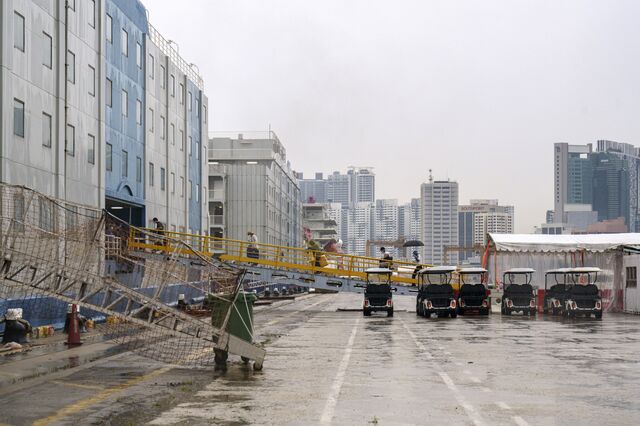
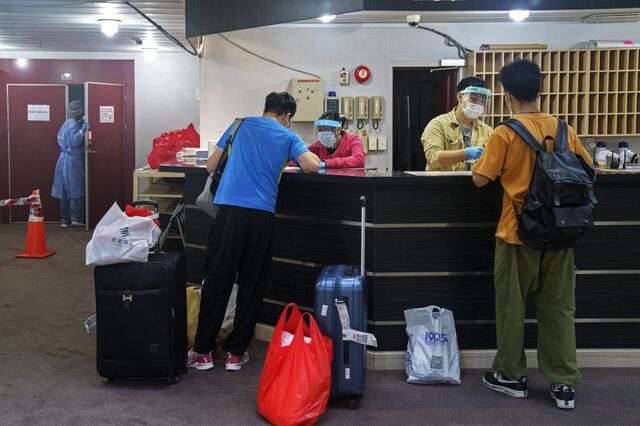
The Singapore port authority runs three floating dorms—accommodation vessels—for seafarers waiting to join their ships.
It's one of the countries still facilitating crew swaps during the pandemic.

PHOTOGRAPHER: ORE HUIYING/BLOOMBERG
 

Crew members check in ahead of their deployment on a bulk carrier.
Seafarers come from China, India, the Philippines and elsewhere to meet their ships.
PHOTOGRAPHER: ORE HUIYING/BLOOMBERG


The quarters give seafarers a place to stay for 48 hours if flight and ship schedules don't line up.
They also keep transient workers away from the local community.
PHOTOGRAPHER: ORE HUIYING/BLOOMBERG


Shipping has always been an attractive investment, first for wealthy land-lubbing speculators, then as a staple of investment banking, hedge funds and, in the last decade, private equity.
In this context, the labor crisis is a Covid-era anomaly.
“It is being addressed and the crews are being repatriated,” said Andy Dacy, head of the $2 billion global transport portfolio for JPMorgan Chase, adding that companies that act irresponsibly in this crisis will suffer in the long term.
“I haven't seen any situations where you can't get a crew home.
It just requires more time, more money and more effort.”

Others, though, are starting to wonder whether the on-board conditions could affect their investments.
“The shipping industry has never been seen as risky,” said Antony Crockett, who leads the Asia-Pacific business and human rights practice for international law firm Herbert Smith Freehills.
“Now those companies are going to get questions from their customers: ‘Tell us about the conditions on ships.
Tell us what you're doing to mitigate these impacts on the workforce?’”

Mariners say they’re concerned the long months at sea are leading to accidents.
On CMA CGM’s APL Pusan, a crew member gashed his head and required stitches.
On a ship carrying coal, a sailor suffered an eye accident with pressurized oil; he said he wasn’t allowed on shore to see a doctor for another two months.
Mentally, seafarers told Bloomberg, they’re suffering.

“We are like hostages,” said a crew member on the JY Ocean, a ship managed by Oceanbulk Maritime SA, a sister company to the Nasdaq-listed Star Bulk Carriers.
By August, almost half of the 20-person crew had been on-board for more than a year, sent contract extensions and, they said, instructed by the captain to sign them.
“It’s very hard to concentrate on your work when you want to be home,” the crew member said.

Oceanbulk Maritime was founded by Star Bulk’s chief executive officer and several executives hold titles at both companies; the two share an address in the Greek capital of Athens, according to public records.
Oceanbulk didn’t respond to a request for comment.
But Hamish Norton, who is president of Star Bulk and was Oceanbulk’s chief financial officer as recently as 2019 according to Securities and Exchange Commission filings, said in an email that the JY Ocean crew had been on board too long, “as have the crew on many of our other ships and thousands of ships all over the globe.
It is a worldwide humanitarian crisis.”

The ship, he went on, has called in ports where crew changes were prohibited or “grossly discouraged” by government quarantine requirements, advance notice or other procedural obstacles.
“Relieving our crews is the highest priority for our management,” said Norton.
“It is a safety issue, it is a mental health issue, it is a contractual issue and we wish we could fix it.”

Oaktree, which holds three seats on Star Bulk’s board, called the situation in shipping “very difficult and unfortunate,” according to a company spokesman.
“Oaktree is fully supportive of industry efforts to work with governments to address these challenges and get these crew off of their ships in a timely manner,” he said.

Taipei-based Evergreen Line, part of the massive Taiwanese conglomerate that includes EVA Airlines, commands one of the world’s biggest container fleets.
It’s received awards for environmental stewardship from the ports of Vancouver and Los Angeles, and its customer service and “maintenance of schedule integrity” earned it an industry award for “Best Shipping Line—Asia-Africa.”

It’s also been recognized by the companies that rely on it to stock their shelves.
Dollar Tree Inc., a $24 billion national U.S.
chain of discount stores, named Evergreen its Ocean Carrier of the Year in 2017, “in appreciation and recognition for service excellence.” Dick’s Sporting Goods, another mega-retailer, gave the shipper its “gold award for outstanding ocean carrier service and customer commitment.”

But seafarers on the Evergreen-chartered Triton, a container ship so big it often makes local news when it comes into port, say they’ve been on the ship for more than a year, with gaps in their employment agreements, according to a worker who asked not to be named.
The ship was put in drydock in China for two months before facilitating a crew change; the seafarers weren’t allowed off while the ship was being repaired.

“The people who own the assets and make money off the assets need to come together to come up with a solution.”

A spokesperson for Evergreen said that crew employment and ship management of the Triton is the responsibility of the owner, Monaco-based Costamare Inc., which is listed in New York.
“Notwithstanding that, Evergreen always takes human rights and crew welfare seriously on all our operating fleet,” the company said, adding that, after Bloomberg’s inquiry, it encouraged Costamare to “seek mitigation on this crew issue soonest.”

Costamare said in a statement that all of the crewmembers of the Triton are under contract, “in full compliance” with the Maritime Labour Convention and the relevant authorities.
“The shipping community, including our company, is doing its best to address these problems while at the same time maintaining the uninterrupted flow of global trade,” the company said.
“The answer lies in persuading governments everywhere to facilitate the exchange of ship crew as essential workers.”

Further up the supply chain, few companies that rely on container shipping have addressed labor conditions for ship workers.
In response to questions about working conditions on Evergreen ships, Dollar Tree confirmed a business relationship with Evergreen but declined to comment further.
Dick’s also declined to comment.

The chartering companies have come together in the past to push for changes in the industry, particularly with respect to climate change and green energy practices, said Meade, the Lloyd’s List editor.
“They will get involved in things that make them look good, like decarbonization,” he said.
“But they don’t want to be involved in the hidden humanitarian crisis affecting hundreds of thousand crew stuck on ships.
It doesn't have the same P.R. ring, does it?”
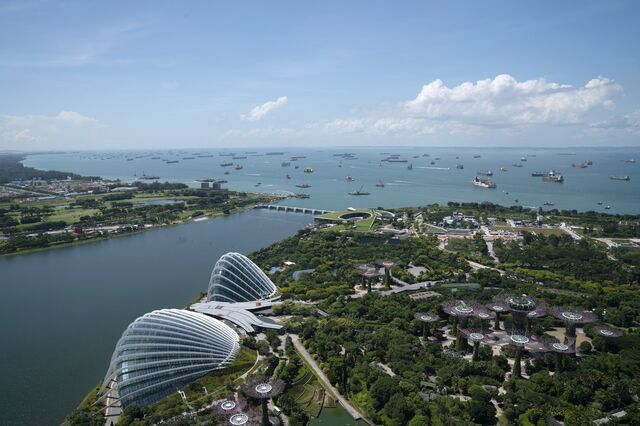

Ships off the coast of Singapore, on July 6.
During the Covid pandemic the narrow waterway off the island became even more congested.
Photographer: Wei Leng Tay/Bloomberg


Of the commercial ports in 123 countries and territories, 45 have stopped allowing crew changes, according to Wilhelmsen Ships Service AS, part of the border closings and quarantine requirements that have come to define coronavirus containment policy.
Seventy-six allow seafarer swaps with restrictions and two permit the changes with appropriate documentation.
Until the world’s ports reopen, shipping companies say, it will be hard to relieve large numbers of workers.

National governments are cautious.
Hong Kong, one of Asia’s biggest cargo ports, had permitted unrestricted crew changes until this summer when a fresh wave of cases swept the city.
Now only ships bringing cargo to the city can enter the port and change crews.
Incoming seafarers must test negative for coronavirus; those leaving are confined to their ship until they head for the airport and are forbidden to use public transportation.
As for workers who aren’t swapping out, they have to stay on ship the whole time.


“In recent years, there’s more availability of seafarers than demand for them, so you have an unequal balance, which can of course lead to exploitation, sadly,” said the ICS’ Poulsson, adding that the problem, “unacceptable as it may be,” is the result of a few bad actors.
“Covid has opened the door for unscrupulous operators to continue being unscrupulous.”


In June, the Australian Maritime Safety Authority put shipping companies on notice.
Flexibility had been critical to supporting international trade in the early months of the pandemic, the marine authority said, but “there is a limit to reasonable continuous periods of service.” Starting July 1, any ship in an Australian port must have satisfactory repatriation plans for workers onboard for more than 11 months.
Seafarers who are no longer working under valid contracts must be repatriated immediately, and if that means the ship falls below its minimum crewing requirements, so be it.


As of Sept.
10, the regulator said it’s received 108 complaints alleging labor violations.
In roughly 32, workers said they’d been on board 14 months or longer.
Most of the complaints have been resolved, authorities say, but seven ships, including the Unison Jasper, were detained for what the regulators described as failure to provide decent working conditions, insufficient quality and quantity of food, underpayment of seafarers and attempts to coerce workers’ silence.
In the most egregious cases, the ships have been barred from Australian ports for six to 12 months.

Investors are also expressing concern.
Fidelity International, a $566 billion asset manager, said it had contacted 30 of its portfolio companies in the shipping, airline and charterer sectors to discuss “the crisis of stranded seafarers,” a company spokesperson said in an email.
“We need collective action and multilateral collaboration.”
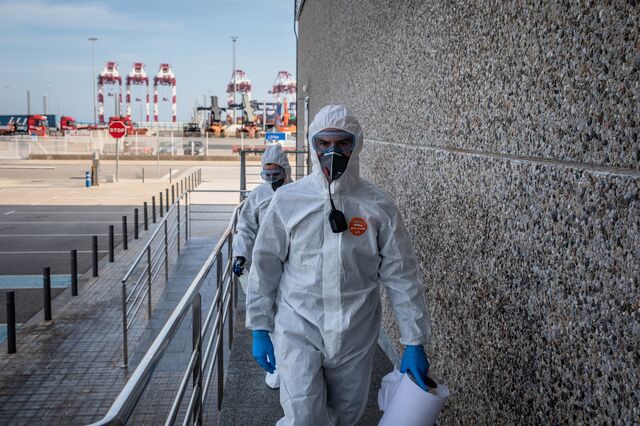

Spain's military emergencies unit (UME) arrives for a deep clean operation at the border inspection point at the Port of Barcelona, Spain, on March 20.
Photographer: Angel Garcia/Bloomberg


Shipping is a business built on coordination between independent entities—it’s called ‘logistics’ for a reason.
But the Covid-19 pandemic has cast all future plans in doubt and, with the world economy in deep recession, few are willing to take on expensive, complicated rescue missions unless they absolutely have to.
While anyone with far-flung family might be unsure when they’ll be able to see them again, it’s particularly hard for seafarers who manage their tours of duty with an end-date in mind.

Indian seafarer Alroyd Fernandes quit his job on an oil tanker when his six-month contract expired in mid-August; he’s stopped working but his company has yet to let him off the boat.
“My wife is in poor health and needs me — she’s managing three kids on her own, including an infant,” Fernandes wrote in his resignation letter.
“I don’t want to jeopardize the safety of the vessel and on-board crew ...
due to stress and my present mental state.”

Relief, for now, is piecemeal and somewhat arbitrary.
The Philippines’ Department of Foreign Affairs says it’s currently working to bring home 127 Filipino seafarers.
The seven Burmese ship workers from the Unison Jasper sought the help of their union and, after much negotiation, have been repatriated.
Crew members on the APL Pusan said that the company finally orchestrated their release after representatives from CMA CGM visited the vessel in Singapore.
The company confirmed the successful crew swap even though, it said, “the country lockdown and flight ban were blocking all initiatives.”

Most efforts haven’t risen to the magnitude of the crisis, says Kinsey, the risk consultant at Allianz.
More drastic action is in order, he says: Ships should stop calling at ports that refuse to repatriate seafarers, and ship owners should declare their vessels unfit to make deliveries because the crew is overworked.

“Nothing’s going to get resolved until you start disrupting trade,” Kinsey said.
“If everything gets delivered and ships continue to come and go, the crew gets forgotten.
That’s what’s happening now.”

“They’ve been delivering goods to consumers, the PPE we all need, the fuel and energy we depend on,” he added.
“Their contracts are done, their time is up, and everyone needs to answer for it.”—With Claire Jiao, Annie Lee, Ann Koh, Stephen Stapczynski, Prejula Prem, Shruti Srivastava, Matthew Boyle and Cindy Wang

(Updates to add efforts by the Philippines government to bring home stranded seafarers in the fourth-to-last paragraph.
An earlier version of this story corrected the eighth and seventh-to-last paragraphs to show that Fidelity International, a $566 billion asset manager, has raised concerns about the seafarer crisis with portfolio companies, not Fidelity Investments.)

Chemical tanker grounding and ENC data accuracy

Navigational chart BA2910 (scale 1:500,000)

 Localization with the GeoGarage platform (NGA raster chart)

From TankerOperator

A report by BSU into a chemical tanker grounding gives interesting insight into the importance of understanding the accuracy of electronic chart data.

 Chemical tanker Pazifik (Liquefied gas carrier)

A report by the Germany Federal Bureau of Maritime Casualty Investigation (BSU) of the grounding of 42,000 dwt chemical tanker PAZIFIK in Indonesia in July 2018, published in January 2020, gives interesting insights into the importance of crew understanding the quality of official electronic navigation chart (ENC) data accuracy.

 Voyage planned using ChartCo

The root cause of the accident could be described as the vessel hitting a rock.
The rock was shown on the ECDIS display with a note “underwater rock (always underwater / submerged 1 MAR 2017)”.

 Passage planned using ChartCo

From this, they assumed that the rock was not a hazard, since surrounding water was a comfortable 100m depth.

The crew also thought the vessel was at a safe distance from the underwater rock, since the electronic chart display had a “cross track distance” of 182m either side of the vessel, and the rock was much further away than 182m, according to the ECDIS display.

(The cross track distance is a system on ECDIS displays where vessels are given a safe corridor shown by red and green lines, rather than a specific course, taking uncertainty into account).

 Indonesian navigational chart : ID295 (scale 1:200,000)

 Indonesian navigational chart : ID268-2 (scale 1:50,000)

But in reality the rock was only 9m below the water surface, and located 400m away from where it was stated to be on the ENC.
The ENC’s stated accuracy was +/- 500m.

Indonesian Navigational chart ID295 (scale : 1:200,000)

 Indonesian Navigational chart ID268-2 (scale : 1:50,000)

The rock’s location was also shown accurately on a small scale paper chart mapped in a 1904 Dutch survey, and warnings were published in “Sailing Directions” available onboard. BSU heard from local sources that several other ships have ran aground on the same rock.

The route chosen was recommended by the vessel’s passage planning software.
The vessel's master was familiar with a route through the Lombok Strait, which would have added 200 nautical miles to the voyage.
He decided to take the route recommended by the software to save the 200nm, the Selat Snape strait between Komodo and Banta.

The vessel was loaded with 18,000 tonnes of ammonia – although no cargo escaped because only the forepeak / ballast water tanks were damaged.

It was able to refloat 5 days later after transferring cargo and ballast water to other tanks, and could proceed to a shipyard in Singapore under its own power, supported by a tug.
The repair included renewing 50m of the double bottom.

The company has decided that the vessel will avoid the Selat Sape passage from now on

Voyage according to route planning

 Deviation from route planning up unitil grounding
 
Navigation background


In its original plan (which was changed due to fishing vessels), the vessel had planned to pass the rock at a distance of 0.7 nautical miles (1300m).

Information stored in the ENC
The following supplementary information is stored for this isolated danger:" Underwater rock (always under water/submerged 1MAR2017)" 

Its ENC was classified as “Zone of Confidence Category C”, which means a position accuracy of +/- 500m horizontally, and “full area search not achieved".


But the ECDIS was set to a cross track distance of 0.1nm (180m) on each side.

This fits company procedures, where it recommends to keep a "cross track distance setting" of 2 x the vessel's beam in confined waters, or just 64.4m, and this passage is considered "confined waters" in the procedural specifications, so the 0.1m (180m) cross track was considered within limits.

There could have been an alarm in the ECDIS that the cross track was set to 180m, while the chart had an accuracy of 500m.

The crew could have brought up data about the chart accuracy on the ECDIS display, including both horizontal and vertical accuracy, such as for submerged rocks.
But it was quite hard to understand how to use it, BSU says.

 Chart p. 138 UKHO Sailing Directions NP34
The electronic version of the UKHO's3sailing directions available on board (e-NP 34, Indonesia Pilot Volume 2) states the following for the Selat Saperoute (6.99): 
"The passage E of PulauBanta is navigable but is seldom used, other than by ferries and other local craft, as tidal streams are strong and fewer anchorages are available [...]." 

If the vessel had been navigating with paper charts, the crew would probably have been more considerate of possible inaccuracies in the chart, and looked up all the “Sailing Directions” if the vessel was going to an area the master was not familiar with.

Or concerns about using paper charts in an unknown area may have led the crew to take on a pilot, who may have had his own accurate soundings map, or had better local knowledge, BSU said.

Sailing directions

The relevant section of Sailing Directions for the strait between Komodo and Banta states "The passage E of Pulau Banta is navigable but is seldom used, other than by ferries and other local craft, as tidal streams are strong and fewer anchorages are available."

The Sailing Direction for the island of Tokohgilibanta states, "a drying rock, 1 mile farther NNW, is small and dangerous; the breakers on it being indistinguishable from the normal overalls and sea conditions in the area."
(Confusingly, on the ENC, the name of the island changes from Tokohgilibanta to Nisabedi when the viewer zooms in).
This description reflects the location of the rock where the vessel ran aground.

A digital version of these sailing directions would have been available onboard, but without any reference to the ENC, which would be required for the computer to connect them.

BSU says that the ECDIS could be described as "not fully engineered" - since it displaces sources of information such as paper sailing directions, without being a consistent replacement for them

 Indonesian ENC

"There are significant differences between traditional voyage planning using paper charts and digital voyage planning using ENCs. Planning a voyage using paper charts often entails referring to sailing directions, the list of lights and pilot charts with proposed routes plotted.”

“Besides drawing on their experience, officers of the navigational watch therefore refer to sources of data other than the navigational chart. Paper charts and sailing directions have developed over centuries and became more accurate in many areas."

"Most of the world's sea areas are looked upon as being inaccurately surveyed, while paper charts only provide an indication of the data of a survey."

"The accident is therefore attributable to the ECDIS and settings specified," BSU says.

More details

The vessel ran aground on a shoal between the islands of Komodo and Banta, Indonesia.

 Waves breaking on rocks

 Rocks above water

It was using a Transas ECDIS, with PassageManager software from ChartCo, with ENCs supplied by ChartCo using data from the Indonesian Hydrographic Office.
It was using voyage planning software "BonVoyage System" (BVS) from StormGeo.

The ChartCo software proposed a route via Selat Sape, passing between Banta and Komodo, going between the tiny islands of Nisabedi and Lubuhtare, which have only 1.5nm between them.
The master and officer decided not to take this route, but instead take a route between the islands of Nisabedi and Banta, which have 2.5nm between them.

BSU looked at the Indonesian and UK Hydrographic paper charts of the region.
The UKHO charts (both 1:500,000) show a "rock awash" symbol, meaning a rock submerged at high tide or temporarily.

The Indonesian smaller scale chart (1:200,000) shows a rock symbol without specifying whether it is sometimes submerged, while the larger scale Indonesian chart (1:50,000) shows a shallow area with water depth of 9m.
This chart was drawn from Dutch surveys carried out in 1904.

 Proper rock designation in official paper charts according to INT1

The ENC shows the shoal 2 cable lengths (400m) from the scene of the accident, with a note saying, "underwater rock (always underwater / submerged 1 MAR 2017)". The general water depth around the rock is about 100m.

The reason for the discrepancy between the ENC and paper chart is not clear.

The ENC has a “Zone of Confidence Category C” (CATZOC) which means “a position accuracy of +/- 500m horizontally, and “full area search not achieved". This data could be fed into the ECDIS to illustrate the range of “cross track distance” needed.

IHO has a Data Quality Working Group looking at options for improve user awareness and presentation of quality data.

Thursday, September 17, 2020

Robots go their own way deep in the ocean

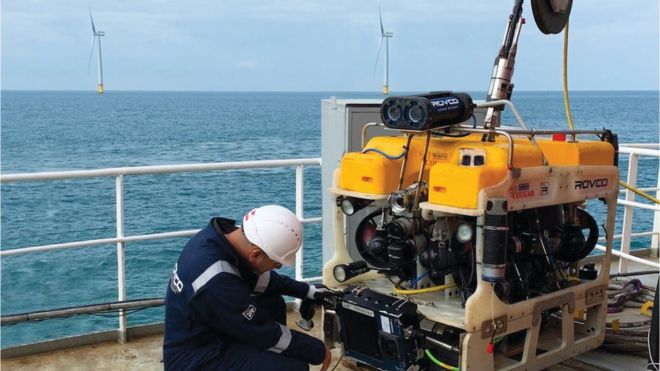
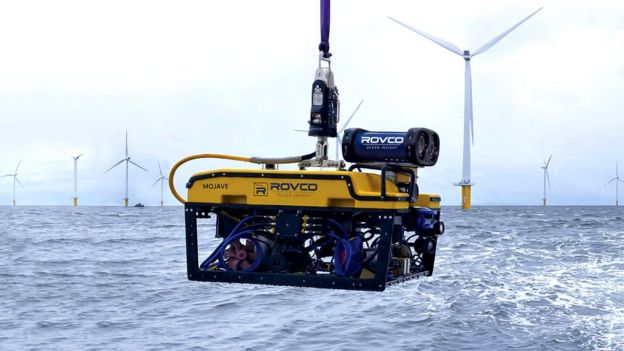
Firms like Rovco are trying to make underwater vehicles more intelligent

From BBC by Ben Morris

Firms like Rovco are trying to make underwater vehicles more intelligent
"It's very common," says Jess Hanham casually, when asked how often he finds suspected unexploded bombs.
Mr Hanham is a co-founder of Spectrum Offshore, a marine survey firm that does a lot of work in the Thames Estuary.
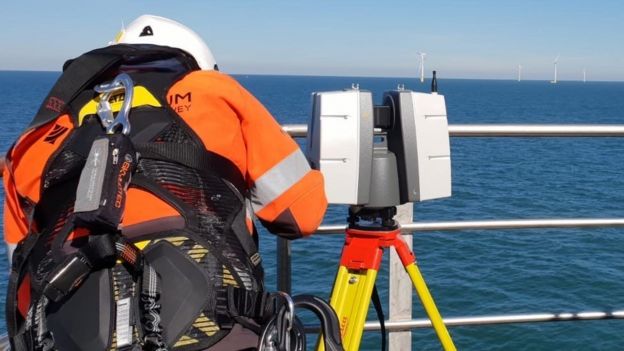
His firm undertakes all sorts of marine surveying, but working on sites for new offshore wind farms has become a big business for him.
Work in the Thames Estuary, and other areas that were the targets of bombing in World War 2, are likely to involve picking up signals of unexploded munitions.
"You can find a significant amount of contacts that need further investigation and for a wind farm that will be established in the initial pre-engineering survey," he says.

Image copyright Spectrum Offshore
Wind farm operators are important customers for Jess Hanham

With that information project managers can decide whether to place turbines and other equipment a safe distance from the suspected bombs, or have them blown up by a specialist firm.

At the moment marine surveying is done by teams who go out on boats, collect the data and bring it back for analysis.

Sometimes that will involve a relatively small vessel with two crew members, a surveyor and his kit. But bigger inspection projects further out to sea can involve much larger boats, with dozens of crew members, costing in the region of £100,000 per day.

The sensor equipment varies according to the job.
Sometimes it might be a sonar array towed behind the boat, for other jobs it might be an underwater unmanned vehicle, which can be controlled by surveyors on the surface.

Bad weather can disrupt the work and make life uncomfortable.
"I've been at sea in force nine and force 10 gales and they're not nice places to work," says Brian Allen, chief executive of Rovco.

His company is one of several looking to disrupt that market using artificial intelligence (AI) systems. They see a future where underwater robots, known as autonomous underwater vehicles (AUVs), will be able to do the surveying work without much human oversight, and send the data back to surveyors in the office.

Bristol-based Rovco is working on key pieces of the technology.
It has trained an AI system to recognise objects on the seabed from data collected at sea, a process which took four years.
Adding AI means the data does not have to be analysed by a human on the ship, or taken back to shore for assessment.
That work is actually being done there and then by the AI, which can operate on the ship, or soon on the underwater robot itself.
"Without AI autonomous underwater robots are pretty dumb - only being able to follow pipelines and cables in pre-programmed lines," says Mr Allen.
"Enabling the AUV to analyse data in real time means you can actually instruct the robot to do other things. If you come across a problem, the survey can be stopped, and more data collected, with the robot making decisions for itself," he says.
So, for example, if the AI flagged up something that looked like an unexploded bomb it could stop, go back, and do further analysis.

 
Image copyright ROVCO
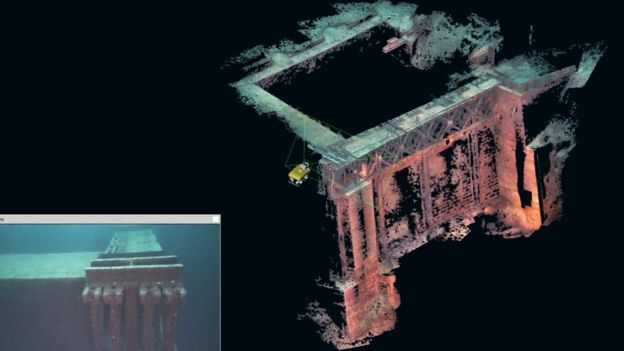
The goal is for robots to survey underwater structures with minimal human oversight

For some jobs, like dismantling underwater oil and gas infrastructure, engineers need to know the exact dimensions and locations of the equipment.

To help with this Rovco has also developed a vision system that produces accurate maps of underwater infrastructure.
The system generates a 3D cloud of individual data points, a format used in modelling software like CAD.
It combines those points with camera images to generate a realistic 3D reconstruction.
Rovco is currently bringing together the vision system, the AI and the underwater vehicle into one package.

Other companies are also racing to introduce AI into the industry.

 
Image copyright MODUS 
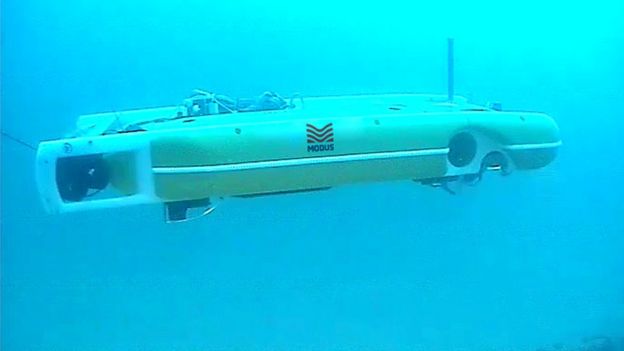
Companies are racing to introduce AI into their underwater vehicles

Jake Tompkins is the chief executive of UK-based Modus, which owns a fleet of 12 unmanned underwater vehicles. It is about to start a two-year programme with Durham University to develop an artificial intelligence control system that would allow some of its underwater vehicles to recognise their location, objects and anomalies during a survey.

He says that combining with Durham is a very efficient way to develop the technology, because they already have proven AI systems for the car and aerospace industries.

Using autonomous subsea robots to survey the seabed and inspect underwater structures would be a "game changer", according to Mr Tompkins and should "significantly" cut costs.

He thinks it won't be long before underwater robots will be stationed out at sea, perhaps at an offshore wind farm, or at an oil or gas facility.

When needed, they will be woken up and sent to harvest data, which will be sent back to an onshore control centre for processing.

 
Image copyright MODUS 
In the coming years underwater vehicles will be based offshore

"I think we're probably two or so years away from the first commercial deployment of field-resident autonomous vehicles, but that is certainly where we are heading," says Mr Tompkins.

His company is currently working on ways to keep the AUVs charged while they are out at sea and on technology that allows them to send back data.

There is a juicy prize for the firms that can make such intelligent underwater robots work. Over the next decade the offshore wind market is expected to see "quite extraordinary" growth, according to Søren Lassen, head of offshore wind research at the consultancy Wood Mackenzie.

At the moment only six countries have a commercial-scale offshore wind power industry.
In 10 years' time, he forecasts that 20 countries will have joined that club.

 
Image copyright ROVCO 
Rapid installation of wind farms is likely to drive demand for autonomous underwater vehicles

Last year 29 gigawatts of offshore wind capacity was connected to electricity grids around the world.
In 2029 Wood Mackenzie forecasts that number will hit 180 gigawatts.
That will involve building thousands of wind turbines and laying thousands of kilometres of cable to connect up those wind farms and all of that will need the services of underwater surveyors.
By 2029, much of that work at sea might be done by autonomous systems, with humans back at the office.

Jess Hanham will keep his business up to date with the latest technology, but fears the work will become less rewarding.
"I love the variety. For me being stuck in the office - I'd hate that. Going out and doing survey work, coming back and seeing the whole thing from start to finish - it gives you ownership of the work. I thoroughly enjoy that. If we were to lose part of that, I think that would be a real shame."

Links :

Wednesday, September 16, 2020

The origin of North Korea's 'ghost boats'


From BBC by Ian Urbina

After exhausting areas close to home, China’s vast fishing fleet has moved into the waters of other nations, depleting fish stocks.
But more than seafood is at stake.

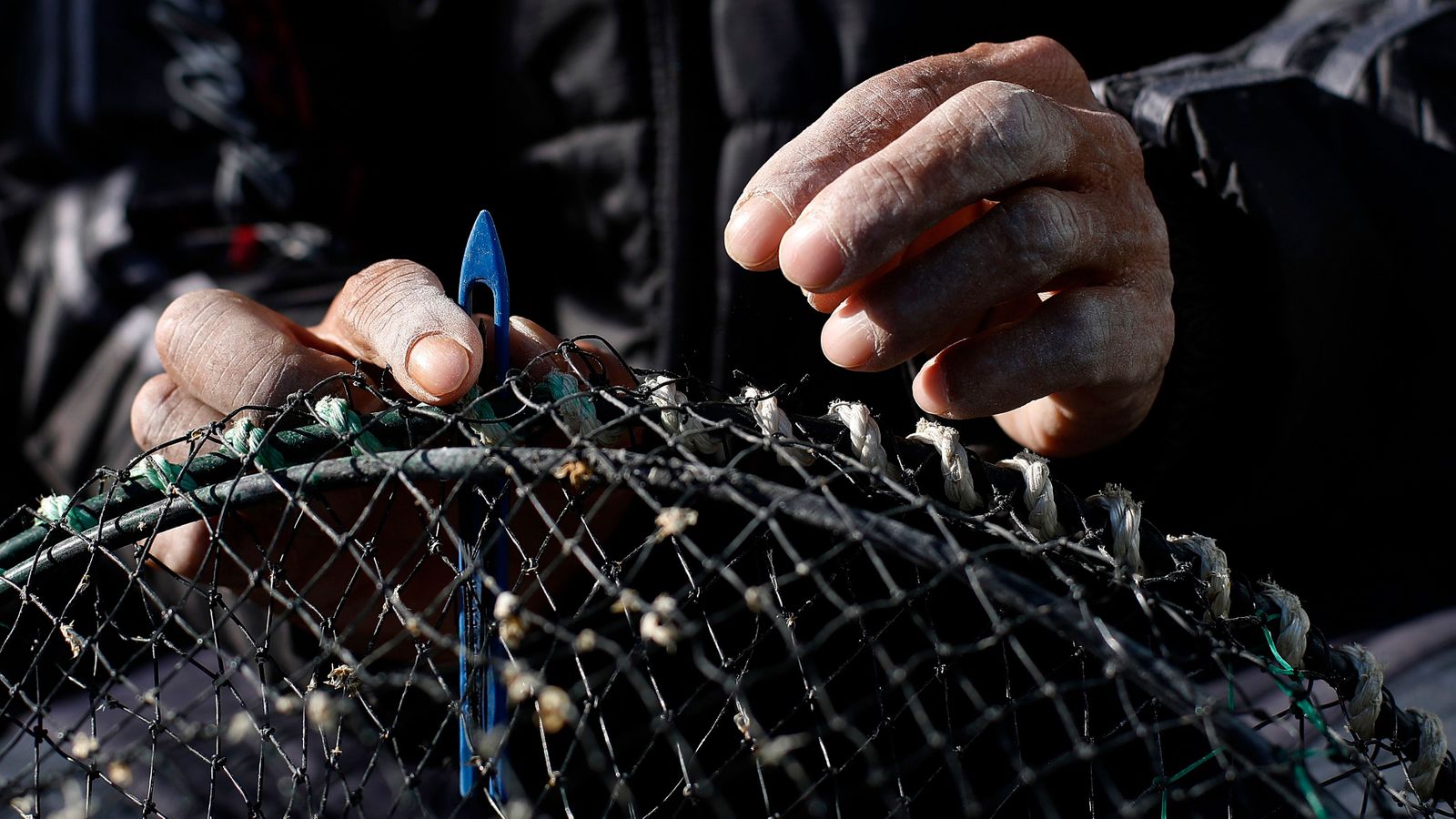
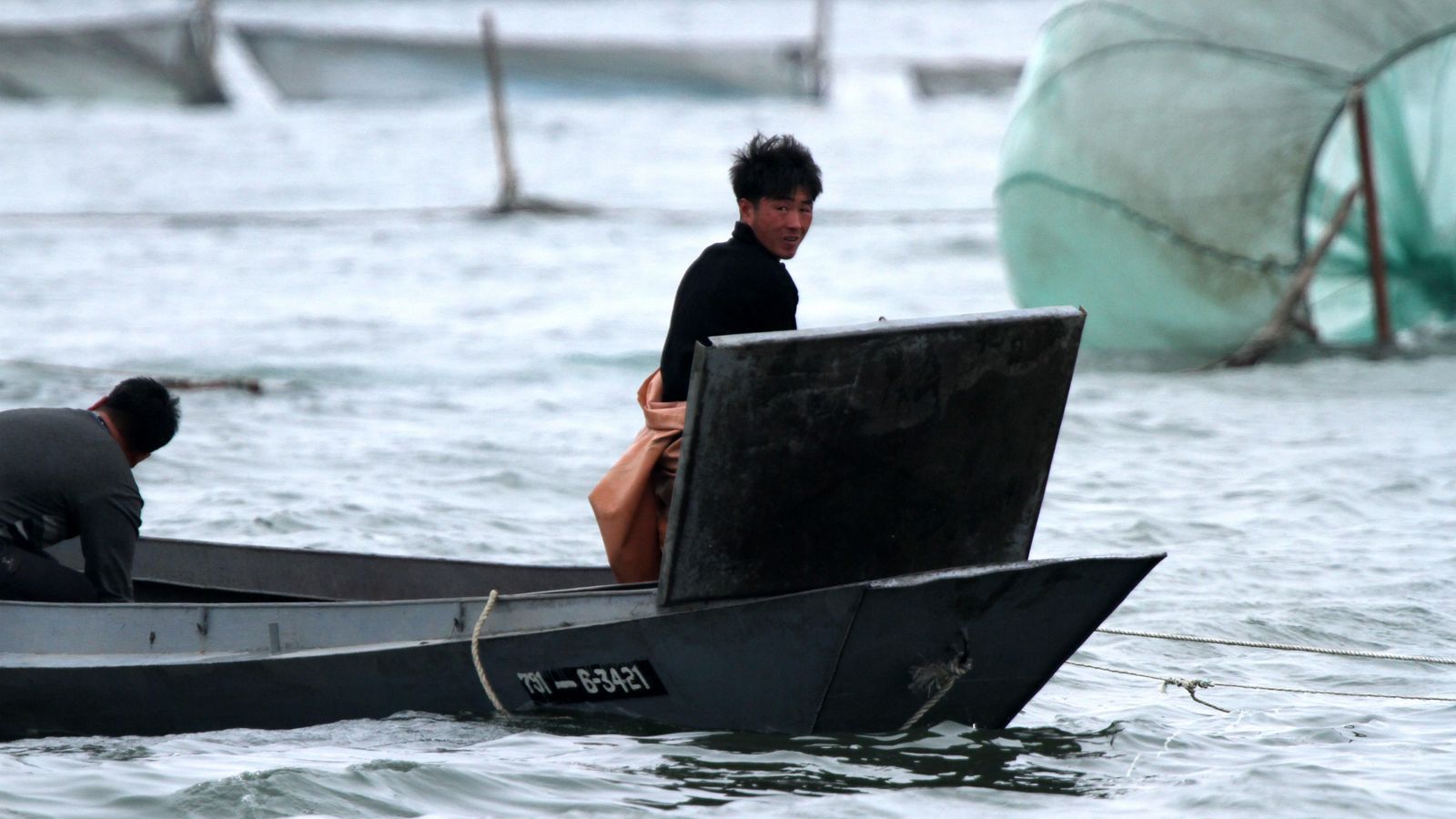
For years, no one knew why dozens of battered wooden “ghost boats” – often along with corpses of North Korean fishermen whose starved bodies were reduced to skeletons – were routinely washing ashore along the coast of Japan.

A recent investigation I did for NBC News, based on new satellite data, has revealed, however, what marine researchers now say is the most likely explanation: China is sending a previously invisible armada of industrial boats to illegally fish in North Korean waters, forcing out smaller North Korean boats and leading to a decline in once-abundant squid stocks of more than 70%.
The North Korean fishermen washing up in Japan apparently ventured too far from shore in a vain search for squid and perished.

The Chinese vessels – more than 700 of them last year – appear to be in violation of United Nations sanctions that prohibit foreign fishing in North Korean waters.
The sanctions, imposed in 2017 in response to the country’s nuclear tests, were aimed at punishing North Korea by not allowing it to sell fishing rights in its waters in exchange for valuable foreign currency.

The South China Sea is home to some of the world's largest fisheries, but they have been severely overfished
(Credit: Getty Images)
The new revelations cast light on the lack of governance of the world’s oceans and raise thorny questions about the consequences of China’s expanding role at sea, and how it is connected to the nation’s geopolitical aspirations.

Estimates of the total size of China’s global fishing fleet vary widely.
By some calculations, China has anywhere from 200,000 to 800,000 fishing boats, accounting for nearly half of the world’s fishing activity.
The Chinese government says its distant-water fishing fleet, or those vessels that travel far from China’s coast, numbers roughly 2,600.
But other research, such as this study by the Overseas Development Institute, puts this number closer to 17,000, with many of these ships being invisible like those that satellite data discovered in North Korean waters.
By comparison, the United States’ distant-water fishing fleet has fewer than 300 vessels.

China is not only the world’s biggest seafood exporter, the country’s population also accounts for more than a third of all fish consumption worldwide.
Having depleted the seas close to home, the Chinese fishing fleet has been sailing farther afield in recent years to exploit the waters of other countries, including those in West Africa and Latin America, where enforcement tends to be weaker as local governments lack the resources or inclination to police their waters.
Most Chinese distant-water ships are so large that they scoop up as many fish in one week as local boats from Senegal or Mexico might catch in a year.

Many of the Chinese ships combing Latin American waters target forage fish, which are ground into fishmeal, a protein-rich pelletised supplement fed to aquaculture fish.
The Chinese fleet has also focused on shrimp.
There is also a large appetite in China for the endangered totoaba fish, which are much prized in Asia for the alleged medicinal properties of their bladders, which can sell for between $1,400 and $4,000 (£1,080 and £3,090) each.

Nowhere at sea is China more dominant than in squid fishing, as the country’s fleet accounts for 50-70% of the squid caught in international waters, effectively controlling the global supply of the popular seafood.
At least half of the squid landed by Chinese fishermen pulled from the high seas is exported to Europe, north Asia and the United States.

To catch squid, the Chinese typically use trawling nets stretched between two vessels, a practice widely criticized by conservationists because it results in a lot of fish inadvertently and wastefully killed.
Critics also accuse China of keeping high-quality squid for domestic consumption and exporting lower-quality products at higher prices.
In addition, critics say, China overwhelms vessels from other countries in major squid breeding grounds and is in a position to influence international negotiations about conservation and distribution of global squid resources for its own interests.

Squid are highly sought-after in many countries, and China is the most active nation in squid fishing (Credit: Alamy)

China’s global fishing fleet did not grow into a modern behemoth on its own.
The government has robustly subsidised the industry, spending billions of yuan annually.
Chinese boats can travel so far partly because of a tenfold increase in diesel fuel subsidies between 2006 and 2011 (Beijing stopped releasing statistics after 2011, according to a Greenpeace study).

For over a decade, the Chinese government has helped pay to construct bigger, more advanced steel-hulled trawlers, even sending medical ships to fishing grounds to enable the fleet to stay at sea longer.
The Chinese government supports the squid fleet in particular by providing it with an informational forecast of where to find the most lucrative squid stocks, using data gleaned from satellites and research vessels.

On its own, distant-water squid fishing is a money-losing business, according to research by Enric Sala, founder and leader of the National Geographic Society’s Pristine Seas project.
The sale price of squid typically does not come close to covering the cost of the fuel required to catch the fish, Sala found.

Still, China is hardly the worst offender when it comes to such subsidies, which conservationists say, along with over-capacity of fishing vessels and illegal fishing, is a major reason that the oceans are rapidly running out of fish.
The countries that provide the largest subsidies to their high-seas fishing fleets are Japan (20% of the global subsidies) and Spain (14%), followed by China, South Korea, and the US, according to Sala’s research.

More recently, the Chinese government has stopped calling for an expansion of its distant-water fishing fleet and released a five-year plan in 2017 that restricts the total number of offshore fishing vessels to under 3,000 by 2021.
Daniel Pauly, a marine biologist and principal investigator for The Sea Around Us Project at The University of British Columbia, said he believes that the Chinese government is serious in wanting to restrict its distant-water fleet.
“Whether they can enforce the planned restrictions onto their fleet is another question,” he added.

Other attempts to rein in China’s fishing fleet, however, have been slow.
Imposing reforms and policing them is difficult partly because laws are lax, much of the workforce on vessels is illiterate, many ships are unlicensed or lack unique names or the identifying numbers needed for tracking, and the country’s fishery research institutions often refuse to standardise or share information domestically or abroad.

The South China Sea is a hotly contested ocean, with several countries laying claim to regions of the sea (Credit: Getty Images)

Chinese fishing boats are notoriously aggressive and often shadowed, even on the high seas or in other countries’ national waters, by armed Chinese Coast Guard vessels.
While reporting at sea, my photographer and I filmed 10 illegal Chinese squid ships crossing into North Korean waters.
Our reporting team was forced to divert its course to avoid a dangerous collision after one of the Chinese fishing captains suddenly swerved toward the team’s boat, coming within 10 metres, likely intending to ward off the boat.

China has sought to extend its maritime reach through more traditional means, too.
The government has been expanding its naval force, while also dispatching at least a dozen advanced research vessels that prospect for minerals, oil and other natural resources.

But China’s fishing fleet too are routinely cast by Western military analysts as a vanguard “civilian militia” that functions as “a non-uniformed, unprofessional force without proper training and outside of the frameworks of international maritime law, the military rules of engagement, or the multilateral mechanisms set up to prevent unsafe incidents at sea”, Greg Poling, director of the Asia Maritime Transparency Initiative at the Center for Strategic and International Studies wrote recently in Foreign Policy.

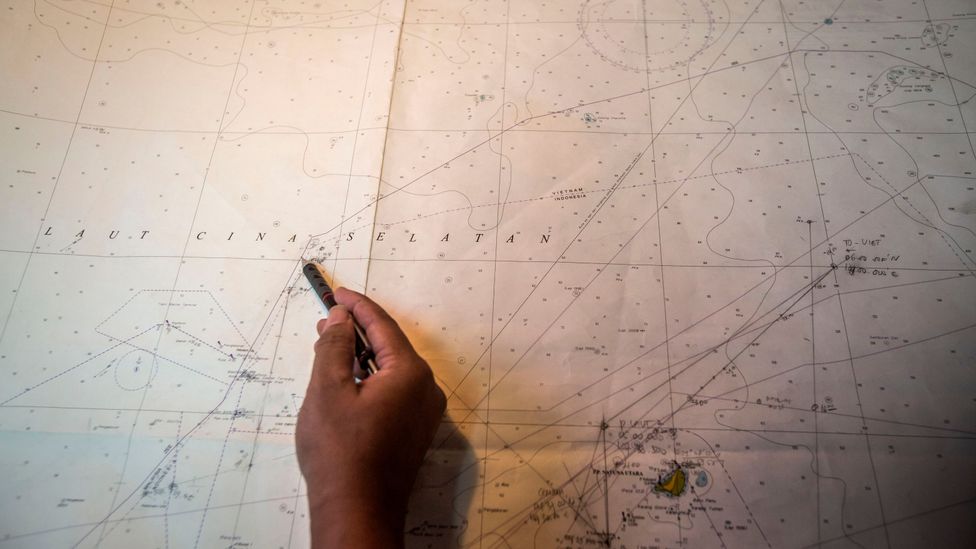
Nowhere is China’s fishing fleet more omnipresent than in the South China Sea, which is among the most hotly contested regions in the world, with competing historical, territorial and even moral claims from China, Vietnam, Philippines, Malaysia, Brunei, Taiwan and Indonesia.
Aside from fishing rights, the interests in these waters stem from a tangled morass of national pride, lucrative subsea oil and gas deposits, and a political desire for control over a region through which a third of the world’s maritime trade flows.

In the South China Sea, the Spratly islands have attracted most attention as the Chinese government has built artificial islands on reefs and shoals in these waters, and militarised them with aircraft strips, harbours and radar facilities.
Chinese fishing boats bolster the effort by swarming the zone, crowding and intimidating potential competitors, as they did in 2018, suddenly dispatching more than 90 fishing ships to drop anchor within several miles of Philippines-held Thitu Island immediately after the Philippine government began modest upgrades on the island’s infrastructure.

The overfishing of waters close to North Korea are thought to be the reason that boats containing the bodies of fishermen washed up on the shores of Japan (Credit: Getty Images)

In justifying its rights over the region, Beijing usually makes a so-called “nine-dash line” argument, which relies on maps of historic fishing grounds that feature a line made of nine dashes encompassing most of the South China Sea as belonging to China.
Partly because China ignores most of the criticism, and partly because China is economically and otherwise dominant on the global stage, there is a tendency in Western media to lay blame on China for many of the same actions of which the US and Europe have been guilty – in the past or presently.
And while defining what is true or fair in the South China Sea may be no easier than it has proven to be in places like the Middle East, most legal scholars and historians say the nine-dash line argument has no basis in international law, and it was found to be invalid in a 2016 international court ruling.

Clashes over fishing grounds involving the Chinese are not limited to the South China Sea.
Japan and China are at odds over the Senkaku Islands, known in Chinese as the Diaoyu or “fishing” islands.
Elsewhere, an Argentine Coast Guard vessel fired a warning shot to halt a Chinese ship’s escape to international waters in March, 2016.
When the Chinese ship, the Lu Yan Yuan Yu, responded by trying to ram the Argentine vessel, the Coast Guard ship capsized the fishing vessel.
Some of the Chinese crew escaped by swimming out to other Chinese vessels, while others were rescued by the Coast Guard.

From the waters of North Korea to Mexico to Indonesia, incursions by Chinese fishing ships are becoming more frequent, brazen and aggressive.
It hardly takes a great feat of imagination to picture how a seemingly civilian clash could rapidly escalate into a bigger military conflict.
Such confrontations also raise humanitarian concerns about fishermen becoming collateral damage, and environmental questions about the government policies accelerating ocean depletion.
But above all, the reach and repercussions of China’s at-sea ambitions highlight anew that the real price of fish is rarely what appears on the menu.

Links :

Tuesday, September 15, 2020

Microsoft finds underwater datacenters are reliable, practical and use energy sustainably


 Submarine datacenter : project Natick

From Microsoft by John Roach 

Earlier this summer, marine specialists reeled up a shipping-container-size datacenter coated in algae, barnacles and sea anemones from the seafloor off Scotland’s Orkney Islands.

The retrieval launched the final phase of a years-long effort that proved the concept of underwater datacenters is feasible, as well as logistically, environmentally and economically practical.

Microsoft’s Project Natick team deployed the Northern Isles datacenter 117 feet deep to the seafloor in spring 2018.
For the next two years, team members tested and monitored the performance and reliability of the datacenter’s servers.


The team hypothesized that a sealed container on the ocean floor could provide ways to improve the overall reliability of datacenters.
On land, corrosion from oxygen and humidity, temperature fluctuations and bumps and jostles from people who replace broken components are all variables that can contribute to equipment failure.

The Northern Isles deployment confirmed their hypothesis, which could have implications for datacenters on land.

Lessons learned from Project Natick also are informing Microsoft’s datacenter sustainability strategy around energy, waste and water, said Ben Cutler, a project manager in Microsoft’s Special Projects research group who leads Project Natick.

What’s more, he added, the proven reliability of underwater datacenters has prompted discussions with a Microsoft team in Azure that’s looking to serve customers who need to deploy and operate tactical and critical datacenters anywhere in the world.
“We are populating the globe with edge devices, large and small,” said William Chappell, vice president of mission systems for Azure.
“To learn how to make datacenters reliable enough not to need human touch is a dream of ours.”

Earlier this summer, marine specialists reeled up a shipping container-size datacenter coated in algae, barnacles, and sea anemones from the seafloor off Scotland’s Orkney Islands.
The retrieval of the Northern Isles datacenter launched the final phase of Project Natick, a years-long research effort that proved the concept of underwater datacenters is feasible as well as logistically, environmentally, and economically practical.

Phase 2 Project Natick, a successful challenge for Naval Group

Proof of concept

The underwater datacenter concept splashed onto the scene at Microsoft in 2014 during ThinkWeek, an event that gathers employees to share out-of-the-box ideas.
The concept was considered a potential way to provide lightning-quick cloud services to coastal populations and save energy.

More than half the world’s population lives within 120 miles of the coast.
By putting datacenters underwater near coastal cities, data would have a short distance to travel, leading to fast and smooth web surfing, video streaming and game playing.

The consistently cool subsurface seas also allow for energy-efficient datacenter designs.
For example, they can leverage heat-exchange plumbing such as that found on submarines.

Microsoft’s Project Natick team proved the underwater datacenter concept was feasible during a 105-day deployment in the Pacific Ocean in 2015.
Phase II of the project included contracting with marine specialists in logistics, ship building and renewable energy to show that the concept is also practical.

“We are now at the point of trying to harness what we have done as opposed to feeling the need to go and prove out some more,” Cutler said.
“We have done what we need to do. Natick is a key building block for the company to use if it is appropriate.”

Microsoft’s Project Natick team used a gantry barge to retrieve the Northern Isles datacenter from the seafloor off Scotland’s Orkney Islands.
A coat of algae, barnacles and sea anemones grew on the datacenter during its two-year deployment.
Photo by Simon Douglas. 

The Northern Isles datacenter was retrieved from the seafloor off Scotland’s Orkney Islands and towed partially submerged between the pontoons of a gantry barge to a dock in Stromness, Orkney. A coat of algae, barnacles and sea anemones grew on the datacenter during its two-year deployment. Photo by Jonathan Banks.

The Northern Isles datacenter was attached to a ballast-filled triangular base for deployment 117 feet deep on the seafloor off the Orkney Islands in Scotland in 2018.
The Project Natick team retrieved the datacenter this summer.
Two years underwater provided time for a thin coat of algae and barnacles to form on the steel tube, and for sea anemones to grow to cantaloupe size in the sheltered nooks of its ballast-filled triangular base.
Photo by Jonathan Banks. 

The Northern Isles was gleaming white when deployed.
Two years underwater provided time for a thin coat of algae and barnacles to form on the steel tube.
Microsoft Project Natick team members said swift ocean currents at the deployment site limited growth of marine life.
Photo by Jonathan Banks. 

Stephane Gouret of Naval Group checks out a sea anemone that grew in a sheltered nook of the ballast-filled base for the Northern Isles underwater datacenter.
Microsoft’s Project Natick team deployed the datacenter to the seafloor off the coast of the Orkney Islands in Scotland where it operated for two years.
Photo by Jonathan Banks.

Members of the Project Natick team power wash the Northern Isles underwater datacenter, which was retrieved from the seafloor off the Orkney Islands in Scotland.
Two years underwater provided time for a thin coat of algae and barnacles to form on the steel tube, and for sea anemones to grow to cantaloupe size in the sheltered nooks of its ballast-filled triangular base.
Photo by Jonathan Banks. 

Members of the Project Natick team power wash the Northern Isles underwater datacenter, which was retrieved from the seafloor off the Orkney Islands in Scotland.
Two years underwater provided time for a thin coat of algae and barnacles to form on the steel tube, and for sea anemones to grow to cantaloupe size in the sheltered nooks of its ballast-filled triangular base.
Photo by Jonathan Banks.

A seabird alights atop the Northern Isles underwater datacenter after it was retrieved from the seafloor off the Orkney Islands in Scotland and cleaned.
The datacenter operated on the seafloor for two years as part of Microsoft’s Project Natick.
The project is a years-long effort to prove the underwater datacenter concept is feasible as well as logistically, environmentally and economically practical.
Photo by Jonathan Banks. 

Members of Microsoft’s Project Natick team use a bucket lift to collect air samples from the Northern Isles underwater datacenter, which was filled with dry nitrogen and sealed prior to deployment to the seafloor off the Orkney Islands in Scotland.
Another team member cuts the datacenter from its ballast-filled base in preparation for transport to the mainland. Photo by Jonathan Banks. 


Members of the Project Natick team remove the endcap from the Northern Isles underwater datacenter at Global Energy Group’s Nigg Energy Park facility in the North of Scotland.
The datacenter was filled with dry nitrogen and spent two years on the seafloor off the Orkney Islands as part of a years-long effort to prove the underwater datacenter concept is feasible as well as logistically, environmentally and economically practical. Photo by Jonathan Banks. 

Members of the Project Natick team inspect the inside of the Northern Isles underwater datacenter at Global Energy Group’s Nigg Energy Park facility in the North of Scotland after the endcap’s removal. When deployed on the seafloor, cabling connected the underwater datacenter to the Orkney Island power grid, which is supplied 100% by renewable energy technologies. 

Spencer Fowers, a principal member of technical staff for Microsoft’s Special Projects research group, removes a server from the Northern Isles datacenter at Global Energy Group’s Nigg Energy Park facility in the North of Scotland.
Project Natick researchers will analyze it to help determine why the servers in the underwater datacenter were eight times more reliable than those in a replica datacenter on land.
Photo by Jonathan Banks. 

Members of the Project Natick team remove 12 racks of servers and related cooling system infrastructure from the Norther Isles underwater datacenter.
The servers in the underwater datacenter were eight times more reliable than those in a replica datacenter on land.
Photo by Jonathan Banks. 

Mike Shepperd, a senior research and development engineer with Microsoft’s research organization, stands in front of the barnacle-encrusted Northern Isles underwater datacenter.
The datacenter was deployed to the seafloor off the Orkney Islands in Scotland as part of Project Natick, a years-long effort to prove the underwater datacenter concept is feasible as well as logistically, environmentally and economically practical. Photo by Jonathan Banks.

Algae, barnacles and sea anemones

The Northern Isles underwater datacenter was manufactured by Naval Group and its subsidiary Naval Energies, experts in naval defense and marine renewable energy. Green Marine, an Orkney Island-based firm, supported Naval Group and Microsoft on the deployment, maintenance, monitoring and retrieval of the datacenter, which Microsoft’s Special Projects team operated for two years.

The Northern Isles was deployed at the European Marine Energy Centre, a test site for tidal turbines and wave energy converters.
Tidal currents there travel up to 9 miles per hour at peak intensity and the sea surface roils with waves that reach more than 60 feet in stormy conditions.

The deployment and retrieval of the Northern Isles underwater datacenter required atypically calm seas and a choreographed dance of robots and winches that played out between the pontoons of a gantry barge. The procedure took a full day on each end.

The Northern Isles was gleaming white when deployed. Two years underwater provided time for a thin coat of algae and barnacles to form, and for sea anemones to grow to cantaloupe size in the sheltered nooks of its ballast-filled base.

“We were pretty impressed with how clean it was, actually,” said Spencer Fowers, a principal member of technical staff for Microsoft’s Special Projects research group. “It did not have a lot of hardened marine growth on it; it was mostly sea scum.”

A member of the Project Natick team power washes the Northern Isles underwater datacenter, which was retrieved from the seafloor off the Orkney Islands in Scotland.
Two years underwater provided time for a thin coat of algae and barnacles to form on the steel tube, and for sea anemones to grow to cantaloupe size in the sheltered nooks of its ballast-filled triangular base. Photo by Simon Douglas.

Power wash and data collection

Once it was hauled up from the seafloor and prior to transportation off the Orkney Islands, the Green Marine team power washed the water-tight steel tube that encased the Northern Isles’ 864 servers and related cooling system infrastructure.

The researchers then inserted test tubes through a valve at the top of the vessel to collect air samples for analysis at Microsoft headquarters in Redmond, Washington.
“We left it filled with dry nitrogen, so the environment is pretty benign in there,” Fowers said.

The question, he added, is how gases that are normally released from cables and other equipment may have altered the operating environment for the computers.

The cleaned and air-sampled datacenter was loaded onto a truck and driven to Global Energy Group’s Nigg Energy Park facility in the North of Scotland.
There, Naval Group unbolted the endcap and slid out the server racks as Fowers and his team performed health checks and collected components to send to Redmond for analysis.

Among the components crated up and sent to Redmond are a handful of failed servers and related cables.
The researchers think this hardware will help them understand why the servers in the underwater datacenter are eight times more reliable than those on land.
“We are like, ‘Hey this looks really good,’” Fowers said.
“We have to figure out what exactly gives us this benefit.”

The team hypothesizes that the atmosphere of nitrogen, which is less corrosive than oxygen, and the absence of people to bump and jostle components, are the primary reasons for the difference.
If the analysis proves this correct, the team may be able to translate the findings to land datacenters.
“Our failure rate in the water is one-eighth of what we see on land,” Cutler said.
“I have an economic model that says if I lose so many servers per unit of time, I’m at least at parity with land,” he added.
“We are considerably better than that.”

Members of the Project Natick team power wash the Northern Isles underwater datacenter, which was retrieved from the seafloor off the Orkney Islands in Scotland.
Two years underwater provided time for a thin coat of algae and barnacles to form on the steel tube, and for sea anemones to grow to cantaloupe size in the sheltered nooks of its ballast-filled triangular base.
Photo by Jonathan Banks.

Energy, waste and water

Other lessons learned from Project Natick are already informing conversations about how to make datacenters use energy more sustainably, according to the researchers.

For example, the Project Natick team selected the Orkney Islands for the Northern Isles deployment in part because the grid there is supplied 100% by wind and solar as well as experimental green energy technologies under development at the European Marine Energy Centre.

“We have been able to run really well on what most land-based datacenters consider an unreliable grid,” Fowers said.
“We are hopeful that we can look at our findings and say maybe we don’t need to have quite as much infrastructure focused on power and reliability.”

Cutler is already thinking of scenarios such as co-locating an underwater datacenter with an offshore windfarm.
Even in light winds, there would likely be enough power for the datacenter.
As a last resort, a powerline from shore could be bundled with the fiber optic cabling needed to transport data.

Other sustainability related benefits may include eliminating the need to use replacement parts.
In a lights-out datacenter, all servers would be swapped out about once every five years.
The high reliability of the servers means that the few that fail early are simply taken offline.

In addition, Project Natick has shown that datacenters can be operated and kept cool without tapping freshwater resources that are vital to people, agriculture and wildlife, Cutler noted.
“Now Microsoft is going down the path of finding ways to do this for land datacenters,” he said.

Go anywhere

Early conversations about the potential future of Project Natick centered on how to scale up underwater datacenters to power the full suite of Microsoft Azure cloud services, which may require linking together a dozen or more vessels the size of the Northern Isles.

“As we are moving from generic cloud computing to cloud and edge computing, we are seeing more and more need to have smaller datacenters located closer to customers instead of these large warehouse datacenters out in the middle of nowhere,” Fowers said.

That’s one of the reasons Chappell’s group in Azure is keeping an eye on the progress of Project Natick, including tests of post-quantum encryption technology that could secure data from sensitive and critical sectors.
The ability to protect data is core to the mission of Azure in multiple industries.

“The fact that they were very quickly able to deploy it and it has worked as long as it has and it has the level of encryption on the signals going to it combines to tell a pretty compelling vision of the future,” Chappell said.

Links :