National Geographic has launched a groundbreaking deep-sea expedition in Fiji, exploring uncharted waters to map hidden ecosystems, document marine life, and support Pacific nations to protect their waters.
Reporter Lice Movono was on board the Pristine Sea submersible as they dive deep to uncover the secrets of the Pacific’s most unexplored ocean zones.
Between
1969 and 1973, Jérôme Poncet and Gérard Janichon sailed their 32ft
cutter Damien from Spitsbergen to Antarctica via the Amazon River.
Marina Guedes looks back at their far-flung voyage
Sailing the legendary 32ft cruiser, Damien from the Arctic Circle to Antarctica Typically a circumnavigation around the world from Europe is westbound, with many cruisers choosing to cross the Atlantic to the Caribbean and then through the Panama Canal to the Pacific.
Those looking for a more challenging option usually follow in the wake of Sir Robin Knox-Johnston and Bernard Moitessier, rounding the Great Capes along the way. But neither of these routes was chosen by school friends Jérôme Poncet and Gérard Janichon during their epic adventure aboard Damien.
The trip on the 32ft wooden cutter – which is now a historic monument based at the La Rochelle Maritime Museum – included places that a small sailboat had never reached before. From 1969 to 1973 Jérôme and Gérard went as far north as the Norwegian Arctic (at Latitude 80°N) to its extreme opposite, the Antarctic Peninsula (at 68°S), visiting remote places such as the Amazon and some of the sub-Antarctic islands along the way.
Gérard Janichon (left) and Jérôme Poncet were just 22 when they left France aboard Damien.
Neither High nor Very High Frequency (VHF) radios were carried on board. Instead, Jérôme and Gérard used celestial navigation, utilising paper charts, compasses, a wrist watch and a sextant bought for £20 from a second-hand shop in London. “We sailed in peace,” recalled Jérôme 50 years later from his home in the Falkland Islands.
As for keeping friends and family updated, they sent messages via the French Embassies or took advantage of a method nearly extinct in the 21st Century: they wrote a letter and sent it via the post. For most high school students, once exams are out of the way, the focus is on the next step towards a career. In France, Damien’s crew had one main concern, which had nothing to do with academic doubts; their goal in 1965 was to start their voyage within five years (they left in 1969 when they were both 22 years old).
Damien was designed by British naval architect Robert Tucker who also penned one of the first trailer-sailers, the Silhouette.
Credit: Jérôme Poncet
But first, they needed a boat. English naval architect Robert Tucker was chosen and commissioned in 1967 to design Damien, which was cold-moulded. The boat had to accommodate three people and cope with occasional harsh seas and bad weather expected while sailing further south.
Jérôme´s idea was inspired by a previous project of Jean-Sebastien made for the Lederlin brothers, back in Grenoble. The Nautic-Saintonge shipyard in Saujon built the bare hull out of four 5mm layers of laminated mahogany; Damien was designed to be robust but not heavy, and when finished the boat weighed five tons. The rest of the work – rigging, building the interior, and painting – was completed by Jérôme and Gérard due to their limited finances.
Many people also offered their services free of charge, so deeply touched were they by the spirit of adventure echoed by Jérôme, Gérard and Jean-François, the last mate to join.
As their departure date neared, Damien’s crew faced bureaucratic difficulties; the lack of watertight bulkheads and a liferaft meant they were delayed until these matters were resolved. On 29 May 1969, the La Rochelle port authority gave the boat the green light, although stressed that Damien should not go beyond 30 miles of the coast. It didn’t stop them.
Damien heads to high latitudes
Arrival at the Norwegian city of Bergen happened after the first storm. Damien coped well in the heavy weather, so they continued north to Spitsbergen in Svalbard, sailing through Lofoten and Tromsø. Everyone was impressed that such a small boat was going so far north. They aimed for Longyearbyen fjord, but constant fog and compass malfunction resulted in a course deviation further north, at 80°.
A plexiglass dome meant the crew could helm protected from the elements.
Credit: Jérôme Poncet
On the way down, Damien successfully went through Forlandsundet Strait, between the west coast of Spitsbergen and Prince Karl Forland Island; good visibility and Damien’s draught of 1.45m/4.7ft made the narrow 100-mile passage possible. To cope with the cold of the Arctic Circle, Damien’s crew wore all of the winter clothes they had on board and drank coffee, tea, whisky, rum and ate apple pies. A stove was eventually installed two years later, in the Argentine port of Ushuaia, before sailing into the Southern Ocean; this also solved Damien’s condensation problem. They also fitted a dome made of Plexiglass above the companionway, so they could steer from inside the boat, sheltered from the elements.
Iceland then around Greenland
Although quick, the stop in Iceland was relaxing for Damien’s crew, with swims in cold and hot pools, a popular attraction of this volcanic island. They also obtained accurate navigation information for Greenland and Canada’s east coast. The dense pack ice near Greenland prevented them from going ashore. Still, they enjoyed special moments near the world’s biggest island, sailing close to glaciers, icebergs and watching memorable northern light ‘performances’. The early September crossing from Greenland to Canada was marked by constant low pressure and their first knockdown, near Cape Farewell.
Dodging icebergs.
Credit: Jérôme Poncet
Under sunshine, and 1,500 miles later, Cape Bonavista was sighted. They made landfall at St John’s in the Canadian province of Newfoundland. But their arrival was not without incident. While Jérôme, Gérard and Jean-François were ashore intruders broke into Damien, stealing both the radio and tape recorder. These were swiftly returned after the trio’s voyage from Greenland was covered by the local media; they also received presents of food from sympathetic residents.
Gérard Janichon and Jérôme Poncet embark aboard the Damien for a five-year world tour.
Excerpt from the film they shot with a camera donated by Bernard Moitessier, whom they met during a stopover.
Hard times on board Damien
Damien’s crew dearly remember the days spent cruising the East Coast of the United States. From Marblehead in Massachusetts to New York, Delaware, Chesapeake Bay, Norfolk and finally Morehead City, there were many stops before their worst leg: the West Indies. Reading Gérard’s book, Damien, 55 Thousand Miles Around the World, it’s clear this part of their voyage tested the crew physically and psychologically. In the US Virgin Islands, Jérôme suffered from kidney stones and then an infection which left him hospitalised in Saint Croix for three months; he eventually had to have one of his kidneys removed. Keeping fouling growth on Damien’s hull at bay was a constant battle, and while at anchor the cutter was struck by a stolen power boat being driven by a drunk skipper. To add to the wounds, Jean-François packed up and left.
Keeping on top of growth on the hull of Damien and the tender was an ongoing battle in the Caribbean. Credit: Jérôme Poncet
As Gérard summed up, they had “physical, technical and psychological accidents.” “Being just the two, however, contributed to a solid and ever-intact friendship among us”, declared Poncet. Over the years, the pair took on other non-human crew, including cats, monkeys, chickens and even coconut crabs. From Martinique, Damien reached the Salvation Islands in French Guiana, then Kourou. On the mainland, they stayed longer than planned due to the kind support from new friends who worked at the National Centre of Space Studies. “Kourou was an important boost in our circumnavigation”, wrote Gérard.
Damien and crew were then more than ready for the upcoming moment they’d wished for, for so long… the Amazon rainforest. The months in the Amazon were meaningful for both of them, especially visiting remote villages having come up through the State of Amapá to continue towards Manaus; 1,000 miles sailing in freshwater. Close to the city of Oriximiná in the Para state, they found a calm spot by Sapucuá Lake which was “a green paradise” for them. Anchored at the protected spot, they took part in the daily life of the locals; Gérard became a ‘bush doctor’ providing medical care with the first aid kits available on Damien. Decades later, he wrote about that experience in another book, Atalaya, one season in the Amazon.
In 2021, it was republished as The Initiation. “It was a simple, grandiose sharing of life. An experience that has accompanied my entire life, even today”, said Gérard.
Damien arrives in Cape Town under jury rig.
Credit: Jérôme Poncet
Back on salt water, they sailed to Fortaleza, Salvador and Rio de Janeiro. A postcard depicting an aerial view of Guanabara’s Bay was all they used to navigate their approach to Brazil´s second-biggest city. From there, Damien continued south where, according to Jérôme, “their life would finally begin.” After Argentina, Damien and her crew were blessed by the weather gods with calm seas and good conditions, enabling them to round Cape Horn via an untraditional route, from east to west. They went on towards Ushuaia before heading east to the higher latitudes. “In two years, it was the most beautiful achievement”, wrote Gérard about their epic approach to South America’s southernmost tip. The toughest moments were on the way to the sub-Antarctic island of South Georgia, in the last days of March 1971. In confused seas and winds gusting 60-70 knots, Damien capsized three times, with both Jérôme and Gérard trapped down below for several minutes. On the final time, the boat was dismasted, although the mast was salvaged. The pair used the wooden spinnaker pole to set up a jury rig and sailed Damien to the port of Grytviken, where the staff of the British Antarctic Survey welcomed them.
Dismasted in South Georgia, Gérard and Jérôme used their wooden spinnaker pole to set up a jury rig to sail to Grytviken.
Credit: Jérôme Poncet
In South Georgia, Jérôme and Gérard installed the original salvaged aluminium mast, albeit shorter, and made other repairs before leaving for Cape Town. A few more knockdowns and 3,000 miles later, Damien limped into the South African city, again under jury rig. Their priority on arrival was to ship a new aluminium mast from Europe and to prepare the boat for Antarctica. They headed south again in December 1971, visiting the remote islands of Crozet, Kergulelen (known as the Desolation Islands), Heard and Macquarie, but bad weather, ice and their compass being affected by magnetic disturbances meant cutting short their voyage and sailing to Australia, New Caledonia, Fiji, the Cook Islands and French Polynesia. In Tahiti, they caught up with Bernard Moitessier, who they greatly admired. “Our trip would have not been complete if we had missed this meeting”, said Gérard.
Damien in Antarctica, at last
The second longest leg of the entire voyage was from Tahiti to the Antarctic Peninsula, the 4,500-mile trip being completed in 37 days when they made landfall at Adelaide Island; it was the first time such a small sailing boat had moored this far south in the Antarctic Circle (Solo sailor David Lewis on Ice Bird arrived several weeks earlier, but did not go as far south as Jérôme and Gérard on Damien).
A jury rig allowed Damien to be sailed to South Georgia for repairs.
Credit: Jérôme Poncet
Despite the hardships and testing conditions of the Southern Ocean, it was always Jérôme and Gérard’s favourite place to sail; even after so many difficulties, they never gave up on their dream to sail there. “The southern world is still a free place”, notes Gérard. After visiting the South Shetland archipelago, Damien continued north for South Georgia, where Jérôme and Gérard rekindled friendships from a year before. By May 1973, Damien was in Argentina and then onwards to Brazil; the circle was almost complete.
Future plans
Throughout the voyage, Jérôme and Gérard had already begun making plans to build two bigger vessels, strong enough to winter in the Polar regions. Thus, their sadness on returning to La Rochelle, on 22 September 1973, was eased by the excitement of starting another new chapter. France would be just another leg before they could return to living at sea, each on his own boat – Jérôme and his wife, Sally, on Damien II and Gérard and his wife, Jacquie on Damien 3 (later renamed Kotick).
Jérôme Poncet on Damien. His love of sailing the Southern Ocean led him to settle in the Falkland Islands.
Credit: Jérôme Poncet
Both were identical steel schooners with a hull length of 46ft 4in/14.14m and a lifting keel. Although frequently seen as heroes, Jérôme and Gérard´s goal was never fame, being an example for others or breaking any world record. Their adventure was not an escape either. Damien meant more than just a yacht; the boat was a companion which allowed them a lifestyle they most appreciated: total freedom.
Where is Damien today?
In September 2002, following a request by Gérard Janichon, Damien was classified as a Historic Monument in France. Years later, the boat was restored and put on display at the Musée Maritime La Rochelle (La Rochelle Maritime Museum), alongside Moitessier’s Joshua. No booking is necessary to visit unless a group is large. Members of the Association des Amis du Musée Maritime de La Rochelle (Friends of the Maritime Museum of La Rochelle Association) can still sail on Damien and Joshua, usually between April and the beginning of November.
Gérard Janichon was pivotal in making sure Damien was restored and preserved.
Credit: Xavier Leoty/Getty
The former president of the association, Marie Guélain, said that when Gérard discovered Damien languishing in La Rochelle, the boat was a wreck. “He asked a friend to buy him, and have him restored by the La Rochelle Maritime Museum, but there was no money. He then launched a crowdfunding campaign and the association was required to help because of its commitment and skills to maintaining Joshua and also restoring old wooden dinghies.” The job was not an easy one. “After estimates from shipyards, maritime consultants’ advice, and availability of volunteers-members, the association benefited from funding from the Ministry of Culture, the department and the city. Later, two private sponsors enabled the work to be completed. Gérard validated all the stages of the restoration. The association’s objective is to promote Damien’s philosophy among young people: adventures, exchanges and respect,” said Guélain.
Jérôme Poncet still lives in the Falkland Islands, where he sails his motor-sailer Golden Fleece.
Credit: Steven J. Kazlowski/Alamy
Following seven years of work, Damien was relaunched on 18 September 2019; Jérôme Poncet and Gérard Janichon were both on board for the inaugural sail. “Damien was not a boat, but like a twin of each one of us, our extension,” explained Gérard. “My daughter, Lucie, was also with us that day. When I handed her the tiller, so that she could discover the ‘Damien sensation’, I wanted to cry. It was very moving, and the transmission was successful. The association, who dedicated themselves to restoring the boat, did a fantastic job.”
Further readingOriginally written in French, Damien, 55 Thousand Miles Around the World by Gérard Janichon (Transboreal, 2010) has been translated into Portuguese, Polish and Italian… but never English. In 2022, it was published as a graphic novel under the title Damien, L’empreinte du Vent (Glénat – Vents d’Ouest, 2022) A film, Damien Around the World, is available in French and English, part of the Collection Adventures Maritimes, (Fac Télévisions, Equator Éditions, 2003)
100 Years of Meteor: Explore the Expedition Interactively Interactive Storymap by GEOMAR and the German Maritime Museum
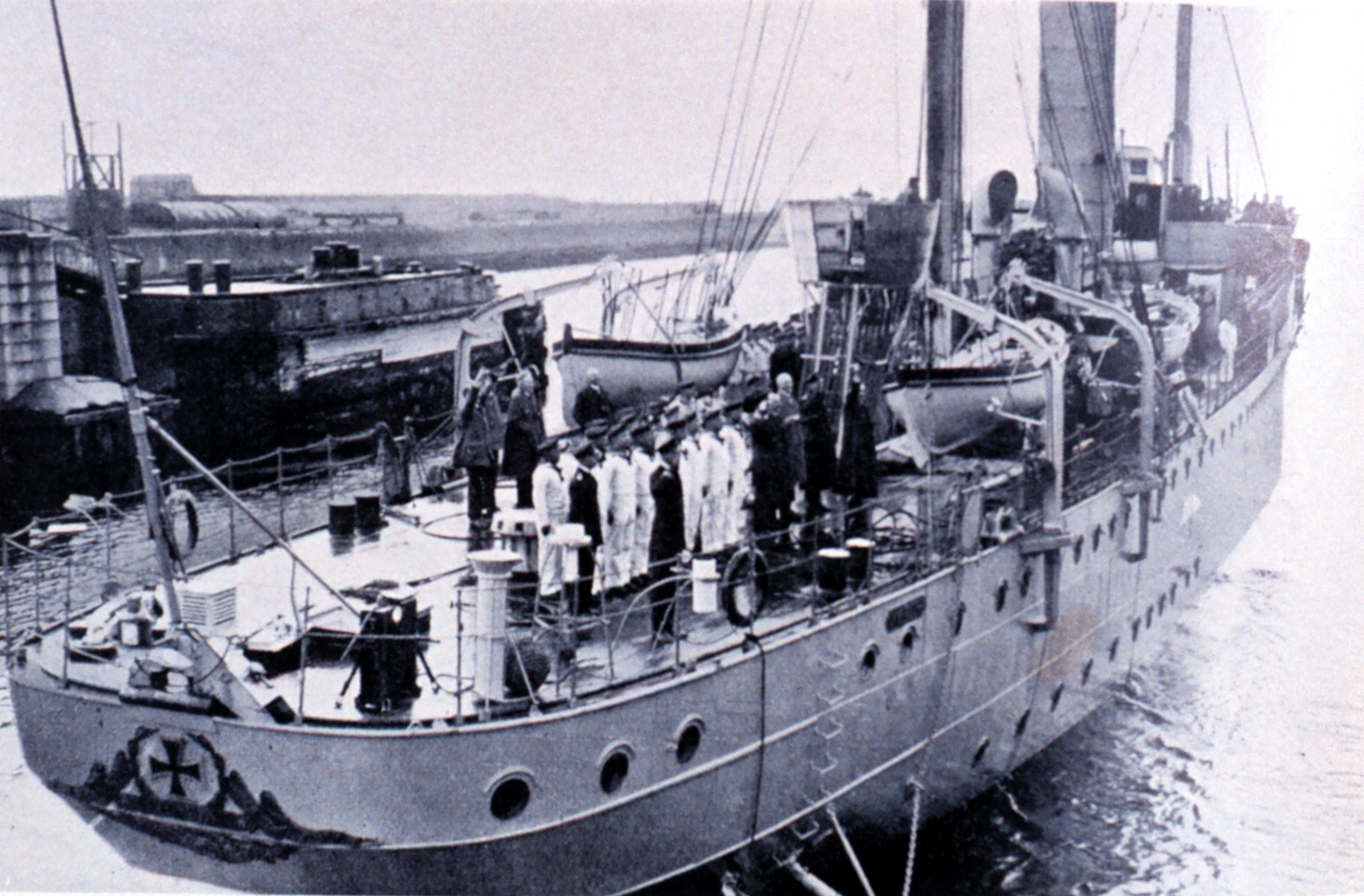
One hundred years ago, the research vessel Meteor set sail to systematically explore the Atlantic Ocean – one of the most important expeditions of the 20th century. To mark the anniversary, the Deutsches Schifffahrtsmuseum (DSM)/Leibniz-Institut für Maritime Geschichte opened the exhibition “Land gewinnen – Die Deutsche Atlantische Expedition von 1925 bis 1927” at the end of June 2025. GEOMAR Helmholtz-Zentrum für Ozeanforschung Kiel supports the exhibition with original photographic negatives, exhibits, and interviews with GEOMAR scientists to place the research in a modern context. In addition, GEOMAR and DSM have jointly launched an interactive storymap: Exactly 100 years ago today, on 18 October 1925, the researchers discovered the so-called Meteor Bank, a formation on the seafloor, on their route from Buenos Aires to Cape Town. The diary entries by captain Fritz Spieß allow the expedition to be traced station by station.
Planned routeing of the expedition
Alfred Merz, 1925
A. Merz - F. Spieß: Die Meteor-Fahrt
Original plan for the Deutschen Atlantische Expeditio 1925-27
In the spring of 1925, Meteor (I) set sail and covered 67,535 nautical miles across the Atlantic within two years – roughly the equivalent of three circumnavigations of the globe. During this time, the ship crossed the South Atlantic 14 times. Using innovative measuring methods, the researchers mapped the seafloor, analyzed currents, and even attempted to extract gold from the ocean. The voyage marked the transition from purely descriptive oceanography to the analytical oceanography practiced today. The Meteor Expedition from Today’s Perspective
In 2023, GEOMAR handed over original photographs of the Meteor expedition to the DSM/Leibniz Institute for Maritime History in Bremerhaven. The images presumably came to the then Institute of Marine Science – a predecessor of GEOMAR – during the Second World War. They are now part of the exhibition “Land gewinnen – Die Deutsche Atlantische Expedition von 1925 bis 1927” at the German Maritime Museum in Bremerhaven, which opened in the summer of 2025 to mark the centenary of the Meteor expedition. In addition to donating the glass plate negatives, GEOMAR is supporting the exhibition with numerous loans. Moreover, GEOMAR scientists provide short interviews to contextualize the research from today’s perspective. An interactive map tells the story of the voyage through original texts, photographs, and current commentary. Interactive Storymap
To accompany the exhibition at the German Maritime Museum/Leibniz Institute for Maritime History, GEOMAR and DSM have developed an interactive storymap that is now available online. It links the ship’s route with diary entries by Captain Fritz Spieß, original photographs, and present-day scientific commentary. In this way, the Meteor voyage is brought to life in a modern context 100 years later. In addition to its scientific aims, the expedition also pursued a political goal: it was a means to strengthen Germany’s international presence after the First World War. Numerous stopovers, especially in former German colonies, were therefore integrated into the voyage. DSM historians provide critical commentary on this aspect.
Marine Research 100 Years Ago
During the two-year expedition, the researchers carried out around 67,000 echo soundings. The resulting higher-resolution image of the seafloor revealed the Mid-Atlantic Ridge clearly for the first time. At over 300 stations, the scientists conducted chemical, physical, and biological investigations, accompanied by atmospheric measurements. Their work made it possible, among other things, to demonstrate the exchange of water between the current systems of the Northern and Southern Hemispheres. 18 October 1925: Discovery of the Meteor Bank
Exactly 100 years ago today, on 18 October 1925, the crew detected a formation on the seafloor with the echo sounder, which they named the “Meteor Bank.”
It was not entirely unknown at the time – but previously unnamed.
Captain Spieß wrote in his diary: "In the morning, we locate a bank using echo sounder, and we set a depth of 800 meters and station 65. We then name the bank “Meteor Bank” or “Meteor Ridge,” in keeping with yesterday's Bouvet Ridge (named Meteor-Bouvet in 1870). We sound the bank; it is a perfect cone rising to 590 meters. In the mess hall, we celebrate the bank and Meier's birthday belatedly. In the afternoon and at night, we sound the bank.
Translated with DeepL.com (free version) […]"
Further discoveries, insights into life on board, and commentary from a contemporary perspective can be explored in the storymap “100 Jahre Meteor-Expedition.”
Southern Ocean circulation, stratification and subsurface CO2 anomalies. (Nature Climate Change)
From Wired by Molly Taft Scientists have a lot of questions about our planet’s most important carbon sink—and a new project could help answer them.
A FOUNDATION CREATED by Eric Schmidt, the former CEO of Google, will fund a project to send drone boats out into the rough ocean around Antarctica to collect data that could help solve a crucial climate puzzle. The project is part of a suite of funding announced today from Schmidt Sciences, which Schmidt and his wife Wendy created to focus on projects tackling research into the global carbon cycle. It will spend $45 million over the next five years to fund these projects, which includes the Antarctic research.
“The ocean provides this really critical climate regulation service to all of us, and yet we don't understand it as well as we could,” says Galen McKinley, a professor of environmental sciences at Columbia University and the Lamont Doherty Earth Observatory and one of the lead scientists on the project. “I'm just really excited to see how much this data can really pull together the community of people who are trying to understand and quantify the ocean carbon sink.”
The world’s oceans are its largest carbon sinks, absorbing about a third of the CO2 humans put into the atmosphere each year. One of the most important carbon sinks is the Southern Ocean, the body of water surrounding Antarctica. Despite being the second smallest of the world’s five oceans, the Southern Ocean is responsible for about 40 percent of all ocean-based carbon dioxide absorption.
Scientists, however, know surprisingly little about why, exactly, the Southern Ocean is such a successful carbon sink. What’s more, climate models that successfully predict ocean carbon absorption elsewhere in the world have diverged significantly when it comes to the Southern Ocean.
One of the biggest issues with understanding more about what’s going on in the Southern Ocean is simply a lack of data. This is thanks in part to the extreme conditions in the region. The Drake Passage, which runs between South America and Argentina, is one of the toughest stretches of ocean for ships, due to incredibly strong currents around Antarctica and dangerous winds; it’s even rougher in the winter months. The ocean also has a particularly pronounced cloud cover, Crisp says, which makes satellite observations difficult.
“The Southern Ocean is really far away, so we just haven’t done a lot of science there,” says McKinley. “It is a very big ocean, and it is this dramatic and scary place to go.”
A large amount of the data available on ocean carbon cycles is not collected by scientific research crews, but by commercial shipping vessels running their usual routes. These ships run autonomous data collection as they travel, which provides a valuable source of information about the world’s oceans. This information, however, is geographically constrained to shipping routes; it’s a tough sell to convince a container ship to stray from a familiar course just to collect scientific data, especially in an ocean as rough as the Southern Ocean.
These data gaps are where uncrewed surface vessels—dubbed USVs—come in. The four USVs that will be deployed over the five-year course of the Schmidt Sciences-funded project can go outside the bounds of the usual shipping routes, collecting data on areas which would be nearly impossible to reach with crewed vessels. The drones will run continuously over the course of five years, piloted remotely, collecting valuable data even during the winter.
Their collection method, McKinley says, will also take more sophisticated measurements of the partial pressure of CO2 in the water—data that will give valuable insight into the carbon cycle process—than other projects that have put unmanned buoys or floats into the ocean. The project will use machine learning, McKinley says, to direct the USVs where to go in order to maximize data collection, adjusting the routes to get the best results. Data collected by the USVs will be made available to the public.
The project’s focus on data collection in the winter months is especially valuable for understanding the carbon cycle in the Southern Ocean, says Eileen Hofmann, a professor of ocean and earth sciences at Old Dominion University. But, she says, there are so many questions about how the carbon cycle works in the Southern Ocean that “anything would be helpful to add to the data collection.” This project, Hofmann said, seems “pretty cool.”
The funding structure of this project is set up as a public-private partnership: Money from Schmidt Sciences will buy collected data from the companies that own and operate the USVs, which, in turn, are contracted out through NOAA. (McKinley’s co-lead on the project, is a NOAA scientist with the Pacific Marine Environmental Laboratory; the agency is supporting her salary. Lexa Skrivanek, a program scientist at Schmidt Sciences, says the organization is “working independently from NOAA.”) NOAA has been testing out public-private partnerships using USV companies for a few years now, including sending USVs to travel into hurricanes this summer to collect data.
Federal funding for scientific research, especially around climate change, has been a central target for cuts from the Trump administration. The presidential 2026 budget, released in May, aims to slash NOAA’s spending by 30 percent; Democratic lawmakers attempting to defend the agency in Congress fear that a long shutdown could further starve the agency. (The proposed presidential budget cuts include eliminating all funding for NOAA’s Oceanic and Atmospheric Research arm, of which the Pacific Marine Environmental Laboratory is a part.) Meanwhile, the National Science Foundation’s budget would be cut by 57 percent under the presidential plan. The NSF’s Office of Polar Programs, which supports funding for other research into the Southern Ocean’s carbon cycle, laid off several program directors in February as part of wider cuts across the federal government. NSF cuts have also recently forced a long-standing Arctic research center to close. Other types of climate research and data collection have been attacked across agencies, including shuttering a long-running program collecting emissions data at EPA.
The carbon cycle projects Schmidt Sciences is funding, which also include projects in the Congo Basin and research on land-based carbon budgets, were pitched before the administration changeover. Skrivanek says that the organization has no plans to change its program focus, and that it is “fundamentally motivated to advance basic research and research that is interdisciplinary,” as well as international projects. However, scientists say that outside funding is becoming more crucial to ambitious projects as the US government scientific funding apparatus—one of the biggest drivers of research and development in the world—falls apart.
“The funding cuts on the federal level are putting more emphasis on looking for this type of funding,” says Hofmann.
New decentralised networks are even harder to disrupt than the hierarchical gangs they have replaced
There was nothing obviously amiss, even when inspectors began opening the tubs of passion-fruit pulp about to be shipped out of Callao port in Peru. A chemical test for illicit substances did not produce a red flag. Yet mixed into the sticky gloop was roughly nine tonnes of cocaine. It had been chemically masked to thwart testing kits, explains General Nilton Santos Villalta, the head of Peru’s anti-narcotics police. Only once the shipment had reached its final destination, in Belgium, would the traffickers have reversed the process and extracted anything that could easily be identified as cocaine.
Neutralizados, as Peruvians call such disguised drugs, are a growing scourge. In Cartagena port, in Colombia, cocaine has been found infused into recycled plastic, mixed into ground coffee and dissolved inside hundreds of carefully resealed coconuts. Such stashes can evade detection not only by chemists, but also by the giant x-ray scanners that are used to hunt for drugs at many container ports. And it is not just smuggling methods that are evolving fast: the entire drugs business is changing in ways that are making it even harder to stem the flow of narcotics around the world.
Global production, seizures and consumption of cocaine are all at record highs, despite 50 years of the war on drugs—a fight that President Donald Trump is now intensifying by bombing alleged Venezuelan smuggling-boats in the Caribbean. This is in part because prohibition makes a cheap commodity, cocaine, enormously lucrative. When it can fetch on the street in Europe 125 times what it does at the laboratory door in Latin America, someone will always be willing to fight to sell it, often literally.
Over the past 15 years the business has evolved rapidly. Whereas drug gangs used to be vertically integrated, with a single kingpin supervising production, transport and distribution, they now rely heavily on outsourcing. This more fragmented, distributed system, in turn, has fuelled specialisation and innovation. Traffickers no longer focus almost exclusively on the United States: smuggling has gone global. The result is a system that is more dangerous to the world and more difficult to disrupt.
Estimating global cocaine sales is, naturally, extremely hard. Global Financial Integrity, a think-tank, valued the market at between $84bn and $143bn in 2014, making it a bigger business than chocolate. Whatever the true figure in 2014, it is now higher: cocaine production (which is easier to track) has more than tripled since.
Painful blow
That partly reflects cocaine’s spread. Demand in America remains high, but has stagnated with the rise of fentanyl and other drugs. Cocaine consumption in Europe, however, is thought to have risen by 60% in the decade to 2022. In 2023, for the seventh year in a row, seizures in Europe hit a record. It is probably a bigger market now than the United States.
Australia seems to consume more cocaine per person than any other country. Snorting is also on the rise in Asia, where seizures grew five-fold between 2013 and 2023. Consumption has soared in Latin America, too: Brazil may be the second-biggest single-country market (see map).
This globalisation has been driven by traffickers chasing high prices. In America a kilo of wholesale cocaine is worth about $30,000 but in western Europe it fetches between $39,000 and $45,000. (Retail prices are more exorbitant still.) Even higher prices are now prompting traffickers to target Asia and Australia. In Hong Kong a kilo goes for $65,000 and in Australia it can reach over $250,000.
As it has globalised, the industry has been transformed. Whereas Colombian and Mexican kingpins used to try to monopolise every facet of the business, from the coca farm to the nightclub bathroom, even today’s biggest gangs, such as the Sinaloa and Jalisco New Generation cartels in Mexico, First Capital Command (pcc) in Brazil and the ’Ndrangheta, an Italian mafia, often directly operate only one part of the supply chain. Drug trafficking is instead a fluid network of subcontractors and service-providers, including chemists, hitmen and money-launderers. Each service-provider charges a fee. Sometimes big outfits, such as the pcc, try to integrate more tightly, pushing service-providers into semi-permanent alliances. Yet often these freelancers work simultaneously for several gangs or for white-collar investors, known as “invisible narcos”, who finance and orchestrate drug shipments.
For the traffickers the new way of doing things has big benefits. It makes the supply chain far more resilient than in the command-and-control model. If a shipment is captured, tracing the owners is fiendishly difficult. Most importantly, as Adam Smith would have predicted, specialisation improves efficiency and breeds innovation.
Consider cultivation. The original coca growers were poor farmers in isolated valleys in the Andes. No longer. In Colombia production is now heavily concentrated in lower-lying border areas, especially near Ecuador, for easier access to the port of Guayaquil. In Peru farming is expanding deep into the Amazon basin for convenient export to Brazil. Coca, traditionally grown almost exclusively in Colombia, Peru and Bolivia, is now also farmed in Belize, Guatemala, Honduras and Mexico.
Yields are rising. In Colombia they have almost doubled since 2005, to about 8.5 tonnes of leaves a hectare. In some areas they reaches 11.7. The savviest farmers test the soil and apply the optimal amount of fertiliser by drone, explains Leonardo Correa of the un Office on Drugs and Crime: “It’s precision agriculture.”
Processing is also changing—and becoming much more efficient as it does so. More than half of the seizures of exports from Peru are now of “coca base”, a less refined product than pure cocaine. Some of that is made into cocaine in laboratories in Bolivia and Brazil, and then sent on to Europe, but the latest trend is nearshoring, in which the final processing takes place in the destination country. Last year police in the Netherlands, for instance, destroyed 24 cocaine labs.
The rationale is economic. Chemists are easier to find in Amsterdam than the Amazon. A seized shipment of coca base constitutes a smaller loss than pure cocaine. European gangs also want to increase their margins. In cocaine, as in much else, Latin America risks becoming only a commodity exporter.
Smuggling and distribution, too, are being subcontracted. A European gang might send an envoy to Los Lobos, a big Ecuadorean gang, to buy cocaine. Los Lobos will then contract a Colombian outfit to bring the goods across the border. The Colombians, in turn, may deal with lots of small suppliers. Both Los Lobos and the Colombians will probably also pay smaller gangs to smooth the route across the border and through Guayaquil. “Everyone is subcontracting absolutely everything,” says Elizabeth Dickinson of International Crisis Group, a think-tank, likening cocaine production to that of an iPhone.
Subcontracting has spread to smuggling, too. A single seized shipment will sometimes have cocaine from many different producers and belonging to multiple owners, often distinguished by marks of different sorts on the packaging. That provides accountability for quality and tracking for ownership, says General Santos Villalta, who points to a confiscated press used to stamp “pf2” into bricks.
Powder play
To confuse the authorities, drugs often go via a transit country such as Costa Rica. There the drug-owners will contract a local gang to receive, store and send on the drugs. Even in Mexico cartels sometimes ship drugs owned by other groups across the American border for a fee, says a trafficker for Los Chapos, a faction of the Sinaloa cartel.
Given all the subcontracting, technology is used to build trust and traceability. “When they put the drugs on the ship, part of those drugs will be tracked by gps,” says Lincoln Gakiya, a Brazilian prosecutor who lives surrounded by bodyguards. Trackers allow buyer and seller to follow a shipment’s progress and to locate it on arrival. In Mexico cars used to transport drugs over the American border may also have a microphone for monitoring, explains the trafficker.
The innovation in smuggling is mind-boggling. Divers weld “parasite” pods of cocaine onto the hulls of ships so often that in Cartagena port watchmen are paid to sit in a tiny boat about 50 metres offshore all day and night to look for telltale bubbles. (To keep this lonely job they must pass a polygraph test every six months.)
Then there are the “narcosubs”. In July Ben Maenu’u was fishing off the Solomon Islands when he spotted an abandoned 25-metre craft that had been used to ship cocaine underwater. These are startlingly common: about 240 have been seized over the past two decades. The rate has increased sharply since 2018, according to InSight Crime, an investigative outfit. Last year some 25 were seized, a fraction of the hundreds that are probably out there.
Most narcosubs cannot fully submerge, but protrude only very slightly from the water, making them hard to spot. They used to take mainly short trips, close to shore. Nowadays, however, they are being used to cross the Atlantic and Pacific. Some genuine submarines are also being built, capable of carrying as much as 10 tonnes of cocaine. None has ever been captured at sea, but several have been discovered half-built in clandestine shipyards. The Colombian navy, meanwhile, recently seized a narcosub drone equipped with a satellite link to transmit live images.
Like squeezing a tube of toothpastephotograph: panos pictures
Such high-tech trafficking requires specialist skills. The result is narco business travel. In 2020 two Peruvian divers stashed 72 kilos of cocaine in the underwater vents of a ship in Callao, a tricky undertaking. Later that month they flew to Spain, donned their scuba gear and retrieved the haul. Narco chemists are frequent flyers, too. The person who makes a neutralizado is often flown to Peru, says General Santos Villalta, and then on to the destination port. “They have to send him because he is the only one who knows the formula to convert it back.”
Laundering drug money is another fast-evolving business. One popular option is to use the cash to finance other criminal enterprises. In Mexico it helped pay for diversification into fentanyl, now America’s biggest narcotic scourge and a business that has evolved along similar lines to cocaine. In Peru drug money often funds illegal gold-mining.
Often, however, the cash is in rich countries and gangs want to bring it back to Latin America. They used to send home wads of cash, but that is becoming rarer. Instead, laundering is often outsourced to Chinese specialists.
Most Chinese citizens cannot take more than $50,000 out of the country each year. That is far too little for many of them, which creates an opening for the launderers. The system uses mirror transactions; no money crosses borders, because that might draw the authorities’ attention. In supermarket carparks in America Chinese laundering groups receive bags of cash from drug dealers. Their affiliates in Mexico then forward the equivalent sum in pesos to the cartel’s Mexican account, minus a fee of about 2%. Wealthy Chinese in America buy the dollars from the Chinese gangsters. The Chinese buyers pay for the dollars via a domestic transfer to the launderers’ accounts in China. If the launderers need cash in Mexico, they can always export electronics or other goods from China, taking payment at the destination.
The system is fast and cheap: laundering used to cost almost ten times as much. And the innovation continues, especially with cryptocurrencies. Chainalysis, a crypto-research firm, estimates that in 2024 some $41bn of crypto linked to illegal activities changed hands around the world. Chinese laundering groups can operate as before, but repay drug gangs with cryptocurrency. Stablecoins are the most popular. These are pegged to a real asset such as the dollar but, unlike international cash transfers, they can be sent from one wallet to another with very little scrutiny.
“In financial crimes one of the biggest problems today in Brazil is usd Tether stablecoin and how easily they buy and sell it anonymously,” says Guilherme Alves de Siqueira of the Brazilian police. Stablecoins sent to Brazil can easily be converted into cash by doleiros, blackmarket money-changers. Brazilian drug gangs also use stablecoins to pay suppliers. A laundering group known as the Criptoboys converted 19.4bn reais ($3.6bn) into crypto between 2017 and 2023 for numerous clients, many of them traffickers.
Fintech firms have also supercharged money-laundering in Brazil. In 2024 it boasted 1,600 of them, only about a fifth of which were regulated by the central bank. “Many criminal organisations have their own fintech,” says Alexandre Custódio Neto, who is also with the Brazilian police. According to Fernando Haddad, the finance minister, such firms laundered 52bn reais over the past four years. The authorities are supposedly now cracking down.
The dispersed, outsourced business model is creating mayhem for governments. Payments to subcontractors are often made in cocaine, breeding addicts and fuelling violence. Small gangs hoping for work compete to show big ones how ruthless they are. The bigger outfits, in turn, resort to torture, beheadings and other grisly displays to punish thefts by subcontractors and thus send a message to other would-be thieves. Such trends helped spur a doubling of the murder rate in Costa Rica in the decade to 2023.
To lubricate business, gangs also try to capture the regulator. In Brazil, Ecuador and Mexico drug gangs regularly run their own candidates in elections. In Peru the parliament has recently passed a barrage of laws that make it harder to investigate crimes, including a requirement for defence lawyers to be present when search warrants are executed, which in effect gives suspects a warning to destroy evidence or flee. “We have already entered a black hole in which illegal economies, mainly cocaine and illegal gold, are taking control of strategic points of the state,” says Rubén Vargas, a former Peruvian minister of the interior.
The huge price premium for cocaine in Asia and Australia spells trouble for those places. Peru, where crime is surging and Asian gangs already have a foothold, is a likely point of origin. A giant new Chinese-owned port in Chancay, north of Lima, intended to dominate trade between South America and China, is a particular worry.
Coke is it
When returns are so vast, crackdowns do not curb trafficking and violence but rather spread it around. When Brazilian authorities declared they would force or shoot down any suspicious plane over the Amazon in late 2004, cocaine trafficking shifted from the air to rivers. A study by Leila Pereira of Insper, a Brazilian university, and colleagues, finds that over 1,400 murders between 2005 and 2020 can be attributed to this shift in trafficking patterns. That is more than a quarter of all murders in the area during that period.
This same logic explains why drug violence, which used to be concentrated in just a few countries in Latin America, now torments the whole region. Six years ago Ecuador was about as safe as the United States. It now has the world’s highest murder rate, as cocaine trafficking has shifted to Ecuadorean ports from more heavily policed ones in Colombia. Even safe havens are no longer safe. In September gangsters attacked the house of Uruguay’s chief public prosecutor with guns and grenades after police seized two tonnes of cocaine.
No matter how many drug boats are blown up, cocaine smuggling is not going to disappear. On the contrary, it is probably coming to a port near you.
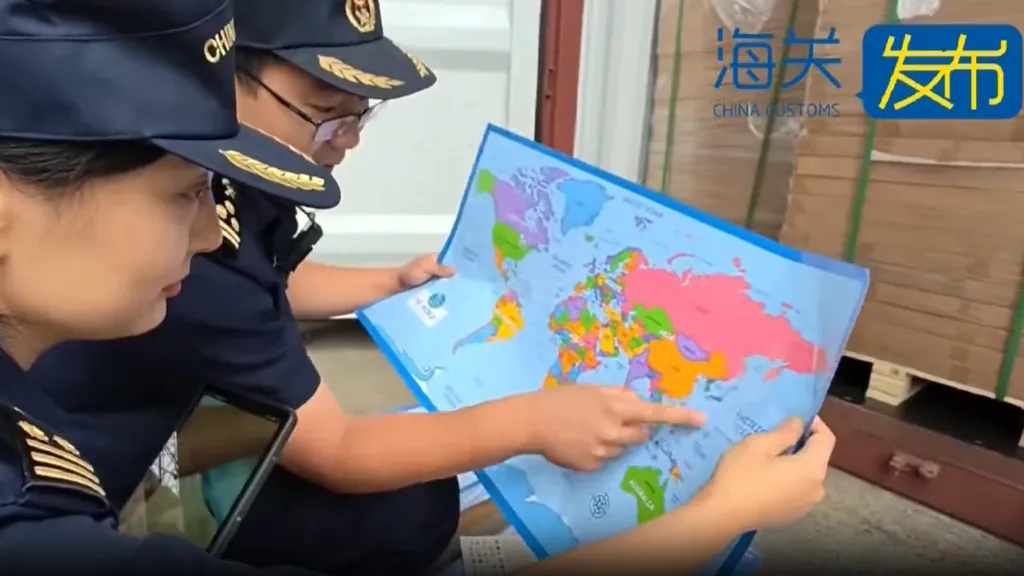
Customs officers recently seized a batch of maps bound for export, which they described as "problematic"
Chinese customs officers in eastern Shandong province have seized 60,000 maps that "mislabelled" the self-governed island of Taiwan, which Beijing claims as part of its territory.
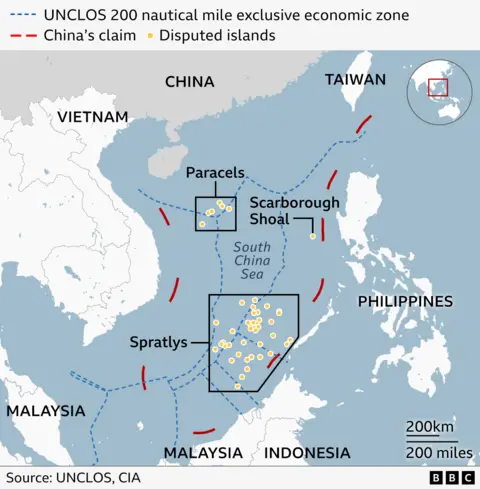
The maps, authorities said, also "omitted important islands" in the South China Sea, where Beijing's claims overlap with those of its neighbours, including the Philippines and Vietnam.
The "problematic" maps, meant for export, cannot be sold because they "endanger national unity, sovereignty and territorial integrity" of China, authorities said.
Maps are a sensitive topic for China and its rivals for reefs, islands and outcrops in the South China Sea.
China Customs said that the maps also did not contain the nine-dash line, which demarcates Beijing's claim over nearly the entire South China Sea.
The line comprises nine dashes which extends hundreds of miles south and east from its most southerly province of Hainan.
The seized maps also did not mark the maritime boundary between China and Japan, authorities said.
Authorities said the maps mislabelled "Taiwan province", without specifying what exactly the mislabelling was.
China sees self-ruled Taiwan its territory and has not ruled out the use of force to take the island. But Taiwan sees itself as distinct from the Chinese mainland, with its own constitution and democratically-elected leaders.
Tensions in the South China Sea flare up occassionally - most recently over the weekend, when ships from China and the Philippines figured in another encounter.
Manila accused a Chinese ship of deliberately ramming and firing its water cannon at a Philippine government vessel.
But Beijing said the incident happened after the Philippine vessel ignored repeated warnings and "dangerously approached" the Chinese ship.
The Philippines and Vietnam are also particularly sensitive to depictions of the South China Sea in maps.
The statement from China Customs did not say where the seized maps were intended to be sold. China supplies much of the world's goods, from Christmas lights to stationery.
The confiscation of "problematic maps" by Chinese customs officers is not uncommon - though the number of the maps seized in Shandong easily eclipses past seizures. Goods that fail inspection at the customs are destroyed.
In March, customs officers at an airport in Qingdao seized a batch of 143 nautical charts that contained "obvious errors" in the national borders.
In August, customs officers in Hebei province seized two "problematic maps" that, among other things, contained a "misdrawing" of the Tibetan border.






 photograph: ap