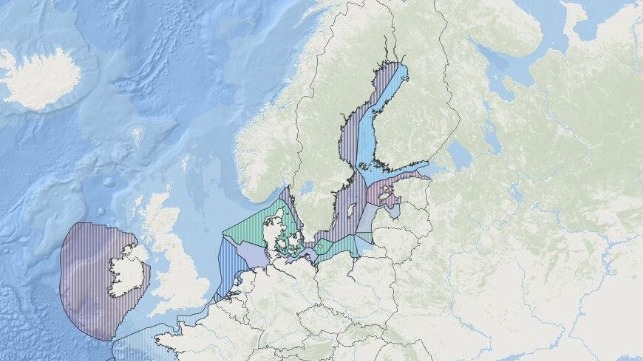
Maritime EssentialsThe semi-enclosed Baltic Sea is both a shallow and narrow basin connecting Europe’s northeast.
It is composed of the littoral states’ territorial waters as well as their exclusive economic zones — which, under the U.N. Convention on the Law of the Sea, allow foreign vessels innocent passage during peace time.
De jure, there’s no high sea in the Baltic.
Crucially, the Baltic Sea is only accessible via three choke points, which pass through individual countries’ littoral jurisdiction.
The principal entrance routes are from the North Sea via the depths of Kattegat and Skagerrak.
These are bounded by the Danish, Norwegian, and Swedish shores at a maximum distance of 100 nautical miles.
These routes proceed into the Danish straits with its Øresund, the Great Belt, and the Little Belt, all tight waterways with narrow widths and depths limiting navigation.
In addition to this route, there is Germany’s Kiel Canal (
used by almost 27,000 vessels in 2023) and Russia’s White Sea-Baltic Canal.
While Russia’s canal carries far less traffic, it is one of several strategically relevant Russian inland waterways
built under Tsarist and Soviet rule to connect the
Unified Deep Water System of Eurasian Russia.
Finally, between the German and Danish coasts, the Kadet Trench represents an additional, natural but significantly shallow waterway.
Due to critical water depths, it is the sole shipping corridor for larger vessels heading in or out the Baltic via the Kiel Canal, making it one of Europe’s most trafficked sea lines.
All incoming east- and northbound vessels pass Denmark’s Bornholm, one of several larger islands in the Baltic.
Since the beginning of the Hanseatic League in the 13th century, the Baltic has been a crucial corridor for trade and transport.
Today it holds tremendous economic value for littoral states.
Around 15 percent of global container shipping crosses the Baltic — roughly 2,500 vessels daily.
Alongside military and law enforcement vessels, the maritime traffic consists of container, tanker, and commercial vessels, as well as fishing boats and ferry services.
On top of that,
a major increase in dark shipping has caused distress
in the Baltic and beyond.
Dark ships are vessels without an active Automatic Identification System, which usually transmits the ship’s position together with necessary information for its identification.
Western sanctions against the Russian Federation and its economy have led to an increase of vessels like oil tankers smuggling sanctioned goods, creating new risks for maritime safety and security
from the Baltic to South East Asia.
This connectivity is also represented on the seabed, which hosts a network of telecommunication cables, energy transmission routes, and pipelines.
Increasingly, it is also home to a growing number of offshore energy installations.
Finally, adding to the complexity, there are sea mines as well as conventional and chemical weapons lying on the seafloor.
In German territorial waters alone there is
estimated to be 1.5 million tons of ammunition stemming from both world wars.
Any effective strategy for the Baltic should take into account the need for a joint and combined approach to planning, operations, and strategy, including the use of islands and choke points to deny an enemy access.
Yet these constraints do not eliminate the need for other fundamentals of naval warfare, including
mine warfare,
anti-surface, anti-air, and anti-submarine warfare, as well as
amphibious operations.
The fragmented coastlines and thousands of islands create both
opportunities to maneuver as well as
challenges for the defenders, and short distances favor the use of aircraft with anti-ship missiles against opponent vessels.
Alongside Denmark’s Bornholm, Sweden’s Gotland, Estonia’s Hiiumaa and Saaremaa, and Finland’s Åland islands are crucial.
This geography makes denying an enemy naval force access to a particular area possible through a concerted effort bringing together a combination of services.
That said, despite NATO members’ control of a majority of the coastline, the idea of complete sea control in the Baltic is
an illusion.
First, in peacetime, international law grants innocent passage and ensures adversarial vessels freedom of navigation.
During conflict, complete control cannot become reality so long as Russia remains an
active presence around the Baltic’s shores.
As stated by the U.S.
tri-service
Maritime Strategy, sea control is “[t]he condition in which one has freedom of action to use the sea for one’s own purposes in specified areas and for specified periods of time and, where necessary, to deny or limit its use to the enemy.” This also includes the space below and above the water’s surface as well.
It would not be possible to achieve such level of control and navigate safely in the Baltic without the “
neutralization of Russian capabilities.”
Allied naval capabilities largely rely on what are called
small navies.
So-called medium navies, such as the Royal Danish Navy and the German Navy, offer a broader set of capacities and capabilities.
They are designed to
operate globally on a
frequent basis.
For
smaller naval forces, their power and influence should be understood with reference to their strategic ends.
In this case, they will have to face the
demands of high-intensity naval warfare vis-à-vis the
still existing European missile gap.
Yet, Baltic Sea navies are adjusting to regional requirements, with upcoming
procurements of new submarines, from the German-Norwegian 212 CD to the Swedish A26 (there are also continuous reports about the
Polish Orka program).
Furthermore, allied forces have focused on asymmetric approaches — including increasing investments in
coastal defenseand denial capabilities — to generate effects from the sea’s coastlines.
Still, for the time being, the support of Baltic external naval powers like the
Royal Navy and
U.S.
services remains central.
There has already been considerable
discussion about how the
admission of Finland and Sweden will affect
NATO’s Baltic strategy.
Both possess significant military capabilities in relation to regional conditions.
Finland’s air force, which will soon include 64 F-35As, has the potential to strike and block maritime targets within the whole Gulf of Finland.
The Swedish submarine-backed naval force is specialized for shallow Baltic conditions and can operate within the sea’s opaque archipelagos.
Finnish and Swedish bases, ports, and infrastructure will now be
even more accessible and available to allies.
The Need for CooperationIn the Baltic maritime area of operations, NATO faces a situation in which it should be able to execute defensive and offensive aspects of naval warfare.
On the one hand, the defense of strategically relevant islands, choke points, and sea lines of communication in general remains crucial.
The maritime realm cannot be treated as a continuation of allied territory or purely as a form of strategic depth.
In case of conflict, movement would be frequently challenged and definitely not guaranteed.
Therefore, NATO forces should not only prepare for far-reaching mine-cleaning operations, but also be able to fulfill offensive operations even in the Baltic area.
Finally, allied navies should remember that challenge in the Baltic is not limited to the possibility of high-intensity conflict.
Already today,
violations of allied air spaces and maritime territories,
harassment of naval and
civilian vessels,
sabotage, and
espionage are taking place.
NATO states are now forced to increase their capacities and capabilities in the region in all domains.
They realize this calls for coordination and integration among different countries and branches, but they are still moving slowly.
The admission of Sweden and Finland into NATO and the readjustment of European threat perceptions are certainly positive, but internal obstacles, such as
fragmented procurement and caveats in sharing
intelligence, surveillance, and reconnaissance data, still offer plenty of grounds for improvement.
Thankfully, cooperation is increasing.
The German-led
European Sky Shield Initiative aims at merging allied air defense efforts.
Besides being labelled a “
procurement initiative,” the battle-proven IRIS-T air defense system is now part of broader
European acquisitions.
The goal of creating a
joint Nordic air defense, consisting of Swedish, Norwegian, Finnish, and Danish air forces, shows the forward-thinking approach of the Nordic countries.
Finally the British-led
Joint Expeditionary Force is increasing its footprint in the Nordic-Baltic region, another important step.
Future DynamicsCurrent assessments of Russian military capabilities in the broader Baltic Sea region are mixed.
Moscow’s position in the Kaliningrad Oblast and the western Russian border regions appears
comparatively weak.
This is because materiel and personnel have been ordered to Ukraine and the original strength has not been restored.
Yet this mainly applies to land forces, like the Baltic Fleet’s
11th Army Corps, and capabilities like air defense systems.
And it may not prove true forever.
Analysts expect a certain
regrowth of the Russian military to take place in the upcoming years.
Besides its fatal losses in the Black Sea, the Russian navy continues to commission new vessels at a pace observers have
grudgingly called “impressive.”
Kaliningradoffers Russia opportunities to influence the southeastern part of the Baltic Sea region, even as it also serves as a
truly vulnerable Russian outpost.
In short, for the Baltic littoral, the Russian threat remains.
Ukrainian innovation and adaptiveness in the Black Sea offers NATO some options in terms of how to respond.
Denial capabilities, paired with increasing intelligence, surveillance, and reconnaissance capabilities, would allow NATO allies ought to better contain Russian naval force in the Baltic.
However, the West should prepare for Russia not only to reconstitute but also adapt its forces based on lessons from the Black Sea.
This could reinforce a dynamic of mutual area of denial — even creating a limited and temporary “
maritime no man’s land” for crewed vessels in areas like the southern Baltic.
Due to the Baltic’s narrow character, this is possible even with limited means.
Looking forward, NATO allies should consider the sea’s challenges while orchestrating a capable allied force to defend against and deter potential aggressions.
This includes taking advantage of islands, archipelagos, and coastal areas.
It also means challenging the misleading idea that these islands are “
unsinkable aircraft carriers.” Ukraine’s tactics have shown the need for a diversified set of bases and airstrips to cope with Russian strikes.
The problem with islands, however, is that you cannot move them.
So, while many of them are valuable for sea control, they are not invulnerable.
With this in mind, the smaller and more numerous islands along Baltic coasts and archipelagos should be
included in planning.
Regional forces could adopt an approach of distributed lethality, while larger NATO assets like U.S.
guided-missile destroyers could support, deter, and fight along the broader northern flank from the North Atlantic up to the Arctic.
Nevertheless, during a kinetic conflict, a NATO including Sweden and Finland should be able to achieve a certain level of control in particular parts of the Baltic, like the Gulf of Bothnia and the Danish straits.
Such high-intensity preparations, however, should be accompanied by serious political preparations.
This means that NATO’s leadership has to prepare for the
potential of nuclear blackmail and escalation.
In the event of a kinetic conflict, would leaders in Europe and the United States be willing, for example, to strike the Kaliningrad Oblast to fully diminish large parts of the conventional threat in the Baltic Sea region? Regardless of the answers to these questions, NATO and the United States remain central to defense and deterrence in the Baltic Sea region.
What happens in the Baltic will have
major implications for regional defense and deterrence efforts.
As such, it should be of interest to alliance members well beyond the sea’s littoral.