Chemicals used to clean up spills have harmed marine wildlife, response workers and coastal residents. The EPA must act.
By day, a secluded bay in Prince William Sound is the site of spawning salmon destined for supermarkets.
But when the tide goes out and the beach is exposed, evidence of oil can be found, 26 years after the Exxon Valdez spill.
Final segment of a three-part investigation.
Thirty years ago, on 24 March 1989, communities in Prince William Sound, Alaska, awoke to horrific news: the Exxon Valdez, an oil tanker, had run aground and leaked 11m gallons of oil into the sound.
Chaos ensued.
Fishermen desperately began collecting oil in five-gallon buckets.
Exxon, meanwhile, responded by burning floating oil and dumping toxic oil-based chemicals called “dispersants”.
Dispersants break oil apart into smaller droplets, and this was assumed to enhance natural dispersion and degradation of oil, thereby “cleaning up” a spill.
Instead, the dispersants formed chemically enhanced oil particles that proved to be more toxic to humans and the environment than the oil alone.
NOAA map excerpt showing Bligh Reef and automated beacon with the GeoGarage platform
Twenty-one years later, on 20 April 2010, the BP Deepwater Horizon drilling rig exploded off the Louisiana coast, releasing 210m gallons of oil into the Gulf of Mexico.
The subsequent response was all too familiar – burning oil and dumping dispersants once again.
Two million gallons of dispersants were applied to “clean up” the spill.
Instead, these chemicals led to unprecedented oil deposition on the ocean floor, resulting in severe impacts to marine wildlife from the sea floor to the upper ocean – including large dolphin die-offs, fish kills, and deformities – and devastating pulmonary, cardiac and central nervous system illnesses for response workers and coastal residents.
Dispersants are being used in the Deepwater Horizon oil spill response.
Dispersants are not safe to humans or the environment.
They contain various industrial solvents and workers must be protected from exposure.
Dispersants are usually applied directly to the spilled oil by spraying from an airplane, helicopter, or vessel.
During the 1989 Exxon Valdez oil spill cleanup in Alaska, some dispersants were manually sprayed by workers on oiled beaches.
Although dispersants are manufactured by many companies and their ingredients may differ, most contain a detergent and a solvent.
The solvent allows the detergent to be applied.
The detergent helps to break up the oil on the water surface into very small drops.
These tiny oil drops are then able to easily mix with the water and be diluted.
Most dispersants contain petroleum distillates, a colorless liquid with a gasoline- or kerosene-like odor.
They are composed of a mixture of paraffins (C5 to C13) that may contain a small amount of aromatic hydrocarbons.
Exposure to can cause irritation to the eyes, skin, or respiratory tract.
NIOSH also recommends preventing skin contact with oil mist.
To prevent harmful respiratory and dermal health effects NIOSH recommends reducing worker exposures to petroleum distillates and similar cleaning agents in dispersants.
This was clipped from video produced by the Governors Office of the State of Alaska in 1989 and 1990.
This is why our coalition of environmental justice organizations, conservation groups and individuals from Alaska to Louisiana directly affected by dispersants gave the Environmental Protection Agency (EPA) notice this week of our plan to sue the agency to compel it to update its rules regulating the use of chemical agents known to be harmful to the environment and everything in it.
We are concerned that the EPA is putting at risk the 133 million or so Americans who live near the coasts, making up 39% of the US population, and the millions more who live near lakes, rivers, or along oil pipeline corridors and who are in harm’s way of the next “big one”.
The use of these dispersants is a response method outlined in a set of federal regulations called the National Contingency Plan, which governs our nation’s oil and chemical pollution emergency responses.
The Clean Water Act directs the EPA to periodically review the plan and update it to account for new information and new technology.
By requiring periodic updates of the plan, Congress sought to ensure it would reflect current understanding of response methods and facilitate actions that minimize damage from oil spills.
The EPA last updated the National Contingency Plan in 1994.
That it does not reflect the advances in understanding of dispersant toxicity that came after the BP Deepwater Horizon disaster is, at best, a gross understatement.
In fact, the 1994 update did not even incorporate lessons learned from the long-term ecosystem studies following the 1989 Exxon Valdez disaster.
In 2011, EPA’s Office of the Inspector General concluded that the plan urgently needed revision.
It took a public petition filed by Dr Ott and members of the grassroots organization now known as Alert (A Locally Empowered Response Team) to prompt the EPA to modernize the plan; in 2013 the EPA finally initiated a rulemaking proceeding.
In 2015, the agency invited and received over 81,000 public comments, a majority of which called for reducing use of oil-based chemical dispersants and better efficacy and toxicity standards.
Techniques used after the 1989 Exxon Valdez oil spill—such as washing sand and returning it to beaches—are helping to clean Gulf of Mexico coasts affected by the oil spill.
But since the comment period closed in April 2015, the EPA has been silent on the issue.
Meanwhile, the Trump administration, under the new National Outer Continental Shelf Oil and Gas leasing program, plans to open 90% of US coastal areas to oil and gas drilling, putting communities back in harm’s way.
Given the history of offshore oil drilling, it is simply a matter of when – not if – another devastating spill will occur.
Delaying updates to the National Contingency Plan is a dangerous dereliction of EPA’s duties under the Clean Water Act.
We can no longer stand on the sidelines and hope the agency will act.
On behalf of those who have already lost their homes, their livelihoods, their health – and even their lives – we are going to court to demand action.
Support yachts can lug your helicopter, and ‘lots of jet skis’ They can also serve as overflow accommodations for guests
Sailing from port to port in peace and seclusion on a multimillion-dollar boat sounds appealing, but as any seasoned yacht owner can tell you, just cruising around can get a bit, well, boring.
To fully enjoy your luxury vessel, you need diversions.
Maybe a sailboat or fishing and diving gear.
Possibly jet skis, a seaplane or perhaps a submarine.
But where does one stash all that gear?
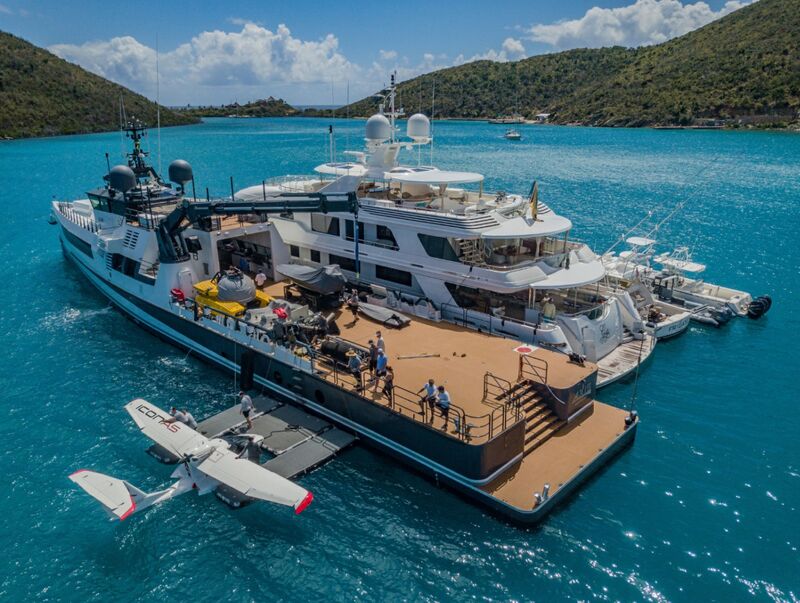
Enter the support yacht.
It’s essentially a boat designed to trail your main yacht and carry all the toys you don’t want cluttering up the mothership.
Pioneered in the 1990s from old offshore oil and gas craft, support yachts have become as slick as the vessels they’re intended to serve.
The 69.15-metre expedition superyacht Game Changer
Dutch shipbuilder Damen has delivered a half-dozen 70-meter support yachts with premium finishes like high-specification air conditioning and entertainment systems that cost about $50 million.
The Damen Yacht Support line starts at 46 meters and $14 million.
“A support yacht boosts the yachting experience in every way,” said Victor Caminada, marketing manager for Damen’s Amels division, which is exhibiting at next week’s Palm Beach International Boat Show.
“Fun on the water, flexibility, spontaneity, more destinations. It’s very difficult and costly to achieve the same capability in one luxury yacht.”
The typical yacht only has room to store a few small leisure craft at most.
To quickly access remote lagoons, dive sites and secluded beaches, wealthy vacationers may need limousine tenders for transfer to the marina, light aircraft, four-wheel drive vehicles, and of course “lots of jet skis,” Caminada said.
Launch Pad
Having all those transport options is helpful in the case some guests want to go on an expedition while others would rather hang out on deck.
Many support yacht can easily store a helicopter for shuttling guests back and forth and have helipads that make for a less disruptive landing and launch.
And they’re not just for heavy equipment.
Support yachts can carry everything from spare provisions, laundry and fine china to garbage and waste water.
To allow more privacy, the support craft could house cabins for staff or family office executives.
These days the vessels are swank enough to even serve as overflow accommodations for guests.
The in-laws, for example.
The boats also need to be equipped with high-performance deck cranes for deploying and retrieving all the toys, which can weigh as much as 10 tons each.
Even at $50 million, the support boats are a value proposition, according to Caminada.
“It’s far more economically viable to add a yacht support vessel than it is to upgrade a 50-meter superyacht to, say, a 90-meter to accommodate extra supplies and equipment,” he said.
“The combination of a luxury yacht and support yacht is a much lower total cost of ownership.”
If people knew the wonder and beauty of the UK’s marine habitats they would want to protect them
The life of a conservationist often feels like one long struggle, taking little-known challenges and trying to make them mainstream.
How do environmental issues move from niche interests to global concerns?
The explosion of action on marine plastics has been a success story on an unprecedented scale.
Film producer Jo Ruxton spent years raising funds and doing research for her film A Plastic Ocean, described by David Attenborough as “one of the most important films of all time”.
But it was not until last year’s Blue Planet II series, and the plastics campaign by this and other newspapers, that concerns around marine litter began to be more widely shared.
Having worked in conservation for more than 20 years, I was delighted by the sea-change in attitudes.
But, like other environmentalists, I am concerned that other challenges are not getting the attention or resources they need.
This isn’t about downplaying the threat of marine plastics, but about how we can learn from the plastics story and apply these lessons elsewhere.
Crucially, all those involved in communicating what is happening to our seas must seek to inspire people as well as alarm them.
The makers of the BBC’s Blue Planet Live, which started on Sunday night, understood this when they chose to present Chris Packham’s joyous encounter with whales off the coast of Mexico along with segments about attempts to regrow the Great Barrier Reef, and endangered sharks.
There is cause for concern closer to home, too.
Around the British Isles we have some fabulous marine habitats.
Seagrass meadows store carbon and are a secret weapon in the fight against climate change.
Horse mussel reefs keep our seas clean and provide nursery areas for the young of whelks and other shellfish.
Having grown up by the sea on the Isle of Man, I have been excited by beautiful, diverse, life-giving marine habitats all my life.
Their loss is one of the main reasons behind our current extinction epidemic.
It frightens me more than anything else apart from climate change.
But if nobody knows about the importance and wonder of these habitats, no one will join the fight to save them.
And there is good news as well as bad.
Marine habitat protection is becoming better understood and momentum is building.
There has been encouraging progress in establishing marine protected areas.
The point of these is to prevent damaging activities, allowing habitats to restore themselves naturally, and to intervene using active restoration when habitats have been damaged beyond the point of natural recovery.
Last week it was announced that Ascension Island (part of the UK overseas territory of St Helena, Ascension and Tristan da Cunha) will be protecting more than 171,000 square miles (443,000km2) of its waters as a no-take marine protected area.
No-take zones are the gold standard of marine conservation and studies from around the world have demonstrated how they allow natural ecosystems to recover and bring benefits to the oceans beyond.
In the UK there are nearly 300 marine protected areas in place and consideration of a further 41 new marine conservation zones is under way.
Results are also beginning to emerge from experiments showing that a high level of protection is possible, even in the busy waters around the British Isles.
Project Seagrass, based at Cardiff University, has been raising awareness of seagrass in the UK and around the world and has developed a seagrass spotter app for scientists and the public to record their sightings.
They promote the value of seagrasses not only for biodiversity, but also for their role in mitigating climate change.
The Native Oyster Restoration Alliance is a network of European scientists and conservationists involved in restoring the extensive oyster beds that were once found all around north-west Europe.
After decades of work by oyster specialists to highlight the value of restoring this habitat, European native oyster restoration is really taking off.
These captivating habitats have been neglected for so long because very few people see them.
There has been a persistent misconception that the waters around the British Isles are usually dull, murky and devoid of life, which couldn’t be further from the truth.
But without a personal connection to these beautiful alien worlds, it is difficult for decision-makers and the public to prioritise healthy habitats over other uses of the seabed.
A way to recycle plastic garbage
We are beginning to understand how the impacts of plastics go beyond the obvious harm to marine life, polluting our food and disrupting natural processes.
Now we also need to turn our attention to the essential role of our marine habitats in supporting fisheries, cleaning coastal waters and helping to regulate our climate – and act now to protect them for the future.