(Credit: AFP/Getty Images)
From BBC by Paul Marks
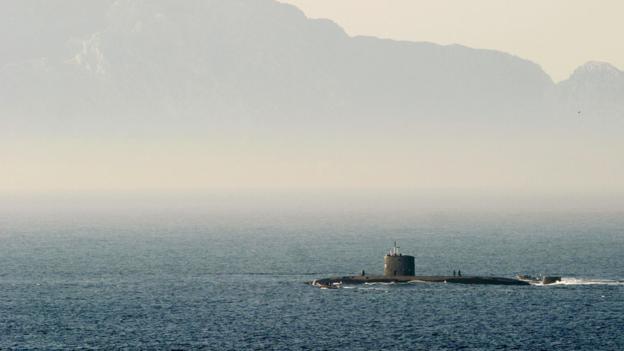
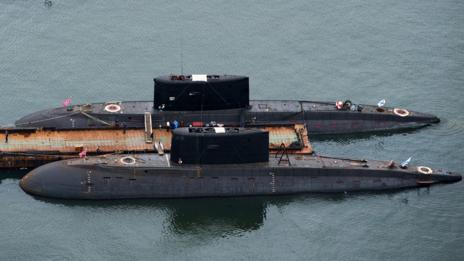
When nuclear-powered submarines reach the end of their lives,
dismantling them is a complicated and laborious process.
Nuclear submarines have long been a favourite in popular fiction.
From
movies such as The Hunt for Red October to long-running TV series like
Voyage to the Bottom of the Sea, they have always been portrayed as
awesome instruments of geopolitical power gliding quietly through the
gloomy deep on secret, serious missions.
But at the end of their useful lives the subs essentially become
floating nuclear hazards, fizzing with lethal, spent nuclear fuel that's
extremely hard to get out.
Nuclear navies have had to go to
extraordinary lengths to cope with their bloated and ageing Cold War
fleets of hunter-killer and ballistic missile nuclear subs.
Kara Sea with the Marine GeoGarage (NGA charts)
As a result, some of the strangest industrial graveyards on the
planet have been created – stretching from the US Pacific Northwest, via
the Arctic Circle to Russia’s Pacific Fleet home of Vladivostok.
These
submarine cemeteries take many forms.
At the filthy end of the
spectrum, in the Kara Sea north of Siberia, they are essentially nuclear
dumping grounds, with submarine reactors and fuel strewn across the
300m-deep seabed.
Here the Russians appear to have continued, until the
early 1990s, disposing of their nuclear subs in the same manner as their
diesel-powered compatriots: dropping them into the ocean.
Rusting remains
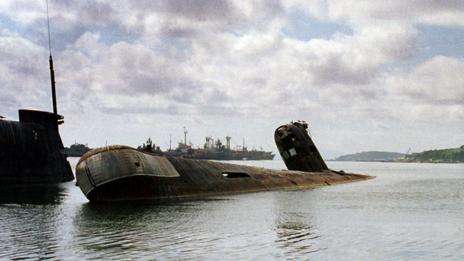
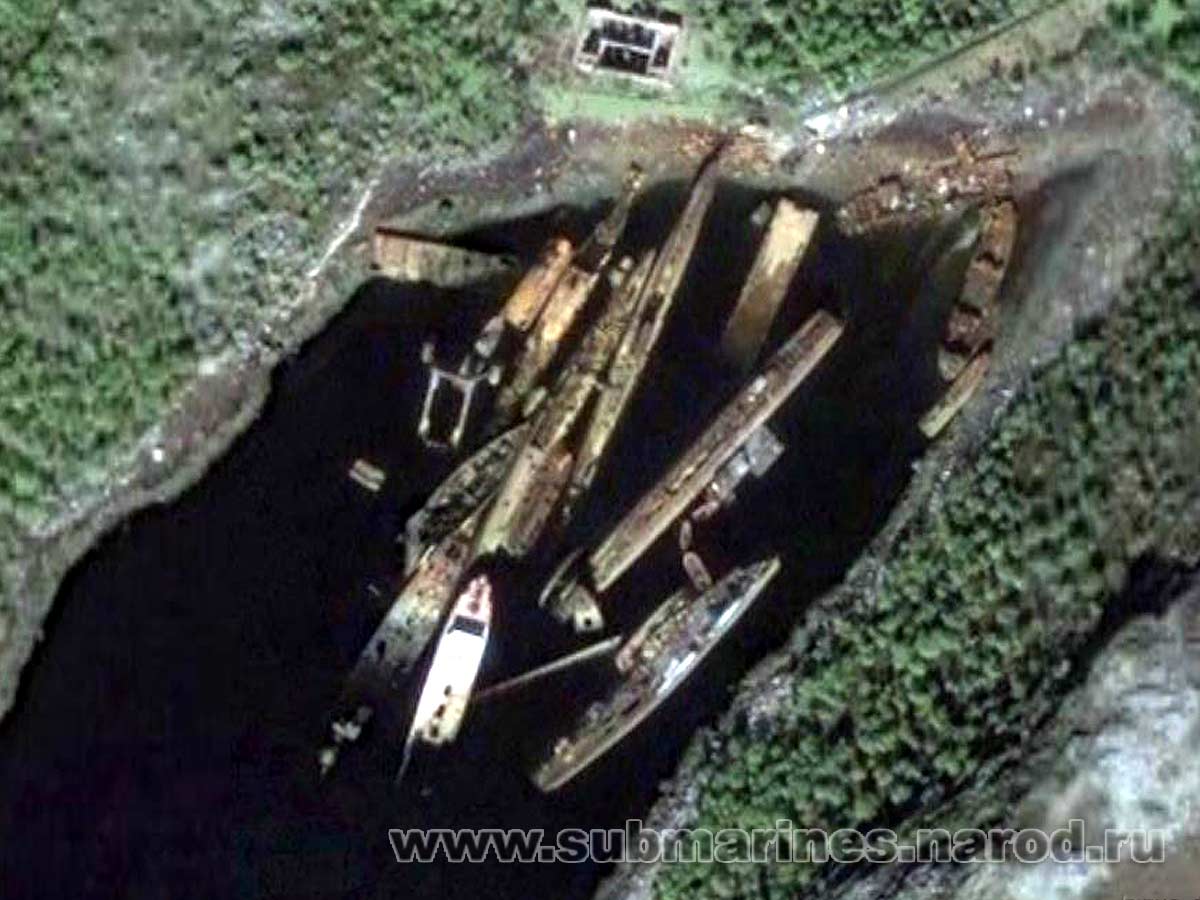
The diesel sub scrapyard in the inlets around
Olenya Bay
in north-west Russia's arctic Kola Peninsula is an arresting sight:
rusted-through prows expose torpedo tubes inside, corroded conning
towers keel over at bizarre angles and hulls are burst asunder, like
mussels smashed on rocks by gulls.
The Soviets turned the Kara Sea
into "an aquarium of radioactive junk" says Norway’s Bellona
Foundation, an environmental watchdog based in Oslo.
The seabed is
littered with some 17,000 naval radioactive waste containers, 16 nuclear
reactors and five complete nuclear submarines – one has both its
reactors still fully fuelled.
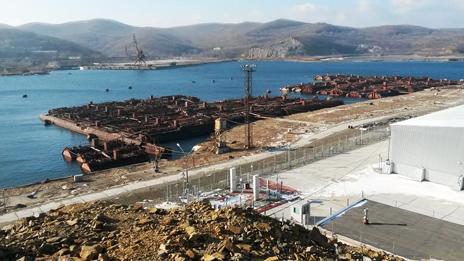
Russian reactors have been stored in the harbour at Vladivostok
The Kara Sea area is now a target for oil and gas companies – and
accidental drilling into such waste could, in principle, breach reactor
containments or fuel rod cladding, and release radionuclides into the
fishing grounds, warns Bellona's managing director Nils Bohmer.
Olenya Bay with the Marine GeoGarage (NGA charts)
Official
submarine graveyards are much more visible: you can even see them on
Google Maps or Google Earth.
Zoom in on America's biggest nuclear waste
repository in
Hanford, Washington,
Sayda Bay in the arctic Kola Peninsula, or the
shipyards near Vladivostok
and you'll see them.
There are row after row of massive steel
canisters, each around 12m long.
They are lined up in ranks in Hanford's
long, earthen pits awaiting a future mass burial, sitting in regimented
rows on a Sayda Bay dockside, or floating on the waters of the Sea of
Japan, shackled to a pier at the Pavlovks sub base near Vladivostok.
Drained and removed
These
canisters are all that remain of hundreds of nuclear subs.
Known as
"three-compartment units" they are the sealed, de-fuelled reactor blocks
produced in a decommissioning process perfected at the US Department of
Defense's Puget Sound Naval Shipyard in
Bremerton, Washington.
It’s
a meticulous process.
First, the defunct sub is towed to a secure
de-fuelling dock where its reactor compartment is drained of all liquids
to expose its spent nuclear fuel assemblies.
Each assembly is then
removed and placed in spent nuclear fuel casks and put on secure trains
for disposal at a long-term waste storage and reprocessing plant.
In the
US, this is the Naval Reactor Facility at the sprawling Idaho National
Laboratory, and in Russia the Mayak plutonium production and
reprocessing plant in Siberia is the final destination.
(Credit: Getty Images)
Although the reactor machinery – steam generators, pumps, valves and
piping – now contains no enriched uranium, the metals in it are rendered
radioactive by decades of neutron bombardment shredding their atoms.
So
after fuel removal, the sub is towed into dry dock where cutting tools
and blowtorches are used to sever the reactor compartment, plus an
emptied compartment either side of it, from the submarine's hull.
Then
thick steel seals are welded to either end.
So the canisters are not
merely receptacles: they are giant high-pressure steel segments of the
nuclear submarine itself – all that remains of it, in fact, as all
nonradioactive submarine sections are then recycled.
Russia also
uses this technique because the West feared that its less rigorous
decommissioning processes risked fissile materials getting into
unfriendly hands.
Forgotten Soviet submarine graveyard on the Kola Peninsula
As of 2001 about six decommissioned nuclear-powered submarines were awaiting dismantlement at Olenya Bay.
At Andreeva Bay, near Sayda, for instance, Russia
still stores spent fuel from 90 subs from the 1960s and 1970s, for
instance.
So in 2002, the G8 nations started a 10-year, $20bn programme
to transfer Puget Sound's decommissioning knowhow to the Russian
Federation.
That involved vastly improving technology and storage at
their de-fuelling facility in Severodvinsk and their dismantling
facility, and by building a land-based storage dock for the
decommissioned reactors.
Andreeva Bay with te Marine GeoGarage (NGA charts)
Floating menace
Safer
land-based storage matters because the reactor blocks had been left
afloat at Sayda Bay, as the air-filled compartments either side of the
reactor compartment provide buoyancy, says Bohmer.
But at Pavlovks, near
Vladivostok, 54 of the canisters are still afloat and at the mercy of
the weather.
Decommissioning this way is not always possible,
however, says Bohmer.
Some Soviet subs had liquid metal cooled reactors –
using a lead-bismuth mixture to remove heat from the core – rather than
the common pressurised water reactor (PWR).
In a cold, defunct reactor
the lead-bismuth coolant freezes, turning it into an unwieldy solid
block. Bohmer says two such submarines are not yet decommissioned and
have had to be moved to an extremely remote dockyard at Gremikha Bay –
also on the Kola Peninsula – for safety's sake.
When nuclear submarines reach the end of their lives,
some of their
hulks remain dangerously radioactive
(Credit: Science Photo Library)
Using the three-compartment-unit method, Russia has so far
decommissioned 120 nuclear submarines of the Northern Fleet and 75 subs
from its Pacific Fleet.
In the US, meanwhile, 125 Cold War-era subs have
been dismantled this way.
France, too, has used the same procedure.
In
Britain, however, Royal Navy nuclear subs are designed so that the
reactor module can be removed without having to sever compartments from
the midsection.
"The reactor pressure vessel can be removed in one
piece, encased, transported and stored," says a spokesman for the UK
Ministry of Defence.
However Britain's plans to decommission 12
defunct submarines stored at Devonport in the south of England and seven
at Rosyth in Scotland won't happen any time soon as the government
still has to decide which of five possible UK sites will eventually
store those pressure vessels and spent fuel. This has raised community
concerns as the numbers of defunct nuclear-fuelled subs is building up
at Devonport and Rosyth, as
BBC News reported last year.
Water fears
Environmental
groups have also raised concerns about fuel storage in the US.
The
Idaho National Lab has been the ultimate destination for all US Navy
high-level spent fuel since the first nuclear sub, USS Nautilus, was
developed in 1953.
"The prototype reactor for the USS Nautilus was
tested at INL and since then every scrap of spent fuel from the nuclear
navy has ended up in Idaho. It is stored above the upstream end of the
Snake River Aquifer, the second largest unified underground body of
water on the North American continent," says Beatrice Brailsford of the
Snake River Alliance, an environmental lobby group.
"The spent
fuel is stored above ground, but the rest of the waste is buried above
the aquifer and that practice may continue for another half century. It
is a source of concern for many people in Idaho."
It's not only the
aquifer's fresh water that's at risk: the state’s signature crop,
potatoes, would also be affected.
Even with high security, radioactive material can occasionally escape – sometimes in bizarre ways.
For instance both
INL and
Hanford
have suffered unusual radiation leaks from tumbleweeds blowing into
waste cooling ponds, picking up contaminated water, and then being blown
over the facility's perimeter by the wind.
The expensive,
long-term measures that have to be taken to render a defunct nuclear sub
safe don’t seem to deter military planners from building more vessels.
"As far as the US is concerned there is no indication that the Navy
believes nuclear submarines have been anything less than a stellar
success and replacements for the major submarine classes are in the
works." says Edwin Lyman, nuclear policy analyst at the Union of
Concerned Scientists, a pressure group, in Cambridge, Massachusetts.
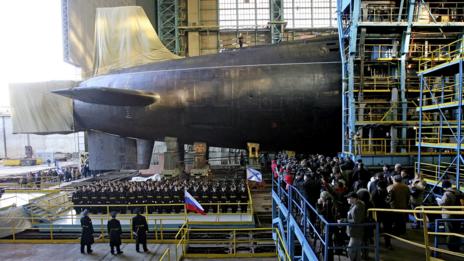
The Russian Navy is planning to launch several new submarines
(Credit: Science Photo Library)
The US is not alone: Russia has four new nuclear subs under construction at Severodvinsk and may build a further
eight before 2020.
"Despite limited budgets Russia is committed to building up its nuclear fleet again," says Bohmer. China
is doing likewise.
The submarine graveyards and spent fuel stores, it appears, will continue to be busy.
Links :