Saturday, May 10, 2014

Friday, May 9, 2014
Inmarsat brings satellite communications to small vessels

'Fleet One' Broadband coverage map
From Inmarsat
Maritime satellite communications provider Inmarsat says it now connects leisure and fishing vessels with a specially designed broadband service.
Accessing weather information and chart updates, keeping in contact with loved ones or simply checking the news are now as simple to do at sea as they are on land with the launch of Fleet One from Inmarsat Maritime.
From now on, yacht and fishing boat owners can take full advantage of maritime broadband services previously only available to much larger vessels.
Whether on a sailing holiday or an extended fishing expedition, the new Fleet One service ensures small vessel owners have uninterrupted access to the Internet, while being able to send SMS messages and have telephone conversations from on board their boat, anywhere in the world.

New Sailor Fleet One terminal to be launched during the second quarter of 2014
Inmarsat’s Fleet One service makes use of the world’s most advanced and reliable global broadband satellite network; the same network which is used by the professional maritime industry across every ocean.
Inmarsat Maritime President, Frank Coles said; “We have all become accustomed to having access to information as and when we need it. When we can’t, it’s frustrating! Being at sea is a unique experience and conditions can change at the drop of a hat. This shouldn’t hamper your ability to remain connected to the world.”
“There is large market of unconnected vessels out there today, for many of these, Fleet One will bring satellite services within reach for the first time and that is a great opportunity for the maritime community and for Inmarsat’s business. Our innovation strategy is keeping us at the forefront of the maritime communications market.”
Fleet One is delivered through a small terminal, especially created for leisure and fishing vessels.
It can be quickly and easily installed, providing a cost-effective solution enabling small vessels to remain connected at all times.
“With this new, simple, solution you will have dependable connectivity whenever you need it. With Fleet One, yachts and fishing boats now have access to the same, robust and reliable technologies previously only available on much larger vessels, allowing them equally to take full advantage of online connectivity,” said Coles.
Fleet One also supports Inmarsat’s unique ‘505’ safety service, which in an emergency routes you directly to a MRCC.
This means that in one phone call one can alert the safety services of your position and nature of distress, by reassuringly speaking to the Search and Rescue Services knowing that assistance is on its way.
The compact 2.5kg terminals will offer data connectivity up to 100kbps, a single voice line and SMS.
Links :
- Cobham : New Inmarsat Fleet One terminal on the way
Thursday, May 8, 2014
Birthright
Birthright from Sean Mullens
One man's struggle to transcend.
This humble film is about a friend of mine named Michael and his daily ritual to find his natural self through surfing.
This humble film is about a friend of mine named Michael and his daily ritual to find his natural self through surfing.
Wednesday, May 7, 2014
Malaysia Airlines flight MH370: Satellite data to be re-examined as ‘more difficult’ phase begins, search on ocean floor widened

Experts want Mapping the sea floor in search area
Rescuers search for weeks, with the latest technology – but of the lost flight MH370 is no trace.
In some places the forces do not even know the depth of the sea.
Now the area is to be measured.
From IBtimes
All data gathered in nearly two months of searching for missing Malaysia Airlines Flight MH370, which disappeared with 239 people on board, will be re-examined by an international panel of experts, officials said Monday.
Teams searching for the missing Malaysia Airlines plane are to deploy a robotic submarine for the first time. Bluefin-21 drone has be sent down to search for wreckage on the sea floor.
Warren Truss, Australia’s deputy prime minister, said the “audit” of collected data, which has yielded no positive results despite crews scouring more than 1.8 million square miles of the Indian Ocean. Officials, who met Monday with senior representatives of the Malaysian and Chinese governments in Canberra, Australia, are shifting efforts to an expanded area of seafloor in a remote part of the Indian Ocean off Western Australia.
"We know very clearly the area of the follow-up search will be even broader, with more difficulties and tougher tasks," Yang Chuantang, China's Transport Minister, said Monday.
Angus Houston, head of the search operation, told reporters in Canberra, according to the Associated Press: “We've got to this stage of the process where it's very sensible to go back and have a look at all of the data that has been gathered, all of the analysis that has been done and make sure there's no flaws in it, the assumptions are right, the analysis is right and the deductions and conclusions are right.”

The Bluefin-21 Autonomous Underwater Vehicle is craned over the side of the Australian Defense Vessel Ocean Shield in the southern Indian Ocean during the continuing search for the missing Malaysian Airlines flight MH370 in this picture released by the Australian Defense Force.
Australian Defence Force/Handout via Reuters
One of the key elements in the new phase will be a detailed mapping of the ocean floor, which will involve “sonar and other autonomous vehicles, potentially at very great depths.”
“It is likely that the debris of flight MH370 sunk to the bottom of the ocean before we started the search,” Truss said, adding that authorities are now considering equipment that can go deeper than Bluefin-21.
The Ocean Shield vessel has returned to Australia’s Fleet Base West on Monday to refill its supplies and “conduct routine maintenance and software modifications to Phoenix Autonomous Underwater Vehicle ‘Artemis’ Bluefin-21,” following which it will resume its search in the area where the underwater hunt for the missing jetliner will continue," the Joint Agency Coordination Centre said in a statement.
The U.S. Navy will continue supporting the MH370 sub-surface search effort for approximately four more weeks with the help of Bluefin-21 side-scan sonar, at the request of the Australian government.

Authorities have so far relied on satellite information and pings in picking their search area for the missing Beijing-bound Boeing 777.
The search for the passenger, which already has engaged dozens of countries and agencies, is expected to become the most expensive search of its kind in aviation history.
Links :
- WP : Malaysian plane’s likely flight path gets 2nd look
- National Geographic : Can an Unmanned Mini Yellow Submarine Find Missing Flight 370?
- DigitalGlobe Tomnod : Crowdsourcing Malaysia Flight #MH370 – Campaign Comes To a Close
- GeoGarage blog : MH370: How do underwater sonar subs work? / Malaysia missing plane search China ship 'picks up signal' /
Tuesday, May 6, 2014
Human litter found in Europe's deepest ocean depths

Locations of the study sites sampled with imaging technology
(ROVs, manned submersible, towed camera systems) and trawling
From The Guardian by Jessica Aldred
Seabed survey reveals depth of marine litter problem by mapping waste in Atlantic and Arctic oceans and Mediterranean
Bottles, plastic bags, fishing nets and other human litter have been found in Europe's deepest ocean depths, according one of the largest scientific surveys of the seafloor to date.
Scientists used video and trawl surveys to take nearly 600 samples from 32 sites in the Atlantic and Arctic oceans and the Mediterranean Sea, from depths of 35 metres to 4.5 kilometres.
They found rubbish in every Mediterranean site surveyed, and all the way from the continental shelf of Europe to the mid-Atlantic ridge, around 2,000km from land.
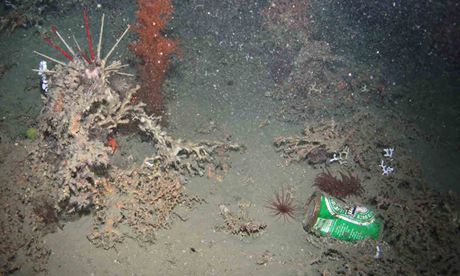
A Heineken beer can found by a remote-operated vehicle in the upper
Whittard canyon at 950m water depth.
Photograph: Hermione
Project/Plymouth University
Plastic was the most common type of litter found on the seafloor, accounting for 41%, while rubbish associated with fishing activities (discarded net and fishing lines) made up 34%.
Glass, metal, wood, paper and cardboard, clothing, pottery and unidentified materials were also documented.
Jonathan Copley, senior lecturer in marine ecology at the University of Southampton, who did not take part in the study, said: "This very important research confirms what most of us who work in the deep ocean have noticed for quite some time – that human rubbish has got there before us.
"But this paper presents an analysis of the kinds of rubbish, what is common where, and what sort of activities are having the most impact in terms of rubbish reaching the deep ocean in different regions. People are piecing this together on a global scale to appreciate how widespread this problem is potentially."
As more of Europe's deep seafloor is being explored, litter is being revealed as far more widespread than previously thought. While individual studies have used trawling to quantify the amount of litter in particular areas or remotely operated vehicles to study the types of waste, this paper is the first to analyse the patterns of distribution and abundance of litter across different underwater geographical settings and depths.
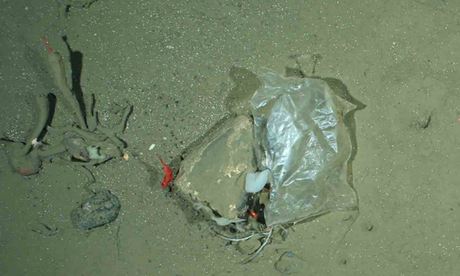
A plastic bag recorded at 2,500m in the Arctic Ocean.
Photograph: Hermione Project/Plymouth University
Dr Kerry Howell, associate professor at Plymouth University's Marine Institute, who took part in the study, said: "This survey has shown that human litter is present in all marine habitats, from beaches to the most remote and deepest parts of the oceans. Most of the deep sea remains unexplored by humans and these are our first visits to many of these sites, but we were shocked to find that our rubbish has got there before us."
Litter disposal and accumulation in the marine environment is one of the fastest growing threats the health of the world's oceans, with an estimated 6.4m tonnes of litter entering the oceans each year.
Plastics are by far the most abundant material, introducing toxic chemicals that can be lethal to marine fauna and break down into "microplastics" that have become the most abundant form of solid-waste pollution on Earth.
Plastic pollution has also been found to be changing microbial processes in the ocean.
Besides the visible impact of marine pollution, litter can be mistaken as food and ingested by a wide variety of marine organisms.
Entanglement in derelict fishing gear – known as "ghost fishing" – is a serious threat to mammals, turtles, birds and corals.
Floating litter also facilitates the transfer of alien species to new habitats.
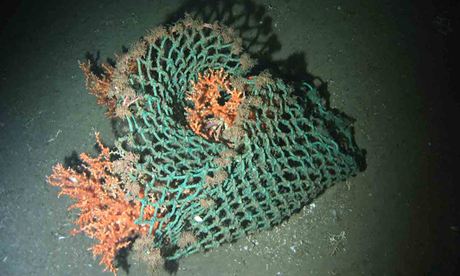
Cargo net entangled in a cold-water coral colony at 950m in Darwin Mound.
Marine biologist Dr Eva Ramirez-Llodra said: "We have known that clinker occurs on the deep-sea bed for some time, but what we found was the accumulation of clinker is closely related with modern shipping routes, indicating that the main shipping corridors have not been altered in the last two centuries."

Litter density
The report also showed the path that materials such as plastics can take, originating from coastal and land sources and being carried along continental shelves and slopes into deep water.
Dr Veerle Huvenne, seafloor and habitat mapping team leader at the National Oceanography Centre, Southampton, said: "Submarine canyons form the main connection between shallow coastal waters and the deep sea. Canyons that are located close to major coastal towns and cities, such as the Lisbon canyon offshore Portugal, or the Blanes canyon offshore Barcelona, can funnel litter straight to water depths of 4,500m or more."
The paper, Marine litter distribution and density in European Seas, from the shelves to deep basins, was published in the journal PLOS ONE.
The study was led by the University of the Azores, and is a collaboration between the Mapping the Deep Project led by Plymouth University and the Hermione Project, coordinated by the National Oceanography Centre, Southampton.
Links :
- GeoGarage blog : Trashed / Trash in the deep sea: bringing a hidden problem to light / How to rid the seas of ‘plastic soup’? / Pollution of Indonesian waters on full display in surf photos / Global call to stop plastic pollution presented at Rio Earth Summit / How much plastic is in the ocean ?
Subscribe to:
Posts (Atom)