Saturday, December 1, 2012

The surfers who really know how to chill out: Daredevils take the plunge in icy ARCTIC waves for the ultimate ride

Refreshing: A surfer rips up one of the waves beneath breathtaking backdrop of snow-covered mountains off the Lofoten Islands, in Norway 
photos Chris Burkard

From DailyMail


  • Water temperature as low as 2C and remotes beaches are covered in waist-high snow
  • Surfers shun safer spring conditions and paddle out in perilous winter swells in search of bigger waves


  • The icy waters of the Arctic would hardly be most people's first choice for a day at the the beach.
    But for these fearless surfers it provides the perfect destination for monster waves.
    The daredevils braved the chilly conditions in the crystal clear water as they enjoyed the powerful swells off the Lofoten Islands, in Norway.


    Surfers Dane Gudauskas, Alex Parker and Keith Malloy normally carve up the golden beaches of sunny California but made the trip to the Arctic, where temperatures as low as just 2-3C, after hearing about the smooth waves.


    Surfer Keith Malloy carves up an icy wave in the Arctic, where the water temperature is as low as 2C. He's more used to the golden beaches of California
    Super cool: Surfer Keith Malloy carves up an icy wave in the Arctic, where the water temperature is as low as 2C. He's more used to the golden beaches of California 

    Don't catch a cold! Mr Malloy crouches in the barrel of one of the powerful waves. He's wearing a thick wetsuit, hood, gloves and shoes to prevent pneumonia

    Don't catch a cold! Mr Malloy crouches in the barrel of one of the powerful waves. He's wearing a thick wetsuit, hood, gloves and shoes to prevent pneumonia
    After putting his wetsuit on, surfer Mr Gudauskas , 26, walked the ice-covered road to the beach through snow as high as his waist - all just to reach the water's edge.
    They wear full wetsuits with shoes and hoods covering as much of their skin as possible.
    But Mr Gudauskas said that once the water hit his face it felt 'like fire'.
    They have to warm up before entering the water - and they contend with the risk of catching pneumonia.

    Breathtaking: One of the surfers performs a grab after getting some air on one of the less threatening of the Arctic waves. Behind him the stunning scenery makes for an impressive picture
    Breathtaking: One of the surfers performs a grab after getting some air on one of the less threatening of the Arctic waves. Behind him the stunning scenery makes for an impressive picture 

    Golden sun rays light up the sky, but the temperatures in the water and air are still dangerously low
    Golden sun rays light up the sky, but the temperatures in the water and air are still dangerously low. 

    The men had to take extra precautions to prevent them from catching pneumonia
    Mr Gudauskas said: 'When the water hit any exposed skin it would burn like fire until your body temperature warmed up from paddling.
    Only then could you get the mojo working.
    'The region is pretty cold I'd imagine by any standard.
    The air was ranging from 2C to way lower depending on the day and wind chill.
    'Winds were very strong through the valley and felt like they could cut you in half - it must have been minus degrees fairly often and the water was probably 2-3C.

    Extreme: One of the brave surfers performs a turn after dropping in to one of the waves. They have to warm up before entering the water if they are to survive the conditions
    Extreme: One of the brave surfers performs a turn after dropping in to one of the waves. They have to warm up before entering the water if they are to survive the conditions 

    Foam from the clear turquoise waters sprays around the surfer as he trails a hand through the swell. They have to walk across rocky shores to reach the remote waves
    Foam from the clear turquoise waters sprays around the surfer as he trails a hand through the swell. They have to walk across rocky shores to reach the remote waves 

    The clean powerful swells are rarely surfed in winter, when most people consider the water too cold to venture in to

    It's a bit fresh out there: The clean powerful swells are rarely surfed in winter, when most people consider the water too cold to venture in to
    'It's a really strange sensation entering water that cold. We're wearing wetsuits between 5-7mm so the only parts that really feel the cold when you first enter is any exposed skin so mostly just your face.
    'I remember it felt like fire - an insane sensation and very uncomfortable. If you had to duck under consecutive waves you would get a crazy headache and it felt like my eye sockets were physically swelling to the point I thought they might swell my eyes shut.
    'I don't think it's too dangerous unless you don't warm up. Although pneumonia would be pretty easy to get if you don't know what you're doing and that can be serious.

    A rainbow appears through the mist of an Arctic waterfall  
    A rainbow appears through the mist of an Arctic waterfall.
     
    A surfer runs back through the water, no doubt in a hurry for some warmer conditions
     Right, a surfer runs back through the water, no doubt in a hurry for some warmer conditions 

    The temperatures in the water may be close to freezing, but the scenes of the Norther Lights are simply stunning
    Beautiful: The temperatures in the water may be close to freezing, but the scenes of the Norther Lights are simply stunning 

    The three surfers survey the waters. They had to walk through the ice-covered road to the beach and through snow as high as his waist - all just to reach the water's edge
    Remote: The three surfers survey the waters. They had to walk through the ice-covered road to the beach and through snow as high as his waist - all just to reach the water's edge

    'Overall it was an awesome challenge. We were there a week and a half and the weather spanned from full snow white-outs, to melting snow on the hills, then right as we were leaving we could barely drive from the house as a blizzard nearly snowed us in.
    'I've been surfing relatively my whole life - I was always around the ocean and it has been a natural progression.
    'But this was extremely different from what we're used to here in California, mainly just the harsh conditions but I loved it and every part of it.
    Deadly power: Clear blue skies can be seen above the Arctic waves, which many people describe as 'unsurfable' during the winter months
    Deadly power: Clear blue skies can be seen above the Arctic waves, which many people describe as 'unsurfable' during the winter months 

    Skills: The surfer performs a frontside turn on the right-hand break. The men said the water was so cold they felt a 'burning sensation' when it touched their exposed skin
    Skills: The surfer performs a frontside turn on the right-hand break.

    The men said the water was so cold they felt a 'burning sensation' when it touched their exposed skin
    Radical: The sportsman ducks inside the barrel of a smaller wave. In the distance the perilous rocks can be seen
    Radical: The sportsman ducks inside the barrel of a smaller wave. In the distance the perilous rocks can be seen 

    Carving it up: A surfer performs a stunt on the chilly 6ft high wave. The conditions looked 'punishing' said the photographer
    Carving it up: A surfer performs a stunt on the chilly 6ft high wave.

    The conditions looked 'punishing' said the photographer
    'I've never done anything like it before, in fact I think it had been almost 10 years since I had seen snow but I relished the experience and the challenges that surfing in the snow presented.'
    Most surfers tackle the cool waves in spring - as the Arctic Circle emerges from its dark winter during the time the snow is melting and the ocean calms down.


    But Dane and the team went over during wild winter chaos most people would describe as unsurfable and conquered even the most powerful of waves.
    The trip was the brainchild of photographer Chris Burkard, 26, who had an aching desire to go somewhere that would be freezing in the winter time

    Should I go in? The surfer, whose wetsuit is around 7mm thick in order to keep warm, looks out across the ocean as he studies how the waves are breaking
    Should I go in? The surfer, whose wetsuit is around 7mm thick in order to keep warm, looks out across the ocean as he studies how the waves are breaking 

    Holed up: Alek Parker takes a rest from hitting the waves. In California he would probably lay on the golden sands, here he tries a spot of ice fishing
    Holed up: Alek Parker takes a rest from hitting the waves. In California he would probably lay on the golden sands, here he tries a spot of ice fishing 

    Keith Malloy rests in a hot tub with a can of beer after a tough day surfing icy Arctic waves
    Chilling out: Keith Malloy rests in a hot tub with a can of beer after a tough day surfing icy Arctic waves 

    Mr Parker wraps up warm in a red jacket and wooly hat as he looks out to sea. Reaching the beach across the rocky shore was one of the biggest challenges
    Mr Parker wraps up warm in a red jacket and wooly hat as he looks out to sea.

    Reaching the beach across the rocky shore was one of the biggest challenges
    He said: 'I've seen it in the summer but in the winter it looked punishing. We wanted to see if it could be done and the weather was worse than we ever imagined.
    'It was so difficult with rain building up on my camera. I tried to go swimming but I could feel my vital organs shutting down and all my blood rushing to my heart to protect it.
    'I swam a couple of days but they were in the water every day. Luckily they're on their boards above the water most of the time but I think they might have started to get used to it.
    'I had to wear thinner gloves to handle the camera so it was almost unbearable. I would get back to the car and simply couldn't move. It was a cool but brutal experience.'

    Friday, November 30, 2012

    Vendee Globe : Tristan de Cunha passage

    Vendee Globe : Vendee Globe: Tristan da Cunha convergence
    (positions 08:00 UTC today 30/11/2012)

    At around 7am GMT the fleet will pass by the island of Tristan da Cunha, a small piece of land, in the middle of the South Atlantic.

    The goldenboy, François Gabart (MACIF), who is loving his Vendée Globe, sent this message:
    "Dear inhabitants of the island of Tristan da Cunha, I hope to come on a cruise stop one day so we can become better acquainted. I believe that if you live on an island like this you will have lots of stories to tell!"


    Inacessible Island, Nightingale Island and Tristan de Cunha island
    >>> geolocalization with the Marine GeoGarage <<<
    (extract from BA 1769 map)


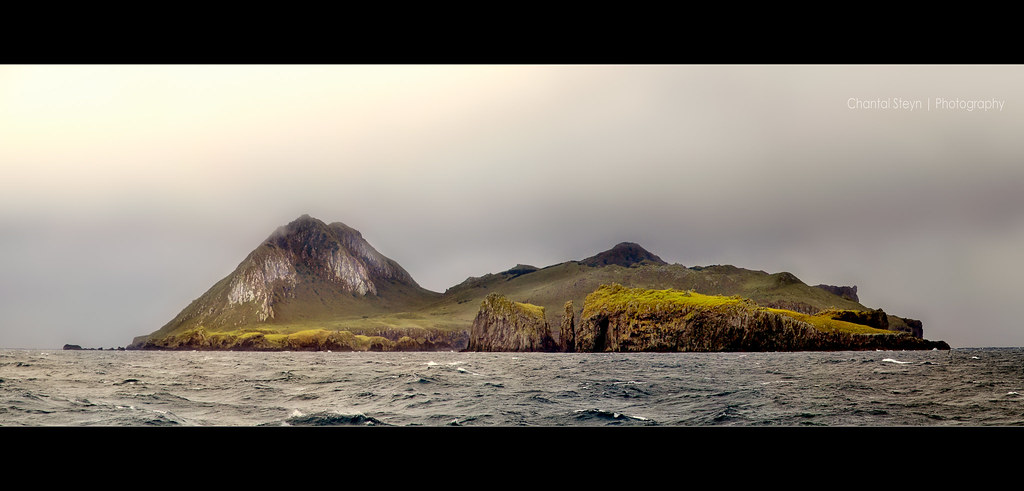
    Tristan da Cunha
    photo Chantal Steyn

     Tristan da Cunha is part of the British overseas territory
    which also includes Saint Helena 2,430 kilometres to its north, and equatorial Ascension Island.
    >>> geolocalization with the Marine GeoGarage <<<

    Links :

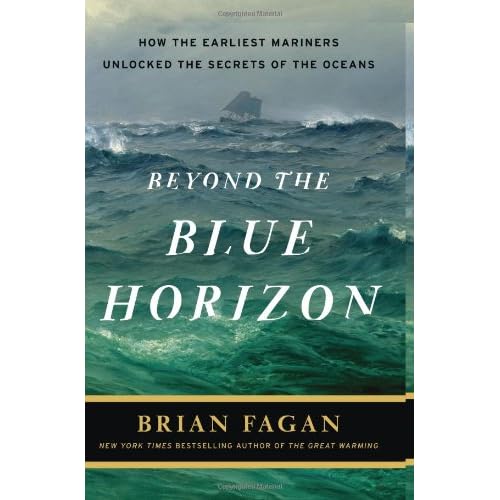
    Book review : Beyond the Blue Horizon

    New York Times-bestselling author Brian Fagan offers a vibrant history of how humans have transformed the seas into highways that connect distant cultures and shaped world civilisation.

    From TheGuardian

    In Beyond the Blue Horizon (Bloomsbury £20), Brian Fagan – a California-based anthropologist and experienced sailor – also focuses on the seas but in this case presents us with a vivid picture of the nautical experiences endured by the first sailors who, in tiny canoes and rafts, made astonishing ocean-wide journeys more than 50,000 years ago and who laid the planet open to human conquest.
    Those journeys changed the course of history and Fagan gives rigour and depth to this overlooked chapter of our history.

    Brian Fagan’s stated aim to discover how and why the earliest seafarers set sail out of sight of land to seek distant shores is ambitious in the extreme.
    He starts his quest in the Far East, during the Ice Age, when humans began moving along what is now the Indonesian archipelago towards Australia, and this is where the book is at its most problematic.
    Not only are there no records, nor a single extant artefact, but even the very shorelines along which they sailed – or paddled – are long lost under seas that rose when the ice melted.
    Any conclusions as to how and why early Homo sapiens took to the waters must necessarily be based on supposition.
    But if anyone is up to the job it is Fagan, a professor of anthropology at the University of California and an experienced sailor.

     A Fijian canoe with D’Urville’s ship L’Astrolabe on its voyage of 1826-29.
    M.Jules Dumont D’Urville. Voyage de la corvette L’Astrolabe execute pendant les années
    1826-1827-1828-1829. (Paris: J. Tartu, 1833).

    Fagan speculates that the secret to decoding the seas 50,000 years ago would have been through observation, principally of the winds and the seasons, as well as such signals as the passage of migratory birds or the feel of waves refracted off an island unseen over the horizon.
    Such knowledge was built up over time and Fagan suggests that the first boatmen came from societies as intimately attuned to the tempers of the sea as they were to the land.
    He is in awe of these early navigators, and some of his theories have a delightful campfire-side quality about them: “Many Australian Aborigines are remarkably adept at handling dugouts in rough water."

    An Indian Ocean boom, The Triumph of Righteousness, under sail. Photograph by Alan Villiers.

    He can be more certain when he moves to the Mediterranean and Indian Ocean, where there is greater evidence of the various civilisations that flourished along the littoral and among the islands.
    Even here he is occasionally left adrift on the tides of probability and possibility, such as when he speculates that goats would start to make awkward cargo on their second day at sea.

    His explanation that trade flourished through “cabotage” – the practice of sailing along a coast from one inlet or harbour to another – is convincing, and he tells us of The Periplus of the Erythraean Sea, a 68-chapter description of coastlines around the Red Sea.
    This sort of thing would have been handed down orally from father to son, a sort of mnemonic to guide a captain along unfamiliar shores.
    In this way trade flourished, so mangrove poles grown in present-day Tanzania, say, might be traded from one town to another until they were matched with planks grown in India to make decent sailing boats.
    None of this would have been easy without first having decoded the monsoon winds and their seasonal fluctuations.

    It is not until he turns to the Atlantic Ocean and the men who braved her waters that he really faces up to what might impel a ship’s captain to turn west and just sail for day after day.
    He mentions the Norse word æfintyr, which means venture, with the suggestion of risk, brought on by restless curiosity, but he makes the point that no one would just set sail without some object in mind, and that knowledge of the seas around Britain and Scandinavia and all the way to Iceland was arrived at incrementally over the centuries.
    By this time boat building had advanced from dugout to the substantial cog that would take Columbus all the way across to the Americas, and throughout Fagan is fascinating on its development.

    He is particularly keen on fibre lashings, as well as sail technology, and the book is peppered with enjoyable stories of his own adventures, as well as shaded boxes explaining sailing terms and techniques.
    One gets the sense this is where his real interest lies, and the largely impenetrable reasoning behind early man’s first voyages is merely the peg on which to hang this brisk and erudite history of early boats.
    It is, though, seasoned with a real love of sailing and a great respect for those who took to the waters without a functioning GPS or reliable diesel engine.

    Links :

    Thursday, November 29, 2012

    Vendee Globe : Gough island, first mark to starboard

    Gough island
    >>> geolocalization with the Marine GeoGarage <<<<
    or on NGA viewer (NGA INT21) / Lansat sat imagery


    Back in October the skippers were told there was risk of large icebergs and growlers around the Gough Island waypoint, the first ice gate of the Vendée Globe, west of South Africa.

    extract from BA 1769 Islands and Anchorage in the South Atlantic Ocean
    Gough island (photo Chantal Steyn)
    Gough Island (also known historically as Diego Alvarez) is a volcanic island rising from the South Atlantic Ocean to heights of over 900 m (2950 ft) above sea level with an area of 35 square miles (91 km2).
    It is part of the Tristan da Cuhna group. 

    photo SANAP / Panoramio

    Gough Island is a subantarctic island and UK overseas territory situated in the South Atlantic Ocean.
    Gough Island has no sheltered harbour or anchorage.
    The only suitable landing place for boats is at Glen Anchorage in Quest Bay on the island's east coast.
    SA Agulhas, on a relief expedition, departs from Cape Town to Tristan da Cunha then onwards to Gough Island on an annual relief voyage.
    This ship carries cargo and passengers.
    There is presently no access for tourists and even crew members from passing yachts may not go ashore except in the case of an extreme emergency (see Operation Gondola, the rescue from Gough Island)

    The island possesses an extraordinary wealth of unique biodiversity and has being called the world’s most important seabird island.
    Not surprisingly, it has been afforded UNESCO World Heritage Site status.

    The old man and the sea: 73-year-old to sail solo around world in 'bathtub' boat

    Yrvind implements test sailings with his boat Yrvind.com in Stockholm archipelago.

    From CNN 

    When faced with the most ferocious waves on the planet, most people would seek protection in the largest, sturdiest vessel they could find.
    But when Swedish pensioner Sven Yrvind sets out on his ambitious mission to circumnavigate the globe, it won't be in a hefty ship piled high with food, creature comforts and telecommunications equipment.
    Instead, the 73-year-old plans to traverse the high seas cocooned in a sailboat only slightly bigger than a bathtub.

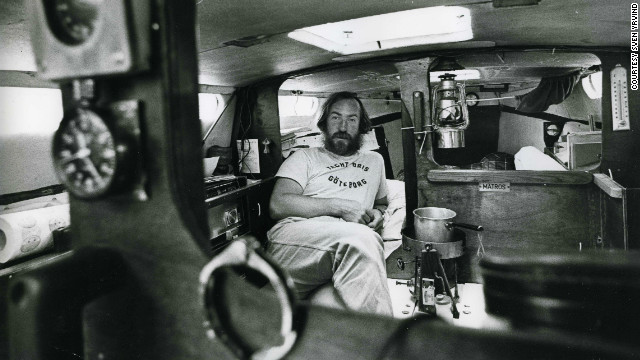
     He first lived on a boat as a 23-year-old studying mathematics in Copenhagen, during the 1960s

    For many, the proposition of sailing non-stop around the world for a year-and-a-half in a vessel just three meters-long will sound rather ambitious, and coming from a man well past the retirement age, downright far-fetched.
    Indeed, few would likely take the idea seriously were Yrvind not one of the world's most respected boat-builders.


    Click on the pindrops above to trace Sven Yrvind's proposed circumnavigation route.

    During his accomplished life he has given lectures to the Swedish king and queen and received awards from the prestigious Royal Cruising Club in Britain, among others.
    "People have said it's a suicide mission," said Yrvind.
    "But a big boat is actually more dangerous than a small one. You've got bigger forces throwing you around -- a bigger engine, a bigger beam, a bigger deck.
    "My small boat is like a little capsule -- nothing can happen to you. It's like throwing a bottle in the water -- it will capsize, it will pitchpole (somersault), but it will always come back up," he added.

    If successful, Yrvind will make history for sailing the smallest boat around the world without docking on land.


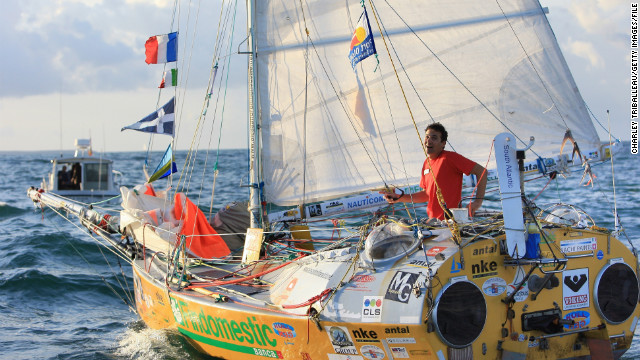
    The record is currently held by Italian Alessandro di Benedetto, who in 2010 circumnavigated the globe in a 6.5 meter yacht -- more than double the size of Yrvind's creation.

    Yrvind, from the small village of Vastervik in south east Sweden, started building the ground-breaking vessel in March.
    Now half-complete, he is reluctant to put a time on its launch.
    Named Yrvind Ten after its 10 foot length, the miniature vessel will be just 1.8 meters wide with two six meter-tall masts.
    Weighing 1.5 tons, it will be made out of a composite foam and fiberglass material which, he says, is "excellent for insulation and floatation."
    Powered by wind, solar panels, gel batteries and a foot crank, Yrvind Ten will set sail from Ireland in a 48,000 kilometer return journey around the globe.

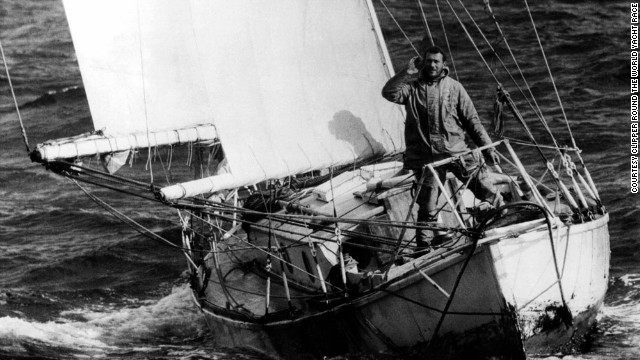
     Sir Robin Knox-Johnston became the first person to single-handedly sail around the world in a 9.8 meter yacht, in 1969.

    Sir Robin Knox-Johnston, the first person to sail around the world in 1969 in a 9.8 meter yacht, said there was a real possibility Yrvind would complete the voyage.
    Briton Knox-Johnston, who also founded the Clipper Round the World Yacht Race, added that many people had thought his own bid to circumnavigate the globe was impossible at the time.
    "One of the biggest challenges he'll face is when he's coming up against these massive 25 meter waves in the Southern Ocean. In a boat that size he's just going to be rolled around and around like he's inside a giant washing machine," Knox-Johnston said.
    "He might also find he's using a lot more energy -- and will need a lot more food -- being rolled around like that."

    The Swede will collect rainwater in sails, funneled by a hose to a tank.
    With no heating equipment on board, he'll rely on 400 kilograms of muesli and sardines, supplemented with vitamin tablets and fish caught from the sea.
    "I need just half-a-kilogram of food a day and this will give me enough food for 800 days," he said.
    "In the beginning I will have fruit but obviously that will run out. I also have a friend in Melbourne with a boat who will come out with supplies."
    The self-described "recluse" plans to spend his days swimming, philosophizing and reading more than 400 books, which weigh around 100 kilograms.
    "On land, people are watching TV, driving cars in traffic, smoking, drinking -- it's not healthy," Yrvind explained.
    "Out at sea it's a cleaner environment -- mentally and physically. When I come back I will be a healthier, younger person. This will prolong my life, not the other way around."

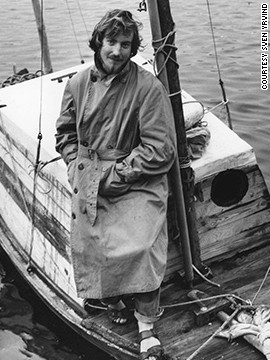
     Yrvind was inducted into the Museum of Yachting's Hall of Fame in 1988, for his many solo expeditions. In 1968 he sailed four meter boat "Anna" (pictured) from Sweden to England.

    Growing up on the small Swedish island of Branno in the North Sea, Yrvind quickly learned to sail in an area so remote he needed to cross water simply to buy a loaf of bread from the shop.
    In his 50-year career building boats, Yrvind has been lavished with awards from around the world. In 1980 he received a Seamanship Medal from the Royal Cruising Club in Britain for single-handedly sailing a six meter boat around the stormy waters of Cape Horn, Chile.

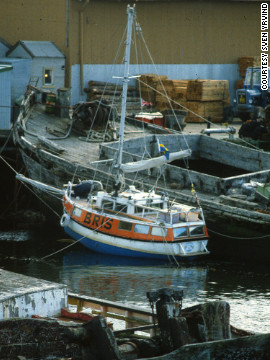
     The boat was named Bris, meaning "breeze" in Swedish. "I built her in 1972 and sailed her until 1982, criss-crossing the Atlantic many times," Yrvind said.

    Eight years later he was inducted into the Museum of Yachting's Hall of Fame, based in Newport, Rhode Island, for his many single-handed expeditions.
    The museum also has one of Yrvind's boats on permanent display -- a six meter yacht he built in his mother's basement and sailed from Sweden to Newport in 1983.

     Yrvind in the six meter yacht he built in his mother's basement and sailed from Sweden to Newport in 1983. The boat is now on display at the Museum of Yachting in Newport, Rhode Island.

    In 1989 Yrvind also built and sailed a 4.5 meter boat from France to Newfoundland, now on display at the Swedish National Maritime Museum in Stockholm.
    And the sprightly septuagenarian is no closer to slowing down -- last year sailing a tiny 4.5 meter-long boat from Ireland to the Caribbean.

    Yrvind, who is also on the look-out for sponsorship, hopes his boat will not simply break the record books, but pave the way for a new environmentally-friendly design for living.
    "We are on Earth living beyond our resources -- oil is running out, fossil fuels are running out, water is running out," he said.
    "If I can show I can live on a boat 10 foot-long for more than a year, with all the food I need with me, I think it might benefit mankind."
    For a man who "loves all things small," should he accomplish the feat it would be a huge achievement in the history of sailing.

    Links :