Mining the seafloor could boost global production of clean energy technology—and destroy the ocean in the process
Editor’s Note (8/15/23): In late July the International Seabed Authority announced it will not issue any extraction permits for deep-sea mining until it finalizes its mining regulations, and it indicated they might not be completed until 2025.
Bizarre creatures from the black ocean abyss, preserved in glass jars, line stacks of shelves in deep-sea biologist Adrian Glover's laboratory at London's Natural History Museum.
Among them is a ghostly white animal, oddly elegant and shaped like an ornamental flower with a glass stalk, retrieved from the bottom of the Pacific Ocean, five kilometers down.
Ninety percent of the species Glover has assembled had never before been seen by humans.
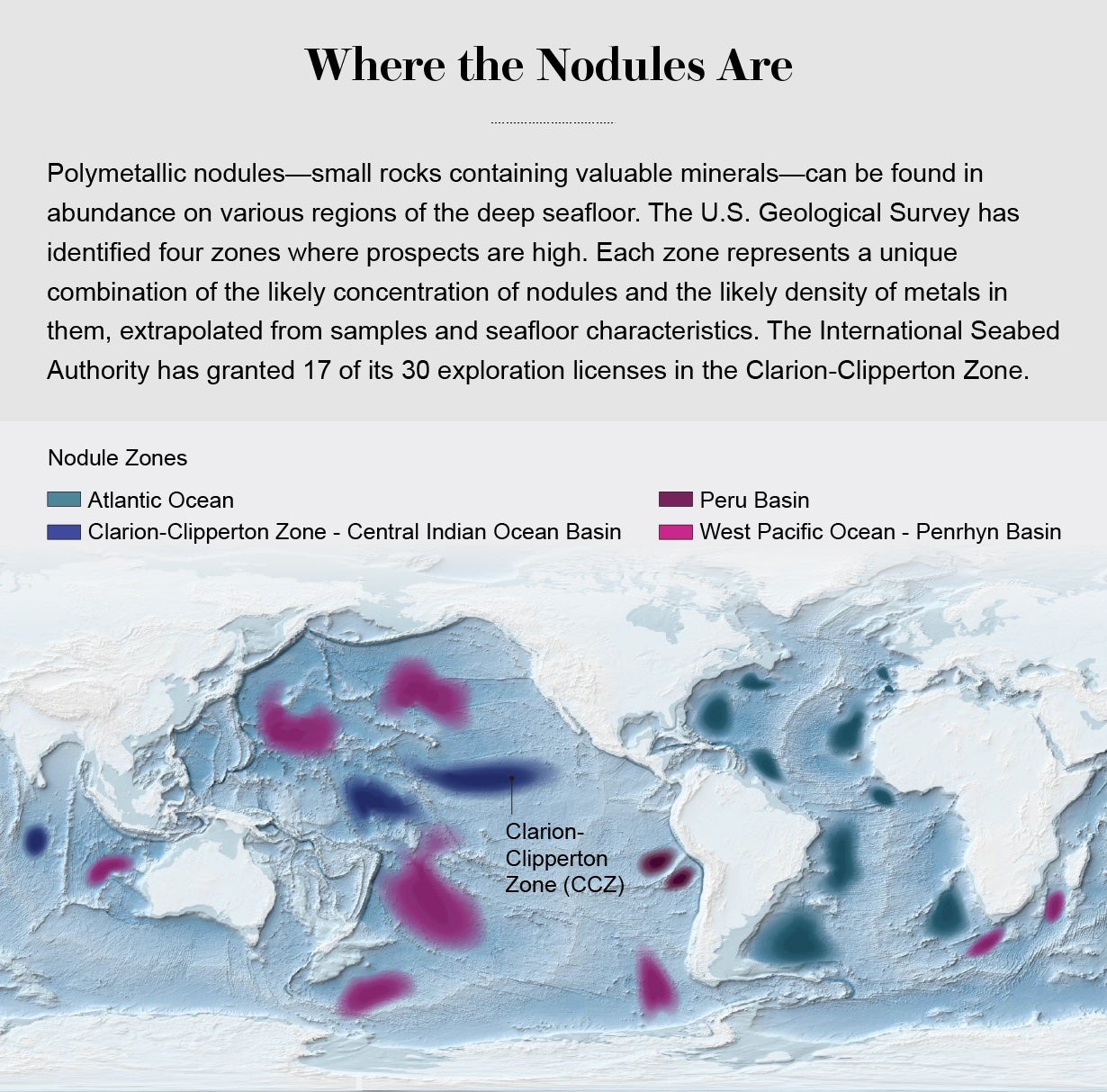
Glover is part of an international effort to discover what lives on a remote part of the Pacific Ocean seafloor called the Clarion-Clipperton Zone.
The CCZ is a
vast abyssal plain slightly larger than the European Union, situated between Mexico and Hawaii, dotted with rocky outcrops and seamounts.
It is one of the most pristine and least explored parts of our planet—and it may soon endure the world's first deep-sea mining operation.
Trillions of black, potato-size rocks known as polymetallic nodules are strewn across the CCZ seafloor.
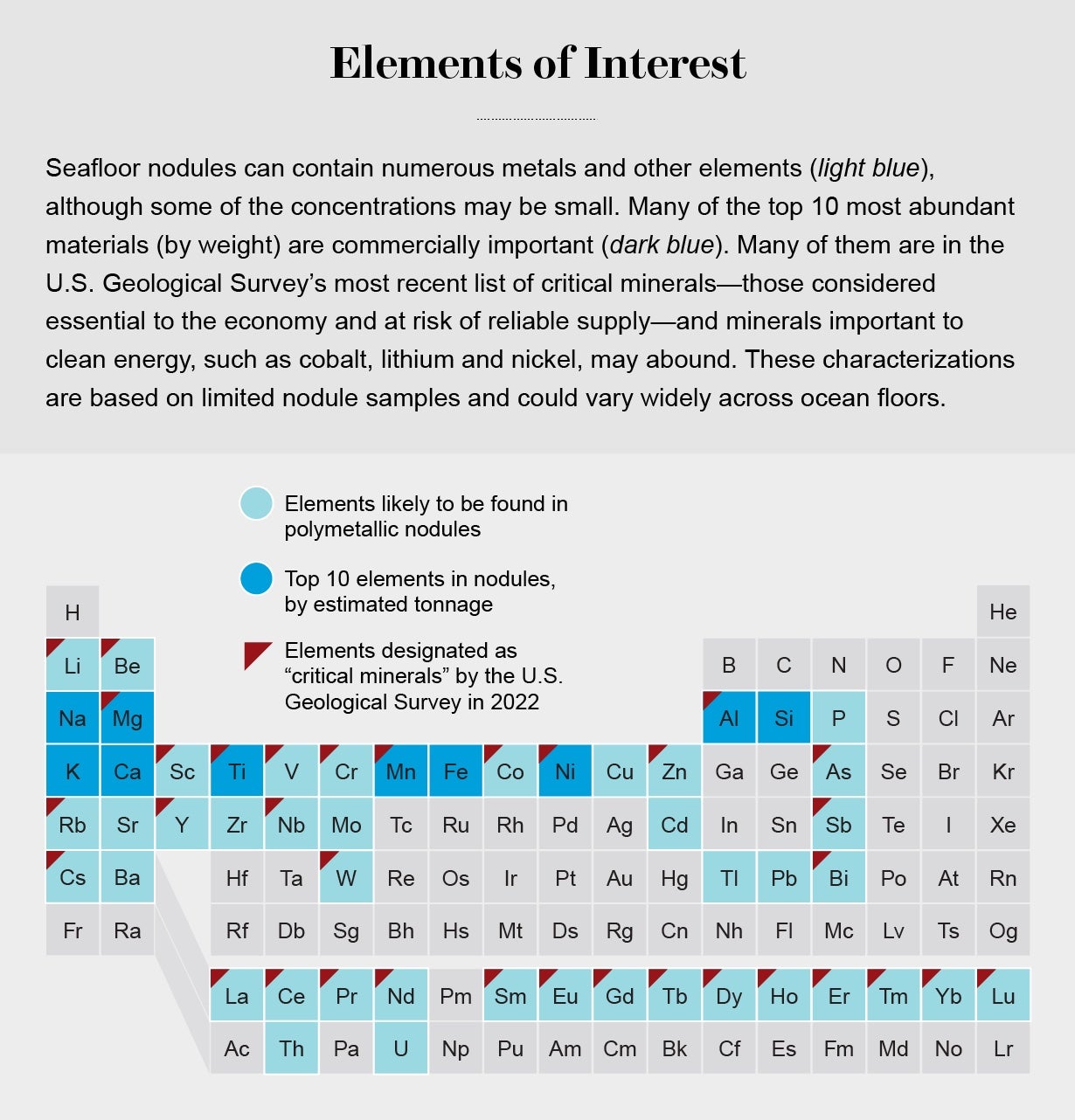
The nodules contain valuable metals, including cobalt, copper and nickel needed for electric vehicles; rare earth elements crucial for clean energy technologies; and smaller amounts of lithium, in high demand for batteries.
Surveyors expect the overall tonnage across the CCZ to be substantial, in some cases higher than the sources now mined on land.
Glover hands me a nodule, which looks and feels like a small lump of coal, cold and lifeless.
On closer inspection I can see faint traces of
foraminifera, single-cell organisms fundamental to the marine food web, which once covered its surface.
Each nodule starts as a little fragment, perhaps a shark's tooth or a piece of seashell.
Over a long time, metals slowly gather and form an expanding crust around this node, growing just one to 10 centimeters every million years.
The specimen in my hand would have taken about 10 million years to form.
Out on the soft CCZ seafloor, nodules offer a hard surface for tiny creatures, from microbes to sponges, to cling to—a life-giving substrate in a severe habitat.
Water temperatures can reach zero degrees Celsius, there is virtually no light, and pressures can exceed 1,000 bars, equivalent to having a couple of elephants standing on your big toe.
The minuscule life attracts other animals; octopuses, for example, lay eggs in the sponges.
Over time, unique communities form across seafloors strewn with nodules.
Life in the CCZ doesn't exist in great abundance, but it does
exist in great diversity.
The nodules “are home to hundreds, maybe thousands, of species that we know little about,” Glover says.
“Whether they would provide food on a plate or stop climate change or become the
next cure for cancer, we can't say yet.
Though we could do the research to find out.”
Not everyone wants to wait for more discovery.
A Vancouver-based start-up called The Metals Company (TMC) is pushing to start mining the CCZ in 2024, in partnership with the Pacific Island nation Nauru.
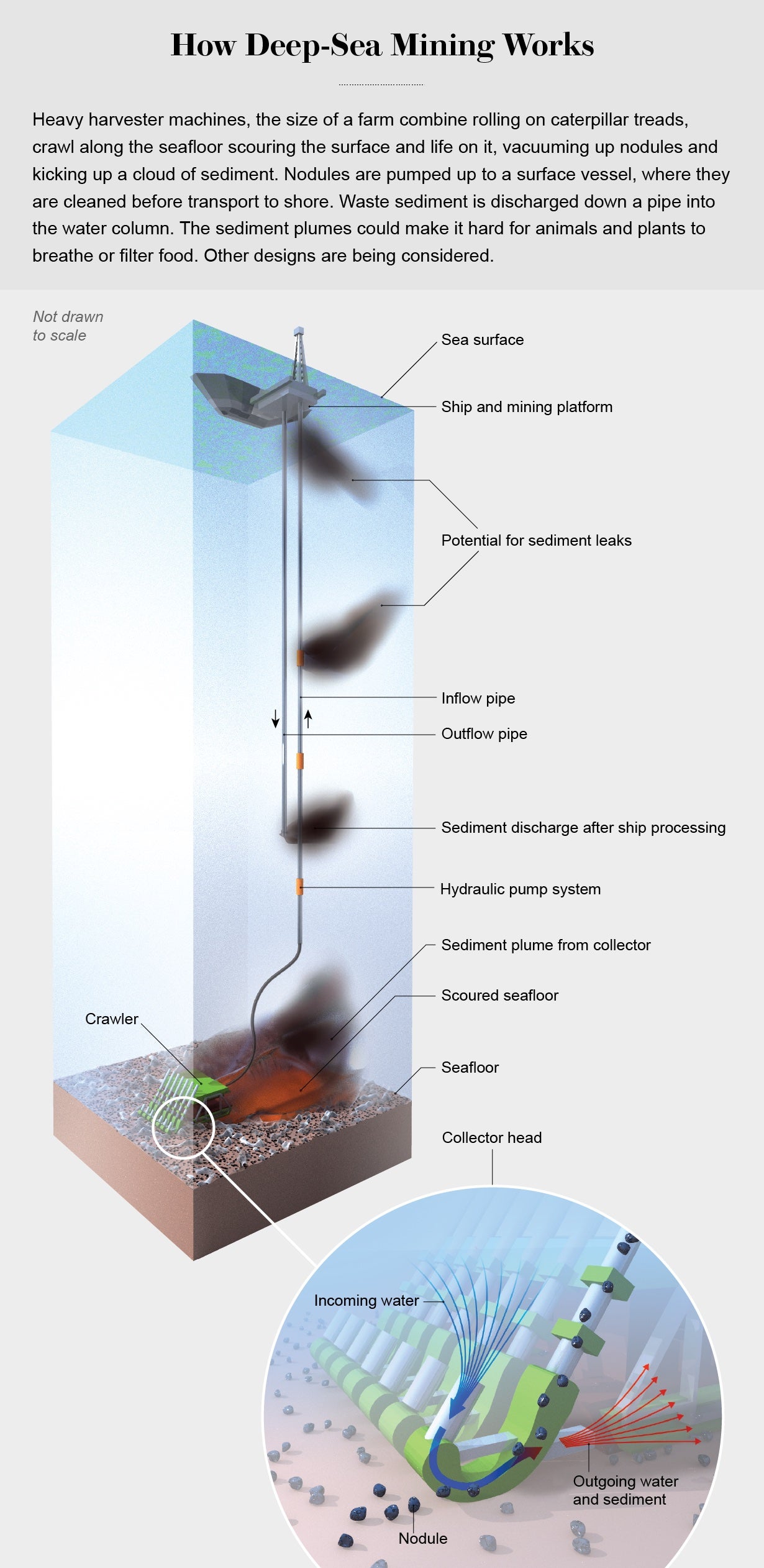
Big machines would scrape the seafloor, scooping up nodules while kicking up clouds of sediment, potentially damaging the deep sea on a vast scale by removing habitat and species and altering ecosystems.
Whether TMC goes ahead with its plans is up to the International Seabed Authority (ISA), a United Nations–affiliated agency responsible for promoting deep-sea mining in international waters while also protecting the deep sea from harm.
ISA has not finalized its mining code, so deep-sea miners such as TMC have no guidelines about how they should operate.
There are significant unknowns about potential environmental damage, as well as about what lives in this remote part of the Pacific and how the region may contribute to ocean health.
Given ISA's conflicting mandate, many experts are concerned that it will prematurely green-light commercial extraction because of industry pressure.
It's not just environmentalists who are concerned; governments and even corporations that want the minerals in the nodules have taken a stand against mining in international waters, at least until the potential impacts of deep-sea mining can be fully assessed.
The growing chorus of voices includes France, Germany and Chile; BMW and Google; and more than 700 experts.
Scientists such as Glover are scrambling to collect data, in many instances funded by contractors, including TMC, which need it to obtain mining approval.
“The rush to understand this place has been related to the fact that we may lose it,” says Diva Amon, a deep-sea biologist at the University of California, Santa Barbara.
 Credit: Jo Hannah Asetre; Source: “Estimates of Metals Contained in Abyssal Manganese Nodules and Ferromanganese Crusts in the Global Ocean Based on Regional Variations and Genetic Types of Nodules,” by Kira Mizell, James R.
Hein, Manda Au and Amy Gartman, in Perspectives on Deep-Sea Mining, edited by Rahul Sharma.
Springer, 2022 (reference)Sunken treasureGerard Barron, CEO of TMC, describes a polymetallic nodule as a “battery in a rock.” The self-assured prospector says deep-sea mining is a rare opportunity to transition the world off fossil fuels.
His company has secured the rights to explore for minerals across several large tracts of the CCZ—enough metals, he claims, to power 280 million electric vehicles, equivalent to the entire U.S.
car fleet.
Prospectors note that deep-sea mining could be the start of ethical mineral extraction: doing away with child labor linked to terrestrial mines in some countries, providing revenue to developing nations through deep-sea profit sharing and leaving a better environmental legacy than mining has on land.
No one has yet scoured the deep sea commercially, but exploration is happening in national and international waters.
Norway, for example, has recently proposed opening its continental shelf to mining.
ISA, which presides over the international seabed, has granted 30 exploration contracts covering 1.4 million square kilometers of the seafloor to prospective miners.
Of those,
17 are for sites in the CCZ; each plot measures around 75,000 square kilometers, roughly the size of Ireland.
The other contracts cover nodules in the Western Pacific Ocean and Indian Ocean, as well as massive sulfide deposits at hydrothermal vents in the Atlantic and Indian Oceans, and cobalt crusts that line the flanks and summits of seamounts at various Pacific sites.
TMC has contracts to explore three CCZ plots for nodules, in partnership with sponsoring states Nauru, Tonga and Kiribati.
In June 2021 TMC and Nauru, through a venture called Nauru Ocean Resources, Inc.
(NORI), invoked an arcane ISA statute known as the two-year rule, which obligates ISA to allow mining to proceed within two years, regardless of whether a mining code is in place.
In theory, TMC could have begun commercial extraction in July.
In November 2022 the company completed its first trial; onboard the 228-meter-long mining vessel Hidden Gem, Barron's team hauled up more than 3,000 metric tons of nodules from 4.3 kilometers underneath the ocean's surface, proving that it is ready, and equipped, to start commercial work.
TMC is the likely frontrunner in the race to mine the deep sea because it is the only contractor to have invoked the two-year rule.
Barron plans to start in 2024.
The company rose from the ashes of Nautilus Minerals, a Canadian start-up headed by a geologist and friend of Barron's named David Heydon, who subsequently founded DeepGreen, later rebranded as TMC.
Barron was one of the early Nautilus investors.
Nautilus intended to excavate minerals from hydrothermal vents, often teeming with exotic life, in Papua New Guinea's territorial waters.
The start-up developed and tested three big mining machines, each the size of a combine harvester and weighing about six metric tons, which quickly came to symbolize the damage industry could impose on the ocean floor.
Faced with issues related to securing a vessel, as well as lack of investment, in 2019 the company liquidated.
Barron, who got out before Nautilus went bust, has cast himself as a green miner.
The 56-year-old Australian exhibits the casual ease of a Silicon Valley tech mogul: tight beard, shaggy hair, jeans and white T-shirt.
He also wears a combat-style jacket, inside which he carries a softball-size polymetallic nodule—a portable prop for his pitches.
When he talks about his company's plans, Barron exudes confidence and calm optimism.
“I think it's important to remember that we're doing this because the world agrees that we should move away from fossil fuels,” he told me when we met recently at a café in west London.
“That transition is going to be very, very metal-intensive.”
Prospectors contend that without deep-sea mining the world will run out of valuable metals for green technologies.
According to the World Bank, we'll need more than three billion (nonmetric) tons of minerals and metals to deploy the wind, solar and geothermal power required to avoid two degrees C of global warming.
Some estimates predict that the reserves of cobalt, used widely in rechargeable batteries, and of nickel, used in electric vehicle batteries and renewable energy storage, in the CCZ are significantly larger than the remaining reserves on land, although it's hard to gauge the real extent of resources in the abyss, especially those that are easily recoverable.
Not everyone is convinced of an impending shortage—or that, in the event of one, deep-sea mining is the only solution.
The Institute of Sustainable Futures says a global transition toward 100 percent renewable energy could be met with land-based reserves.
“Urban mining”—recovering metals from our discarded computers, mobile phones, tablets and other electronics—could also be greatly scaled up.
The world recycles less than 20 percent of its electronic waste, and safe disposal is a rapidly growing problem.
Also, future demand for certain metals, such as cobalt and lithium, may not be as high as once anticipated; Tesla now uses cobalt-free batteries in half of its new cars.
Manufacturers are exploring alternatives to lithium-based batteries, too.
Smothered by sediment
If the 17 CCZ exploration contracts all progress to exploitation, it's possible that within a decade, multiple operators will be dredging the seafloor for nodules.
Most operators, including TMC, would use harvesters to mine the dark seafloor.
A typical harvester is fitted with twin caterpillar tracks like those on an army tank so it can crawl across the seabed sediment.
The harvester sucks up nodules, whipping up a cloud of fine silt as it travels along, and sends them to a surface vessel through a pipe called a vertical riser.
An average harvester would gather about 400 metric tons of nodules per hour from the CCZ floor; that's 67,000 metric tons per week.
One machine, over a 30-year contract, the standard duration, could strip 10,000 square kilometers (3,900 square miles) of seabed.
Some upset is certain.
Given the incredibly long time it takes nodules to grow and their role as a substrate for marine life, “it's very clear that if you take the nodules away, the ecosystem would move to a different state for millions of years,” says Sabine Gollner, a research scientist at the Royal Netherlands Institute for Sea Research.
As the big machines crawl along, they will suspend large amounts of fine sediment in the water, which could settle as much as tens of kilometers away.
Scientists have little evidence for what the effects might be, but it is plausible the plume could smother sedentary creatures such as sea anemones and sponges.
Barron cites a 2022 study led by the Massachusetts Institute of Technology that found that the sediment plume kicked up by mining vehicles didn't disperse as widely as people thought it would.
But that was from an experimental trial with a prototype collector about one-third the size of an actual machine.
Sediment stuck to the nodules is sucked up along with them to the surface vessel.
Onboard, the nodules would be cleaned before being transported to a shore-based facility for processing, and the waste sediment would be pumped back into the ocean through another long pipe.
To save on expenses, most contractors plan to release this “dewatering plume” at around 1,000 meters above the ocean floor.
This rain of sediment is likely to cause problems for midwater swimmers, such as jellyfish, by interfering with their visual communication cues or their ability to filter food from the water.
It could also clog the gills of commercial species that forage there, such as fish and shrimp, which are eaten by larger species like tuna and billfish.
Barron's response to environmental concerns is that land mining creates extensive ecological damage and in some places involves human labor abuses.
He points to the growth in nickel mining in the world's equatorial rain forests, notably Indonesia and the Philippines, which studies have shown seriously harms ecosystems there.
“You can't look at one [environmental] situation without having an eye on the other,” he contends.
Under ISA rules, contractors have up to 15 years to explore their claim areas.
They must conduct a “baseline survey” of the nodules and the environment—including details of the habitat and what lives there—and submit it to the ISA's Legal and Technical Commission as part of their exploitation application.
The type and amount of data included in the survey, however, are left up to the contractors, based on ISA guidelines, and the commission is still discussing what data might be acceptable.
Credit: Jen Christiansen; Source: “Estimates of Metals Contained in Abyssal Manganese Nodules and Ferromanganese Crusts in the Global Ocean Based on Regional Variations and Genetic Types of Nodules,” by Kira Mizell, James R.
Hein, Manda Au and Amy Gartman, in Perspectives on Deep-Sea Mining, edited by Rahul Sharma.
Springer, 2022 (nodule data); “2022 Final List of Critical Minerals,” by U.S. Geological Survey (reference)
Some mistrust stems from the fact that ISA has never refused an application for exploration, even in regions recommended as marine-protected areas by international conservation organizations.
One especially contentious case is a 2018 contract awarded to Poland to explore a vast site in the mid-Atlantic, next to and partly in the site of the Lost City hydrothermal field—one of the most extreme environments ever discovered on Earth, which scientists hope will be considered for World Heritage status.
Diva Amon, a biologist from Trinidad, is one of ISA's most vocal critics.
She says the agency's requirements for contractors are far too weak.
Amon's first postdoctoral research position, at the University of Hawaii, took her to the CCZ, where—like Glover—she was collecting biological data from a site targeted for mining, in her case by UK Seabed Resources, then a subsidiary of the arms giant Lockheed Martin.
In 2017 Amon founded SpeSeas—a nonprofit dedicated to raising ocean awareness—and in 2020 she was named a National Geographic Emerging Explorer.
She starred alongside Will Smith in the actor's documentary series Welcome to Earth.
Now at U.C.
Santa Barbara, Amon focuses on understanding the deep sea, including the CCZ; she is no longer collecting data for contractors.
Amon says “there's a fundamental difference between science to understand and science to exploit”—something she has learned from working in both situations.
She says science to exploit often becomes “a tick box exercise”—doing only what's needed to satisfy a checklist.
The problem with that, Amon says, is “not all contractors are doing high-quality science.
Not all contractors are doing a lot of science.
And not all contractors are making their science accessible.” Malcolm Clark, a biologist who has served as an adviser on the ISA's Legal and Technical Commission for the past seven years, agrees.
TMC has conducted several baseline surveys of one of its three CCZ sites, called NORI-D, collecting data on the density and location of the nodules, and the area's habitat and biology.
In March 2023 it submitted the first tranche of these data to ISA, saying it intended to submit the remaining data before August 2023.
Amon claims the information is insufficient.
“A big part of understanding a place—especially a place that you've never been to—is understanding the variation over a [long] period of time,” she says.
Renee Grogan shares some of Amon's frustrations with the ISA.
She is co-founder and chief sustainability officer of Impossible Metals, a start-up that is promoting what it calls a less intrusive extraction method—using a fleet of autonomous robots to pick up nodules individually from the seafloor rather than sucking up everything in a machine's path.
ISA should force transparency from contractors, says Grogan, who previously worked on sustainability for Nautilus Minerals.
“Regulators with backbones” are needed for that to happen, she says.
Another concern about ISA's conflicting mandate to regulate and promote mining is that ISA recommends, but does not require, that contractors conduct small-scale tests of their operation's potentially harmful impacts.
Clark says few contractors could afford the financial risk without any surety they would be licensed.
“Going into test mining is a huge increase in the complexity and the expense of what a contractor might need to do,” he says.
He acknowledges that very little is known about the impacts mining could create.
“That's obviously a very big question, as you start to move from a few hundreds of [metric] tons of resource extraction into thousands and millions of tons over much larger areas.”
Barron claims that nodule mining could have a regenerative effect on marine life.
“What we're finding now is that actually, when you do disturb an area, it creates much more attraction … for organisms to come back,” he says.
“Once we start to collect nodules, the area starts to rehabilitate pretty well straight away.” Without mining having been done, it is hard to substantiate such a claim.
A 2022 project Barron referred to, which involved a few mining study sites, looked only at foraminifera and found no statistical difference between sites, whether mined or untouched.
When queried, TMC responded in writing that “further study of the impacts of actual collection system tests, such as those NORI is undertaking, [is] essential.”
Missing data
In March 2022 Amon led a review, with 30 other scientists, to identify categories of information needed to manage a mining operation, including how animals that live there vary over time and space and their relationships to one another, as well as noise and light pollution, sediment plumes and the release of toxic metals.
One issue was whether a contractor or the regulator has an effective management plan in place: If there is an adverse impact, whose job is it to mitigate the consequences? The study concluded that, for the CCZ, sufficient data to sustainably manage a mining operation exist for only 15 percent of the categories.
Filling in the knowledge gaps would be a “monumental task” that could take a decade or more, the experts wrote.
Ten of the 30 authors support a moratorium.
One unanswered question is how mining will impact life in the water column.
Jeff Drazen, a biologist at the University of Hawaii whom TMC has contracted to collect biological data in the CCZ, worries that this issue is being ignored.
“Despite a lot of scientists wanting to monitor [midwater] biology, we were not asked to do that.
So that has still not happened,” he says, noting that contractors have not required it.
Drazen says that when TMC tested its mining equipment in NORI-D there was no capability on the ship to look at impacts on midwater life.
Credit: Violet Isabelle Frances for Bryan Christie Design; Source: “Towards Deep Sea Mining—Impact of Mining Activities on Benthic Pelagic Coupling in the Clarion Clipperton Fracture Zone,” by Benjamin Gillard. Ph.D. thesis, Jacob’s University; November 2019 (reference)
Another open question is whether mining will impact the survival of isolated populations.
For example, one strategy to maintain deep-sea diversity might be to rake long strips of seafloor that are separated by intact strips.
But would the newly isolated populations be able to survive?
Barron says Amon's review is flawed, claiming it includes only the views and data of select experts and excludes contractor data, which he says show that mining impacts are likely far less than once feared.
In reply, Amon says contractor data were mostly missing from DeepData, the platform ISA uses to house information.
“It may be true that there are more data out there.
But they are not accessible to any stakeholders in a meaningful way,” says Beth Orcutt, a marine biologist at the Bigelow Laboratory for Ocean Sciences in Maine.
According to ISA more than 100 CCZ surveys have been done.
Data from just 24 of them reside on DeepData.
A recent study led by Muriel Rabone, a data curator at London's Natural History Museum, unearthed problems with the biological information stored on the platform, including duplication of records and misidentification of species.
Rabone has communicated her concerns to ISA and says the regulator
is working hard to fix the problems.
Rabone says that until corrections are made, experts analyzing the data could reach false conclusions.
Trust
Barron remains outwardly optimistic that mining will start soon, even though the past few months have been tough for TMC.
In March the International Union for the Conservation of Nature, with 160 member countries, urged ISA members to back a moratorium on deep-sea mining.
In May the shipping company Maersk, an investor in TMC since Barron became CEO in 2017, announced that it was divesting, without detailing reasons why.
TMC's share price has been volatile in recent months.
Still, now that the two-year rule's embargo date has passed, TMC could just begin mining, without ISA having finalized its regulations, as long as there is no veto from ISA member nations indicating a need to wait for those guidelines.
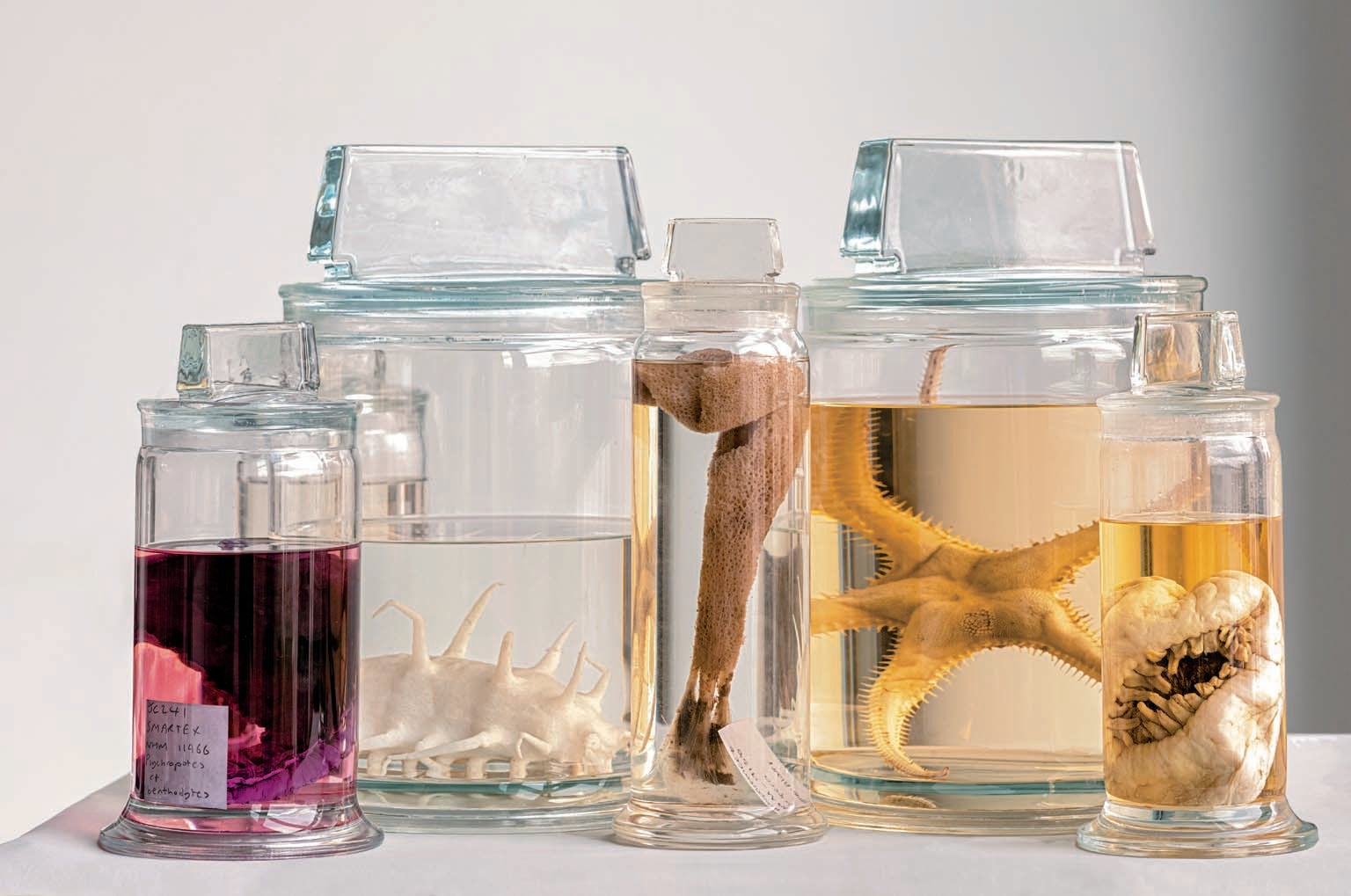 Creatures from the Clarion-Clipperton seabed include (left to right) a sea cucumber (purple), a different sea cucumber (white), a glass sponge, a sea star and a sea anemone.
Credit: Vincent Fournier
Scientists hope the effort being made to understand the ocean's abyss will lead to an informed decision.
“There has to be a level of trust that [contractors] are doing it correctly and reporting it correctly,” Orcutt says.
“So much of deep-sea mining is going to rely on trust because no one can go out there and watch what they're doing.” A crucial consideration for ISA will be deciding how much evidence about harm is enough.
“This is essentially a decision as to what level of risk people are prepared to accept,” Glover says.
“We're never going to answer every question.”
Mining's larger future will rest largely on how ISA finalizes its rule book amid the rush to scour the seafloor.
ISA has a rare chance to regulate an industry before the industry has begun.
Links :





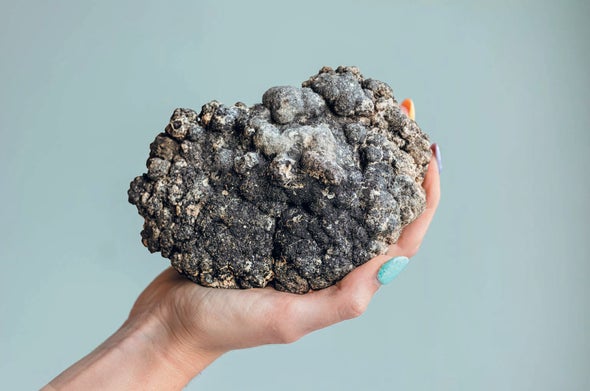 Polymetallic nodules from the deep ocean floor are rich in valuable minerals such as cobalt and nickel.