Featured on National Geographic. "A lone freediver escapes to another world underwater where his impossible dreams become reality." "The Superman" is a labour of love project for directors Jack Pirie and Alex Hylands-White, made in collaboration with Freediver Francisco Del Rosario and Bamford Watch Department.
The short film follows Del Rosario, who lives on the remote island of El Hierro in the Canary Islands.
Thomas Karl and colleagues were harassed by Republicans for publishing inconvenient science. A new study proves them right.
A new study has shown that a 2015 NOAA paper finding that the Earth is warming more rapidly than previously thought was correct.
Once again, science is shown to work.
The laborious process in which
scientists check and recheck their work and subject their ideas to peer
review has led to another success.
An independent test of global warming
data has confirmed a groundbreaking 2015 study that showed warming was
faster than prior estimates.
Because of its inconvenient findings, the study’s lead author Thomas Karl was subjected to harassment by Lamar Smith (R-TX),
chair of the House Science Committee, in an effort to impugn his
credibility.
But now Karl and his co-authors have been vindicated.
Let’s
take a step back and discuss the science.
Measuring the temperature of
the Earth is hard.
There are many locations to measure and many choices
to make.
Should we measure the temperature of the ground? Of the ocean
waters? How deep in the water? If we measure air temperatures, what
height should the measurements be taken? How many locations should we
make measurements at? What happens if the instruments change over time
or if the location changes? What happens if a city grows near a
measurement location and the so-called urban heat-island effect grows?
How do we estimate the temperatures in areas where no measurements
exist?
Climate Change: Global Temperature Data
These and many other questions make measuring global warming
challenge.
Different groups of scientists make different decisions so
that depending on the institution, they will get a slightly different
temperature result.
But this diversity is also a good thing.
It turns out that it doesn’t
matter whose results you use – NASA, NOAA, The Hadley Centre in the UK,
the Japanese Meteorological Agency, or the Berkeley Earth group – they
all report a warming world.
However, the rates are slightly different.
So, one persistent question is, which group is most accurate? Whose
methods are best?
The new study looks into just this question.
The group focused on
perhaps the biggest differences among the groups – how they handle ocean
temperatures.
Specifically, global temperature values typically use a
combination of near-surface air temperatures in land regions and sea
surface temperatures in ocean regions.
Since oceans cover approximately
70% of our planet, the way ocean temperatures are dealt with can
separate the warming rates between these groups.
Ocean temperatures can be measured by ship-based temperature sensors,
by special floating measuring instruments, or by satellites.
Prior to
the advent of satellites and floating sensors, ships were the main
temperature sensing platforms.
Ship sensors, which measure engine intake
water, are known to be slightly warmer than the actual water.
So using
them introduces a warm bias in the measurements.
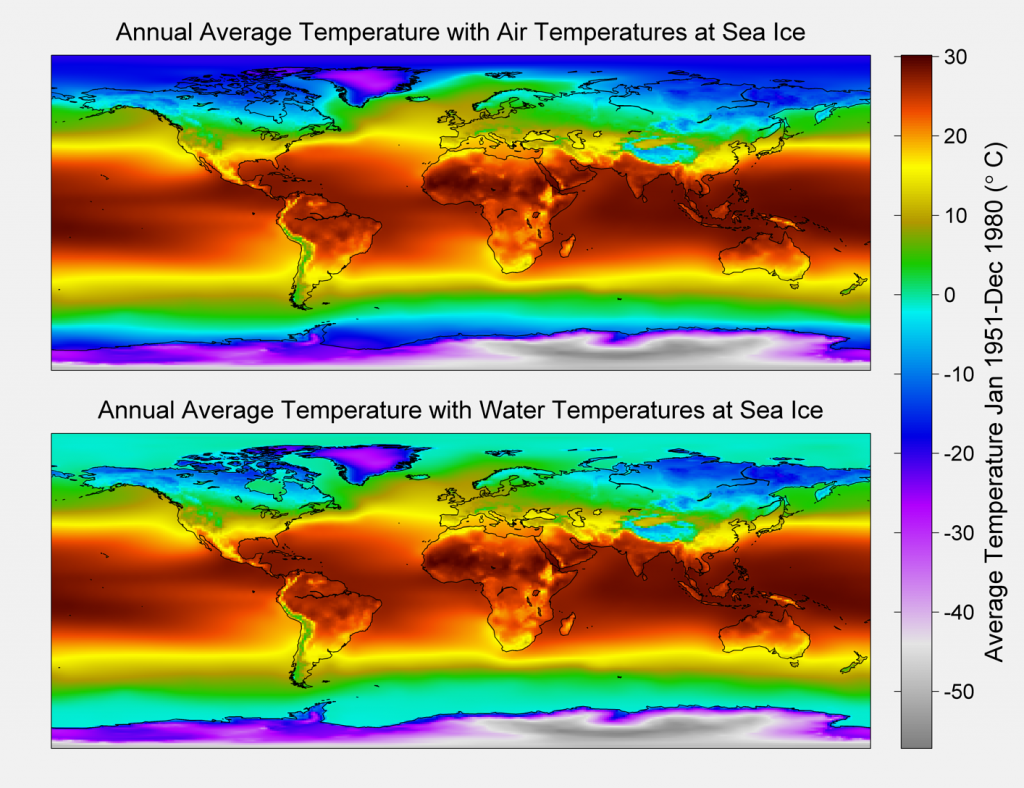
Annual Average Global Temperatures.
Both panels are calculated using a 1951-80 periodand represent the average Global Temperature index in degrees C.
At the poles where ice cover varies over the record we provide two cases.
For the baseline case the air temperature over iceis used for the average and in the alternative case in the bottom panel Sea Temperature under the ice cover is used. -1.8 C is used for this value in all cases
Also, as ships have gotten larger, the depth of the engine intakes
have increased – meaning the tested water was further from the actual
ocean surface.
Since the temperature results from buoys differs from
ship measurements, the various scientific groups have tended to try to
perform corrections between the different sensors.
The way the
correction is done affects the reported warming rate.
The authors recognized that one of the biggest questions is how to
stitch together different temperature results from different sensors.
Therefore, they broke the temperature data up into groups according to
the measurement device (buoys, satellites, ARGO floats, ships, etc.) and
they evaluated warming rates separately for each group.
The authors
also used advanced statistics to handle areas where no data were
recorded.
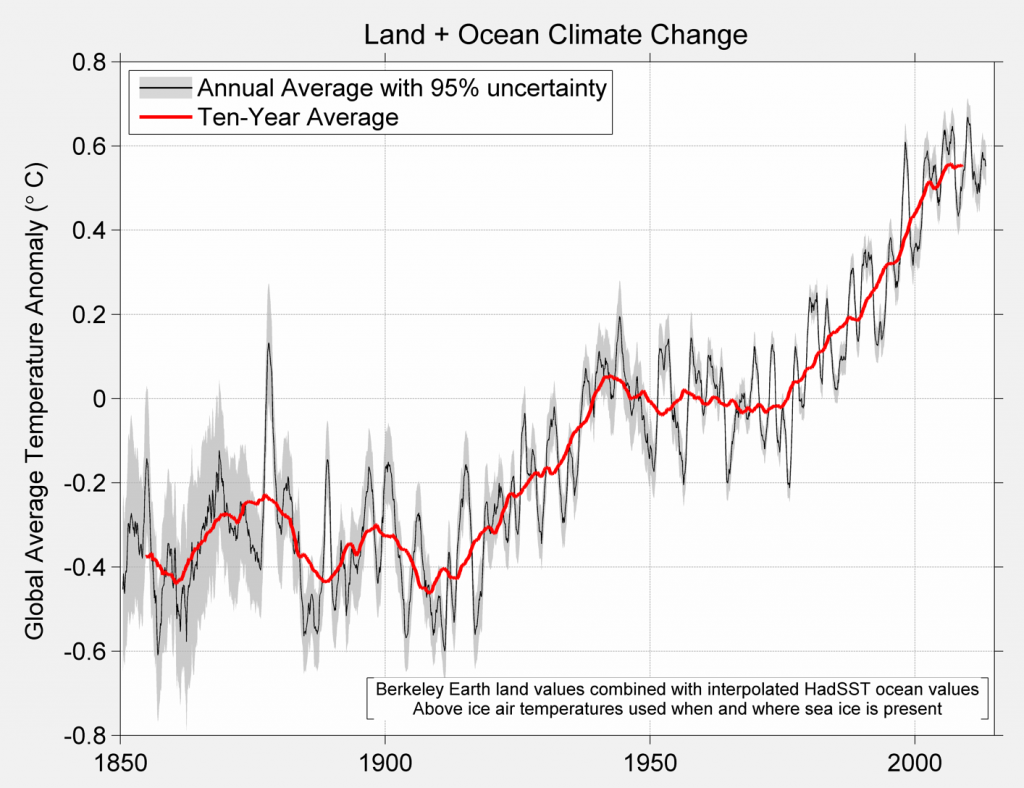
Berkeley Earth Global Temperature index, 1850 to present
After applying their tests, the authors found that the results
promoted by Karl at NOAA are the best, and other groups, in particular
the Hadley Centre in the UK and the Japanese agency, are too cold.
So what does this all mean? A few things.
First, this study is a nice
reminder that the proper way for science to work is for publications to
be scrutinized and checked by others.
This process leads the entire
scientific community to a deeper understanding of the science.
Second, this validates the scientists who were originally attacked by
political non-scientists and in some cases by contrarian scientists.
For instance, Judith Curry, a well-known critic of mainstream climate
science was quoted as saying:
The new NOAA dataset disagrees with a UK dataset, which is generally regarded as the gold standard for global sea surface temperature datasets … The new dataset also disagrees with ARGO buoys and satellite analyses ...
Color me unconvinced.
I actually study ocean temperatures so I knew this statement by
Judith Curry was complete nonsense.
It is nice to see a team actually
take the time to prove it.
Perhaps she and others will finally admit
they were wrong.
This paper is another reminder why it is so important to invest in
the temperature measurements that are needed to create long-term climate
records.
We really need uninterrupted measurements that span many
years/decades if we want to truly understand the Earth’s changing
climate.
Even though the costs of making these measurements are very
small compared to what we spend on other less important activities, I am
concerned that the new US administration will decide to pull the plug
on these projects.
If that happens, we will be flying blind.
Finally, and for those who read my posts regularly, I am sounding
like a broken record.
Global warming is happening, it never stopped, it
never paused, and the models have gotten it right.
It reminds me of a debate between creationists and scientists.
One
scientist whose name I cannot remember stated, “we have the fossil
record, we win.” Well, a similar quote works here.
“We have the data, we
win.” Now let’s move on to solving the problem.