Saturday, December 7, 2013

Fv25


Fv25 is our cold water surf film (finisterreuk.com)
It is cold water surfing as we see it, living and surfing within a cold water environment.
Filmed over 8 months, Fv25 will take you to the Outer Hebrides and Norway.
Filmed by award winning film maker Chris McClean and music composed by CJ Mirra.

Friday, December 6, 2013

Netherlands NLHO update : announcement of the issue date concerning the 1800 series


From 2013 onwards the Netherlands Hydrograpic Officeonly publishes a new edition of an 1800-atlas in the event of significant changes of the chart content.
This means that the eight 1800-serie charts have now different publication dates and regularly remain valid longer than one season, provided that they are weekly updated with the notices to Mariners (Ntm).
The eight 1800-atlases are no longer published at once as one pile.

With this message the Netherlands Hydrograpic Office informs us about the publication date of five 1800-atlases for 2014.
  • 1811 'Wadden Sea west sheet and adjacent North Sea Coast' and 1812 'Wadden Sea East leaf and adjacent North Sea coast' : second quarter 2014.
  • 1803 'Westerschelde and 1810 IJsselmeer, Edge Lakes and North SeaCanal' : third quarter 2014.
  • 1809 'Nieuwe Water route, etc' : fourth quarter 2014.

The other three 1800 serie-atlases remain valid, provided that they are weekly updated with the notices to Mariners. These are the :
  • 1801 NorthSea coast: Edition 2013
  • 1805 Oosterschelde, Veerse Meer: Edition 2012
  • 1807 Zoommeer, Volkerak et c., Edition 2012
In addition to paper 1800-series charts there is an increasingly use of additional electronic chart systems (ECS).
Mostly, these electronic charts are usually based on the 1800 series in which the ECS-producer or
customer makes the choice for the update frequency.
The Netherlands Hydrograpic Office has no supervision over these electronic charts (ECS) and emphasize the importance of a good voyage preparation in which the user becomes aware of the importance of the time stamp (actuality) of the chart and the differences in scale of the two product types.
The notices to Mariners are weekly published per atlas on www.hydro.nl
In addition, the brochure "BaZ mapped" is available for further practical assistance and interpreting and processing the NTM's.

Links :

Vast undersea freshwater reserves mapped


With the majority of Australia’s population living along the coast, the management of coastal groundwater resources is becoming ever more important.
Recent research of groundwater systems at the land–ocean interface has clearly shown the importance of acknowledging the connectivity between onshore and offshore parts of coastal aquifers.
This information is necessary to understand and predict the movement of groundwater and its dissolved solutes across a range of spatial and temporal scales.
Coastal aquifer systems do not terminate at the coastline, and nor is the coastline fixed in time.
Past changes of sea level and coastline migration still have an influence on the groundwater salinity distribution today.
This presentation reviews the current state of the science, and explains the need for more research on the offshore parts of aquifers, which may contain significant volumes of exploitable groundwater.

From ABC

Vast freshwater reserves are trapped beneath the ocean floor which could sustain future generations as current sources dwindle, say an international team of scientists.
In this week's issue of Nature they estimate 500,000 cubic kilometres of low-salinity water is buried beneath the seabed on continental shelves around the world, including off Australia, China, North America and South Africa.
"The volume of this water resource is a hundred times greater than the amount we've extracted from the Earth's sub-surface in the past century since 1900," says Australian lead author, Vincent Post, a groundwater hydrogeologist from Flinders University in Adelaide.
"Freshwater on our planet is increasingly under stress and strain so the discovery of significant new stores off the coast is very exciting," says Post, who is also with the National Centre for Groundwater Research and Training.
"It means that more options can be considered to help reduce the impact of droughts and continental water shortages."
UN Water, the United Nations' water agency, estimates that water use has been growing at more than twice the rate of population in the last century due to demands such as irrigated agriculture and meat production.
More than 40 per cent of the world's population already live in conditions of water scarcity. By 2030, UN Water estimates that 47 per cent of people will exist under high water stress.
Post says his team's findings were drawn from a review of seafloor water studies done for scientific or oil and gas exploration purposes.
Prior to this report Post says such undersea water reserves were considered to be rare.
"By combining all this information we've demonstrated that the freshwater below the seafloor is a common finding, and not some anomaly that only occurs under very special circumstances," he says.

Underwater aquifers

Post says the deposits were formed over hundreds of thousands of years in the past, when the sea level was much lower and areas now under the ocean were exposed to rainfall which was absorbed into the underlying water table.
When the polar icecaps started melting about 20,000 years ago these coastlines disappeared under water, but their aquifers often remained largely intact -- protected by layers of clay and sediment.
"In some case you have actually have fresh water under the sea, but in most cases it's a mixture between freshwater and sea water - we call that brackish water," says Post.
Post says the deposits are comparable with the bore basins currently relied upon by much of the world for drinking water and could cost much less than seawater to desalinate.
"For some areas it is economically viable to desalinate that brackish water and make it economically competitive with other sources of water recovery."
Post says similar technology to offshore oil exploration.
"You could drill from a platform or drill horizontally under the sea bed," says Post.

Challenges

But, Post says drilling for the water would be expensive, and Post says great care would have to be taken not to contaminate the aquifers.
He warned that they are a precious resource.
"We should use them carefully: once gone, they won't be replenished until the sea level drops again, which is not likely to happen for a very long time," says Post.
Water resources expert Dr Richard Davis of the Wentworth Group agrees.
While he says this "neglected resource" could become economically viable to obtain with the drop in desalination costs, humans don't have a good track record when it comes to exploiting the world's onshore groundwater resources, such as the Great Artesian Basin.
"We just squandered the water," says Davis, who was previously with CSIRO, the World Bank and the National Water Commission.
"In the Great Artesian Basin case we spent around 100 years pumping the water to the surface and letting it flow free and evaporate, using only a very very small fraction of what we tapped," he says.
As a result, says Davis, Australia has had to undertake a very expensive remedial program to try and cap the free-flowing bores to save water. He says there are similar stories in Africa and China.
"What concerns me here is that we don't take the same approach again," says Davis.
"Let's be slow, cautious and thoughtful about it this time and show how we can act responsibly if in fact the economics do stack up for the use of some of these aquifers."

Thursday, December 5, 2013

Canada to file Arctic seafloor claim this week

 Canada, Denmark, Norway, Russia and the United States claim overlapping parts of the region believed to be rich in hydrocarbons,
and have been rushing to gather evidence in support of their respective claims.
(Canadian Arctic Oil & Gas reference map from Pew)

From CBCnews

Some time this week, Canada is expected to make its case to the world to dramatically expand its boundaries by an area equivalent to the size of all three Prairie provinces.

Arctic topography / Arctic bathymetry
According to the US Geological Survey, the Arctic seabed is thought to hold about 90 billion barrels of oil and 30 percent of the world’s undiscovered gas resources.

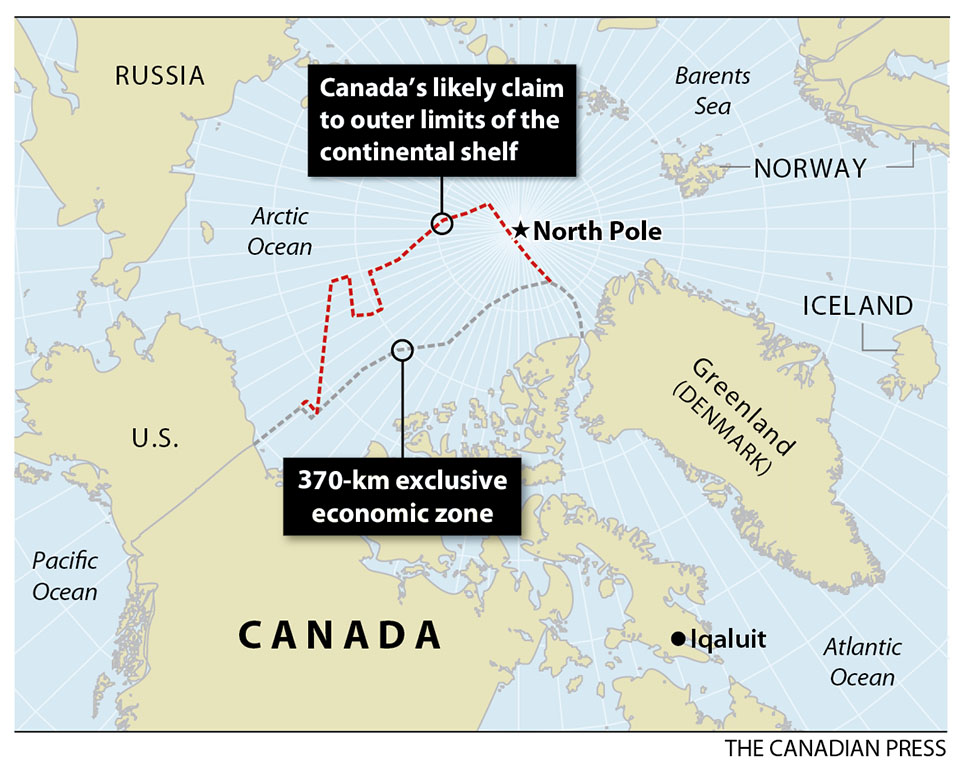
Canada's deadline is Friday to apply to a United Nations commission for exclusive rights to what is likely to be another 1.7 million square kilometres of Arctic seafloor.
The application under the Convention on the Law of the Sea will be the culmination of a decade of work and more than $200 million in public money.

The lines on the map will have been drawn by scores of scientists working everywhere from Ottawa labs to ice camps off the northern shores of Ellesmere Island, peering under the stormy black waters to discern the shape and composition of sea floor thousands of metres below.

The effort required more than a dozen icebreaker voyages, as well as trips by helicopters, airplanes and an unmanned, remote-controlled submarine that spent days under the ice.

The effort to map the Arctic seafloor required more than a dozen icebreaker voyages, as well as trips by helicopters, airplanes and an unmanned, remote-controlled submarine that spent days under the ice.
(Vladimir Chistyakov/Associated Press)

With the co-operation of three Arctic neighbours — Denmark, Russia and the United States — more than 18,000 kilometres of sea-floor data was collected from a part of the globe less familiar than the surface of the moon.
"It was a huge effort and enormously challenging," said Michael Byers, an expert on Arctic and international law at the University of British Columbia.

The United Nations Convention on the Law of the Sea governs which nations exert what kinds of controls over their surrounding waters.
In addition to the 22-kilometre territorial waters and the 370-kilometre exclusive economic zones, coastal countries are allowed to claim additional sea floor if they can show their continental shelf extends beyond the economic zone.

A Canadian nautical map charts the Canadian coastline in Nares Straight which separates Ellesmere Island with Greenland.
The old Soviet Union may have been just as familiar with Canada's Arctic waters as Canadians.
Sections of Cold-War-era nautical charts obtained by The Canadian Press suggest that Russian mariners have for decades possessed detailed and accurate knowledge of crucial internal waterways such as the Northwest Passage.
Canada is to file a claim to expand its Arctic seafloor boundaries this week.
(Michael Byers/The Canadian Press)

Canada has previously released maps on the likely boundaries of its claim.

 Artur Chilingarov, the veteran explorer who led the expedition to plant a Russian flag on the seabed at the North Pole in 2007, told Russia's claim to a portion of the Arctic shelf 

Russia filed its claim in 2002 and Denmark released its last week.
The U.S. has not signed the convention, but has agreed to follow most of its articles.
Its boundary dispute with Canada involves the exclusive economic zone and doesn't directly impact Friday's claim.

Ice floes float in Baffin Bay above the Arctic circle from the Canadian Coast Guard icebreaker Louis S. St-Laurent on July 10, 2008.
(The Canadian Press/Jonathan Hayward)

Decision decades away

Conflicts are likely to be few.
One calculation puts the amount of overlap between claims at a mere 75,000 square kilometres out of millions and millions.
Rob Huebert, an Arctic expert at the University of Calgary, will be watching to see if Canada stretches its claim past the North Pole.
The geologic justification — an undersea mountain range called the Lomonosov Ridge that stretches north from Ellesmere Island — is there, he said.
"I don't think there's something magical that stops [the claim] at the North Pole," he said.

The North pole is now a lake (YouTube)

Canadian officials have acknowledged mapping flights over the top of the world and into Russia's claim, which does stop at the pole.
But Byers said there's no evidence that Canada has collected the kind of data it would need to challenge Russia.
"We may have some small overlaps in the middle, but for the most part there will not be any overlap between the Russian submission on the one side and the Canadian and Danish submissions on the other," he said.

It all depends on how valuable Canadian officials think that real estate is, said Huebert.
"Maybe it's simply not worth it. Maybe we said, 'You know what, for the sake of international peace and stability, it's not important. We'll only do our science up to that and that will be the basis of our claim.'
"[But] it means we didn't go as far as we could."

Whether or not Canada will claim the North Pole, a decision on its fate is still probably 20 years off. Just checking the science on Canada's claim will likely take five years, said Huebert.
And there isn't any particular rush, said Byers.
These claims cover some of the remotest and harshest points on the planet and commercial exploitation of resources is a long ways off.
But just getting to the point where countries have filed claims is a triumph, he said.
"In this former Cold War frontier we have an agreed set of rules. That has a huge payoff."

Fredrick De Wit:  Poli Arctici et Circumiacentium Terrarum Descriptio Novissima

Links :

Wednesday, December 4, 2013

Extreme science: Oceanography, checking weather and climate on lonely wild seas

Adventures in Oceanography - Perspectives on Ocean Science
Join research oceanographer and photographer Dale Stokes for a global photographic journey featuring ships, submarines, underwater habitats, and both poles.
This presentation includes a decade of images documenting exotic locations underwater and topside and a variety of unusual vessels and research instruments.

From The Guardian

For an oceanographer, life aboard in the middle of gigantic waves means gravity cannot be trusted

Mountains of water are rolling towards us, covered in an army of huge breaking waves.
 Winds hitting 75mph are blowing the surface of the ocean away, and whatever is left is white with foam.
 The ship is facing directly into the wind, riding over the top of it all, juddering and bumping as it clings to the place where the sea touches the sky.
 On the bridge, the chief scientist is grinning as though all his Christmases have come at once.
 After four years of planning, this has turned out better than we dared hope.
 All that violence outside means that the ocean is doing something important – taking a really, really deep breath.
 And we are here to study it.

I like living on ships.
 A ship is a little floating village, a temporarily self-sufficient sliver of human society.
 The ocean is not our habitat, but it's amazing how much a steel bubble can help you live in denial.
 This particular glorified tin can is the R/V Knorr, an 85-metre research vessel carrying 20 crew and 12 scientists.
 For six weeks, the ship and everything inside her is all we've got.

A couple of weeks ago, the chief engineer prowled though the main lab, then pounced on a small cardboard box holding tools.
 The explanation came in a slow Boston drawl: "D'you mind if I take my box back? Boxes are rare around these parts.
" He removed the tools and disappeared into the bowels of the ship, clutching his cardboard box.
 On land, nothing comes cheaper than cardboard.
 On a ship, a box matters.

The one thing we're not short of is ocean.
 We are in the north Atlantic, hundreds of miles from land.
 There is nothing to look at except water and sky, and what we see would be familiar to any seafarer in history.
 But we are here to study something that was invisible to them, even though it was right in front of their noses.
 Around this ship, all the time, the ocean is breathing.
 My lungs and yours have a huge area – 70 square metres – and that surface helps you to take oxygen from the air and give back carbon dioxide.
 What I can see from the top of the ship is the lungs of the ocean, the vast but thin layer right at the top of the sea.
 Oxygen, carbon dioxide, nitrogen and lots of other gases travel both ways across that boundary all the time.

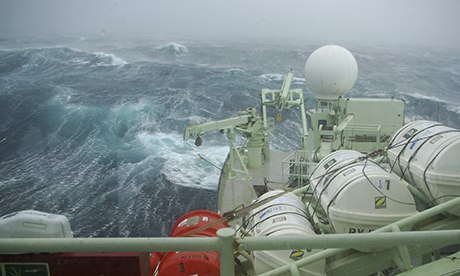
The view from the Knorr when the what was called the St Jude storm in Britain hit.
Photograph by Ian Brooks

Most importantly, about a third of all the extra carbon dioxide humanity puts into the atmosphere is being sucked up by the oceans.
 This area is one of the places where it is breathing in.
 Calm ocean isn't very efficient at breathing, but when the wind blows, the surface becomes more turbulent and breaking waves and bubbles vastly increase the surface area.
 As the wind blows faster, the ocean breathes more deeply.
 Even a single storm is disproportionately important.
 Understanding these storms means a better understanding of our planet, and a better ability to predict weather and the implications of changes to our climate.
 So here we are, bobbing about on the lungs of the ocean.

Gravity is untrustworthy on a ship in bumpy seas.
 We tend to take the "downwards" nature of gravity completely for granted, a reasonable approach in most circumstances.
 But out here, it's fickle.
 In the shower, you have to chase the shower flow around, because it keeps falling in different directions.
 I haven't stood a shampoo bottle up for weeks because there's no point.
 The only way to be sure something will be there when you get back is to make it a prisoner, with tape, straps, Velcro, string and whatever else you can find.
 Electronics, computers, tools and books must all be captive, and only the human beings float free.

Tasks like fixing electronics seem to take forever.
 First you wedge yourself against the bench so you're steady enough to hold the screwdriver in the right place.
 Then, at the crucial moment, the ship bumps and the tiny fiddly screw that was the object of your attention will make an enthusiastic aerial bid for freedom.
 Gathering the escapees is like herding cats, and then you have to start all over again.


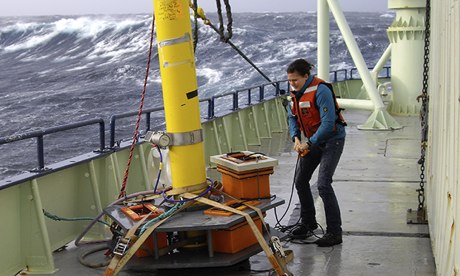
Helen Czerski working on deck in extreme conditions
On the brink: Helen Czerski working on the deck of RV Knorr.
 Photograph by Ian Brooks

I know you won't believe me when I say this, but one problem we don't have is seasickness.
 Most people who do feel nauseous get over it completely within three or four days.
 It's common to feel drowsy for longer than that, but it's hard to separate that from the semi-permanent sleep-deprivation.
 Floating is quite a nice feeling, until you arrive back on your bunk with a thump.
 My cabin is in the middle of the ship, so I don't get to float quite as much as some, but I still have to wedge myself in so that I don't slide up and down the mattress as the ship rolls.
 Some mornings even the night owls turn up to early breakfast, after the nights when they gave up pretending to sleep.

But there's a good reason for putting up with all this.
 This is where the action is.
 We are a large collaborative scientific team, essential because there are so many interconnected features to measure.
 We have two "nostrils" on the ship – one above and one below the waterline.
 They're sniffing the air and water for carbon dioxide and other trace gases so we can work out how much is going in to or out of the ocean at each moment.
 Buoys float close to the ship to measure the precise details of the waves.
 My contribution is attached to the biggest buoy of the bunch: it's the suite of instruments that are spying on the millions of bubbles beneath the surface.

The bubble buoy is 11 metres long and weighs about half a tonne.
 Getting it safely on and off the ship takes two cranes, about eight people and a lot of shouting from the bosun.
 But when it's floating out in a storm, it looks very small.
 Anyone can see the foam patches left on the surface by breaking waves, but this buoy lets us see what's hidden just underneath.
 Breaking waves will leave behind bubble plumes that could be many metres in size, and each bubble has the potential to transport a tiny puff of gas up or down.
 It still astonishes me that such minuscule things can make a contribution to how our planet works.
 But there are billions of them, and they do.

Splotches of colour on weather maps dictate our lives.
 Storms cross this part of the ocean from east to west every few days, and each one will take a couple of days to pass over us.
 Each morning, after my 10-second commute, the first task is to look at the ship's intraweb to see where we are.
 It doesn't make much difference, but I feel the need to look anyway.
 Then I check what day it is.
 That doesn't make much difference either, but it seems important to know.

Then I get to the weather forecasts, which do make a difference.
 Blues mean low winds, and red is high.
 Two weeks into the trip, a storm with a fuchsia-pink centre appeared to the east.
 Bright pink like that is on its way off to the top of the wind speed scale.
 While it was still calm, we put the buoy in the water, packed away almost everything, strapped down whatever was left, and waited.

The night before the height of the storm, no one slept.
 At breakfast, clutching the table and his coffee, the chief scientist was gleefully repeating "65 knots!" over and over again.
 Even the bosun admitted that it was "blowing a bit".
 I spent the morning on the bridge, looking out over seas that were fiercer than I had ever dreamed possible.
 The average waves were 10 metres high, the highest 15 metres, and I just couldn't stop looking.
 When it arrived in the UK three days later, this became known as the St Jude storm.

Being able to measure in these conditions felt like winning the lottery.
 We have a huge amount of very valuable data from the rest of the trip, but this was a first glimpse at the effect of the strongest winds of all.
 The ocean has been kind to us, in a tough love kind of way.

I've been on this ship for 35 days, and we will arrive in port tomorrow.
 I'm bruised from the bumpy ride, yearning for a good night's sleep (preferably with a proper duvet) and fidgeting from cabin fever.
 I can't wait to walk on solid ground, and to go swimming and running again.

But it's been worth it to be immersed in the environment out here, and to spend time on the other surface of our planet, the one that flows and splashes and never stays still.
 The vast blue of our blue planet is so easy to forget when you live on the land.
 But it's always out there, and this trip has reminded me of how dynamic, how beautiful – and how important it is for the Earth.

Links :