Saturday, June 11, 2022

America's Cup: Innovations will mark huge year for Team NZ

EMIRATES TEAM NZ 

The new hydrogen-powered chase boat being developed by Team New Zealand for the next America's Cup is set to be launched in March.

 
From Stuff by 
 
Team New Zealand will look to turn a stressful 2021 into a year when their innovation dominates the America’s Cup scene.
 
The defenders had the pressure applied to them by a highly competitive Luna Rossa to retain the Auld Mug in Auckland last March. Within a day of that victory, Team New Zealand were under the pump for their intentions to take the regatta offshore, adamant the funding resources could be found for a home defence.
 
Emirates Team New Zealand COO, Kevin Shoebridge talks to Stuff after the announcement of protocols for the 37th America's Cup


That decision dogged them for the rest of the year as attempts to force them to keep the Cup in Auckland continued against the threat of legal action.

The offshore venues - Cork in Ireland, a multi-city Spanish bid, Jeddah in Saudi Arabia, and a mystery fourth option – remain in play.

Team New Zealand boss Grant Dalton admits the hosting decision could go right down to the wire of their new deadline of March 31.“2021 started stressful for us and ended stressful,” Dalton admitted as he worked to keep the syndicate’s critics at bay.

It’s been a stressful year for Grant Dalton and Team New Zealand as they won the America’s Cup and looked to take the regatta to another level. 
Phil Walter/Getty Images
It’s been a stressful year for Grant Dalton and Team New Zealand as they won the America’s Cup and looked to take the regatta to another level.


The frustration for them is the exciting developments they are achieving with the Cup continue to get swamped by controversies.

Team New Zealand are hoping that can change as the realities of their bold plans come to fruition.

“It’s an innovation year for us,” Dalton says of 2022, when some key dates in the current cycle roll towards the next regatta in 2024.

The venue decision will be vital in several ways and hints of innovation in its destination.

There could be a new feel to the competition if it heads north, as expected, to a neutral venue, a rarity in the history of sport’s oldest trophy that dates back to 1851.

March will also be a month when Team New Zealand’s growing reputation for technological brilliance is on show again.

The prototype of the foiling hydrogen-powered chase boats to be used now sits in Team New Zealand’s base, getting fitted with plans to have it water-tested in March.

The purpose-built catamaran that will carry eight support staff is a futuristic concept - “Think of the Jetsons,” quips Dalton - designed to keep pace with the AC75 yachts that will threaten the 100km/h barrier.

In an era where the environment is everything, it has the ability to be a game-changer for pleasure-boating in a trickle-down effect that is a hallmark of America’s Cup design work.

The current Cup teams can design and build their own, or Team New Zealand are willing to supply them.Team New Zealand have the benefit of the brilliant Te Rehutai to develop their next America’s Cup boat from.

Ricky Wilson/StuffTeam
New Zealand have the benefit of the brilliant Te Rehutai to develop their next America’s Cup boat from. 

Time never sits still in this game and Team New Zealand have 30 designers beavering away in their Auckland base, working on the 40-foot foiling version of the Cup class that enthralled the world from last December to March on the Waitemata Harbour.

These smaller but equally powerful boats will be used for team testing as well as the youth and women’s America’s Cups.

They will be built at a yard in China and Team New Zealand expects to receive the first of them in August, looking to have their sailors in them by September.

The Kiwis will have two, seeing them as essential to developing the match-racing skills they felt weren’t at their best during the successful defence.

DAVID WHITE/STUFF
Key decisions made in 2022 will help decide who drinks from the America’s Cup in 2024.
 
Again, this is an innovation that could have long-term benefits to the sport with the revolutionary auto-pilot system able to manage the boat in flight on its foils, simplifying the requirements of the four-person crew.There are hopes the AC40 could develop into a racing class of its own.

Team New Zealand’s designers are also looking at how they can further improve their Cup-winning design. Te Rehutai was a step ahead of their opposition and will be the platform to launch their next thinking.

With teams allowed to build just one, rather than two, Cup boats in this cycle, the pressure is on to get the design right.
The racing boats aren’t expected to hit the water until late 2023, but with a 10-month build key decisions will be made in 2022.

For new teams - returning Swiss syndicate Alinghi is a “new” team for this cycle with a couple more yet to reveal their intentions - there is the ability to purchase a first generation AC75, and they can sail these from June 17 for a total of 20 days to help get them up to speed with the intricacies of the class.
 
EMIRATES TEAM NZ
The numbers around the next America's Cup.

Entries close on July 22, and it will be interesting to see who else surfaces by then.

There is an allowance for late entries to be accepted up till May 31, 2023 but that late deadline hardly promises a competitive challenge given the complexities involved.

All teams are able to sail their AC75s from September 17 and look for Te Rehutai to be back out on the Auckland waters with a need to get new signing Nathan Outteridge comfortable on the wheel of a full-scaled Cup boat.

By the end of the year the race schedule and the actual racing zone at the new venue will be released.

AT A GLANCE – KEY 2022 DATES FOR AMERICA’S CUP

Early March: Team NZ to launch first hydrogen-powered foiling chase boat.

March 31: Team NZ and Royal New Zealand Yacht Squadron to announce Match venue and approximate event dates.

June 17: New competitors may sail Version 1 AC75’s for 20 sailing days.

July 31: Entry period closes.

Early September: Team NZ to launch first AC40, the smaller-scaled testing boat and youth and women's America’s Cup class.

September 17: Competitors may sail an AC75 yacht.

November 30: Race schedule course areas for the Match and challenger series revealed.

Friday, June 10, 2022

Antarctica: Southern Ocean floor mapped in greatest ever detail


From BBC by Jonathan Amos
 
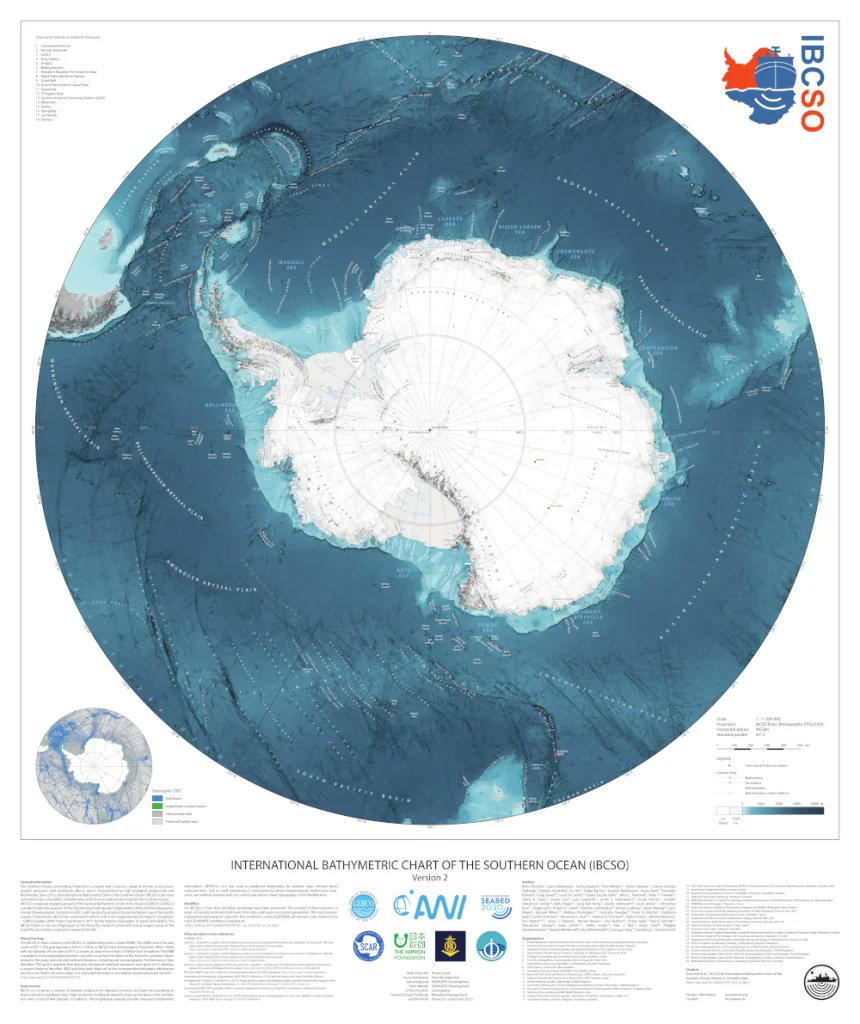
Scientists have made the most precise map yet of the mountains, canyons and plains that make up the floor of Antarctica's encircling Southern Ocean.

Covering 48 million sq km (18.5 million sq miles), this chart for the first time details a new deepest point - a depression lying 7,432m (24,383ft) down called the Factorian Deep.

Knowledge of the shape of the ocean's bottom is essential to safe navigation, marine conservation, and understanding Earth's climate and geological history.

But we still have much to learn.
Vast tracts of terrain have never been properly surveyed.
 
A close up of the structures seen on the Seabed map released June 7, 2022. Dorschel et al., 2022

The International Bathymetric Chart of the Southern Ocean (IBCSO) has taken five years to compile and updates the first attempt at a comprehensive map, which was published in 2013.

The IBCSO project and others like it around the world are gradually filling in the gaps in our scant knowledge of the bottom of the world's oceans.
Ships and boats are being encouraged to routinely turn on their sonar devices to get depth (bathymetric) measurements; and governments, corporations, and institutions are being urged not to hide away data and put as much as possible into the public domain.
This is paying dividends.
 
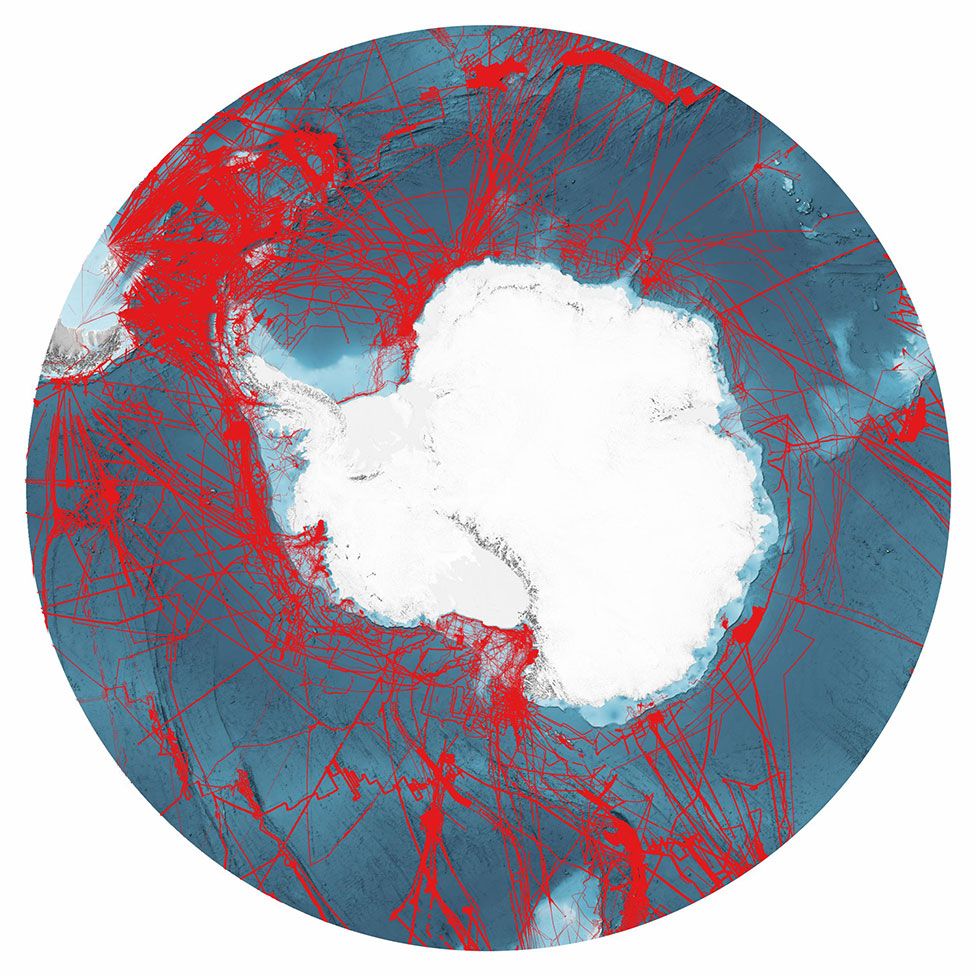
IBCSOv2/AWI/Nippon Foundation/Seabed2030
Image caption,
The tracks of surveying ships. Low-resolution satellite measurements must fill in the rest

The new map covers all the Southern Ocean floor poleward of 50 degrees South.
If you divide its 48 million sq km into 500m grid squares, 23% of these cells now have at least one modern depth measurement.
 

Comparaison IBCSO v1 VS v2
 
That's a big improvement on nine years ago.

Back then, IBCSO began only at 60 degrees South, and less than 17% of its grid boxes had a modern measurement.

"You have to realise just what the change from 60 degrees to 50 degrees means; we've more than doubled the area of the chart," said Dr Boris Dorschel from Germany's Alfred Wegener Institute.
"So, we've increased the area coverage, but we've also increased the data density, because, in parallel, we've kept on acquiring new data and knocking on doors to free up existing data," he told BBC News.
 

Much of the information in the chart comes from the ice-strengthened ships that support scientific endeavours in Antarctica, including from the UK's former polar ship, the RRS James Clark Ross.
(In future, this British contribution will come from its successor, the RRS Sir David Attenborough, affectionately known as Boaty McBoatface.)

As these vessels shuttle back and forth between the White Continent and the likes of Chile, South Africa and Tasmania - their echosounders make a habit of surveying the submerged terrain below.

And this activity is increasingly coordinated, with research organisations from different nations working together to try to offset slightly the routes taken by their icebreakers.
 
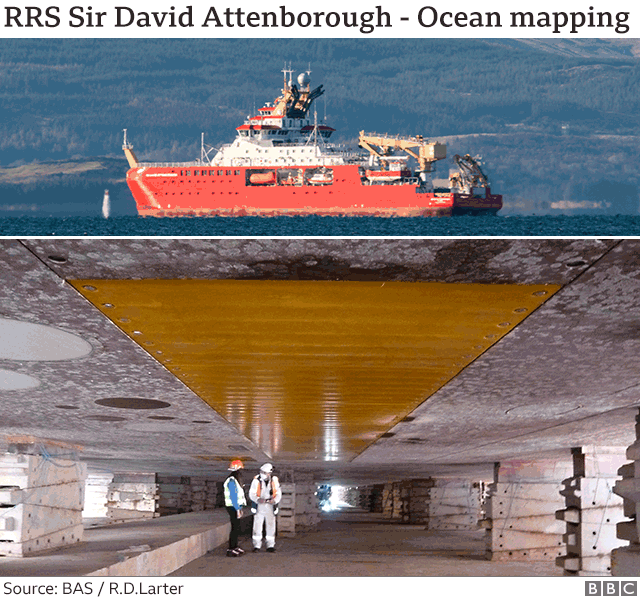
The UK's new polar ship, the RRS Sir David Attenborough, is equipped to map millions of sq km of ocean bottom over its career.
The above image shows the ship's hull in dry dock.
The yellow rectangle in the centre is a cover made of a synthetic material over the 8m-long array of transmitting transducers for the deep-water multibeam echosounding system.

Better seafloor maps are needed for a host of reasons.

They are essential for safe navigation, obviously, but also for fisheries management and conservation, because it is around the underwater mountains that marine wildlife tends to congregate.
Each seamount is a biodiversity hotspot.

In addition, the rugged seafloor influences the behaviour of ocean currents and the vertical mixing of water.
This is information required to improve the models that forecast future climate change - because it is the oceans that play a pivotal role in moving heat around the planet.

"We can also study how the Antarctic Ice Sheet has changed over thousands of years just by looking at the seafloor," explained Dr Rob Larter from the British Antarctic Survey.
"There's a record of where the ice flowed and where its grounded zones (places in contact with the seafloor) extended. This is beautifully preserved in the shape of the seafloor."

The new map was made possible by financing from Japan's Nippon Foundation and the support from Seabed2030, the international effort to properly chart Earth's ocean floor by the end of the decade.

At the moment, our knowledge of four-fifths of the planet's underwater terrain comes only from low-resolution satellite measurements that have inferred the presence of tall seamounts and deep valleys from the gravitational influence these features have on the sea surface.
Water piles up over the mass of a large submarine mountain and dips slightly where there is a trench. 
 
 
One key finding in the years between the first and second versions of IBCSO is the recognition of the Southern Ocean's deepest point.
It's a depression called Factorian Deep at the far southern end of the South Sandwich Trench.  
It was measured and visited by the Texan adventurer Victor Vescovo in his submarine Limiting Factor in 2019.

The remote and often inhospitable nature of the Southern Ocean means substantial sections of it are unlikely to get mapped unless there is dedicated undertaking.
There's high hope that an emerging class of robotic vessels could be given this task in the years ahead.

The International Bathymetric Chart of the Southern Ocean is published in the journal Scientific Data.

Links :

Thursday, June 9, 2022

Enormous 'rogue waves' can appear out of nowhere. Math is revealing their secrets.

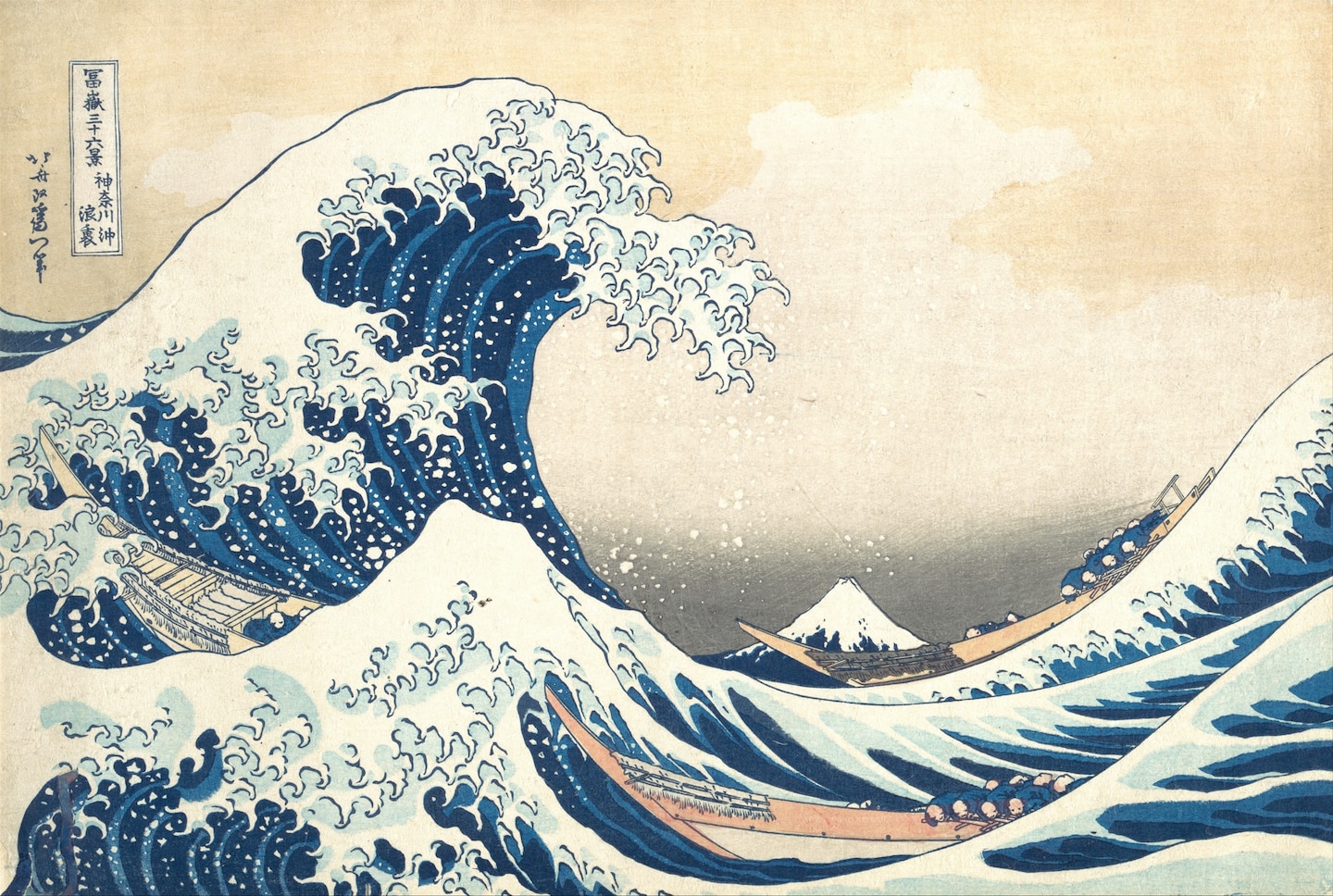
Katsushika Hokusai's iconic woodblock print, Under the Wave off Kanagawa, depicts a large wave many often misidentify as a tsunami.
The large off-shore wave depicted is more likely a rogue wave.
Katsushika Hokusai, The Metropolitan Museum Of Art

From National Geographic by Ally Hirschlag

Once considered a maritime myth, these towering waves can pose serious risks to ships in the open sea.
Now scientists are developing ways to predict them before they strike.


In 1826 Captain Jules Dumont d’Urville, a French scientist and naval officer, was caught in a turbulent storm while crossing the Indian Ocean.
He watched as a wall of water rose some 100 feet above his ship, the Astrolabe.
It was one of several waves more than 80 feet tall that he recorded during the wild storm.
One of his crew was lost to the sea.
Yet after Dumont d’Urville made it back to land, his story, backed by three witnesses, seemed so outlandish that it was dismissed as fantasy.

Scientists at the time believed waves could only reach about 30 feet tall, so the handful of 19th century reports of massive waves rising in the open ocean were largely written off as maritime myths.
Only later would scientists realize that the accounts were rare because many mariners who experienced these so-called rogue waves didn't survive to tell the tale.


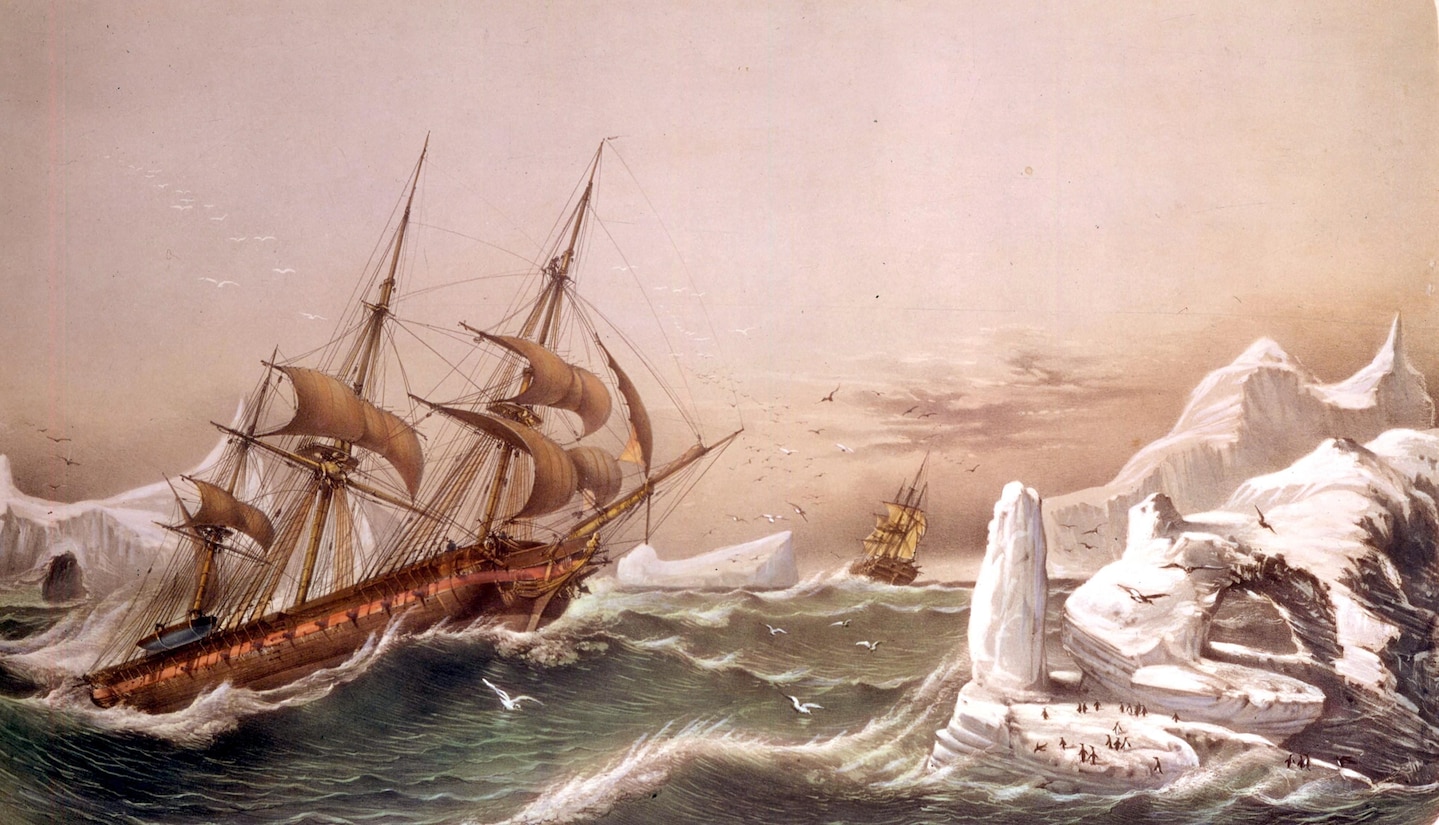
Jules Dumont D'Urville's ships, the Astrolabe and Zelee, drawn and lithographed by Louis Le Breton in 1840.
The scene depicts a voyage between 1837 and 1840 to investigate the perimeter of Antarctica.
On a previous expedition about a decade earlier, Dumont D'Urville encountered what he described as a 100-foot wave in the Indian Ocean.
Smith Archive, Alamy Stock Photo


Photograph of a breaking rogue wave in the Southern Ocean taken from the French icebreaker Astrolabe, named after Dumont d'Urville's historic ship, during one of its regular voyages between Hobart, Tasmania, Australia, and the Dumont d'Urville Station in Antarctica.
The shape is remarkably similar to that depicted by Hokusai in Under the Wave off Kanagawa.
Photograph by Veronique Sarano

Today a rogue wave is defined as one that is more than twice as tall as the waves around it.
These giant swells can appear suddenly and seemingly out of nowhere.
With steep sides and a deep trough below, they resemble a wall of water rising out of the sea.
They can occur during storms with choppy seas but have also been reported in calm waters, which is one reason they’re so difficult to predict.

Scientists have recognized rogue waves as real phenomena since the mid-1990s—but keeping sea travelers safe from them is still a major challenge.
Though they are relatively rare, rogue waves can cause severe damage and loss of life if they hit a ship in the open sea.
In the vastness of the ocean, the interaction of the many forces leading to rogue waves can be difficult to untangle.
More recently, mathematicians have been combining real-world data collected from monitoring buoys with statistical models to understand what causes these gargantuan waves to form.
Their work offers hope that we may even be able to predict rogue waves before they strike.


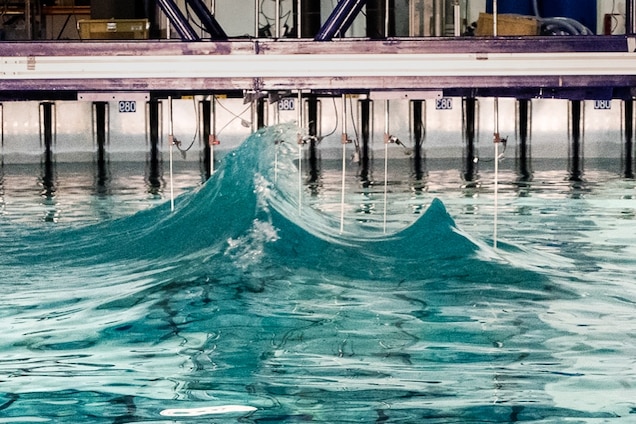
This image reveals the morphology of a rogue wave recreated in the lab at the FloWave Ocean Energy Research Facility at the University of Edinburgh in Scotland.
Photograph By Dr Donald Noble, University Of Edinburg, and Dr Mark Mcallister, University Of Oxford


How waves can grow


As shipbuilding technologies advanced in the 20th century, the number of surviving witnesses to rogue waves grew.
In April 1966 an Italian cruise ship called the Michelangelo met with an 80-foot wave that rose high above the storm-driven waves around it.
The ship sustained significant damage and three people were drowned, but most who were on board made it safely back to shore.

The crew aboard the MS München, a German container ship, weren’t so lucky.
In December 1978 the ship left the German port city of Bremerhaven for Savannah, Georgia, packed with steel cargo and a crew of 28.
After reporting bad weather and sending out distress signals in the early morning hours of December 13, the ship and everyone on it disappeared.
A lifeboat that had been attached to the ship about 65 feet above the water was recovered, but it appeared to have been ripped from its post, likely by a towering wave at least that high.

Scientific doubts about these mysterious, giant waves were not completely dispelled until 1995, when a rogue wave hit the Draupner oil rig, a natural gas platform in the North Sea off the coast of Norway.
The wave’s peak, measured by a laser detector on the rig’s scaffolding, rose 85 feet above the surface.


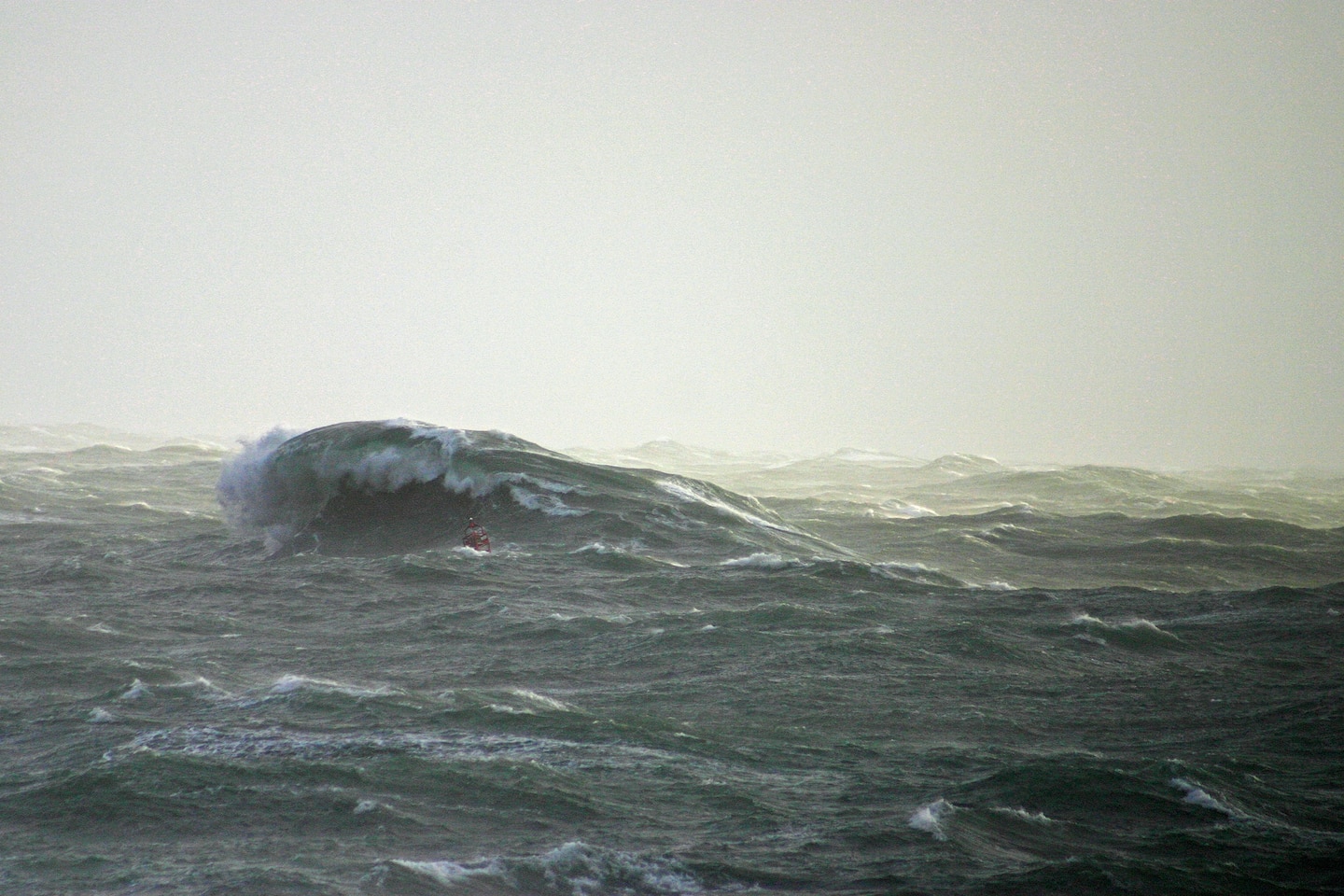
A monitoring buoy operated by Canadian research company MarineLabs is seen in rough waters, approximately three miles from the site off the coast of British Columbia where another MarineLabs sensor buoy measured an extreme rogue wave in 2020.
Photograph by Mary & Ed Goski


Scientists have since figured out that unlike tsunamis, which are large waves produced by a sudden displacement of water from an event such as an earthquake or landslide, rogue waves form due to a chance combination of wave movements through the ocean.

Two main mathematical theories have emerged to explain the wave movements that spawn rogue waves: Linear addition and nonlinear focusing.
Linear addition assumes that waves travel through the ocean at different speeds, and when they overlap, they can strengthen into a rogue wave.
Nonlinear focusing assumes waves travel in groups and can lend energy to one another, which sometimes spawns a rogue wave.

One reason for the uncertainty is that rogue waves are rare.
Even now, there’s a dearth of quality tracking data.

“Generally ocean rogue waves are measured from platform measurements or buoys, which record time-measurements at a specific location without any knowledge of what happened before or will happen further,” says Amin Chabchoub, a wave physicist at the University of Sydney in Australia.
A 2019 study led by Chabchoub evaluated several rogue wave observations and models, and the team concluded that the inciting rogue wave mechanism can change depending on the varying factors in the sea at a given time, known as the sea state.

To compensate for limited observations of rogue waves, scientists rely on wave tanks.
“Recreations in a laboratory mimic almost one-to-one what happens on the ocean surface,” Chabchoub says.
These experiments can even account for currents and winds, although the controlled settings have their own limitations.

When water is trapped in a narrow channel such as a wave tank, it’s much easier for large waves to form and to be observed.
However, these experiments represent an “unrealistic scenario” because waves cannot spread in all directions as they would at sea, says Francesco Fedele, an ocean engineer at the Georgia Institute of Technology.

The National Oceanic and Atmospheric Administration is developing a system that can forecast potentially hazardous areas of the ocean every hour using a program called WAVEWATCH III. The latest version, released in 2019, uses a probability formula that Fedele developed in 2012 to predict extreme conditions in the ocean at a specific place and time.
It’s a useful tool to help mariners steer clear of dangerous seas, but it may not be enough to protect them from a rogue wave that appears out of the blue.

Johannes Gemmrich, a research scientist at the University of Victoria in Canada who analyzed the 2020 rogue wave near Vancouver Island, says rogue waves are most often generated when waves travel at different speeds and occasionally overlap, supporting the linear addition model.
But he believes wave asymmetry—when waves have higher peaks and lower troughs—plays a crucial role as well.
“If we allow for stronger asymmetry, the probability of extreme rogue waves increases drastically,” Gemmrich says.

A general formula for the sea


One school of mathematicians says it doesn’t matter what causes a rogue wave, because one can still predict rogue waves quite accurately using a statistical framework for rare occurrences called large deviation theory.

The idea behind this method is to model the most efficient way a rogue wave can form, then use that model to chart a particular rogue wave’s path of development.
The theory can factor in linear and nonlinear effects depending on the scenario, which is why its proponents consider it a unifying theory—one that could perhaps be used to predict rogue waves in various ocean conditions.

“If you just look at the absolute most efficient way of forming these waves, it very nicely agrees with the actual observed ones,” says Tobias Grafke, a mathematician at the University of Warwick in the United Kingdom.

Grafke and a team of researchers tested this theory in wave channels, measured results against real-time wave observations, and found the method could predict rogue waves in both settings surprisingly well.

One problem with this framework, however, is that it’s extremely challenging to account for all the factors of a sea state at a specific point in time.
If you’re the captain of a ship, the most helpful forecasting information would be derived from real-time observations, not statistical probabilities.
Grafke says his team’s formula can account for the specifics of a given sea state, but the more variables you fold in, the harder it becomes to solve quickly.

“The more complex these [equations] are, the better the prediction, the higher the computation effort and time,” Chabchoub says.
“It is therefore a trade-off between accuracy and time to obtain useful results.”

Real-time forecasting


Scientists have been moving toward real-time wave prediction technology, but the newer approaches need to be tested in real-life settings—a challenge given the rarity of rogue waves.
In many cases, the computation process needs to be ramped up to match the speed of the waves.

Rogue waves can form in just “10 to 15 seconds in rough seas,” Fedele says.
“It is still hard to make fast and accurate predictions in such a brief time interval.”

To predict a rogue wave, scientists would need a radar system to continuously measure waves near a boat, so they could run data through a mathematical model that paints a picture of the ocean’s surface at that moment.
A model that calculates a new surface every five minutes would offer a relatively accurate prediction of how waves would evolve in the next several minutes.

Such a system is not a reality yet.
“The technology is there. The question now is: How [do] you make it fast?” Fedele says.

As more rogue waves are measured, mathematicians may finally find a way to anticipate these deadly waves before they rise out of the ocean—a technology that Captain Dumont d’Urville could have only dreamed of back in 1826.

Links :

Wednesday, June 8, 2022

Belgium (Vlaamse Hydrografie) layer update in the GeoGarage platform


3 nautical raster charts updated


The dead shellfish littering our beaches tell you a lot about safety and secrecy in Britain


Illustration: Thomas Pullin/The Guardian

From The Guardian by George Monbiot

Environmentalists fear a toxic disaster is occurring on the seabed, and government denials seem less and less plausible


With every passing week, it looks more like a cover-up.
The repeated mass strandings of crabs and lobsters on the coast of north-east England, and the ever less plausible explanations provided by the government, are the outward signs of an undersea disaster and a grim new politics.

Last October, beaches around the Tees estuary and along the coast of North Yorkshire were suddenly covered in dead and dying crabs and lobsters.
The government launched what it called an “investigation”.
In January, hundreds of dogs reportedly fell ill after being walked on the same beaches.
In February, a government press release announced that the mass death of sea creatures was caused by an “algal bloom” – a rapid increase in the population of algae that can release toxins into the water and affect other wildlife.Record low wild salmon catch in Scotland alarms ecologists

No report was published, no data, no evidence of any kind.
An algal bloom in October seems highly unlikely in north-east England, as such blooms require high temperatures and clear water: the sea at the time was almost certainly too cold and turbid.
No bloom had been noticed by the fishing community or any other water users.

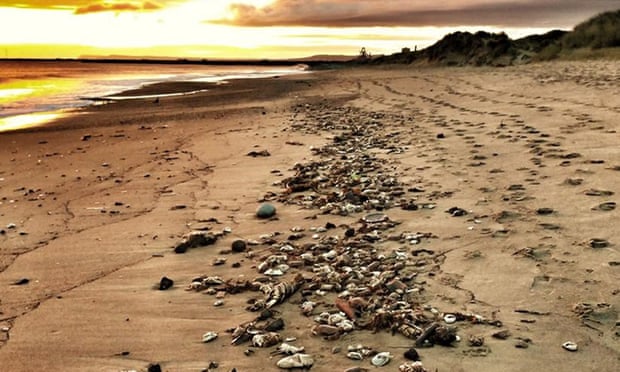
Dead crabs on the beach at Seaton Carew.
Photograph: Paul Grainger/PA
 
Soon after the press release was published, another mass death of crabs and lobsters was reported on the same coastline.
While an algal bloom in October is implausible, an algal bloom in February is impossible.
The government reopened its investigation, but promptly shut it down again, on the extraordinary grounds that a few healthy crabs and lobsters had been caught.
Nothing to see here.

Last month, there was another mass stranding of crabs and lobsters on the same beaches.
Divers reported that the seabed immediately south of the River Tees was a “dead zone”: even the seaweed was dying.

The government has still not published its evidence.
When I asked, it refused to send it to me.
It was unable to produce a convincing explanation for this refusal.
So we have no means of determining whether its methodology was robust, whether its data gathering, management and analysis was sound, or whether its conclusions reflected its results.
Transparency is a basic scientific principle: if it’s not published, it’s not science.

A coalition of local commercial fishers and anglers raised the money for an independent investigation by the marine pollution consultant Tim Deere-Jones.
He made a series of freedom of information requests, which revealed that the government’s only evidence for an algal bloom consisted of satellite images.
But such images, without corroboration by water sampling, can be misleading: plumes of sediment can give similar results.
Astonishingly, although there is no evidence that it conducted such sampling, the government concluded not only that a bloom had occurred, but that it was caused by a particular, toxic species: Karenia mikimotoi.
This is the stuff of science fiction.
Karenia thrives in temperatures between 20 and 24C.
The average water temperature on this coast in October is 13C.
There is no plausible mechanism by which a Karenia bloom could cause the mass death of lobsters and crabs without also killing large numbers of fish, sea urchins and many other species.

The freedom of information requests revealed something else: that the levels of a pollutant called pyridine in the north-eastern crabs the government tested were up to 74 times higher than those found in crabs caught in Cornwall.
Pyridine is highly toxic to aquatic life.
Despite this finding, the government press release claimed it has “ruled out chemical pollution as a likely cause”.
It says that “pyridine was not present in water and surface sediment samples collected off the Tees”.
Until we see the evidence, we have no means of knowing when, where and how such samples were taken, or how were they assessed.

Environmental Disaster, North East England Coast
Thousands of dead and dying sea creatures have washed up on the shore. 


Pyridine is a waste product of heavy industry, and is also manufactured as a base for insecticides and marine biocides.
Several of the industries once located on the Tees estuary are likely to have produced it.
Deere-Jones found that there were very high levels of pyridine derivatives in sediments in the estuary.
A dredger started work in the mouth of the Tees at the end of September, deepening the channel.
Deere-Jones’s hypothesis is that the dredger inadvertently exposed contaminated mud.
This was then dumped at the legal disposal sites farther offshore.
The currents flowing southwards, he believes, spread these sediments down the coast.
As pyridine attaches itself to particles that fall to the seabed, and accumulates up the food chain, it is likely disproportionately to affect bottom-living scavengers such as lobsters and crabs.

The government’s insistence that chemical pollution was not responsible might seem hard to understand.
But consider this.
In July, work begins on the Teesside freeport, the biggest and most spectacular of the government’s fabled “Brexit opportunities”.
The project is being overseen by the Conservatives’ favourite mayor, Ben Houchen.

Constructing the Tees freeport will require a massive dredging operation.
To enable ships to dock at the new South Bank Quay in the Tees estuary, a crucial component of the freeport, the channel needs to be deepened from 9m to 13m, and the “berth pocket”, where the vessels moor, to almost 16m.
This means excavating historic sediments that are likely to contain the chemical legacy of Teesside’s old industries.
Questions have been raised about whether these sediments have been properly tested before dredging begins.
If they turn out to be highly contaminated, the expense of removing them safely could be prohibitive.

Freeports have been a magnet for money-laundering, tax evasion, corruption, smuggling, counterfeiting, drug trafficking and terrorist money flows.
Just before the government launched its consultation proposing 10 freeports in the United Kingdom, Brussels announced that it was clamping down on freeports in the European Union.
This helps the UK to consolidate its position as the world’s financial entrepot for organised crime, now a major sector of our economy.
In conjunction with the City of London, which acts as a global hub for tax havens, the flow of criminal money into our property market and the complete collapse of the prevention of fraud and the regulation of waste dumping (a traditional preserve of the mafia in poorly regulated economies), freeports may secure this country’s place as the favoured destination of the rich and unscrupulous.
That’s what Brexit opportunity means.

It’s possible to prevent some of the criminal uses of freeports if they are tightly regulated.
However, the government has so far failed to commit to the OECD’s protocol for preventing illicit trade, and boasts of “cutting red tape” in developing the ports: in other words, dismantling regulations.

If Tim Deere-Jones’s thesis is correct, marine ecosystems are already feeling the effects.
The government could be obscuring the likely impacts of the freeport’s construction before it has begun.
Those dead crustaceans look to me like a tide of dirty money, washing up on our beaches.

Links :