New alliance from 14 nations pledges to fight latest EU curbs on ‘indefensible’ practice of scooping up fish from the sea floor
An EU action plan to deal with fishing practices that trawl the ocean floor is set to trigger a row between conservationists and a new industry alliance that says it is fighting for Europe’s culture and identity.
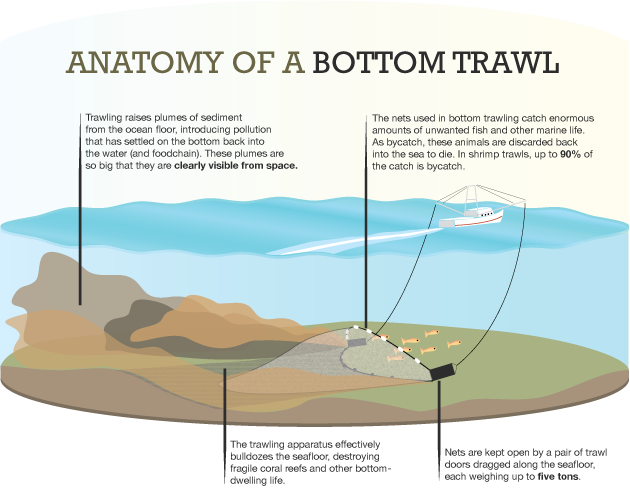
About 32% of Europe’s fish are caught by industrial fishing vessels that rake the sea floor with enormous nets in a process called bottom trawling.
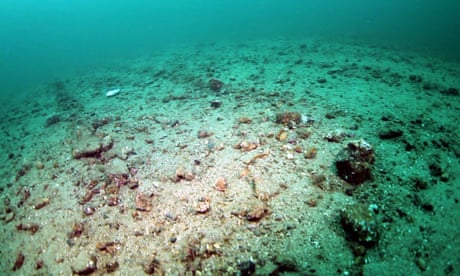
Studies indicate that these nets can suck up to 41% of all invertebrate life from the sea floor and cause grave damage to marine environments such as cold water coral reefs and seagrass beds.
Bottom-trawling is already banned by the EU at depths of more than 800 metres but the European Commission has promised to implement whatever restrictions it deems necessary to further limit the practice, which it called “the most damaging activity to the seabed”.
The fishing industry, however, is preparing to fight back with the formal launch of the European Bottom Fishing Alliance (EBFA) later this month.
Formed in response to a petition signed by 150,000 people in December calling for an immediate ban on bottom trawling in MPAs, the alliance unites fishing associations across 14 countries.
New trawling curbs could create a supply squeeze with the potential to price many common fish species such as sole, turbot, plaice, halibut and shrimps out of European menus, EBFA says.
“We don’t want to see an industry catering for the rich,” said Ivan López, chair of EBFA, who runs a trawling business in Spain.
“It would not be fair if fish became a luxury product.” Seafood is a “culture and identity” issue in Spain, he added.
Bottom trawling is an indiscriminate fish harvesting method, capturing all in its path and scraping vital marine growth off the seabed.
Others are critical of these arguments.
While trawling restrictions could raise prices for a period, said Joachim Claudet, a senior scientist at France’s National Centre for Scientific Research, “ecosystems would recover quite quickly if we stopped trawling, and that would mean there would be more fish to catch with more sustainable practices.”
Rebecca Hubbard, programme director of the Our Fish campaign group, described the new industry offensive as “a desperate greenwashing initiative in defence of the indefensible”.
The issue is escalating into a battle, said Nicolas Fournier, campaign director of the Oceana conservation group, which argues for practices such as long-line fishing, and eating more locally-caught and less threatened species.
“If we are to seize this opportunity to tackle bottom-trawling, it’s basically now or never,” he said.
Brussels has pledged to establish protected areas for at least 30% of Europe’s seas but, under EU law, MPAs have specific objectives, such as protecting seabirds, crustaceans or other marine features.
Their effectiveness is contested, however. Fournier said that their benefits often exist mainly on paper and that shipping, dredging, oil and gas drilling, aquaculture, harbour developments and windfarms can still be permitted in MPAs.
One tenth of Europe’s waters have marine protected status but more than 2.5m hours of bottom trawling took place within them in 2020, according to research by Oceana.
“In some areas, bottom trawling is prohibited in order to protect the seabed, but many other [MPAs] focus on other features and therefore don’t regulate bottom trawling,” said one EU official, who did not want to be named. “It’s a nonsense that ‘protected’ areas can allow trawling, which is one of the most damaging human activities at sea,” Claudet said.
The EBFA cites studies by the University of Washington academic Ray Hillborn to support its case for allowing bottom trawling in MPAs on a case-by-case basis – in areas where seabirds are being protected but the seabed is not, for example.
However, “if seabirds are eating fish or organisms from the seabed, you can’t treat them in isolation from the rest of their ecosystem,” said Prof Clare Bradshaw of Stockholm University.
A European Commission spokesperson said it had to weigh any new measures against the economic effects they could have on an industry sector that makes up a quarter of the EU fishing fleet.
“We will not aim for a blanket approach by banning all gears in all waters,” the official said.
“Instead, we will look at how best to protect the seabed and work on the basis of science to see how to balance the decisions.”
Some research also suggests that beyond biodiversity loss, sedimentary disturbances from bottom trawling may cause more CO2 releases than the world’s entire aviation fleet.
All of which creates newfound uncertainty for an EU fishing sector which, critics say, has been accustomed to punching above its weight in Brussels.
Fishers, like farmers, carry significant lobbying clout but many believe they have lost out in debates over catch limits and Brexit, and could now bump up against further restrictions.
“We feel that the green deal is pushing too much on to the fisheries,” said Lopez.
“We feel the argument is too skewed in one direction on the [environmental] issue,” he added, “and it’s not ours.”
Since early november, more and more vessels navigating in chinese waters are disappearing from the tracking systems normally used in maritime transport, likely following the introduction of the new chinese law on the protection of personal information, which came into effect last 1st november.
In this video, we give you a peek into what Unseenlabs' maritime monitoring service can achieve on a daily basis.
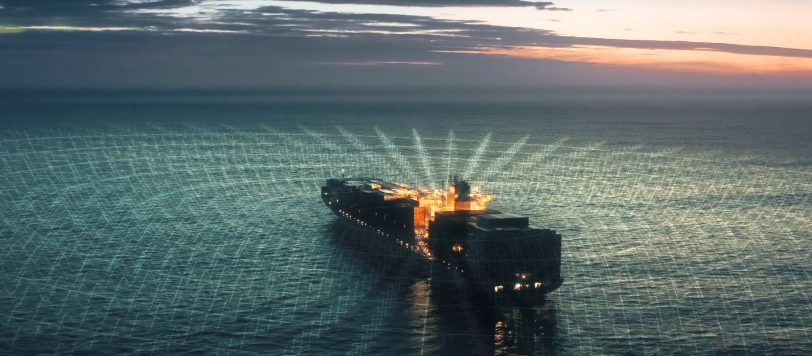
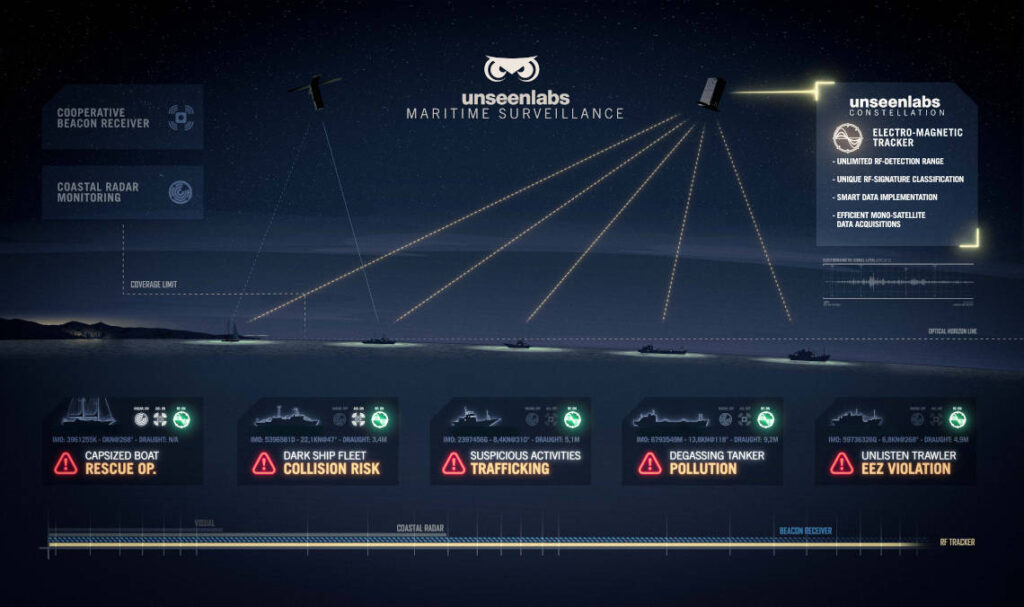
While waiting for the upcoming launch of our two new satellites, here’s an example of what Unseenlabs’ maritime monitoring system can achieve with just our first satellite BRO-1.
Unseenlabs’ innovative technology is currently the only one on the market that allows for each satellite to be an independent measurement point.
Our three satellites will thus be able to monitor three different areas of interest simultaneously, while guaranteeing the best revisit time available on the RF detection market.
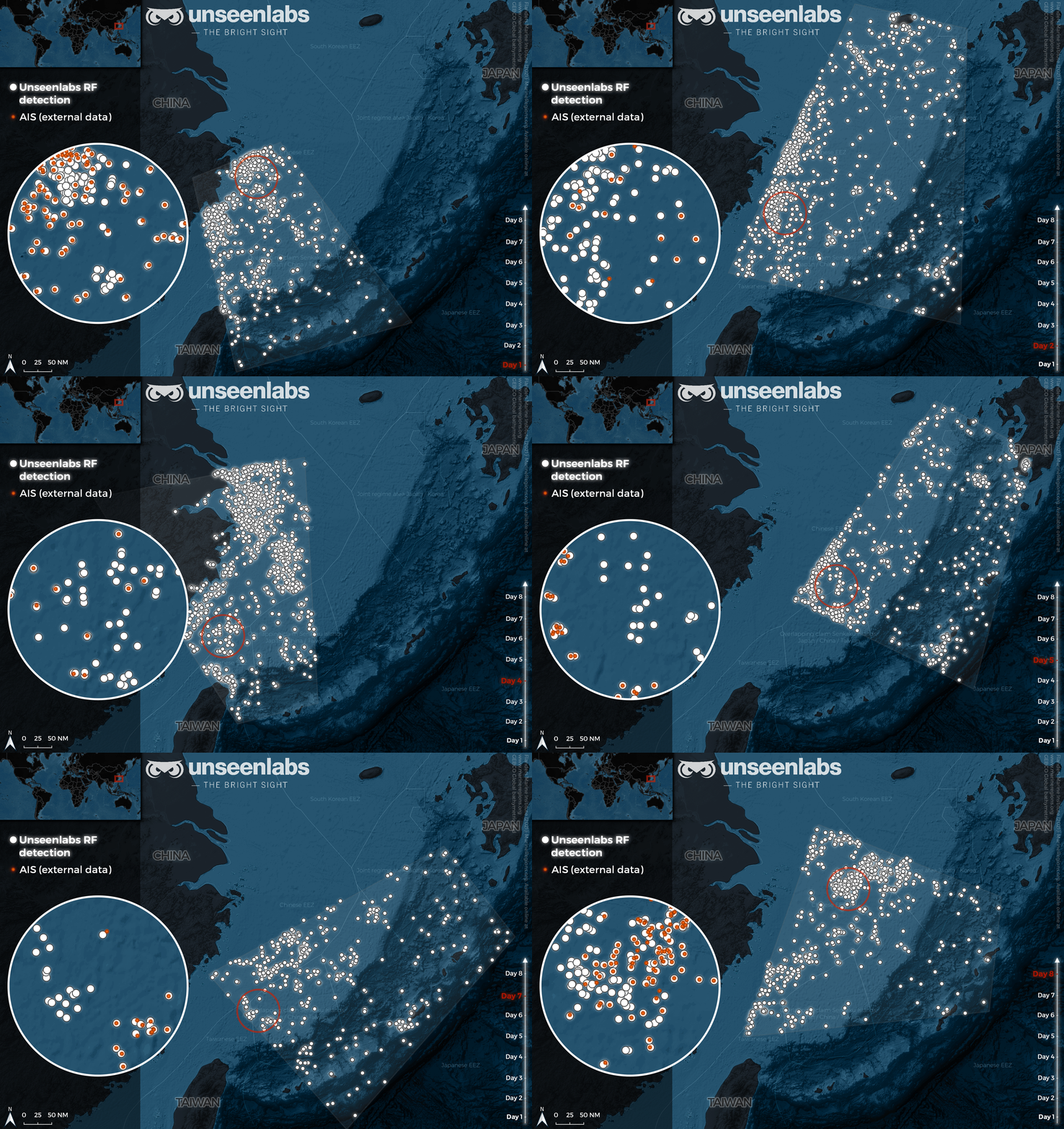
Over a few weeks we monitored a large fleet operating very close to an EEZ (Exclusive Economic Zone), and by crossing our RF data with AIS positions we found that a significant proportion of these ships kept their AIS beacons turned off, most probably to avoid detection while operating in a restricted area…
This law compels all handlers of chinese data to get government’s approval before any transfer of data to foreign countries.
Although the law does not specifically mention sea freight, maritime companies could be withholding information just to be “on the safe side” while waiting to know exactly what they are allowed to share. The enforcement of this law and the blockage of information are worsening the current shipping crisis and congestion of ports.
From 21 to 28 of last november, unseenlabs made several satellite acquisitions in east china sea to highlight the ships now missing from ais screens.
For 8 days, Unseenlabs made several satellite acquisitions in East China sea to highlight the ships now missing from traditional geolocation systems.
Since early november, a growing number of ships seem to vanish from conventional tracking systems as they approach chinese coasts.
According to vesselsvalue, the number of ships broadcasting ais signals from chinese waters has dropped by 90% since the entry into force of the new law.
Normally vessels can be identified via their ais transponders, which broadcast the ship’s geolocation as well as other information such as its mmsi number (a unique 9-digit number associated with each ship) type (carrier, tanker, fishing vessel), nationality, course, speed… the ais identification system was made compulsory for most ships by the imo (international maritime organization) to all signatory flag states of the solas convention (safety of life at sea) to facilitate traffic and avoid collisions.
But since its implementation wider uses of the system have developed, and it has become an essential tool for port management, by providing information on berth availability and anchorage waiting times among other things.
While it has its flaws as a surveillance tool, the ais system has become essential for the management and monitoring of sea freight flows worldwide.
Chinese authorities invoke national security and sovereignty issues for this measure, saying that foreign intelligence agencies and companies use the ais system to keep track of chinese military vessels and gather sensitive economic intelligence, according to a chinese state media report.
Although nothing in the law refers to ais data, maritime transporters are being cautious and withholding the data while waiting for more information.
As a result, most ships are not visible from traditional surveillance systems once they get close to chinese shores. In this new context, the ais system doesn’t provide an accurate picture of traffic at sea, as shown in unseenlabs’ series of satellite acquisitions in that area (space-based radiofrequency signals detection): In the sample below, more than 60% of ships in the area have disappeared from ais screens.
Blind zone: Disruption of global maritime traffic
an important consequence of this new regulation is the disruption of sea traffic due to a lack of data on ships positions: Six of the world’s ten busiest container ports are in china, it is therefore essential to have visibility on ships departures, arrivals, and general flow of activity around chinese shores.
An exhaustive picture of traffic at sea with space-based rf signal interception.
Unseenlabs conducted an eight-day satellite acquisition campaign in east china sea, revealing a consequent gap in ais data: Up to 80% of ships located with rf detection don’t broadcast an ais signal (ais beacons turned off or data transmission blocked by chinese authorities).
Unseenlabs’ radiofrequency detection system allows for an exhaustive picture of marine traffic near the chinese coasts, revealing the number and location of all ships in the area, with or without ais.
This new disruptive technology provides all maritime stakeholders in need of precise and up-to-date information on marine traffic with a new type of data that contributes to a new level of accuracy in maritime domain awareness.
The new situation around chinese shores illustrates the limits of current data sources such as the ais system and highlights the need for alternatives, such as space-based rf detection, for a thorough picture of human activities at sea.
Some childhood dreams can become realities, others remain just that- dreams. For a 10-year-old boy growing up in Bendigo Australia, his childhood dream was to go faster than anyone else had done, powered by the wind.
Speed has always been at the centre of Glenn Ashby’s existence, on yachts, motorbikes- or land yachts. The quest for speed has won him 3 America’s Cups, an Olympic Silver Medal and 17 World Championships in 4 different classes of boat.
After the 36th America’s Cup victory in 2021 the stars aligned for both Ashby and Emirates Team New Zealand, who he has been an integral part of for over 10 years, bringing together his lifelong ambition with the depth of design, technology and innovation of Emirates Team New Zealand. All the while utilising the window of opportunity that existed with the usual lull in AC activities during the transition from the 36th to the 37th America’s Cup.
Emirates Team New Zealand has always commissioned external contracts to keep the design team sharp and engaged during these periods. So, when the independently funded project to attempt to beat the Wind Powered Land Speed World Record emerged it was not hard to find willing designers, engineers and shore crew to put their talents to the test from being fastest on the water of the America’s Cup to being fastest on land ever.
The speed record attempt has been a common point of discussion for a number of years between Ashby and ETNZ CEO Grant Dalton, who himself has had a long-held interest in such a record shot. “The wind powered land speed record is something I have always been interested in, so when bringing a design challenge like this into ETNZ I knew it would be beneficial on a number of fronts to keep the technicians and the innovators of the organisation engaged during a down time with new, complex technical issues to solve with a cool project.” said Dalton
Glenn Ashby has been like a cat on a hot tin roof on the end of dozens of Zoom calls back to the Emirates Team New Zealand base unable to re-enter New Zealand for the past 10 months.
“I have never spent so much time on the computer as I have this past year,” explained Ashby. “Basically, from the point that Dalts said ‘let’s look at it’ after the finish of AC36, we have been all go. First job was a two-week in-depth feasibility study to ensure enough of a global understanding that this was something that could be done in a positive way for ETNZ and would not impact the team and its America’s Cup objectives financially or resource wise.”
Since then, the core group of Guillaume Verdier, Romaric Neyhousser, Benjamin Muyul, Jeremy Palmer, Romain Gard, Tim Meldrum, Sean Regan, Adrian Robb, Jarrod Hammond and Dave French have been working through the new design and engineering challenges entirely focused towards beating the existing Wind Powered Land Speed World Record of 202.9km/h (126.1m/h) which was set in 2009 by Richard Jenkins in Greenbird.
A British man, Richard Jenkins (today CEO SailDrone), has broken the world land speed record on the wind powered vehicle Ecotricity Greenbird, reaching the amazing speed of 126.1 mph, becoming the fastest person and vehicle of any kind under sail.
Ashby paid tribute to Richard Jenkins whose record he is trying to conquer. “In doing our research and digging deeper and deeper into the intricacies of the design challenges, it became very apparent that Richard really did an incredible job with his world record design.” said Ashby. “As a team we explored some pretty creative and innovative conceptual ideas in the quest for more speed, however in the end our design and performance principles evolved into a concept reasonably similar in basic layout to the existing record holder, which really emphasised to us what a huge challenge this will be.”
Without a silver bullet in terms of a revolutionary design, and very much like what is predicted in the 37th America’s Cup with the next generation of AC75’s, the gains will come down to the small improvements and refinements that add up to overall advancements and success.
“Like the America’s Cup we just need to be doing it better across the board by utilising our experience, skills and tools gained as a team to date,” explained Ashby, “And then, like sailing, there is always the weather gods and doing everything we can to be ready when the right conditions are presented at the location.”
Emirates Team New Zealand Principal Matteo de Nora, who is a significant supporter of the world record attempt, is clear on why now is the right time for the challenge.“We are seeing some very close collaborations now where the design is crossing into Formula 1 territory with Ineos Britannia and Mercedes and Alinghi and Red Bull Racing for a start. This isn’t a coincidence and is focused on the top line speeds and lessons that can be learnt the faster you can go. So, this project will be beneficial in continuing to evolve and learn so much more in the aerodynamic realm which was a significant factor in AC36.” said de Nora.
From a design and engineering perspective, Guillaume Verdier explained “this project is a really compelling one for all of us involved.There are a lot of similarities to what we do with fast sail boats in terms of the aerodynamics and structural forces, construction methods, materials etc, so we are well placed in many respects. But without doubt, no boat we ever design will go anywhere near as fast as we need our land yacht to go. So, with the increase in speed comes increased complexities, but we are sure these are complexities that we can learn from so we can make our next AC75 go faster.”
The obvious element of uncertainty and point of difference for all the Emirates Team New Zealand designers is tyre technology and the dynamic forces associated with tyres on the ground, as opposed to hydrodynamic forces on foils in the water.
“This is the big unknown for us,” explained ETNZ Mechanical Engineer Tim Meldrum. “Tyres on a flat salt surface going at over 200km/h is a whole lot different to foils in the water at over 50 knots. The rules stipulate we must run on a flat natural surface. The best ones we know of where it can be windy are dry salt lakes. With the tyres being the only point of contact to the salt it is a pretty important factor in finding the sweet spot in maintaining sufficient grip- with the least amount of rolling resistance.”
Our craft when compared to a speed record motorised car has a lot of differences. Firstly our “motor” – a wing in our case really delivers a small thrust force compared to a racing combustion engine. So, anything working against that thrust – wheel rolling resistance and aerodynamic drag has been a high priority to reduce if we want to hit high speeds. Secondly our wing creates a lot of side load over the main back wheels – so we need to provide grip to keep it tracking straight. A downforce aerodynamic wing like those used in F1 to assist cornering grip would rob us of too much speed, so we have opted to add variable ballast weight to allow us to tune our grip level. Extra weight mainly affects our acceleration time but does not compromise aerodynamic drag. The trade-off is we can go faster but we end up using more runway to get to our top speed. Luckily our racetrack is 8km across.”
Another contradictory problem to the norm in the America’s Cup is around weight. In the AC75’s the less weight in the boat the easier it will be to fly and faster it will be. With a land yacht, weight is a positive in certain respects explains Construction Manager Sean Regan: “In land speed, weight will be our friend if used in the right location. So, we can refine our construction techniques that account for additional weight in certain aspects and not be so focused on weight savings. On the outrigger pod we are actively adding weight or ballast to counter the wind force on the wing sail, without which, the craft would just tip over. Not something we want for Glenn approaching such high speeds.”
But like a scale measuring gold, the weight still needs to be precise. Too little the outboard tyre will come off the ground losing contact, too much it will add unnecessary resistance and lose valuable clicks of speed.
It is these sorts of design problems that will have to be overcome in the typically condensed lead up to a shot at the World Record in July / early August which Ashby and the team are working towards attempting on one of Australia’s vast salt lakes with Lake Gairdner in South Australia or Lake Lefroy in Western Australia as potential locations.
Any world record needs to be stringently verified and will require officials from the North America Land Speed Association to measure and record the run with a specific set of rules that must be adhered to in order to qualify for the World Record.
For now, the craft is already under construction at the Emirates Team New Zealand build facility on Auckland’s North Shore. “The build is scheduled for completion in late March, for assembly and commissioning and preliminary testing in Auckland subsequent to that.” said Sean Regan. “The plan is to then pack the craft and equipment into containers and ship it all to South Western Australian and truck to the record attempt location where a small team will be based from July for testing and then ultimately a shot at the World Record speed run.
“Obviously the objective is to design a craft that becomes the fastest wind powered land yacht ever.” said Glenn Ashby “And no one would have ever been that fast in a wind powered craft on or off the water. So that’s a pretty bloody exciting thing to try to become.”
A new "Seabed Warfare Strategy" was unveiled by French Minister of Armed Forces, Florence Parly and Joint Chief of Staff, General Thierry Burkhard on 14 February.
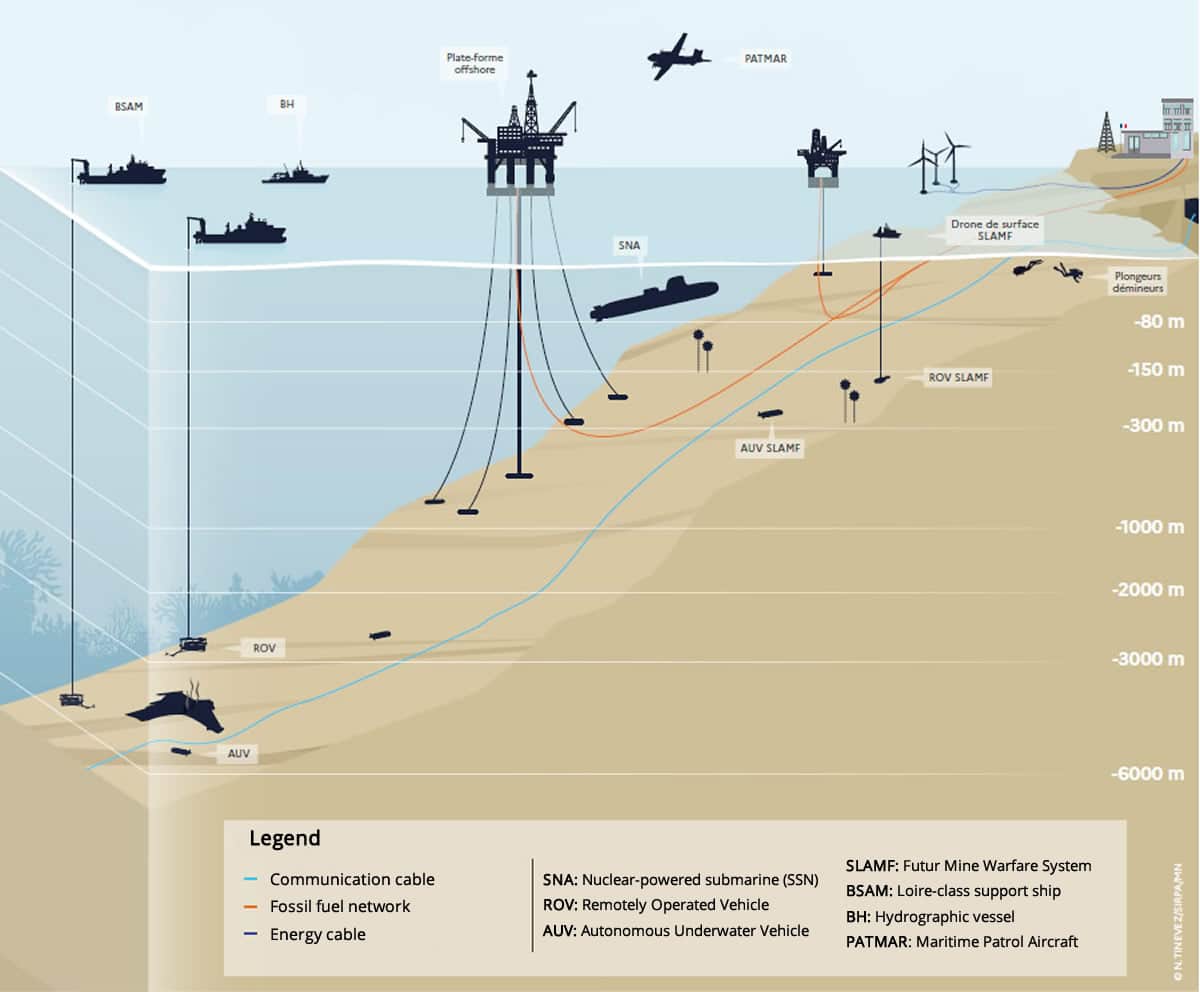
The strategy aims at broadening the capabilities of anticipation and action of the French Navy (Marine Nationale) up to 6,000 m depth.
The seabed constitutes a new field of conflict in the same way as exo-atmospheric space, cyberspace and the information sphere:
“The second exclusive economic zone in the world, France wants to be able to guarantee the freedom of action of its forces and to protect its sovereignty, its resources and its infrastructure even in the depths of the ocean” French Ministery of Armed Forces
Maritime areas are governed by a corpus of international standards, foremost of which is the United Nations Convention on the Law of the Sea (UNCLOS).
This text stipulates that the rights of States diminish as one moves away from the coast.
In recent years, however, some States have developed extensive interpretations of the convention, for the purpose of appropriating resources (mining, biological or fossil) or maritime areas with regard to the geopolitical situation of the area.
Faced with these assertions of power, the resurgence of hybrid actions in the seabed and the emergence of the concept of “seabed warfare” (mastery of the seabed), the protection of France’s strategic interests in this space is a decisive issue for :
Guarantee the freedom of action of the French Armed Forces in the face of submarine surveillance and interdiction strategies potentially deployed from the seabed
Protect France’s underwater infrastructures such as communication and energy transport cables (electricity, gas, oil);
Protect France’s resources. The immense French maritime territory is home to biodiversity and resources that should be known but above all protected
Be ready to act and pose a credible threat in the face of diverse, evolving and hybrid modes of action.
Seabed Control Operations aim to integrate these new challenges into the French defense strategy.
This doctrine will be articulated around three functions “know”, “monitor” and “act”.Marine Nationale illustration (translation by Naval News).
The French Navy already has mine warfare and hydro-oceanography capabilities contributing to the control of the seabed.
For expanding its investigation and action capacities down to 6,000 meters deep, France is going to equip itself with deep-sea exploratory military capacities, made up of underwater drones (AUV – Autonomous underwater vehicle) and robots ( ROV – Remotely operated vehicle).
The ambition to control the seabed to protect France’s strategic interests:
Support innovation in the development of sensors on board deep-sea AUV and ROV
Accelerate studies on physical variables for the detection of submarine installations.
Study the particular modes of ultra-low frequency acoustic propagation.
Increase our undersea search, surveillance and intervention capabilities to meet the needs inherent in maintaining freedom of action for French forces in areas with depths down to 6,000 metres.
Continue to analyse ways of deploying underwater surveillance vehicles in order to broaden the range of military options: air-portability, combat ships, submarines, etc.
Make CEPHISMER a centre of expertise capable of implementing a military capability complementary to SLAMF for depths greater than 300 metres.
Complete the project to revise national regulations on the laying of submarine cables (system of authorisation in the territorial sea and of notice in the EEZ)
Integrate the supervision of “autonomous vessel/maritime drone” activities into the regulations for State representatives at sea.
In an order issued by the French Prime Minister, define the areas within the protection of national defence interests for the purpose of marine scientific research.
Support DTIB development in command of sensitive capabilities, by taking advantage of solutions developed for civil needs and in line with the France 2030 plan.
“We are obviously not the only ones interested in the seabed. There are many powers that display their ambitions more or less clearly, even if it is under the seal of secrecy for the majority of them. China is known to have an advanced project for a great underwater wall, or more openly, the British have expressed their ambition for the seabed in the Integrated Review of 2021.” Florence Parly
The strategy of the Ministry of the Armed Forces will support the development of innovation with the private sector and the emergence of a national sector responding to its needs in the great ocean depths.
French defense companies likely to be involved in the new strategy include Alseamar, ECA Group, Elwave, Forssea Robotics, iXblue, Naval Group, RTSys, Thales…
The IFREMER’s deep diving (6,000 meters) UAV “Ulyx” designed and produced by ECA Group. IFREMER picture.
For example, ECA Group designed and produced the new generation deepwater AUV for IFREMER, (French Research Institute for Exploitation of the Sea), an oceanographic institution.
Ulyx will be deployed from French and international oceanographic research vessels for deep water exploration and research. A military variant of such an AUV could be designed for the French armed forces in the future.
The Chief of Staff of the French Navy, Admiral Vandier, shared on Twitter pictures showing a French Navy officer during a demonstration aboard IFREMER’s Nautile deep-submergence vehicle (DSV):
“2152 meters under the sea. Lieutenant Arnaud is the 1st French navy active officer to reach this depth with the Eledone demonstration on board the IFREMER’s Nautile, to inspect a submarine cable. A success which is part of the French strategy to control the seabed.”
2152m sous les mers. Le LV Arnaud est le 1er officier d’active à atteindre cette profondeur à bord du Nautile de l'@Ifremer_fr pour inspecter un câble sous-marin lors de la démonstration Eledone. Un succès qui s'inscrit dans le cadre de la stratégie🇫🇷 de maîtrise des fonds marins pic.twitter.com/XQ36fxcsal— Chef d'état-major de la Marine (@amiralVandier) February 15, 2022