It’s not every dive that deep-sea explorers encounter a bigfin squid (Magnapinna sp.).
It’s actually pretty unusual; roughly a dozen sightings have been confirmed worldwide.
So, when we captured an adult bigfin squid on camera during Dive 10 of Windows to the Deep 2021 off the West Florida Escarpment in the Gulf of Mexico, it was quite an exciting moment.
From jellyfish in the Caribbean to hypothermia in the English Channel, swimming hasn’t been easy for Chloë McCardel – but can feel ‘so wild and free’
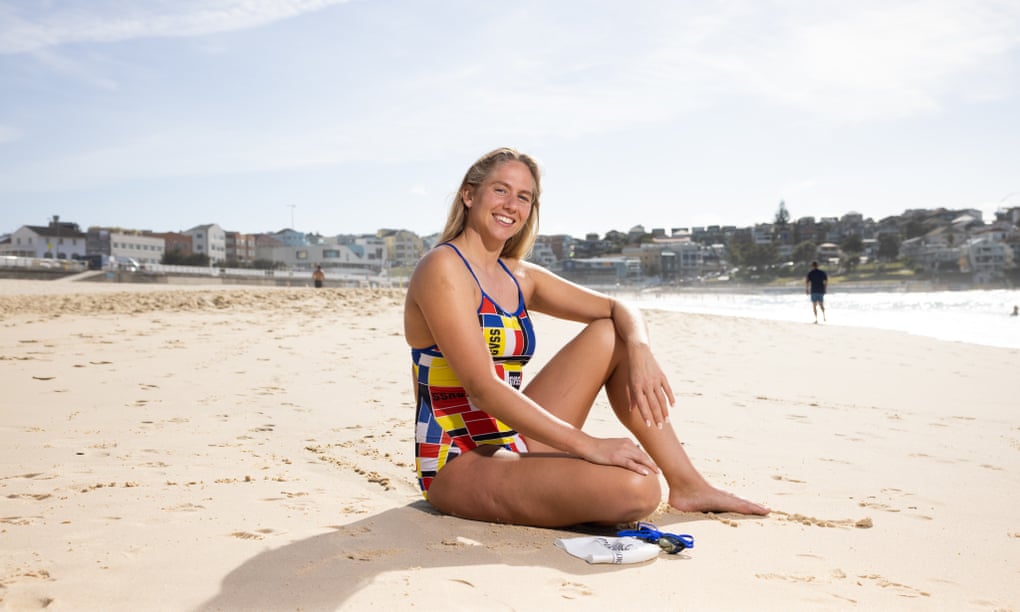
Chloë McCardel and I are going for an ocean swim at Bondi.
She dives into the foamy sea ahead of me – more slender mermaid than broad-shouldered Amazonian.
Knee deep, I feel the current suck at my flesh. It’s not one of Bondi’s better days. Chest deep, I realise I’m being dragged out and my very amateur ocean-swimming abilities are no match for this surf. Panic rises. McCardel is an impatient white-cap in the distance. What was I thinking, suggesting a swim with superwoman?
By any objective measure, Chloë McCardel is also a crazy woman, her commitment to putting herself through demented levels of physical and mental torture almost inexplicable. “I own crazy, I wear it as a badge of pride,” she tells me later.
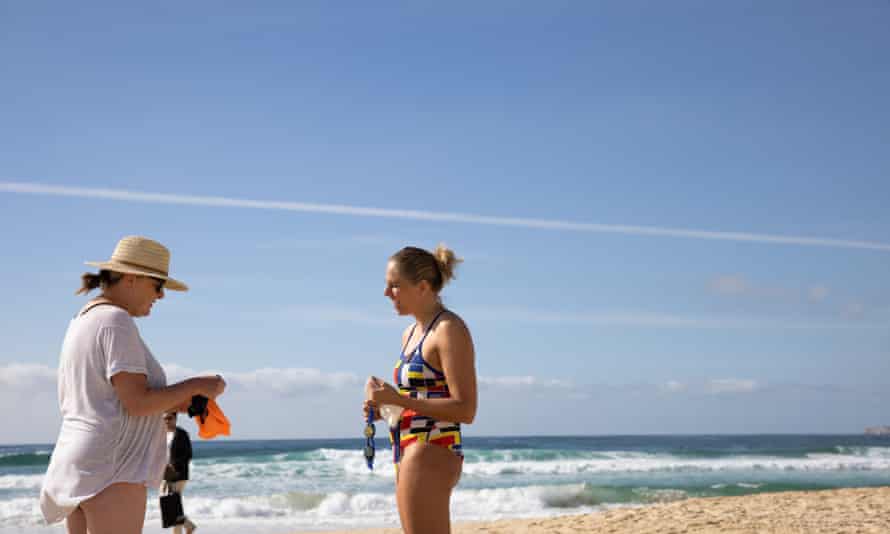
Stephanie Wood prepares to swim out into the Bondi surf with Chloë McCardel.
Photograph: Carly Earl/The Guardian
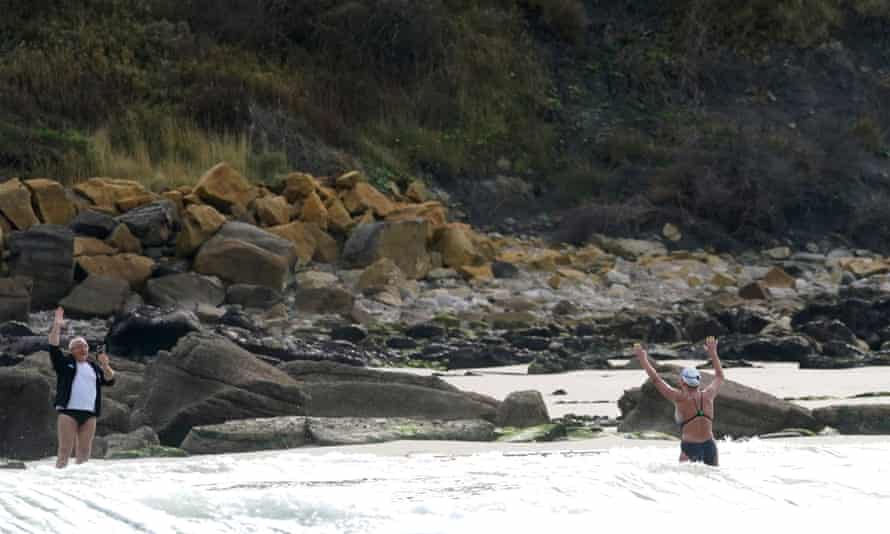
On 13 October, the 36-year-old Melbourne-born, Sydney-based ultra-marathon swimmer set a new world record, completing her 44th crossing of the English Channel in 10 hours and one minute. She left the water, stood on a French rock at Pointe de la Courte Dune and raised her lanolin-smeared arms in victory. McCardel’s 44 crossings of the world’s busiest shipping highway include three non-stop doubles (to France and back) and one triple non-stop (to France, back to England, then to France again). The “King of the Channel”, Englishman Kevin Murphy, has done only 34 crossings.
McCardel has conquered other waters too: in 2014 she set a world record for the world’s longest non-stop ocean swim – 124.4km from Eleuthera Island in the Bahamas to the capital Nassau, a 41-hour, 21-minute journey.
McCardel finishing her record-breaking English Channel swim.Photograph: Gareth Fuller/PA
But the bare numbers and facts hardly tell McCardel’s story. There are good times when the sea is as smooth as a pane of glass, the water clarity is extraordinary, dolphins bounce around and she feels her technique is exquisite. But things can go bad quickly. In 2013 she jumped into the sea in Havana, Cuba, to attempt to be the first person to swim the 166km to the Florida Keys without a shark cage.
After about 10 hours of heavenly swimming, with 40 or 50 hours ahead of her, and dusk setting in, McCardel started seeing translucent shapes many metres below her. “I’m like, ‘Oh, that’s interesting,’ and then literally like 10 minutes later, it was like a blanket underneath me just rising up and I’m like, ‘Oh this is not going to turn out well.’”
She was stung dozens of times by what is believed to have been a jellyfish similar to a box or irukandji.
Almost immediately, her right arm was paralysed and she could no longer use it to stroke. She called to her support team to get her out but they did not realise the extent of the problem and shouted affirmations – keep going, you can do it. In a marathon swim you never get out. The jellyfish were still rising. McCardel curled into a ball to reduce the surface area of her body. “Once my head went under the water, they were like: ‘We need to get her out.’”
Twenty minutes or so after the first sting, she was hauled out of the water on to the boat. “I was whimpering, I was making a dying animal noise and they were picking the jellyfish stings off me. One person even pulled one out of my mouth like a bit of spaghetti. I just wanted to die – the pain was horrific.”
So many other stories: the first time she attempted the Channel in 2009, she signed up for a double crossing and the captain of the support boat lost her for a time during a dark and stormy night when she was two-thirds of the way back to English shores. “They drifted away and I was screaming out ‘Don’t leave me behind’ – I was terrified.”
She was battling two-metre waves and felt the ghostly presence of hulking ships which take a kilometre to come to a stop.
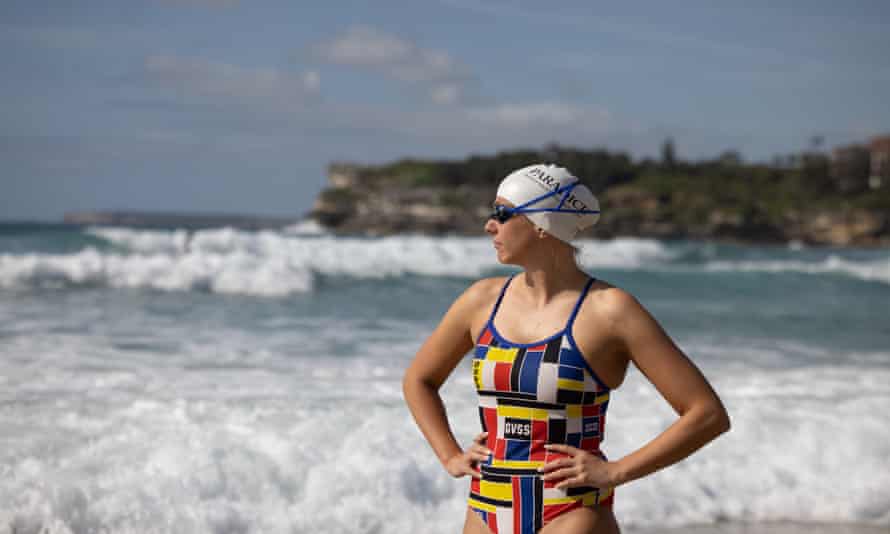
McCardel looks out over Bondi. In cooler water swims, she has been told, she had been on the edge of death. Photograph: Carly Earl/The Guardian
During her first attempt to triple-cross the Channel in 2011, the weather turned. She was floundering, barely stroking with one arm and resisted her support crew’s attempts to get her out. “My brain was not functioning.” When she was pulled out she couldn’t walk, was delirious and mumbling and dangerously hypothermic. In intensive care at Canterbury Hospital, a doctor told her that 30 more minutes in the water and she would have been dead.
There are clues in McCardel’s childhood to the woman she would become. Her role models – three older and sporty siblings – told her she could only play with them if she kept up. “I wanted to be better at whatever game they were playing or I wanted to be like them and so I would push myself.” When she was about seven, she insisted on pedalling with her 14-year-old brother on his paper round. He told her she couldn’t because she wouldn’t keep up. “I’m like, ‘No, I will keep up, I’m coming.’”
Her parents were far from pushy and when she started to swim competitively as a teenager, they refused to take her to swim training at 5am (they agreed to pick her up afterwards). On weekdays, a friend’s mother took her and on weekends she set her alarm for 3.15am and rode her bike 9km. She remembers the day her mother came outside in a pink nightie and, unsuccessfully, tried to stop her pedalling off in the dark. McCardel feared she’d be in trouble when she got home. “Instead, my Dad’s like, ‘Right, we’re going to buy you some lights.’”
But McCardel’s times weren’t fast enough to get her into the national championships in the open category and her parents encouraged her to quit swimming to concentrate on her final two years of study. After school, she went to Monash University to do an arts degree.
‘I had this beautiful connection with the water,’ says McCardel. Photograph: Carly Earl/The Guardian
At some point, though, she had decided she wanted to be “the best in the world at something”. She tried triathlon but failed to reach an elite level. She did well in the Melbourne marathon and started to think that distance might be where she could be the best. In 2007, she did a marathon swim, 11.3km between Frankston and Mornington. “It was so wild and free … I had this beautiful connection with the water.” About midway through the swim she was smashing the field – the first woman, with only one man ahead of her. “I just knew at that moment that I could be the best in the world at marathon swimming.”
She came second, after the male swimmer.
Chloë McCardel’s swimming career has not made her money. Most of her income comes from coaching others to swim the Channel and motivational speaking. (As a survivor of domestic violence, she also advocates for the criminalisation of coercive control.) Ahead of every swim, she runs fundraisers. But the goal is the thing that pulls her forward: “I set scary goals and then I’m so petrified I get out of bed in the morning.”
She has set herself another scary goal: in 2022 she wants to be the first person in history to swim the 92km from England to Belgium through the stormy, frigid waters of the North Sea. “The idea is to get to the other end before I die. And if I don’t end up in intensive care, it’s a bonus.”
The Bondi surf that is making me panicky is like a soak in a bath for McCardel. She strokes back towards me and, with no small amount of embarrassment, I tell her that I think we should grab a coffee instead. No dramas, she says as we reach the sand. As we towel off, she adds: “I don’t even like waves.” Links :
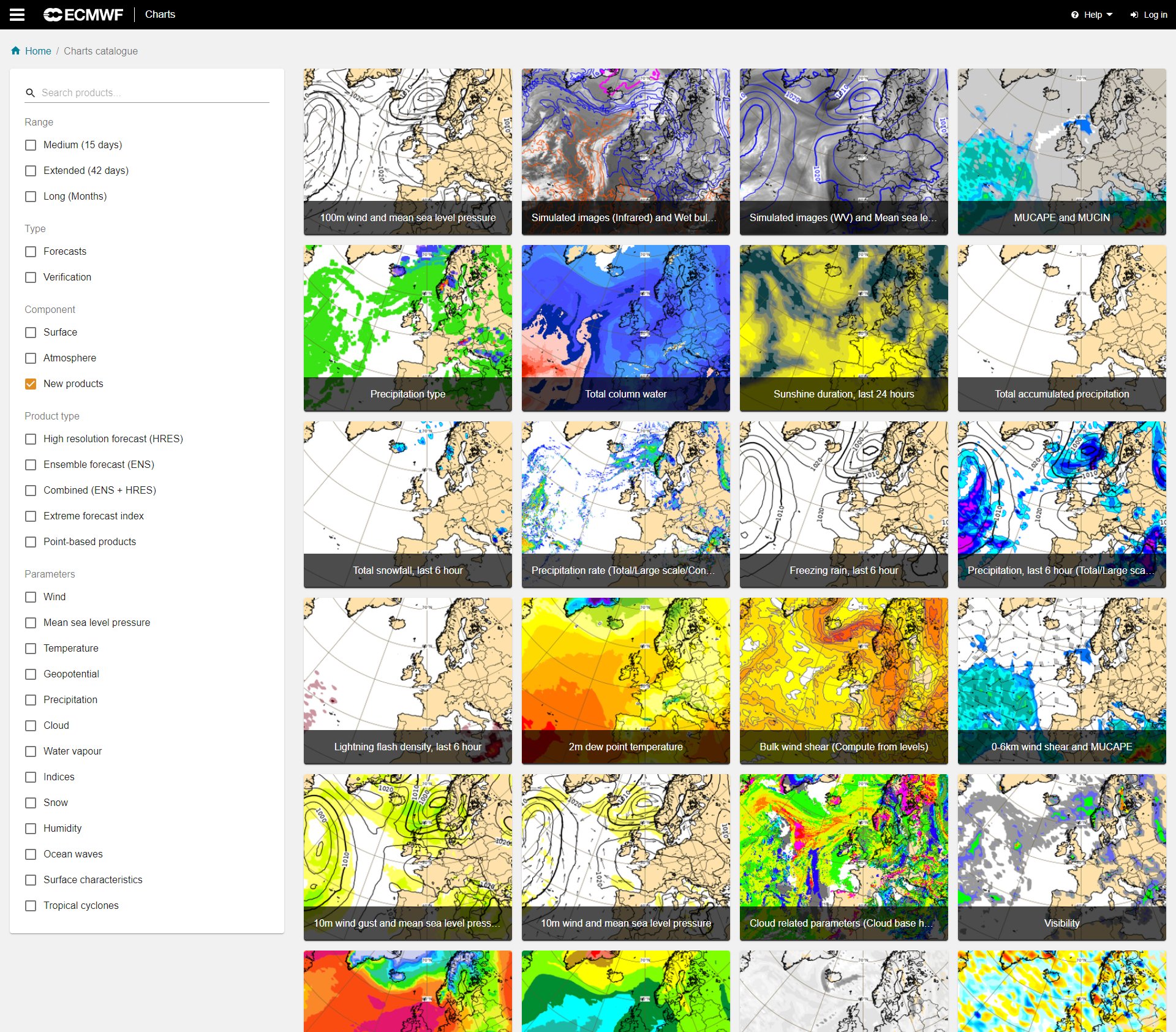
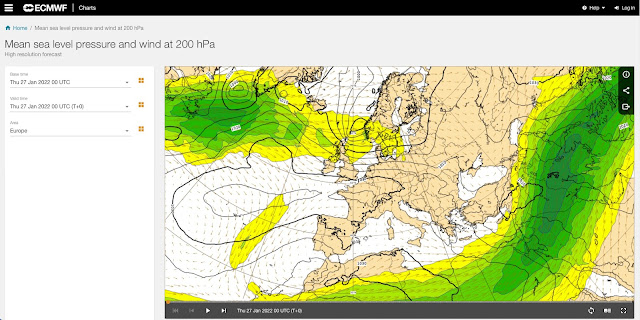
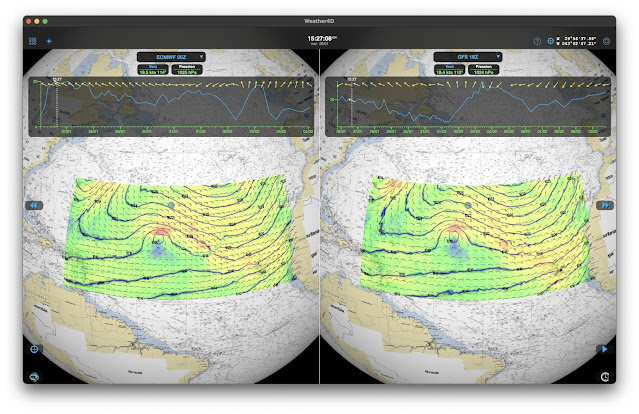
ECMWF have just added more than 50 new products to its #OpenCharts catalogue!
These forecast charts are free for anyone to access, redistribute and adapt - even for commercial applications - part of our open data Strategy for 2021-2030.
From 25 January 2022, a wide range of ECMWF’s forecast data across the globe will be openly available.
This move towards ‘open data’ comes after a large range of forecast charts were earlier made available to anybody interested in them.
The data that are becoming available are based on a range of high-resolution forecasts (HRES – 9 km horizontal resolution) and ensemble forecasts (ENS – 18 km horizontal resolution).
They will be made accessible at a resolution of 0.4 x 0.4 degrees.
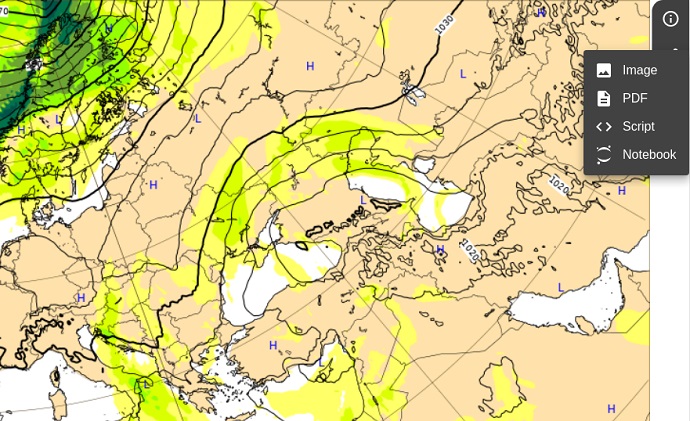
While many programming languages can be used to access and visualise the data, ECMWF has prepared a set of Jupyter notebooks to help users familiar with Python and Jupyter discover the open dataset.
They can also reproduce the plots from our open forecast charts using our open-source software libraries.
The plan is to expand open data in the future by adding more data.
The data are available through ECMWF’s https service and via the Microsoft Azure cloud. In future, they may also be made available via other cloud providers.
For six weeks every year, the research vessel Celtic Explorer surveys Ireland‘s Atlantic shelf, sampling 170 points on the nautical chart.
Led by David Stokes, the Marine Institute scientific team tackles questions only fisheries surveys can answer: how many young fish have been spawned here over the past year?
Is this new generation of fish numerous enough to replace what has been removed from the sea by fishing vessels? In other words: is commercial fishing here sustainable?
The Chief Scientist of the Irish Groundfish Survey 2021, David says: "We're out at this time of the year, basically fishing to try and assess the size of the various fish stocks and all the demersal species - these are the species that live and feed on the seabed, basically. So we try and estimate whether the stocks are going up or down and particularly try and focus on the juvenile fish that are coming through into the fishery."
At each sampling station, the vessel deploys a trawl that has been specially modified to catch small fish. This is different from commercial fishing vessels that use nets with large meshes, aimed at targeting only mature fish that hopefully have already spawned offspring.
For the scientists, this work is vital for forecasting what catches can be expected in the future.
Their motto is “Good science supporting sustainable fisheries”.
"We shoot the trawl, it goes to the seabed, and then we tow it along the seabed for 30 minutes. Haul it back. And then it's dropped into the hopper, and then the fish come into the fish room, where everything is sorted into species," David explains. David Stokes explains how the surveys provide a unique insight into fish populations - including some key facts that cannot be found in the commercial catch statistics.
An onboard laboratory works like a busy factory floor in the middle of the sea: researchers quickly sort fish from the moving conveyor belt into separate boxes.
They are especially interested in the commercial stocks like haddock, whiting and other economically important species.
Each fish is then measured with an electronic measuring board. All the data are combined in a database to make it easy to spot any errors.
"For commercial stocks we take length, sex, maturity and the otoliths (ear-stones) from the head, which gives us the age of the fish. It's kind of like reading the age of a tree by the rings," explains Sinead O’Brien, a Lab Analyst at the Marine Institute.
By studying ear bones, scientists can accurately determine the proportion of young fish in the population.
Shrimp, crab and invertebrates also help monitor the general health of the marine ecosystem.
"You see here in the tray, we've got a really good selection of benthic creatures that we caught on the last tow. It tells us how diverse the community of animals are at that particular station at that particular time. So we know that in this area, we're seeing a certain number of species every year and we're always interested in species' richness and diversity," says Jennifer Doyle, a Fishery Scientist at the Marine Institute.
Everything trapped in the trawl is logged - even plastic litter.
Fishery surveys collect a wide range of data used by marine scientists - such as the water temperature, the salinity at various depths or the hydroacoustic profile of the seafloor.
As part of the EU Data Collection Framework (DCF), this is one of many coordinated surveys along the northern and western coasts of the European continent.
"These surveys are run around the same time every year, normally around October to November, and include probably about ten countries, all using the same standard protocols, procedures and very similar sampling gear, even though it wouldn't be exactly the same," explains David. "It is quite a piece of work to try and keep independent countries with different languages, different capacities and different resources, to keep everybody on the same fixed page, you know, all the time. So yeah, there's quite a lot of coordination work that has to go into actually keeping all that as standard as it is," he adds.
Managing fishing stocks
The results of the surveys conducted by all these research vessels are collected and analysed at an intergovernmental organisation, headquartered in the Danish capital.
"All the countries submit their data on surveys and also on catch here to ICES. And then that flows into what we call working groups, which are international scientific groups, which put it all together and start putting the information into our models," explains Mark Dickey-Collas, the Chair of the Advisory Committee to the International Council for the Exploration of the Sea.
Given the competing interests, reaching agreement is not easy.
"There are some major challenges. One is trying to make sure that we work in partnership with the fishing industry and also with the environmental groups to make sure that the overall impression and understanding of the processes are good enough to have a consensus in terms of our advice," says Dickey-Collas.
Danish fishermen say they are happy to share their own data with scientists.
They say some quotas are putting their businesses at risk.
While environmental activists see many catch limits as excessive and unsustainable, fishermen say tight quotas put their businesses at risk.
At the port of Thyborøn in North-Western Denmark, fishermen are sceptical about the scientific advice: they say the catches are better than forecast, but the available resources can’t be fully harnessed due to what they see as a rush towards sustainability.
"Stocks go up and down. We, as fishermen, have to live with that. But what's really important is that the advice is what we see at sea, and at the moment sometimes there's a big difference. You have climate change, you have cod stocks move north - maybe it's time to modernise the way they do the surveys!" says Alfred Fisker Hansen, the Chairman of Thyborøn Harbour Fishermen Association.
Fishing quotas are a matter of much debate, but there’s no arguing that marine resources must be managed wisely.
The fishermen say they are happy to share their own data with the scientists - and new technologies make that easier.
The Thyborøn fishing auction sells around 150 tonnes of fish per day - all online. That's valuable data readily available for researchers.
In addition to that, fishermen often invite scientists onto their vessels to make observations that can help fine-tune mathematical models.
"We have good cooperation, in Denmark at least, between scientific institutions and the fishing industry," says Michael Andersen, Chief Scientific Advisor to the Danish Fishermen Association.
"There may be some harsh words sometimes and disagreements, certainly, quite often, but there is a good cooperation. It's a common goal of getting the stock size right, because that's in everybody's interest. Everybody appreciates that," he adds.
The fishing industry relies on healthy fishing stocks for its very survival. However imperfect, scientific assessment still remains the best way to monitor them.


 Stephanie Wood prepares to swim out into the Bondi surf with Chloë McCardel.
 McCardel finishing her record-breaking English Channel swim.Photograph: Gareth Fuller/PA
 McCardel looks out over Bondi.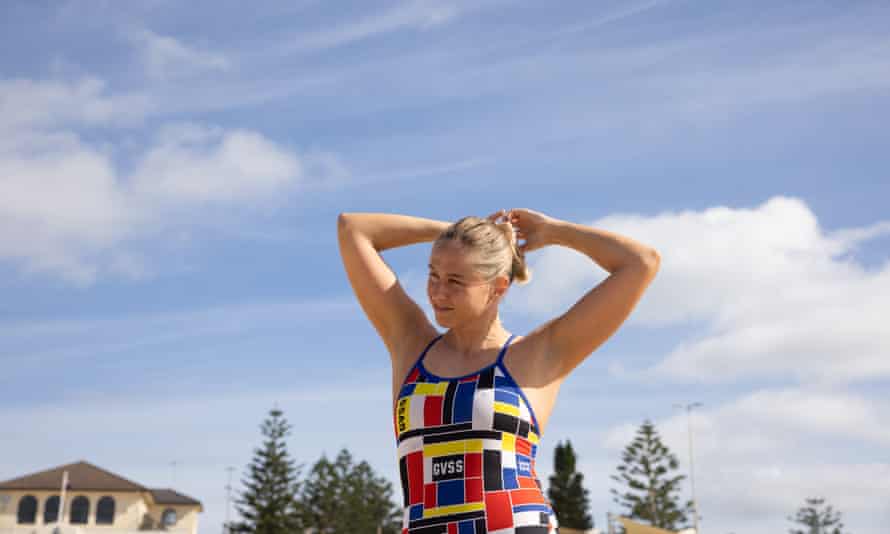
 Jupyter notebooks for reproducing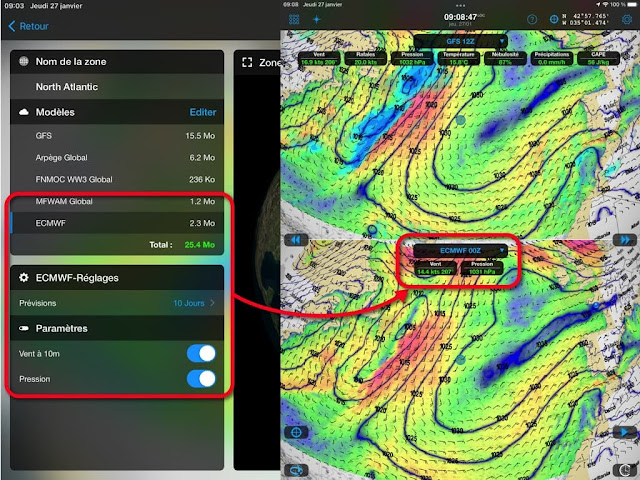
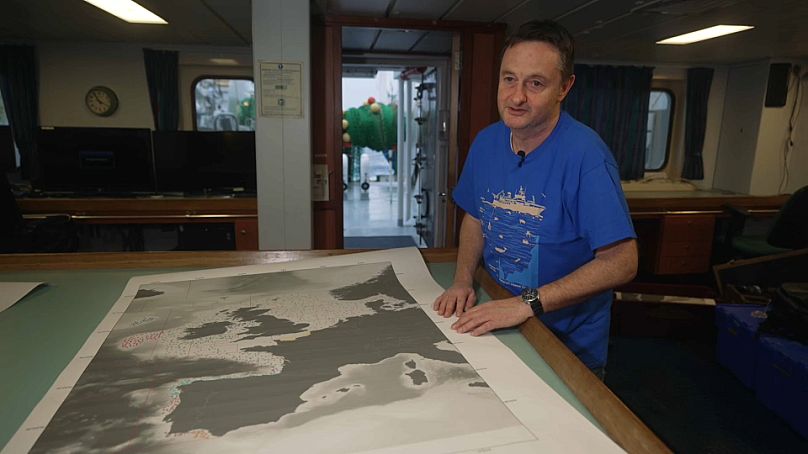 Marine Institute scientist David Stokes leads the Irish Groundfish Survey.© Euronews
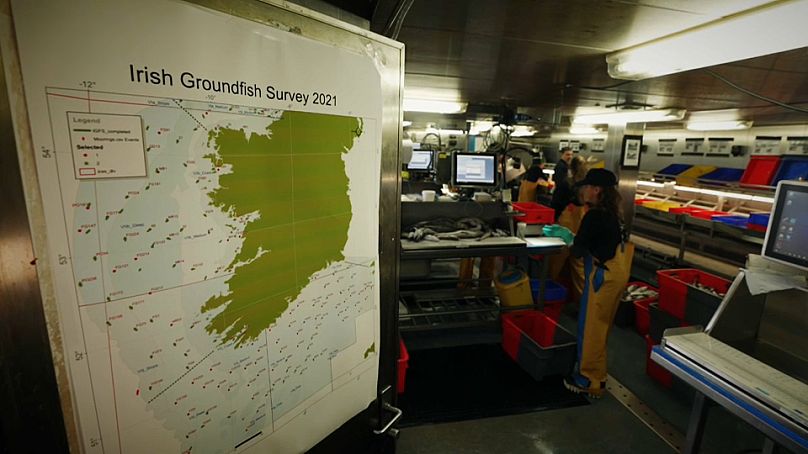 Researchers sort and measure fish in a lab onboard the Celtic Explorer. They are particularly interested in commercial fishing stocks, such as cod and haddock.© Euronews
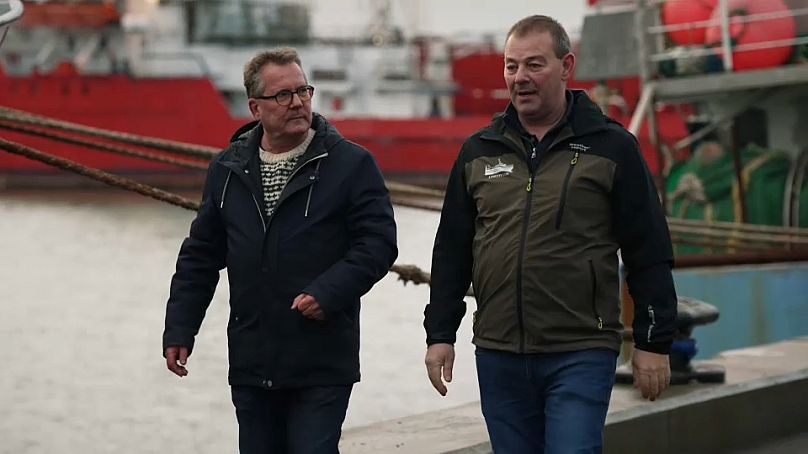 Danish fishermen say they are happy to share their own data with scientists.