Thursday, May 28, 2020

Hundreds of towering hydrothermal chimneys discovered on seafloor off Washington

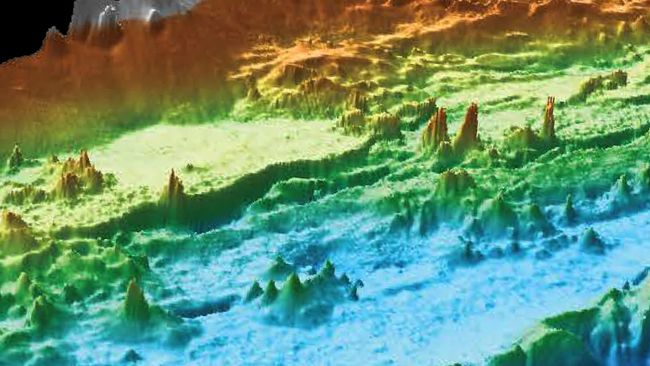
 This computer-generated view of the seafloor shows just a few of the hundreds of hydrothermal chimneys in the Endeavour hydrothermal vent field. 
Image: © 2020 MBARI

From LiveScience by Mindy Weisberger

An autonomous diving robot captured the vents in unprecedented detail.

In the dark ocean depths off the coast of the Pacific Northwest, a magical fairyland of towering spires and hydrothermal chimneys sprout from the seafloor, a stunning new underwater map reveals.

These towers belch superheated liquid warmed by magma deep inside Earth.
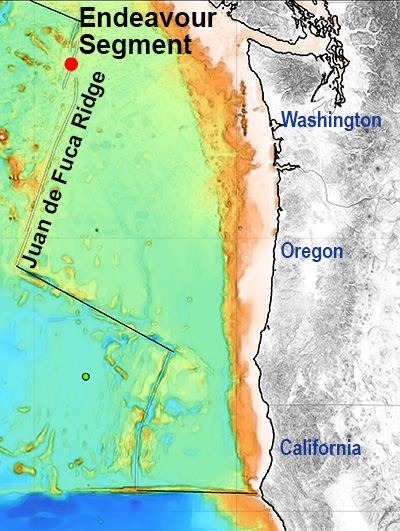
 The Endeavour Segment of the Juan de Fuca Ridge is an active volcanic area
far off the coast of the Pacific Northwest.
Image: © 2020 MBARI

 Localization with the GeoGarage platform (NOAA nautical chart)

The field of hydrothermal chimneys stretches along the ocean bottom on the Juan de Fuca Ridge to the northwest of coastal Washington state, in an area known as the Endeavor Segment.

Research on the Endeavor vents began in the 1980s, and scientists had previously identified 47 chimneys in five major vent fields.
But recent expeditions, using an autonomous underwater vehicle operated by the Monterey Bay Aquarium Research Institute (MBARI) revealed more than 500 chimneys in a zone about 9 miles (14 kilometers) long and 1 mile (2 km) wide.

Deep-sea chimneys form around hydrothermal vents from a buildup of minerals that flow to the surface in heated liquid — as hot as 750 degrees Fahrenheit (400 degrees Celsius).
As hot liquid meets cold seawater, minerals precipitate and settle around the vent, collecting to form towers that can reach impressive heights.

At the Endeavor Segment, "abundant and vigorous" hydrothermal activity has transformed the seafloor for approximately 2,300 years, and periods of intense seismic vibration shake things up even more, according to a new study on the MBARI expedition.
Chimneys that climb from Endeavor are among the tallest in any mid-ocean ridge; the biggest ever documented, a top-heavy tower known affectionately as "Godzilla," extended 150 feet (45 meters) from the seafloor, but it crumbled in 1995.

Most of the five Endeavor vent fields have whimsical names.
While the field serving as the main research destination is simply called "Main Endeavor Field," the other fields are known as: "High Rise" (for its resemblance to a cityscape crammed with skyscrapers); "Sasquatch;" "Mothra;" and "Salty Dawg."
Other vent sites are named "Quebec," "Dune" and "Clam Bed," according to the study.
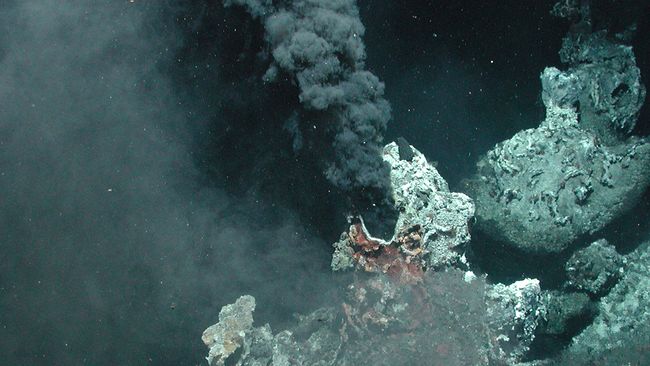
"Black smokers," such as this one in the Endeavour vent field, belch superheated fluids at over 570 degrees Fahrenheit (300 degrees Centigrade) into the surrounding seawater.
(Image credit: Copyright 2020 MBARI)

High-res surveys

Prior expeditions struggled to identify seafloor structures in the depth and darkness of the vent fields; sonar from surface vessels and explorations by diving robots couldn't map the region at high enough resolution for researchers to count individual chimneys.

"It's very hard to see down there because all the particulates in the water create a kind of haze," said MBARI senior scientist, geologist and volcanologist David Clague, who is lead author of a new study on the Endeavour Segment.
"There was one well-studied chimney where the composition of the fluids seemed to vary from one research dive to the next.
It wasn't until we did our detailed mapping that people realized they had actually been sampling at two different chimneys," Clague said in a statement.
"They apparently would encounter one chimney or the other depending on what direction they approached the site," he said.

This time, MBARI scientists took a closer look at the chimneys with the D.
Allan B, a yellow torpedo-shaped AUV measuring about 17 feet (5 m) long and capable of mapping with multibeam sonar at a resolution of 4 feet (1 m), according to the study.

(Image credit: Copyright 2020 MBARI)

The AUV performed four surveys in 2008 from the research vehicle Atlantis, and it conducted three surveys from the research vehicle Zephyr in 2011, enabling the scientists to generate a map covering about 24 square miles (62 square km).

The study authors counted 572 chimneys that were taller than 10 feet (3 m) high — tall enough to be distinguished from other landscape features.
Most of the chimneys were under 26 feet (8 m) tall, though the tallest extended to heights of 90 feet (27 m) above the sea bottom.
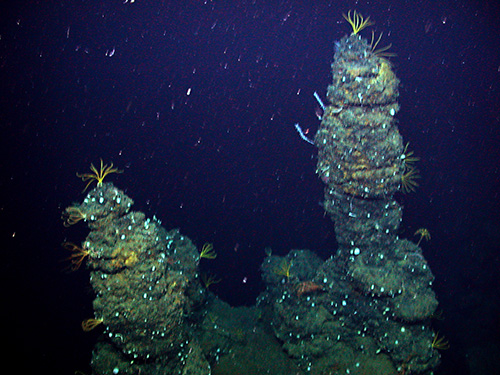
 When superheated fluids stop flowing from a hydrothermal chimney, the chimney becomes inactive, but may remain standing for hundreds of years.
 Image: © 2004 MBARI

Most of those chimneys were quiet.
If mineral buildup blocks the chimney vent, superheated fluids divert to another crack and the chimney ceases to grow, though they can remain standing for centuries.
Only 47 of the Endeavor chimneys (those that were identified in previous maps) were active, the researchers reported.
By comparison, a similar hydrothermal field, Alarcón Rise in the Gulf of California, has only 109 chimneys mapped, but 31 of them are active.

Endeavor likely has more inert structures than Alarcón Rise because the latter lies in a more volcanically active region, and its older, inactive chimneys have been buried over time by lava flows, so you can't see them, the researchers reported.
However, that may soon change.

Geologic evidence from Endeavor and other vent fields suggests that hydrothermal activity is part of a cycle that reshapes the seafloor over many thousands of years.
Endeavor's hydrothermal period may be winding down, to be replaced by a lava-spitting "magmatic phase" that can last tens of thousands of years, according to the study.
When that happens, many of the newly mapped Endeavor structures may vanish — as did the older chimneys at Alarcón Rise, the researchers wrote.

The findings were published online April 14 in the journal Geochemistry, Geophysics, Geosystems.

Links :

Wednesday, May 27, 2020

Climate crisis: Sea level ‘on course to rise by one metre by 2100’ if global emissions targets are missed

Projected rise in relative sea level by the late 21st century for two emissions scenarios, compared with the period 1981-2010
Under the low emissions scenario, European coasts would experience mean sea level rise between 0.2 m and 0.4 m, with the exception of the northern Baltic Sea and the northern Atlantic coast, which are experiencing considerable land rise because of post-glacial rebound.
Under the high emissions scenario, European coasts would experience mean sea level rise between 0.4 m and 1.0 m (based on some studies up to 2.5 m), with the exception of the northern Baltic Sea and the northern Atlantic coast, which are experiencing considerable land rise because of post-glacial rebound.

From The Guardian by Jonathan Watts

Oceans rising faster than previously thought, according to survey of 100 specialists

Sea-level rise is faster than previously believed and could exceed 1 metre by the end of the century unless global emissions are reduced, according to a survey of more than 100 specialists.

Based on new knowledge of climate sensitivity and polar ice melt, the experts say coastal cities should prepare for an impact that will hit sooner than predicted by the United Nations and could reach as high as 5 metres by 2300.

“A global sea-level rise by several metres would be detrimental for many coastal cities such as Miami, New York, Alexandria, Venice, Bangkok, just to name a few well-known examples.
Some may have to be abandoned altogether as they cannot be defended,” said co-author Stefan Rahmstorf, from the Potsdam Institute for Climate Impact Research in Germany.

In the worst-case scenario – with rising emissions and global heating of 4.5C above pre-industrial levels – the study estimates the surface of the world’s oceans in 2100 will be between 0.6 and 1.3 metres higher than today, which would potentially engulf areas home to hundreds of millions of people.

By contrast, if humanity succeeds in cutting carbon dioxide and holding the increase in temperature to 2C, the rise would be a more manageable 0.5 metre.

The figures for both pathways are more pessimistic than those outlined by the UN intergovernmental panel on climate change (IPCC), which predicts the worst possibility is a 1.1-metre rise by 2100.

The gap reflects advances in climate science and differences in approach.
The IPCC works largely through consensus among scientific working groups, which tends to produce relatively conservative estimates.

By contrast, the new survey – published in the journal Climate and Atmospheric Science – aggregates the views of 106 specialists, who were chosen because they have published at least six peer-reviewed papers on the subject in major academic journals.
As a result, the predictions are more representative of a range of views in the field.

The map shows the estimated area of, and the current population in, low-lying regions at 1 to 6 m above current mean sea levels.
In the absence of any existing or future coastal protection, these areas would be permanently inundated in the coming centuries if sea level rises by the projected amount.
However, temporary coastal flooding of these areas caused by extreme high sea levels could occur much earlier as a result of the combined effects of mean sea level rise, waves and storm surges.

The countries and regions with the largest shares of low-lying areas include:

  • the coasts of Belgium, Netherlands and north-west Germany
  • most of the coastal regions in Denmark and southern Sweden
  • the coasts in southern and western and France
  • north-east Italy, including the region of Venice
The higher estimates highlight growing concern about the world’s two biggest ice sheets, in Antarctica and Greenland. Satellite data and on-the-ground measurements show these regions are melting faster than most computer models predicted.
Many of the scientists said there was now greater understanding of the risks posed by marine ice-cliff instability, which can lead to the collapse of ice shelves.

The study was led by scientists at the Nanyang Technological University in Singapore with support from seven research institutions across the world, including Durham University in the UK, Tufts University in the US and the Potsdam Institute for Climate Impact Research in Germany.

The lead author, Prof Benjamin Horton of the university’s Asian School of the Environment, said the research aimed to condense the growing mass of academic studies about sea-level projections into a simple overview.
“It is useful to survey leading experts on the expected sea-level rise, which provides a broader picture of future scenarios and informs policymakers so they can prepare necessary measures,” he said.

The authors said the results showed how much warming – and sea-level rise – could be avoided if governments fulfilled their 2015 Paris climate agreement promises to cut emissions of the gases that are heating the planet.
Most countries are far off reaching their goals.

“Like in the Covid pandemic, timing is critical to prevent devastation. If you wait until you already have a serious problem, then it is too late. Unlike with corona, sea-level rise cannot be stopped for many centuries or even millennia once ice sheets have been destabilised past their tipping points,” Rahmstorf said.

The coronavirus pandemic has temporarily slowed the discharge of carbon dioxide and methane because there are fewer cars on the road and industrial activity is lower.
The International Energy Agency projects global fossil fuel emissions will decrease by 8% this year.

But, without deeper structural changes, the reduction is likely to be temporary and will make little difference to the build-up of greenhouse gases in the atmosphere.
The Met Office predicted on Thursday carbon dioxide measurements at the Mauna Loa measuring station would rise 2.5 parts per million this year.

“Although emissions are reducing this year, this does not mean the build-up of CO2 in the atmosphere will reverse – it will just be slightly slower” the Met Office’s chief CO2 forecaster, Richard Betts, said in a blogpost.

“An analogy is filling a bath from a tap – it’s like we are turning down the tap, but because we are not turning off the tap completely, the water level is still rising.”

Links :

Tuesday, May 26, 2020

Climate change in deep oceans could be seven times faster by middle of century, report says

‘Marine life in the deep ocean will face escalating threats from ocean warming until the end of the century, no matter what we do now,’ report author says.
Photograph: BBC/Jo Ruxton

From The Guardian by Graham Readfearn

Rates of climate change in the world’s ocean depths could be seven times higher than current levels by the second half of this century even if emissions of greenhouse gases were cut dramatically, according to new research.

Different global heating at different depths could have major impacts on ocean wildlife, causing disconnects as species that rely on each other for survival are forced to move.

In the new research, scientists looked at a measure called climate velocity – the speed at which species would need to move to stay within their preferred temperature range as different ocean layers warm.

The study, published in the journal Nature Climate Change, found different parts of the ocean would change at different rates as the extra heat from increasing levels of greenhouse gases moved through the vast ocean depths.

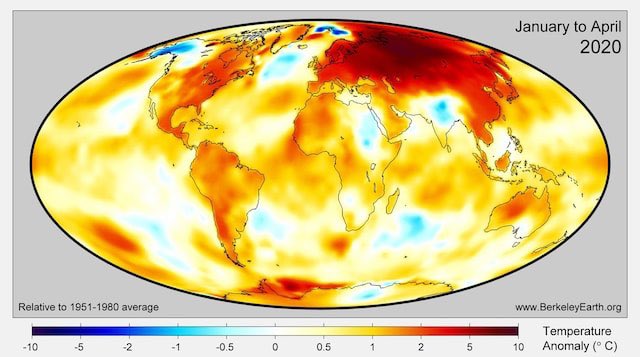
January to April 2020 temperature anomalies

By the second half of the century, the study found “a rapid acceleration of climate change exposure throughout the water column”.

Oceans can be restored to former glory within 30 years, say scientists

The study used climate models to first estimate the current rates of climate velocity at different ocean depths, and then future rates under three scenarios – one where emissions started to fall from now; another where they began to fall by the middle of this century; and a third where emissions continued to rise up to 2100.

Prof Jorge García Molinos, a climate ecologist at Hokkaido University and a co-author of the study, said: “Our results suggest that deep sea biodiversity is likely to be at greater risk because they are adapted to much more stable thermal environments.”

At present, the world’s heating was already causing species to shift in all layers of the ocean from the surface to more than 4km down, but at different speeds.

But even under a highly optimistic scenario, where emissions fell sharply from now, the ocean’s mesopelagic layer – from 200m to 1km down – climate velocity would change from about 6km per decade to 50km by the second half of the century.
But over the same period, climate velocity would halve at the surface.

Even at depths of between 1,000 and 4,000 metres, climate velocity would triple current rates, even if emissions dropped sharply.

Prof Anthony Richardson, of the University of Queensland and the CSIRO and one of the study’s 10 authors, told Guardian Australia: “What really concerns us is that as you move down through the ocean, climate velocity moves at different speeds.”

This could create a disconnect for species that rely on organisms in different layers.

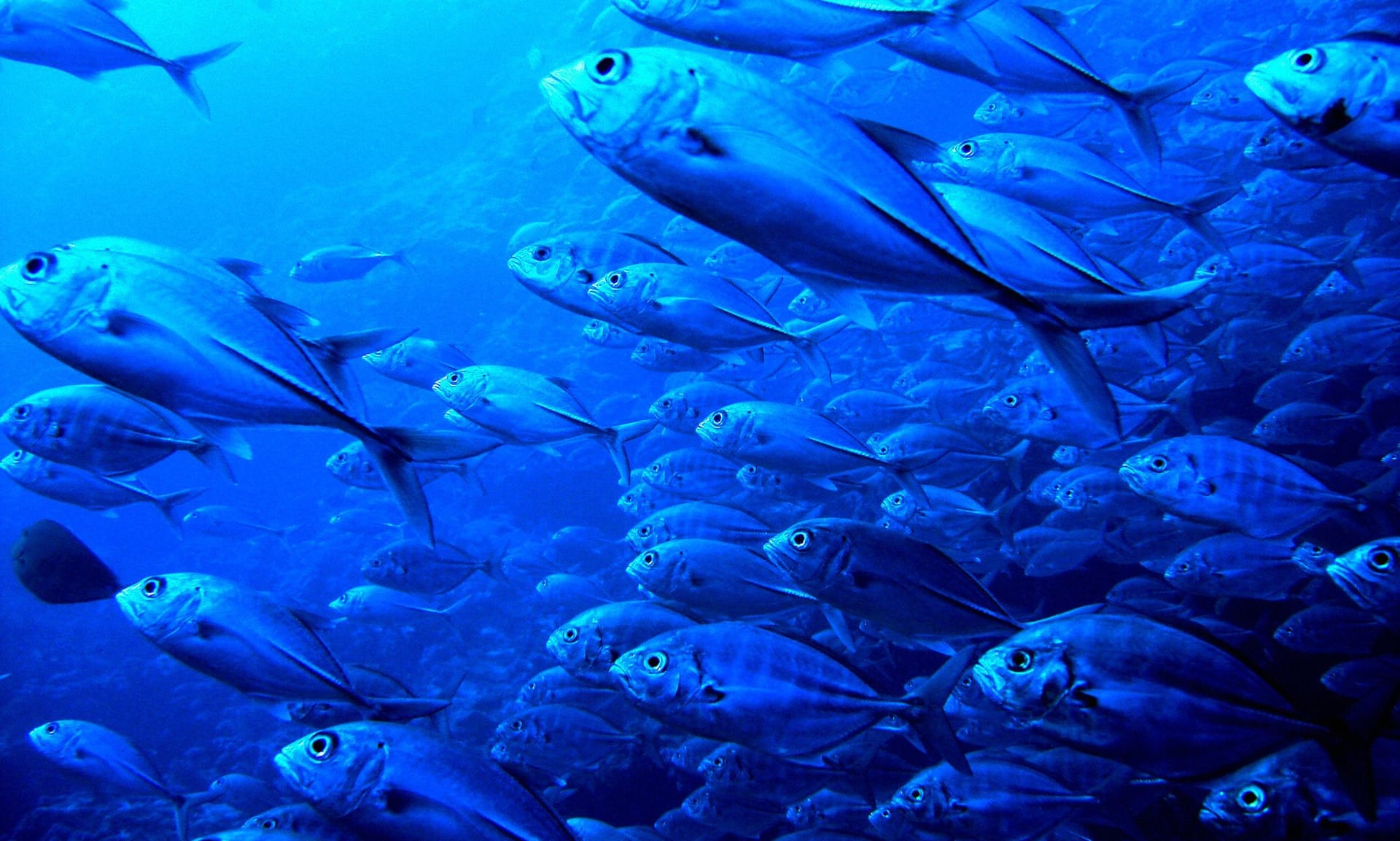
For example, Richardson said tuna lived in the mesopelagic layer between 200 and 1,000 metres deep, but they relied on plankton species near the surface.

He said because the planet’s oceans were so large and stored so much heat, “warming already absorbed at the ocean surface will mix into deeper waters.”

“This means that marine life in the deep ocean will face escalating threats from ocean warming until the end of the century, no matter what we do now.”

Isaac Brito-Morales, the study’s lead author and a researcher at the University of Queensland, said: “Because the deep ocean has a more stable temperature, any small increase will have an impact on species – they’re more at risk than those at the surface.”

Richardson added it was “concerning” their results showed, as well as different rates of climate velocity at different depths, the direction that species would need to move wasn’t uniform either.

This could mean that marine park areas designed to protect different species or habitats could become compromised as species moved out of the protected areas into unprotected areas.

Links :

Monday, May 25, 2020

That fresh sea breeze you breathe may be laced with microplastic

The study casts doubt on the assumption that once in the ocean, plastic stays put, as well as on the restorative powers of a fresh sea breeze.
Photograph: Ben Birchall/PA

From Wired by Matt Simon

Researchers have discovered that the ocean is burping tiny plastic particles, which then blow onto land—and potentially into your lungs.

When you stand on a beach and take in a great big gulp of fresh air, you’re actually breathing bacteria, viruses, and aerosolized salts.
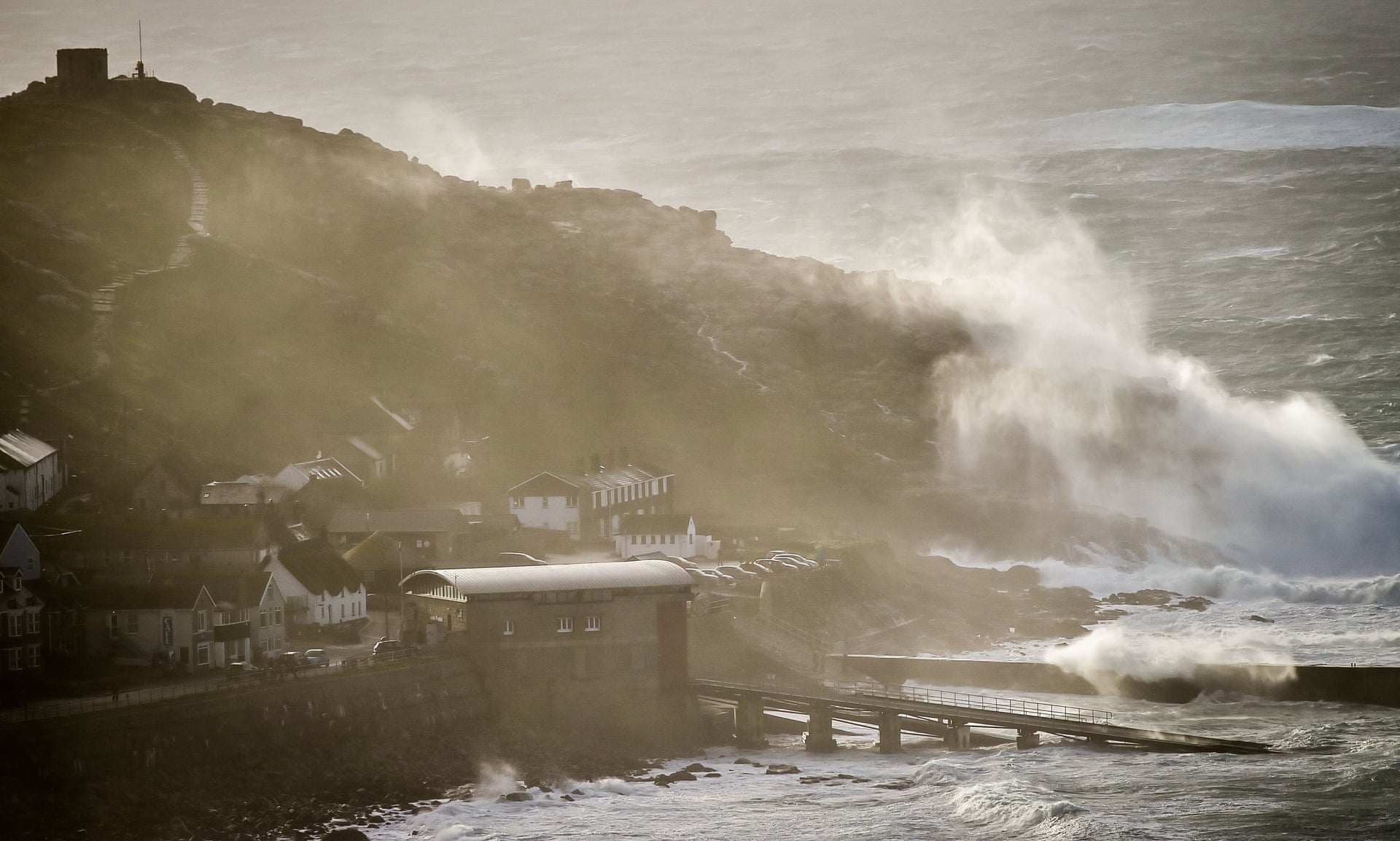
Those are all punted into the air when whales breach or waves crash or even when bubbles rise to the surface of the sea, ejecting material that gets caught up in sea breezes and fog banks.
And as much as I hate to rain on your beach day, you can now add an omnipresent pollutant to that list of debris: microplastics.

Microplastics are the ground-up remnants of plastic bottles and bags, or the synthetic fibers shed from your polyester clothing—technically anything smaller than 5 millimeters long—and of late scientists have been finding them everywhere, from the deep sea to the tallest mountains.
And now, writing today in the journal PLOS ONE, researchers from Europe and South Africa demonstrate in the lab how popping bubbles can fling microplastics into the air; the same team also gathered microplastics from the air flowing over a French beach.
The picture ain’t pretty: They found that up to 19 microplastic fragments float in a cubic meter of air.
Even worse, they were measuring at the edge of relatively clean Atlantic waters—highly polluted seas like the Mediterranean are probably flinging far more particles onshore.
Globally, the researchers calculate that 136,000 tons of microplastic could be blowing onshore each year.

Up until now, scientists had considered the ocean to be a kind of microplastic sink.
When you wash your clothes, for instance, synthetic fibers flow in wastewater to a treatment plant, which only removes some of the microplastic before pumping the water out to sea.
Plastic trash also flows into rivers and eventually out to sea, where it breaks into ever-smaller pieces over time.
Ocean currents then transport the microplastic particles far and wide: Just last month, another group of researchers showed how microplastics flow into the deep sea, eventually settling in sediment and corrupting seafloor ecosystems.

And in the ocean the plastic bits stayed, researchers once thought.
But this new work shows how something as minuscule as a bubble can burp microplastics into the atmosphere.
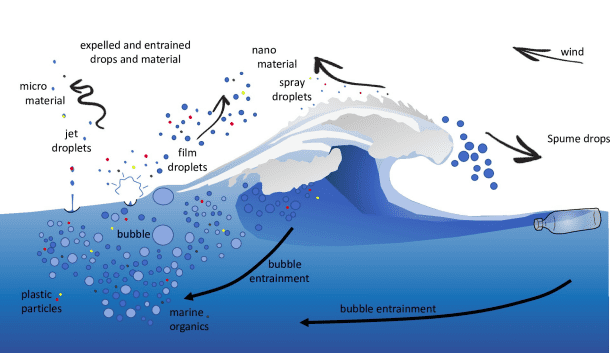
Oceanic bubbles are quite complex; when one comes to the water’s surface, it brings both air and hitchhikers.
“That bubble actually acts as like a sponge for tiny particles like sea salt, viruses, bacteria, and—potentially—plastics, as it comes up through the water column,” says University of Strathclyde microplastic researcher Deonie Allen, co-lead on the new research.
“So the outside of that bubble is now sort of coated in particles.”

 credit PlosONE

When the bubble surfaces, half of it protrudes above the water line, with the other half hidden beneath it.
“On the top side out of the water, you've got a very thin layer of water, which when it bursts actually fragments, and that releases nano-sized materials,” says University of Strathclyde microplastic researcher Steve Allen, co-lead on the work.
(The Allens are spouses.) “But when the ocean tries to fill the void left by the bottom half of the bubble, it comes in from all sides and produces the ejection, or the jet,” he continues.

In the lab, the Allens and their colleagues used a black light, or long-wave ultraviolet light, to watch this phenomenon in action, as their bubbles spewed fluorescent materials into the air.
Scientists were already well aware that oceanic bubbles fling viruses, bacteria, and salts into the atmosphere, but in this experiment they’ve shown that microplastics come along for the ride as well.

And that’s not even the most violent transport method in the sea: All sorts of gunk is flung into the air when waves crash against the shore.
It’s this particulate matter that makes its way into the atmosphere, attracting moisture to form fog.

Out in the field, the researchers chose a particularly rough and stormy section of French coastline along the Bay of Biscay to search the air for microplastics.
They set up two kinds of collectors: one that could pull particles out of the water droplets that make up sea spray, and another that filtered just the dry air of onshore winds.
And sure enough, there they found microplastic particles, as many as 19 per cubic meter on a misty autumn day.

The ocean, then, isn’t sequestering microplastics, as scientists previously believed—it seems to be actively ejecting them into the atmosphere, spreading them around the planet.
The Allens’ previous research has shown that winds can carry microplastics far and wide, transporting them from European cities onto the supposedly pristine mountaintops of the French Pyrenees.
This new research makes that bad news all the worse.
“There's an awful lot of water in the world,” says Deonie Allen.
“So if you can see water surfaces as not just a sink, but also a source, then that's a really large surface area that could then be influencing the amount of microplastics that are not just in the atmosphere.”

 The beach of Mimizan in France where researchers measured microplastics on the sea breeze.
Photo : Nicolas Tucat / AFP

This work goes a long way towards illuminating a microplastic pollution cycle that’s far more complex than previously believed.
“Previous studies have shown that plastics and microplastics can be washed onshore from the oceans, and that larger plastics can be blown onshore.
But this is the first study to show that sea spray can release microplastics from the ocean,” says University of Manchester earth scientist Ian Kane, who researches how deep-sea currents transport microplastics, but who wasn’t involved in this new work.
“Even if blown onshore, it is likely that much will make its way, eventually, into watercourses and the sea. Some may be sequestered into soil or vegetation and be ‘locked up’ indefinitely.”

So when you eat vegetables, you may also be eating microplastics that once flowed to the sea, then were ejected from the water and blown back onto land.
The air you breathe may likewise be contaminated both with microplastics shed from objects around your home, as well as from microplastics that once floated in the ocean.

The Allens’ work brings with it another troubling implication that demands more research.
If microplastics can “seed” clouds, like other particulate matter from the sea does—acting as the foundation on which moisture accumulates to build a nice big fluffy cloud—what does that mean for the transportation of water on Earth?

“If there's enough of it, it can change the size of the cloud, and also the albedo of the cloud,” says Steve Allen.
That is, the whiter a cloud is—thanks to those microplastics attracting more moisture—the more of the sun’s energy it can bounce back into space.
And that might actually help cool the planet.
“So that'll have a positive effect for us for climate change,” he says.

On the other hand, he points out, this extra sequestering of water into clouds might also change rainfall patterns.
“It'll gather the moisture that's in the air,and not produce rain,” Allen continues.
“That rain can move somewhere else.
So we would get rain somewhere it doesn't belong, and we don't get rain where we need it.”

Plus, think about what the scientists couldn’t see.
Plastic doesn’t just disappear entirely—as it degrades in the environment, it breaks into ever smaller pieces, meaning there could be even tinier particles that are slipping through researchers’ filters.
“The smaller it gets, the easier it will be to get into the atmosphere, which is troubling,” says Scripps Institution of Oceanography microplastic researcher Jennifer Brandon, who wasn’t involved in this work.
“Especially because in the atmosphere, it can travel really far.” For example, sand from the Sahara readily travels across the Atlantic and lands in South America.
If microplastic is moving just as freely around the globe, it’s hard to imagine an ecosystem that’d be safe from contamination—no matter how remote it may be.
And that could have untold implications for the organisms that live there.

Super tiny, lightweight particles could also more easily penetrate through tissues of humans and other creatures, for instance passing through the gut lining if swallowed.
Scientists are only in the very early stages of studying how ingested or inhaled microplastics affect our bodies, but we can already assume it isn’t great for us.
They’re worried that the chemicals from the microplastics themselves might leach into our tissues, and also about the biological gunk that grows on these particles.
In the sea, this is particularly problematic, because microplastics accumulate pathogens as they float through the water.
What happens when that all gets in your lungs after a day at the beach is, at this point, anyone’s guess.

Links :

Sunday, May 24, 2020

Expedition to the end of the world

Haslund Film presents a real adventure film - but in a very modern sense.
A grand, adventurous journey to the last uncharted areas of the globe.
Yet no matter how far we go, and how hard we try to find the answer, the ultimate meeting is with ourselves and our own transience.
A real adventure film – for the 21st century. 
On a three-mast schooner aboard with artists, scientists and ambitions worthy of Noah or Columbus, we set off towards the end of the world: in this case, the rapidly melting ice massifs in North-East Greenland.
An epic journey where the brave sailors get acquainted with imaginary tent pitches, polar bear nightmares and entirely new species.
But in their encounter with the new, unknown parts of our world, the crew - which ranges from the artists Tal R and Daniel Richter to the geologist Minik Rosing - addresses a number of questions of a fundamental, existential nature.
Curiosity, great pathos and a liberating splash of humour come together in a film that is superbly orchestrated by the cinematic talent Daniel Dencik, who in one iconic image after another seduces us both far beyond and deep into the historical footnote that is humanity.
A film that is both conceived and brought into life on a large scale, just like an old childhood dream lived out by grown artists and scientists realised in adult company.