Wednesday, May 15, 2019

Strange things are afoot in the Strait of Hormuz

Four tankers, including the Saudi Arabian-owned Al Marzoqah, were “sabotaged” in the Strait of Hormuz on Sunday, raising tensions in the Gulf.
Reports said a US official had suggested Iran was responsible
photo : AFP

From The Economist by

Mysterious attacks and military planning are raising war jitters


When Donald Trump hired John Bolton to be his national security adviser, he reportedly joked that the mustachioed hawk was “going to get us into a war”.
It is easy to see why.
When serving under George W. Bush, Mr Bolton embellished intelligence on Cuban and Syrian weapons and lobbied hard for the invasion of Iraq.
After leaving government he argued that America should bomb Iran to set back its nuclear programme.
Now that he’s back, he appears to be on the warpath once again.

 About 40% of the world's traded oil passes through the Strait of Hormuz,
making it the global market's most important chokepoint

It was Mr Bolton, not the commander-in-chief, who announced on May 5th that America had dispatched an aircraft-carrier strike group and bombers to the Persian Gulf.
This was in response to undisclosed intelligence which, unnamed officials claimed, showed that Iran and its proxies were planning attacks on American forces (or its allies) in the region.
On May 9th Mr Bolton reviewed war plans, updated at his request, that call for sending up to 120,000 troops to the Middle East if Iran attacks or restarts work on nuclear weapons, according to the New York Times.
Such planning is not a sign of imminent conflict.
But Mr Trump is reported to be telling that joke again, now with more seriousness, as Mr Bolton also ratchets up pressure on Venezuela.
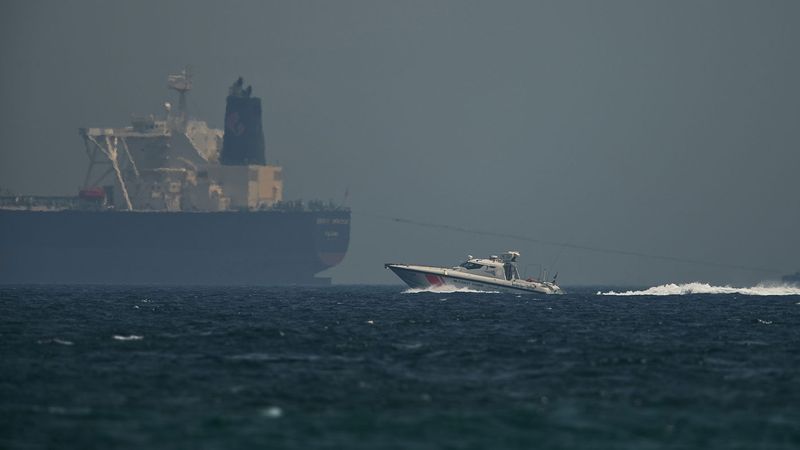
 An Emirati coast guard vessel passes an oil tanker off the coast of Fujairah, United Arab Emirates. Saudi Arabia said two of its oil tankers were sabotaged off the coast of the United Arab Emirates near Fujairah in attacks that caused "significant damage" to the vessels.
(AAP)

Some fear Mr Bolton is looking for a provocation by Iran, adding ominous undertones to recent events in the region.
On May 12th four oil tankers were struck by a “sabotage attack” off Fujairah, part of the United Arab Emirates (UAE).
The incident remains murky, but Emirati, Saudi and American officials claim that four ships—two Saudi, one Emirati and the other Norwegian—had 1.5-metre to 3-metre holes blown in their hull, near the waterline.
Unnamed American officials were quoted fingering Iran or its proxies as the likely culprit, without presenting evidence.
Fujairah lies just outside the Strait of Hormuz, a key chokepoint that Iranian officials have threatened to block if America attacks.

 Fujairah port with the GeoGarage platform (UKHO chart)

That was not the only flare-up.
On May 14th Saudi Arabia said two of its oil-pumping stations were attacked.
The damage was limited, but the Houthis, Shia rebels who control much of Yemen, claimed responsibility and threatened more such attacks.
They are fighting a Saudi-led coalition, supported by America, that backs the Yemeni government.
America and Saudi Arabia accuse the Houthis of being an Iranian puppet.
That is an exaggeration, though the Houthis have received arms from Iran.
The facilities that came under attack lie more than 700km north of the Yemeni border.
They were probably hit by long-range drones that the Houthis acquired last year.

More than 16 million barrels a day of crude and condensate was shipped through the Strait of Hormuz in the first four months of 2019

The two incidents taken together highlight the vulnerability of Gulf energy supplies—and thus Gulf economies.
Fujairah is connected via a pipeline to Abu Dhabi's oil fields.
The pumping stations hit in Saudi Arabia are part of the “east-west pipeline”, which moves crude from eastern oil fields to western ports.
Both pipelines are meant to help producers bypass the Strait of Hormuz.

Iran has a record of subversive action and supporting allied militias in the region—and of attacking shipping.
The so-called tanker war between Iran and Iraq ravaged international shipping in the 1980s.
Over 500 ships were attacked.
Four years into the tanker war, after an American-flagged ship was struck by an Iranian mine, America conducted its largest ever attack on Iran, destroying two oil platforms and sinking a frigate.
At least some in the White House look back fondly on that show of force.

But the timing of the incident in Fujairah, and the quickness with which American officials blamed Iran, has raised eyebrows.
Max Boot, a hawkish foreign-policy scholar, writes that Mr Bolton “may be trying to provoke Iran into striking first”.
He and others are reminded of the Gulf of Tonkin incident—a murky naval skirmish in 1964 used by America as a pretext for expanding its involvement in Vietnam.

Some officials have tried to calm matters.
On May 14th John Abizaid, America’s ambassador to Saudi Arabia, who previously commanded American troops in the Middle East, called for a “thorough investigation to understand what happened [and] why it happened”.
Only then, he said, should America “come up with reasonable responses short of war”.
Mr Abizaid insists that it is not in America’s interest to have a conflict.

 Strait of Hormuz (marine vessel traffic)

 Strait of Hormuz with the GeoGarage platform (UKHO nautical chart)
The Strait of Hormuz is the only sea passage from Persian Gulf to Arabian Sea.

Even so, European officials are nervous.
On May 13th Jeremy Hunt, Britain’s foreign secretary, said he was “very worried about the risk of a conflict happening by accident with an escalation that is unintended”.
That was shortly before a meeting with Mike Pompeo, America’s secretary of state, who received a frosty reception from his European counterparts in Brussels.
On May 14th Spain, sensing trouble ahead, withdrew its frigate from the American aircraft-carrier strike group heading towards the Gulf.
Major General Christopher Ghika, the top British officer in the American-led coalition against Islamic State, said, “There’s been no increased threat from Iranian-backed forces in Iraq and Syria.”

Many in Europe blame America for the rising tensions.
Last year Mr Trump pulled out of a deal that curbed Iran’s nuclear programme in return for economic relief.
Now he seems intent on undermining what is left of the pact by imposing crippling sanctions on Iran.
On May 8th President Hassan Rouhani said Iran would abrogate parts of the deal and gave the remaining signatories—Britain, China, France, Germany, Russia and the European Union—60 days to work out how to relieve the economic pressure it was under.
If they cannot, Iran would feel free to enrich uranium to ever higher levels, which would shorten its path to producing fissile material for a nuclear bomb.

Mr Trump, for his part, runs hot and cold on Iran.
After Mr Rouhani’s announcement, he said Iran should call him for direct talks (Mr Rouhani has spurned several such offers).
After the incident in Fujairah, however, Mr Trump said, “It’s going to be a bad problem for Iran if something happens.”
But he said the war plans involving tens of thousands of troops are fake news: “We have not planned for that. Hopefully we’re not going to have to plan for that.”
Though he added, “If we did that, we’d send a hell of a lot more troops than that.”

Links :

Tuesday, May 14, 2019

Canada (CHS) layer update in the GeoGarage platform

39 nautical raster charts updated

Mariana Trench: Deepest-ever sub dive finds plastic bag

The latest dive reached 10,927m (35,849ft) beneath the waves - a new record
photo : Tamara Stubbs

From BBC by Rebecca Morelle

An American explorer has found plastic waste on the seafloor while breaking the record for the deepest ever dive.
Victor Vescovo descended nearly 11km (seven miles) to the deepest place in the ocean - the Pacific Ocean's Mariana Trench.

see other video

He spent four hours exploring the bottom of the trench in his submersible, built to withstand the immense pressure of the deep.
He found sea creatures, but also found a plastic bag and sweet wrappers.
It is the third time humans have reached the ocean's extreme depths.

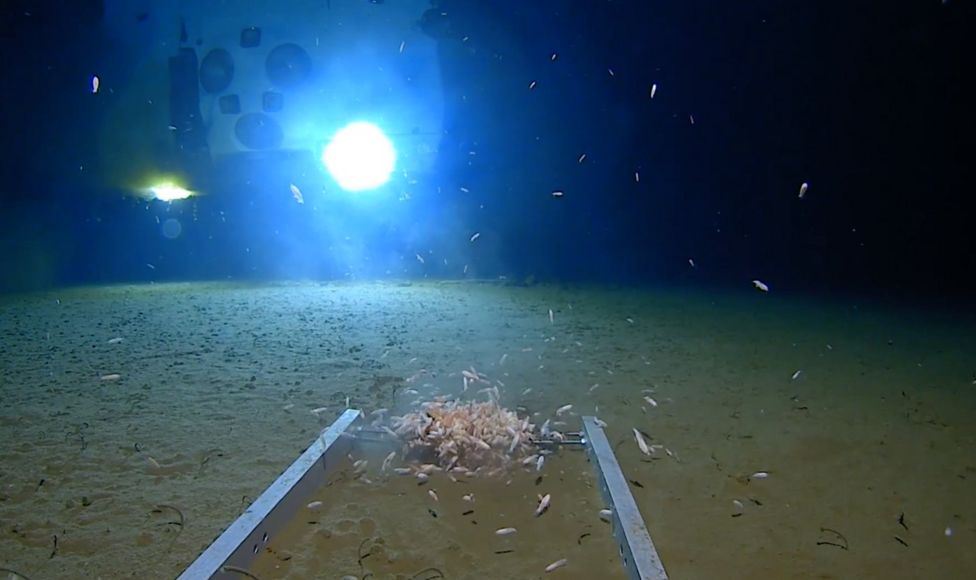
 The explorers believe they have discovered four new species of prawn-like crustaceans called amphipods


The Five Deeps Expedition successfully dived to the deepest point in the Indian Ocean, in the Java Trench. During one dive, what is believed to be a new species of Jellyfish was recorded on video.photo : Atlantic productions dor Discovery Channel

The first dive to the bottom of the Mariana Trench took place in 1960 by US Navy lieutenant Don Walsh and Swiss engineer Jacques Piccard in a vessel called the bathyscaphe Trieste.
Movie director James Cameron then made a solo plunge half a century later in 2012 in his bright green sub.

The latest descent, which reached 10,927m (35,849ft) beneath the waves, is now the deepest by 11m - making Victor Vescovo the new record holder.

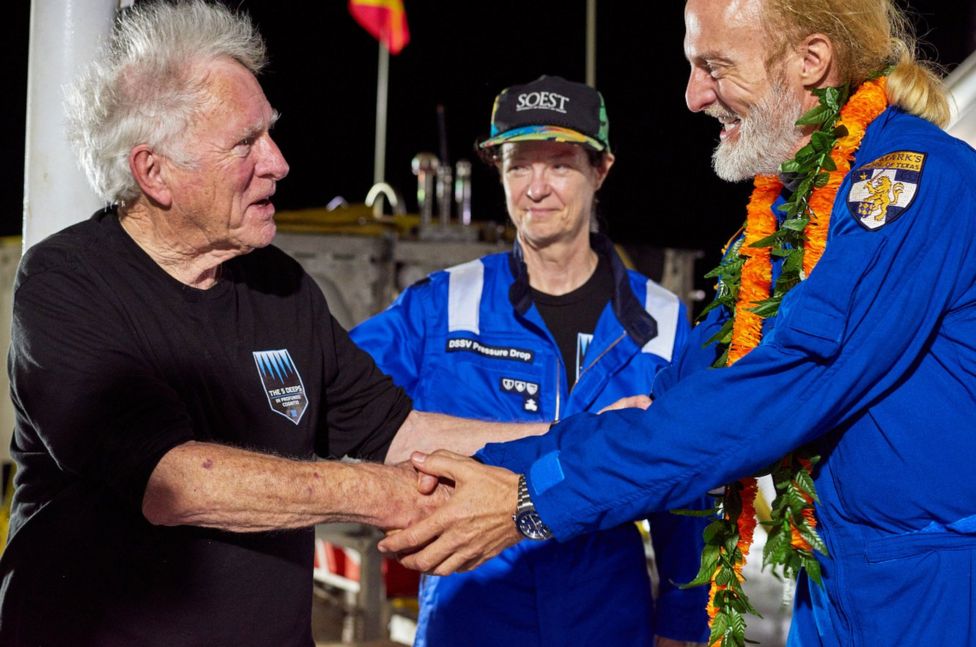
Don Walsh (left), who dived to the bottom of the Mariana Trench in 1960,
congratulated Victor Vescovo (right)
photo : Reeve Jolliffe

In total, Mr Vescovo and his team made five dives to the bottom of the trench during the expedition. Robotic landers were also deployed to explore the remote terrain.
Mr Vescovo said: "It is almost indescribable how excited all of us are about achieving what we just did.
"This submarine and its mother ship, along with its extraordinarily talented expedition team, took marine technology to a ridiculously higher new level by diving - rapidly and repeatedly - into the deepest, harshest, area of the ocean."


Witnessing the dive from the Pacific was Don Walsh.
He told BBC News: "I salute Victor Vescovo and his outstanding team for the successful completion of their historic explorations into the Mariana Trench.
"Six decades ago, Jacques Piccard and I were the first to visit that deepest place in the world's oceans.
"Now in the winter of my life, it was a great honour to be invited on this expedition to a place of my youth."

The team believes it has discovered four new species of prawn-like crustaceans called amphipods, saw a creature called a spoon worm 7,000m-down and a pink snailfish at 8,000m.
They also discovered brightly coloured rocky outcrops, possibly created by microbes on the seabed, and collected samples of rock from the seafloor.

Humanity's impact on the planet was also evident with the discovery of plastic pollution.
It's something that other expeditions using landers have seen before.
Millions of tonnes of plastic enter the oceans each year, but little is known about where a lot of it ends up.

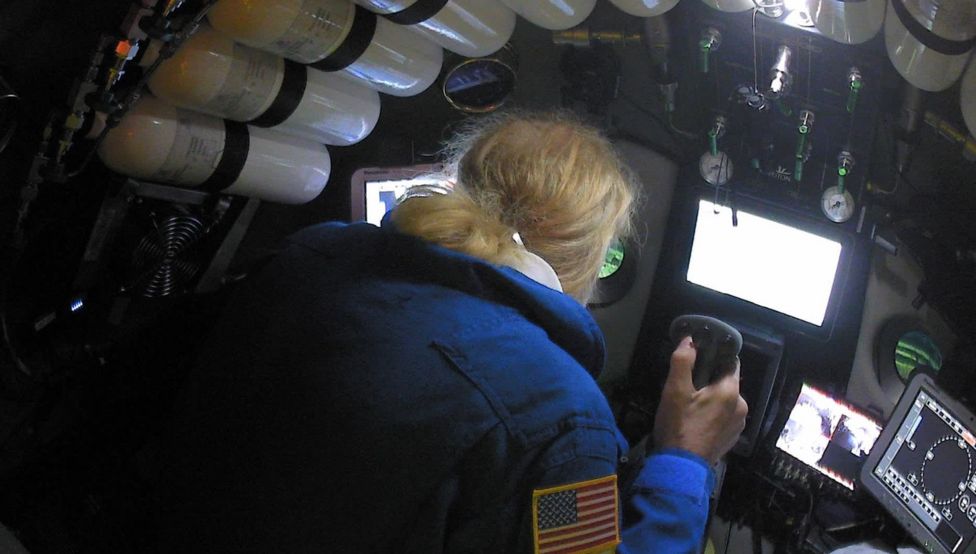
Victor Vescovo spent four hours exploring the bottom of the trench
photo : Atlantic productions dor Discovery Channel

The scientists now plan to test the creatures they collected to see if they contain microplastics - a recent study found this was a widespread problem, even for animals living in the deep.
The dive forms part of the Five Deeps expedition - an attempt to explore the deepest points in each of the world's five oceans.
It has been funded by Mr Vescovo, a private equity investor, who before turning his attention to the ocean's extreme depths also climbed the highest peaks on the planet's seven continents.

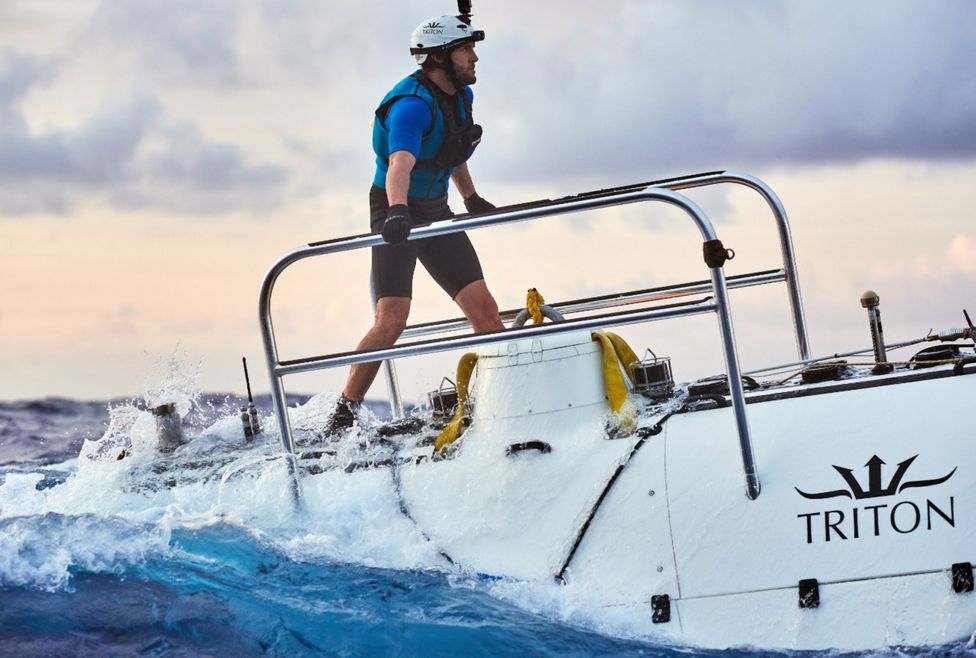
The 4.6m-long, 3.7m-high DSV Limiting Factor submersible was built by the US-based company Triton Submarines
photo : Reeve Jolliffe
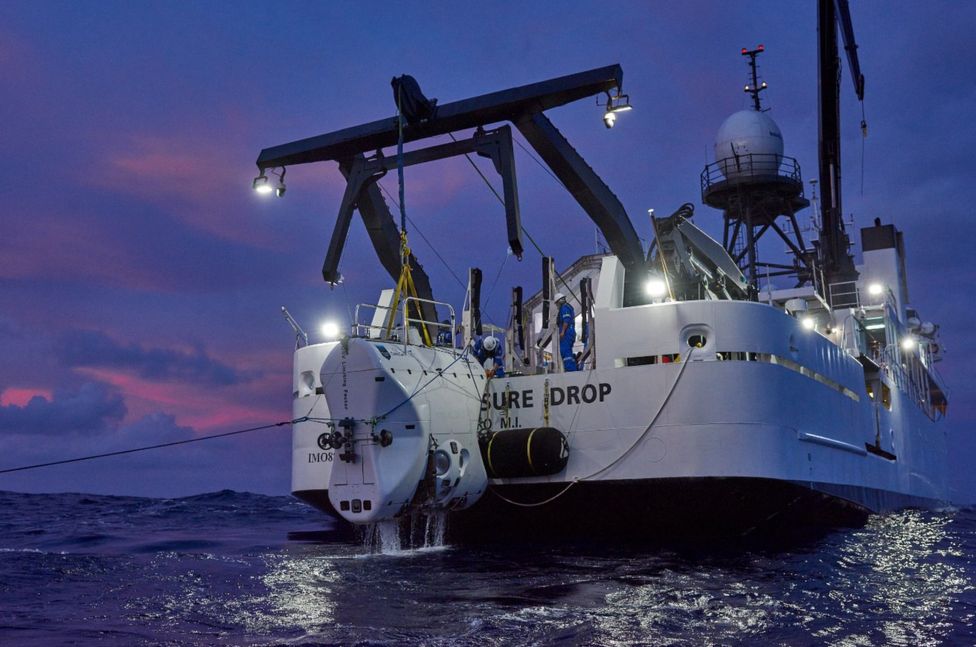
After the record dive, the submersible was brought back on the expedition's main vessel - the DSSV Pressure Drop

As well as the Mariana Trench in the Pacific, in the last six months dives have also taken place in the Puerto Rico Trench in the Atlantic Ocean (8,376m/27,480ft down), the South Sandwich Trench in the Southern Ocean (7,433m/24,388ft) and the Java Trench in Indian Ocean (7,192m/23,596ft).

The final challenge will be to reach the bottom of the Molloy Deep in the Arctic Ocean, which is currently scheduled for August 2019.

The 4.6m-long, 3.7m-high submersible - called the DSV Limiting Factor - was built by the US-based company Triton Submarines, with the aim of having a vessel that could make repeated dives to any part of the ocean.
At its core is a 9cm-thick titanium pressure hull that can fit two people, so dives can be performed solo or as a pair.
It can withstand the crushing pressure found at the bottom of the ocean: 1,000 bars, which is the equivalent of 50 jumbo jets piled on top of a person.

Mariana Trench
10,994 Deepest natural trench in metres
1960 First dive
3 Number of dives to date
2,146Higher than Mount Everest in metres, if inverte
Source: Deepsea Challenge/Geology.com
photo : Atlantic productions dor Discovery Channel
As well as working under pressure, the sub has to operate in the pitch black and near freezing temperatures.


On the deepest dive ever made by a human inside a submarine, a Texas investor found something he could have found in the gutter of nearly any street in the world: plastic rubbish.
Victor Vescovo, a retired naval officer, made the unsettling discovery as he descended nearly 6.8 miles (35,853 feet/10,928 meters) to a point in the Pacific Ocean's Mariana Trench that is the deepest place on Earth, his expedition said in a statement on Monday.
His dive went 52 feet (16 meters) lower than the previous deepest descent in the trench in 1960.
Vescovo found the manmade material on the ocean floor and is trying to confirm that it is plastic.

These conditions also made it challenging to capture footage - the Five Deeps expedition has been followed by Atlantic Productions for a documentary for the Discovery Channel.
Anthony Geffen, creative director of Atlantic Productions, said it was the most complicated filming he'd ever been involved with.
"Our team had to pioneer new camera systems that could be mounted on the submersible, operate at up to 10,000m below sea level and work with robotic landers with camera systems that would allow us to film Victor's submersible on the bottom of the ocean.
"We also had to design new rigs that would go inside Victor's submersible and capture every moment of Victor's dives."

After the Five Deeps expedition is complete later this year, the plan is to pass the submersible onto science institutions so researchers can continue to use it.
The challenges of exploring the deep ocean - even with robotic vehicles - has made the ocean trenches one of the last frontiers on the planet.
Once thought to be remote, desolate areas, the deep sea teems with life.
There is also growing evidence that they are carbon sinks, playing a role in regulating the Earth's chemistry and climate.

Monday, May 13, 2019

New Zealand (Linz) layer update in the GeoGarage platform

14 nautical raster charts updated

Plumbing the depths of the seas in the hidden battle for the internet

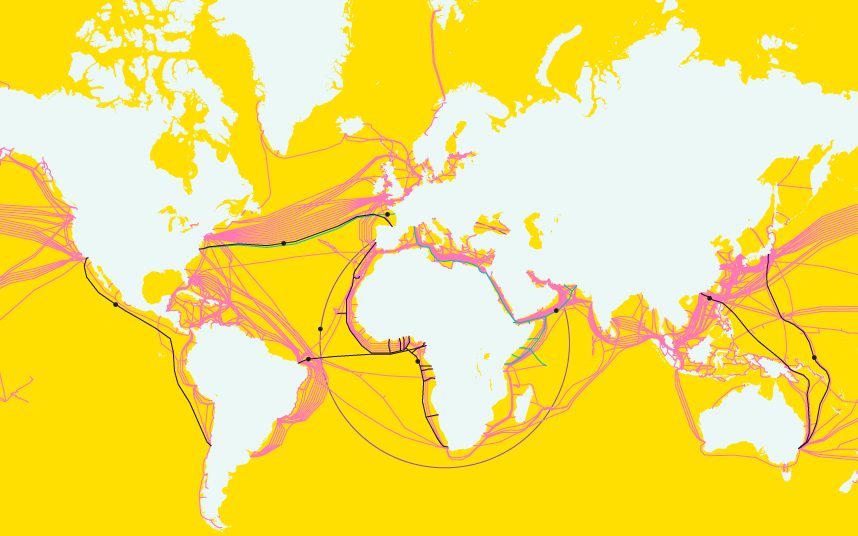
Subsea cables carry almost 99pc of the world's internet data and traffic.
About critical undersea fibre optic cable network, not from the usual physical vulnerability angle but examining who is increasingly building & operating new large capacity data pipes, notably Google & Huawei, in attempt to gain control.

From The Telegraph by Hasan Chowdhury

Tourists to the scenic port city of Valparaiso, on the Pacific coast of Chile, have plenty to admire.
Traditionally, visitors have swarmed across the city’s hillside to look at its vibrantly hued clifftop homes, street murals and sea views that inspired Pablo Neruda, the Nobel laureate.
“If we walk up and down all the stairs of Valparaiso, we’ll have walked all around the world,” the poet once wrote.

More recently, the city has been hosting a new visitor: Google, which is building a connection with the world of an entirely different kind.
Last month, the US technology giant laid the final section of a giant undersea cable, named Curie after the Polish scientist, that stretches 6,500 miles across the Pacific Ocean from Los Angeles.

Undersea cables are the vital unseen plumbing of the internet, carrying near 99pc of the world’s data and web traffic at close to the speed of light across the sea floor.
By being hooked up to them, places such as Valparaiso and cities across Latin America and beyond can enjoy the economic fruits delivered by high-speed broadband connectivity.

The subsea fibre cable which arrives here is not unique.
Around the world – from the remote island of Tonga to the shores of Cameroon – some of America and China’s biggest technology companies, including Facebook, Microsoft and Huawei, are forking out billions of dollars on similar underwater projects in a bid to gain an edge in a battle for control of the physical infrastructure of the internet.


There is a lot at stake.
Mark Sedwill, Britain’s former national security adviser, warned parliament in 2017 that by severing undersea internet cables an attacker could “achieve the same effect as [was] achieved in World War Two by bombing the London docks”.

Much of the debate around who controls access to the data on which our modern lives depend has revolved around the roll-out of 5G telecom networks.
But a similar debate over who owns and controls access to these subsea networks is emerging, amid growing concerns about security and espionage.

“Because we’re so connected by wireless devices, people often think about things being up in the air,” says Jayne Stowell, an infrastructure specialist at Google.
“The reality is [that] bits of information [travel] through fibre optic until the very last mile of delivery.
Intercontinentally, almost all of it goes through the sea.”

Many of the existing subsea links were built at the height of the dotcom boom of the late Nineties, when more than $20bn (£15bn) was spent on the technology.
But the decades-old fibre optic links that were laid by telecoms firms are starting to be replaced by tech giants looking to seize control of cables to provide faster and better links, including to new regions where internet use is booming.

In 2017, Facebook, Microsoft and telecoms firm Telxius teamed up to build a cable running over 4,000 miles from Virginia Beach on the east coast of the US to Bilbao, Spain.
Microsoft claims the cable, called Marea, about the weight of 34 blue whales, can deliver 160 terabytes of data per second – enough, it says, to make it 16m times faster than the average home internet connection.


Google is planning another cable, named Dunant, that will connect the US to France by 2020 along one of the busiest global routes for the internet, taking its tally of investments in subsea cables to 13.
Facebook is planning to develop a cable named Simba to encircle the entire African continent.

US firms aren’t the only players. Huawei, the Chinese telecoms giant that has been at the heart of a debate about the security of 5G infrastructure, is the dominant player from China in the subsea cables market.

A giant, 9,000-mile cable linking South Africa with the UK, built initially by former telecoms firm Alcatel-Lucent, was upgraded by Huawei Marine in 2015.
In total, Huawei is working to build or reconstruct close to 100 subsea cables.


The South Atlantic Inter Link project, a 3,700-mile cable connecting Cameroonian beach resort Kribi to Brazilian city Fortaleza, is the result of a joint investment by telecoms firms China Unicom and Camtel.

At present, there are around 380 deep sea cables owned by companies that control the internet.
But with just 30pc of the possible routes currently in use, according to market research firm TeleGeography, an image of cables sprawling from one continent to the next starts to emerge.

“You get this amazing pattern that emerges of the physical infrastructure of the internet built on centuries-old trading paths,” says Andrew Blum, author of Tubes, a book on the physical infrastructure of the internet.
“You have networks that connect the same cities that have always been connected by networks: New York and London, Singapore, Hong Kong, Mombasa – classic port cities.”

Deep sea cables are about the size of a garden hose.
A number of fibre optic wires about the thickness of horse’s hair can be packed into a loose tube that is wrapped by a mesh to keep the wires in place.
The more fibre, the faster the internet.

Surrounding that is another layer of copper welded tight and a final layer of plastic to allow electrical signals to zip across the ocean without the fear of seawater ruining the cable.
A specialised boat lowers a digging device into the ocean that ploughs the sea floor and lays the cable.

At regular, 62-mile (100km) intervals, the signals that carry the data of internet users around the world require a boost.
“Because you can’t put power plants under the ocean, you have power equipment on either end to power the cable,” says Stowell.

Traditionally, subsea cables have been the product of a consortium of companies and organisations working together to achieve similar goals.

But the advantage of taking control of one’s own sea cables have become apparent.
Google’s Curie cable is privately owned by the firm, allowing them to build it in “under two years”, Stowell says.
That compares to a normal time frame of four or five years.

Not only that, it gives a company such as Google full autonomy over the exact technology used, the end goal to be served by the cable and the precise configuration of its route.
“You have no public internet but just a very large collection of privately owned networks that connect to each other,” says Blum.
“Who pays who for use of those networks and who pays who to carry their data becomes a really complex issue.”

China Telecom Global Network Infrastructure Map 2018

The complexities run deep.
As the US and Chinese firms fight to gain control of cables, the question of who can, and should, control the internet, becomes a muddied one.
“There are moments where internet companies exceed the bounds of state players and I think there are moments where there’s still a state interest in controlling infrastructure.” says Blum.

Deeper still is a question of security.
As undersea cables bounce some of the most sensitive user data back and forth between regions, the tussle to grab hold of cables becomes inherently geopolitical.

Last year, Australia inked a deal to build a cable to the Solomon Islands.
The $78m project was initially due to be managed by Huawei, but the Chinese firm was ultimately left out over security concerns.

The decision is one that is likely to shape a debate for other countries around the most vital components of the internet, and could turn out to be as polarising as the one that has shaped around 5G.

In the more immediate future, the US and China may have a more menial problem facing their subsea cables.
“The areas of vulnerability are usually fishermen and ship anchors,” says Stowell.
“Almost 90pc of outages of cables are caused in shallow waters and are caused by those two sources.”

Links :