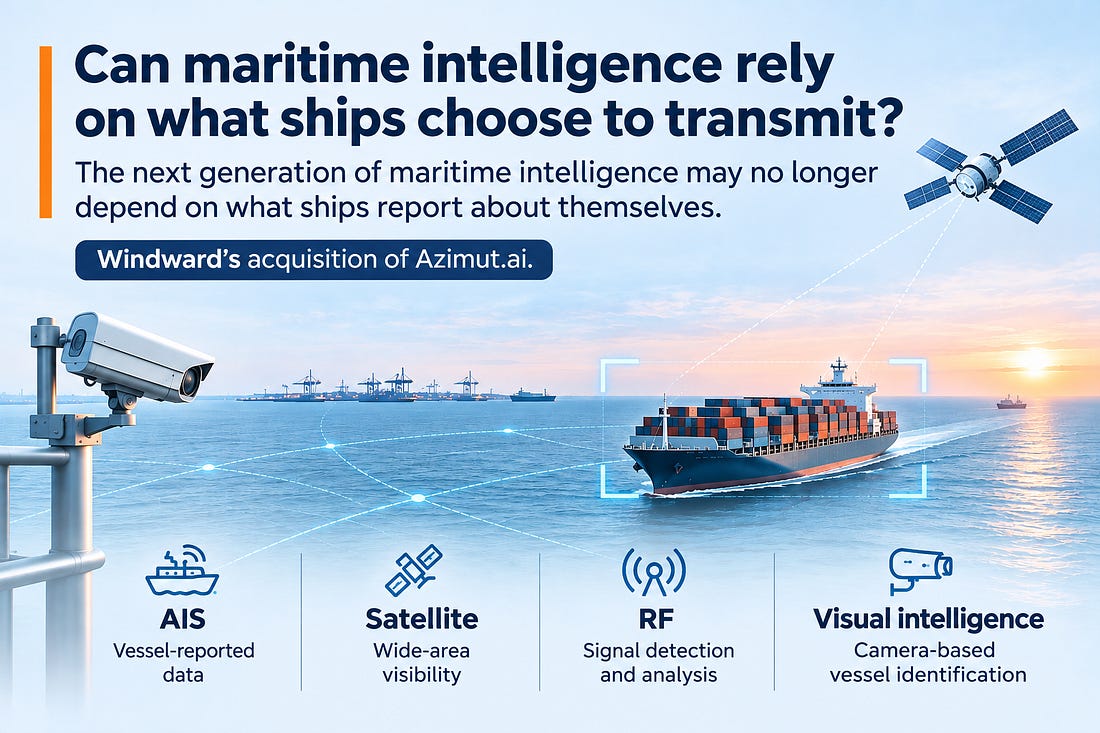
Windward has acquired maritime visual intelligence company Azimut.ai, adding camera-based vessel identification to its existing maritime intelligence platform.
The technology uses cameras positioned at ports and maritime chokepoints to identify and fingerprint vessels in real time, providing an additional means of tracking ships that have switched off their Automatic Identification System (AIS) transponders or are otherwise attempting to evade detection.
The technology uses cameras positioned at ports and maritime chokepoints to identify and fingerprint vessels in real time, providing an additional means of tracking ships that have switched off their Automatic Identification System (AIS) transponders or are otherwise attempting to evade detection.
From Substack by The Shipping Brief
How Windward’s acquisition of Azimut.ai signals a shift from vessel-reported data to independently verified maritime intelligence.
For decades, the Automatic Identification System (AIS) has been one of the foundations of maritime intelligence.
It provides information about a vessel’s identity, position, course and speed, allowing shipping companies, authorities and analysts to monitor maritime traffic.
But AIS has a fundamental limitation: it relies on vessels transmitting information about themselves.
Ships can switch off their transponders, manipulate transmitted information or disappear from conventional tracking systems.
Some interruptions are deliberate; others result from technical failures, environmental conditions or interference.
In an increasingly complex maritime environment, knowing what a vessel reports is not necessarily the same as knowing what it is doing.
Windward’s acquisition of Azimut.ai, announced on 3 November 2026, addresses precisely this gap.
The maritime intelligence company is adding a visual sensing capability to its existing platform, introducing camera-based vessel identification alongside AIS, satellite imagery and radio-frequency intelligence.
The significance goes beyond adding another data source.
Windward is moving into the physical infrastructure that generates maritime intelligence, potentially giving it access to observations that do not depend on a vessel’s own transmissions.
It is a strategic move that raises a bigger question: is the future of maritime intelligence shifting from tracking vessels to independently verifying their identity and behaviour?
From vessel-reported data to independent observation
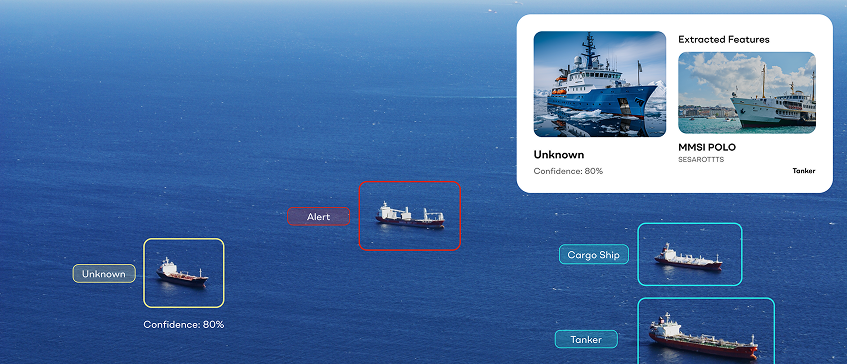
Azimut.ai brings optical sensing capabilities into Windward’s maritime intelligence platform.
The technology uses cameras positioned at strategic maritime locations, including ports, thoroughfares and chokepoints, to identify and fingerprint vessels in real time.
The distinction is important.
AIS provides information transmitted by the vessel.
Camera-based observation offers an independent way to establish that a vessel was physically present at a particular location and to support its identification.
Consider a vessel approaching a monitored port after a period during which its AIS signal was unavailable.
Its broadcast information may be incomplete or inconsistent.
A visual observation could provide another reference point against which its identity and movements can be assessed.
The two sources answer different questions.
AIS tells us what the vessel is transmitting.
Visual intelligence can provide evidence of what is physically observed.
When combined, they can help identify discrepancies that would be difficult to detect using a single source.
This is particularly relevant in areas where maritime traffic is concentrated, including major ports, straits and strategic passages.
It does not mean that cameras provide continuous visibility across the world’s oceans.
Their value depends on where sensors are deployed, the areas they cover and the conditions under which they operate.
But at critical points in the maritime network, independent visual confirmation can add an important layer of intelligence.
Windward is expanding beyond data integration
The acquisition is strategically interesting because it changes the nature of what Windward can offer.
The company has built its platform around combining multiple sources of maritime information, including AIS, satellite imagery, radio-frequency signals and other intelligence datasets.
Azimut.ai adds a different capability: physical sensors that can generate visual observations of vessels.
In its acquisition announcement, Windward describes this as a proprietary visual intelligence layer.
It plans to combine visual identifications with existing information on vessel ownership, sanctions, cargo, behaviour and risk.
The result is intended to turn an individual sighting into a broader, explainable assessment that government and commercial customers can act on.
This is where the commercial value lies.
A camera image on its own may establish that a vessel passed a particular location.
Its value increases when that observation can be connected to a vessel record, ownership structure, previous movements and other relevant intelligence.
The same principle applies to satellite and radio-frequency data.
Individual observations become more useful when they can be compared, cross-referenced and interpreted together.
For Windward, the acquisition potentially strengthens the relationship between data collection and intelligence analysis.
It also gives the company a more direct role in the physical sensing infrastructure behind its platform.
That is a meaningful distinction.
Many technology providers compete on their ability to process and interpret third-party data.
Owning or controlling additional sensing capabilities can create another source of differentiation, although it also introduces new operational responsibilities.
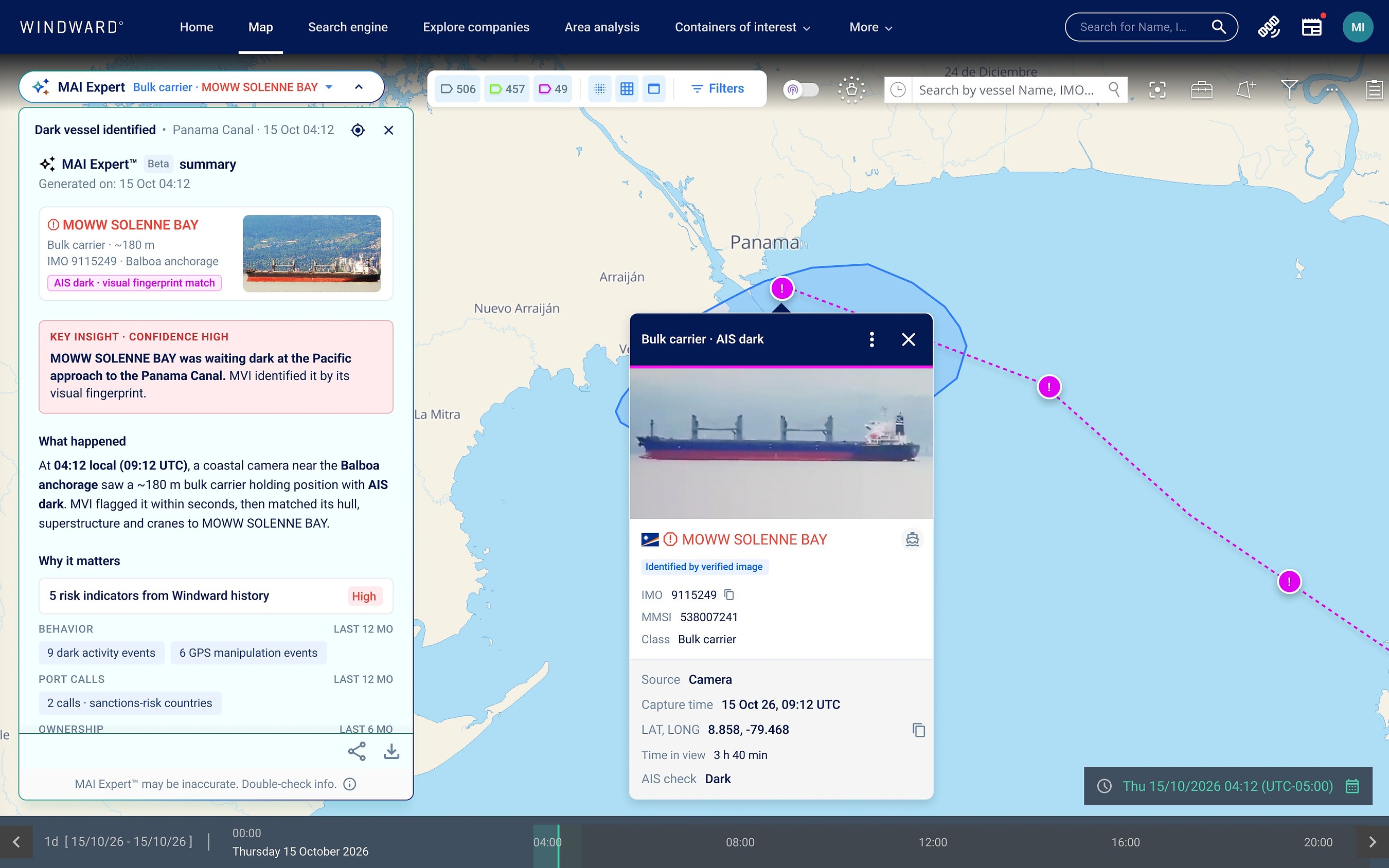
Screenshot of Winward's Maritime Visual Intelligence
Why this matters for maritime risk and sanctions
The ability to independently identify vessels has applications across several parts of the maritime ecosystem.
Independent observations can help investigate inconsistencies in vessel movements and identity.
Additional sensing capabilities can help build a more complete operational picture.
Visual identification can provide another means of verifying traffic at monitored locations.
Better vessel verification can support more informed assessments of operational and counterparty risk.
The ability to independently identify vessels has applications across several parts of the maritime ecosystem.
- Sanctions compliance and investigations
Independent observations can help investigate inconsistencies in vessel movements and identity.
- Maritime security
Additional sensing capabilities can help build a more complete operational picture.
- Ports and terminals
Visual identification can provide another means of verifying traffic at monitored locations.
- Commercial risk management
Better vessel verification can support more informed assessments of operational and counterparty risk.
The common requirement is not simply tracking a vessel.
It is establishing how much confidence can be placed in the information associated with it.
For organisations dealing with sanctions exposure, opaque ownership structures and suspicious maritime activity, that distinction can be commercially and operationally significant.
The technology is only as good as its coverage
There are, however, important limitations.
Camera-based vessel identification is not a replacement for satellite monitoring or AIS.
It is another layer of evidence, with its own strengths and constraints.
Coverage is geographically dependent.
Cameras need to be installed at locations where they can observe relevant maritime traffic.
A network covering several strategic ports or chokepoints does not provide continuous visibility across open oceans.
Performance also depends on environmental and operational conditions, including visibility, camera positioning, image quality, distance and vessel density.
There is another distinction worth making: detecting a vessel, identifying it correctly and interpreting its behaviour are three different tasks.
A camera may detect an object on the water.
A recognition system may match it to a particular vessel.
Further analysis is then required to establish whether its movements or associated information indicate suspicious activity.
These stages should not be confused.
Visual intelligence can strengthen an assessment, but it does not automatically prove intent or wrongdoing.
Windward has also emphasised privacy in its announcement.
The company says customers will not receive raw images or video footage.
The system is designed to support analytics relating to vessel activity, rather than the identification or verification of individuals.
That distinction will matter as the deployment of maritime camera networks expands.
The commercial model: from software to sensor infrastructure
One of the more interesting implications of this acquisition is that Windward is moving further into the infrastructure layer of maritime intelligence.
A software platform can scale through data partnerships, integrations and additional customers.
A physical sensor network has different requirements.
It needs suitable installation locations, access agreements, equipment, maintenance and reliable connectivity.
It also requires enough relevant traffic and observation quality to make each deployment commercially useful.
Windward has invited maritime stakeholders and other organisations to become site partners, indicating that partnerships will be part of its deployment strategy.
This creates an interesting business model question.
Will Windward build and operate a network of proprietary cameras at selected locations? Will it rely on partners to host and maintain installations? Or will it combine owned infrastructure with third-party deployments?
The answer will influence the cost of expansion, geographical coverage and the economics of the new capability.
Owning the sensing assets may provide greater control over data availability and consistency.
But it also means taking responsibility for the physical network.
The acquisition therefore brings an infrastructure dimension into a business that has largely been associated with data analytics and maritime AI.
A changing competitive landscape
Windward’s move also reflects a broader evolution in maritime intelligence.
The market is no longer limited to traditional vessel-tracking providers.
It increasingly includes satellite operators, radio-frequency detection companies, computer vision specialists, data platforms and AI-based analytics providers.
Each technology contributes a different type of evidence.
- AIS provides vessel-reported identity and movement information.
- Satellite imagery offers wide-area observation, although coverage and revisit frequency vary.
- Radio-frequency intelligence can detect and analyse electronic emissions.
- Visual intelligence provides camera-based vessel observations at locations where sensors are deployed.
The competitive advantage may increasingly belong to companies capable of bringing them together, resolving conflicting information and translating the results into operational decisions.
This is particularly important as AI becomes more deeply integrated into maritime intelligence workflows.
The quality of the underlying data will influence the quality of the analysis and the decisions that follow.
Windward’s acquisition suggests that the company sees proprietary data collection as an important part of its future positioning.
It is also a reminder that the maritime AI race will not be won by algorithms alone.
Access to differentiated data, physical infrastructure and strategically located sensors may become just as important.
What remains unanswered?
The acquisition announcement provides a clear indication of strategic direction, but several important details remain undisclosed.
First, Windward has not disclosed the financial terms of the transaction.
We therefore cannot assess the valuation of Azimut.ai or the scale of the investment required to develop the sensor network.
Second, the company has not provided detailed information about the existing network’s geographical coverage, number of installations or operational capacity.
Third, the integration roadmap remains unclear.
How quickly will visual identifications become available within Windward’s existing products? How will customers access the new intelligence, and how will it affect pricing?
Finally, the economics of deployment need to be demonstrated.
A proprietary camera network could create a valuable competitive advantage, but only if it can be expanded efficiently and deliver information that customers are willing to pay for.
These are the questions that will determine whether the acquisition becomes a meaningful commercial differentiator or remains a promising technological addition.
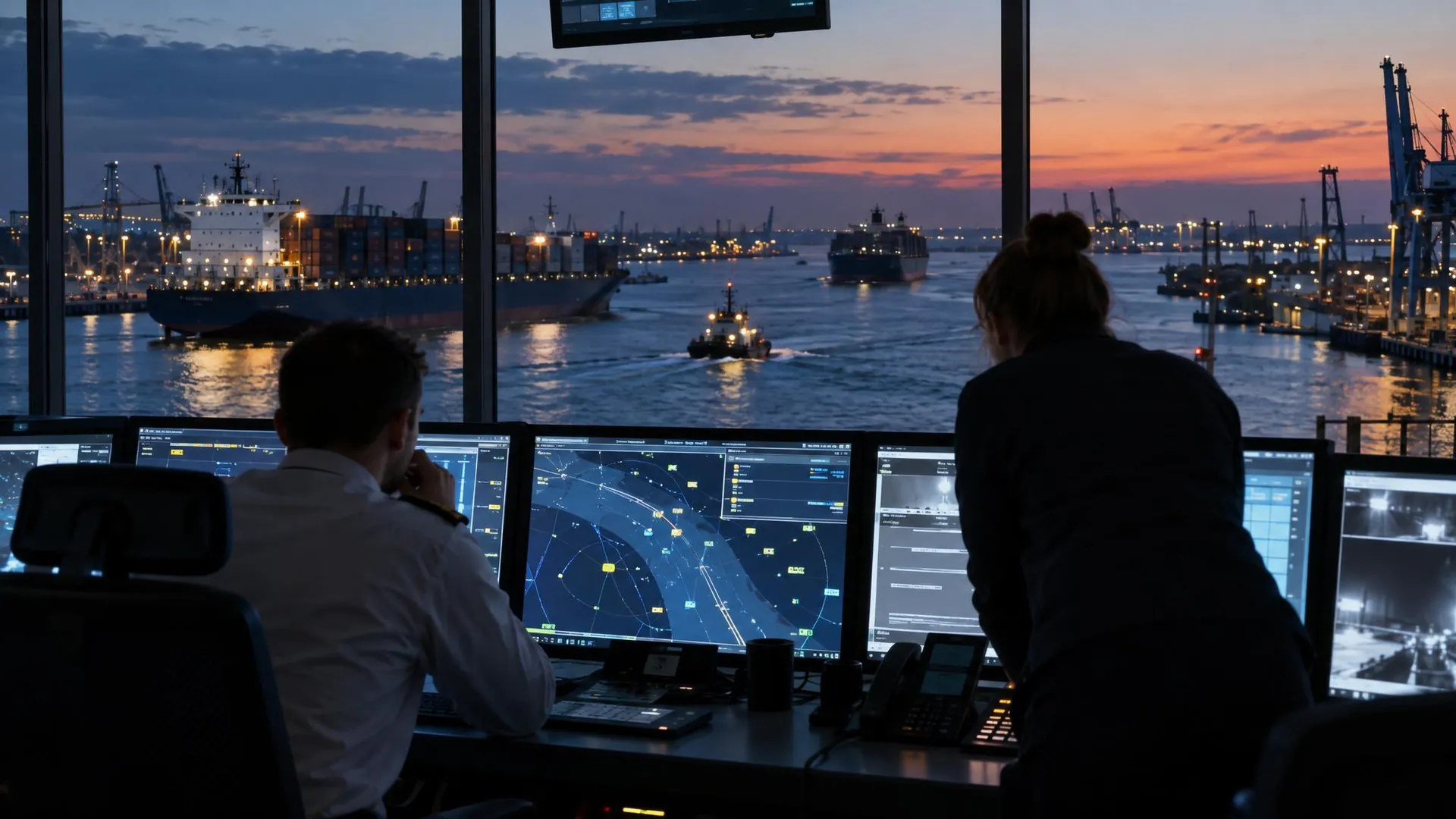
The next generation of maritime intelligence
Windward’s acquisition of Azimut.ai is more than an expansion into computer vision.
It signals a move towards a more comprehensive model of maritime intelligence, in which vessel-reported data is supplemented by independent observations from physical sensors.
The implications extend beyond Windward.
As maritime risks become more complex and the limitations of individual tracking systems become more apparent, the ability to combine multiple sources of evidence will become increasingly important.
For the industry, the question is no longer simply how many vessels a platform can track.
It is how reliably it can identify them, verify their movements, detect inconsistencies and explain what those observations mean.
Asking a vessel where it is has always been useful.
Being able to independently verify the answer could become much more valuable.
Links :

No comments:
Post a Comment