Saturday, December 29, 2012

Ocean origins


A documentary that explores the natural world of the sea, from the single-celled organism to more complex forms of life, 'Ocean Origins' was originally filmed in the IMAX large format, which adds a crispness and clarity to the images.
This documentary film seeks to examine the process of evolution by looking at the many creatures of the sea that can illustrate the way multi-cellular life emerged over the course of four billion years.

'Ocean Origins' is a creative film that uses fascinating documentary footage to look at scientific theories and principles in an interesting manner.

Friday, December 28, 2012

NZ Linz update in the Marine GeoGarage

10 charts have been updated in the Marine GeoGarage
(Linz December published 20 December 2012 updates) 

  • NZ23 New Zealand, North Island
  • NZ25 New Zealand, South Island
  • NZ63 Kaikoura Peninsula to Banks Peninsula
  • NZ64 Banks Peninsula to Otago Peninsula
  • NZ632 Banks Peninsula
  • NZ5314 Mercury Islands
  • NZ5318 Great Mercury Island / Ahuahu to Otara Bay
  • NZ6321 Lyttelton Harbour / Whakaraupo: Port of Lyttelton
  • NZ14600 New Zealand including Norfolk and Campbell Island / Motu Ihupuku
  • NZ14601 Tasman Sea, New Zealand to S.E. Australia
      Today NZ Linz charts (178 charts / 340 including sub-charts) are displayed in the Marine GeoGarage.

      Note :  LINZ produces official nautical charts to aid safe navigation in New    Zealand waters and certain areas of Antarctica and the South-West    Pacific.


      Using charts safely involves keeping them up-to-date using Notices to Mariners

      Royal Navy 'does not keep sea monster sighting archive'

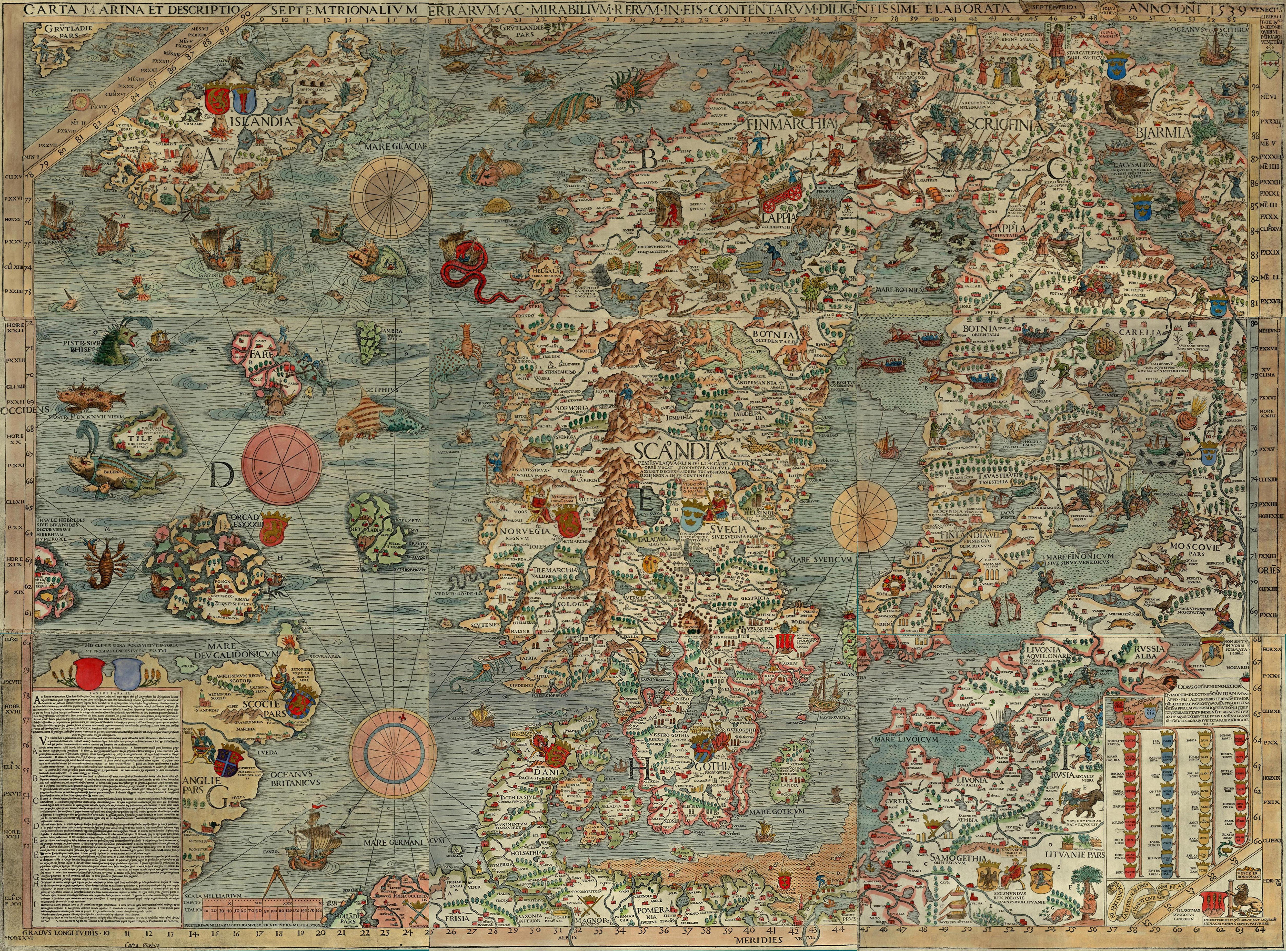
      The Carta marina (Latin "map of the sea" or "sea map"), created by Olaus Magnus in the 16th century, is the earliest map of the Nordic countries that gives details and placenames.
      It is about 500 years old, depicts the North of Europe and includes sea monsters.
      The monsters are seen attacking the ships and each other.

      (with zoom possibilities) 

      From TheTelegraph

      Sailors can note unusual sightings on the ocean waves in their ship's logs, the Navy said.
      But they are not required to do so and none of the information is assembled in a central archive devoted to sea monsters.
      Any sightings of strange marine animals reported to the Navy by the public are passed on to the UK Hydrographic Office, which provides charts and other navigational services for mariners.
      Details of the Navy's policy on giant creatures of the deep emerged in response to a Freedom of Information (FOI) request.

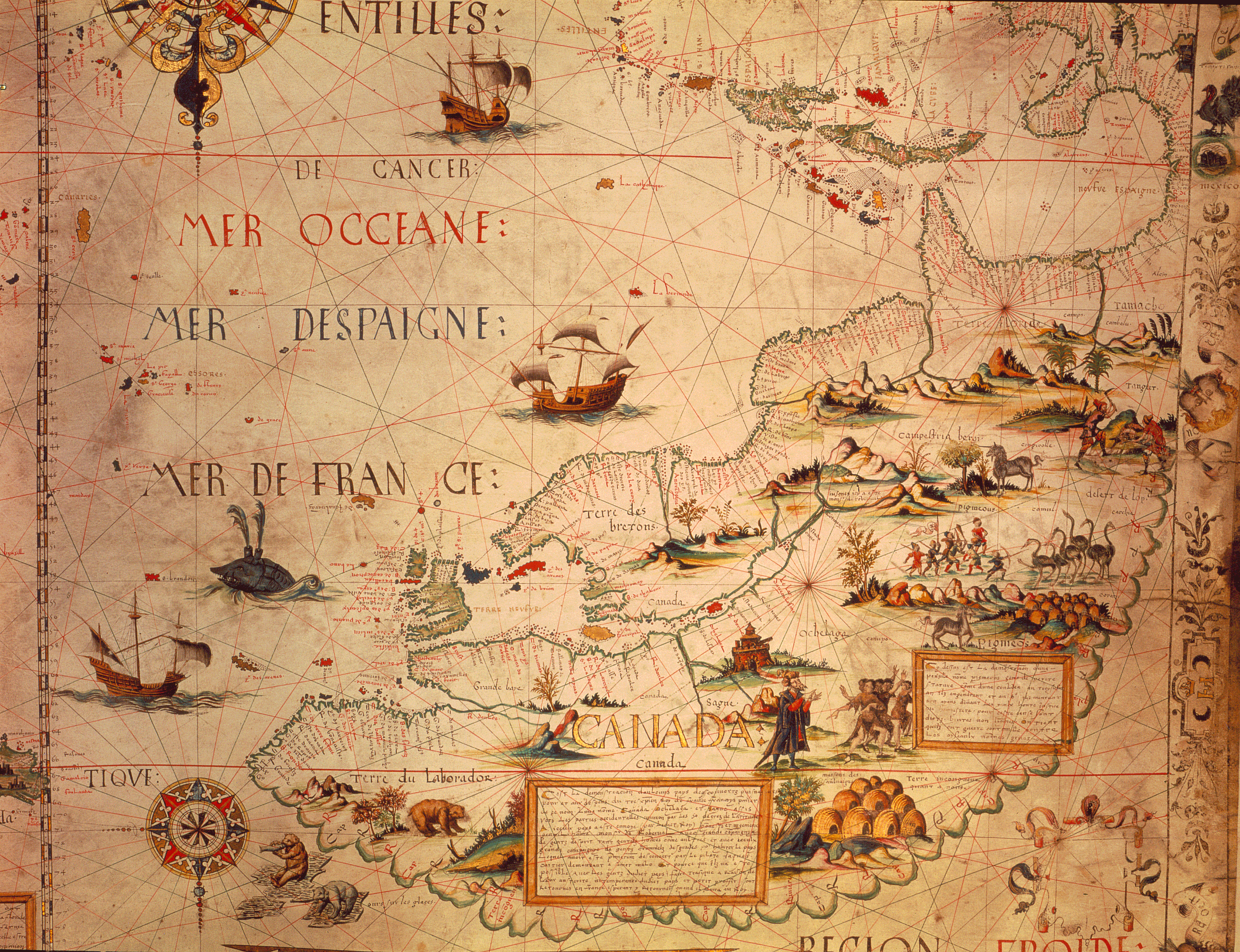
      Map of Canada (Pierre Desceliers' World Map 1550)

      A marine biologist inquired whether the Ministry of Defence held records about ''abnormally large or dangerous sea monsters hundreds of metres under the sea'' that had not been revealed to the public.
      In reply an official wrote: ''The RN (Royal Navy), and MoD in general, does not maintain any form of central repository of information purely devoted to sea monsters.

       Sebastian Munster's Famous Chart of Sea Monsters
      Remarkable chart of mythical land and sea monsters and other creatures, from Munster's Cosmographia, one of the most influential works of the 16th Century.
      Munster's plate of mythical creatures is taken from Olaus Magnus' Carta Marina of 1539 and includes abundant tusks, horns and twin-spouts.
      One vignette shows a galleon trying to outrun one monster by throwing their cargo overboard, while one sailor takes sight with a musket. 
      Ortelius also adapted many of the monsters for use on his map of Iceland in 1587.
      One of the most sought-after of all 16th Century curiosities. 

      ''Personnel might be inclined to record unusual sightings in ship's logs but there is, as far as we know, no actual requirement for them to do so, and it would be beyond the resource constraints of an FOI request to check every line of every RN log book for any such references since 2005.
      ''However, the RN does invite people to report sightings of marine mammals, and it's possible this could include unusual sightings.
      ''These are forwarded to the UK Hydrographic Office at Taunton.''
      The MoD's stance on sea monsters contrasts with the policy on UFOs it maintained for more than 50 years.
      Thousands of reports of strange sights in the skies were recorded by the military's UFO investigation unit until it was shut down on December 1 2009.

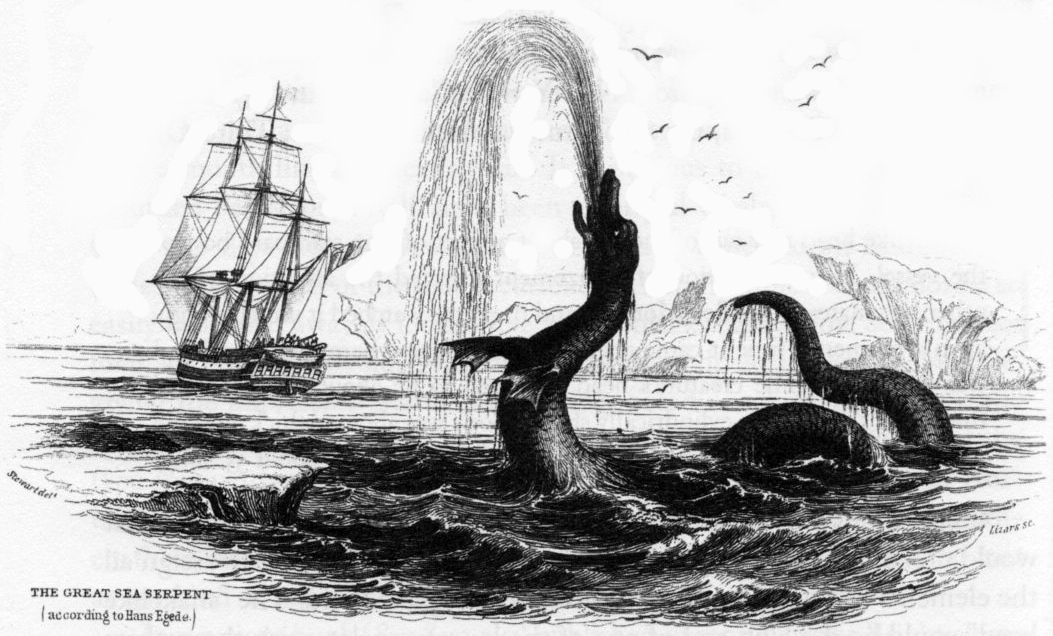
      The "Great Sea Serpent" according to Hans Egede. (1734 illustration)

      Old maps often included illustrations of fearsome sea dragons and serpents and there are many tales of mariners' encounters with weird creatures.
      Dr David Clarke, an expert in unexplained phenomena, said the Navy showed an interest in sea monsters in the 19th century.
      The National Archives in Kew, west London, contain several historic Royal Navy files about strange sightings on the oceans, he said.


      These include an 1830 report sent to the Admiralty in London by the captain of the ship Rob Roy about a ''great thundering big sea snake'' measuring about 129ft long seen by his crew in the waters near the remote island of St Helena in the South Atlantic.

      The documentation at issue details the remarkable encounter with a sea-serpent that was seen on May 9, 1830 by the crew of the Rob Roy: a British Royal Navy ship that was homeward bound after a lengthy sea-journey across the Atlantic Ocean.
      As the ship sailed by the island of St. Helena, something remarkable occurred, as the Rob Roy’s captain, James Stockdale, recorded in his official log the following:
      “About five p.m. all at once while I was walking on the poop my attention was drawn to the water on the port bow by a scuffling noise. Likewise all the watch on deck were drawn to it. Judge my amazement when what should stare us all in the face as if not knowing whether to come over the deck or to go around the stern – but the great big sea snake! Now I have heard of the fellow before – and I have killed snakes twenty-four feet long in the straits of Malacca, but they would go in his mouth.
      “I think he must have been asleep for we were going along very softly two knots an hour, and he seemed as much alarmed as we were – and all taken aback for about fifteen seconds. But he soon was underway and, when fairly off, his head was square with our topsail and his tail was square with the foremast.”
      Captain Stockdale continued: “My ship is 171 feet long overall – and the foremast is 42 feet from the stern which would make the monster about 129 feet long. If I had not seen it I could not have believed it but there was no mistake or doubt of its length – for the brute was so close I could even smell his nasty fishy smell.
      “When underway he carried his head about six feet out of water – with a fin between the shoulders about two feet long. I think he was swimming about five miles an hour – for I watched him from the topsail yard till I lost sight of him in about fifty minutes. I hope never to see him more. It is enough to frighten the strong at heart.”


      Another file records how Commander George Harrington, captain of the Castilian, saw ''a monster of extraordinary length'' rear its head out of the sea, again near St Helena, in 1857.

      A second report of a sea-monster sighting has been declassified at an official level by the British Government and describes an extraordinary December 13, 1857 encounter that also occurred in the vicinity of the island of St. Helena.
      A statement prepared by Commander George Henry Harrington revealed the facts:
      “While myself and officers were standing on the lee side of the poop – looking toward the island – we were startled by the sight of a huge marine animal which reared its head out of the water within twenty yards of the ship – when it suddenly disappeared for about half a minute and then made a reappearance in the same manner again – showing us its neck and head about ten or twenty feet out of the water.
      “Its head was shaped like a long buoy – and I should suppose the diameter to have been seven or eight feet in the largest part with a kind of scroll or ruff encircling it about two feet from the top. The water was discolored for several hundred feet from the head, so much so that on its first appearance my impression was that the ship was in broken waters, produced, as I supposed, by some volcanic agency, since I passed the island before.”
      And Captain Harrington had far more to impart:
      “But the second appearance completely dispelled those fears and assured us that it was a monster of extraordinary length and appeared to be moving slowly towards the land. The ship was going too fast to enable us to reach the masthead in time to form a correct estimate of this extreme length – but from what we saw from the deck we conclude that he must have been over two hundred feet long. The Boatswain and several of the crew, who observed it from the forecastle, state that it was more than double the length of the ship, in which case it must have been five hundred feet.”
      The captain concluded in his official report: “I am convinced that it belonged to the serpent tribe.”


      Dr Clarke, a lecturer in journalism at Sheffield Hallam University, said: ''At this time they were exploring areas of the world where they thought there may well have been such creatures living.
      ''I have looked at some of the ship's logs in the National Archives, and there are instructions about what people should record.
      ''Any unusual observations of any kind should be recorded in the ship's log.''

      He said the MoD would argue that it was only funded for defence and not to investigate strange phenomena.
      ''They should be recording those kind of things, but I don't think anybody is recording them,'' he said.
      ''It's short-sightedness – but that's bureaucracy.''

      Links :

      Thursday, December 27, 2012

      Vendee Globe : round-world yachtsman declines help

      situation 08:00 UTC

      >>> geolocalization with the Marine GeoGarage <<<
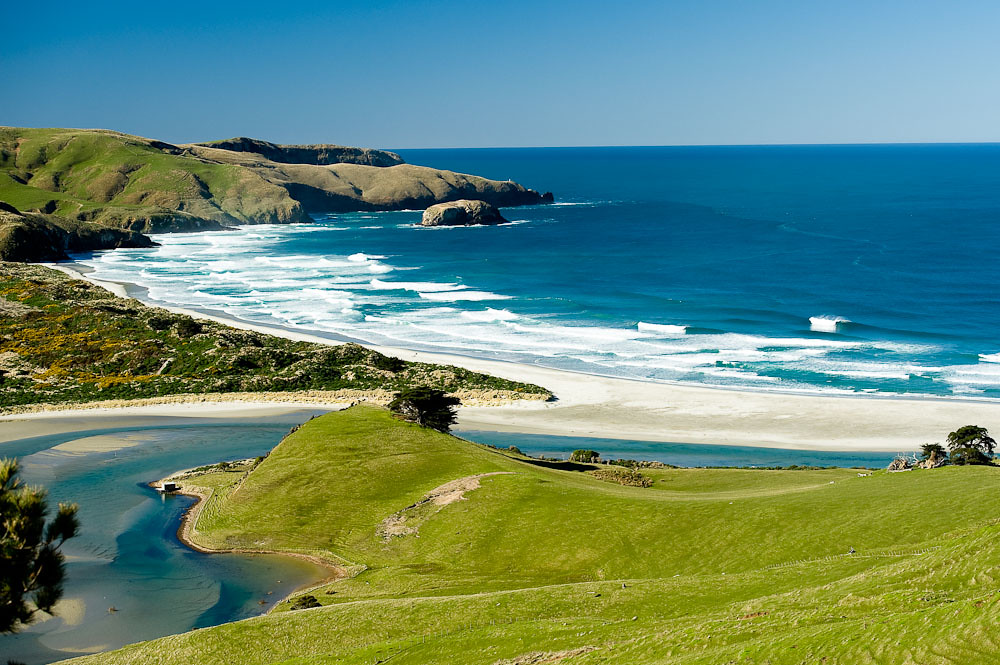
      The skipper is now anchored close to the secluded beach north of Dunedin’s Tairoa Head and has light winds, partial sunshine with the threat of some light rain, but temperatures are in the 20’s. 

      Stricken sailor forced to Dunedin for repairs

      >>> geolocalization with the Marine GeoGarage <<<
      Bernard left Kaikai Bay at 2:00 local to move to the South East of the small island of Wharekakahu facing Allans Beach.
      This new shelter will offer better protection against the winds blowing northwest in this area.

       From Otago Daily Times

      A stricken yacht has anchored off the coast of Dunedin to make emergency repairs after being damaged during one of the world's most gruelling round-the-world solo yacht races.
      Swiss sailor Bernard Stamm first attempted to make repairs to the hydro-generator and the central winch column on his yacht Cheminees Poujoulat in the Auckland Islands last week while racing towards Cape Horn, South America.

      But finding a suitable place to anchor in a sheltered bay away from kelp beds and other seaweed proved too difficult.
      So he headed for New Zealand, and anchored near Murdering Beach yesterday.

       Swiss yachtsman Bernard Stamm stands on the stern of Cheminees Poujoulat off Murdering Beach, near Dunedin, waiting for the swell to subside so he can make repairs to his hydro-generator before returning to the Vendee Globe 2012 round-the-world yacht race.

      The vessel's 19m-long, 6m-wide hull could not be sailed into Otago Harbour because it needs deep keel clearance.

      Mr Stamm was interviewed and photographed from a small boat yesterday afternoon after a friend emailed the Otago Daily Times about his plight.
      He said the long sail north was a major detour in his bid to win the Vendee Globe 2012 round-the-world yacht race.
      The non-stop race, known as the ''Everest of the Seas'', begins in Les Sables d'Olonne, France, and heads east via the capes of Good Hope, Leeuwin and Horn before heading back to the finish in Les Sables d'Olonne.

       Kaikai's Beach, Murdering Beach
      The bay south of Whare ake ake is called Kaikai after a Ngati Mamoe man dwelling there in a cave in the early days.
      The proper name is Takeratawhai.
      The cave belonging to Kaikai is now used as a sheep pen.
      A heavy "tapu" rested on Murdering Beach until it was lifted by a North Island tohunga at the request of the Purakaunui Maoris.
      The three bays south of Purakaunui have been the happy hunting-grounds of curio collectors, alas many not venerating the burial-places.
      It has been estimated that 3½ tons of worked greenstone has been recovered.

      Mr Stamm said he was leading the race when one of the brackets securing the hydro-generator on the hull failed.

      The system uses motion through water to generate electricity, and without it, he does not have enough energy to power appliances such as lights, pumps, computers, navigation and automatic piloting equipment.

      Mr Stamm said he was taking care to avoid physical contact with any other vessels for fear of breaking race rules, which state competitors will be disqualified if they receive help or equipment during the race.

       photo : Sophie Luther

      While in the Auckland Islands, a Russian ship came alongside and offered fuel, but he rejected the offer because he was determined to continue the race.

      He said it was a difficult choice, but he was guided by his ''sense of responsibility''.

      Allans beach & Wharekakahu Island

      Wharekakahu Island, near Cape Saunders on Otago Peninsula, with colony of Stewart Island shags visible near right-hand end of crest. The island is a predator-free nature reserve.
      It reputedly has a colony of green-backed skinks (Oligosoma chloronoton)
      photo : Tony Jewell

      Mr Stamm said he had been at sea since November 10, and at an average speed of 14 knots, he still had about 40 days to go before he crossed the finish line.

      When asked if he had had a shower since his departure, he shook his head and pointed to the sea before making scrubbing motions.
      He often dreamed of having a cold beer.
      He said: ''A beer would be nice now, but it would taste better at the end.''

      Being at sea alone was lonely at times, but he was grateful he could communicate via his laptop with his wife and two children.
      However, the damaged hydro-generator meant he has had to cut back on the amount of communication with his family.
      He was looking forward to finishing the repairs so he could make contact with them more often.
      He hoped to be back on the high seas some time today, he said.

      Although Mr Stamm was only about halfway through the race, he said he was now more than 3500km behind the race leader and it was unlikely he could still win.
      In his previous attempt at the Vendee Globe race, he had to retire due to damage, so this year's race was now more about getting to the finish, he said.

      Ocean oasis


      Ocean Oasis depicts the life, richness and beauty of nature in a part of the world which has not yet been ruined by men.
      It is a fascinating journey into the bountiful seas and pristine deserts of two remarkably different, but inextricably linked worlds — Mexico's Sea of Cortés and the Baja California desert.