
Île Saint-Paul, a tiny island in the Indian Ocean, some 120 miles southwest of the deep sea site where the Antarctica and Australia tectonic plates diverged during an earthquake in 2024.
Credit... Benoit Stichelbaut/Hemis, via Alamy
From NYTimes by K. R. Callaway
In 2024, a swarm of earthquakes in the Indian Ocean caused tectonic plates to abruptly separate, adding more than three feet of new seafloor in a single event.
For the first time ever, scientists had instruments in place to observe the process as it happened, deployed just two months before the earthquakes struck.
The findings, published earlier this week, offer the most detailed look yet at how Earth recycles its own crust.
The spread of the ocean floor, as tectonic plates spread apart, is known but hard to observe.
Scientists have now documented the process in action.
Far down on the ocean floor, Earth is recycling its own skin.
At certain boundaries, the huge plates of rock that make up the planet’s crust crash into or over each other, pushing old crust below.
At other junctures, these tectonic plates are spreading apart, allowing magma to bubble up and create entirely new stretches of seafloor.
But the process is subtle and difficult to catch in action.
Typically, the seafloor only adds a few inches of new ground per year, unless prompted by sudden, unpredictable earthquakes and other large-scale interactions of the tectonic plates.
In 2024, however, researchers were able to observe for the first time a large-scale seafloor spreading event, in which a series of earthquakes abruptly added more than three feet of new seafloor to the Indian Ocean.
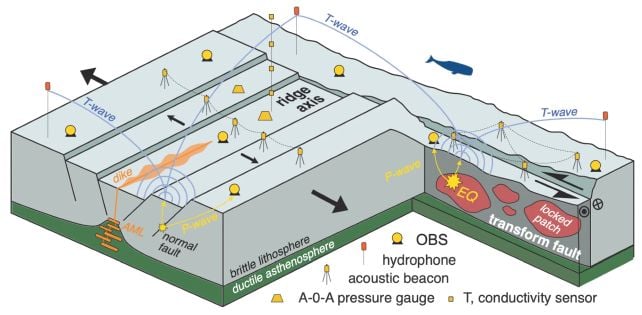
A schematic drawing of the complete observatory in early 2025. (J.-A. Olive (LG-ENS) & J.-Y. Royer (Geo-Ocean), OHA-GEODAMS/Bluesky)
Their findings, described in a study published on Wednesday in the journal Nature, offer a look at one of Earth’s most elusive processes.
“We have been very lucky to have had all these instruments set up when it happened,” said Jean-Yves Royer, a marine geophysicist and lead author of the study.
“But also we are lucky because these big piles of lava outpoured one or two kilometers away from our instruments, so we didn’t lose any data.”
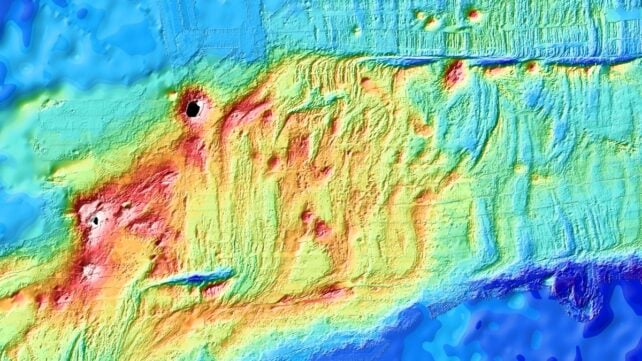 Bathymetry of the seafloor around the Southeast Indian Rift where two tectonic plates abruptly opened a portal to the magmatic underworld in April 2024. (Royer et al., Nature, 2026)
Dr. Royer and his colleagues had only recently begun a three-year experiment along the ridge between two of the Indian Ocean’s tectonic plates.
The observatory they used, called OHA-GEODAMS, was made up of 15 monitoring stations that could sense sound waves traveling through the ocean from earthquakes and other geophysical changes at the seafloor.
By good fortune, it was deployed just two months before the swarm of earthquakes in 2024.
The movement of Earth’s tectonic plates is noisy.
The observatory they used, called OHA-GEODAMS, was made up of 15 monitoring stations that could sense sound waves traveling through the ocean from earthquakes and other geophysical changes at the seafloor.
By good fortune, it was deployed just two months before the swarm of earthquakes in 2024.
The movement of Earth’s tectonic plates is noisy.

A map of the world showing the tectonic plates and a mid-ocean ridge down the middle of the Atlantic Ocean. NOAA
The observatory detected not only the low-frequency rumblings of rocks but also the precise details of the motion: Part of the ridge collapsed by about 13 feet, and its two sides separated by more than three feet.
“It’s quite difficult, and perhaps rare, to make these measurements,” said Aaron Micallef, a marine geoscientist who was not involved in the new study.
“We know so little about what’s going on in these settings that we’re not even really sure of what measurements we need to carry out, so that’s why it’s very useful to throw all the instruments that you have at the problem, as these researchers have done.”
Using underwater microphones, pressure sensors and other instruments, the researchers were able to dissect the process of seafloor spreading in more detail than previous indirect observations had allowed.
The process, they determined, begins with high-pressure pockets of melted magma deep within Earth.
Eventually, the pressure builds enough to propel magma between the layers of rock in the crust, and the earth above the former pocket collapses inward.
Earthquakes spawned by the movement of magma wrench the tectonic plates apart, allowing magma to bubble up to the seafloor and form a new, rocky stretch of ocean bottom.
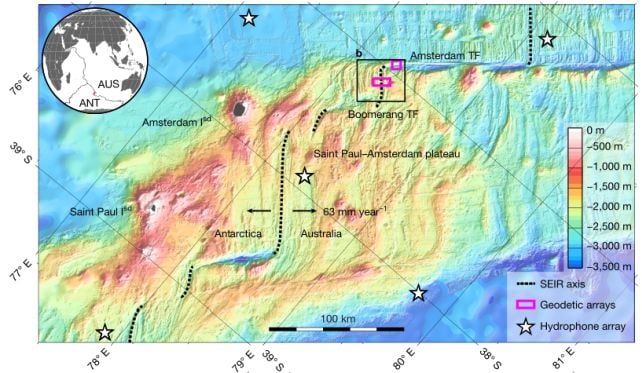
The tectonic setting of the observed seafloor spreading event. (Royer et al., Nature, 2026)
“Where the authors put their instruments may have spread the last time several decades ago, and now they’ve sampled a spreading event just two months after the deployment of their equipment,” he said.
“Jean-Yves Royer and co-workers were very, very, very lucky — like, getting the jackpot.”
Installing the underwater observatory and gathering data from it entailed a minor expedition.
The researchers had to travel 45 days by ship to deposit the sensors and other equipment, and they return annually to collect the data.
“You can’t just drive your car to the site, and you can’t just take an airplane to the site,” said Daniel Fornari, a marine geologist at the Woods Hole Oceanographic Institution who was not involved in the new study.
“Doing something at the bottom of the ocean requires clever engineering and expertise.”
The instruments are now back on the seafloor, where the equipment will continue to gather data on Earth’s movement until 2027.
Dr. Royer said he hoped the work would inspire other scientists to conduct similar measurements where the seafloor is known to spread quicker than average.
“This was a good demonstration that it’s possible to measure with a bit of luck and also a bit of flair,” he said.
Links :
- ScienceAlert : World First: Scientists Witnessed a Piece of Earth's Oceanic Crust Being Born
- NYPost : Scientists discover new seafloor being born — for the first time in history: ‘Massive event’
- Interesting Engineering : In a global first, scientists observe the formation of Earth’s crust in the ocean

No comments:
Post a Comment