
Optimal Transit Unveils Kraaken™: The World’s First Self-Powered Maritime AI Infrastructure Platform with CAPEX & OPEX Costs at a Fraction of Conventional Land-Based Facilities.
From SmartMaritimeNetwork by Rob O'Dwyer
Optimal Transit has unveiled Kraaken, a family of standardised self-powered maritime AI data centre platforms engineered to eliminate dependence on land, the electrical grid, freshwater cooling and conventional fuel.
Kraaken generates its own continuous electrical power by combining the thermal energy naturally stored in the ocean with waste heat produced by the data centre itself.
Through the company’s multi-stage Digital Ocean Thermal (DOT) engine, waste heat that would otherwise be rejected is transformed into an energy source.
This is combined with cold ocean water for cooling.
The system is designed for continuous operation 365 days per year in marine environments ranging from equatorial waters to Arctic regions without requiring conventional fuel deliveries.
The platforms are built upon Small Waterplane Area Twin Hull (SWATH) vessel technology to provide stability for hyperscale computing while supporting continuous high-bandwidth optical and satellite communications.
The modular platforms can operate either permanently moored offshore or independently at sea.
If severe weather threatens, a platform can disconnect from its mooring and relocate under its own propulsion at speeds approaching 30 kilometres per hour.
“Artificial intelligence is creating unprecedented demand for power, water and land,” said Scott Myers, President of Optimal Transit.
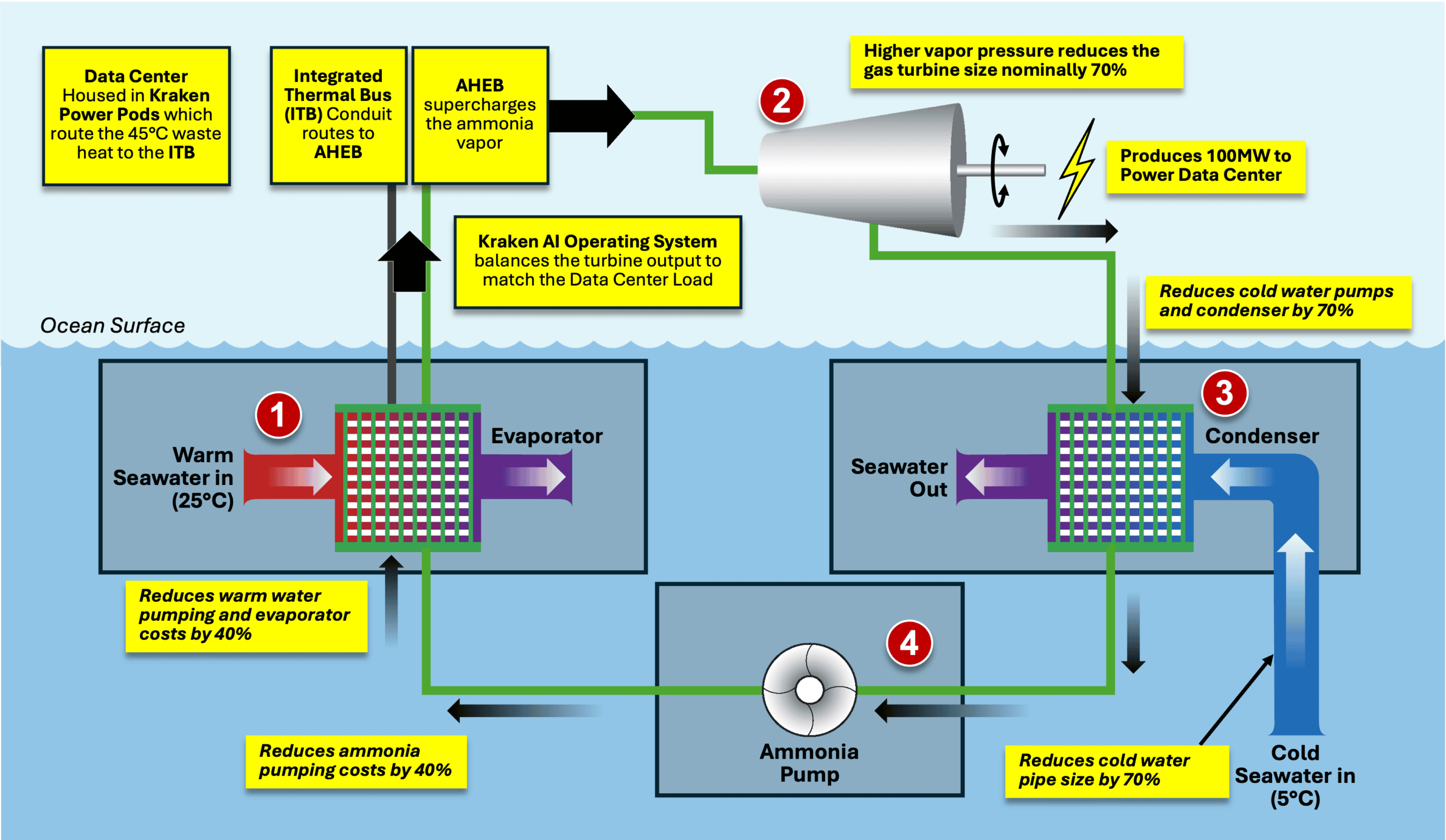
Optimal Transit’s Patented Digital Ocean Thermal (DOT) Engine Technology Uses COTS Components to Generate 100MW of Continuous 365-day/24-hour Electricity
“Our innovation is not dependent on new scientific breakthroughs – it’s built on integrating commercially proven technologies into a standardised platform.”
Optimal Transit estimates that the infrastructure cost of a standardised 100 MW Kraaken platform, excluding computing hardware, is less than US$500 million, with projected annual operating expenses of US$10 million to US$20 million.
The product family is designed around standardised modular platforms optimised for different computing missions.
The 10/20 MW Kraaken is a 76.2-metre, 10,160-ton vessel configured for edge computing, cloud applications and regional AI processing.
The flagship 50/100 MW Kraaken is a 91.4-metre, 50,802-ton vessel optimised for hyperscale AI training and large language model applications.
Over the next nine months, proceeds from the company’s ongoing Series A financing are expected to fund the completion of American Bureau of Shipping (ABS)-ready engineering drawings for the 20 MW and 100 MW platforms, together with digital twin validation of the DOT engine.
Subject to the completion of a planned Series B financing in 2027, the company intends to establish standardised production capable of delivering up to 20 Kraaken 100 MW platforms annually through shipyards worldwide, with each platform representing approximately US$400 million in infrastructure value.

No comments:
Post a Comment