Wednesday, June 26, 2024

‘So far we’ve just been lucky’: Maritime security expert warns of Russian risks in North Sea


From FTM by Dimitri Tokmetzis / Birte Schohaus

The North Sea is an industrial area in the making, important for the energy, data and food supply of the whole of Europe.
It’s high time to take safety in, on and around the North Sea seriously, says professor of international relations Christian Bueger.

Is professor of international relations at the University of Copenhagen.

Directs the Ocean Infrastructures Research Group and the Copenhagen Ocean Hub.

Sits on the board of the SafeSeas network on maritime security.
His most recent book is Understanding Maritime Security (Oxford University Press).


Countries are jostling for control in the South China Sea.
Somali pirates regularly make headlines when attacking boats in the Arabian Peninsula.
In the Mediterranean, coastguards and navies have their hands full combating human and drug smuggling.

By comparison, the North Sea looks like a calm European inland sea.
But appearances are deceptive, says Christian Bueger.
He is a professor of international relations at the University of Copenhagen, specialising in maritime security.
The Dane investigates all aspects of maritime security: from piracy to conflicts between states and from sabotage to espionage .
His conclusion: security in the North Sea is at risk.

In an interview with FTM, the professor explains what makes the situation in, on and around the North Sea so complicated and, in his opinion, dangerous.
Bueger talks about the tactics of the Russian authorities, unclear regulations and powers and the security risk of the visible infrastructure on the seabed.
He argues for a different view.

When did you, as a security expert, start paying attention to the North Sea?

“For me, it was one of the outcomes of the Brexit process: that we need to start paying attention to the North Sea.
Because before Brexit it was mainly a European [sea], with the Norwegians having a close partnership with the European Union.
Right after Brexit, we had a couple of these incidents between French and British fishermen, leading basically to new forms of uncertainty and insecurity.
That was initially what brought me to the North Sea as a type of security region.”
 

A joint investigation by Follow the Money and Belgian newspaper De Tijd showed this week that Russian ships have been engaging in suspicious activities in the North Sea since 2014.
Security services suspect Russia of using both military and civilian ships for espionage and sabotage of data and electricity cables, gas pipelines and other infrastructure on the seabed.

But the big impetus for navies, security services and experts to pay closer attention to security, according to Bueger, was the attack on the Nord Stream pipeline in September 2022: before the new section of this pipeline, which would transport Russian gas to Germany, could be put into use, both the new and old parts of Nord Stream were blown up near the Danish island of Bornholm.
(Investigations so far don’t point to Russia as the culprit, as media and experts first suspected, but to Ukraine.
In all likelihood, a Ukrainian team from a sailboat planted and detonated the explosives.)

A year later, in October 2023, the Chinese container ship Newnew Polarbear destroyed a gas pipeline and some data cables with a dragging anchor – presumably on purpose.


What are the biggest security threats for the North Sea?

“I think it would be a series of mysterious accidents that cause damage to the environment, largely, which would be primarily staged to demonstrate our ongoing vulnerability: that whatever we do, it’s not enough.
So that would be, for me, the most worrying and most realistic threat in the region.

It could be a shadow fleet, it could be an attack on a life pipeline.
We’re seeing quite a series of mysterious accidents.
It could continue and it could be much worse.
So far we’ve just been lucky.

There are a lot of bilateral arrangements between the states, and that is largely energy cooperation in the end.
...
It's not security cooperation: you have quite a number of environmental agreements.
But it's largely interpreted in terms of preventing accidents and things like that.
And not necessarily in security terms.”

What strategies does Russia use in the North Sea and how long have they been doing that for?

“Russian fishing vessels are being used for intelligence operations, and that is not a new thing.

In 2014, the UK Royal Navy took me out at sea.
On the bridge, they had a picture of a fishing vessel.
I asked them ‘why do you have this picture hanging there’, and then the guy said: ‘ah this is one of the Russian spy vessels.’ We know what they look like.
When we see it, we report that.”

Bueger emphasises that this form of espionage – also known as greyzone tactics – has existed for decades.
In Soviet times, Soviet ships carried a security officer from the secret service on board.
After the collapse of the Soviet Union, things calmed down a bit.
In the 1990s, European countries hoped for a rapprochement, and exchanges took place between research vessels.

That changed around 2014, at about the same time as Russia's annexation of Crimea.
During the same period, Western countries became more active in the Arctic.
Due to climate change, the Arctic becomes navigable in summer, which greatly reduces the travel time between China and Europe.
New gas fields are also being developed in the north of Russia.
Russia is therefore trying to strengthen its grip on the area and keep other powers out.

Since then, there has been a significant increase in greyzone tactics by civilian ships.
This is now official policy in Russia, says Bueger.
It is described in black and white in the new maritime doctrine drawn up in 2022.
Civilian ships, such as fishing boats, container ships and oil tankers, must cooperate in military missions.

“One of the explanations is also that the Russian Navy is just overstretched.
So they are trying to find alternative means to exert influence.

The point of doing that is not actually to find out anything.
It’s more about putting the threat out, or demonstrating the vulnerability: ‘Hey, we can sail along your cables and cut at any time.’ You literally cannot do anything.
It’s just about keeping us busy, worrying about the threat.
And this works really, really well.”

All those cables and pipes are easy to find, they are simply located on all kinds of maps.
Is that wise?


“This is what we call the visibility paradox: if you want to protect the infrastructure from accidents, then you need to put it on the [nautical] map as accurately as possible, but at the same time, if you want to protect it from deliberately being targeted, then you should hide it.
You can’t get out of this.”

What can the North Sea countries do when a ship displays suspicious behaviour in their exclusive economic zones, an area 12 to 200 nautical miles from the shore?

“Exclusive Economic Zones are a tricky legal construct, and many countries have not fully clarified what their legislation is.
So for instance, I learned from the German federal police that is in charge of patrolling the exclusive economic zone that there is no criminal offence in the German law for the exclusive economic zone.
So basically if you find a Russian vessel tempering with the pipeline or a cable, the only thing that the federal police can do is say ‘hello, can you please stop that?’ and they don’t have any power to arrest.”

How can security in the North Sea be improved?

“Europe doesn't have a secure information-sharing network, which would involve military actors.
And because of that … the Belgians launched a new initiative a couple of weeks ago and negotiated a memorandum of understanding for the North Sea, which is primarily focused on information-sharing between the North Sea countries, excluding France.
So what the Belgians are planning is to set up an entirely new information-sharing network, which would be secure and trusted, and also deals with how the industry can actually feed into that network.

“If you find a Russian vessel tempering with a pipeline, the only thing that the German federal police can do is say ‘hello, can you please stop that?’”


When it comes to the [role of] companies, I think we can see different models: the Norwegian position is largely that much of the protection should be handled by the industry, because it's just cheaper and they have the technical knowledge.
In the UK, we see the idea is more that it should be a governmental task.
Of course, the UK has this sophisticated maritime security infrastructure – but it's not really clear who should be in charge of handling that.”

Does stricter action make sense?


“There is some reluctance.
For example, many experts have been calling for the Danes to inspect the Russian vessels and check for insurance certificates and so on.
Denmark is afraid of doing that.
You don't know what kind of repercussions this could have elsewhere in terms of threats to infrastructure.

Can joint EU policy help? For example, a joint navy? And what’s NATO’s role in all this?

“NATO has been very, very, very active – in particular since the Nord Stream incident it has put emphasis on the region again; their first reaction was sending military ships, including by the Italian navy, to the region.

The European Union is a complex entity.
And here we have on the one side all the work on critical infrastructures in general, but the implementation of that is largely in the hands of nation states, and of the member states.

I've been advocating for a long time that the solution lies on these regional sea levels: the Mediterranean is a radically different context and set up to the North Sea.
The North Sea is an interesting template, because it's so much simpler: you're only dealing with Norway and the UK – both NATO states.
And, of course, in the Mediterranean, this is all a lot more complex, because of the North African countries, but then also Israel, Greece, Turkey, and all these tensions in that particular space.

It would be good to harmonise the law on a regional level so that we have clear cut interpretations of what is allowed and what can be criminalised in the specific exclusive economic zone.

And then if the next Russian research vessel passes by, you at least have some legal foundations in terms of telling the Russian Navy, ‘hey, what you're doing here does not fall under our interpretation of the freedom of scientific exploration.’ So clarifying that legal space is one of the things that is utterly missing.”

Links :

Tuesday, June 25, 2024

Explorer Shackleton's last ship found on ocean floor

A Canadian-led team has found the Quest, the ship on which renowned polar explorer Ernest Shackleton died in 1922.
It was found intact off the coast of Canada’s Newfoundland and Labrador, laying at a depth of 1,280 feet

From BBC by Jonathan Amos

Wreck hunters have found the ship on which the famous polar explorer Ernest Shackleton made his final voyage.

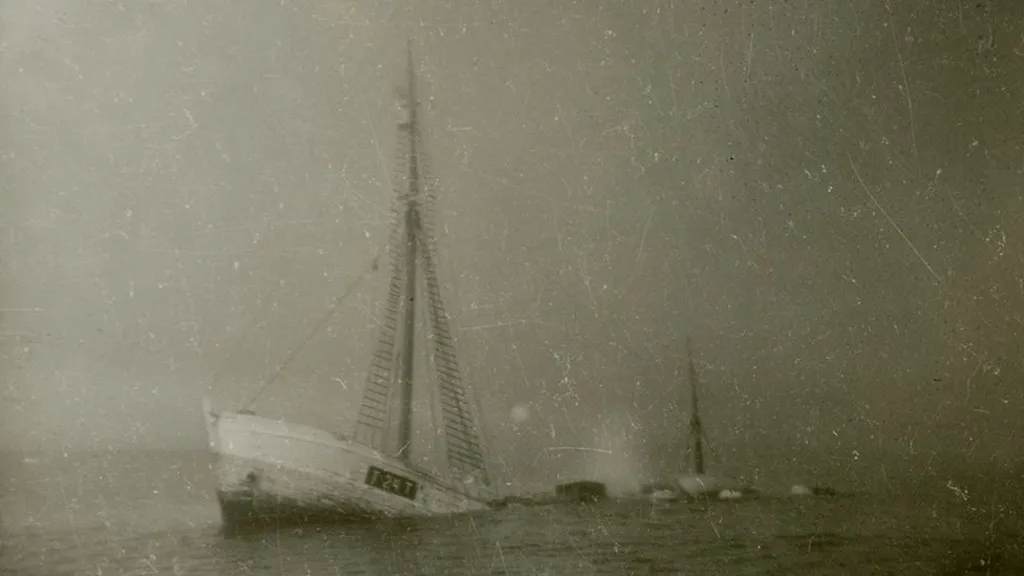
After Shackleton's death, the ship was used for seal hunting, Arctic research and rescue missions. British Arctic Air Route Expedition / Royal Canadian Geographical Society
 
The vessel, called "Quest", has been located on the seafloor off the coast of Newfoundland, Canada.

Localization with the GeoGarage platform (CHS nautical raster chart)
 
Shackleton suffered a fatal heart attack on board on 5 January 1922 while trying to reach the Antarctic.

And although Quest continued in service until it sank in 1962, the earlier link with the explorer gives it great historic significance.

The British-Irish adventurer is celebrated for his exploits in Antarctica at a time when very few people had visited the frozen wilderness.

"His final voyage kind of ended that Heroic Age of Exploration, of polar exploration, certainly in the south," said renowned shipwreck hunter David Mearns, who directed the successful search operation.
"Afterwards, it was what you would call the scientific age. In the pantheon of polar ships, Quest is definitely an icon," he told BBC News.
 
Ernest Shackleton is seen aboard Quest as it departs from London on September 17, 1921. 
Central Press/Hulton Archive/Getty Images

The remains of the ship, a 38m-long schooner-rigged steamship, were discovered at the bottom of the Labrador Sea on Sunday by a team led by The Royal Canadian Geographical Society (RCGS).

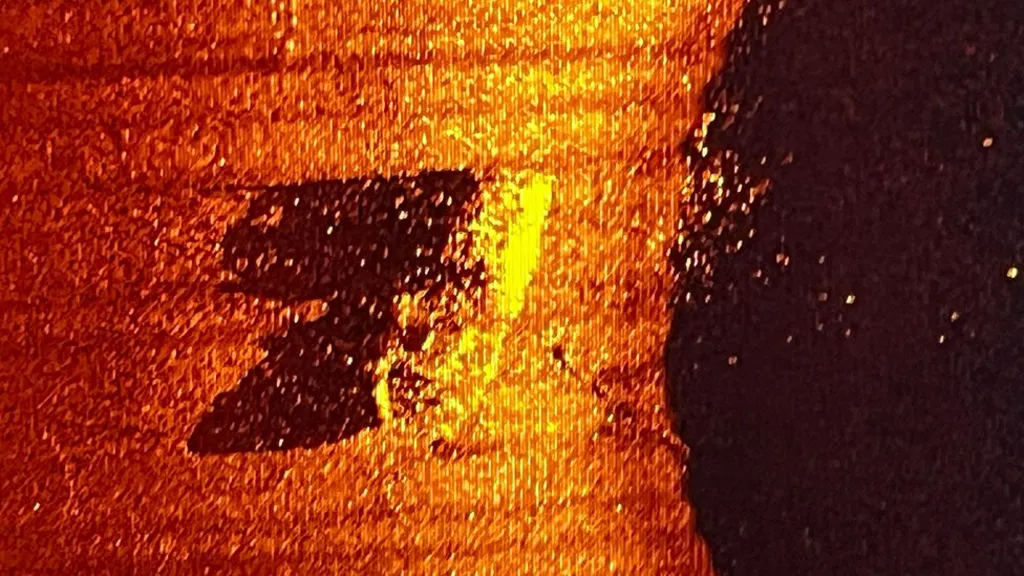
Sonar equipment found it in 390m (1,280ft) of water. 
The wreck is sitting almost upright on a seafloor that has been scoured at some point in the past by the passing of icebergs.

The main mast is broken and hanging over the port side, but otherwise the ship appears to be broadly intact.

Quest was being used by Norwegian sealers in its last days. 
Its sinking was caused by thick sea-ice, which pierced the hull and sent it to the deep.

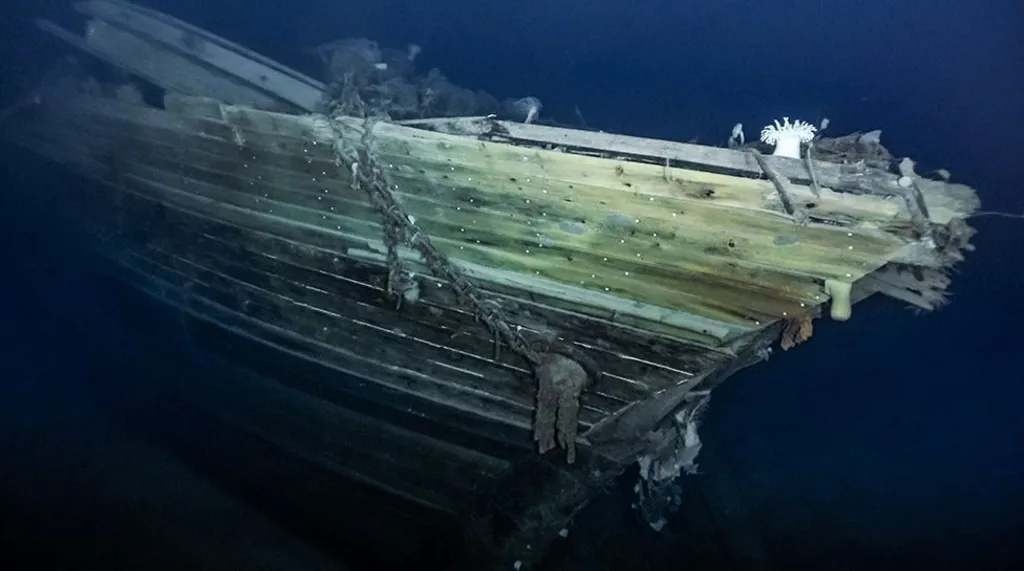
The irony, of course, is this was the exact same damage inflicted on Shackleton's Endurance - the ship he used on his ill-fated Imperial Trans-Antarctic Expedition of 1914–1917.

Fortunately, the crews of both Endurance, in 1915, and Quest, in 1962, survived.

Indeed, many of the men who escaped the Endurance sinking signed up for Shackleton's last polar mission in 1921-1922, using Quest.

Crushed by sea-ice, Quest went down stern first.
The entire crew were rescued
Photo courtesy of Tore Topp


His original plan had been to explore the Arctic, north of Alaska, but when the Canadian government withdrew financial support, the expedition headed south in Quest to the Antarctic.

The new goal was to map Antarctic islands, collect specimens and look for places to install infrastructure, such as weather stations.

Shackleton never made it, however, struck down by heart failure in the Port of Grytviken on the British Overseas Territory of South Georgia, the last stop before reaching the White Continent. 
He was just 47 years old.

After his death, Quest was involved in other important expeditions, including the 1930-31 British Arctic Air Route Expedition led by British explorer Gino Watkins, who himself tragically died aged 25 while exploring Greenland.

Quest was also employed in Arctic rescues and served in the Royal Canadian Navy during WWII, before being turned over to the sealers.

A sonar image of the sunken vessel. It went down on 5 May 1962
RCGS

The RCGS team members carried out extensive research to find Quest's last resting place.
Information was gathered from ships' logs, navigation records, photographs, and documents from the inquiry into her loss.

The calculated sinking location in the Labrador Sea was pretty much spot on, although the exact co-ordinates are being held back for the time being.

A second visit to the wreck, possibly later this year, will do a more complete investigation.

"Right now, we don't intend to touch the wreck. It actually lies in an already protected area for wildlife, so nobody should be touching it," associate search director Antoine Normandin said. 
"But we do hope to go back and photograph it with a remotely operated vehicle, to really understand its state."
 
The Royal Canadian Geographical Society says it has found polar explorer Sir Ernest Shackleton’s final ship, the Quest, off Labrador's south coast, 390 metres underwater. 
The wreck was found just 2.5 kilometres from Quest’s last reported position.
Researchers used the ship's last-known position, as well as historical maps and logs, to aid in their search.
(Royal Canadian Geographical Society/X)
 
Alexandra Shackleton is the explorer's grand-daughter, and was patron to the RCGS survey.

"I was thrilled, really excited to hear the news; I have relief and happiness and a huge admiration for the members of the team," she told BBC News.
"For me, this represents the last discovery in the Shackleton story. It completes the circle."

The explorer continues to spark interest more than a century after his death.

Hundreds of people visit his grave on South Georgia every year to pay their respects to the man known by his crews simply as "The Boss".

"Shackleton will live forever as one of the greatest explorers of all time, not just because of what he achieved in exploration but for the way he did it, and the way he looked after his men," said David Mearns.
"His story is timeless and will be told again and again; and I'm just one of many disciples who'll keep telling it for as long as I can."
 
Shackleton's Endurance ship was found on the Antarctic seafloor in 2022
FMHT/National Geographic

Links :

Monday, June 24, 2024

France & misc. (SHOM) layer update in the GeoGarage platform

190 nautical raster charts updated & 1 new chart added


Strawberry Solstice moon of June 2024 shines tonight for summer stargazers

The full moon in June is known as the Strawberry Moon.
Here's how to see the rare Strawberry Moon - the first to coincide with summer solstice since 1985 
 
From Space by Joe Rao
 
This month, let's turn our attention to two celestial objects that can readily be seen even from bright cities.
One is our nearest neighbor in space, while the other is a familiar pattern of stars.

This week finds a relative paucity of bright planets in our evening sky.
Only one, Mercury, is available by month's end, but even then, this rocky little world can only be glimpsed for about 30 to 45 minutes after sundown very low to the west-northwest horizon.
After that, you'll have to wait until after the witching hour of midnight to sight another celestial wanderer, Saturn.


That having been said, let's turn our attention to two celestial objects that can readily be seen during evening hours this week from even from bright cities.
One is our nearest neighbor in space, while the other is a familiar pattern of stars.

The first is of course, the moon, which will turn full on the first full day of summer, June 21.
The moment when the moon "officially" turns full will come that evening at 9:08 p.m.
Eastern Time; the moon will be above the horizon for most eastern states, though for much of the central and western U.S.
it will have yet to have risen.
No problem, however, since for a day or two on either side of June 21, the moon will appear practically full for most casual observers.

The Full Moon as seen on the night of this June 4, 2023 in Praia Mole, Florianopolis, Brazil. 
(Image credit: Getty Images)

Native American tribes of a few hundred years ago kept track of the seasons by giving distinctive names to each recurring full moon.
Their names were applied to the entire month in which each occurred.
According to our Space.com listing of full moon names, the full moon of June was traditionally known to every Algonquin tribe as the "Strawberry Moon," likely because strawberry picking season peaks during this month.
Europeans called it the Rose Moon.

Want to capture photos of tonight's full moon? Make sure to see our guide on how to photograph the moon.
If you need imaging gear, consider our best cameras for astrophotography and best lenses for astrophotography to make sure you're ready for the next eclipse.

Another June lunar moniker

Based solely on astronomical geometry, British astronomy popularist Guy Ottewell in his annual Astronomical Calendar, sometimes has referred to the June full moon as the "Honey Moon." The sun in June is at its greatest distance to the north of the celestial equator and the full moon (which is nearly opposite to the sun in the sky) is therefore at its greatest distance to the south of the celestial equator.
The full moon of June is therefore seen especially low in the southern sky.
Objects seen low in the sky are affected by the reddening properties of the atmosphere.

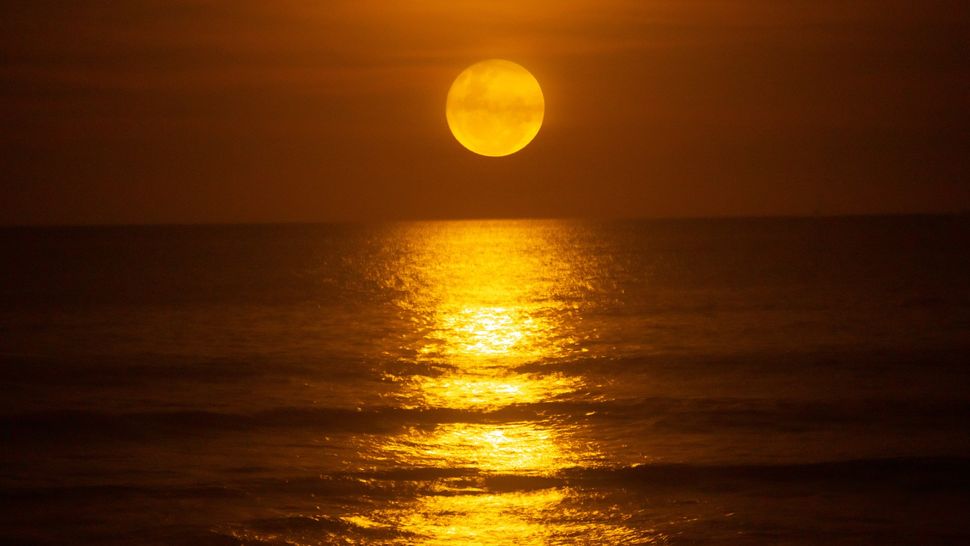
Consequently, the full moon in June usually has a beautiful golden appearance, just like good honey.

There are many other effects of atmospheric reddening.
The most obvious is the rising or setting sun.
When the sunlight passes through a great thickness of the atmosphere, most of the blue light is absorbed and scattered away; the red light comes through preferentially.
The reddening of stars when they are seen close to the horizon is less obvious to the casual observer.
Finally, the red color of the moon during a total lunar eclipse is due to sunlight being reddened as it passes through the Earth's atmosphere and then bent by refraction into the Earth's shadow.

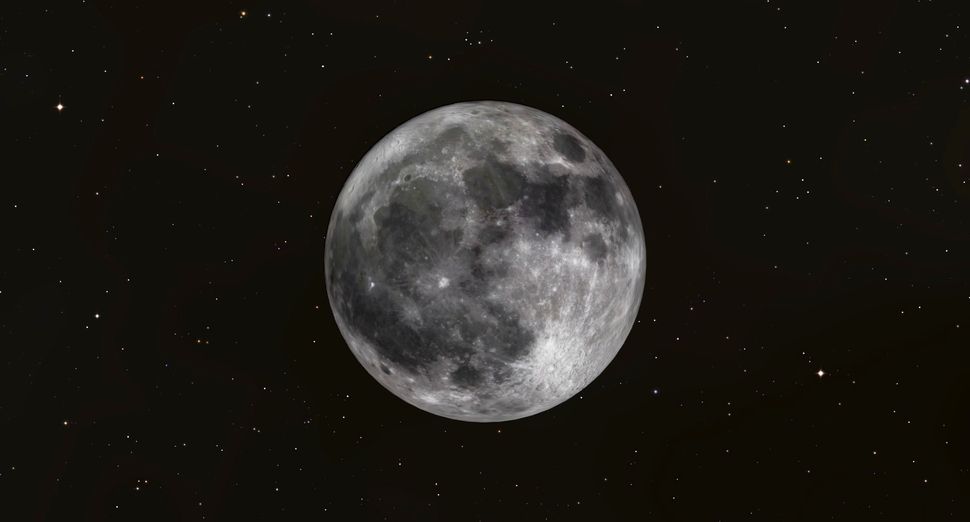
An illustration of the Full Strawberry Moon as it will appear on June 21, 2024. 
(Image credit: Chris Vaughan/Starry Night)

Big Bear or Dipper?

During this week, as the sky darkens sufficiently to allow us to see stars, we can look well up into the northwest sky and catch sight of the seven stars that form the Big Dipper.
At this time of the year, the Dipper is oriented sideways, with the bowl pointed downward and the handle straight up.

Interestingly, scholars are fairly sure that the oldest of our star groups trace back to the Mesopotamian peoples of five or more millennia ago.
In fact, the creatures that were made into the ancient Western constellations are similar to those in the Bible.
And there are hints that some are far older.
The fact that the seven stars of the Big Dipper formed a bear to Native Americans and to the cultures of the Old World and Siberia suggests that our Ursa Major is a piece of Stone Age culture at least 8,000 to 12,000 years old.
That is the estimated era of the last migration from Siberia to North America across the Bering Strait.

And yet strangely enough, the Big Dipper itself has been a source of frustration to some constellation historians: Just who originated this name?

In Great Britain, it is better known as the Plough.
But as a Dipper it is strictly an American phenomenon; this celestial "drinking gourd" was often mentioned in mid-19th-century books, but not before then.
It's unfortunate that the Little Dipper is so much fainter and more difficult to see compared to the Big Dipper, since — at least to my eyes — it resembles more closely a real dipper, such as might be used to ladle soup.
The Big Dipper looks more like a saucepan.

Wagon in the sky

For much of the world this pattern has been, if not a bear, then some sort of a wagon, chariot or other wheeled vehicle.
In Shakespeare's King Henry IV, there is a reference to the Big Dipper as Charles' Wain (a wain being defined as a large open farm wagon).
Here is how it is translated from an astronomical passage in Homer's Iliad:

Therein he wrought the Earth and the
heavens, and the Sea.

The unwearied Sun and the full Moon,
And all of the constellations with which the
Heavens are crowned.

The Pleiades, the Hyades, the strength
of Orion

And the Bear, which they also call the Wain.
Which there revolves and watches Orion,
But is alone unwashed by Ocean's briny bath.


These words date back to around 700 B.C., so we can see just how ancient this seven-star asterism is as a wagon. 

Links :

Sunday, June 23, 2024

China’s slave fishermen and the companies allegedly exploiting Uyghur labour

Fish caught by Chinese vessels and processed in Chinese factories end up on dinner plates around the world.
China’s seafood industry is the world’s biggest, accounting for a fifth of international fishing trade.
But onboard China's ships and in its processing plants, alleged human rights abuses and labour trafficking are rampant.
With footage filmed over several years on the high seas and additional reporting on land, 101 East investigates the deadly secrets of China’s massive fishing fleet, and the price we pay for seafood.
 
Links :