Thursday, December 15, 2022

Shackleton’s Antarctic voyage to be recreated by rowing team honouring Harry ‘Chippy’ McNish


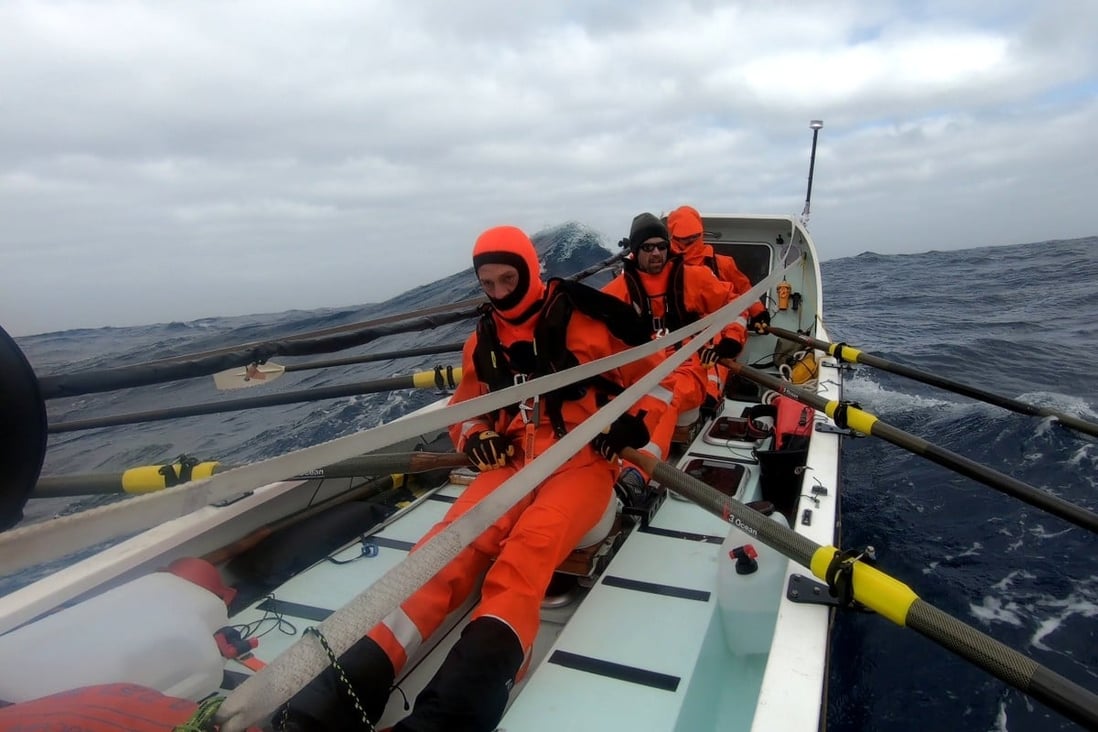
Fiann Paul rows across The Drake Passage in 2020 - he is now leading a team to recreate Shackleton’s voyage.
Photo: Handout

From SCMP by Mark Agnew
  • Fiann Paul is set to lead a team of six ocean rowers, and hopes to become a ‘badass’ by notching up some world firsts
  • Shackleton is famous for keeping all of his men alive despite his ship, the Endurance, being crushed by the ice
A team of six ocean rowers are recreating Ernest Shackleton’s famous 1916 voyage from Elephant Island to South Georgia, departing on January 12.

The crew will row in shifts – 1½ hours on, 1½ hours off – day and night for around 18 days, covering 1,481km across one of the most hazardous stretches of ocean on the planet.
They will be in a modern ocean rowing boat with cabins, so three can row while three sleep.

As per the Antarctic treaty, the team will be accompanied by a supervising vessel, which will house a documentary film team and researchers using the trip to gather data.

In 1914, British explorer Shackleton sailed for the Antarctic with his crew.
They were attempting to become the first people to travel across from one side of the Antarctic continent to the other, via the South Pole.

Their ship, the Endurance, became trapped in ice before reaching land, with their adventure going on to be one of the most famous and incredible stories of survival.
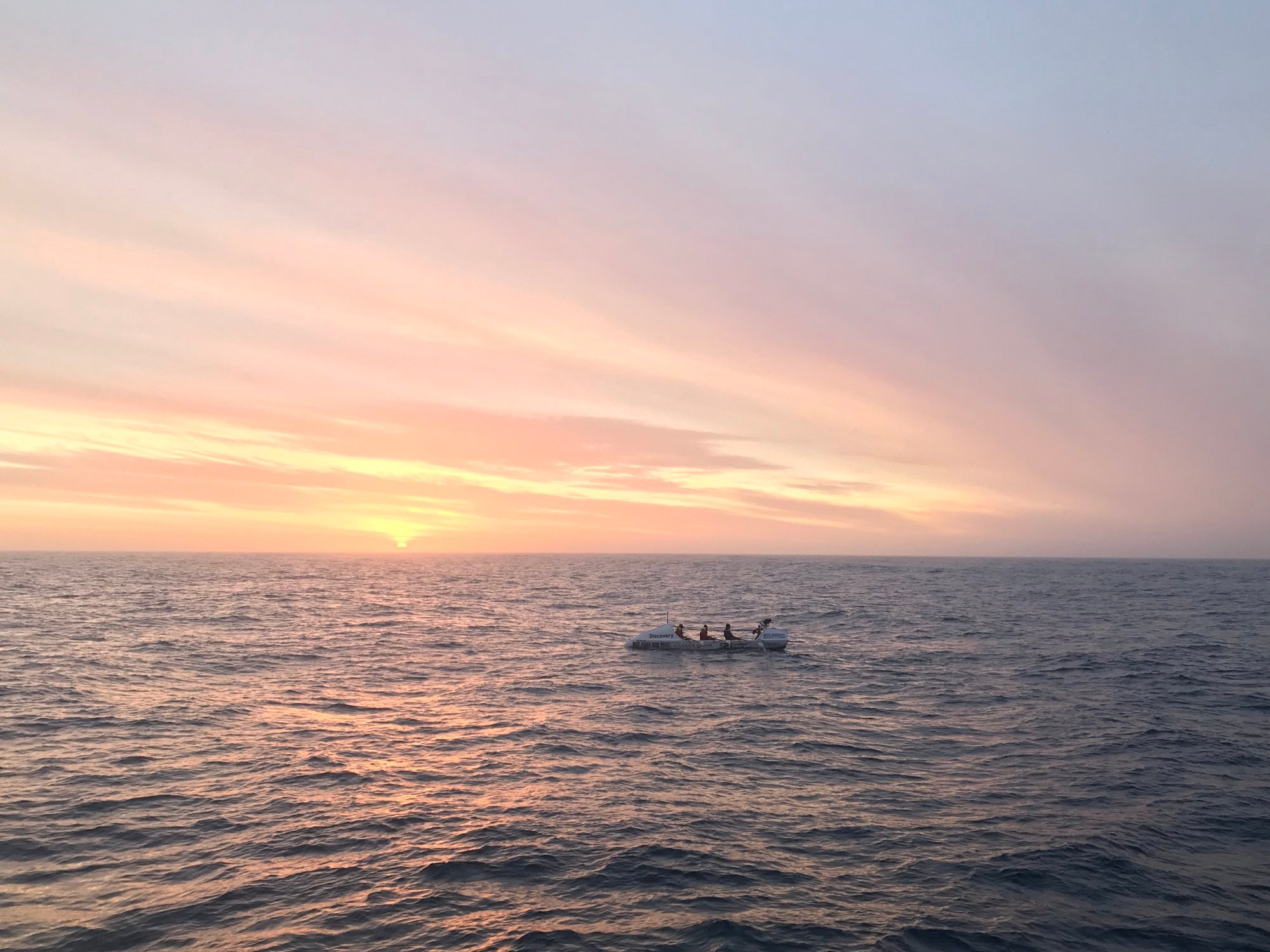

Paul and Douglas-Hamiton were both on the crew that crossed the Drake Passage.
Photo: Handout


The Endurance was crushed by ice, and the crew camped on the sea ice from November 1915 until April 1916.
When the ice broke up for summer, they paddled to Elephant Island in the lifeboats, and then stood on land for the first time in 497 days.

Most of the party remained on Elephant Island while a small group, led by Shackleton, took their tiny lifeboat and sailed for South Georgia.

Their prospects for survival were minimal – the ability to navigate on a tiny boat bucking like a horse was near impossible.
But it was their only choice.

They reached South Georgia 16 days later.
Their success is considered the greatest small boat journey of all time, made possible by ship captain Frank Worsley’s astounding navigation.

The ordeal was not over when they landed though, and they had to mountaineer across the unmapped island to a whaling station to seek help.
Shackleton returned to Elephant Island with the Chilean Navy in August, by which time the remaining men were beginning to suspect their tiny rescue mission had failed.
Not one of Shackleton’s men died, a testament to his leadership.
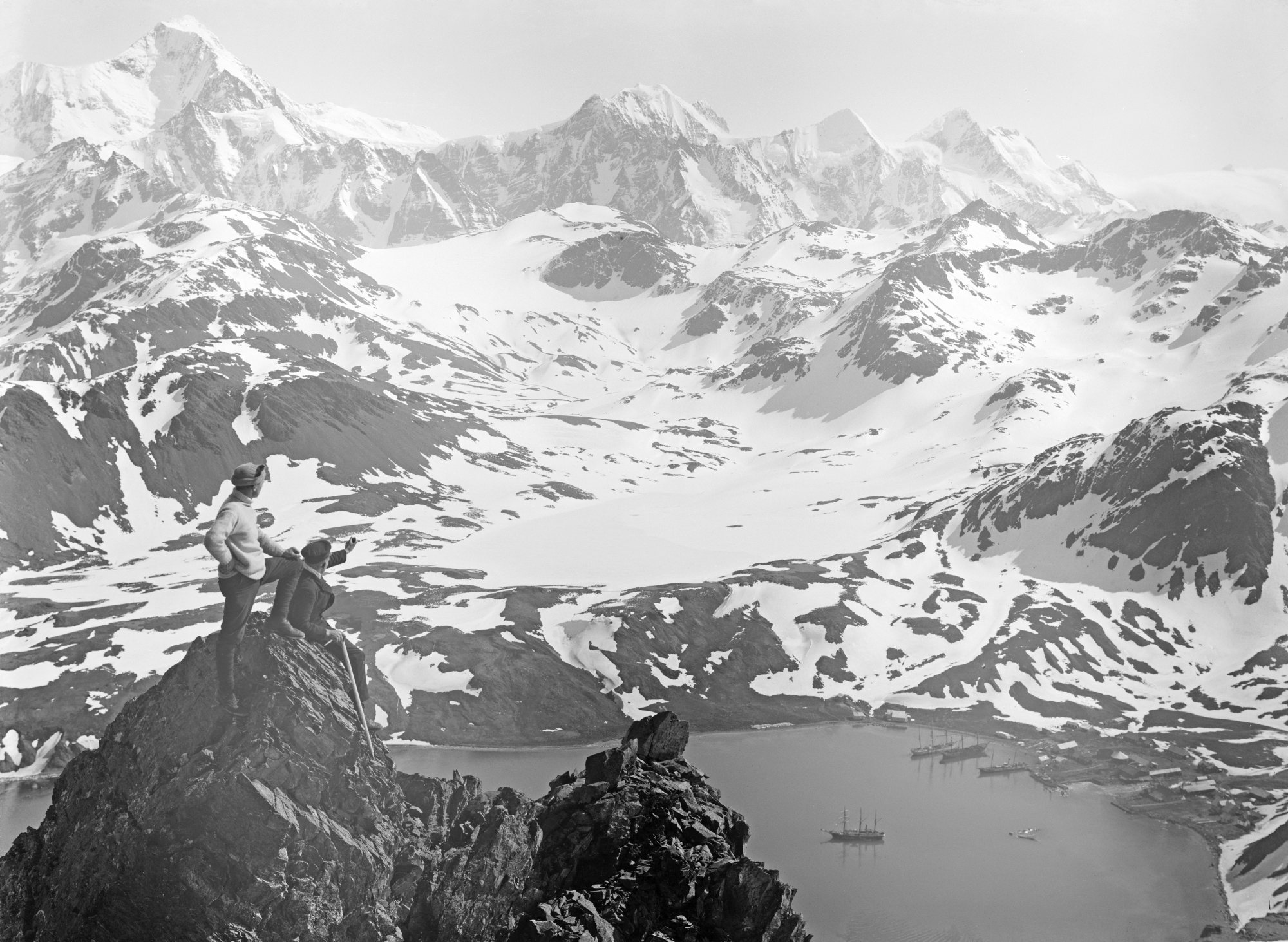

Frank Worsley and another crew member looking down on the Endurance in South Georgia before departing for the doomed adventure.
Photo: Frank Hurley


The rowing team recreating Shackleton’s journey is led by Icelander Fiann Paul.
He is accompanied by Mike Matson and Brian Krauskopf of the US, Jamie Douglas-Hamilton of the UK, Lisa Farthofer of Austria, and Stefan Ivanov of Bulgaria.

If successful, they will achieve three Guinness World Firsts: first to row the Scotia Sea, first to row from the Antarctic Continent, and first to row the Southern Ocean South to North.
“The Shackleton Mission is a chance for me to practice leadership in the most challenging and unforgiving of environments,” Paul, 42, said.
“Pack ice on a high swell is the scariest environment that a small rowing boat can ever encounter
“So yes, I want to be the badass who is going to achieve all these world’s firsts.
World’s first are the highest explorers’ trophies – the ownership of such titles never expires, because only once one can achieve something for the first time.
And achievement brings me joy.”

Another aim of the expedition is to earn a Polar Medal posthumously for Harry “Chippy” McNish, one of Shackleton’s crew members.
The Polar Medal is awarded by the UK government for outstanding achievements in polar regions.

McNish was the expedition’s carpenter and was crucial to the team’s survival after their ship sank.
In particular, he took the small lifeboat that was destined to cross from Elephant Island to South Georgia and made it sea worthy.
With limited supplies he raised the sides, strengthened the keel, covered the boat with a tarpaulin, and sealed the craft with a mixture of seal blood and flour.

Without his ingenuity and skill the crew would have surely perished.

However, earlier in the misadventure McNish had refused to haul the lifeboats across the ice.
He postured that he was no longer under Shackleton’s command, given the ship had sunk.

Shackleton was livid and read McNish the ship’s articles that said Shackleton was still in charge until they reached port.
McNish reluctantly complied.
Despite the service McNish provided as the carpenter, and as one of the few on the famous small boat crossing, Shackleton never forgot or forgave the slight, and McNish was one of just four among the crew denied the Polar Medal.

The boat of the 2023 expedition is named “Mrs Chippy” in memory of Chippy’s cat who accompanied the original voyage.

Paul already has a host of world firsts to his name.
He was the first and only person to achieve the Ocean Explorers grand slam, completing open-water crossings on each of the five oceans using human-powered vessels.

In 2020, Paul led a team, including Douglas-Hamilton, to row across the Drake Passage.
The journey from Cape Horn to Antarctica took 12 days.
It was not long until Paul thought up the Shackleton row.
“I think being an ambitious leader is to a degree like being an artist, a lot of creativity needs to be engaged to manifest an original project that brings some uniqueness,” Paul said.
“It was a sudden epiphany. At one point I knew I would like this expedition to be dedicated to Chippy’s case and the boat to be named after his cat.
“I thought it would be a great reminder for our team of our vision, as well as to announce to the world our intent to rewrite a historic wrong.
I thought that this way as a team, we will not only rewrite history, but also make some history of our own.”
 
Links :

Wednesday, December 14, 2022

Ever heard of ocean forests? They’re larger than the Amazon and more productive than we thought

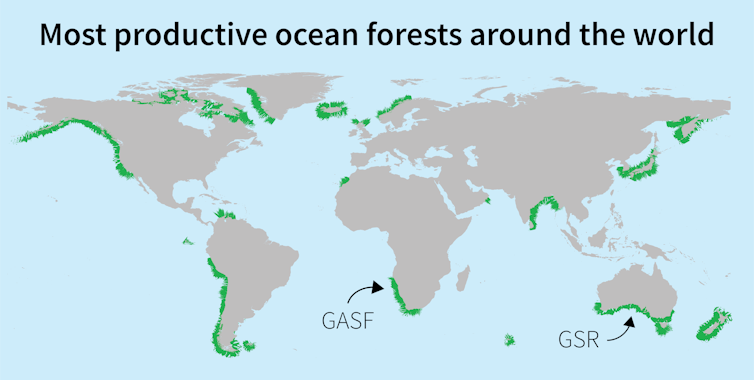
Only a few of the world’s most productive forests, such as the Great African Seaforest (GASF) and the Great Southern Reef (GSR), have been recognised and named.
From The Conversation by Albert Pessarrodona Silvestre / Karen Filbee-Dexter / Thomas Wernberg

Amazon, Borneo, Congo, Daintree.  
We know the names of many of the world’s largest or most famous rainforests.
And many of us know about the world’s largest span of forests, the boreal forests stretching from Russia to Canada.

But how many of us could name an underwater forest?
Hidden underwater are huge kelp and seaweed forests, stretching much further than we previously realised.
Few are even named.
But their lush canopies are home to huge numbers of marine species.

Off the coastline of southern Africa lies the Great African Seaforest, while Australia boasts the Great Southern Reef around its southern reaches.
There are many more vast but unnamed underwater forests all over the world.

Our new research has discovered just how extensive and productive they are.
The world’s ocean forests, we found, cover an area twice the size of India.

These seaweed forests face threats from marine heatwaves and climate change.
But they may also hold part of the answer, with their ability to grow quickly and sequester carbon.

What are ocean forests?


Underwater forests are formed by seaweeds, which are types of algae.
Like other plants, seaweeds grow by capturing the Sun’s energy and carbon dioxide through photosynthesis.
The largest species grow tens of metres high, forming forest canopies that sway in a never-ending dance as swells move through.
To swim through one is to see dappled light and shadow and a sense of constant movement.

Just like trees on land, these seaweeds offer habitat, food and shelter to a wide variety of marine organisms.
Large species such as sea-bamboo and giant kelp have gas-filled structures that work like little balloons and help them create vast floating canopies.
Other species relies on strong stems to stay upright and support their photosynthetic blades.
Others again, like golden kelp on Australia’s Great Southern Reef, drape over seafloor.

How extensive are these forests and how fast do they grow?

Seaweeds have long been known to be among the fastest growing plants on the planet.
But to date, it’s been very challenging to estimate how large an area their forests cover.

On land, you can now easily measure forests by satellite.
Underwater, it’s much more complicated.
Most satellites cannot take measurements at the depths where underwater forests are found.

To overcome this challenge, we relied on millions of underwater records from scientific literature, online repositories, local herbaria and citizen science initiatives.

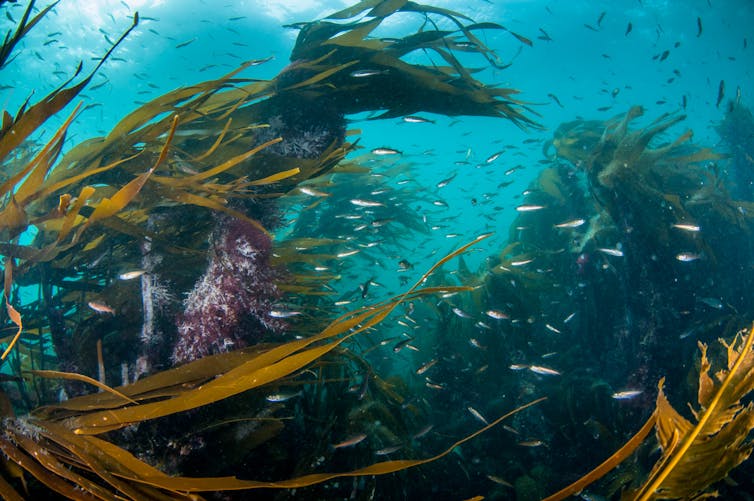
Ocean forests support biodiversity worldwide.
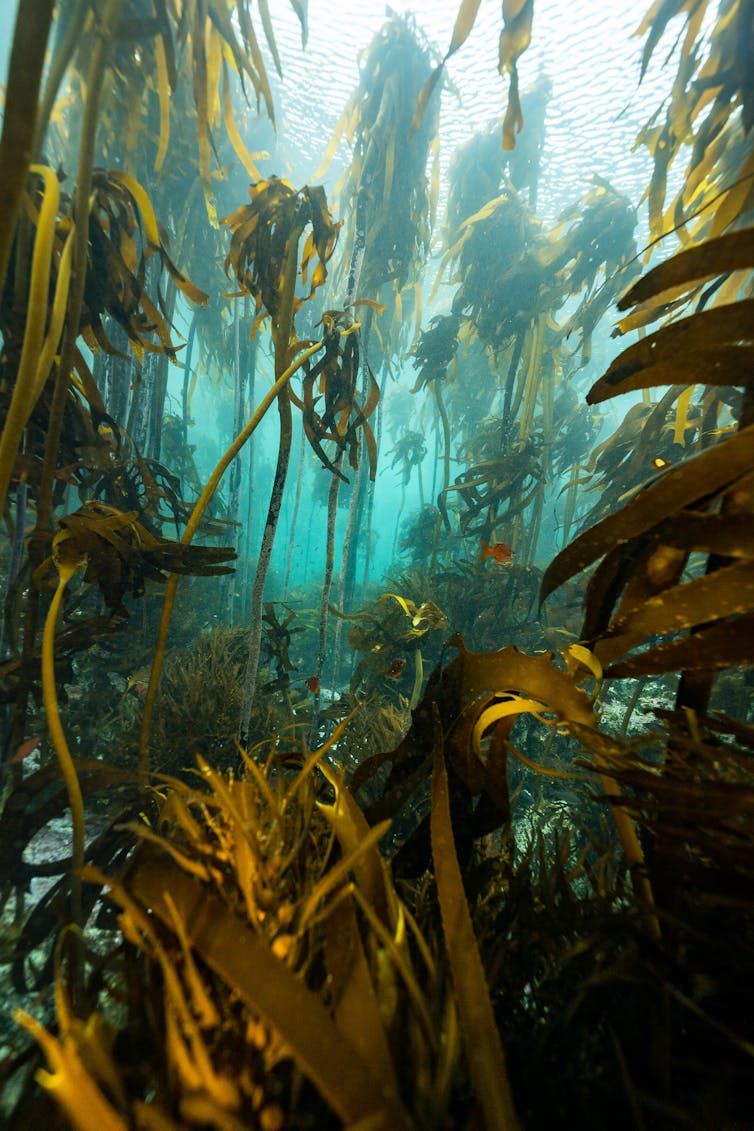
Richard Shucksmith., Author provided


With this information, we modelled the global distribution of ocean forests, finding they cover between 6 million and 7.2 million square kilometres.
That’s larger than the Amazon.

Next, we assessed how productive these ocean forests are – that is, how much they grow.
Once again, there were no unified global records.
We had to go through hundreds of individual experimental studies from across the globe where seaweed growth rates had been measured by scuba divers.

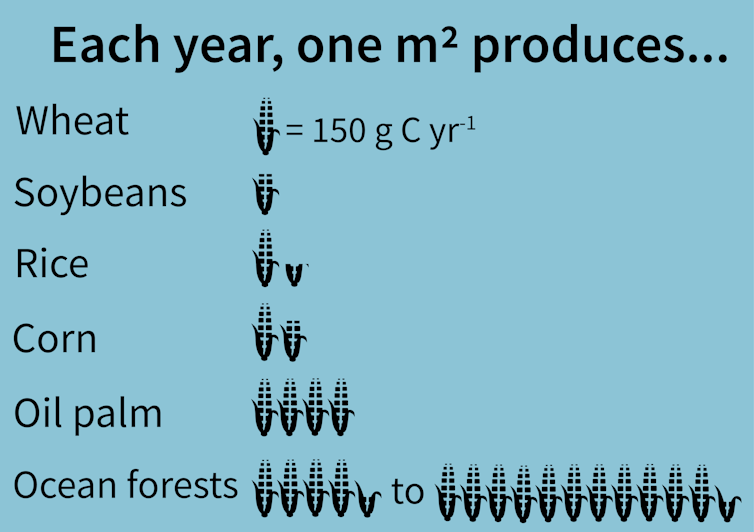
We found ocean forests are even more productive than many intensely farmed crops such as wheat, rice and corn.
Productivity was highest in temperate regions, which are usually bathed in cool, nutrient-rich water.
Every year, on average, ocean forests in these regions produce 2 to 11 times more biomass per area than these crops.

 
Biomass production of different crops and ocean forests (in grams of carbon per metre squared per year).
Data derived from Pessarrodona et al.
2022 and the Food and Agriculture Organization.

What do our findings mean for the challenges we face?

These findings are encouraging.
We could harness this immense productivity to help meet the world’s future food security.
Seaweed farms can supplement food production on land and boost sustainable development.

These fast growth rates also mean seaweeds are hungry for carbon dioxide.
As they grow, they pull large quantities of carbon from seawater and the atmosphere.
Globally, ocean forests may take up as much carbon as the Amazon.

This suggests they could play a role in mitigating climate change.
However, not all that carbon may end up sequestered, as this requires seaweed carbon to be locked away from the atmosphere for relatively long periods of time.
First estimates suggest that a sizeable proportion of seaweed could be sequestered in sediments or the deep sea.
But exactly how much seaweed carbon ends up sequestered naturally is an area of intense research.

 
Ocean forests take up vast quantities of carbon dioxide, and some of it may be sequestred for long periods of time.
Helen Walne.

Hard times for ocean forests

Almost all of the extra heat trapped by the 2,400 gigatonnes of greenhouse gases we have emitted so far has gone into our oceans.

This means ocean forests are facing very difficult conditions.
Large expanses of ocean forests have recently disappeared off Western Australia, eastern Canada and California, resulting in the loss of habitat and carbon sequestration potential.

Conversely, as sea ice melts and water temperatures warm, some Arctic regions are expected to see expansion of their ocean forests.

These overlooked forests play a crucial, largely unseen role off our coasts.
The majority of the world’s underwater forests are unrecognised, unexplored and uncharted.

Without substantial efforts to improve our knowledge, it will not be possible to ensure their protection and conservation – let alone harness the full potential of the many opportunities they provide.

Links :

Tuesday, December 13, 2022

NASA'S ICON space weather satellite has suddenly gone silent

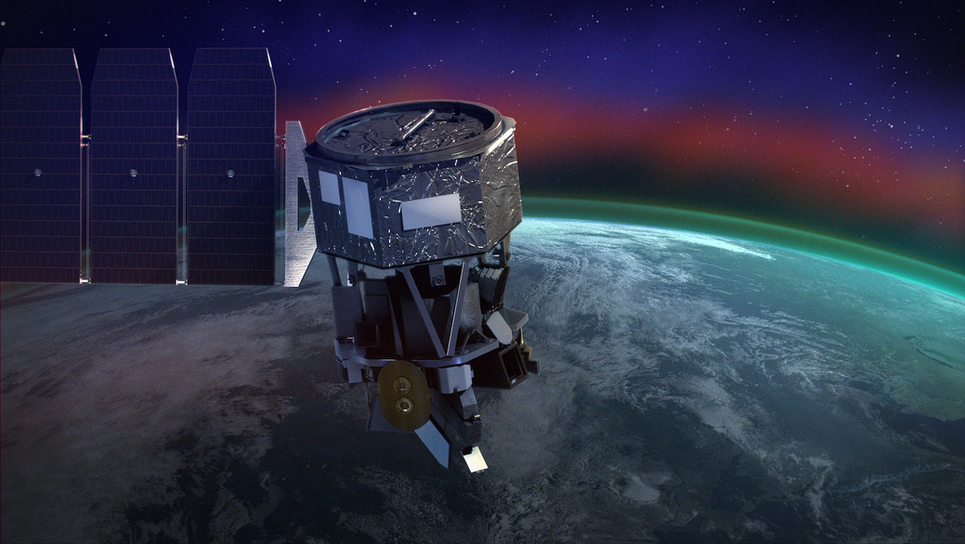
An artist’s depiction of the ICON spacecraft.Illustration: NASA


From Gizmodo by Passant Rabie

The mission team lost contact with the ionosphere-probing spacecraft two weeks ago and hasn't heard from it since.

A three-year-old NASA satellite lost touch with ground controllers two weeks ago and is now wandering through low Earth orbit without supervision.
Sadly, the space agency fears the worst.

NASA’s Ionospheric Connection Explorer (ICON) mission has not communicated with ground stations since November 25 due to some sort of glitch the space agency is yet to identify, NASA wrote in a blog post on Wednesday.
The spacecraft is equipped with an onboard command loss timer that’s designed to reset ICON in the event that contact is lost for eight days, but the reset seemingly did not work as the team was still unable to communicate with the spacecraft on December 5 after the power cycle was complete.

Although silent, the ICON spacecraft is still intact. NASA used the Department of Defense’s Space Surveillance Network to confirm that ICON is still out there in one piece, according to the space agency.
But communication is obviously key for orbiting spacecraft, as it allows the mission team to send commands to satellites and also receive data through downlinked signals.

“The ICON mission team is working to troubleshoot the issue and has narrowed the cause of the communication loss to problems within the avionics or radio-frequency communications subsystems,” NASA wrote in the blog post.
“The team is currently unable to determine the health of the spacecraft, and the lack of a downlink signal could be indicative of a system failure.” Oof, that doesn’t sound good.

ICON, launched in October 2019, is tasked with observing the way terrestrial weather interacts with space weather in Earth’s ionosphere.
It does so (or at least it did so) from an orbital outpost that’s roughly 360 miles (580 kilometers) above the planet.
The spacecraft carries four instruments to measure variouscharacteristics of the ionosphere and capture ultra-violet images of the upper atmosphere.
The ICON mission has offered a comprehensive view of this part of Earth’s atmosphere which would otherwise require two or more orbiting spacecraft to gather, according to NASA.

The mission was originally supposed to last for two years and has been operating on an extended timeline since December 2021. Hopefully NASA can squeeze more overtime from this important space weather satellite.
 

Monday, December 12, 2022

New research unlocks clues about the iconic flight of the wandering albatross

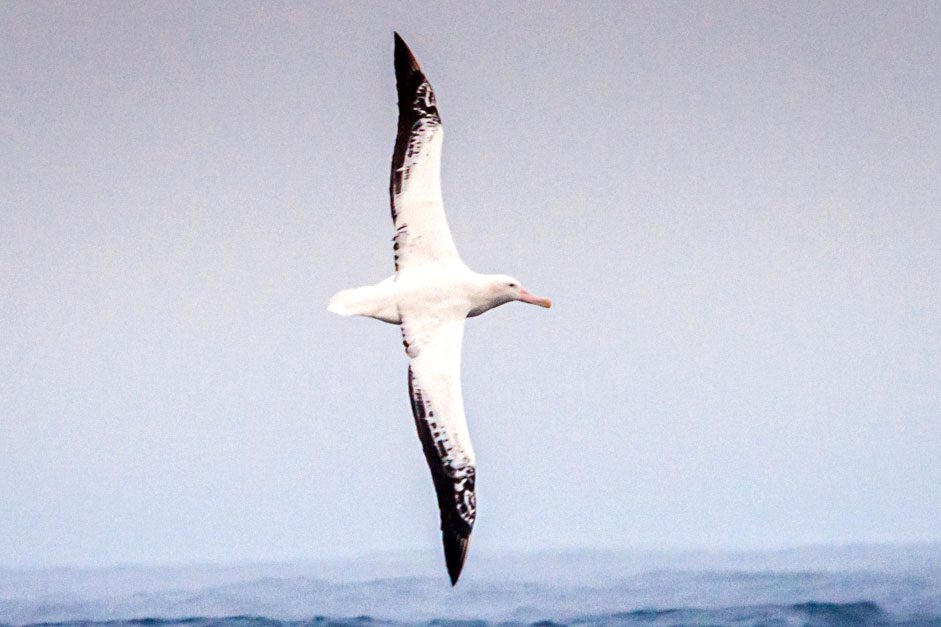
Wandering albatrosses are highly adapted to long-distance soaring flight, assisted by a wingspan of up to 11 feet -the largest known of any living bird.
Researchers are unlocking new clues about how these iconic birds are such amazing flyers.
By analyzing GPS tracks of wandering albatrosses, researchers have found that the birds’ airspeed increases with wind speed up to a maximum of 20 meters per second (45 miles per hour).
Researchers developed a model of dynamic soaring, which predicts that the birds could fly much faster than 20 meters per second (m/s).
However, researchers hypothesize that the birds limit their maximum across-wind airspeeds to about 20 m/s in higher wind speeds (and greater wind turbulence), probably to keep the aerodynamic force on their wings during dynamic soaring well below the mechanically-tolerable limits of wing strength.
The paper concludes that the birds limit airspeed by adjusting the turns in their trajectories to be around 60° and that in low winds the birds exploit updrafts over waves to supplement dynamic soaring.
Although a theoretical model predicted that the minimum wind speed necessary to support dynamic soaring is greater than 3 meters per second (m/s), GPS-tracked albatrosses were observed in flight at wind speeds as low as 2 m/s.
Researchers hypothesize at these very low wind speeds, wandering albatrosses fly by obtaining additional energy from updrafts over water waves.
The study points to ways in which theoretical models need to be refined to capture more faithfully the amazing complexity and beauty of albatross flight.
(Photo credit: Philip Richardson, ©Woods Hole Oceanographic Institution)


From WHOI by Philip L. Richardson and Ewan D. Wakefield

Wandering albatrosses, which are an iconic sight in the Southern Ocean, are highly adapted to long-distance soaring flight.
Their wingspan of up to 11 feet is the largest known of any living bird, and yet wandering albatrosses fly while hardly flapping their wings.
Instead, they depend on dynamic soaring—which exploits wind shear near the ocean surface to gain energy—in addition to updrafts and turbulence.

Now researchers, including Philip Richardson, a senior scientist emeritus in Physical Oceanography Department at the Woods Hole Oceanographic Institution (WHOI), are unlocking more clues about exactly how wandering albatrosses are such amazing flyers.

In a new paper analyzing GPS tracks of wandering albatrosses, researchers have found that the birds’ airspeed increases with wind speed up to a maximum airspeed of 20 meters per second (m/s; 45 mph).
Researchers developed a model of dynamic soaring, which predicts that the birds could fly much faster than 20 m/s.
The paper concludes that the birds limit their airspeed by adjusting the turns in their trajectories to be around 60°, and that in low winds the birds exploit updrafts over waves to supplement dynamic soaring.

“We hypothesize that wandering albatrosses limit their maximum across-wind airspeeds to ~ 20 m/s in higher wind speeds (and greater wind turbulence), probably to keep the aerodynamic force on their wings during dynamic soaring well below the mechanically-tolerable limits of wing strength,” according to the paper, “Observations and Models of Across-wind Flight Speed of the Wandering Albatross,” published in the journal Royal Society Open Science.

The paper adds that, given the complex field of wind waves and swell waves often present in the Southern Ocean, “it is also possible that birds find it increasingly difficult to coordinate dynamic soaring maneuvers at faster speeds.”

Regarding low flight speeds by albatrosses, the paper notes that a theoretical model predicted that the minimum wind speed necessary to support dynamic soaring is greater than 3 m/s.
“Despite this, tracked albatrosses were observed in flight at wind speeds as low as 2 m/s.
We hypothesize at these very low wind speeds, wandering albatrosses fly by obtaining additional energy from updrafts over water waves,” according to the paper.

“We tried to figure out how these birds are using the winds to go long distances—without overstressing their wings—for foraging for food and returning to feed their chicks.
To do that, we modeled dynamic soaring and what different turn angles would do to stress on the birds’ wings and speed over the water,” said journal paper co-author Richardson.
A dynamic soaring trajectory is an s-shaped maneuver consisting of a series of connected turns, he noted.

“This research is a step in the direction of understanding how wandering albatrosses are able to do these foraging trips and maintain a fairly large population.
These birds figured out an amazing way to use the wind to almost effortlessly soar for thousands of miles over the ocean.
We wanted to find out exactly how they did it,” he said.

In addition to learning more about albatrosses, the study could have broader implications for helping researchers better understand how to use dynamic soaring to power potential albatross-type gliders to observe ocean conditions, Richardson added.


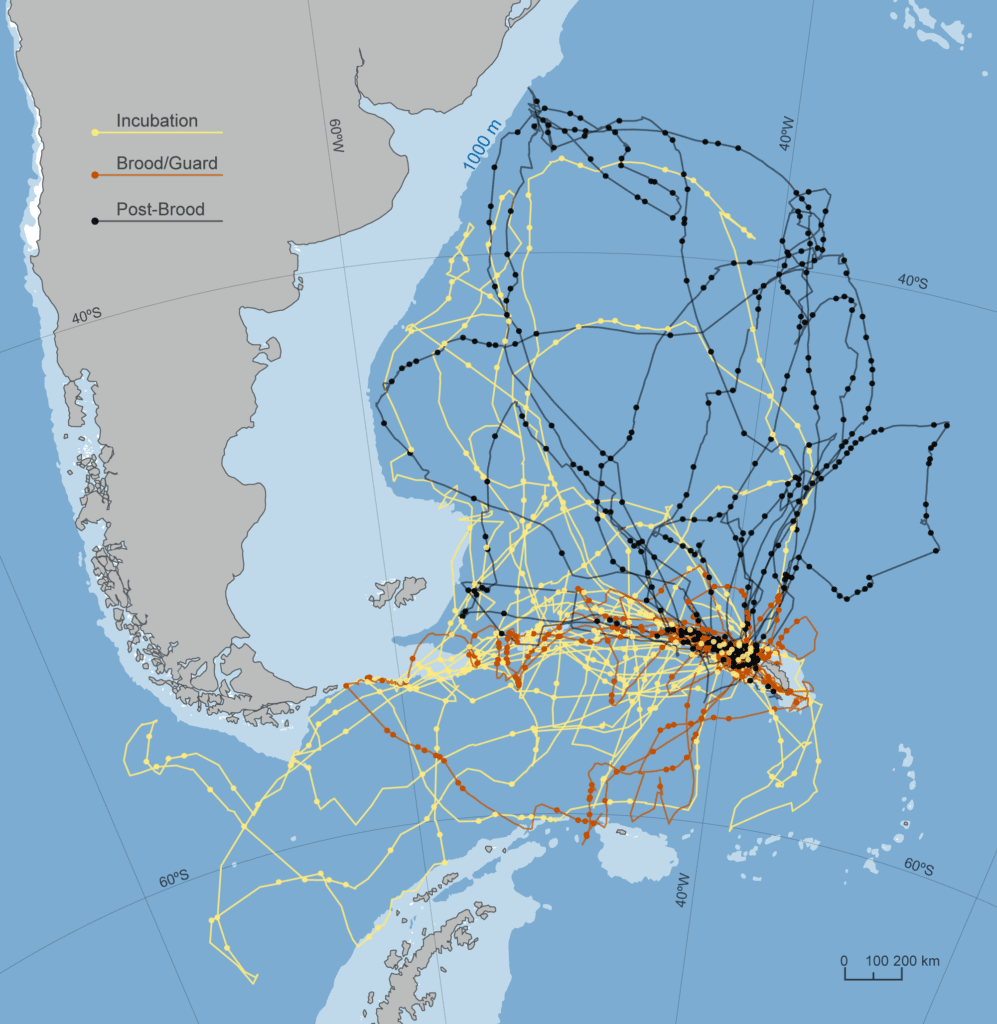
Trajectories of breeding wandering albatrosses nesting on South Georgia Island in the South Atlantic.
These birds are highly adapted to long-distance soaring flight assisted by a wingspan of up to 11 feet--the largest known of any living bird.
They use the winds to soar thousands of miles seeking food to bring back to nourish their chicks.
(Map by Natalie Renier, ©Woods Hole Oceanographic Institution)


For the study, researchers used GPS to track 46 wandering albatrosses during foraging trips the birds made between February to September 2004.
The birds were breeding on Bird Island, which is off the northwest tip of South Georgia in the Southern Atlantic Ocean.
Wandering albatrosses lack sufficient musculature to sustain continuous flapping flight for long periods of time; however they have a shoulder lock that mechanically holds their wings outstretched so that little energy is expended while soaring, according to the paper.

Since the earliest days of scientific inquiry, the way that many birds are able soar—that is, fly without flapping their wings—has fascinated and perplexed observers, said paper co-author Ewan D. Wakefield, affiliate researcher at the University of Glasgow and postdoctoral research associate at the University of Durham, UK.
Wandering albatrosses are particularly remarkable for their ability to soar over the surface of the sea for long periods, covering vast distances, Wakefield said.
He added that the physical principles explaining dynamic soaring flight were established over a century ago: Basically, albatrosses swoop up and down between layers of fast and slow moving air near the surface of the sea, gaining airspeed each time they do so.

“However, as our study shows, real-world albatross flight differs considerably from the predictions of simple physical models,” Wakefield said.
“On the one hand, our GPS-tracking data show that they can and do fly in lighter winds than dynamic soaring models say should be possible.
We suspect that this is because they can also fly by surfing updrafts created by the large waves that constantly surge around their Southern Ocean home.
On the other hand, the upper limit of albatrosses' airspeed that we measured is much slower than physics predicts.
We think that this is because albatrosses need to keep the forces on their wings within tolerable limits.
After all, they're made from bone and muscle, not aluminum and titanium.
Our study therefore points to ways in which theoretical models need to be refined to capture more faithfully the amazing complexity and beauty of albatross flight.”

Richardson recalled being entranced by wandering albatrosses ever since he observed them during a 1997 oceanographic cruise in the South Atlantic Ocean.
“We were steaming upwind at 15 knots, pounding into waves, and these albatrosses caught up to us from astern and were cruising around and having a grand old time,” Richardson said.
“I sat there for hours watching these birds in amazement, and wondering how they could fly like that.
Now we are learning more about how they do it.”

Funding for this research was provided by the Woods Hole Oceanographic Institution emeritus fund and the UK Natural Environment Research Council.

Sunday, December 11, 2022

Ancient US nautical chart

This 1869 Salem Harbor chart represents one of the more impressive early surveys.
Originally published in 1855, this chart received criticism, prompting additions and corrections for this highly detailed republished edition!
 
Salem harbor with the GeoGarage platform (NOAA RNC)