Monday, May 10, 2021

Why the sailing yacht movement is greener than ever

From Boat International by Marilyn Mower
 
There are few more eco-friendly ways to travel than by sailing yacht, but, thanks to fresh innovations, the future is ever greener.
 
If you want to go around the world, the only way to do it with any conscience is on a sailing boat,” asserts Wally Yachts CEO Luca Bassani.
Indeed, environmental sensitivity and mounting scientific and social pressure for reducing fossil-fuel consumption seemed to be making progress until Covid-19 took over the news cycle.
Interestingly, naval architects, designers yacht builders and suppliers have continued nose to the grindstone in anticipation of a future that is not a bounce back but a bounce forward toward a day when far more yachts are powered by sail, and those yachts make an ever smaller environmental impact.

Rather than a green revolution, the actual picture is incremental, “a steady drip, drip, drip,” as naval architect Bill Tripp puts it. 
“Progress is an S-shaped curve slowly moving up but then something comes along and the axis shifts and it steepens quickly. That’s what happened with electric cars. It was a very long, low curve, but now you can argue that one of the best cars in the world is electric.”

The Wally 145 has a hybrid propulsion system
Credit: Wally

Is the totally electric boat a possibility?
Definitely for a small boat or yachts that primarily day sail, says Tripp, but a superyacht with its high hotel load is a different matter with a lot of variables.
Let’s take a look at the puzzle pieces emerging for the development of low-to-no impact superyachts.

A good sailing boat is an efficient boat, but “efficient” can mean either faster or less costly to operate, both attractive outcomes but for different reasons and perhaps to different customers.

At yacht builder Southern Wind, the mantra is “Improving sustainability through efficiency.” 
Taking weight out is an everyday battle but the yard attracts customers who like the large but pared-down ethos of its boats and their modest crew requirements.

Credit: Southern Wind Yachts

“One of the complaints about sailing boats during Med cruising season is that the wind is too light and the boat won’t go anywhere in less than six to eight knots of breeze unless it’s motoring. We put our effort into resolving that issue,” says Southern Wind commercial director Andrea Micheli. 
“If a boat has a bigger sailplan, it can sail faster and at a lower wind speed. Our new 105 will carry 15 per cent more sail area than our 102-footer [31-metre]. It will sail in four knots true wind! We will go upwind at 4.5 knots and downwind at 4.9 knots. At seven to eight knots of wind, we sail beautifully at eight to nine knots while most of our competitors will be motoring.”

Of course, sail area is not the only string to the yard’s bow.
Boats consume remarkably little energy when sailing; it is the time at anchor with owners and guests aboard when the hotel loads explode.
Even a blue-water cruiser sits for about eight months of the year. Southern Wind has invested in the development of awnings that can generate seven to 20kW of electricity using solar cloth panels that stow in a dedicated deck locker.

Credit: Bill Dixon Yacht Design

“When the owner and guests are gone, we think the boat can be nearly energy self-sufficient when on a mooring or at a dock,” says Micheli. 
“It also keeps the boats cooler during the day. You won’t need to supplement as much with a generator or shore power.”

“This summer we delivered Kauris IV, which has huge battery banks,” says Bassani. 
“You can motor at 10 knots for eight hours if you don’t have wind. Unfortunately, available solar cells for recharging a yacht of this size are not enough. You can keep a stationary 40-footer [12-metre] charged on solar, but not a superyacht.”

Efficiency also means power management systems and using battery power for peak shaving (upsizing battery banks to draw power off them for silent running or short-term loads) instead of upsizing gensets. 
“Based on our real data, the 105 will have two 19kW gensets,” says Micheli. One can power the boat and charge the batteries while the other manages short-term demands or hydraulics for sail hoists. Small gensets will run at 70 to 80 per cent load, which is much better for them. Proprietary software lets crew manage energy generation and use.”

The heights of hybrid

Royal Huisman, which pioneered hybrid power with Ethereal in 2009, has an ongoing complete hybrid re-power of its 43.5-metre Juliet to give it the ability to cruise zero-emissions zones.
The centrepiece is a new gearbox aligned with a sophisticated electric motor/generator for indirect electric propulsion from the battery bank for silent operation, or a generator via the power management system.
The main engine can still turn the prop shaft if necessary or provide electric power to meet the hotel load.

Naval architect Merfyn Owen says that on 25- to 35-metre yachts the main power consumers are air conditioning and refrigeration. 
“Adding insulation and scaling back expectations need to be part of the package, but the right combination would be peak shaving. Entering and exiting a harbour at low speed is not good for an engine; it’s better to use electric motors when you only need six knots.”
He has a 25-metre high-latitudes yacht in construction that will enjoy hybrid propulsion.

Credit: Royal Huisman

“We find peak shaving very effective in that crew don’t need to start up another generator for a short period of extra load that can be handled by the batteries,” says Royal Huisman project manager Henriko Kalter.
“Project 404, a 59.7-metre sloop, will be fully diesel-electric, meaning [there will be] no main engines but a system that pulls power for all uses off a grid fed by several smaller generators.
These are just for recharging and can be smaller than mains.

“Let’s say your peak load when everything is on is 100kW, but the rest of the day it drops to around 25kW. It’s not good for a 100kW generator to be running at 25 per cent load – the maintenance is awful. So if we put in a 50kW generator, we charge the batteries when power consumption drops below 50 kW and draw from the batteries when it goes above. It also allows us to use a more basic DC system for everything, which gives us more options, such as two retractable electric drive legs.


“Our ‘smart energy’ approach has two pillars – one to reduce power consumption and one to generate electrical power,” continues Kalter. 
“We studied where power is consumed on the boats and it’s primarily the galley and air conditioning, which take 50 per cent of the power. Beyond waste heat recovery, we are also recovering cool air. Ventilation systems just dump cooled air over the side but we are using the previously cooled air to pre-cool the fresh air coming in so the ambient temperature is being reduced in two steps.

“We are also looking at hydrogen and we have been talking to Lloyd’s about storage safety,” says Kalter.
 “The problem is availability. Can you go from Antigua to the Med on hydrogen? Probably not. We look to solar and hydro-generators when the boat is under way, [so] it’s not one solution but many contributors to becoming autonomous. We think a totally fossil-free boat is possible.”

Sunreef Yachts’ Eco 80 is covered in solar cells powering enough battery capacity to allow silent mode all night long
Credit: Sunreef

Catamaran builder Sunreef Yachts introduced its Eco line with an 18-metre at Cannes 2019.
Now it has scaled up to a 24-metre that will be available in both power and sailing versions. 
“Electric power is the basis but we take it further,” says Sunreef Yachts’ Artur Poloczanski. 
“The boats are designed with enough battery capacity to allow silent mode at night, and we use a non-toxic silicon bottom paint that is slicker than most paint, so there is less resistance. We have also used reclaimed teak for the soles inside the boats, and having water makers with purification means you don’t need to lug around plastic bottles.”

A recent source of pride is the yard’s design of integrated carbon-fibre bimini tops that take advantage of new high-output solar cells that can be curved – both saving weight and improving aesthetics. 
The E series boats use these same solar cells in curved sections of hulls and decks. 
“We believe that 32kW peak generation from solar is achievable. Wind and hydrogeneration add more self-sufficiency,” says Poloczanski.
“Eco design and construction is a main focus for Sunreef now.” Sunreef’s own R&D has led to counter surfaces being made of compressed paper and resin, and components made of flax and basalt fibre, rather than fibreglass.

Tripp has several parallel hybrid projects under construction of sizes varying from 13 to 27 metres. 
“It’s the Prius model of batteries and an engine. 
Even if you had the 80kW of a Tesla battery pack you could only power your boat for about two and a half hours at full power – there’s not much excitement to that. 
You need a source to power the batteries.

Credit: Tom van Oossanen

“Hybrid systems are trickling up from simple systems on small boats and trickling down from huge ships,” says Tripp. 
“We found a flywheel alternator that looks like a six-inch pancake that fits between the gearbox and the engine. Under sail [with the propeller set in reverse] you lose maybe half a knot. When more systems are available, there will be more acceptance.

“Hydrogenerators with even a small propeller on a standard shaft can generate about 10kW, which makes them quite practical for small boats,” continues Tripp. 
“But superyachts have a different problem because of their greater loads and the number of people aboard. I’m always running into captains who says they have to keep the boat closed down to preserve the fabrics and woods inside. That’s a choice. I think we need to be less precious and design boats to be able to open hatches.”

“You absolutely can regenerate enough energy to cover the hotel loads on a sailing superyacht,” says naval architect Bill Dixon. 
“Black Pearl has proven that it’s possible under way with hydrogeneration and solar cells charging battery banks.”


Dixon, a proponent of the Dynarig, is developing concepts that marry the spaces associated with a motor-yacht lifestyle with the green credentials of a sailing yacht. We have enquiries from people now, mostly younger owners, who are putting their companies through sustainability analysis and realise their yacht should meet the same standards.”
 
Reduce, reuse, recycle

Naval architect Rob Doyle says he’s been “stripping away stuff” from his designs. 
“I’m always asking, ‘Do you really need that?’
It turns out owners like natural ventilation and a boat that can be silent for 15 hours.

“Boats got heavier because yards got worried about warranty issues and redundancy [so they] upsized and duplicated gear, adding cost. The lighter we make them, the cheaper it gets. Carbon fibre costs nearly twice the price of aluminium, which is totally recyclable and the hull will be close on weight. It’s often the stuff inside that’s heavy.”

Take the new ClubSwan 80 for example. Currently under construction at Persico Marine, Nautor's Swan's latest addition to its series of performance sailing yachts recycles carbon-fibre from previous moulds by separating the carbon from the resin to create new moulds.
Persico also collects prepreg scraps and ship to a company specialising in medical prostheses.


YYachts, a company based on the concept of light, efficient, uncomplicated boats, plans to show its new 21-metre Y7 Cin Cin at the Cannes show.
Its deck is laid with sustainable engineered wood from Lignia that looks like teak, weighs the same and mellows to the same silver grey.

YYachts also internalises environmental protection.
Founder Michael Schmidt insists that subcontractors come from within a 100-kilometre radius to lower transportation costs and reduce the carbon footprint. 
“We digitalised the shipyard as much as possible to reduce travelling and installed LED lighting everywhere. In addition, we use second-hand shipping containers as office space and let a couple of sheep take care of the grass in front of the yard,” he says. 
“We are also focusing on new materials we can use on our projects, such as green resin foam generated from recycled PET bottles.”


“If a customer’s company has to meet zero-carbon status by 2030, then their personal possessions probably also should,” says Kalter. 
“We are seeing more owners moving in this direction in tender packages we receive, some even coming from motor-yacht owners. It’s not that they want to do regattas, but they don’t want to give up the yachting lifestyle.”

Voicing cautious optimism, Tripp adds, “We’ll see all these things come to the fore, hopefully driven by clients demanding it rather than by naval architects saying you could have it.”

Sunday, May 9, 2021

The swim, official trailer

 
In 2018, Seeker chronicled Ben Lecomte’s historic swim across the Pacific to raise awareness for the state of our oceans.
Now, Lecomte’s incredible expedition has been turned into a full-length documentary, streaming now on Discovery+. Terms apply.
Watch here: http://bit.ly/dplus-yt​ »
Watch more Swim | http://bit.ly/TheSwimPlaylist
 
He swam from Japan to Hawaii and at times saw a piece of plastic in the ocean every three minutes https://www.cnn.com/2018/12/11/us/pac...​ 
"A French man’s attempt to swim across the Pacific Ocean may be over for now, but his campaign to warn the world about the dangers of plastic pollution in the ocean continues." 
Six months. 5,700 miles. 
One ocean. 
 
Ben Lecomte wants to be first to swim across Pacific.
"Ben Lecomte, a 50-year old Frenchman turned Texan, will slip into the water on Sunday off the coast of Choshi, Japan, and start swimming. 
If all goes as planned, he won’t set foot on land for six months. In that time, he plans to swim through the largest collection of trash on the planet, great white shark migration areas, through jellyfish and storms and isolation and monotony." 
 
Man begins to swim across Pacific Ocean, garbage patch and all https://www.nbcnews.com/news/world/ma...​ 
"Lecomte said he is undertaking the expedition as a kind of existential challenge and to help publicize threats like the Great Pacific Garbage Patch — the vast expanse of man-made pollution that fouls that ocean."
 
Ben Lecomte's historic swim across the Pacific Ocean is a feat that can’t be missed.
Join us as we dive into the most extensive data set of the Pacific Ocean ever collected.
Learn about the technology the Seeker crew is using to deter sharks away from Ben and measure the impact of the long-distance swim on his mind and body.
Ben's core mission is to raise awareness for ocean health issues, so we’ll investigate key topics such as pollution and plastics as he swims closer to the Great Pacific Garbage Patch, discover potential consequences from climate change, and examine how factors like ocean currents can impact his progress along the way.
Seeker empowers the curious to understand the science shaping our world.
We tell award-winning stories about the natural forces and groundbreaking innovations that impact our lives, our planet, and our universe. 
 
Links : 

Saturday, May 8, 2021

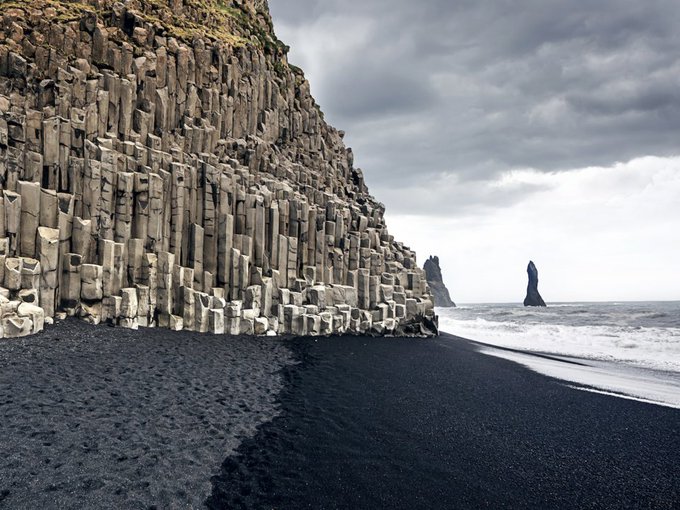
Reynisfjara black sand beach, the most famous beach on the South Coast of Iceland


Reynisfjara is the most famous beach on the South Coast of Iceland.
 
Localization with the GeoGarage platform (Icelandic nautical raster chart)
 
Its beautiful black sand, powerful waves, and the nearby Reynisdrangar sea stacks make Reynisfjara a truly unique place to visit and a popular filming location (Game of Thrones, Star Wars and more).
Reynisfjara Beach is one of the most well-known black sanded beach in the whole world.
This is a place of wild and dramatic beauty where the roaring waves of the Atlantic Ocean power ashore with tremendous force.
 
In 1991, Reynisfjara appeared on the top ten list of the most beautiful non-tropical beaches in the world, and it is very easy to see why it was chosen!
It is said that to stand on Reynisfjara Beach is akin to being in a natural amphitheater where the white water of the Atlantic waves provides the drama.
At any time of year, and in any light, this is a place of great beauty which will remind people that they can never be far from the powerful forces of nature which shaped the island of Iceland.
Marvel at the power of the ocean but do not stand too close – those masterful waves deserve your respect and can be quite dangerous if you get too close! 

Friday, May 7, 2021

This map is alive with the beauty of lighthouse signals

At night, the rims of the North Sea flicker and flash with a multitude of light signals to guide ships to safety.
Credit: Geodienst – Lights at Sea

From BigThink by Frank Jacobs

The unique light signatures of nautical beacons translate into hypnotic cartography.
  • Many of the world's 23,000 lighthouses feature a distinct combination of color, frequency, and range.
  • These unique light signatures help ships verify their positions and safeguard maritime traffic.
  • But they also translate into this map, visualizing the ingenuity and courage of lighthouse builders and keepers.
Land and sea are both shaded dark, so it's a bit hard at first to make out that this collection of merrily blinking lights is actually a map.
Once the coastal contours pop, though, all becomes clear: these are lighthouses!


At night, the Eastern Mediterranean is awash with lighthouse signals.
Credit: Geodienst – Lights at Sea

The Age of Big Data

The map not only shows where they are, but how they are: static or blinking in various colors with the size of the circles corresponding to the range of their lights.

Up until the 20th century, a map of lighthouses would have been a subdued affair: just a string of dots strung along lines of coast. But this is the 21st century!
We're in the Age of Big Data, ruled by the clever boffins who know how to stitch one dataset to another. Zap it with electricity and presto: it's alive!

That's what the folks did over at Geodienst, the spatial expertise center of the University of Groningen (Netherlands). Back in 2018, student/assistant Jelmer van der Linde (currently with the University of Edinburgh) came across OpenSeaMap, an open-source resource for nautical information similar to its more famous landlubber cousin, OpenStreetMap.

OpenSeaMap contained a database with detailed information on nautical beacons and lighthouses, which included not just their location, but also the frequency, range, and even the color of their signals. Would it be possible to visualize all those data points on a map?
Yes, it would!


Norway's craggy coastline requires lots of light.
Not that much blinking going on, though.
Credit: Geodienst – Lights at Sea

The result is this riot of a map. It's important that ships don't mistake one lighthouse for another.
That's why they come in various colors and their lights flicker with a distinct frequency.
Norway in particular is lit up with beacons and lighthouses, as its fjord-indented coast warrants. And the rest of Europe is well provided with nautical warning lights.

However, while the map is reminiscent of other global traffic trackers for flights (like Flightradar24 or FlightAware) or shipping (such as VesselFinder or MarineTraffic), it is neither live nor global.
The flickering lights aren't a real-time report; they merely repeat the code in the original database. And that database is incomplete.

The colors are really those of the lighthouses, the rhythms are real and the size of the dots represents the distance at which each focus is visible.

Zoom out, and the map gets a bit too dark.
According to the Lighthouse Directory, there are at least 23,000 lighthouses in the world.
And even though the United States has more lighthouses than any other nation700 by some counts – the map only shows a handful of lights in North America.

Like its parent, the lighthouse map is open source too, so if anyone out there is capable of filling in the gaps, they can.
Lighthouse enthusiasts, get to it!

Not one yet yourself?
Below are 10 lighthouse facts to help you come over to the light side.

Now you see them, now you don't.
Credit: Geodienst – Lights at Sea

Trapped in a giant phallus and other true facts about lighthouses

  1. The world's smallest lighthouse is the North Queensferry Light Tower, near the Forth Bridge in Scotland. A mere 16 feet (5 m) tall, it was built in 1817 by Robert Stevenson, famous builder of lighthouses, as was his son Thomas, who was the father of the famous novelist Robert Louis Stevenson.
  2. Reaching a height of 436 ft (133 m), Jeddah Light in Saudi Arabia is the world's tallest lighthouse.
  3. The 2019 movie The Lighthouse, starring Willem Dafoe and Robert Pattinson, was based on a true incident, known as the Smalls Lighthouse Tragedy. In 1801, a storm trapped two Welsh lighthouse keepers, both named Thomas, in their lighthouse. One died, the other went mad. Asked to summarize his film, writer/director Robert Eggers said, "Nothing good can happen when two men are trapped alone in a giant phallus."
  4. From its inauguration in 1886 until 1901, the Statue of Liberty also served as a lighthouse. Its nine electric arc lamps, located in the torch, could be seen 24 miles out to sea.
  5. All U.S. lighthouses are now automated – save for Boston Light, the oldest continually used lighthouse in the country. For historical reasons, Congress has decided it shall remain staffed year-round.
  6. Hook Lighthouse, on Hook Head in Ireland's County Wexford, claims to be the world's oldest lighthouse still in use. It was first built by a medieval lord in the early decades of the 13th century.
  7. The Tower of Hercules in La Coruña, Spain has a slightly better claim. It was built by the Romans in the 1st century AD and still functions as a lighthouse.
  8. Stannard Rock Lighthouse is also known as "the loneliest place in the world." It is located in Lake Superior, Michigan. At 24 miles (39 km) from shore, it is the most remote lighthouse in the U.S. and one of the most remote in the world. It opened in 1883 and was staffed for parts of the year until 1962.
  9. A lighthouse on Märket is the reason for the weird border on the island, divided between Sweden and Finland. In 1885, the Finns built a lighthouse on the highest part of the island – on the Swedish half. Thanks to a complicated land swap, the lighthouse is back on the Finnish side.
  10. In the United States, August 7 is National Lighthouse Day.
Robert Pattinson (left) and Willem Dafoe in The Lighthouse.  
Credit: © 2019 A24 Films, via IMDB

Links :

Thursday, May 6, 2021

Revealed: 2,000 refugee deaths linked to illegal EU pushbacks


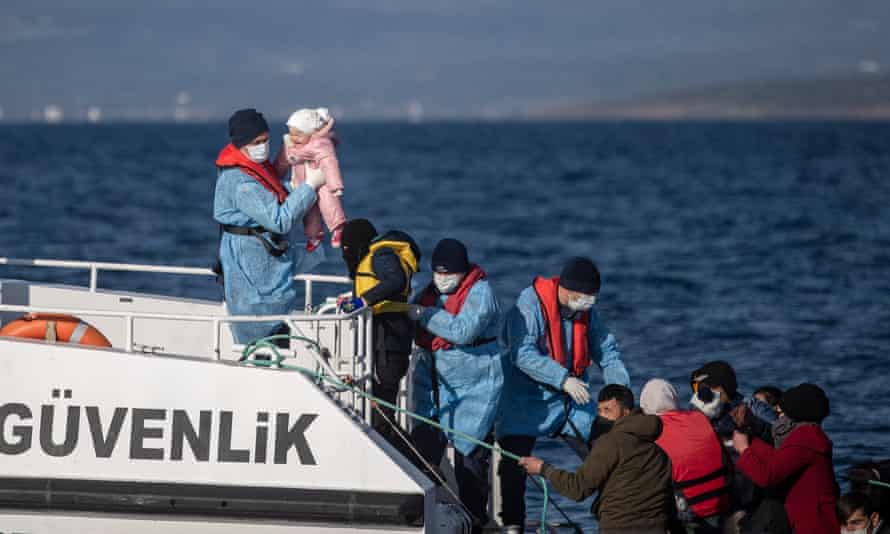
Migrant rescue patrol in the Aegean Sea by the Turkish coastguard.
A case has been filed against the Greek state that claims patrol boats towed migrants back to Turkish waters and abandoned them.
Photograph: Erdem Åžahin/EPA

From The Guardian by Lorenzo Tondo

A Guardian analysis finds EU countries used brutal tactics to stop nearly 40,000 asylum seekers crossing borders


EU member states have used illegal operations to push back at least 40,000 asylum seekers from Europe’s borders during the pandemic, linked to the death of more than 2,000 people, the Guardian can reveal.

In one of the biggest mass expulsions in decades, European countries, supported by EU’s border agency Frontex, systematically pushed back refugees, including children fleeing from wars, in their thousands, using illegal tactics ranging from assault to brutality during detention or transportation.

The Guardian’s analysis is based on reports released by UN agencies, combined with a database of incidents collected by non-governmental organisations.
According to charities, with the onset of Covid-19, the regularity and brutality of pushback practices has grown.

The findings come as the EU’s anti-fraud watchdog, Olaf, has launched an investigation into Frontex over allegations of harassment, misconduct and unlawful operations aimed at stopping asylum seekers from reaching EU shores.

According to the International Organization for Migration, in 2020 almost 100,000 immigrants arrived in Europe by sea and by land compared with nearly 130,000 in 2019 and 190,000 in 2017.

Since January 2020, despite the drop in numbers, Italy, Malta, Greece, Croatia and Spain have accelerated their hardline migration agenda.
Since the introduction of partial or complete border closures to halt the outbreak of coronavirus, these countries have paid non-EU states and enlisted private vessels to intercept boats in distress at sea and push back passengers into detention centres.
There have been repeated reports of people being beaten, robbed, stripped naked at frontiers or left at sea.

In 2020 Croatia, whose police patrol the EU’s longest external border, have intensified systemic violence and pushbacks of migrants to Bosnia.
The Danish Refugee Council (DRC) recorded nearly 18,000 migrants pushed back by Croatia since the start of the pandemic.
Over the last year and a half, the Guardian has collected testimonies of migrants who have allegedly been whipped, robbed, sexually abused and stripped naked by members of the Croatian police.
Some migrants said they were spray-painted with red crosses on their heads by officers who said the treatment was the “cure against coronavirus”.

According to an annual report released on Tuesday, the Border Violence Monitoring Network (BVMN), a coalition of 13 NGOs documenting illegal pushbacks in the western Balkans, abuse and disproportionate force was present in nearly 90% of testimonies in 2020 collected from Croatia, a 10% increase on 2019.

In April, the Guardian revealed how a woman from Afghanistan was allegedly sexually abused and held at knifepoint by a Croatian border police officer during a search of migrants on the border with Bosnia.

“Despite the European Commission’s engagement with Croatian authorities in recent months, we have seen virtually no progress, neither on investigations of the actual reports, nor on the development of independent border monitoring mechanisms,” said Nicola Bay, DRC country director for Bosnia.
“Every single pushback represents a violation of international and EU law – whether it involves violence or not.”

Since January 2020, Greece has pushed back about 6,230 asylum seekers from its shores, according to data from BVMN. The report stated that in 89% of the pushbacks, “BVMN has observed the disproportionate and excessive use of force.
This alarming number shows that the use of force in an abusive, and therefore illicit, way has become a normality […]

“Extremely cruel examples of police violence documented in 2020 included prolonged excessive beatings (often on naked bodies), water immersion, the physical abuse of women and children, the use of metal rods to inflict injury.”

In testimonies, people described how their hands were tied to the bars of cells and helmets put on their heads before beatings to avoid visible bruising.

A lawsuit filed against the Greek state in April at the European court of human rights accused Athens of abandoning dozens of migrants in life rafts at sea, after some had been beaten.
The case claims that Greek patrol boats towed migrants back to Turkish waters and abandoned them at sea without food, water, lifejackets or any means to call for help.

BVMN said: “Whether it be using the Covid-19 pandemic and the national lockdown to serve as a cover for pushbacks, fashioning open-air prisons, or preventing boats from entering Greek waters by firing warning shots toward boats, the evidence indicates the persistent refusal to uphold democratic values, human rights and international and European law.”

According to UNHCR data, since the start of the pandemic, Libyan authorities – with Italian support since 2017, when Rome ceded responsibility for overseeing Mediterranean rescue operations to Libya – intercepted and pushed back to Tripoli about 15,500 asylum seekers.
The controversial strategy has caused the forced return of thousands to Libyan detention centres where, according to first hand reports, they face torture.
Hundreds have drowned when neither Libya nor Italy intervened.

 
SOS Méditerranée operates the Ocean Viking, one of the few remaining NGO rescue boats in the Mediterranean
Photograph: Flavio Gasperini/SOS Mediterranee

“In 2020 this practice continued, with an increasingly important role being played by Frontex planes, sighting boats at sea and communicating their position to the Libyan coastguard,” said Matteo de Bellis, migration researcher at Amnesty International. “
So, while Italy at some point even used the pandemic as an excuse to declare that its ports were not safe for the disembarkation of people rescued at sea, it had no problem with the Libyan coastguard returning people to Tripoli. Even when this was under shelling or when hundreds were forcibly disappeared immediately after disembarkation.”

In April, Italy and Libya were accused of deliberately ignoring a mayday call from a migrant boat in distress in Libyan waters, as waves reached six metres.
A few hours later, an NGO rescue boat discovered dozens of bodies floating in the waves.
That day 130 migrants were lost at sea.

In April, in a joint investigation with the Italian Rai News and the newspaper Domani, the Guardian saw documents from Italian prosecutors detailing conversations between two commanders of the Libyan coastguard and an Italian coastguard officer in Rome.
The transcripts appeared to expose the non-responsive behaviour of the Libyan officers and their struggling to answer the distress calls which resulted in hundreds of deaths.
At least five NGO boats remain blocked in Italian ports as authorities claim administrative reasons for holding them.

Malta, which declared its ports closed early last year, citing the pandemic, has continued to push back hundreds of migrants using two strategies: enlisting private vessels to intercept asylum seekers and force them back to Libya or turning them away with directions to Italy.

“Between 2014 and 2017, Malta was able to count on Italy to take responsibility for coordinating rescues and allowing disembarkations,” said De Bellis.
“But when Italy and the EU withdrew their ships from the central Mediterranean, to leave it in Libya’s hands, they left Malta more exposed. In response, from early 2020 the Maltese government used tactics to avoid assisting refugees and migrants in danger at sea, including arranging unlawful pushbacks to Libya by private fishing boats, diverting boats rather than rescuing them, illegally detaining hundreds of people on ill-equipped ferries off Malta’s waters, and signing a new agreement with Libya to prevent people from reaching Malta.”

Last May, a series of voice messages obtained by the Guardian confirmed the Maltese government’s strategy to use private vessels, acting at the behest of its armed forces, to intercept crossings and return refugees to Libyan detention centres.

In February 2020, the European court of human rights was accused of “completely ignoring the reality” after it ruled Spain did not violate the prohibition of collective expulsion, as asylum applications could be made at the official border crossing point.
Relying on this judgment, Spain’s constitutional court upheld “border rejections” provided certain safeguards apply.

Last week, the bodies of 24 migrants from sub-Saharan Africa were found by Spain’s maritime rescue. They are believed to have died of thirst and hunger while attempting to reach the Canary Islands.
In 2020, according to the UNHCR, 788 migrants died trying to reach Spain.

The Guardian has approached Frontex for comment.
Previously the agency has said it will be “co-operating fully” with Olaf.
 
Links: