Tuesday, October 30, 2018

Sulphur-emissions rules for shipping will worsen global warming

Carriage ban adopted to implement Sulphur 2020 limit
Owners planning to install ‘emissions cheat’ systems to avoid having to buy cleaner,
more expensive fuel 
 From The Economist

The IMO’s rules could also wipe 3% off America’s GDP

Dp world london gateway, a container terminal on the Thames estuary, is Britain’s fastest-growing port.
The borough of Thurrock, where the port is situated, has the country’s third-worst levels of air pollution, in part because of fumes spewed out by ships in the port.
Upriver, in London, the International Maritime Organisation (imo), the United Nations agency for shipping, began a meeting on October 22nd aimed at taking action against air pollution.
But new rules to make ships cleaner will impose crippling costs on the industry while worsening global warming.

The imo will cut emissions of sulphur either by reducing its content in marine fuel from 3.5% to 0.5% from 2020 or by requiring ships to remove it from exhaust fumes.
Sulphur from ships causes acid rain and air pollution, which contributes to between 212,000 and 595,000 premature deaths a year and 14m cases of childhood asthma, according to research published in Nature Communications in February.

Installing a scrubber is accepted by flag States
as an alternative means to meet the sulphur limit requirement.
Shipowners can meet the rules by installing “scrubbers”, but these are expensive.
Only around 2,000 of 90,000 commercial vessels on the world’s seas will have them by the deadline.
And dealing with sulphur has other ill-effects, points out Paddy Rodgers of Euronav, an oil-tanker firm.
The most popular system washes sulphur out of engine fumes with seawater, which is then chucked overboard.
The wastewater kills marine wildlife and causes cancer in humans, according to some research.

Most shipowners will switch to pricier low-sulphur fuels.
But if all ships did so in 2020, demand for them would double (see chart) and the industry’s fuel bill would rise by $60bn, roughly the entire sum spent in 2016, say analysts at Wood Mackenzie, a research firm.
It would also have a dramatic impact on aviation and road transport.
Ships run on a heavy residue that remains after petrol, diesel and other lighter hydrocarbons are extracted from crude oil in refining.
Competition for lighter fuel that clean ships require could raise the price of diesel for lorries by 50% and for jet fuel by 30-40% in 2020, reckons Philip Verleger, an energy economist.
The resulting spike in global transport costs, he says, would hit world trade and wipe a staggering 3% off America’s gdp and 1.5% off the whole world’s in 2020.


Big shipping lines such as Denmark’s Maersk, which can afford scrubbers or pricier fuels, support the changes.
Smaller firms could be forced to scrap older ships, says Basil Karatzas, a consultant.
Less capacity will mean higher rates for the rest.

Worse still is the effect of the new rules on global warming.
The Intergovernmental Panel on Climate Change, a un-backed body, says sulphur emissions have a net cooling effect because they scatter sunlight in the atmosphere.
Sulphur also helps to form and thicken clouds that reflect sunlight away from the Earth.

Some studies find that by burning heavy marine fuel the industry is slowing global warming, as the cooling effects of sulphur emissions outweigh the warming caused by those of carbon dioxide.
Scientists at the Centre for International Climate and Environmental Research in Oslo calculate that shipping in net terms reduced man-made warming by 7% in 2000.
The imo’s new rules will undo much of this effect.
The paper in Nature Communications found that the use of lower-sulphur fuels after 2020 will reduce the cooling effect from shipping by around 80%.

The imo does not accept that this might kill more people in the longer term than the number who succumb each year to air pollution.
“This is the imo's biggest impact in its 60-year history,” beams Kitack Lim, the organisation’s secretary-general.
Alas, for efforts to combat climate change, it is an impact of the wrong sort.

Links :

Monday, October 29, 2018

A sea change: how one small island showed us how to save our oceans


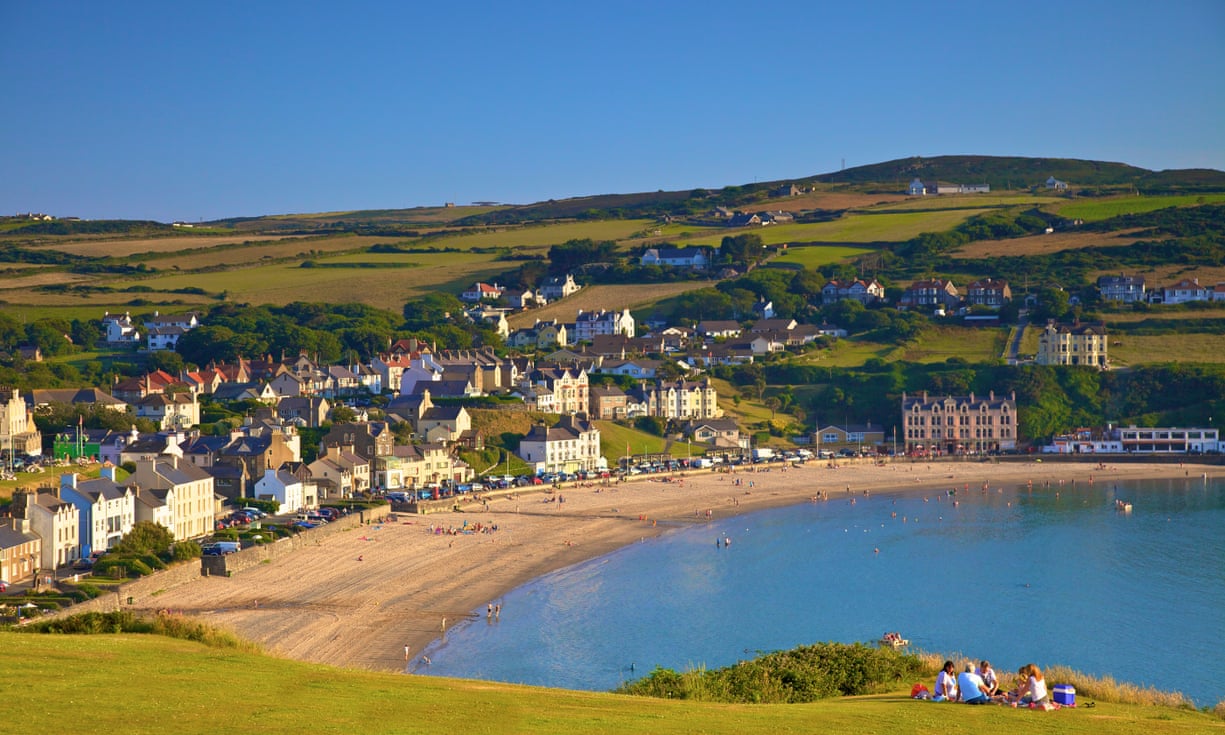
A community effort involving thousands of volunteers keeps the Isle of Man’s beaches plastic-free.
Photograph: Neil Farrin

From The Guardian by Sandra Laville

In just 10 years, the Isle of Man has rid its beaches of plastic and earned Unesco status as a world leader in ocean protection.
So how did it do it?

Standing on a windswept beach on the north-west coast of the Isle of Man, Bill Dale looked out on to plastic bottles, cartons and packaging forming a thick carpet covering the shingle.
It was 2007, the global plastic binge was already well under way, but the millions of tonnes of waste seeping into the oceans as a consequence had not reached the public consciousness.
“I was with a friend and we thought, ‘Let’s just clean up this one beach.’
We had no idea then of the scale of the problem.”

It took six weekends, working long hours, to collect all the plastic litter.
“We shifted 30,000 plastic bottles and large pieces of plastic,” said Dale.
“You would pick one piece up, and underneath was another and another in layers.
Some of the stuff went back 20 years.”

 Isle of Man with the GeoGarage platform (UKHO chart)

Today, as Dale stands outside an Edwardian summerhouse in the west of the island at Niarbyl bay, he believes Manx beaches are the cleanest in Europe.
But the regular sweeps of the 100-mile coastline, conducted by his charity Beach Buddies, are just one facet of the island’s approach to ocean protection that makes it a global leader.

In the charity’s visitors’ book, alongside comments from schoolchildren, teachers and parents, there is a signature that stands out: that of Dr Han Qunli, a senior figure within the United Nations Educational, Scientific and Cultural Organisation (Unesco).
It was after his visit that the Isle of Man joined the likes of Mauritius, Menorca, Jeju in South Korea and Noosa in Australia in being singled out for a commitment to protecting and enhancing the coastal environment and biodiversity.

The Isle of Man does not have its own energy supply and imports natural gas from Europe
picture CROGGA

The island’s determination to protect the coastal environment from the multiple threats of plastic pollution, climate change and overfishing has earned it the status of a Unesco biosphere region, designated because it is an outstanding example of a place where people and nature work in harmony.
It is the only entire island jurisdiction to be granted the status.

One indication of the islanders’ commitment to a better marine environment is the numbers that turn out for Beach Buddies.
It has attracted 10,000 volunteers over the years – 12% of the Manx population.
Dale said: “We have kids who come with their schools to do a beach clean, then tell their parents: ‘Dad, I want to go and do a beach clean on Saturday,’ and they bring their parents here.
These beaches are virtually self-cleaning now.”

For marine biologist Dr Fiona Gell, who grew up on the Isle of Man, the grim reality of what is happening to the world’s oceans is all too familiar.
She has spent her life studying the damage being done to the sea’s flora and fauna, and has seen first-hand the devastation that means just 13% of the world’s oceans are untouched by the impact of humanity’s footprint.

Now a marine scientist at the Department for Environment, Food and Agriculture in the Isle of Man government, she heralds the steps being taken on the island as proof that all is not entirely lost.

In 2011, there were just two protected marine areas in the seas off the island.
But in the past seven years Gell and her team have been instrumental in throwing a protective ring around the island, increasing the number of marine protected areas to 10, which cover 50% of the inshore waters.
From the Calf of Man, a tiny island off the south coast where seals sunbathe on the rocks and basking sharks swim in the summer, to Ramsey Bay in the north, these marine nature reserves restrict trawling and dredging by fishermen and other damaging activities, in order to protect sealife habitats.

Looking out over Ramsey Bay, which in 2011 became a marine nature reserve covering 94 sq km, Gell points out the location of seagrass beds, horse mussel reefs and maerl beds that are once again thriving.
“Seagrass has declined globally in a really scary way, particularly in the UK, since the 1920s,” said Gell.
“It looks like a green meadow under the sea and has a really high level of carbon storage.
It is also really important for juvenile scallops.”

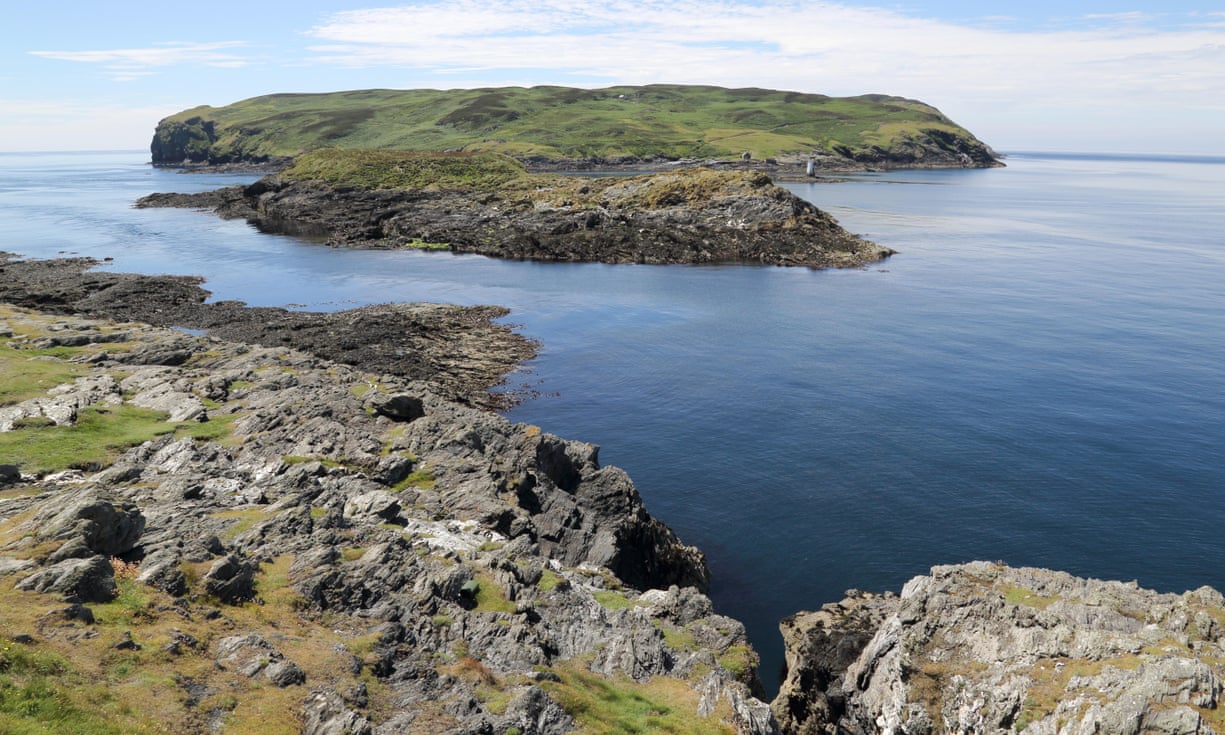
The Calf of Man, a small island on the Isle of Man’s south west coast, where seals sunbathe on the rocks and basking sharks swim.

 The Calf of Man island with the GeoGarage platform (UKHO chart)

Each marine feature being protected and enhanced by the reserve creates diverse habitats that allow scallops, juvenile cod, lobster and other fish to thrive.
And while in many areas the fishing industry finds itself at loggerheads with environmentalists, fishing businesses on the Isle of Man – which fish for king and queen scallops, brown crab, lobster and whelk – have been involved in drawing up the protective marine belt around the island, even if some had to be heavily persuaded at first of the case for the protection zone.

Dr David Beard, chief executive of the Manx Fish Producers Organisation, is also a marine biologist.
“Back in 2009, Ramsey Bay had been overfished, there was very little stock left in there and the industry volunteered that area to be closed for a period of time,” he said.

“It was an important source of both king and queen scallops from a value point of view and because the whole area supplies the spats [young scallops] to other areas in the Irish sea it affects the recruitment of the other stocks.”

The bay encompasses one of the most restricted fishing areas in the coastal waters, where dredging or trawling for scallops is banned throughout the year, except for two weeks before Christmas when up to 30 boats are allowed to go out.
Each year the fishermen carry out a stock survey, so by the time they are allowed to fish they know the location of the highest quantities of scallops.

“They get the highest value for the least impact,” said Beard.
“It is a very low-carbon action because they know where to go and they are allowed to trawl for 20 minutes maximum, and it means there is less impact on the seabed.
The fishermen know that if they destroy the seabed by overfishing you prevent the spat from settling, so you destroy the fishing, and it is a vicious circle.”

Gell has been instrumental in trying to bring the public and fishing industry along with the conservation efforts.
“We are trying not to impose from the top,” she said.
“Each marine protected area comes from a lot of engagement with the local people.
We go out all over the island to villages and towns and hold stakeholder meetings, with maps to discuss why an area needs to be protected, and to involve people and bring them onboard.
It is a slow process but when I look back to 2008 and see what we have achieved I think it shows that people working together in communities can make a difference.
“We have to stay optimistic. From my experience here over the past 10 years, I think we have shown people can get involved in a real community approach and can make a change.”

Isle of Man firm wins permission to search seabed for gas and oil (see BBC)
The area where surveys will be carried out spans 266 sq km (165 sq mile) 
(Block 112/25, also called the "Crogga Field" is the area the company has the licence to search)
image via Crogga

As one of 52 Unesco island and coastal biosphere areas, the Isle of Man is focusing now with partners in Menorca, the Maldives, the Philippines and other islands on eliminating single-use plastic from their shores.

If that eventually puts Bill Dale out of a job, he could not be happier.

Links :

Sunday, October 28, 2018

Sir Robin Knox-Johnston: a force of nature

It's 50 years since Sir Robin Knox-Johnston sailed non-stop around the world.
To mark this unique anniversary, Sir Robin talks to Neil Sackley about his epic voyage and why he did it.

Saturday, October 27, 2018

Hybrids


Hybrids - Film from HYBRIDS
When marine wildlife has to adapt to the pollution surrounding it, the rules of survival change.  

Friday, October 26, 2018

Ancient Black Sea shipwreck is unprecedented discovery

 An ancient Greek trading ship dating back more than 2,400 years has been found virtually intact at the bottom of the Black Sea, the world's oldest known shipwreck, researchers say.

From National Geographic by Kristin Romey

Archaeologists say the 2,400-year-old ship is so well preserved that even the mast and rowers' benches have survived for millennia.


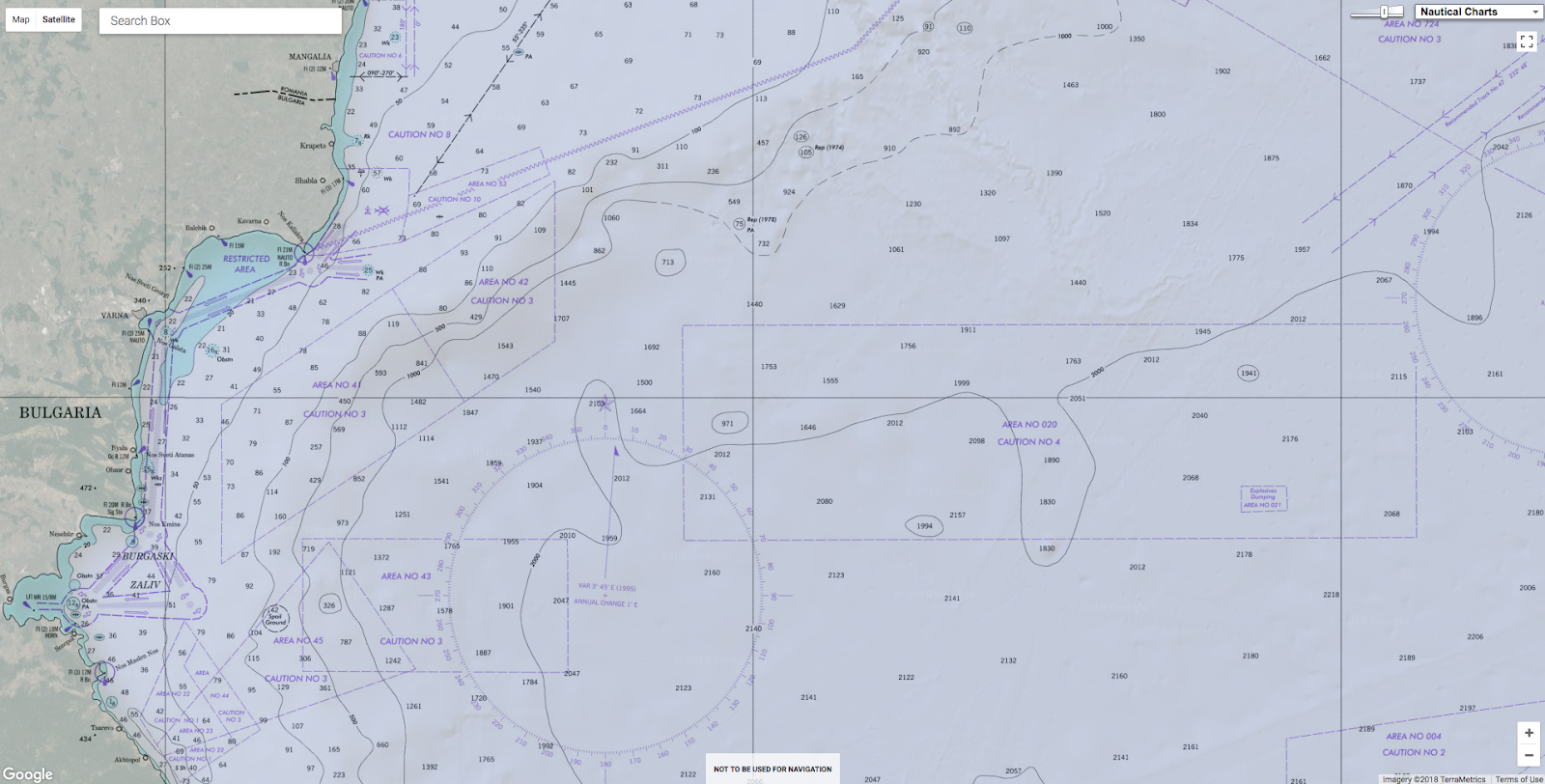
Archaeologists are heralding the discovery of an unusually intact ancient shipwreck, found more than a mile below the surface of the Black Sea off of the Bulgarian coast.
The 2,400-year-old wooden vessel features elements of ship construction, including the mast and rowing benches, that until now have not been preserved on ships of this age.

The Black Sea is considered to be one of the world’s finest under water laboratories due to the anoxic (un-oxygenated) layer which preserves artefacts better than any other marine environment.
(Read more about the Black Sea Maritime Archaeology Project.)

 The 23-metre (75ft) vessel, thought to be ancient Greek, was discovered with its mast, rudders and rowing benches all present and correct just over a mile below the surface, off the coast of Bulgaria
GeoGarage platform (NGA chart)

An announcement of the discovery, made by the Black Sea Maritime Archaeology Project (MAP), first appeared in the Guardian.
MAP has discovered more than 60 historic shipwrecks during a three-year survey of the Black Sea.
(See more shipwrecks discovered by the Black Sea Maritime Archaeology Project.)


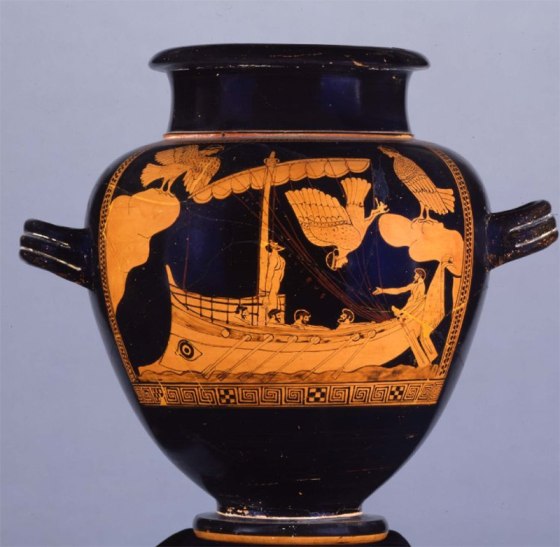
The 75-foot-long ship, documented by a Remote Operated Vehicle (ROV) equipped with cameras, appears similar to merchant vessels depicted on ancient Greek vases.

The 'Siren Vase' showing Odysseus at the mast.
The Trustees of the British Museum

A small piece of the wreck was raised and radiocarbon dated to around the fifth century B.C., a time when Greek city-states were frequently trading between the Mediterranean and their colonies along the Black Sea coast.

Black Sea MAP Maritime Archaeology Project documentary footage

While older intact sailing vessels have been recovered from Egyptian burial sites on land, it is unusual for submerged ancient wrecks to be preserved so well.
The unique preservation of the 2,400-year-old ship is due to the unusual water chemistry of the Black Sea and the lack of oxygen below 600 feet.
This anoxic layer, which makes up nearly 90 percent of the sea’s volume, prevents physical and chemical processes that cause organic decay to take place.


National Geographic Archaeologist-in-Residence Fredrik Hiebert, who has searched for Black Sea shipwrecks on an earlier National Geographic-sponsored expedition, says the new discovery reinforces the idea that the anoxic waters of the Black Sea “are an incredibly rich museum of human history.”
“This wreck shows the unprecedented potential for preservation in the Black Sea, which has been a critical crossroads of world cultures for thousands of years,” Hiebert says.
“It’s an incredible find.”

Links :