Monday, October 24, 2016

Mystery of the Bermuda Triangle solved?


National Geographic documentary

From BigThink by Paul Ratner

One of life’s great mysteries, the Bermuda Triangle might have finally found an explanation.
This strange region, that lies in the North Atlantic Ocean between Bermuda, Miami and San Juan, Puerto Rico, has been the presumed cause of dozens and dozens of mind-boggling disappearances of ships and planes.

The Bermuda Triangle lore includes such stories as that of Flight 19, a group of 5 U.S. torpedo bombers that vanished in the Triangle in 1945.
A rescue plane sent to look for them also disappeared. Other stories include the mystery of USS Cyclops, resulting in the largest non-combat loss of life in U.S. Navy’s history.
The ship with a crew of 309 went missing in 1918.
Even as recently as 2015, El Faro, a cargo ship with 33 on board vanished in the area.


Altogether, as far as we know, 75 planes and hundreds of ships met their demise in the Bermuda Triangle.
Possible causes for the catastrophes have been proposed over time, ranging from the paranormal, electromagnetic interference that causes compass problems, bad weather, the gulf stream, and large undersea fields of methane.
Now, a new theory has been proposed by meteorologists that claims that the reason for the mysteries pervading the Bermuda Triangle area are unusual hexagonal clouds creating 170 mph air bombs full of wind.
These air pockets cause all the mischief, sinking ships and downing planes.

courtesy of Science Channel

By studying imagery from a NASA satellite, the scientists concluded that some of these clouds reach 20 to 55 miles across.
Waves inside these wind monsters can reach as high as 45 feet.
What’s more - the clouds have straight edges. 
As told by Colorado State University’s satellite meteorologist Dr. Steve Miller to Science Channel’s “What on Earth”: “You don’t typically see straight edges with clouds. Most of the time, clouds are random in their distribution."
What’s special about that?
Meteorologist Randy Cerveny added: “The satellite imagery is really bizarre… These types of hexagonal shapes over the ocean are in essence air bombs. They are formed by what are called microbursts and they’re blasts of air that come down out of the bottom of a cloud and then hit the ocean and then create waves that can sometimes be massive in size as they start to interact with each other.”
Anything caught inside one of these air bombs could be very well knocked out of the air, flipped over, sunk.
More observation is needed to confirm this theory that could finally explain many of the infamous Bermuda Triangle events.
Scientists are pouring over satellite imagery to confirm.

Here’s the Science Channel interview:

Sunday, October 23, 2016

Jean-Michel Cousteau’s Secret Ocean

secretocean-thefilm.com
Narrated by renowned oceanographer Dr. Sylvia Earle, “Jean-Michel Cousteau’s Secret Ocean 3D” offers a breakthrough look at a secret world within the ocean that is perhaps the biggest story of all—that the smallest life in the sea is the mightiest force on which we all depend.
Alongside marine biologist Holly Lohuis, Jean-Michel Cousteau invites audiences to dive into this whole new world that will leave them in awe of the beauty and diversity of the oceans – the source of all life on our planet – and inspire an even stronger desire to protect what they have either seen for the first time or perhaps re-discovered along the journey. 

Filmed over 3 years in vibrant marine environments from the Bahamas to Fiji, the first giant screen film directed by Jean-Michel Cousteau provides a compelling, breakthrough look at a secret world within the ocean that is perhaps the biggest story of all—that the smallest life in the sea is the mightiest force on which we all depend.

"Secret Ocean 3D" engages audiences of all ages to experience the ocean as never before.
With breathtaking underwater sequences, viewers are introduced to over 30 species — some no bigger than one inch — and will discover behaviors captured for the very first time thanks to the development of new filming technologies in ultra-HD 5K, slow motion, macro, and with motion control.

"Since the 1940s, the Cousteau family has been deeply connected to the water. Millions of people have grown up with our Calypso adventures, which revealed to the public what was a totally unknown world at that time," said Jean-Michel Cousteau.
"Thanks to the new technology developed specifically for us, I immediately understood that this was a revolution in underwater filming that would allow us to capture a whole new range of behaviors I had never before witnessed in my 71 years of diving. 'Secret Ocean 3D' takes us one step further in the discovery of the ocean in a way my father, Jacques Cousteau, could have only imagined."

"From the time of my very first dive, I've had the frustration of knowing that there was always more beyond what I could see, but technology is key to being able to see the ocean with new eyes," said narrator Dr. Sylvia Earle.
"Thanks to the stunning giant screen format, 'Secret Ocean' allows us a deeper understanding of all life in the sea, the heart of our planet, and encourages us to take care of not only the large creatures, such as whales and dolphins, but also the tiny creatures that make the rest of life possible. With knowing comes caring, but first we need to know."

Alongside marine biologist Holly Lohuis, Jean-Michel Cousteau provides a brand new view of the underwater world that will leave audiences in awe of the beauty and diversity of the oceans – the source of all life on our planet – and inspire an even stronger desire to protect what they have seen for the first time, or re-discovered along the journey.

Saturday, October 22, 2016

Best of Les Voiles de Saint Tropez 2016

by Gilles -Martin Raget and Guilain Grenier "GMR+G1"

Friday, October 21, 2016

Wreck of German U-boat found off coast of Scotland


From BBC by

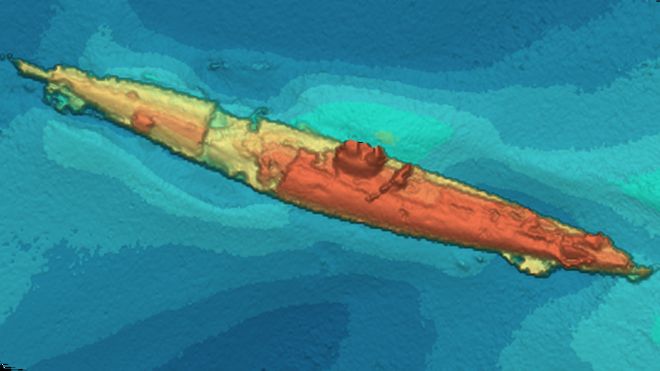
The wreck of a German U-boat that sank almost 100 years ago has been discovered by engineers laying subsea power cables.

 Images show the damage done to the wreck of the U-boat
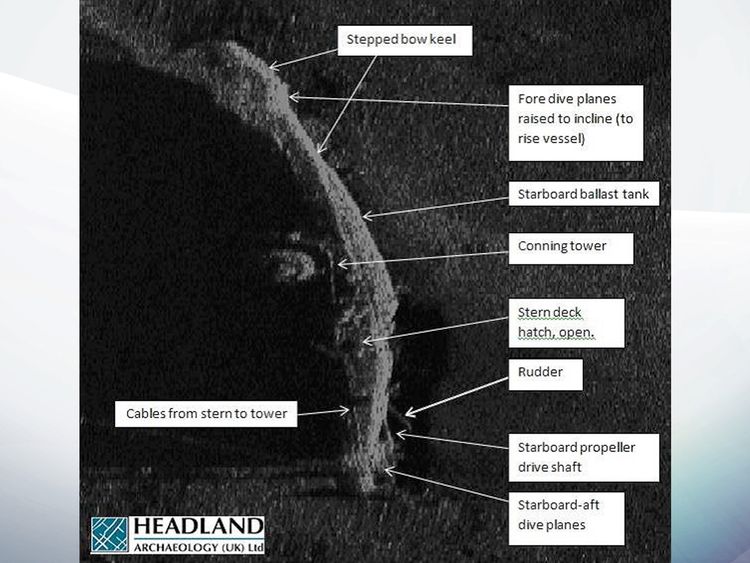
Remarkable sonar images show the missing World War One submarine is largely intact and lying off the Galloway coast.
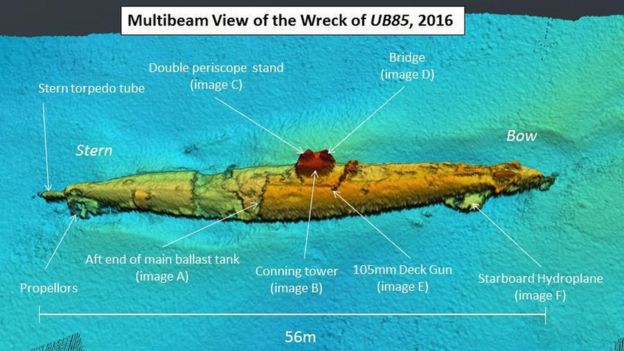
Experts believe the vessel could be the UB-85, a sub that sank in 1918, according to official records.
However, naval folklore suggests it may have been attacked by a "sea monster".

The WW1 U-boat wreck found off the coast of Scotland
could be the key to unlocking the alleged "Loch Ness" sinking.

Mysterious sinking

The entire crew of the U-boat is reported to have abandoned ship due to the "monster attack".
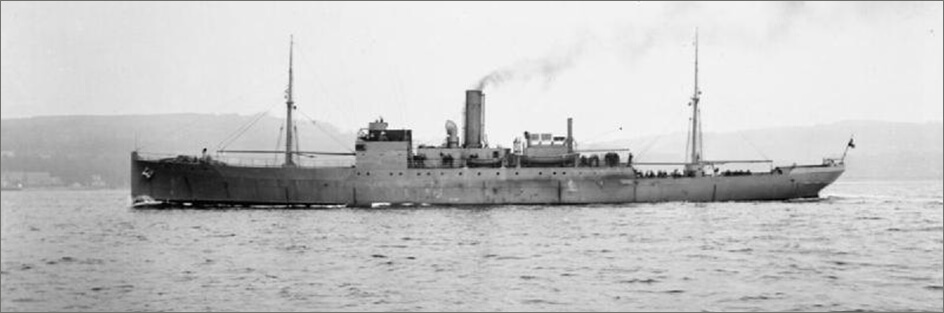
Once aboard the British ship HM Drifter Coreopsis, their commander, Captain Krech described their encounter.
He is said to have spoken of a beast with "large eyes, set in a horny sort of skull…with teeth that could be seen glistening in the moonlight".
He apparently claimed that the sub was so damaged in its battle with the "monster", it could no longer submerge.


However, Dr Innes McCartney, a historian and nautical archaeologist who helped identify the wreckage, does not believe the tale.
"In reality, the real sea monster was the U-boat, here trying to sink ships," he said.
He added: "The submarine was caught on the surface at night, recharging its batteries.
"It saw the patrol ship coming. It attempted to do a crash dive to get away.
"Once the submarine was under water, it rapidly started flooding from above so they had no option but to blow all the compressed air they had, bring the submarine to the surface at which point all they could do was surrender."
The historian said tales of sea monsters and haunted U-boats came about due to secrecy surrounding exactly what happened during the first U-boat war which meant that period was "ripe for conspiracies".
He said the stories were often concocted as a result of journalists and ex-Navy men "talking late at night, after having a nice time".


Mechanical failure

Dr McCartney said there were at least 12 British and German submarines known to have sunk in the Irish Sea.
He said: "The features of this particular wreck, which is largely intact, confirm it as a UBIII-Class submarine, of which we know of two which were lost in the area - the more famous UB-85 and its sister boat UB-82.
"While I can conclude that this wreck is likely to be one or the other, they would be practically impossible to tell apart, aside from the numbers painted on them in service, now obviously long gone.
"Unless a diver can find a shipyard stamp, we cannot say definitively, but yes, we're certainly closer to solving the so-called mystery of UB-85 and the reason behind its sinking - whether common mechanical failure or something that is less easily explained."

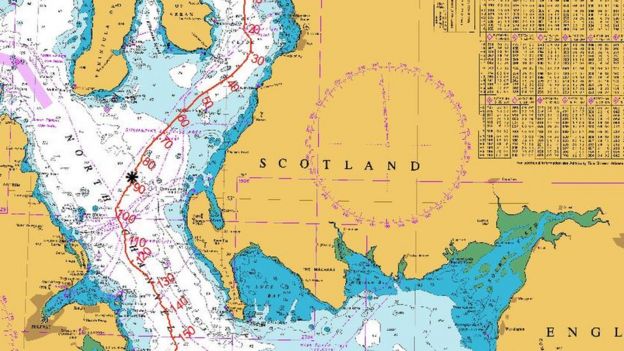
The site of the wreckage is marked with a black star, on the route of the undersea cable 
off coast of Stranraer

The historic discovery was made by engineers involved in the £1bn Western Link project to lay a subsea power line between Ayrshire and the Wirral.
The 385km (239miles) long cable will carry renewable energy produced in Scotland to England and Wales.
The engineers found the wreckage 120m north-west of the centre of the planned route, off the Stranraer coast.
It is about 45m long, with debris spilling from the stern.

Gary Campbell, the keeper of the Official Sightings Register of the Loch Ness Monster, said it was "entirely feasible" that a large sea creature disabled the submarine.

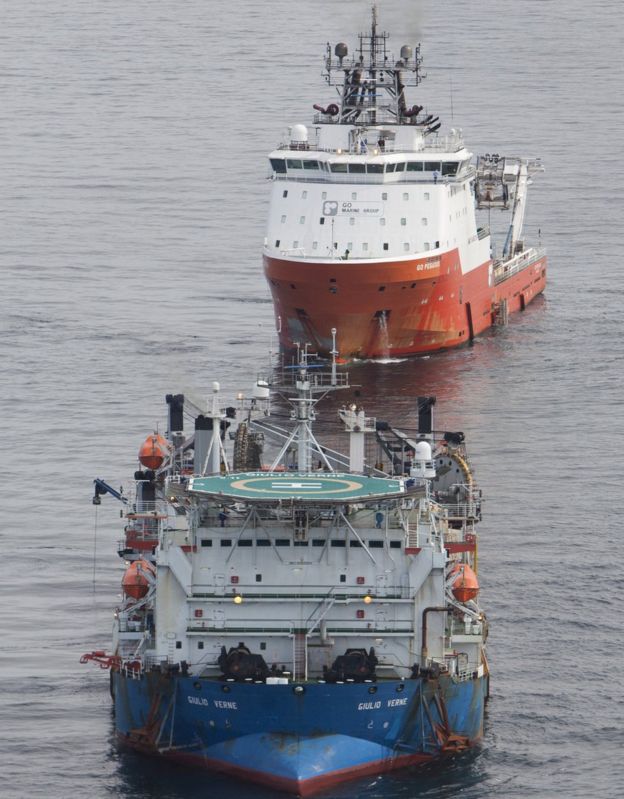
 The discovery was made by marine engineers involved in laying an offshore cable connecting Scotland and England

Environmental impact

"The World War One report from the captain of the British ship HMS Hilary a year earlier makes it clear that sea farers at that time were well aware of large sea 'monsters' that could be harmful to their ships," he said.
"The area of sea where the attack took place has a history of sea monster sightings - they have ranged from the north coast of Wales to Liverpool Bay. What the German captain said could well be true."

 The marine cable is approximately 385km long.

Scottish Power Transmission and the National Grid are working together on the Western Link project to lay the undersea cable.
Peter Roper, of Scottish Power, said: "The images we get back from the subsea scans are incredibly detailed, but we obviously need to be aware of what lies beneath before we can start laying a power cable.
"In all the years I have been building power lines, I can say that this is the most extraordinary discovery."

National Grid's Graham Edwards said: "The Western Link is a very significant project for the UK and has required careful planning in all aspects, but particularly in the laying of high-voltage cables in the sea, where we are working hard to minimise our impact on the environment.
"During construction we take great care over archaeology, whether on land or at sea, and it's always exciting to record a significant find and help to shed new light on our history - especially one with such a good tale involved!"

Links :

Thursday, October 20, 2016

Stanford VR project takes students to oceans of the future

Roughly 30 percent of the carbon dioxide produced by humans dissolves into oceans, rivers and lakes, transforming conditions for ocean life for the worse.
Stanford scientists have produced a 360-degree virtual underwater ecosystem to provide an up-close look at how coral reefs might appear by the end of the century if emissions aren’t curbed

From Campus Technology by Dian Schaffhauser 

A new, free virtual reality program allows users to explore what happens as climate change kills off coral reefs.
The Stanford Ocean Acidification Experience is a free science education tool that takes students to the bottom of the sea and then fast-forwards their experience to the end of this century, when, as scientists predict, many coral reefs are expected to corrode through ocean acidification.
By putting the experience in VR, the collaborators say they are hoping to change people's behavior in the real world.

The project came out of Stanford's Virtual Human Interaction Lab, which created a related 360-degree video project that also examines the problem of global warming and its impact on the ocean's life forms.
But it's the VR version that allows the viewer to deep-sea dive and collect samples off of the ocean floor.

 Wearing a virtual reality headset, a researcher tries out the Stanford Ocean Acidification Experience, a new VR science education tool, with coral animation still in background.
(Image credit: Stanford Virtual Human Interaction Lab)

The simulation places the viewer into heavy traffic, where he or she can follow carbon dioxide molecules as they float from car tailpipes to the sea, where they're absorbed.
Then the viewer steps into the waves and moves around coral as it loses its vitality and displays the effects of increasingly acidic water on marine life.
A narrator explains what's happening as the story unfolds and encourages the viewer to undertake specific actions, such as a species count.
"You're not watching something, you're doing it," said Jeremy Bailenson, founding director of the lab and a communications professor.
"You learn by doing. These are magic, teachable moments."

The lab created the software in partnership with marine biologists Fiorenza Micheli from Stanford and Kristy Kroeker, formerly at Stanford and now at the University of California, Santa Cruz, as well as Roy Pea, a professor at Stanford's Graduate School of Education.
The development process took two years to recreate a virtual replica of an actual rocky reef around the Italian island of Ischia, where underground volcanic vents have been spewing carbon dioxide at the reef.
The data collected from that site has allowed researchers to measure the impact on marine life and to extrapolate what effect people's increasing fossil fuel use will have in decades to come.

A related video, "The Crystal Reef," filmed in 360 degrees and developed as part of a master's degree project by a lab member, premiered during the Tribeca Film Festival earlier this year.
There, people could watch the film on VR headgear.
"We had a line of dozens of people for 11 hours a day, six days straight," said Bailenson, in a Stanford article about the project.

The VR project has also gone to Washington, where lawmakers and staffers tried it out during a Capitol Hill event organized by non-profit Ocean Conservancy.
Among them was Sen. Sheldon Whitehouse of Rhode Island.
"This simulation shows in rich detail the damage carbon pollution inflicts on our oceans," said Whitehouse after his viewing.
"I appreciate the Stanford Ocean Acidification Experience for calling attention to the peril our oceans face and what we must do to protect them."


 Other research from Stanford :
A combination of sensors and video reveals details about the hunting methods of the largest predators that have ever lived.
The study focuses on rorquals, a family of baleen whales that includes blue whales, humpbacks and minke whales. 

Links :