Monday, November 5, 2012

Canada CHS update in the Marine GeoGarage


24 charts have been updated (October 30, 2012) :

    • 1220    BAIE DES SEPT ILES            
    • 1233    CAP AUX OIES TO SAULT-AU-COCHON            
    • 1315    QUEBEC TO DONNACONA            
    • 1316    PORT DE QUEBEC            
    • 1317    SAULT-AU-COCHON TO QUEBEC            
    • 1431    CANAL DE BEAUHARNOIS - LAC SAINT-LOUIS TO SAINT    FRANCOIS
    • 2023A    PETERBOROUGH TO LAKEFIELD            
    • 2023B    LAKEFIELD TO BURLEIGH FALLS            
    • 2023C    STONY LAKE            
    • 2025A    BOBCAYGEON TO BALSAM LAKE            
    • 2025B    BALSAM LAKE            
    • 2025C    BALSAM LAKE TO LAKE SIMCOE            
    • 2060    MAIN DUCK ISLAND TO SCOTCH BONNET ISLAND            
    • 2064    KINGSTON TO FALSE DUCKS ISLANDS            
    • 3646    PLANS BARKLEY SOUND            
    • 3671    BARKLEY SOUND            
    • 3809    CARPENTER BAY TO BURNABY ISLAND            
    • 4001    GULF OF MAINE TO STRAIT OF BELLE ISLE
    • 4003    CAPE BRETON TO CAPE COD            
    • 4099    SABLE ISLAND / ILE DE SABLE - WESTERN PORTION
    • 4115    PASSAMAQUODDY BAY AND ST CROIX RIVER            
    • 4124    LETETE PASSAGE LETANG HARBOUR AND BLACKS HARBOUR
    • 4209    LOCKEPORT HARBOUR AND SHELBURNE HARBOUR            
    • 4432    ARCHIPEL DE MINGAN            
    • 4652    HUMBER ARM - MEADOWS POINT TO HUMBER RIVER            
    • 4921    CHALEUR BAY - NORTH SHORE
    • 4954    CHENAL DU HAVRE DE LA GRANDE ENTRE            
    • 4955    HAVRE-AUX-MAISONS           

    So 688 charts (1659 including sub-charts) are available in the Canada CHS layer. (see coverage)

    Note : don't forget to visit 'Notices to Mariners' published monthly and available from the Canadian Coast Guard both online or through a free hardcopy subscription service.
    This essential publication provides the latest information on changes to the aids to navigation system, as well as updates from CHS regarding CHS charts and publications.
    See also written Notices to Shipping and Navarea warnings : NOTSHIP

    Mysterious pumice raft in Pacific explained

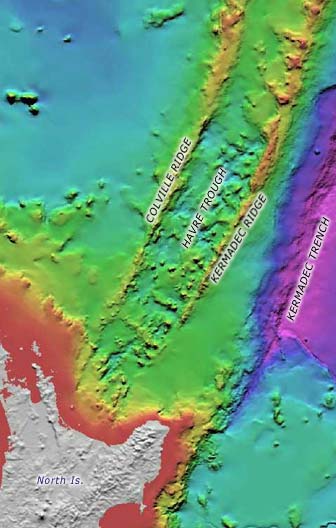
    A multibeam echosounder image showing the undersea volcano called Havre Seamount, including a new cone that formed during the July 2012 eruption.
    credit: NIWA/GNS Science

    From LiveScience

    Back in August, an enormous floating mass of pumice was spotted in the South Pacific Ocean off the coast of New Zealand.
    New evidence of changes on the seafloor confirms an erupting undersea volcano created the sprawling rock raft.
    New Zealand scientists aboard the research vessel Tangaroa recently mapped the underwater volcano, Havre Seamount, which erupted on July 19 and was thought to have sent pumice rocks floating over a stretch of ocean 8,500 square miles (22,000 square kilometers).
    Now, the scientists say they detected a new volcanic cone — a feature built during an eruption — at Havre Seamount, reaching within 3,600 feet (1,100 meters) of the surface.
    (Pumice forms when volcanic lava cools quickly.
    Gas gets trapped inside as the lava hardens, resulting in porous lightweight rocks that can float.)

    >>> geolocalization with the Marine GeoGarage <<<


    Fluffy white stuff

    On Aug. 9, the HMNZS Canterbury ship observed the floating pumice "island" — measuring 300 miles (482 kilometers) in length and more than 30 miles (48 km) wide.
    The floating fluff apparently "lit up a brilliant white color" under a spotlight, "like the edge of an ice shelf," said Lieutenant Tim Oscar, a Royal Australian Navy officer, in a statement at the time.
    [See Photos of the Pumice Raft & Volcano]

     On the same day, though this time in the afternoon, NASA's MODIS snaps imagery clearly showing the Havre Seamount eruption, including the gray pumice, ash-stained water and the volcanic plume.credit : Jeff Schmaltz, LANCE MODIS Rapid Response Team at NASA GSFC

    The researchers from New Zealand's National Institute of Water and Atmospheric Research (NIWA) aboard Tangaroa are currently on the last leg of their 23-day voyage to study the Kermadecs, a volcanic island arc north of New Zealand.
    Their findings, along with an analysis of satellite images, make a pretty sealed-tight case for the pumice culprit.
    They had previously mapped this undersea volcano in 2002 using a so-called multibeam echosounder, so they could compare those images with the recent ones taken this month.
    (The angle and travel time of the initial sound waves sent out allows scientists to create an image of the seafloor.)
    They found these new volcanic cones, or miniature versions of the larger volcano, one towering at 787 feet (240 meters), on the rim of the caldera, NIWA marine geologist Joshu Mountjoy told LiveScience.
    "The new map shows that the internal wall of the caldera now has up to 180 meters [590 feet] of lateral 'bulging' indicating the location of future eruption, or wall collapse," Mountjoy added.
    Their analysis also suggests two magma types were involved, an explosive type called rhyolite that shot pumice up to the ocean surface, and a less volatile one that settled out to build the new volcanic cones.
    "The rhyolite had high volatiles, much as a can of soda is full of carbon dioxide, so when it was shaken up and the pressure released on eruption (like opening the tab on the soda can) the magma came out violently and explosively, leading to ash and pumice that went from about a mile below sea level into the atmosphere," NIWA volcanologist Richard Wysoczanski wrote in an email to LiveScience.
    The geochemistry of fresh samples of pumice taken from around the Havre Volcano matched up with that of samples taken from the surface raft, Wysoczanski found.

    An undersea shakeup

    Here's how Wysoczanski thinks events leading to the vast raft went down: Sizeable earthquakes in the region on July 17 may have shaken up chambers of magma and caused movement of the basaltic magma well beneath the volcano.
    As it moved toward the surface, that magma would have intersected the rhyolitic, pumice-forming magma.

     On Aug. 9, the HMNZS Canterbury, a Royal New Zealand Air Force ship, observed a stretch of floating pumice, measuring a whopping 300 miles (482 kilometers) in length and more than 30 miles (48 km) wide. credit : New Zealand Defence Force

    "Contact between the two magmas would have triggered the eruption leading to an explosive ash and pumice eruption from the caldera floor as well as basaltic magmas being erupted on the caldera rim at the top of the volcano, forming the volcanic cones," Wysoczanski wrote.
    The Havre eruption tapered off by July 21, just days after it began, leaving behind the sprawling raft of pumice. Winds and currents have since spread the porous rocks into "a series of twisted filaments," according to the NASA statement.
    On Aug. 13, the pumice was spread over an area about 280 by 160 miles (450 by 258 kilometers).
    And currently, according to NIWA scientists, the pumice is still floating in thin filaments and it will likely take some time for the rocks to totally disperse.

    Links :

    Sunday, November 4, 2012

    There's a storm coming! Photographer captures spectacular shelf cloud formation off the coast of Florida

     June 12, 2012 Southern Volusia / Northern Brevard County, FL.
    Chased as the East Coast and West Coast seabreezes combined with an outflow boundary
    to produce a line of storms along the East Coast of Florida.

    From DailyMail

    There's a storm coming! Photographer captures spectacular shelf cloud formation off the coast of Florida

    There may be trouble ahead - at least for the people living on Florida's Atlantic coast.
    These stunning pictures were taken by award-winning photographer Jason Weingart at Ormond Beach and show a spectacular shelf cloud formation rolling in from the ocean.
    Shelf clouds are low, horizontal wedge-shaped arcus cloud, associated with a thunderstorm gust front or occasionally with a cold front.

    Watch out: There's bad weather on the horizon in Florida
    Watch out: There's bad weather on the horizon in Florida
    Warning: Jason Weingart captures a shelf cloud appoaching Ormond beach in Florida

    While they're are not dangerous, their threatening appearance certainly looks so.
    Moreover, they are a reliable indicator that a thunderstorm is nearby and could be arriving soon.
    Mr Weingart entered his picture of a lifeguard at the beach into NASA's Global Precipitation Mission sponsored extreme weather photo contest. (It was named one of the five winners.)


    Speaking about the picture, he said: 'I have shot many storms from the same spot this photo was taken, and I almost drove by to get a different vantage point, but something told me to just stop at my spot.
    'I jumped out of my car and ran down to the beach. To my surprise, there were still several beach-goers taking in the sight of this massive shelf cloud, as well as a few surfers in the water, trying to catch one last wave.'

    There's trouble ahead: Jason Weingart's pictures show an incredible shelf cloud formation

    Jason Weingart captures a shelf cloud appoaching Ormond beach in Florida
    While shelf clouds are not dangerous, their threatening appearance certainly looks so

    Jason Weingart's amazing pictures were taken by chance in Florida
    Jason Weingart's amazing pictures were taken by chance in Florida

    Saturday, November 3, 2012

    Two fishermen rescued by another fishing vessel

    Dramatic footage shows a fishing boat being swallowed up by the sea — moments before the two-men crew is plucked to safety by another trawler.

    From TheSun

    Captain Stephen Kearney, who has been fishing for nearly 20 years, and another man were on board the vessel on Tuesday when it began taking on water and they were forced to head for Ardglass (Ireland).
    "We just went up on a wave and the back of the boat went into the water and she just never come back - she just went down that quick," Stephen explained.
    While another fishing boat, the Tribute, was nearby and went to the rescue, Stephen's fellow fisherman had already become entangled in a rope attached to the boat."
    A split second and you had to react," the captain said, describing how fast the sinking and the rescue effort all happened.
    Both men are lucky to be alive, with Stephen recalling how the strong tides kept pushing them away from the boat that was trying to save them.
    Both men spent 10mins in the water.
    They were airlifted to hospital by the Irish coastguard.
    Stephen knows how lucky they are to be alive but, while he will be taking some time off to recover fully, he plans to be back fishing within weeks.
    And he's very grateful to their rescuers, who he credits with saving their lives.

    Friday, November 2, 2012

    Mike Peyton, "The world's greatest yachting cartoonist,"


    From CNN

    "Cartoons are about doom and disaster -- and you don't get more doom and disaster than in a German prisoner of war camp," says Mike Peyton, the man uniquely hailed as the world's greatest yachting cartoonist.
    As a teenage illustrator from the British mining town of Durham, Peyton was captured by World War II German forces while drawing maps of the north African desert for the Intelligence Corps.
    Yet amid the horrors of his prison camp - the 91-year-old recalls eating Nazi guard dogs that had been clubbed to death - Peyton carved a unique space for laughter by drawing wry, darkly humorous cartoons.
    Published in a prisoner-run newspaper, the drawings poked fun at camp life, offering Peyton a distraction from the everyday brutality and his fellow inmates a rare source of joy.

    They would also spark the beginnings of a career spanning seven decades, more than 20 books and the birth of an unusual new genre in illustration - nautical cartooning.
    It's a genre that Peyton has dominated for 70 years, amassing followers across the world with his trademark, roughly scribbled drawings of rain-sodden sailors naively headed for impending doom.
    If the leap from a 1942 prison camp to hopeless yachtsmen lost at sea seems huge, Peyton has the answer: "The secret to cartoons is you always need something going wrong."
    Following the war, the then 24-year-old continued sketching his droll observations of everyday life.
    But it wasn't until Peyton bought a boat in his late 20s, setting up a business offering charter cruises, that he began to turn his illustrations to sailing.


    "I'll be glad to get in. We've had enough excitement for one day."

    Now a retrospective of his work - "The World of Peyton" - published this week, features 150 of his favorite sketches.

    Sadly it will also be Peyton's last book, after gradually losing much of his eyesight.
    "Mike has reached the point now where he is going blind," Janet Murphy, publishing director at Adlard Coles Nautical, said.
    "It seemed such a cruel disability for a cartoonist to have their eyesight shot down. So we asked Mike to put together his best cartoons for a final retrospective."

     Having been published in a plethora of British magazines ranging from Yachting Monthly to the Church of England Times, Peyton admitted it was a huge undertaking whittling down his immense collection of work.
    Science and technology periodical New Scientist paid tribute to the man who began drawing for them in the 1950s, claiming he had "seen off more editors than anyone else at the magazine."
    It added: "His sharp eye and satire often contrasts with a softer, gentler approach when the subject warrants it."

    "The last time I saw the boat keys was where you always leave them: 
    on top of your desk -- and may I add -- to be touched by no one."

    But It is among sailing enthusiasts that Peyton's name brings most smiles.
    As Janet explained: "Mike is synonymous with nautical cartoons."
    "He is on a pinnacle all on his own -- Mike is the one yachting cartoonist people think of. He's got a unique skill of seeing the funny side in a typical situation -- whether it's people huddling under waterproof gear or wives looking forlornly out the window as they lose their husbands to sailing in the snow on Christmas Day," she said.


    "There's no one who can touch him, both because he's been going for 70 years and because he's been so prolific over that period."
    Before Peyton, there simply were no yachting cartoonists, she argued: "He blazed a trail. There was humorous writing around sailing but up until the war it was still quite an elitist pastime, which people took very seriously.
    "It's quite hard to keep humor going year after year. But that's Mike's skill. Those everyday sailing mishaps such as tweaking bits of rope or relying on the weather strike a chord with people all over the world."

     "I thought we were in with a chance when you stopped praying 
    and started composing a letter to your insurance company."

    After the war Peyton pursued his love of drawing, heading to Manchester Art School where he met future wife and now successful children's author Kath Peyton.
    The penniless newlyweds spent their honeymoon sleeping rough across Europe, paying their way by collecting waste paper en route.

    "I reckon I am the only bride that ever had to collect salvage in Paris to earn her fare back across the Channel," Kath recalls in Dick Durham's autobiography on Peyton, titled -- naturally enough - "The World's Greatest Yachting Cartoonist."
    Returning to the UK, the couple set up home in rural Essex on the River Crouch. But instead of spending their hard-earned savings on renovating their dilapidated cottage as planned, Peyton bought a boat -- much to his wife's dismay.
    His reason? "You can't sail a house," he told CNN.

     "Have you got everything? Aspirins, Stugeron, spare glasses, medication, hearing aid, factor 30, thermals, digestive tablets..."

    When not drawing, the father-of-two worked as a sailor; taking out charter parties, racing boats and delivering yachts everywhere from London to the Baltic Sea.
    "I didn't have to think up cartoons -- I saw them happen. They're all based on real life," he said.
    "I remember years ago I thought I'd run out of ideas. But I never have."