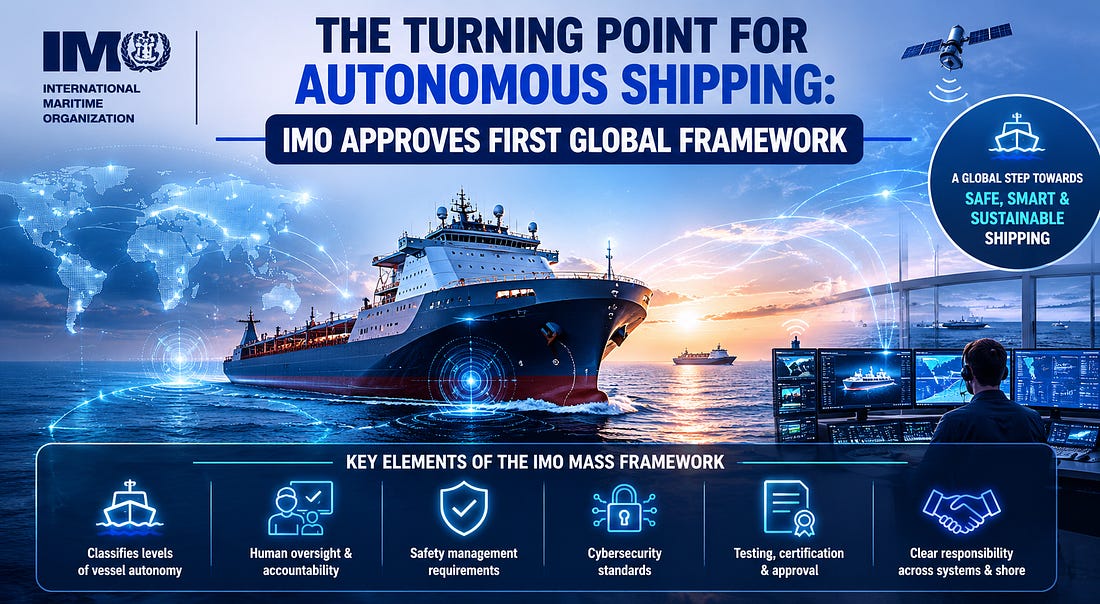
The International Maritime Organization (IMO) has taken a significant step toward the commercial adoption of autonomous shipping by approving the first global regulatory framework for Maritime Autonomous Surface Ships (MASS).
The framework establishes baseline international requirements for the safe operation of autonomous and remotely operated vessels.
The framework establishes baseline international requirements for the safe operation of autonomous and remotely operated vessels.
It is designed to provide a harmonised approach across flag states, reducing fragmented national interpretations and creating a consistent structure for future deployment.
The IMO Maritime Safety Committee has approved the introduction of the VHF Data Exchange System (VDES) into the regulatory framework, with implementation expected from January 1, 2028.
VDES is often described as the next evolution of AIS, but its significance goes beyond vessel tracking.
VDES is often described as the next evolution of AIS, but its significance goes beyond vessel tracking.
While AIS primarily broadcasts a vessel's identity, position, speed, and course, VDES enables richer and more secure bidirectional communication between:
→ Ship-to-ship
→ Ship-to-shore
→ Ship-to-satellite
It also enables the exchange of operational and sensor data across the maritime ecosystem.
This is a key step toward a connected maritime future where:
- Vessels become data nodes
- Ports become intelligence hubs
- Fleets operate as coordinated networks
- Maritime awareness extends beyond individual platforms
VDES alone will not create a network-centric ocean, but it provides one of the critical communication layers needed to make it possible.
The future of maritime autonomy is not just autonomous vessels.
It is connected maritime intelligence.
→ Ship-to-ship
→ Ship-to-shore
→ Ship-to-satellite
It also enables the exchange of operational and sensor data across the maritime ecosystem.
This is a key step toward a connected maritime future where:
- Vessels become data nodes
- Ports become intelligence hubs
- Fleets operate as coordinated networks
- Maritime awareness extends beyond individual platforms
VDES alone will not create a network-centric ocean, but it provides one of the critical communication layers needed to make it possible.
The future of maritime autonomy is not just autonomous vessels.
It is connected maritime intelligence.
Key elements of the framework
The approved framework includes several foundational components intended to govern the safe integration of autonomous vessel technologies: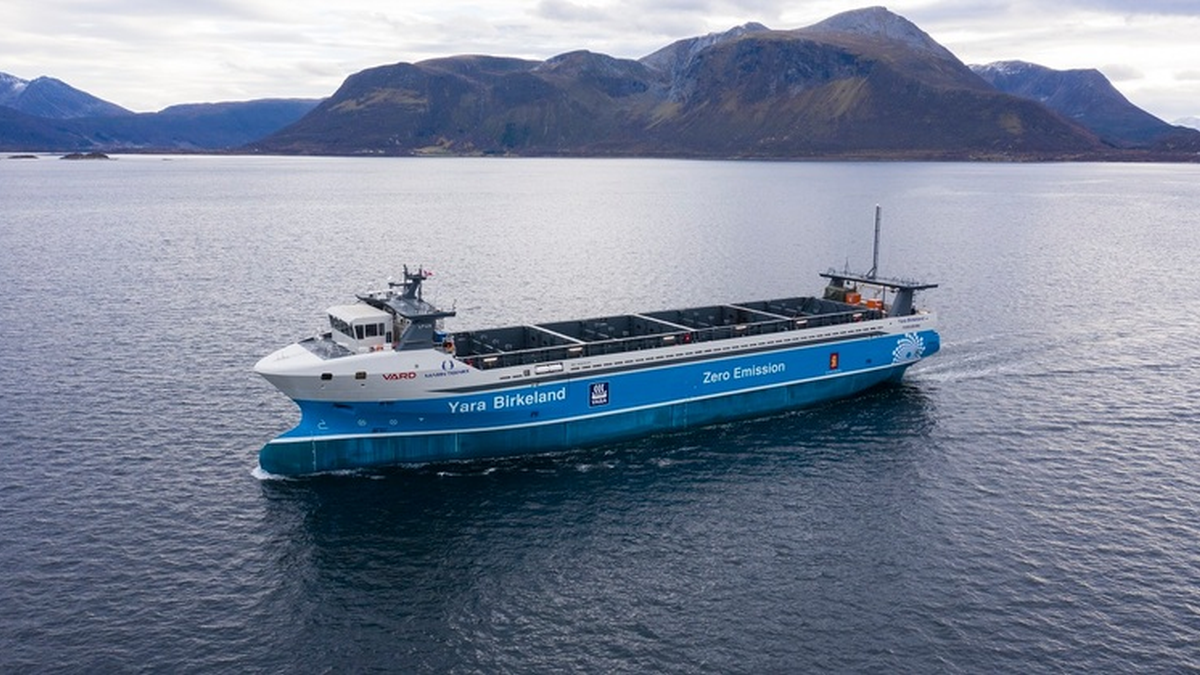
The approved framework includes several foundational components intended to govern the safe integration of autonomous vessel technologies:
- Classification of different levels of vessel autonomy, from ship-controlled to fully autonomous operations
- Requirements for human oversight and accountability, including the role of shore-based control centres
- Mandatory safety management provisions for autonomous and remotely operated systems
- Cybersecurity standards addressing system resilience and operational integrity
- Testing, certification, and approval processes for autonomous vessel technologies
- Allocation of responsibility between onboard systems, remote operators, and regulatory authorities
Yara Birkeland was the world’s first fully autonomous container ship
(source: Yara Marine Technologies)
Why this matters for shipping markets
For years, autonomous vessel technology has progressed through trials and pilot projects, but regulatory uncertainty has remained one of the main barriers to wider commercial adoption.
For years, autonomous vessel technology has progressed through trials and pilot projects, but regulatory uncertainty has remained one of the main barriers to wider commercial adoption.
This framework provides the first structured pathway for integration into international shipping rules.
The development is relevant not only for maritime technology providers but also for commodity shipping markets, where operational efficiency and cost structures are closely linked to vessel performance.
Expected operational benefits
Autonomous and AI-enabled vessel operations are expected to support several efficiency gains across global shipping networks:
The IMO’s move reflects a broader industry transition toward digitalisation, where AI-assisted navigation, digital twins, and advanced analytics are becoming increasingly embedded in vessel operations.
Rather than being a standalone innovation, autonomous shipping is emerging as part of a wider transformation in how maritime logistics systems are managed and optimised.
The development is relevant not only for maritime technology providers but also for commodity shipping markets, where operational efficiency and cost structures are closely linked to vessel performance.
Expected operational benefits
Autonomous and AI-enabled vessel operations are expected to support several efficiency gains across global shipping networks:
- Improved voyage optimisation and route planning
- Reduced fuel consumption and emissions
- More efficient port arrivals and reduced waiting times
- Enhanced predictive maintenance capabilities
- Greater use of remote monitoring and operational support
The IMO’s move reflects a broader industry transition toward digitalisation, where AI-assisted navigation, digital twins, and advanced analytics are becoming increasingly embedded in vessel operations.
Rather than being a standalone innovation, autonomous shipping is emerging as part of a wider transformation in how maritime logistics systems are managed and optimised.
MASS stands for Maritime Autonomous Surface Ships.
These are ships that can operate with varying degrees of autonomy, ranging from partial automation to fully autonomous operations without human intervention.
The International Maritime Organization (IMO) has defined four levels of autonomy for MASS:
Degree One: Crewed Ships with Automation: Ships with automated processes and decision support. Seafarers are on board to operate and control shipboard systems and functions. Some operations may be automated.
Degree Two: Remotely Operated Ships with Crew Onboard: Remotely controlled ships with seafarers on board. The ship is controlled and operated from another location, but there are still crew members on board.
Degree Three: Remotely Operated Ships without Crew Onboard: Remotely controlled ships without seafarers on board. The ship is operated entirely from a remote location, and there is no crew on board.
Degree Four: Fully Autonomous Ships: Fully autonomous ships. The ship’s operating system can make decisions and take actions independently without human intervention.
What comes next
While fully autonomous deep-sea bulk carriers and tankers remain some way off, this framework marks an important transition from experimentation toward regulated implementation.
It will be interesting to see which segment adopts first: coastal shipping, offshore support vessels, short-sea trades, or eventually large-scale deep-sea commercial fleets.
Links :
While fully autonomous deep-sea bulk carriers and tankers remain some way off, this framework marks an important transition from experimentation toward regulated implementation.
It will be interesting to see which segment adopts first: coastal shipping, offshore support vessels, short-sea trades, or eventually large-scale deep-sea commercial fleets.
Links :

No comments:
Post a Comment