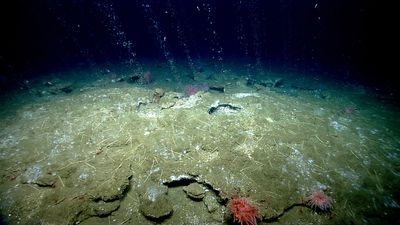
Cold seeps offer a brilliant window into this otherwise hidden world.
These cracks in the ocean floor act as vents, spewing enormous volumes of fluid from the subseafloor into the sea above.
Image credit: NOAA Office of Ocean Exploration and Research, 2013 ROV Shakedown and Field Trials in the U.S. Atlantic Canyons
Image credit: NOAA Office of Ocean Exploration and Research, 2013 ROV Shakedown and Field Trials in the U.S. Atlantic Canyons
From IFLS by Tom Hale
Earth's lifeless geology and its organic inhabitants share a surprisingly harmonious, cyclical relationship.
Beneath the seafloor, rich colonies of microbes thrive within buried ocean sediment.
Through the slow grind of tectonic plates, some are carried to the surface while others are swallowed into the planet's interior in what geologists have dubbed a "tectonic pump."
Until recently, scientists had little idea of just how much life lurks below the surface.
The deep subsurface was long considered too hot, too pressurized, too starved of nutrients to harbor much of anything.
But over the past few decades, advances in sampling technology and DNA sequencing have revealed a hidden “deep biosphere” of staggering scale.
By some estimates, the majority of microbes on the planet live underground, sometimes sitting dormant for thousands or even millions of years.
According to new research by the University of Southern California, the “tectonic pump” may be an important part of this process.
The researchers unearthed evidence of a giant geological “elevator” upon noticing that regions with more earthquake activity tended to harbor a greater abundance of underground-dwelling microbes on the seafloor.
Earthquakes, it seemed, were dredging these microbes up from the deep.
“We can also examine how seismic activity relates to the relative abundance of different microbial groups, and we find a positive correlation between seismic energy and the abundance of subsurface-associated microbes,” Zhengze Li, a PhD student at the University of Southern California, said in a statement.
Li and the team explain how the tectonic pump is linked to subduction zones, places where one tectonic plate slides and descends beneath another.
As the downgoing plate sinks, layers of sediment are scraped from its surface and pile up in a wedge against the overriding plate, squeezing fluid and microbial life upward in the process.
Meanwhile, many microbes on the downgoing plate are sent on a “trip to hell,” Li said, deeper within Earth’s interior to its mantle.
For those brought back toward the surface, the journey may be a fundamental part of their evolutionary cycle, allowing them to wake from dormancy and reproduce after millions of years of dormancy.
"The full cycle – from burial and transport with the subducting plate to eventual return – can take tens of millions of years or longer," Li said.
From lava lakes to hydrothermal vents, microbial communities can survive in some of the most extreme conditions on the planet—and nowhere is that more apparent than the peculiar landscapes of the deep sea.
Dive deep with geobiologist Jeffrey Marlow to explore the hidden worlds inside a volcano and at the bottom of the oceans and discover how the incredible microbes that live there are essential to the health of our planet in ways we’re only just beginning to understand.
It doesn't just take a catastrophic earthquake to set the pump in motion.
The models suggest that even a “silent” slow slip event and the gradual creeping of plates can mobilize fluid and send microbes on their way.
The scale of this movement is monumental.
According to their models, the tectonic pump could circulate more than 1 million gigatons of fluid per million years, potentially transporting up to 1030 (that’s 1,000,000,000,000,000,000,000,000,000,000) microbial cells.
They may be microscopic, and it takes hundreds of thousands of years, but this would represent the largest migration of life ever recorded.
The research was recently presented at the 2026 Seismological Society of America Annual Meeting.

No comments:
Post a Comment