Sunday, January 14, 2024

Six whales bubble-net feeding in Antarctica

Incredible cooperative behaviour.
A pod of six Humpback whales in Antarctica team up and work together to trap krill in a net of bubbles before scooping them up from below.
Humpback Whales work collaboratively to make Fibonacci Spiral bubble net.
Sound on!
Filmed and Produced by Richard Sidey 
 
other video by Piet Van den Bemd

Saturday, January 13, 2024

The scary job of US Navy divers working 610m deep in the ocean


How does being deep in the ocean as a US Navy diver feel with saturation diving? 
“A lot of sailors talk about how they feel claustrophobic underwater
 US Navy Atmospheric Diving.
I kind of feel the opposite and am happy to share my experience
 There’s endless space, everywhere.
I remember a particular dive at dusk.
It was getting dark, and I descended to 80 feet in 450 feet of water and used my sonar equipment to locate a “mine shape” (a fake mine for testing & research) for a test we were doing.
I located the mine and grabbed onto the chain attached to the mine and looked down.
The rest of the equipment plunged into absolute darkness.
All I could feel was the vast expanse all around me, and I got the feeling that I might fall.
I just remember holding onto that chain and feeling like an endless fall was imminent.
I snapped back into focus, finished up the job, and went home.”
US Navy Divers are responsible for going underwater to carry out naval operations such as ship repairs and retrieval of ship wreckage.
These naval crew members are also responsible for escorting astronauts when they land in space capsules in the middle of the sea.
For some operations, they have to dive quite deep into the sea and, to successfully carry out such operations, there is a special technique these divers employ.

Friday, January 12, 2024

‘Really a sad day’ as Norway votes to allow deep-sea mining in Arctic waters

Norway is set to become the first country to move forward with deep-sea ùmining in its waters
 
From Mongabay by Elizabeth Claire Alberts

Norway’s parliament has voted to allow deep-sea mining to commence in the Norwegian Sea, a move that has garnered criticism from scientists and environmentalists.
While the Norwegian government insists that it can conduct deep-sea mining in a sustainable way, critics say these activities will put marine ecosystems and biodiversity at risk.
Norway will open a 281,000-square-kilometer (108,500-square-mile) area of the ocean for deep-sea mining, which mostly falls along its continental shelf.

Norway’s parliament has officially voted to allow deep-sea mining to go forward in the Norwegian Sea, despite warnings from scientists and conservationists that it could damage the marine environment.

This result was already anticipated in December 2023 after Norway’s minority government negotiated a deal with opposition parties to open up the ocean off Norway’s coast to deep-sea mining.

The government previously proposed opening a 329,000-square-kilometer (127,000-square-mile) portion of the Norwegian Sea to deep-sea mining.
However, this was later reduced to 281,000 km2 (108,500 mi2), an area nearly the size of Italy.
Most of this region falls across Norway’s extended continental shelf, which is technically in international waters, but over which Norway has jurisdiction.
Another portion falls within the territorial waters of the Svalbard archipelago, which Norway claims as its own exclusive economic zone, although this is contested by nations such as Russia, Iceland, the U.K.
and several EU countries.

Photo of the seabed mining plan from the Norwegian Government website.
Photo: Regjeringen.no
 
Experts say they believe the next step could be the Norwegian Offshore Directorate, the government agency responsible for regulating petroleum resources, inviting companies to bid for exploration licenses, which could happen as early as this year.
However, there’s currently no public timeline of forthcoming events.
 
Activists gathered outside Norway’s parliament, protesting the country’s plans for deep-sea mining.
Image by Greenpeace.


Norway intends to mine for minerals such as magnesium, cobalt, copper, nickel and rare-earth metals found in manganese crusts on seamounts and sulfide deposits on active, inactive or extinct hydrothermal vents.
The government says seabed mining is necessary to ensure that Norway is able to succeed in a “green transition.”

“We need to cut 55% of our emissions by 2030, and we also need to cut the rest of our emissions after 2030,” Astrid Bergmål, Norway’s state secretary for the energy minister, told Mongabay.
“So, the reason for us to look into seabed minerals is the large amount of critical minerals that will be needed for many years.”

Critics, however, say that minerals for renewable energy technologies could be obtained from land-based sources and recycling processes.

Bergmål said deep-sea mining will be done in a “step-by-step approach” and that it will only be permitted to go forward if the Norwegian government can ensure it will be done in a “sustainable way and with acceptable consequences.”

“If there is one country that can do this in a stepwise manner … that is Norway,” Bergmål said, “because when we say that we are going to put the world’s highest standards with respect to environmental concerns, we do it in practice.”

Norway isn’t the only country with ambitions to mine the deep sea.
Other nations, including the Cook Islands, China and Japan, are working on similar plans within their own jurisdictions.
 
Deep-sea coral off the East coast of the U.S.
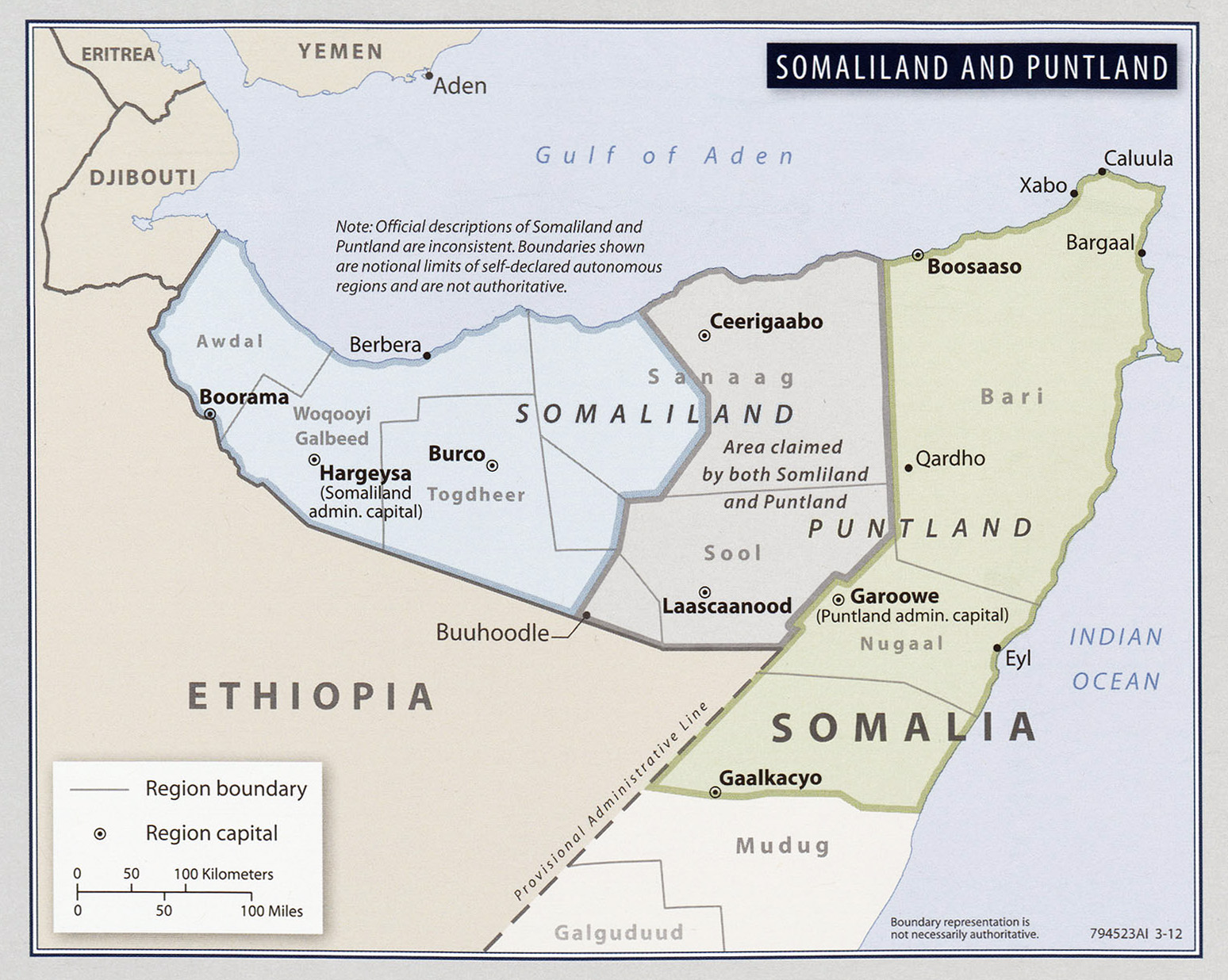
Image by NOAA Ocean Explorer, Okeanos Explorer 

The high seas, which are areas beyond national jurisdiction, have also been earmarked for seabed mining, particularly in a region of the Pacific Ocean known as the Clarion-Clipperton Zone, where there are vast expanses dotted with potato-shaped polymetallic nodules containing minerals like manganese, nickel, cobalt and copper.
The International Seabed Authority (ISA), a U.N.-mandated mining regulator, has been overseeing negotiations to approve a set of rules that would govern this activity so it could potentially start in the near future.

Peter Haugan, a scientist who serves as policy director of Norway’s Institute of Marine Research and director of the Geophysical Institute at the University of Bergen, said Norway’s plans go against scientific advice and could endanger marine biodiversity.

“Destroying very sensitive and vulnerable areas and eliminating biodiversity … is a real risk,” Haugan told Mongabay.
“It’s really a sad day for Norway.”

Haugan said Norway’s decision could also be a “violation of the law” due to a lack of scientific evidence needed to assess the environmental impacts of future mining activities, which is legally needed for such decisions to be made.

Haldis Tjeldflaat Helle, a campaigner at Greenpeace Norway against deep-sea mining, who participated in a protest outside the Norwegian parliament on Jan.
9, said she’s still hopeful that environmentalists will be able to stop the industry before it goes ahead.

“We will use the tools we have available,” Helle told Mongabay.
“We will continue to do activism against this disruptive industry and try to influence Norwegian politicians to stop deep-sea mining.”

Links :

Thursday, January 11, 2024

Ethiopia’s controversial quest for the sea

Somalia Maps - Perry-Castañeda Map Collection - UT Library Online
For Ethiopia, access to the sea is linked to securing international trade and achieving national security.

From The Washington Post by Ishaan Tharoor

Many centuries ago, chroniclers conjured what was in antiquity called Ethiopia as a realm at the heart of global trade.
The treasures of Rome and India all flowed through its ports along the Gulf of Aden and the Red Sea.
Merchants and pilgrims made their way to the Middle East and Mediterranean world via its caravan routes and docks.
A 6th-century Byzantine historian described a kingdom with a vast fleet of wooden boats.
The ancient Greeks even named the southern part of the Atlantic Ocean, thousands of miles away from the Ethiopian highlands, the Ethiopian Sea.

Somali women gather to march against the Ethiopia-Somaliland port deal at the Yarisow stadium in Mogadishu, Somalia on Jan. 3.
(Feisal Omar/Reuters)


But modern-day Ethiopia is famously landlocked.
Apart from a few decades in the 20th century when Ethiopia had annexed neighboring Eritrea, Africa’s second-most populous nation has never had a coastline.
It maintains a meager, mostly riverine navy and pays tiny Djibouti some $1.5 billion a year for the privilege of accessing its ports and coastal infrastructure.

That’s why Abiy Ahmed, the ambitious Ethiopian prime minister, has long harbored visions of reaching the sea.
He has groused against his country’s “geographic prison” and summoned the legacy of seafaring medieval empires as one the contemporary Ethiopian state must redeem.
Ethiopia’s profound economic woes and constant internecine conflicts have not dented Abiy’s desires for maritime access — indeed, they may fuel them.

And last week, in what was a geopolitical bombshell in the Horn of Africa, Abiy appeared to achieve his goal.
Alongside Muse Bihi Abdi, president of the self-declared breakaway Republic of Somaliland, Abiy announced that the two parties had reached a memorandum of understanding that would see Somaliland lease to Ethiopia some 12 miles of its coastline by the port of Berbera.
In return, the autonomous entity that exists within the internationally recognized territory of Somalia may win something altogether more valuable: diplomatic recognition from Addis Ababa.


Somaliland declared its independence from Somalia three decades ago, amid the wave of turmoil that turned the country into a perennial failed state.
It comprises the northwestern wing of Somalia, and represents the territory once governed under a British protectorate that was separate from the Italian colony that mostly made up the rest of what is now independent Somalia.
The breakaway republic prints its own currency, maintains its own political institutions and has earned a reputation for being one of the more stable corners of the Horn of Africa — certainly more so than the areas controlled by the beleaguered government in Mogadishu.

But, apart from solidarity ties with the self-ruling island of Taiwan, Somaliland has not been recognized by any U.N. member state — and certainly any major regional power in Africa.
The autonomous region’s officials expect this deal, should it come to fruition, may trigger a meaningful shift.

“Their hope is that where Ethiopia goes, the rest of Africa will follow: the African Union is based in Addis Ababa,” explained the Economist.
“Abiy also enjoys strong relations with the United Arab Emirates.
Some foreign diplomats suspect the UAE, which is also close to Somalia’s government, may have played a part in brokering the deal.”

Cash-strapped Ethiopia is also paying for the port access by giving Somaliland’s authorities a stake in their national airline, a major continental carrier.
But the political dividend is clearly the most significant factor here for Somaliland, while Abiy hopes to succeed where previous efforts have failed.

“For years, Ethiopia’s government has sought to diversify its seaport access, including exploring options in Sudan and Kenya,” noted the New York Times.
“In 2018, it signed a deal to acquire a 19 percent stake in the port at Berbera, but the deal fell through.”

Somaliland President Muse Bihi Abdi and Ethiopian Prime Minister Abiy Ahmed in Addis Ababa, Ethiopia on Jan.
1 for the signing of the memorandum of understanding agreement, which allows Ethiopia to use a Somaliland port.
(Tiksa Negeri/Reuters)


Somalia, though, is outraged.
The country’s ambassador in Addis Ababa was recalled.
Protests and rallies against the developments have been held in Mogadishu.
On Saturday, Hassan Sheikh Mohamud, the country’s president, signed a bill that symbolically nullified the agreement between Ethiopia and Somaliland, since the latter exists within Somalia’s internationally-recognized borders.
“This law is an illustration of our commitment to safeguard our unity, sovereignty and territorial integrity as per international law,” he said.

It’s also an illustration of Mogadishu’s toothlessness in recent years, and inability to accept or quash Somaliland’s de facto independence.
But other major international blocs and powers have sided with Somalia: The European Union, African Union, Arab League and Organization of Islamic Countries all issued statements urging Ethiopia not to proceed.

“The Horn of Africa doesn’t need more tensions,” declared Josep Borrell, the E.U.'s top diplomat, after a phone call with Somalia’s president.
 

Why is Ethiopia risking war for a port?
 
The United States called on the dispute to be settled through dialogue; so too did Britain, which issued a statement offering its “full respect” to Somalia’s “sovereignty and territorial integrity.” 
Turkey, which has a significant footprint in Somalia and a tacit rivalry with the UAE in various corners of the region, also voiced its support for Somalia’s “unity.”

Abiy’s critics in the region cast him as a would-be East African hegemon.
But he argued that his nation has no “desire to forcefully coerce anyone” through this deal and simply wants to diversify (and cheapen) its access to the sea.
The move also may boost Abiy at home, buffeted by a tanking economy and ruinous ethnic conflicts.

“It will give Abiy the opportunity to rehabilitate his unpopular image in the country caused by his wars in the Tigray region, the violent insurgencies in Amhara and Oromo regions as well as the economic regression the country faced for the last few years,” Moustafa Ahmad, an analyst and researcher based in Hargeisa, Somaliland’s de facto capital, told Al Jazeera.
“Access to the sea has been presented as an existential issue for Ethiopian leaders over the years, and with this new deal, it will give Abiy domestic political gains.”

J. Peter Pham, a former U.S. ambassador and Washington envoy to the region, shrugged off concerns that a potential pact could stoke a wider crisis.
“It’s a real win-win, and it respects the reality of what’s on the ground in the Horn of Africa and not notional theories,” he told the BBC.
 
Links :

Wednesday, January 10, 2024

Oh good, hurricanes are now made of microplastics

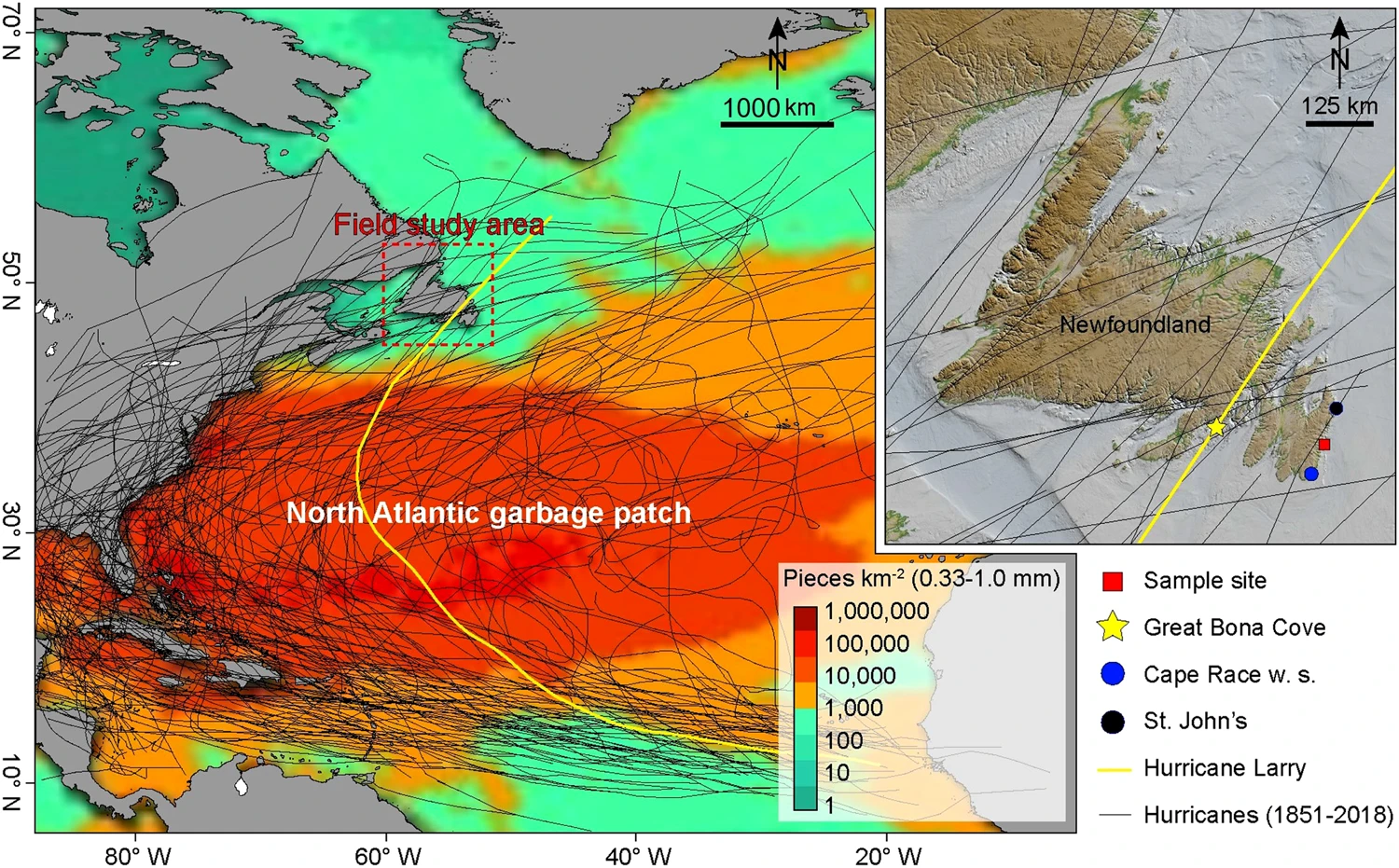
Illustration of the trajectory of all hurricanes since 1851, with emphasis on the trajectory of Hurricane Larry, on the large "garbage stain" of the North Atlantic, with high concentrations of microplastic. Image taken from Ryan et al (2023).
 
From Wired by Matt Simon

When Hurricane Larry made landfall two years ago, it dropped over 100,000 microplastics per square meter of land per day.
It’s another ominous sign of how plasticized the environment has become.


As Hurricane Larry curved north in the Atlantic in 2021, sparing the eastern seaboard of the United States, a special instrument was waiting for it on the coast of Newfoundland.
Because hurricanes feed on warm ocean water, scientists wondered whether such a storm could pick up microplastics from the sea surface and deposit them when it made landfall.
Larry was literally a perfect storm: Because it hadn’t touched land before reaching the island, anything it dropped would have been scavenged from the water or air, as opposed to, say, a highly populated city, where you’d expect to find lots of microplastics.

Anna Ryan collected samples of microplastics near Saint Michaels, N.L., a sparsely populated location with no major industry or other obvious sources of microplastics.
She says even the most pristine places now have plastics in the air.
(Submitted by Anna Ryan.)
 
As Larry passed over Newfoundland, the instrument gobbled up what fell from the sky.
That included rain, of course, but also gobs of microplastics, defined as bits smaller than 5 millimeters, or about the width of a pencil eraser.
At its peak, Larry was depositing over 100,000 microplastics per square meter of land per day, the researchers found in a recent paper published in the journal Communications Earth and Environment.
Add hurricanes, then, to the growing list of ways that tiny plastic particles are not only infiltrating every corner of the environment, but readily moving between land, sea, and air.

As humanity churns out exponentially more plastic in general, so does the environment get contaminated with exponentially more microplastics.
The predominant thinking used to be that microplastics would flush into the ocean and stay there: Washing synthetic clothing like polyester, for instance, releases millions of microfibers per load of laundry, which then flow out to sea in wastewater.
But recent research has found that the seas are in fact burping the particles into the atmosphere to blow back onto land, both when waves break and when bubbles rise to the surface, flinging microplastics into sea breezes.

Amber LeBlanc, a Dalhousie student who helped Ryan collect samples, checks a large glass cylinder set up near Saint Michaels, N.L., during Hurricane Larry.
(Submitted by Anna Ryan )
 
The instrument in a clearing on Newfoundland was quite simple: a glass cylinder, holding a little bit of ultrapure water, securely attached to the ground with wooden stakes.
Every six hours before, during, and after the hurricane, the researchers would come and empty out the water, which would have collected any particles falling—both with and without rain—on Newfoundland.
“It’s just a place that experiences a lot of extreme weather events,” says Earth scientist Anna Ryan of Dalhousie University, lead author of the paper.
“Also, it’s fairly remote, and it’s got a pretty low population density. So you don’t have a bunch of nearby sources of microplastics.”

A sample of the microplastics collected by Dalhousie students durring Hurricane Larry, as seen through a microscope.
(Submitted by Anna Ryan)

The team found that even before and after Larry, tens of thousands of microplastics fell per square meter of land per day.
But when the hurricane hit, that figure spiked up to 113,000.
“We found a lot of microplastics deposited during the peak of the hurricane,” says Ryan, “but also, overall deposition was relatively high compared to previous studies.” These studies were done during normal conditions, but in more remote locations, she says.

The researchers also used a technique known as back trajectory modeling—basically simulating where the air that arrived at the instrument had been previously.
That confirmed that Larry had picked up the microplastics at sea, lofted them into the air, and dumped them on Newfoundland.
Indeed, previous research has estimated that somewhere between 12 and 21 million metric tons of microplastic swirl in just the top 200 meters of the Atlantic, and that was a significant underestimate because it didn’t count microfibers.
The Newfoundland study notes that Larry happened to pass over the garbage patch of the North Atlantic Gyre, where currents accumulate floating plastic.

These new figures from Newfoundland are also likely to be significant underestimates—and necessarily so.
It remains difficult and expensive to look for the smallest of plastic particles: This research searched for bits as small as 1.2 microns (1.2 millionths of a meter), but there were likely way, way more pieces of plastic smaller than that falling into the instrument.
“From previous studies, we know that there’s an exponential curve for particle numbers as you go smaller,” says University of Birmingham microplastic researcher Steve Allen, coauthor of the new paper.
“So we’ve been talking about 113,000 particles per square meter a day of big stuff.
It just must be staggering, what is smaller.”

The researchers could also determine what kinds of plastic had fallen out of the sky.
“We saw not an overwhelming amount of one certain polymer—there’s a real variety,” says Ryan.
“In the ocean, there’s such a mix of particles that you have a little bit of everything.
And also because the hurricane came from so far away: It formed off the west coast of Africa, and you could potentially have particles picked up from all the way back there.”

This echoes what other scientists have been finding with microplastics in the environment.
Microplastic pollution comes from so many sources—our clothing, car tires, paint chips, broken-down bottles and bags—that it’s all mixed into a kind of multi-polymer soup out there.
That’s true both in the oceans and in the sky: In remote stretches of the American West, microplastic-sampling instruments similar to the one in Newfoundland have been gathering huge numbers of particles falling as plastic rain.
Microplastics haven’t just gone airborne, but have become a fundamental component of Earth’s atmosphere.

So microplastics don’t just flush into the sea and stay there—they blow into the atmosphere and back onto land, only to get picked back up again by winds and blown out to sea.
Back and forth, back and forth.
“It’s becoming quite clear that the ocean-to-atmosphere exchange is a very real thing,” says Allen.
“And the numbers in this paper here are just staggering.
It’s arriving in Newfoundland at just the time of year when all the biota—in the ponds and things—are all just trying to fatten up and breed for winter.”

Because microplastics travel so readily on winds and ocean currents, what were once considered pristine environments are now anything but.
Scientists are racing to figure out how the particles are affecting the organisms there.
Microplastics from Europe, for instance, have polluted the Arctic, in turn contaminating the algae Melosira arctica, which grows on the underside of sea ice.
The algae are the very base of the Arctic food chain, meaning all sorts of organisms are consuming them plus their accumulated microplastic.

As if hurricanes couldn’t get any worse, they’re yet another way for plastic particles to spread where they don’t belong.