Saturday, June 24, 2023

Sea Level through a porthole


As the planet warms and polar ice melts, our global average sea level is rising. 
Although exact ocean heights vary due to local geography, climate over time, and dynamic fluid interactions with gravity and planetary rotation, scientists observe sea level trends by comparing measurements against a 20 year spatial and temporal mean reference.
These visualizations use the visual metaphor of a submerged porthole window to observe how far our oceans rose between 1993 and 2022.
This visualization watches the global mean sea level change through a circular window.
The blue mark on the ruler shows the exact measurements of the Integrated Multi-Mission Ocean Altimeter Data for Climate Research.
The level of the animated water changes more smoothly, driven by a 60-day floating average of the same data.


Friday, June 23, 2023

France & misc. (SHOM) layer update in the GeoGarage platform

3 new nautical raster charts & 183 updated
 
1834 Dépôt de la Marine Nautical Map of St. Pierre Island 
 
île Saint Pierre with the GeoGarage plateform
 

Conor O’Brien’s pioneering saoirse Circumnavigation centenary will be honoured by Irish Cruising


Valentine’s Day with a difference – the new-build of Conor O’Brien’s global pioneering Saoirse steps out in style under sail for the first time at Baltimore on Tuesday February 14th 2023
Credit: Kevin O’Farrell


From Afloat by WM Nixon

The magnificent pioneering voyage round the world south of the Great Capes in 1923-1925 by Conor O’Brien (1880-1952) of Foynes, sailing his new-built engine-less 42ft Baltimore ketch Saoirse, was of such heroic proportions that any attempts at a re-enactment to mark the Centenary of its start this year from Dun Laoghaire on June 20th might seem faintly ridiculous, a profound ocean challenge reduced to pantomime.

Yet the latest images by noted West Cork photographer Kevin O’Farrell of the new and very precise re-build of Saoirse having her first sail in Baltimore on Tuesday of this week (Valentine’s Day, of course) and setting impressively traditional sails from Barry Hayes and his team at the UK Sailmakers loft in Crosshaven, make such a forceful impression that you could well believe that all things – real or re-enacted - are possible.

Saoirse. Conor O’Brien’s sail-plan for his first yacht design was essentially for offwind sailing, and the stunsails…
 

…were by no means ornamental, adding real speed in light winds. 
Photo courtesy O’Brien family
 
And this was very much the mood when the original Saoirse sailed out from Dublin Bay a hundred years ago.
For apart from anything else, the characterful little ship, which had been designed by O’Brien himself though with some welcome modifications by Baltimore’s master shipwright Tom Moynihan, was still largely untried at sea, and had done no ocean voyaging at all.

 
Into the unknown…when the new Saoirse departed from Dun Laoghaire on June 20th 1923, neither she nor her skipper had done any ocean voyaging of significance.
Photo: Irish Times

IRISH CRUISING CLUB AGM REVEALS CENTENARY PLAN

At the time of Saoirse’s build through 1922, West Cork was a hotspot of some of its most active scenes of conflict in the Civil War.
Yet while the construction job was done, there was little enough time or opportunity for sea trials, and Saoirse departed from Dun Laoghaire for “a voyage to New Zealand” largely as an act of faith.
But it was an act of faith gloriously fulfilled, and as confirmed at last night’s AGM of the Irish Cruising Club in Dun Laoghaire, the 1929-founded ICC and the 1880-founded RCC – the latter having given O’Brien’s achievement international recognition while the voyage was under way - have come up with a very appropriate programme to mark the event.

O’Brien’s initial stage of the voyage in June 1923 started with a first passage from Dun Laoghaire to Madeira.
It went very well indeed, with the surprisingly swift little Saoirse making such good time in the brisk Portuguese Trades that, despite calms in the later stages, she arrived off Funchal in Madeira on July 3rd.
So although there’ll be a gathering of cruisers and their crews at the RIYC in Dun Laoghaire on June 17th prior to heading south, there’s no attempt at that stage to match O’Brien’s actual departure date of June 20th, as it’s felt the “Saoirse Show” was really only up and running when Madeira was reached.

 
Conor O’Brien in relaxed mood at Saoirse’s helm as she proves unexpectedly fast running south in the Portuguese Trades, June 1923.

Thus those members who genuinely wish to show their appreciation of what O’Brien was doing will need to sail their boats to Madeira for the main event on July 3rd, and the word from ICC Commodore David Beattie last night was that 46 boats from many areas and several cruising clubs had expressed interest in being there.
And O’Brien’s other famous ocean-going design, the 56ft trading ketch Ilen of 1926-vintage restored through the tireless efforts of Gary Mac Mahon of Limerick, will also be heading south as part of the fleet, with trainees and ocean-cruising enthusiasts making up her ship’s company.

 
The restored 56ft Trading Ketch Ilen of 1926 vintage will be sailing to Madeira as part of the Saoirse Centenary celebrations.
Photo: Gary MacMahon

SAOIRSE’S WEST CORK CONNECTIONS

Whether or not the new Saoirse herself is present remains to be seen, as the resources behind her re-build are being provided by Fred Kinmonth, whose family have strong West Cork connections even though he has spent his working life as a Corporate Lawyer in Hong Kong.
Nevertheless, his heart is in West Cork, and his first priority is to emphasise that Saoirse was and is a West Cork boat, despite Conor O’Brien’s frequently-avowed devotion to Foynes Island in the Shannon Estuary.

So with much completion work still to be done internally, after her trial sail on Tuesday the new Saoirse was re-hauled at Liam Hegarty’s boatyard at Oldcourt on the Ilen River, and it is hoped that she will be making her fully-completed and formal debut at the Baltimore Wooden Boat Festival on May 26th-28th 2023.

 
The Saoirse re-creation newly launched at Oldcourt, September 2022.
Although the hull lines used were those taken off the original hull by Uffa Fox in 1927, they were shown to match Conor O’Brien’s own “rough” pre-build sketches of 1922 very closely.
Photo: John Wolfe


The new build of the design of Saoirse herself by Liam Hegarty at Oldcourt - to very precise lines taken off by Uffa Fox, no less, in 1927 - saw her reaching the launching stage last autumn, and now the accelerated commissioning programme opens up fresh schedule possibilities.
But perhaps the most meaningful option would be to have her in all her unique glory – and very much the flagship of West Cork - in Dun Laoghaire on June 20th 2025, a hundred years to the day from O’Brien’s return.
His success was celebrated with such widespread enthusiasm afloat and ashore that Dublin Bay Sailing Club unprecedentedly cancelled their racing for the day (it was a Saturday) so that their fleet could welcome the great circumnavigator home.

A BOOK THAT CHANGED WITH EACH EDITION

The first edition of Across Three Oceans, O’Brien’s lively and often idiosyncratic account of the voyage, was published within a year in 1926, and it had a freshness which has convinced total Saoirse aficionados that this is the only true account of the voyage.

Yet O’Brien’s lively and decidedly opinionated mind meant that he was always seeing new ways of interpreting his first thoughts and impressions, and subsequent editions always carried so many different angles on it all that the initial impact was lessened, even if the debating points were increased.

 
One of sailing’s greatest books.
The new Irish Cruising Club/Royal Cruising Club 6th edition of Conor O’Brien’s pioneering account of his global circumnavigation south of the Great Capes with the 42ft Baltimore-built traditional gaff ketch Saoirse in 1923-1925.
Compiled by Alex Blackwell and a special ICC/RCC Publications Committee, it includes extra material about O’Brien’s personal background, and other after-thoughts on ocean sailing which he added with additional analysis and further sea-going experience


But 97 years later, in the hopes of providing an accessible and user-friendly account of O’Brien’s extraordinary achievement and his own equally extraordinary background and family history, the ICC and RCC are jointly publishing a manageable paperback 6th Edition of Across Three Oceans (“manageable” means you can read it in bed), with a foreword by this columnist which tries to explain the history and character of a man who at times would have been at a loss to provide those explanations himself, or would have delighted in spinning a yarn which was at variance with reality.

Meanwhile, for those who wish to go into it all in complete detail, in 2009 Collins Press of Cork published an excellent biography of O’Brien titled In Search Of Islands, written by Judith Hill using the impressive selection of O’Brien material amassed over many years by Gary Mac Mahon.
And of course O’Brien wrote other sailing-related books, the best of them in conjunction with his wife, the artist Kitty Clausen, who died tragically young, but in her prime had sketched the most impressive portrait we have of Conor O’Brien.

 
Kitty Clausen’s insightful portrait of her husband Conor O’Brien

As for the new Saoirse, Kevin O’Farrell has meticulously photographed every aspect of her build from the beginning of the project in Liam Hegarty’s atmospheric Top Shed at Oldcourt, and his book of those evocative images of the creation of the new Saoirse will be published in May, a work of art in itself and a total immersive experience for lovers of wooden boats, connoisseurs of craftsmanship, and everyone for whom West Cork is a very special place

IRISH CRUISING CLUB AWARDS

It says much about the contemporary widespread interests of the Irish Cruising Club that the Saoirse Centenary was just one of many topics covered in a busy agenda last night, but inevitably it was prominent in everyone’s thoughts.
For although the ICC was not founded until 1929 at a modest gathering of five cruising yachts at Glengarriff, one of the first acts of the new club was to make Conor O’Brien an Honorary Member, and from his retirement at his little house of Barneen on Foynes Island, he occasionally emerged to take part in the ICC’s Annual Dinner.

The Club has come through the pandemic in good heart, helped by the fact that the very able Commodore David Beattie had his period of office extended to three years from the usual two, thereby providing continuity at a time when it was sometimes difficult to tell whether boats could go cruising or not.

SMALL BOAT SUCCESS FOR CLEW BAY

Yet once there were the faintest chinks of light in the restrictions, they sailed the seas near and far.
But nevertheless there’s something encouraging about the fact that the adjudication by Tom Kirby of Clonakilty for the premier award, the Faulkner Cup, which dates from 1931, has gone to Clew Bay member Duncan Sclare, who’d bought a well-used 29ft Verl 900 on the west shores of the North Sea.
As soon as restriction-easing began in March, he sailed this little boat – called Quibus - home to Mayo in the seasonal fair winds of very raw easterlies, an efficient and seamanlike exercise in exemplary style which gave the Faulkner Cup a fresh perspective.

 
Plans of the Verl 900 – Duncan Sclare’s Quibus to this design is the smallest boat in many years to have been awarded the ICC’s premier trophy, the Falkner Cup

For many years now, high latitude places have feature in the top awards, and Svalbard or Spitzbergen – just as you wish – has been frequently visited in tines past, But these days that Arctic archipelago is not only too popular for its own good through being over-run by cruise liners, but it’s now considered political frontier country.
So Adrian Spence and Paddy Barry with the former’s 47ft ketch El Paradiso had more than enough problems to deal with in making a worthwhile visit there, but they are awarded the Strangford Cup nevertheless.

Adrian Spence’s Vagabond 47 El Paradiso found that Svalbard is now well-wrapped in red tape, yet she still managed enough cruising to be awarded the Strangford Cup

The Round Ireland cruise can be a work of art in its own right if properly executed, so the contest for its special cup is always fascinating, and in 2022 it was Vice Commodore Derek White of Strangford Lough, with his Limerick-built Fastnet 34 Ballyclaire, who got it right despite the weather in the west sometimes not being right at all.

Derek & Viv White’s Fastnet 34 Ballyclaire in Derrynane during their award-winning Round Ireland cruise

SAILING THE ATLANTIC IN A LOCKDOWN PROJECT

All the ICC logs have been superbly collected and presented in the professional-standard Annual by Maire Breathnach of Dungarvan.
Yet despite this winter workload, her own enthusiasm for cruising and cruising boats seems greater than ever, for although she and husband Andrew Wilkes were stuck in the Canaries during the depths of the lockdown with their 64ft gaff cutter Annabel J, they kept themselves busy by taking over and restoring an abandoned Nicholson 43 called Hunza which they sailed home in due course, thereby taking the ICC’s Atlantic Trophy.

Another ICC member who has always given over and above the call of duty if John Clementson of Strangford Lough, whose ability as a tech whizz landed him with the job of moving the Club into the Internet age, which he did so capably that his work has been recognised with the John B Kearney Cup for Services to Sailing.

The ICC now has a host of trophies covering every possibility of activity and achievement afloat, but one which those in the know look out for is the Fingal Cup for the log which the Adjudicator most enjoyed.
No-one will argue with Tom Kirby’s choice here, as it goes to Andy and Paddy McCarter of Lough Swilly, whose Starlight 35 Gwili 3 suddenly seemed very far away in her longterm Canary Islands base.

Andy and Paddy have both been Free Bus Pass holders for a while, but nothing daunted, they decided to bring Gwili 3 home to Ireland themselves, with both boat and crew requiring specialist attention at times.
In due course, they did it, and produced an enjoyable account of it all while they were at it, in the best ICC style in a club which is itself now beginning to think about its Centenary.

Links :

Thursday, June 22, 2023

Titanic sub: Safety concerns raised about missing submersible

Titan Oceangate submarine
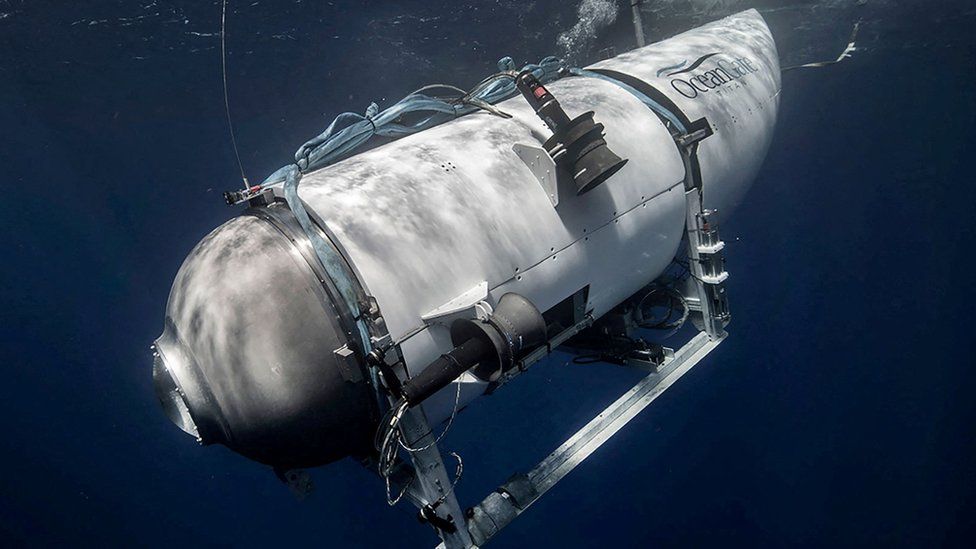
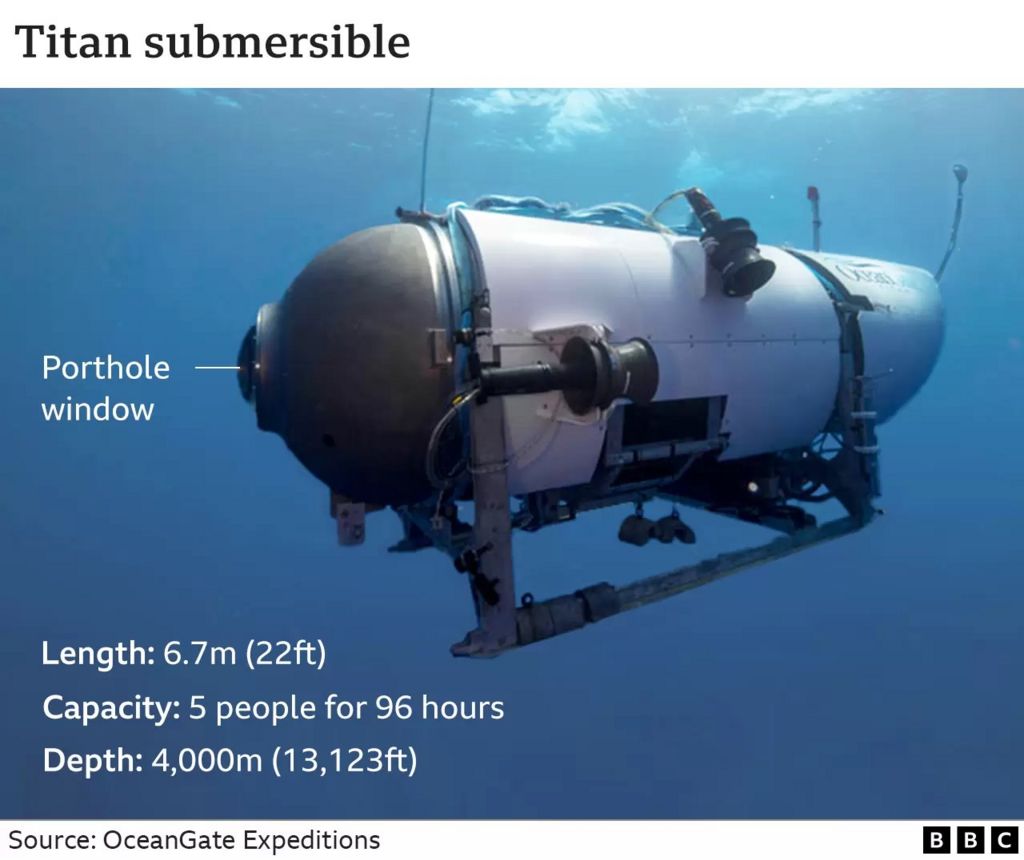
Finding the 22-foot-long Titan submersible, which went missing on June 18, is a desperate race against time.
The craft, powered by four electric thrusters that move it at a maximum speed of 3 knots, lost contact with its surface vessel, the Polar Prince, around 105 minutes into a dive.
The Titan was headed for the wreckage of the Titanic, roughly 375 nautical miles from Newfoundland, Canada.
If the sub is still intact, those aboard have only hours of air left.
image : Reuters

From BBC news by y Rebecca Morelle & Jake Horton

A former employee of OceanGate - the company that operates the missing Titan submersible - warned of potential safety problems with the vessel as far back as 2018.

US court documents show that David Lochridge, the company's Director of Marine Operations, had raised concerns in an inspection report.

The report "identified numerous issues that posed serious safety concerns", according to the documents, including the way the hull had been tested.

Mr Lochridge "stressed the potential danger to passengers of the Titan as the submersible reached extreme depths". 
He said his warnings were ignored and called a meeting with OceanGate bosses but was fired, according to the documents.

The company sued him for revealing confidential information, and he countersued for unfair dismissal. The lawsuit was later settled but we don't know the details of the settlement.

The BBC tried to contact Mr Lochridge but he is not commenting. 
 

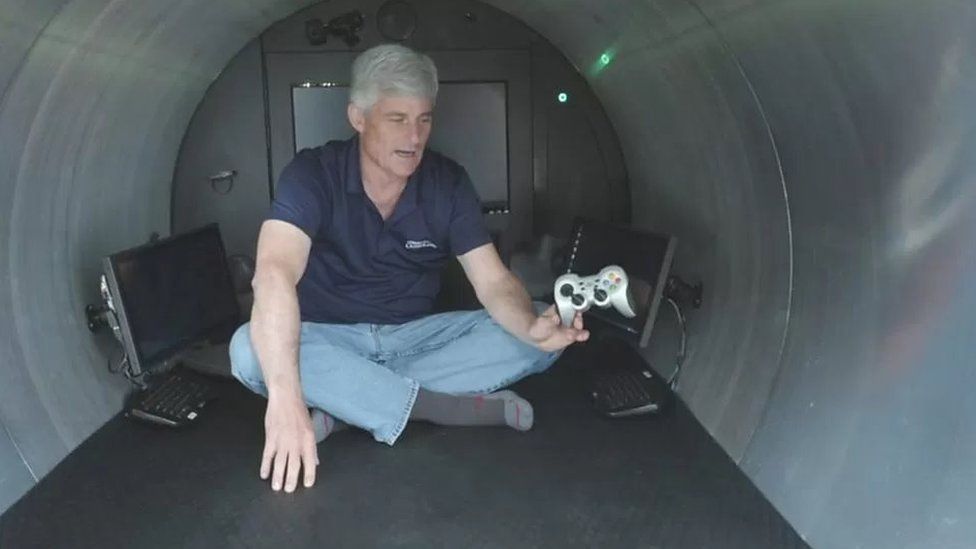
It can take five passengers to The Titanic on the ocean floor, you can pilot it with a gaming controller...and it has a toilet.
Climb aboard Titan, a unique submarine used to explore the world's most famous shipwreck.
 
Separately, a letter sent to OceanGate by the Marine Technology Society (MTS) in March 2018 and obtained by the New York Times, stated "the current 'experimental' approach adopted by OceanGate... could result in negative outcomes (from minor to catastrophic)".

A spokesman for OceanGate declined to comment on the safety issues raised by Mr Lochridge and the MTS.

The Titan submersible, described as "experimental" by the company, was built from an unusual material for a deep sea vessel.

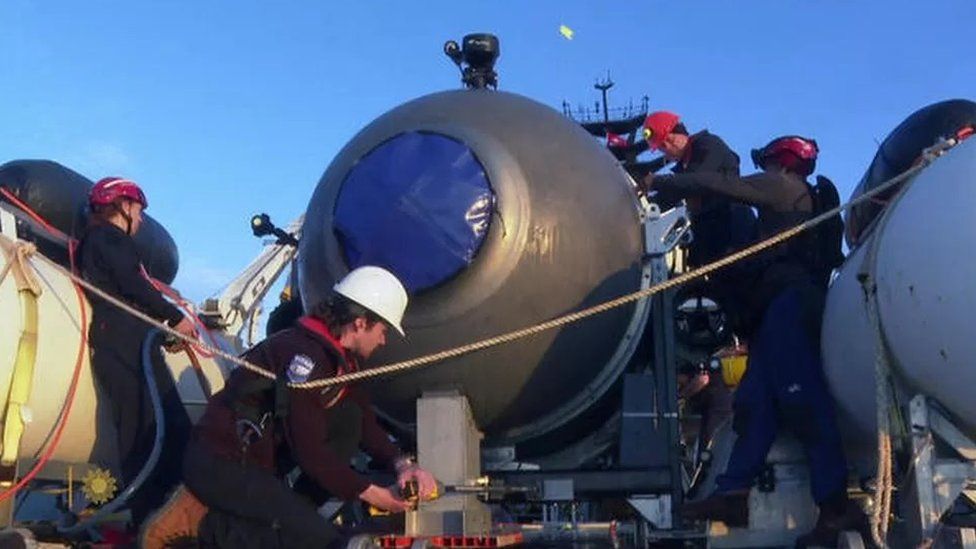
Its hull - surrounding the hollow part where passengers sit - was made from carbon fibre, with titanium end plates and a small window at one end.


"Typically, the part of deep-sea submersible housing the humans is a titanium sphere around 2m in diameter," said Dr Nicolai Roterdam, lecturer in marine biology at the University of Portsmouth.

To withstand the immense pressures of the deep you need super-strong materials, to resist the weight of water above that's pressing down on you.

Carbon fibre is cheaper than titanium or steel and is extremely strong, but it is largely untested for deep sea vessels like the Titan.

In an interview with Oceanographic last year, OceanGate's CEO Rush Stockton said: "Carbon fibre is used successfully in yachts and in aviation, but it has not been used in crewed submersibles."

In the court documents, Mr Lochridge claimed the hull had not been properly tested - where it's placed under extreme pressures and analysed to look for potential problems.

He claimed that trials on a smaller scale model of the sub had revealed flaws in the carbon under pressure testing.

Mr Lochridge also raised the issue of the Titan's glass viewport.
He claimed the company that made the material would only certify its use down to 1,300m.

A December 2018 statement from OceanGate said the Titan had completed a 4,000 meter dive which "completely validates OceanGate's innovative engineering and the construction of Titan's carbon fiber and titanium hull".

In a 2020 interview with GeekWire, Mr Rush said tests were conducted which revealed that the Titan's hull "showed signs of cyclic fatigue".


The BBC filmed Stockton Rush inside the submersible in 2022


In a May 2021 court filing, the company said Titan had undergone more than 50 test dives, including to the equivalent depth of the Titanic, in deep waters off the Bahamas and in a pressure chamber.

The shape of the Titan is also unusual.

The hull of a deep-diving sub is usually spherical, which means it receives an equal amount of pressure at every point, but Titan's hull is tube-shaped, so the pressure would not be equally distributed.

"Titan is quite a different deep-sea submersible compared to those used in research," said Dr Roterman.
"Whether or not this design with composite materials represents a structural weakness would be for engineers to determine, however," she added.
 

Some of the most awe-inspiring scenes included in Titan – A Viewport to Titanic, are Titanic’s legendary bow, the forecastle, the well deck, the ship’s bridge and wheelhouse area, and the officers’ deck. Notably, viewers can also see the telemotor where Quartermaster Robert Hichens was at the helm and the crow’s nest location where lookout Frederick Fleet alerted the bridge of the iceberg ahead.
Areas of accelerated deterioration include Titanic’s foremast that has completely disintegrated, and Captain Smith’s cabin that is now destroyed by the ravages of time, currents, and the effects of iron eating bacteria that leave rivers of rusticles all over the wreck.
The sea life that now makes the Titanic home are also to be seen including squat lobsters, rattail fish, and bamboo coral.
For those interested in supporting the continuing efforts to document and study the Titanic and the creatures that make it their home, there are still a limited number of Mission Specialist roles available for the 2023 Titanic Expedition.
 
Why wasn't the sub certified?

In the court documents, Mr Lochridge also said he had urged OceanGate to get the submarine inspected and certified.

Subs can be certified or "classed" by marine organisations - for example by the American Bureau of Shipping (ABS) or DNV (a global accreditation organisation based in Norway) or Lloyds of London.
This essentially means that the vehicle must meet certain standards on aspects including stability, strength, safety and performance.
The process involves reviewing the design and construction, assessing testing and trials to be certified. And once the sub is in service it needs to be checked periodically to ensure it still meets these criteria.
But certification of subs isn't mandatory.


OceanGate's Titan submersible (pictured above) has been missing since Monday
Image CBS news

Titan was never certified or classed - as the company wrote a blog post about it in 2019.

It said the way that Titan had been designed fell outside the accepted system - but it "does not mean that OceanGate does meet standards where they apply."

It added that the classing agencies "slowed down innovation… bringing an outside entity up to speed on every innovation before it is put into real-world testing is anathema to rapid innovation".

A CBS reporter who went on the Titan in 2022 quoted a waiver people signed before boarding as stating it was "an experimental submersible vessel that has not been approved or certified by any regulatory body which could result in physical injury, emotional trauma or death."

Any sub that dives over 4,000m is a one-off vehicle - not something mass-produced - and requires innovation and novel design to survive at these depths.

But that doesn't mean this falls outside the classing system.

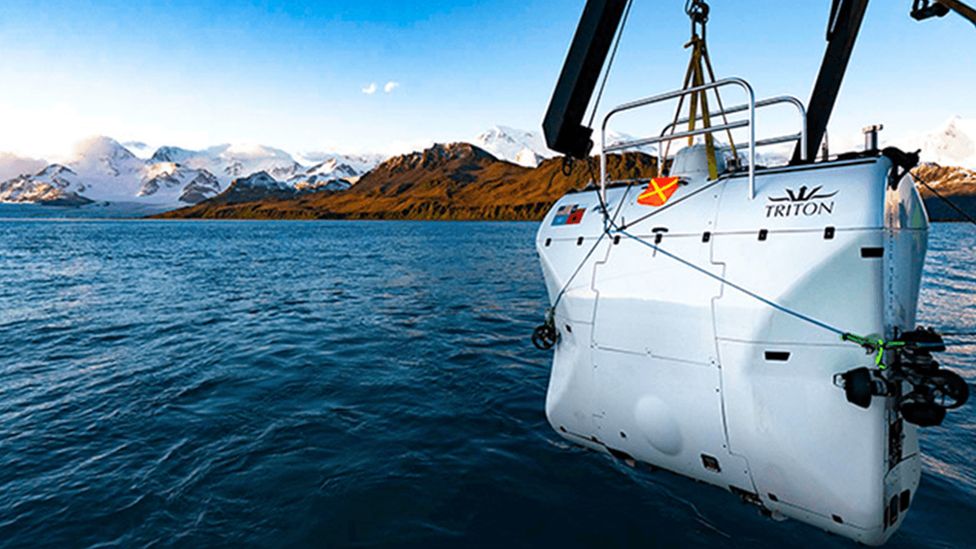
Take for example the sub called the Limiting Factor. 
This vessel, designed by Triton submarines, has repeatedly travelled to the very deepest places in the ocean - performing many dives to the bottom of the Mariana Trench, which lies 11km down.

Image Triton submarines

It's a truly unique and cutting-edge vessel - but the team behind it collaborated with the DNV classing agency from design, through to construction and testing. 
And the Limiting Factor is fully certified to repeatedly - and safely - dive to any depth in the ocean.

Links :

Wednesday, June 21, 2023

Navigating climate change: Kiribati’s efforts to address sea-level rise

 
From Hydro y Wim van Wegen
 
Interview with Tion Uriam, national coordinator for hydrography and charting, Kiribati
Tion Uriam is the national coordinator for hydrography and charting in the Marine Division of Kiribati’s Ministry of Information, Communications and Transport.
He has a diverse academic background, including a diploma in Geospatial Science from the University of the South Pacific and a Bachelor’s of Applied Science in Surveying from RMIT University, and he also completed the GEBCO/Nippon Foundation Cat A programme at the University of New Hampshire.
Uriam has over 15 years of experience working in the Kiribati government.
He started as a GIS officer in the Ministry of Fisheries, then transitioned to become a land surveyor before his current position.
As the national coordinator for hydrography and charting, he oversees the hydrography department – ensuring that Kiribati’s waters are safely chartered – and manages maritime safety and infrastructure development.


The impacts of climate change and sea-level rise on daily life in Kiribati and the Pacific region can also be felt in the hydrographic profession.
In this interview, Tion Uriam, the national coordinator for hydrography and charting in Kiribati, emphasizes the challenges faced by Pacific Island nations and the importance of addressing root causes.
Uriam discusses the challenges in obtaining support and resources for the Kiribati Outer Islands Transport Infrastructure Investment Project, and how initiatives like Seabed 2030 are helping to bring together countries and organizations to share resources and expertise.
Kiribati is also working to educate and raise awareness about the significance of hydrography and the effects of climate change.

How has everyday life in Kiribati – and other countries in the Pacific – been impacted by climate change and sea-level rise?

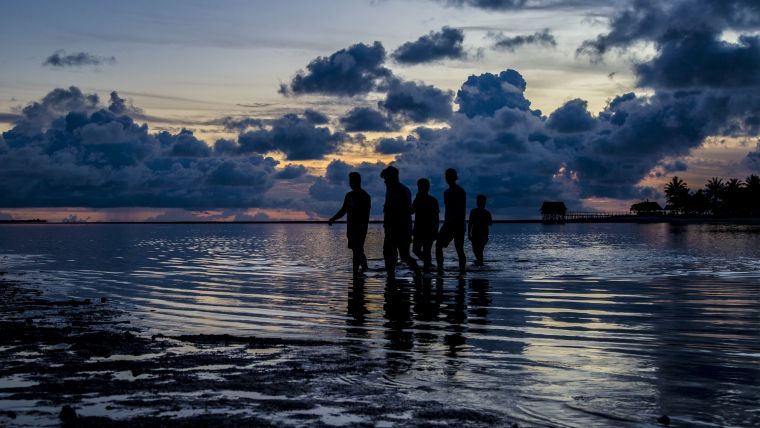
Climate change and sea-level rise have had a significant impact on everyday life in Kiribati and other Pacific Island countries.
Rising sea levels have caused increased coastal erosion and saltwater intrusion into the freshwater lens.
In our part of the world, we are experiencing the impacts of La Niña: with climate likely to have an impact on the ENSO cycle, La Niña means less rain for us.
In fact, we have just recently experienced a heavy drought period.
The islands in the Pacific face similar challenges, but at varying scales.

In your opinion, what is the most pressing challenge facing Pacific Island nations such as Kiribati on the topic of climate change and global warming, and how do you envision the country addressing this challenge in the coming years?

Pacific Island nations like Kiribati are facing a major challenge with climate change and global warming due to their vulnerability to rising sea levels and frequent natural disasters.
These events are already having serious consequences for the people and environment of these islands.
In Kiribati specifically, the challenge is largely caused by high population density and inadequate planning, which are affecting the two most crucial resources – land and water.

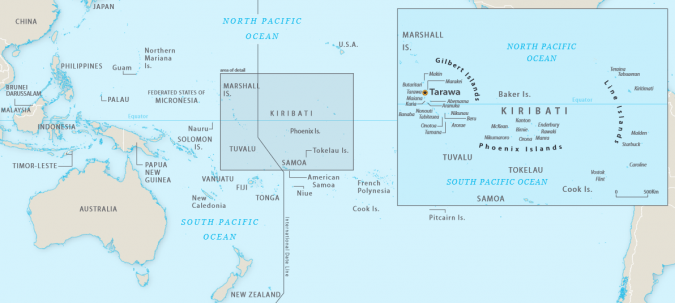
Map of Kiribati.
(Data sources: UNCS, Esri, Global Discovery, Government of USA;
map created by UN OCHA ReliefWeb)


Tackling climate change and global warming is not something that can be done by Kiribati alone, but we can control how we use our land and protect our water.
Although steps are being taken to adapt with modern measures, the root cause of the problem is still the high population and poor planning.
Addressing these underlying issues is crucial to effectively dealing with the impacts of climate change.

What measures is Kiribati taking to adapt to these changes and to protect its coastlines and communities?

Our traditional way of life was characterized by its capacity for adaptability to environmental changes.
The design of homes, for example, allowed for mobility and portability, and families acquired only sufficient resources for their daily sustenance.
The implementation of measures to support adaptation in response to environmental challenges can be considered more as reactive, rather than proactive, in nature.
Genuine adaptation entails the capability of survival in a constantly changing environment and growing population, which ultimately depends on effective resource management practices.

How is Kiribati working to maintain accurate and up-to-date hydrographic charts and maps of its waters?

The Kiribati Outer Islands Transport Infrastructure Investment Project (KOITIIP), an ADB and WB funded project, is currently focused on updating the charts of four islands in Kiribati.
The goal is to use this work as a stepping-stone to gain support for mapping the rest of the islands in Kiribati and producing more nautical charts.
The most recent data available is satellite-derived bathymetry that covers all 33 islands in Kiribati.
We are also taking part in the Seabed 2030 initiative, which allows for the exploration of crowd-sourced bathymetry to map more of Kiribati’s waters.
Vessels that frequently ferry between the islands carry single beam echosounders, effectively helping to map Kiribati’s waters through the collection of data.

What challenges does Kiribati face when it comes to conducting hydrographic surveys and maintaining accurate maps in the face of climate change and sea-level rise?

The current biggest obstacle is obtaining the necessary support to establish a sustainable programme.
My department currently lacks the budget and manpower needed to undertake the work.
The perceived value of producing maps and its potential contribution to Kiribati’s long-term socio-economic development plans is not yet clearly understood.

The phrase “we cannot manage what we can’t measure” is especially relevant in the context of Kiribati.
Through KOITIIP, we aim to increase awareness of the importance of mapping and the potential benefits it can bring.

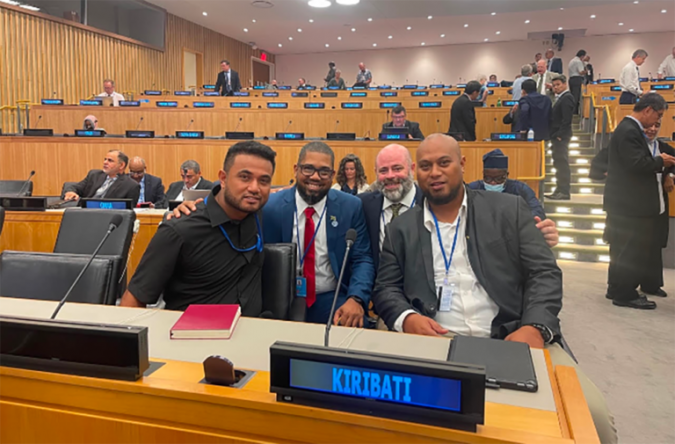
From left to right: Robert Karoro (Kiribati), Diego Billings (Jamaica), John Nyberg (USA) and Tion Uriam (Kiribati) at the Eleventh Session of the United Nations Committee of Experts on Global Geospatial Information Management, in New York, August 2022.
(Image courtesy: NOAA)

When it comes to the effects of climate change and sea-level rise, various models predict that Kiribati could be underwater in the coming years.
These predictions are based on satellite-derived elevation data, which has a very low level of detail.
Since many of Kiribati’s atolls are only three metres above sea level, more accurate predictions could be made by mapping the elevation at a higher level of detail.

How are technology and innovation being employed to improve hydrographic capabilities and address the impacts of climate change?

Affordability and access to technology are important factors in improving hydrographic capabilities and addressing the impacts of climate change in Kiribati.
The cost of technology, both hardware and software, can be a barrier for small island nations like Kiribati.
However, initiatives like the Seabed 2030 project, which seeks to map the world’s oceans by 2030, are helping to bring together countries and organizations to share resources and expertise.
Additionally, open-source and low-cost technology solutions are becoming increasingly available, which can help to reduce the cost of technology and increase access to it.
It’s important for Kiribati to find the most affordable and accessible technology solutions that meet their needs and capabilities.

How is Kiribati working to educate and raise awareness about the importance of hydrography and the impacts of climate change on its waters?

In order to educate and increase awareness on the significance of hydrography and the effects of climate change on Kiribati’s waters, workshops were conducted with representatives from various government departments.
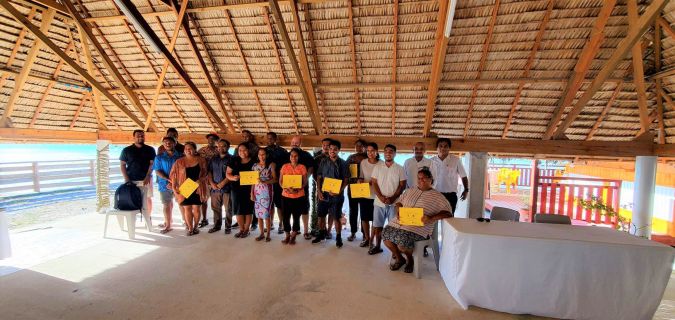
One of these workshops, held in November 2022, was in collaboration with our friends from the National Oceanic and Atmospheric Administration (NOAA), aimed at creating and engaging various stakeholders in developing a comprehensive action plan for managing geospatial data using the United Nations Global Geospatial Information Management Integrated Geospatial Information Framework (UNGGIM IGIF model).
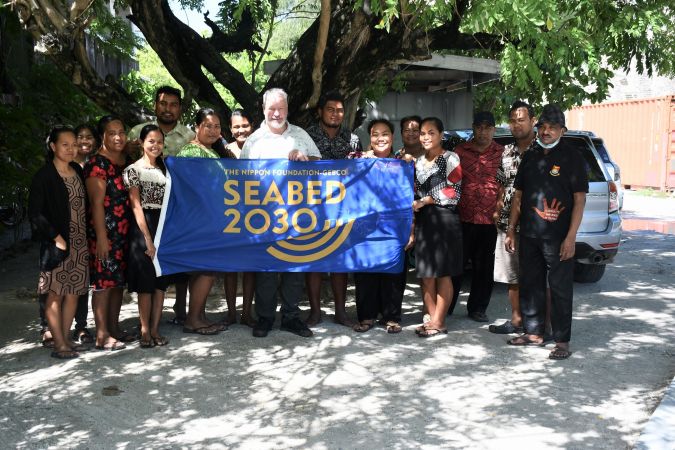
Recently, another workshop was conducted by Seabed 2030, resulting in the signing of a Memorandum of Understanding between my ministry (MICT) and Seabed 2030 on the sharing of data.

 
By participating in the Seabed 2030 initiative, Kiribati can leverage crowd-sourced bathymetry to expand the mapping of its waters.

How do Kiribati and other Pacific Island nations work with international organizations and other countries to exchange knowledge and best practices in hydrography?

Kiribati collaborates with international organizations and other countries by exchanging knowledge and best practices in hydrography through various initiatives, such as workshops and conferences.
Additionally, there is a mentorship programme through the South West Pacific Hydrographic Commission where individuals can receive guidance and support from experienced mentors.
In this case, Dr John Nyberg has served as a mentor, providing valuable assistance and support.

Are there any other ways in which Kiribati and other countries in the Pacific are working to advance the field of hydrography and stay up to date with the latest technologies and techniques?


As I mentioned earlier, one way that Kiribati and other Pacific Island nations are advancing the field of hydrography is through participating in mentorship programmes.
For example, Kiribati has participated in the South West Pacific Hydrographic Commission’s mentorship programme, where experienced hydrographers provide guidance and support to the next generation of hydrographers in the region.
This type of programme allows for the exchange of knowledge and the sharing of best practices in the field, helping to ensure that countries in the Pacific stay up to date with the latest technologies and techniques in hydrography.

Climate change is one of the most pressing issues facing the world today.
What steps do you believe need to be taken by industrialized countries to mitigate the effects of climate change and avoid worst-case scenarios?


There is a very simple answer to this that says it all: I think it’s important that we all do our part, as we are all in this together.

Do you have any final message or advice that you would like to share with the global hydrographic community, particularly regarding the challenges and opportunities facing Kiribati and other small island nations in the Pacific in the face of climate change and sea-level rise?

I truly am a firm believer in mentorship programmes: whether between individuals or organizations, we can benefit from learning from one another.
Especially in our case, where we do not have the experience or expertise, a mentorship programme can be useful in bridging this gap.

Attendees at the Kiribati national workshop on the Integrated Geospatial Information Framework in Betio, Kiribati, November 2022.