Visualizing the World’s Largest Container Shipping Companies
Did you know that 80% of the global goods trade is transported over sea?
Given the scale of human consumption, this requires an enormous number of shipping containers, as well as ships to carry them.
At an industry level, container shipping is dominated by several very large firms.
This includes Maersk, COSCO Shipping, and Evergreen.
If you live along the coast, you’ve probably seen ships or containers with these names painted on them.
Generally speaking, however, consumers know very little about these businesses.
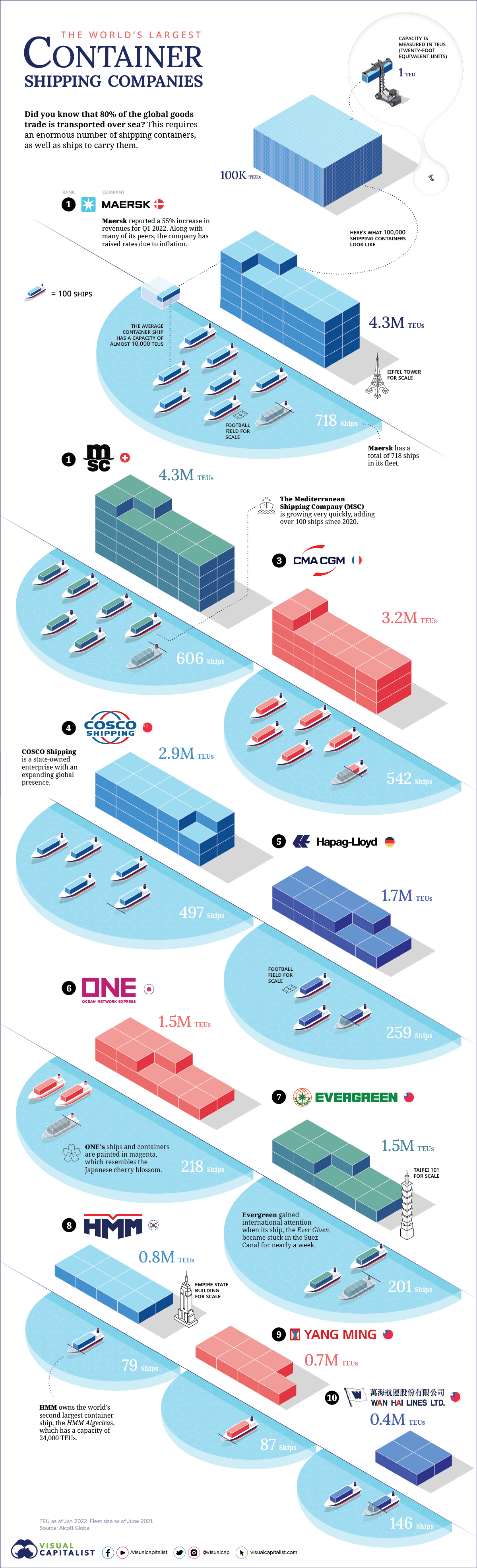
This graphic aims to change that by ranking the 10 largest container shipping companies in the world.
Ranking the Top 10
Companies are ranked by two metrics.
First is the number of ships they own, and second is their total shipping capacity measured in twenty-foot equivalent units (TEUs).
A TEU is based on the volume of a twenty-foot long shipping container.
The data used in this infographic comes from Alcott Global, a logistics consultancy.
Fleet sizes are as of June 2021, while TEU capacity is from January 2022.
In this dataset, Maersk and MSC are tied for first place in terms of TEU capacity.
This is no longer the case, as news outlets have recently reported that MSC has overtaken the former.
Trailing behind the two industry leaders is a mixture of European and Asian firms. Many of these companies have grown through mergers and acquisitions.
Interesting Facts
Maersk
At the time of writing, Maersk is Denmark’s third largest company by market capitalization.
The firm was founded in 1904, making it 118 years old.
MSC
The Mediterranean Shipping Company (MSC) has grown very quickly in recent years, catching up to (and surpassing) long-time leader Maersk in terms of TEU capacity. The Swiss firm has increased its fleet size through new orders, acquisition of second-hand vessels, and charter deals.
COSCO Shipping
COSCO Shipping is China’s state-owned shipping company. American officials have raised concerns about the firm’s expanding global influence. For context, Chinese state-owned enterprises have ownership stakes in terminals at five U.S. ports.
This includes Terminal 30 at the Port of Seattle, in which two COSCO subsidiaries hold a 33.33% stake.
Moving forward, any further Chinese interest in U.S. terminals will face an even more stringent regulatory environment. – KARDON (2021)
Evergreen
Evergreen is likely a familiar name, but not for the right reasons.
In 2021, one of the company’s ships, Ever Given, became stuck in the Suez Canal, putting one of the world’s most important shipping routes out of commission for nearly a week.
Bulking Up
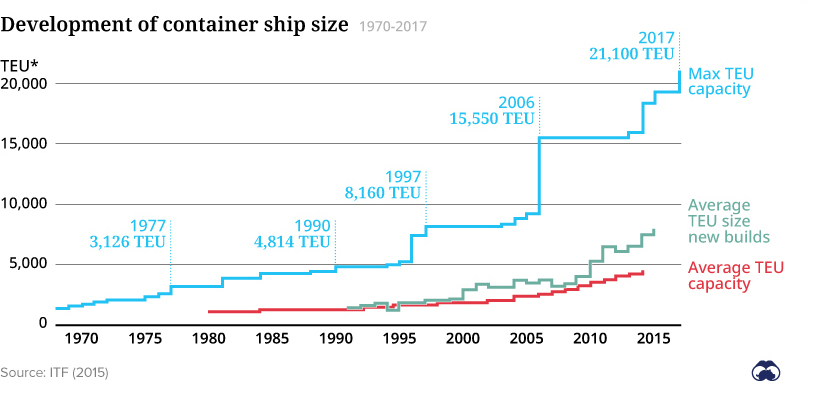
To achieve better economies of scale, container ships are growing bigger and bigger.
The following chart illustrates this trend from 1970 to 2017.
Average capacity is being pulled upwards by the arrival of mega-ships, which are ships that have a capacity of over 18,000 TEUs.
Their massive size creates problems for ports that weren’t designed to handle such a high volume of traffic.
It’s worth noting that the largest ship today, the Ever Ace (owned by Evergreen), has a capacity of 24,000 TEUs.
Watch this YouTube video for some impressive footage of the ship.
Going Green
Bloomberg reports that shipping accounts for 3% of the world’s carbon emissions.
If the industry were a country, that would make it the world’s sixth-largest emitter.
Due to the growth of ESG investing, shipping companies have faced pressure to decarbonize their ships.
Progress to this day has been limited, but there are many solutions in the pipeline.
One option is alternative fuels, such as liquefied natural gas (LNG), hydrogen, or biofuels made from plants.
These fuels could enable ships to greatly decrease their emissions.
Another option is to completely do away with fuel, and instead return to the centuries-old technology of wind power.
The seaweed in the pilot test was harvested by a mechanical arm At a testing site way off the Dutch coast a breakthrough was made this summer.
Some 12km (7.5 miles) out at sea, a converted fishing boat mechanically harvested a batch of farmed seaweed.
The kelp had been grown on netting hanging below a 50m (164ft) long plastic tube that was floating on the water, held in place by buoys and two anchors on the seafloor.
The boat was positioned alongside, and an 8m tall, electric-powered cutting arm was moved into the water.
It pulled up the tubing and sliced the long strands of seaweed from the 2m wide net.
The seaweed was then automatically bagged-up, and dropped onto the deck.
North Sea Farmers, the consortium behind the test, says it was the world's first mechanical harvest of an offshore (some distance from the coast) seaweed farm.
Eef Brouwers, North Sea Farmers' manager for farming and technology, says that the successful harvest was "an important first step" towards the large-scale cultivation of commercial seaweed farms in the North Sea.
Image : Tristen Taylor
Eef Brouwers, pointing in the direction of the seaweed farm out at sea, says that the North Sea Farmers consortium will now move onto larger-scale testing as it moves towards commercial production North Sea Farmers has almost 100 members including food and consumer goods giant, Unilever, and energy firm Shell.
They hope to dramatically increase Europe's production of farmed seaweed over the next decade.
Currently global seaweed production is dominated by Asia, and particularly China.
While most of us don't give seaweed much thought, it is an increasingly sought after crop.
Its uses ranging from a human food and additive, to animal feed, land fertilizer, an ingredient in cosmetics, as a form of bio-packaging in place of plastic, as a biofuel, and to absorb carbon dioxide.
There are thousands of different types of seaweed around the world, but seven are harvested more than most.
These include kelp and pyropia.
The latter is used to make nori, the dried Japanese seaweed sheets that wrap rolled sushi.
Adrian Vincent, an associate at the organisation, says this goal is "ambitious but completely achievable". What will greatly help is that the target is being backed by the European Commission.
A spokesman for Brussels added that the EU is already giving financial support of €273m ($277m; £228m) to seaweed projects, a figure "that is expected to grow".
Meanwhile, the Dutch government is proposing setting aside 400 sq km (154 sq miles) of its territorial waters in the North Sea for large-scale seaweed cultivation. Germany and the Republic of Ireland are also at the forefront of developments. In the UK, which of course is no longer in the European Union, Scotland is leading the way.
Dutch firm The Seaweed Company is now farming kelp off the west coast of Ireland, plus in Moroccan and Indian waters, and in its home country. "We are seaweed pioneers," says Joost Wouters, the firm's founder.
"Scale and speed is our mission. To be sustainable from the financial, social and ecological side, you need a lot of seaweed."
Image : Tristen Taylor
Joost Wouters tasting seaweed at his company's Irish processing facility Located above the picturesque Mulroy Bay in County Donegal, the company's Irish processing facility consists of a barn where harvested seaweed is shredded and then dried in in the firm's specially-designed own machine. Mr Wouters refuses to allow the dryer and mechanical cutters to be photographed, wanting to protect the company's technology from rivals.
In order to farm seaweed, the company first has to cultivate spores in a laboratory, which are then placed on ropes in hatcheries.
Once the seaweed starts to grow, the lines are moved to the open ocean. Harvest takes place just a few months later. "That's the beauty of it," he says.
"You don't need land, fresh water or fertiliser. That's why so many people are now seeing interesting opportunities in algae."
Lucy Watson, the development executive at Ireland's Seafood Development Agency, says that the country has "good sites [for farming seaweed], well informed industry players, and R&D capacity".
She adds: "There are no negative environmental impacts of farming seaweeds per se."
Image : Nathalie Bertrams
Staff at The Seaweed company's Irish facility cut the kelp from netting by hand
Others are not convinced, such as Marc-Philippe Buckhout from Seas At Risk.
The group is a coalition of more than 30 European environmental organisations working to protect Europe's seas and the wider oceans. He fears that seaweed has become the new green hype, with potentially negative repercussions, such as crowding out other sea organisms. "Large scale farms might be the industry's preferred way forward," he says, "but we would definitely favour smaller operations that are set in the sort of carrying capacity of the area that they're situated in."
Reinier Nauta, a specialist seaweed researcher at Wageningen University in the Netherlands, shares these concerns.
"One of the most important questions is the impact of algae cultivation on the nutrient balance of the sea," he explains. He points out that farming seaweed at scale could result in a decline in phytoplankton, an important food for fish, and these fish are, in turn, then feeding seals and porpoises.
Image : Tristen Taylor
The Republic of Ireland has a coastline of more than 3,000km (1,864 miles), so lots of sea in which to explore the commercial farming of seaweed
North Sea Farmers' Eef Brouwers admits that in order to fully determine the environmental impact there will have to be much larger test farms.
"We need to get to a large scale first to be able to figure out what's going on," he says.
Off Germany's Baltic Sea coast, Eva Strothotte a biologist from Kiel University of Applied Science is managing an EU-funded project to see if growing kelp at offshore wind farms is technically and economically viable.
The test site is 100km from the coast and subject to extreme weather.
Her team has had to develop specially toughened moorings for the lines, and set up an extensive array of sensors to monitor the seaweed's growth. She says: "We talked to seaweed producing companies in Scotland and Norway, and they said 'you must be absolutely crazy, there's no way to grow seaweed in such a location', but if you can do it here then you can do it anywhere." Back in Mulroy Bay, Mr Wouters admits he is concerned that the fast-growing industry could "attract people who don't care about nature, and don't want to grow with nature." Links :