Sunday, August 8, 2021

Voice above water


Voice above water is the story of a 90-year-old Balinese fisherman who can no longer fish because of the amount of plastic pollution in the ocean, instead he collects trash in hopes of being able to fish again.
The story is a glimpse into how one human is using his resources to make a difference and a reminder that if we all play our part we can accomplish something much greater than ourselves.

Saturday, August 7, 2021

A research vessel found SpongeBob look-alikes a Mile under the ocean's surface


From NPR by Laurel Wamsley

An ocean expedition exploring more than a mile under the surface of the Atlantic captured a startlingly silly sight this week: a sponge that looked very much like SpongeBob SquarePants.

And right next to it, a pink sea star — a doppelganger for Patrick, SpongeBob's dim-witted best friend.

NOAA's Okeanos Explorer captured video of a notable sponge and sea star this week. In real life, the two aren't such good friends.
Christopher Mah was one of the scientists watching a live feed from a submersible launched off the NOAA ship Okeanos Explorer.
He's a research associate at the National Museum of Natural History who frequently collaborates with National Oceanic and Atmospheric Administration.He's also an expert on starfish.
Mah immediately noticed the underwater creatures' resemblance to the animated buddies.
"They're just a dead ringer for the cartoon characters," Mah tells NPR.
So he tweeted an image of the two noting the resemblance, delighting lots of folks.Someone helpfully added faces and legs.

Bad news: Sponges and sea stars aren't actually pals

Rather than chilling together under the sea, Mah suspects a different reason for the creatures' closeness: Sea stars like to feed on sponges. "In all likelihood, the reason that starfish is right next to that sponge is because that sponge is just about to be devoured, at least in part," he says.

Or maybe not.
The sponge might be bright yellow because of its chemical defenses, Mah says.

Either way, he says, "The reality is a little crueler than perhaps a cartoon would suggest."

In scientific terms, a sponge is Hertwigia, while a starfish is a Chondraster.

Mah says the starfish spotted by the expedition was probably a species called a Chondraster grandis — the pink starfish that was likely the inspiration for the Patrick character.

 
Patrick and SpongeBob are not anatomically correct starfish and sponges.
Tasos Katopodis/Getty Images for Nickelodeon
 
While the real-life sponge is as yellow as the Nickelodeon character, SpongeBob's shape is far from what's found in nature.

"SpongeBob is obviously shaped like a plastic cleaning sponge — he's rectangular," Mah says.But actual deep-sea sponges? "They're almost surreal. They're bizarre, crazy shapes."

Patrick's anatomy is not exactly faithful to that of a real starfish, either.
The expedition was exploring the depths of the Atlantic

The expedition was more than 200 miles off the Atlantic coast when the now-famous sponge and starfish were sighted.

The find was part of NOAA's North Atlantic Stepping Stones, a monthlong expedition on the Okeanos Explorer to collect information about unknown and poorly understood deep-water areas off the eastern U.S. coast and high seas.
 

More than a mile underwater, the cartoon doppelgangers were found side by side.
NOAA Ocean Exploration 

Deep-sea life is poorly understood

Is the fuss over a real sponge that looks like an animated sponge a bit silly?

Absolutely, says Mah. But he welcomes the attention if it means that people think about the life that is dwelling in the world's oceans.

"These are literally animals that the public might not have ever even seen before. They live at almost a 2,000-meter depth," he notes.

He hopes the hubbub brings awareness not only to sponges and starfish but also to their habitat, which is under threat from forces including mining and fishing.

The positive response from folks on Twitter has been nice, too.

"They're like, 'Oh, my God, this is perfect. This is great. I can't believe this is true,' " Mah says."
So if we can bring positivity and we can make people happy by showing them nature — well, that's what nature has always done for us before."

Friday, August 6, 2021

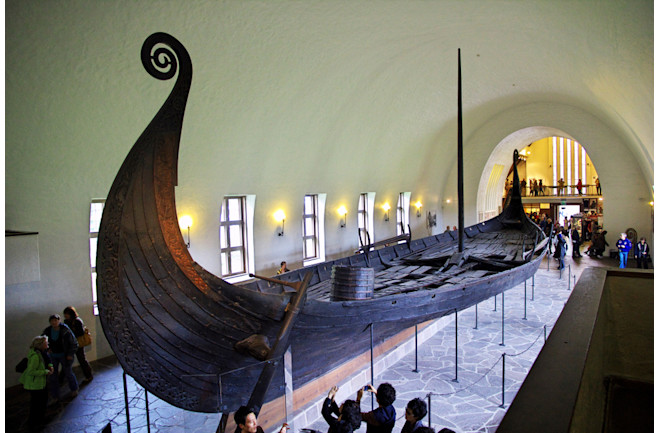
The Viking longship: an engineering marvel of the ancient world

(Credit: Aerophoto/Shutterstock)
 
From Discover Mag by Joshua Rapp Learn
 
The favored war ships of Norsemen were fast and adaptable to various conditions.

Even today a Viking longship is the kind of image that arouses fear and respect.
In the front you’re faced with the high bows carved into the image of a dragon or other creature, while the sides reveal a row of round shields that don’t exactly foretell peaceful maritime exchange.

During the Viking Age of Scandinavia, which lasted roughly from the end of the 8th century to the middle of the 11th century, Norsemen and Norsewomen used these agile ships to expand from icy lands, islands and fjords they called home in northern Europe to travel and raid as far as Newfoundland to the West, Russia to the east and the Mediterranean Sea in the south.
Many Vikings even conquered kingdoms in the British Isles and mainland Europe, marrying into the local populations to create a mixed heritage that remains today in places like Normandy, England and Scotland.

But why were these boats so successful? Through a combination of speed, durability and adaptability to a range of conditions, says one expert.

“These raids they conducted were something that was extraordinary at the time, at least at the beginning of the Viking Age,” says Morten Ravn, a research coordinator and curator at the Viking Ship Museum in Denmark and also a Viking in training.

The Beginning of an Era


Before they were Vikings, Scandinavians have always relied largely on the sea that surrounds the Scandinavian countries.
Many of these older boats were much smaller than the famed longships.
Ravn says that the Norse would have used smaller boats built from planks of wood and dugout canoes built by felling thick trees and hollowing out their trunks.
These vessels were largely propelled by rowing, according to archaeological evidence.
While northern Europeans certainly had some contact with Roman provinces about 2,000 years ago and likely had some knowledge of sail technology, archaeologists have never found any evidence either in ship finds or depictions that Scandinavians began to use sails themselves until the 7th or 8th centuries.


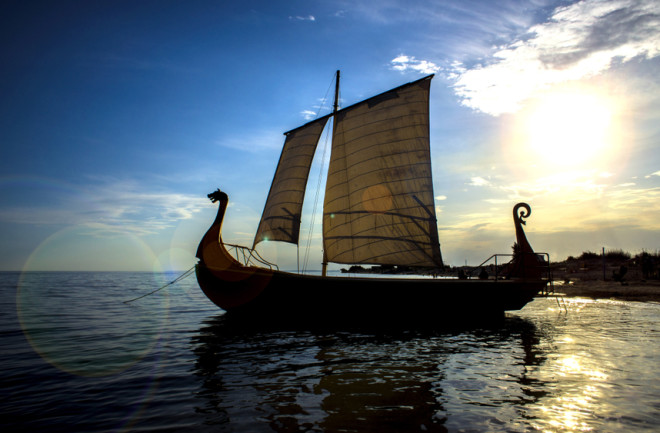
(Credit: Sergey-73/Shutterstock)

“It might just be that we simply haven’t found the ship finds where we would see this technology being used,” Ravn says.
But this timeline roughly makes sense when understanding why Scandinavian people began to expand outwards on longer sea voyages and raids about 1,200 years ago.

But by the time they began to use the sail, Scandinavians would certainly have been well versed in carpentry since most of their houses and settlements were built of wood.
“They would definitely already have excellent skills in selecting proper woods and using these resources in different construction projects,” Ravn says.
The combination of their knowledge of boatbuilding with sailing technology likely led to the construction of the first longships.
 

In Iceland there is a bridge in the shape of a sword, as a nod to the country's Viking past
 
Navigating the Sea

Researchers still debate about how Vikings managed to navigate the open sea on voyages that carried them to lands as far as Iceland, Greenland and even eastern Canada.
On the TV show Vikings, main character Ragnar Lothbrok is shown using a type of compass in a bucket together with a special sun stone that reveals the solar position during cloudy days.
Unfortunately, there is little archaeological evidence to indicate Vikings made use of such technologies, Ravn says — but he believes they wouldn’t have necessarily needed it in most cases anyway.

Ravn says the Vikings also may have made some use of the stars and sun for navigation.
Signs like birds could tell sailors that land was nearby while the behavior of fish or marine mammals could give clues as well, he says.
Wave patterns might reveal distant beaches or cliffs and seasoned mariners could likely even sense the difference in smell before they ever set their eyes on solid ground.
Except for exceptions like traveling to Iceland or Newfoundland, Ravn says that Viking ships largely hugged the coastlines in their travels.

Hit and Run

Many scholars mark the beginning of the Viking age at 793 with a violent raid on a Christian monastery at Lindisfarne, an island off the coast of Northumberland.
Right from the beginning, longships would have been particularly well suited to maneuvers like this.

The ships were likely built with a psychological component in mind.
The shields were likely put on the side partly due to the relatively small space for crew, but they also create a menacing appearance.
Ravn says the sails and hulls were often colorful, and powerful and frightening symbols like dragons were carved on the stems of the prows.
“Having these ships symbolizing power and splendor was very important for the Vikings,” he says.
“Seeing a fleet of these ships arrive, you would also be fairly intimidated.”

Sails would have allowed these ships great speed when the wind was favorable.
But the vessels were also equipped with rows of benches and oars so that the crew could still beat a fast approach or retreat on calm days.

Ravn says that the two strategies for moving these boats would have helped Vikings conduct quick, precision landings on beaches.
He speaks from personal experience as a Viking in training — the Viking Ship Museum where he works has reconstructed several Viking longships using traditional methods in an effort to understand more about the building technique.
They have taken them to the seas, and experiments the museum conducted showed that by the time the ships were first spotted on the sea to the time the first wave of warriors landed on the beach would only take an hour.

The hulls of the ships also sat very high on the water — the boats only dipped less than a meter below the water line.
This would have allowed longships to get into very shallow water without slowing down, allowing for quick troop deposits and effective amphibious assaults.
Ravn says that ships could even be brought together side by side, or using planks, to act as bridges to give warriors faster access to the shore.

Small raids would pick up over the next century until the time in which Viking armies were conquering European kingdoms.
Ravn says that Vikings also made use of less-adaptable cargo ships during this period that could carry equipment and supplies for armies.

Ravn’s experience as a crew member on reconstructed longships taught him that life onboard could be very cramped.
Warriors would have had to work well together just to operate the vessels, he says — but the experiences also produce strong personal bonds.
“All of this creates a very tight and well-organized community,” Ravn says.
“It’s a very special experience.”
This well-knit connection between warriors would have served them later on during their raids.

Organization, seamanship and technology all would have combined to give the Vikings an upper hand starting in the late 8th century.
But at the same time as other Europeans were victimized by the Vikings, they were also learning how to resist these types of assaults.
By the mid-11th century, mixed populations of Vikings and Europeans were savvy to their maritime tactics.
The Normand King William the Conqueror — himself a descendent of the Viking Rollo, defeated the English with the Battle of Hastings in 1066 and was crowned king.
A few other major Viking attacks occurred over the next century or so in different parts of the British Isles and Europe, but they were often repelled.

Thursday, August 5, 2021

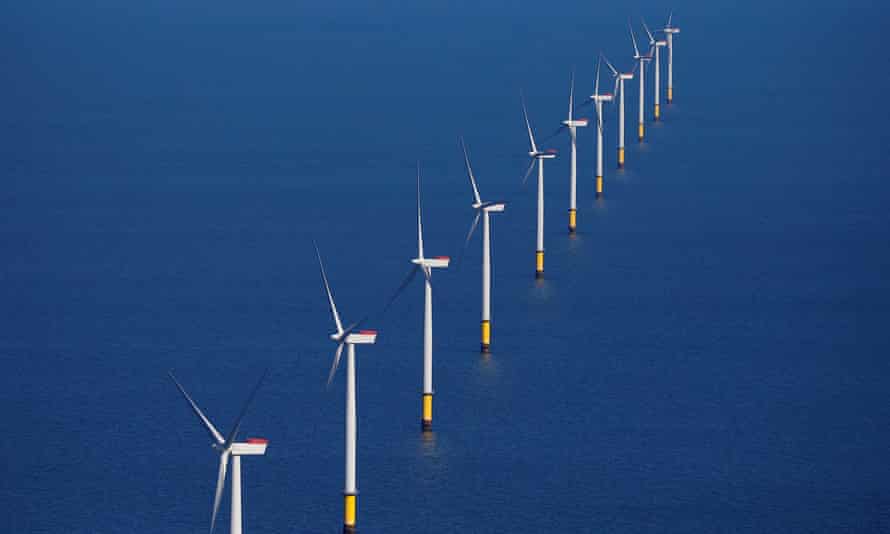
Australia has huge potential to develop offshore windfarms near existing substations, report says

 
A new report has found more than 2,000GW of offshore wind turbines could be installed in areas in Australia that are within 100km of electricity substations.
Photograph: Phil Noble/Reuters


From The Guardian by Adam Morton

Hunter and Latrobe valleys considered particularly suitable sites as union says industry could offer oil and gas workers a career transition

Australia has the potential to develop a substantial offshore wind energy industry from scratch, with abundant resources available near existing electricity substations across the continent, according to a new report.

The Blue Economy Cooperative Research Centre said Australia was yet to capitalise on significant offshore wind capacity despite the International Energy Agency nominating it as one of the “big three” likely sources of renewable energy globally alongside solar and onshore wind.

It found more than 2,000GW of offshore wind turbines – far more than Australia’s existing generation capacity – could be installed in areas within 100km of substations.
Environmentally restricted and low-wind areas were excluded from the assessment.

Sites that have traditionally been electricity generation hubs, such as the Hunter and Latrobe valleys and Gladstone, were found to be particularly suitable as they were close to transmission grids and had strong offshore winds at times when solar and onshore wind output was limited.

Dr Chris Briggs, research director at the University of Technology Sydney’s Institute for Sustainable Futures and a contributor to the report, said there had been a view in the energy industry that offshore wind energy would not play as significant a role in Australia as some other countries due to the availability of much cheaper solar and onshore wind energy.

He said that was starting to change as people recognised the scale of the clean energy transition required and what offshore wind could deliver.
“The combination of the scale, falling cost and the development of floating wind turbines means it has come into focus,” he said.

Briggs said offshore wind could be built on a much larger scale than solar or onshore wind – up to 2GW for a project – and could generate more electricity per megawatt of capacity.
“This could be very valuable in the late 2020s and 2030s as we see coal plants retiring,” he said.

The project’s leader, Dr Mark Hemer of the CSIRO, said offshore wind could be particularly important under “energy superpower” scenarios that involved mass electrification of industry and transport and hydrogen production for domestic use and export.

The report said there were 10 offshore wind projects with a combined capacity of 25GW in development in Australia, all at an early stage.
The most advanced is the $10bn Star of the South – a 2.2GW windfarm planned for between 7km and 25km offshore in South Gippsland.
 
Star of the South localization with the GeoGarage platform (AHS nautical chart)

The federal government is yet to finalise the regulatory framework necessary for an offshore wind industry to develop.
The report said it could help develop an industry by supporting the technology through the Clean Energy Finance Corporation and the Australian Renewable Energy Agency, incorporating it into planning for the national hydrogen strategy, and considering allocation of marine space in commonwealth waters.
The work was partly funded by the maritime, electrical and manufacturing unions.
They called on federal and state governments to take immediate steps to support the development of an industry, saying it had the potential to create jobs for workers in fossil fuel industries.

Paddy Crumlin, the national secretary of the Maritime Union of Australia, said the development of an offshore wind industry would give seafarers and offshore oil and gas workers an opportunity “to transition into the important work of delivering Australia’s clean energy future”.

Offshore wind is more advanced in countries with limited capacity to develop renewable energy on land.
The report said 2030 targets for offshore wind energy totalled about 200GW, including 60GW in the European Union, 40GW in Britain and 12 GW in South Korea.
Japan plans to reach 45GW by 2040.

Solar and onshore wind have grown substantially in recent years, leading to renewable energy providing nearly 30% of generation in the national electricity market.
But the Morrison government also continues to support fossil fuels.

A report by BloombergNEF and Bloomberg Philanthropies this week found Australia increased support for fossil fuel by 48% between 2015 and 2019, the largest rise in the G20.

It said most of the support had been delivered in the form of tax breaks to oil and gas projects.
They included tax capex deductions for mining and petroleum operations, fuel-tax credits and reductions in fuel-excise rates and offset schemes.
Australia “lost out on nearly US$6bn in foregone taxes” over the five years, it said.
The Bloomberg report did not include the Morrison government’s support for a “gas-fired recovery” from the pandemic.
The government dedicated hundreds of millions of dollars to gas projects in the May budget, including up to $600m for a new power plant in the Hunter Valley that experts say is not needed 
 
Links :

Wednesday, August 4, 2021