Saturday, December 5, 2020

Friday, December 4, 2020

Book review : Melville’s whale was a warning we failed to heed
 The killing in the 1830s of Mocha Dick, a giant sperm whale said to attack whaling ships with premeditated ferocity.
Mocha Dick was an inspiration for Melville’s “Moby-Dick.”
Credit... Alamy
From NYTimes by Carl Safina
In 1841, while aboard the whaler Acushnet, Herman Melville met William Chase among another ship’s complement.
William lent Melville a book by his father, Owen Chase: “Narrative of the Most Extraordinary and Distressing Shipwreck of the Whale-Ship Essex.” Melville had read Jeremiah Reynolds’s violent account of a sperm whale “white as wool,” named — for his haunt near Mocha Island, off the coast of Chile — Mocha Dick.
It’s unknown what led Melville to tweak Mocha to “Moby.” Good thing he did, and that Starbuck was the name he gave his first mate rather than his captain.
Otherwise the novel would follow Starbuck’s obsession with a Mocha.
Owen Chase gave Melville his climax: As Essex’s boats were harpooning female sperm whales, a huge male, around 85 feet, rushed and holed the 88-foot ship, twice.
No whale had ever sunk a ship.
“The reading of this wondrous story upon the landless sea, and so close to the very latitude of the shipwreck had a surprising effect upon me,” Melville later recalled.
He initially planned a book about whales and whaling.
Reynolds helped supply Melville with a more Stygian idea, by exhorting his men to attack Mocha Dick as “though he were Beelzebub himself!” — a demon rather than a whale.
Yet Moby Dick is neither whale nor demon, but a white prop contrasting with the demonic Captain Ahab, the tormented tormentor, the malignant, abused abuser of authority and of men.
Ahab’s bias is personal and color-based.
A white whale becomes a blank pincushion for Ahab’s thrusting mania as Melville shades pages with his madness.
Yet — and this was absolutely astonishing for its time — Moby Dick becomes the ultimate asserter of reason.
In self-defense the whale delivers justice.
And never dies.
Ahab vows to chase Moby Dick “over all sides of earth,” but he can’t do it alone, so he flatters his men into allegiance to his maniacal quest: “What say ye, men …? I think ye do look brave.” The harpooners shout, “Aye!” Ahab is impeccably skillful at manipulating people into abetting him, at making his self-destructive obsessions their own.
Ahab isn’t merely symptomatic; through his ability to steer men into complicity — and their inability to see it — he becomes contagious, truly dangerous.
Ahab isn’t merely symptomatic; through his ability to steer men into complicity — and their inability to see it — he becomes contagious, truly dangerous.
“Moby-Dick” is called a great American novel.
Perhaps it’s the first great global novel.
Melville broke through American myopia, vanishing over many horizons, rubbing shoulders with apostates, seeing civility in savages, savagery in the civilized and ruinous obedience to mad tyrants.
Melville’s years on ships sowed what his biographer Newton Arvin called “a settled hatred of external authority.”
[For the social distancing edition of an annual marathon reading of “Moby-Dick,” volunteers are recording performances from home.]
By the 1840s, having ventured half the world away from America, Melville cast a frigatebird-like perspective on the American character’s deepest congenital malignancy, then called Negrophobia.
In the early 19th century, sperm whale hunting was never far from slave trading.
Thomas Beale’s 1839 “The Natural History of the Sperm Whale” included this telling dedication to the British shipowner Thomas Sturge: “Your character may be estimated by the incessant efforts you have made to liberate the Negro from the condition of the slave.”
On docks and decks humans of varied skin shades and breathing one another’s sweat in close company tended whale-boiling caldrons and looked one another in the eye.
Light-skinned men could feel trapped and dark men could taste freedom, surviving, sometimes drowning, together.
Melville’s ever-philosophical narrator, Ishmael, asks: “Who ain’t a slave? Tell me that.” From a world he experienced as spherical from atop ships’ masts, Melville perceived a sea-level humanity, embracing and celebrating the latitudes and longitudes of human variation, now termed diversity.
When Ishmael finds himself compelled to share a blanket at the sold-out Spouter Inn, he declares, “No man prefers to sleep two in a bed.” But he settles in, waiting for his mysterious South Seas roommate who, he’s informed, is peddling a shrunken head on the streets of New Bedford.
Queequeg’s appearance terrifies Ishmael mute.
But after things equilibrate, Ishmael reconsiders: “For all his tattooings he was on the whole a clean, comely looking cannibal … a human being just as I am. … Better sleep with a sober cannibal than a drunken Christian.”
In the morning Ishmael wakes to find Queequeg’s arm “thrown over me in the most loving and affectionate manner.
You had almost thought I had been his wife.” Now there’s no panic.
Eventually Queequeg rouses and, by signs and sounds, makes Ishmael understand that he’ll dress and leave.
“The truth is, these savages have an innate sense of delicacy,” Ishmael editorializes.
“It is marvelous how essentially polite they are.
… So much civility and consideration, while I was guilty of great rudeness.” Reflecting on Queequeg’s tatted visage, he concludes: “Savage though he was, and hideously marred about the face — at least to my taste — his countenance yet had a something in it which was by no means disagreeable.
You cannot hide the soul.
… Queequeg was George Washington cannibalistically developed.”
Mates now for life, they find a ship, but Queequeg is barred; he’s not Christian.
Ishmael fast-talks: Queequeg, like “all of us, and every mother’s son and soul of us,” belongs to “the great and everlasting First Congregation of this whole worshiping world.
… In that we all join hands.” Impressed by Ishmael’s impromptu sermon, the recruiter allows their marks; they’ll board the Pequod, a ship Melville has named, he reminds us, for a famed tribe of Massachusetts natives, already extinct.
Nearly two centuries ago, Melville showed us how easy it is to welcome as our own the touches of others, their equivalent colors, customs and beliefs; their journeys, their transitions.
And to remember those who, unwelcomed, suffered.
How much could have been avoided, and embraced, had we heeded.
Melville feverishly scribbled a diagnosis, prognosis and prescription for the human condition.
We are all Ishmael the ingénue and Starbuck the pragmatist and Ahab the maniac, stuck on a ship driven by winds we cannot predict, helmed by a mind not fully comprehensible, whose compulsions we don’t control.
The world is an elusive whale; we might choose coexistence or destruction.
And though we do not decide the outcome, the hands on those oars are ours; each stroke invites consequences.
And lest we overlook the obvious: The men went equipped to do harm in their quest for — oil.
If we are all Ishmael and Starbuck and Ahab, caught in our collective addiction, the whales exemplify a counterculture, a way of living weightlessly, of not draining the world that floats them.
It’s no coincidence that Leviathan, the sperm whale, is Melville’s chosen vehicle.
No other candidate qualifies.
Ahab could have chased a fire-breathing dragon.
But to face real quotidian madness we must have at stake real blood and real will on both sides.
Only this creature — the largest with teeth on the planet — comes to us as quickened flesh and immortal metaphor, tangling us with our own pursuits, profane, bleeding, sacred, free.
Only Leviathan could do it.
Could win.
So one wonders about those who’ve turned the book aside — as, in college, I did.
How does one fare, having failed to be forewarned about our inner Ahabs or the risks of being led into complicity with madness, uncounseled on the wisdom of rejecting the obsessive quests that the world’s pulpits condone and its ports reward.
“Moby-Dick” is only partly about madness; it’s equally about banality.
Herman Melville’s haunting inquiry — “whether Leviathan can long endure so wide a chase, and so remorseless a havoc” — returns to me again while every whale in every ocean returns to share our air in seas we’re warming and thickening with plastic.
“If ever the world is to be again flooded, like the Netherlands, to kill off its rats,” Melville mused, “then the eternal whale will still survive, and … spout his frothed defiance to the skies.” But the warming that will erode the contours of Florida and New York, Houston, Hong Kong and Bangladesh will make life difficult for whales, too.
They, and all beings, as the naturalist Henry Beston wrote, are “caught with ourselves in the net of life and time, fellow prisoners of the splendor and travail of the earth.” Mesh by knotted mesh, it’s a net we have woven, perversely, by unweaving the web of life.
Melville tried to warn us.
Links :
Thursday, December 3, 2020
State of the art in multibeam echosounders
From Hydro by Huibert-Jan Lekkerkerk
The Evolution of a Bathymetric Workhorse
Although the single beam echosounder is still in use, it has over the last 25 years gradually been replaced with new and less expensive multibeam echosounder (MBES) systems.
And, although some side-scan sonar (SSS) systems also offer bathymetry, the MBES is the go-to system when it comes to bathymetry today.
MBES technology has gone through an evolution rather than a revolution in recent years.
In this article, we focus on the current state of the art for this bathymetric workhorse.
The Multibeam Echosounder
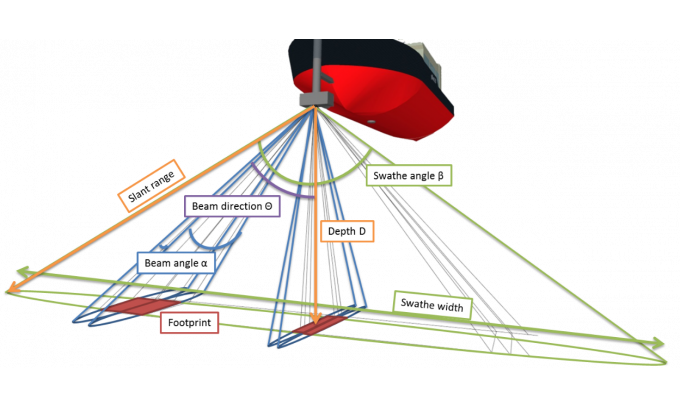
The main function of an MBES is to detect a number of depths along a swath of bottom.
To obtain these depths, the transducer sends out a pulse of sound that is reflected off the bottom and received by an array of transducers in a certain angular sector or swathe.
The system has a single transmit beam and a number (often 256) of receive beams.
The receive beams are formed on reception (and not, as some think, on transmission).
The swathe angle varies per system but is generally somewhere between 120° and 170°, giving swathe widths on the bottom in the order of 3.5 to 25 times the water depth.
Most multibeam echosounders are ‘shallow-water’ MBESs, with ranges between a few tens of metres and a few hundreds of metres.
A modern shallow-water MBES has a weight of a few kilograms up to tens of kilograms and can be installed on a surface vessel, ASV, AUV or ROV.
Although large and heavy special deepwater versions with ranges up to full ocean depth are also available, the ‘basic’ MBES is described below.
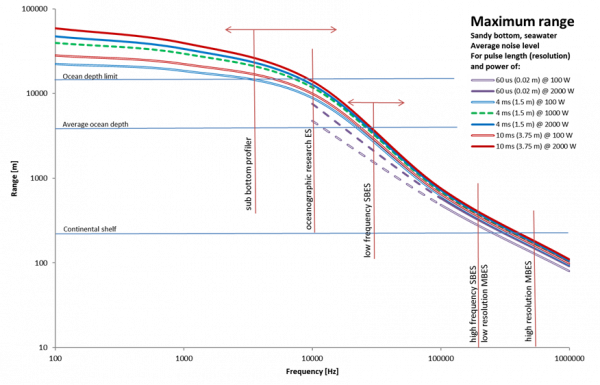
The final data density is defined by the number of beams (depths) and the ping rate, or the number of swathes that the MBES can measure per second.
The ping rate depends on the water depth, but can be as high as 60 pings per second in shallow water.
Accuracy
For nautical charting, the Special Publication 44 of the IHO sets the standard for sounding accuracy to which an MBES should adhere (together with the other sensors).
Some countries, and especially the offshore and dredging industry, do not find the S44 standards strict enough and impose their own accuracy standards on the work to be performed.
For the MBES to meet these standards, it not only needs to give full bottom coverage (sounding density) but also to measure each depth point with a minimum accuracy.
That accuracy depends both on the local situation and, more specifically, the sound velocity and the pulse length of the system.
Where in the past the transmitted signal was a ‘continuous wave’ (CW), a modern MBES can often also transmit what is called an FM or CHIRP (Compressed High Intensity Radar Pulse) signal.
The main advantage of the CHIRP is a longer range with better range resolution.
For a CW type MBES, the range resolution is defined by the pulse length of the signal, whereas for a CHIRP type MBES the range resolution is defined by the bandwidth of the signal, allowing longer pulses and therefore more power to be transmitted.
For a high frequency, shallow-water FM MBES, the range resolution is sub-centimetre for short ranges, allowing high accuracy for the sounded depths.
Frequency
The capabilities and dimensions of any acoustic system are mainly defined by physics.
Underwater acoustics tell us that a high frequency will have a smaller range than a low frequency system.
However, a high frequency system can, at a given size, produce a smaller beam angle than a low frequency system.
Also, frequency dictates whether the system can penetrate the top layer of the sea bottom or will be reflected by it.
Finally, the frequency defines the smallest possible pulse length or bandwidth.
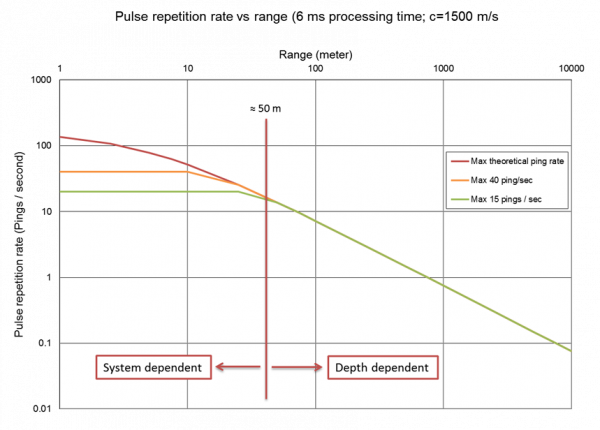
As can be seen, beam angle, size and range are all a function of frequency and counteract each other.
As such, there is no ideal frequency.
For highly detailed, close-range bathymetry, a high-frequency system will give the best results in a relatively small form factor.
For full ocean depth bathymetry, a low frequency needs to be chosen; if a small beam angle is then required the transducer will become large (and heavy).
In general, shallow-water MBESs operate at a frequency between 100 and 700kHz, which reflects off the top of the sea bottom but generally does not penetrate it.
To counteract frequency limitations, most manufacturers now offer shallow-water MBESs that are frequency-selectable.
That is, the MBES can be tuned to a specific frequency in the range of 100–700kHz.
Of course, the above remains true and the specifications of the MBES therefore change with a different frequency.
Multi-frequency and Multi-ping
Some manufacturers allow the user to not just select a single frequency but to use multiple frequencies simultaneously.
Although all the previous limitations still hold, using multiple frequencies can reduce the amount of noise encountered.
So, rather than not having some (high frequency) depths, these data points can be filled in using lower frequency data (although with a larger footprint and thus showing less detail).
Another option for especially deepwater MBES is the use of multi-ping.
In this situation, two to four pings are transmitted at slightly different angles simultaneously.
This counteracts the long travel times of the signal in deep water and allows for greater coverage without gaps at higher survey speeds.
Water Column Data
A traditional MBES measures a single depth per beam per ping.
In general, the ‘first depth strong enough to be detected’ will result in the depth displayed.
Less strong depths that may be closer to the multibeam are not detected.
Also, a strong reflector close to the transducer may give a depth rather than the weaker bottom below it.
Many modern MBES systems circumvent this limitation by offering water column data as an option.
With this technique, the water column of each beam is divided into a number of ‘bins’.
The MBES now looks for a return within each bin for each beam for each ping.
This allows the MBES to measure multiple reflections and thus create 3D images of objects in the water column (or to see the bottom through, for example, vegetation).
Some manufacturers even support multi-frequency in combination with water column data, allowing even more objects to be positively detected.
As can be deduced, especially with many beams, multi-frequency and a high ping rate make the amount of data gathered enormous.
To compensate, the water column data is often compressed to make it manageable.
Despite this, the data volumes (and thus the time spent processing) are still large.
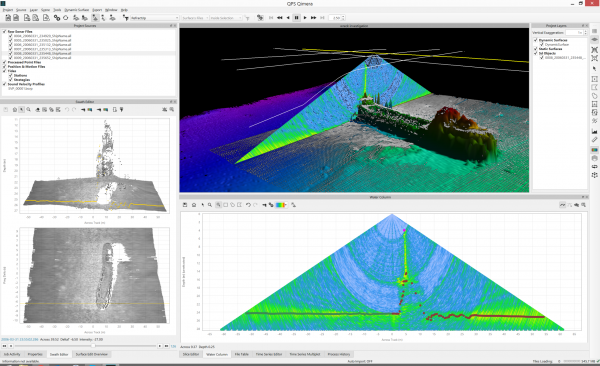
Water column data.
(Image courtesy: QPS.nl)
(Image courtesy: QPS.nl)
Backscatter Data
Backscatter is the amount of signal returning from the bottom.
Depending on the type of material, more or less signal will be received thus allowing object and bottom classification.
Most modern MBES systems have the option to receive backscatter data together with the depth information and show an SSS-like image.
Some manufacturers combine the backscatter data with both water column and multi-frequency capabilities, allowing even more information to be collected.
The advantage of combining backscatter with water column data is that objects in the water column can be better identified.
The combination of backscatter with multi-frequency is especially useful for bottom classification.
As materials can react differently to different frequencies, measuring the backscatter at different frequencies but at the same moment in time can give classification algorithms better information to work with.
SSS vs Multibeam Echosounders
With the backscatter option on the MBES, a common question is whether an SSS is still required.
As described in an earlier article on SSS technology, the brief answer is that it is.
The difference between MBES backscatter and a true SSS is that the MBES will provide one backscatter value per beam, whereas the SSS will provide an almost continuous signal, thus giving a higher resolution.
So, an MBES provides at most around 1,024 backscatter points per swathe, whereas an SSS has a continuous signal.
However, the MBES data may be more than enough for a general classification.
If, however, more detail is required, it is advisable to use an SSS.
Backscatter is the amount of signal returning from the bottom.
Depending on the type of material, more or less signal will be received thus allowing object and bottom classification.
Most modern MBES systems have the option to receive backscatter data together with the depth information and show an SSS-like image.
Some manufacturers combine the backscatter data with both water column and multi-frequency capabilities, allowing even more information to be collected.
The advantage of combining backscatter with water column data is that objects in the water column can be better identified.
The combination of backscatter with multi-frequency is especially useful for bottom classification.
As materials can react differently to different frequencies, measuring the backscatter at different frequencies but at the same moment in time can give classification algorithms better information to work with.
SSS vs Multibeam Echosounders
With the backscatter option on the MBES, a common question is whether an SSS is still required.
As described in an earlier article on SSS technology, the brief answer is that it is.
The difference between MBES backscatter and a true SSS is that the MBES will provide one backscatter value per beam, whereas the SSS will provide an almost continuous signal, thus giving a higher resolution.
So, an MBES provides at most around 1,024 backscatter points per swathe, whereas an SSS has a continuous signal.
However, the MBES data may be more than enough for a general classification.
If, however, more detail is required, it is advisable to use an SSS.

Other Options
Besides the options described above, manufacturers offer additional options in their systems.
An example is a dual head set-up.
With this option, a much larger swathe can be created with swathe angles up to 240°, allowing surface to surface measurements for inspection work.
The dual head option is often used in pipeline inspections.
Some manufacturers also offer a pipeline mode, where a small sector beneath the transducer gives highly detailed information (at a high frequency).
Another option often offered is the integration of an Inertial Motion Unit (IMU) with the MBES.
This is often advertised as not needing any calibration, although most manufacturers mean that there is no additional calibration required between the MBES and the IMU.
Performing an MBES calibration will also give the IMU calibration parameters.
Sometimes ignored is the fact that the IMU also plays a role in the positioning system.
This means that, even though the values can be obtained from the MBES calibration, they still need to be entered into the survey software to compensate for any positioning offsets.
Wednesday, December 2, 2020
Polar scientists wary of impending satellite gap
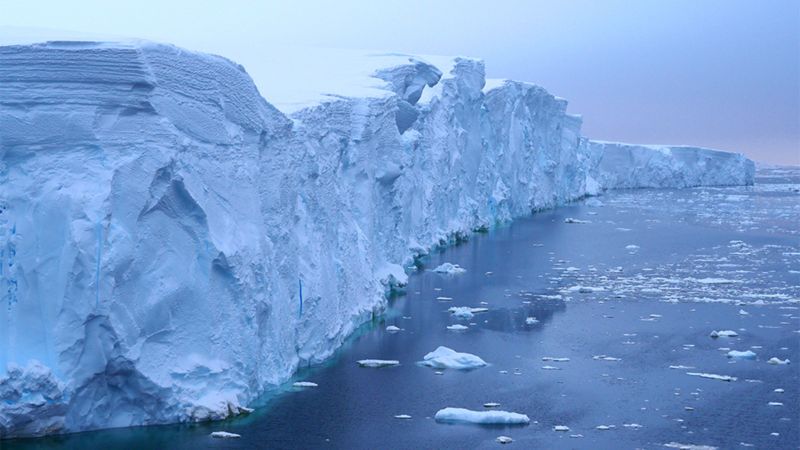
It's satellites that have tracked the loss of ice in the Antarctic and the Arctic
photo Rob Larter/BAS
From BBC by Jonathan Amos
There is going to be a gap of several years in our ability to measure the thickness of ice at the top and bottom of the world, scientists are warning.The only two satellites dedicated to observing the poles are almost certain to die before replacements are flown.
This could leave us blind to some important changes in the Arctic and the Antarctic as the climate warms.
The researchers have raised their concerns with the European Commission and the European Space Agency.
A letter detailing the problem - and possible solutions - was sent to leading EC and Esa officials this week; and although the US space agency (Nasa) has not formally been addressed, it has been made aware of the correspondence.
At issue is the longevity of the European CryoSat-2 and American IceSat-2 missions.
These spacecraft carry instruments called altimeters that gauge the shape and elevation of ice surfaces.
They've been critical in recording the loss of sea-ice volume and the declining mass of glaciers.
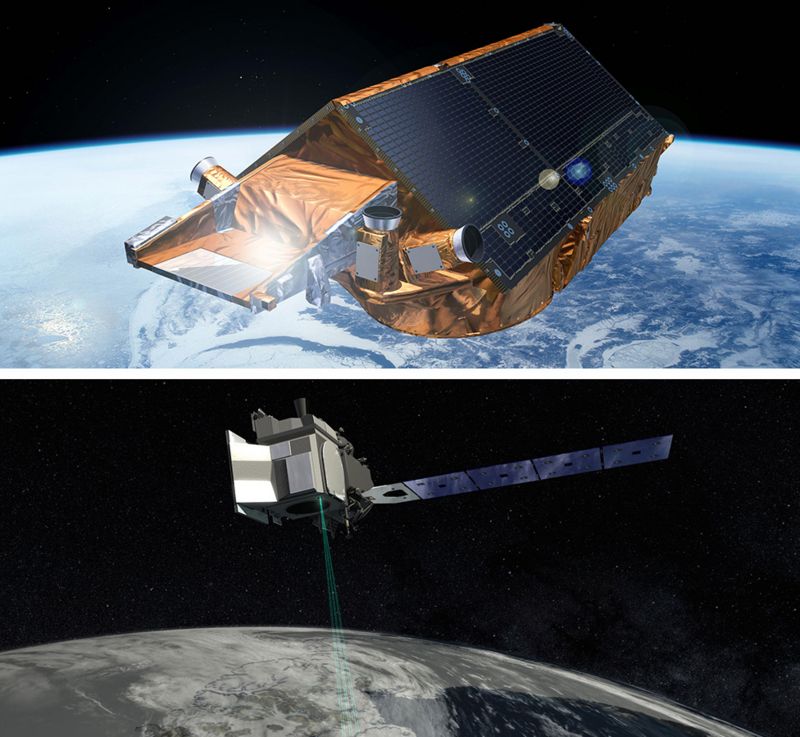
Image copyright ESA/NASA
image captionArtwork: CryoSat-2 (top) and IceSat-2 (bottom) will hopefully last until mid-decade
image captionArtwork: CryoSat-2 (top) and IceSat-2 (bottom) will hopefully last until mid-decade
What's unique about the satellites is their orbits around the Earth.
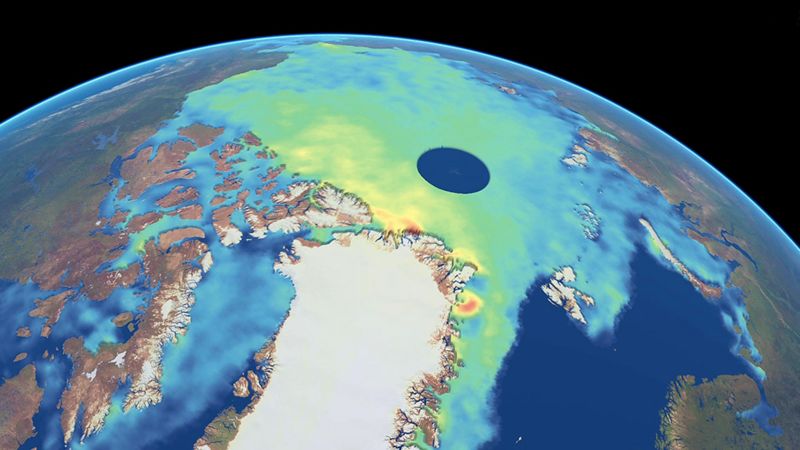
They fly to 88 degrees North and South from the equator, which means they see the entire Arctic and Antarctic regions, bar a small circle about 430km in diameter at the poles themselves.
In contrast, most other satellites don't usually go above 83 degrees.
In contrast, most other satellites don't usually go above 83 degrees.
As a consequence, they miss, for example, a great swathe of the central Arctic Ocean and its frozen floes.
The worry is that CryoSat-2 and IceSat-2 will have been decommissioned long before any follow-ups get launched.
CryoSat-2 is already way beyond its design life. It was put in space in 2010 with the expectation it would work for at least 3.5 years.
The worry is that CryoSat-2 and IceSat-2 will have been decommissioned long before any follow-ups get launched.
CryoSat-2 is already way beyond its design life. It was put in space in 2010 with the expectation it would work for at least 3.5 years.
Engineers think they can keep it operating until perhaps 2024, but battery degradation and a fuel leak suggest not for much longer.
IceSat-2 was launched in 2018 with a design life of three years, but with the hope - and expectation - it can operate productively deep into the decade.
IceSat-2 was launched in 2018 with a design life of three years, but with the hope - and expectation - it can operate productively deep into the decade.
The satellites' orbits leave only a very small hole in their measurements at the poles
ESA
"Without successful mitigation, there will be a gap of between two and five years in our polar satellite altimetry capability," the scientists' letter states."
This gap will introduce a decisive break in the long-term records of ice sheet and sea-ice thickness change and polar oceanography and this, in turn, will degrade our capacity to assess and improve climate model projections."
The only satellite replacement currently in prospect is the EC/Esa mission codenamed Cristal.
The only satellite replacement currently in prospect is the EC/Esa mission codenamed Cristal.
It will be like Cryosat, although with much greater capability thanks to a dual-frequency radar altimeter.
Industry has started work on the spacecraft but it won't launch until 2027/28, maybe even later because full funding to make this date a reality is not yet in place.
Dr Josef Aschbacher, the director of Earth observation at Esa, said his agency was working as fast as it could to plug the gap.
"This is a concern; we recognise it," he told the BBC. "We've put plans in motion to build Cristal as quick as we can. Despite Covid, despite heavy workloads and video conferences by everyone - we have gone through the evaluation... and Cristal was kicked off in early September."
 IMAGE COPYRIGHTNAS Aimage caption An option for Europe?
Just over 10% of the near-600 signatories to the letter are American scientists.
Dr Thomas Zurbuchen, the head of science at Nasa, is not being sent the letter because it is primarily aimed at European funders - and most of the signatories are European.
Industry has started work on the spacecraft but it won't launch until 2027/28, maybe even later because full funding to make this date a reality is not yet in place.
Dr Josef Aschbacher, the director of Earth observation at Esa, said his agency was working as fast as it could to plug the gap.
"This is a concern; we recognise it," he told the BBC. "We've put plans in motion to build Cristal as quick as we can. Despite Covid, despite heavy workloads and video conferences by everyone - we have gone through the evaluation... and Cristal was kicked off in early September."
IMAGE COPYRIGHTNAS Aimage caption An option for Europe?The Americans flew a stop-gap laser altimeter on aeroplanes
Just over 10% of the near-600 signatories to the letter are American scientists.
Dr Thomas Zurbuchen, the head of science at Nasa, is not being sent the letter because it is primarily aimed at European funders - and most of the signatories are European.
Nonetheless, Dr Zurbuchen is aware of the letter and its contents.
He said he was hopeful any polar gap could be plugged or minimised.
"I think there are multiple options at this moment in time that we can deploy to that end, in partnership or otherwise," he commented.
One of those solutions in Europe would be to run a version of Nasa's IceBridge project.
This was an airborne platform that the US agency operated in the eight years between the end of the very first IceSat mission in 2010 and the launch of IceSat-2 in 2018.
An aeroplane flew a laser altimeter over the Arctic and the Antarctic to gather some limited data-sets that could eventually be used to tie the two IceSat missions together.
There are many who think a European "CryoBridge" is the most affordable and near-term option to mitigate the empty years between CryoSat-2 and Cristal.
The cost of manufacture of the airborne radar altimeter could be accomplished for perhaps €5m (£4.5m), scientists believe, but its design and fabrication would likely take two years.
He said he was hopeful any polar gap could be plugged or minimised.
"I think there are multiple options at this moment in time that we can deploy to that end, in partnership or otherwise," he commented.
One of those solutions in Europe would be to run a version of Nasa's IceBridge project.
This was an airborne platform that the US agency operated in the eight years between the end of the very first IceSat mission in 2010 and the launch of IceSat-2 in 2018.
An aeroplane flew a laser altimeter over the Arctic and the Antarctic to gather some limited data-sets that could eventually be used to tie the two IceSat missions together.
There are many who think a European "CryoBridge" is the most affordable and near-term option to mitigate the empty years between CryoSat-2 and Cristal.
The cost of manufacture of the airborne radar altimeter could be accomplished for perhaps €5m (£4.5m), scientists believe, but its design and fabrication would likely take two years.
Such a project would therefore have to get under way relatively soon.
It would, of course, also need an operational budget.
The signatories to the letter sent to the EC and Esa include leading scientists using CryoSat and IceSat data, the president of the International Glaciology Society, and lead authors on the United Nations' Intergovernmental Panel on Climate Change, which prepares the authoritative state-of-the-climate reports for world governments.
The signatories to the letter sent to the EC and Esa include leading scientists using CryoSat and IceSat data, the president of the International Glaciology Society, and lead authors on the United Nations' Intergovernmental Panel on Climate Change, which prepares the authoritative state-of-the-climate reports for world governments.
Links :
Subscribe to:
Posts (Atom)