Saturday, July 26, 2014

Canada CHS nautical chart layer : caution with vertical clearances

Message from Director of CHS Products and Services (25/07/2014)


Caution.

The Canadian Hydrographic Service (CHS) would like to let you know of that the vertical clearances on charts and equivalent BSB are inaccurate :

1313 Batiscan au/to Lac Saint-Pierre
1314 Donnacona à/to Batiscan
4026 Havre Saint-Pierre et/and Cap des Rosiers à/to Pointe des Monts
4275 St. Peters Bay
2250 Bruce Mines to/à Sugar Island
2283-1, 2283-2 Owen Sound to/à Giant's Tomb Island
4266 Sydney Harbour
4201 Halifax Harbour - Bedford Basin

Notships will be issued shortly.
Notmar will be issued in the next edition.

TP-52 worlds in Sardinia

TP 52 Worlds -- filmed by Drone from Pigeon Vision

Winds were 8-13 knots : TP52 World Championship, June 11 in Porto Cervo

Friday, July 25, 2014

Deep sea mining licences issued


Hydrothermal Vents: What does the future hold?
Since being discovered in 1977, Hydrothermal Vents have been a source of huge interest, due to their rich diversity and huge populations of new and specialised species in a comparatively baron and homogenous abyss.
The mineral rich chimneys spew out a sulphurous fluid which forms an energy source for microbes, forming the base of these fascinating and unique ecosystems.
Their isolation and mysterious interconnectivity reveals a fragile web of life that still has so much more left to be fully appreciated.
The vents have also caught the attention of deep-sea mining contractors.

30 years on from their initial discovery, the global population has doubled and commodity prices have increased.
Now, with new technological advances, deep-sea mining has become an imminent reality.
Specialist researcher, Dr Jon Copley, talks through his experiences with Hydrothermal Vents and how irresponsible and short-sighted mining practices may have potentially catastrophic consequences on an ecosystem we still do not fully understand.

From BBC by David Shukman

Vast new areas of the ocean floor have been opened up in an accelerating search for valuable minerals including manganese, copper and gold.

In a move that brings closer a new era of deep sea mining, the UN's International Seabed Authority (ISA) has issued seven new exploration licences.
State-owned and private companies from India, Brazil, Singapore and Russia are among those to land permission for minerals prospecting.
One British firm, UK Seabed Resources, a subsidiary of the US defence giant Lockheed Martin, has secured exploration rights to an area larger than the entire UK.

 For decades, the idea of mining these deposits was dismissed as unfeasible

This means that the total area of seabed now licensed in this new gold rush has reached an immense 1.2 million square kilometres under 26 different permits for minerals prospecting.
Deep sea mining is a new frontier in the quest for the precious raw materials needed for modern economies but environmental groups have long warned of the potential damage to marine ecosystems.
Mining the ocean floor was first investigated in the 1960s but only recently have technological advances - spurred by the oil and gas industry - and high prices for resources combined to make operations feasible.

The ISA was set up to manage the exploitation of the ocean floor beyond territorial limits to prevent a free-for-all and has so far only issued licences for exploration.
The first permits for exploitation could come in the next few years.

Nodules are a target for extraction - these small lumps of rock contain high proportions of metals

Michael Lodge of the ISA told the BBC: "There's definitely growing interest. Most of the latest group are commercial companies so they're looking forward to exploitation in a reasonably short time - this move brings that closer."
Still to be negotiated are the conditions and rules for actual mining.

Sustainable Seabed Mining: A New Concept For Atlantis II Deep

A protocol to minimise the environmental impact is still being drawn up.
And arrangements for royalties to be paid to developing and landlocked countries have yet to be settled - a basic principle of the ISA is that seabed riches should be shared globally.
Two of the new licences - for German and Indian organisations - cover deep ocean ridges where hydrothermal vents have created potentially rich deposits.

Dr Jon Copley of the University of Southampton, a marine biologist, has monitored the development of deep sea mining amid concerns about its possible effects on the natural world.
"In total, about 6,000 km of mid-ocean ridge in international waters are now being explored for potential seafloor mining. In total, around 7.5% of the global mid-ocean ridge - the geological backbone of our planet - is now being explored for its mineral wealth.
"Ridges are one of the three deep-sea environments where there are mineral deposits attracting interest, in this case for the metal ores that form at deep-sea vents along the ridges.
"But those vents are also home to colonies of some species that aren't found in other deep ocean environments, which may make them susceptible to environmental impacts from mining."

UK Seabed Resources, a wholly owned subsidiary of Lockheed Martin UK, in partnership with the Department for Business Innovation and Skills, has received a licence and contract to explore a 58,000 sq kilometre area of the Pacific for mineral-rich polymetallic nodules.

UK Seabed Resources (UKSRL) conducted a baseline environmental survey of its licence area in the Pacific last October.

Construction of a seafloor mining machine was completed in the UK

It is hoping to extract so-called nodules from the ocean floor - small lumps of rock which contain far higher proportions of metals than ores found on land.
Duncan Cunningham of UKSRL said the company remained "committed to environmentally responsible, transparent and commercially sound development of the area".
He added: "We were extremely pleased to have had the opportunity to present details of our first environmental baseline cruise to the ISA and other stakeholders."

Deep-Ocean Vents Power Plant (Marshall Hydrothermal)

The first seabed mine is likely to be in the waters off Papua New Guinea.
In a deal arranged outside the ISA system, a Canadian company, Nautilus Minerals, plans to extract metals from a field of hydrothermal vents.
The project was delayed for years by a dispute with the PNG government but terms have now been finalised and huge robotic mining machines are being constructed.

Links :
  • BBC : UK Seabed Resources joins deep-ocean mineral-mining rush
  • TheGuardian : Seabed mining could earn Cook Islands 'tens of billions of dollars'

Thursday, July 24, 2014

Costa Concordia : the last travel

Follow the last route of Costa Concordia in Live with MarineTraffic

From BBC

The wrecked Italian cruise ship, the Costa Concordia, is being towed to the port of Genoa for scrapping after a two-year salvage operation.

Its removal is one of the biggest ever maritime salvage operations.
The Concordia struck a reef off the Italian island of Giglio in January 2012 and capsized, killing 32 people.
Captain Francesco Schettino has denied charges of multiple manslaughter and abandoning ship, which could see him jailed for up to 20 years.
The Costa Concordia was re-floated nine days ago and is being kept above the surface by giant buoyancy chambers.
More than a dozen vessels will help to tow the ship.

Costa Concordia Giglio wreck removal aerial view from drone

The wreck was hauled upright in September last year but was still partially submerged, resting on six steel platforms.
Sirens on nearby boats wailed and bells on Giglio tolled just before two tugboats pulled the vessel away.


Italian civil protection service head Franco Gabrielli told the Reuters news agency that "victory" could only be declared when the ship was in sight of the port of Genoa.
The cruise ship is being towed to Genoa at two knots, almost at walking pace, with an escort of more than a dozen tug boats.
The journey, which is expected to take four days, began shortly before 09:00 local time (07:00 GMT).


'Tragedy strike'

Senior salvage master Nick Sloane said early on Wednesday that everything was going according to plan.
However, French ecology minister Segolene Royal has said she will monitor the ship's movement from Corsica. Residents on the island fear that any oil leak from the cruise ship could cause significant environmental damage.

The Concordia is set to sail 25km (15 miles) from Corsica and close to the islands of Elba and Capraia before its expected arrival in Genoa late on Saturday.

A survivor of the tragedy told Reuters that initially he saw the area where the ship sunk as "a place where I saw tragedy strike", but over time his view had changed because it was a miracle that 4,000 people were saved.

Investigators are still looking for the body of Indian waiter Russel Rebello, whose body is the only one not to have been found.

The Costa Concordia's owners, Costa Crociere, estimate the operation to remove the wreck from the reef and tow it for scrapping will cost 1.5bn euros (£1.2bn; $2bn) in total.

Links :

Wednesday, July 23, 2014

This floating platform could filter the plastic from our polluted oceans


From ArchDaily

“Plastic is an extremely durable material, taking 500 years to biodegrade, yet it’s designed to be used for an average of 5 minutes, and so it’s thrown away. Few know where this mass of junk will end up … in the oceans, killing and silently destroying everything, even us.”

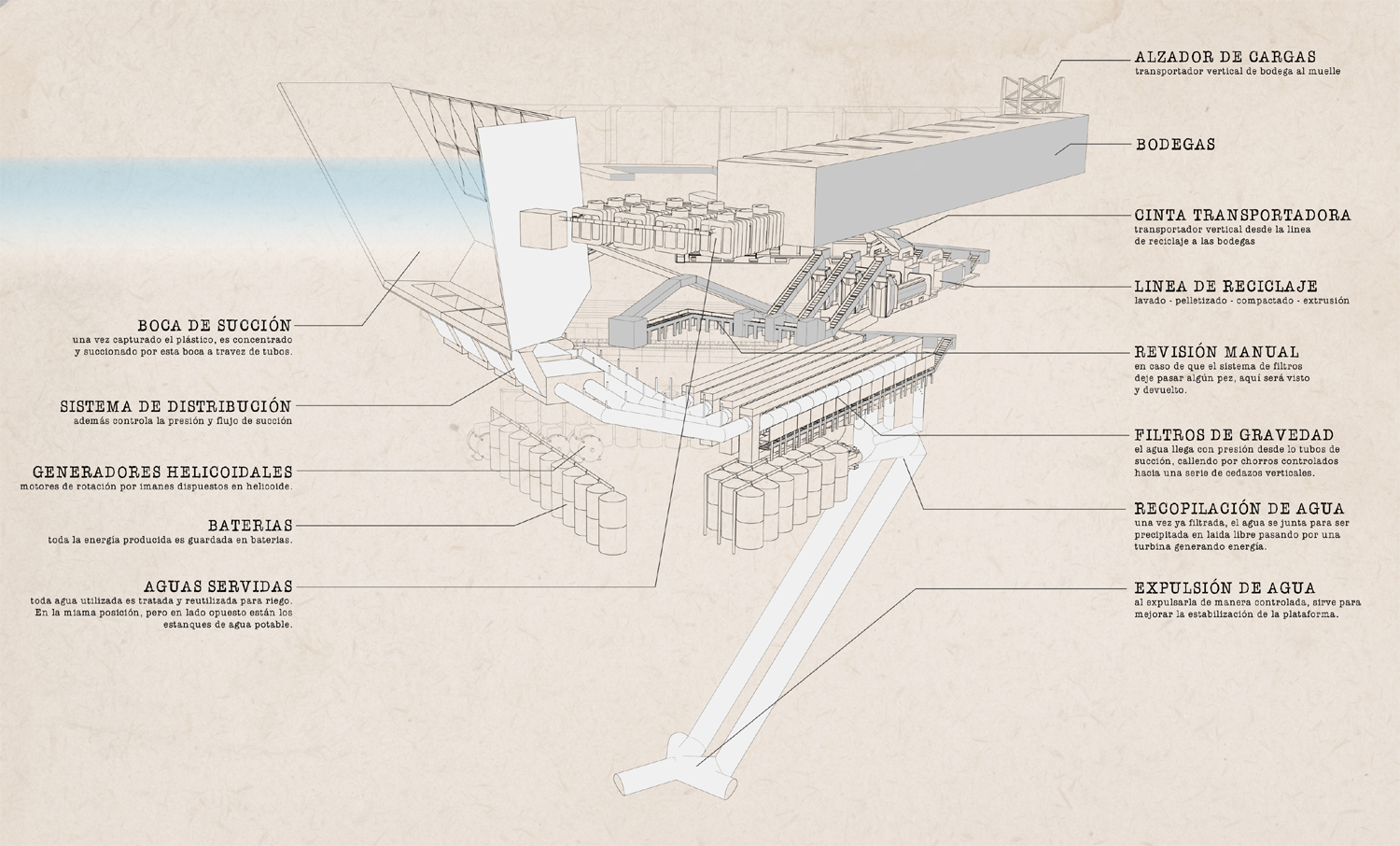
Cristian Ehrmantraut has developed a prototype for a floating platform that filters the ocean and absorbs plastic.
Located 4 km from the coast of Easter Island, close to the center of the mega-vortex of plastic located in the South Pacific, the tetrahedral platform performs a kind of dialysis, allowing the natural environment to be recovered as well as energy and food to be produced.


From the Architect.
The idea for the project comes from a reality that, although few realize it, affects us all: the disposable culture and its principal actor — plastic

Since the 1960s, plastic has become a part of our daily lives, allowing us, among other things, to extend our lifespan.
However, behind this remarkable reality lies an uncomfortable fact: plastic is an extremely durable material, taking 500 years to biodegrade, yet it’s designed to be used for an average of 5 minutes, and so it’s thrown away.
Few know where this mass of junk will end up … in the oceans, killing and silently destroying everything, even us.

Today there are six mega-vortexes of floating plastic: five between the continents and a sixth close to the Arctic, which is similar in size to Brazil (8.5 million square kilometers) and is 10 meters thick.
It is in this environment that Halobates – a wild insect that feeds on zooplankton – thrives.
The insect has experienced such exponential growth, in fact, that it’s endangering the zooplankton, essentially eliminating the base of the oceanic food chain.

Internal System

In the center of the mega-vortex of the South Pacific is Easter Island. Tons of micro-plastic trash arrive with every wave (Special Report – TVN – Plástico, el doble filo), making it a strategic place to start cleaning the global oceans.
Easter Island, which hosts over 50,000 tourists annually from all over the world, could well become the world’s referent for a new ecology, which, whether we like it or not, will be focused on cleaning up this disastrous mess for the next 1000 years (see the documentary: Charting the garbage patches of the sea).
This effort will enlist architecture, which will not only have to sustainably produce energy without polluting, but also actively clean the environment.

Thus, the project, which would be located 4 km off the coast of Easter island, is a prototype for a floating platform that filters the ocean, absorbs plastic, and protects the island from this ceaseless attack.

Platform

The design of the sub-structure is based on the application of the M.E.F. logic, which is similar to the Sierpinski fractal, but in three dimensions in order to achieve the overall coordination of the small, prefabricated elements. Its tetrahedral shape is simple, clean, stable, and static.

At the conceptual level, interesting things also occur, such as the verticality of the space in its natural state; just by being submerged, it’s possible to see the sky from below sea level.
Aspects of emergence at a non-invasive, horizontal level were also considered, which results in a volume no bigger than a freighter, with the habitable zone on the surface and the recycling zone underwater.
Ocean water is directed toward the recycling zone via gravity filters that separate the water from the plastic, which is later processed into plastic bricks, tiles, or anything that could be used to improve the quality of life of those in need.
The habitable zone also has gardens to produce food for its 65 workers, without having to resort to supplies from the Island.
The roof is made from photovoltaic cells.


To capture the plastic and lure it to the platform, we developed a modular system of rolling barriers that use the waves to separate the living from the inert, all while producing energy and preserving the free passage of fish, boats, etc.
Due to the the huge magnitude of ocean currents, a platform would be needed every several kilometers.

The ocean is dynamic, so it’s not necessary that the platforms move; eventually, all the water will pass through the same zone.

A range of platforms operating systematically will cover hundreds of kilometers – a good start to fixing the disaster we’ve all collectively caused.

So let’s get to work...


Floating cities

Links :