Thursday, February 27, 2025

Meet Sylvia Earle, the trailblazing marine biologist who has spent her career giving algae their long-deserved due

Marine Biologist Sylvia Earle in a DeepWorker submersible.
Tim Taylor, Mission Blue

 
For International Women and Girls in Science Day, the museum’s Ocean Portal spoke with “Her Deepness” about science, seaweed and the planet’s future

Hidden from public view at the National Museum of Natural History is a massive room filled with rows and rows of storage shelves.
Each holds stacks of thousands of herbarium sheets – dried samples of plant species from around the world.

Within this sprawling assemblage of plastered plants is a set of algae sheets with a very important history — they are the life’s work of Sylvia Earle.
This past November, “Her Deepness” returned to the museum and visited the specimens she collected half a century ago.

Earle is one of the great naturalists of the last century, often mentioned among the likes of David Attenborough and Jane Goodall.
She was the first woman to lead the National Oceanic and Atmospheric Administration, holds the record for the deepest untethered dive and has led countless expeditions across the globe.
One of her most famous missions was leading an all-female expedition inside the Tektite Habitat, an underwater laboratory, during a time when women were often excluded from similar opportunities.
Born in 1935, Earle continues to passionately advocate for ocean conservation.

In 1999, Earle donated her life’s work to the museum, which is home to the United States National Herbarium.
She felt it was important that her specimens remained preserved in the “central headquarters for keeping the history of life intact.” The Earle collection includes over 6,000 herbarium sheets with meticulously preserved algae and seagrass specimens from across the globe.
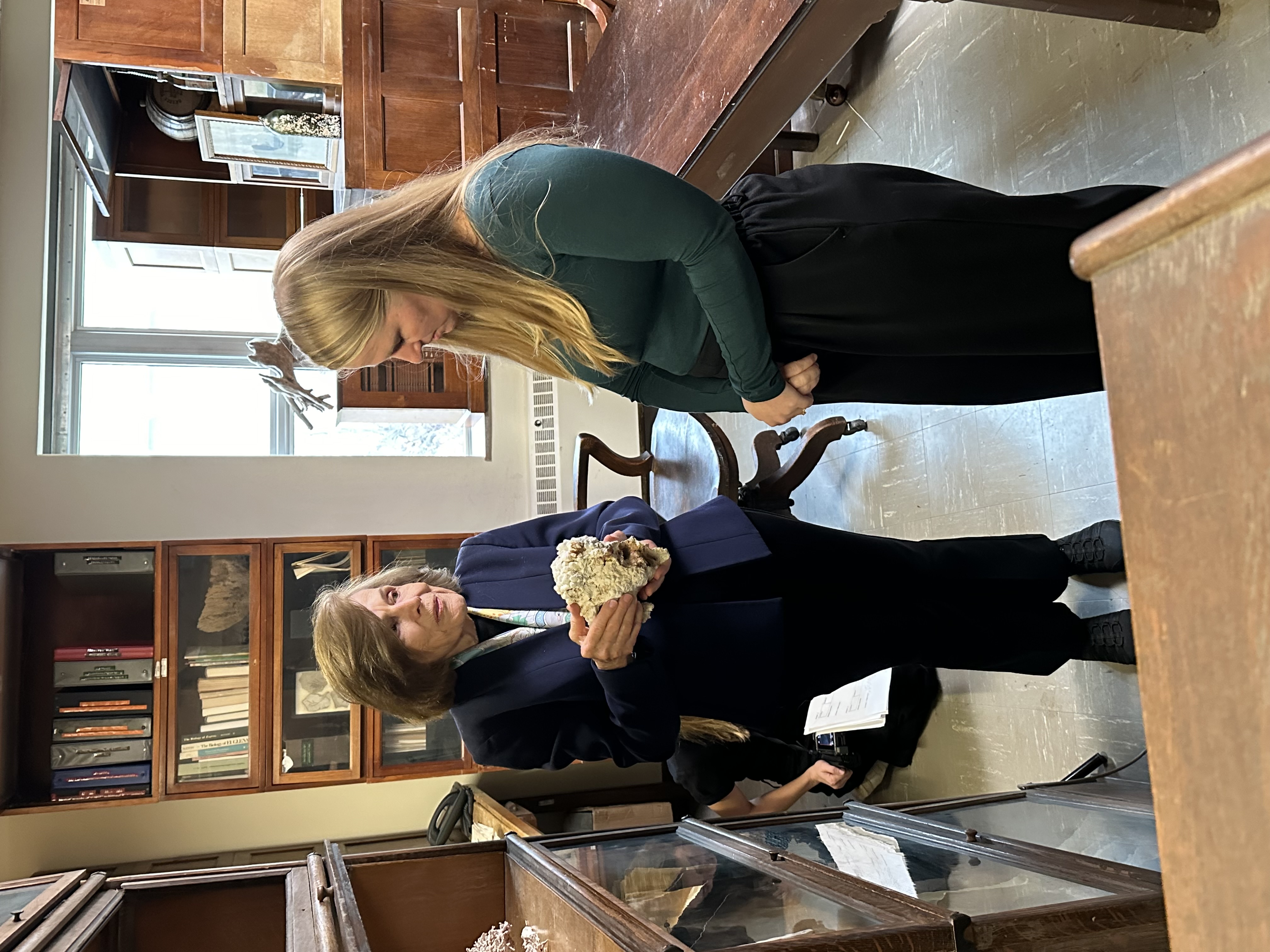
 
 
Earle (left) speaks with Danielle Olson in the National Museum of Natural History’s collection space in late 2024. 
Emma Saaty, NMNH

During her 2024 visit, Earle had a chance to sit down with Danielle Olson, the managing editor of the Smithsonian’s Ocean Portal.
As a child Olson dressed up as Earle for a school wax museum project and, like many young girls, she was inspired by Earle to pursue a career in the marine sciences.

In the interview below, Olson asked Earle about her pioneering career and some of the seaweed she has collected along the way.
The following is from their discussion and has been edited for length and clarity.

Danielle Olson (DO): Your parents instilled a love for the ocean and the natural world.
Why did you gravitate toward algae?


Sylvia Earle (SE): Why not? I had my eyes opened to the amazing diversity, beauty, wonder and importance of the photosynthesizers in the sea, what we call seaweeds or algae and seagrasses, by my major professor Harold Humm during a summer class in marine biology at Florida State University.
We literally immersed ourselves in the ocean.
Harold’s passion for seaweed was contagious.
I think I was the only one of the eight students who stuck with it.

I had already been splashing around a bit in the Gulf of Mexico but had not appreciated the seagrasses and algae.
I was initially more intrigued by the fishes and invertebrates— the crab and the sea cucumbers—and other things where I lived in Clearwater Bay.

DO: Using scuba gear to conduct research was very new when you did your PhD work.
What went into your decision to use the gear and how did that affect what you were able to do?


SE: Before I even started my doctoral program, it was difficult to find out who knew what about life in the Gulf of Mexico.
There was one publication in 1954 that tried to pull together as much as was then known about the [Gulf’s] biology, geology and the currents and tides.
A very small portion was about marine plants and algae written by William Randolph Taylor, which summarized all that was known then.
It wasn’t very much.
Most was derived from what could be either dragged from the ocean using a net or trawl or picked up off the beach.
People just did not get into the water.

Having a facemask and fins, that was in itself a breakthrough.
But scuba had also come along.
That class I took in marine biology in the summer of 1953 was my first introduction to scuba.
Harold Humm had somehow managed to get two of the first scuba tanks with regulators that were intended for Navy diving, which we used for the summer class.
We also had a compressor that had a cable attached to it with a mask and a regulator.
The compressor stayed on the surface on the boat and one person at a time could dive down to the length of the hose.
 
During a dive, Earle (left) displays samples to a colleague inside a submersible.
NOAA Photo Library


The beauty of scuba is that you’re free.
It was transformative for me.
Before I could take a breath and stay down for half a minute.
But with scuba, I could stay [underwater] longer and go deeper.
The biggest breakthrough as far as I’m concerned was the facemask, so that you could see clearly underwater.
It makes all the difference.
The next big breakthrough was being able to breathe underwater.

Unlike my predecessors who were exploring the Gulf of Mexico looking at seaweeds [at the surface], I could actually see where they were growing.
Like taking a walk in a forest, I could stroll through these underwater gardens.
It was the first time, literally, that anyone was at the places that I was diving.

DO: You have been studying the ocean for roughly 7 decades.
What are some key takeaways you’ve learned over that time?


SE: So little of the ocean is explored.
It’s easy to find new species underwater.

It’s a mystery to me that in the twenty first century it is obvious that the ocean dominates the Earth — without the ocean, life could not exist — and yet we take it for granted.
 
Earle speaks with President Barack Obama during a 2016 visit to Midway Atoll.
Earle is holding a photo of a recently discovered species of fish native to Midway waters.
Barack Obama Presidential Library


or anyone who has been around for a while and paying attention, it’s obvious that we have displaced, consumed and otherwise lost so much of the [terrestrial] system.
The ocean has not been as obvious, but it has been as comprehensive.
We have a different attitude about ocean life and land life.

I think everyone should know what air is, know the basics of what keeps every one of us alive.
We live on a miracle.
Earth is a miracle.
Look around the universe, there is nothing like Earth and nothing like what we take for granted, the ocean.
It’s a living ocean, not just rocks and water.
It has taken 4.5 billion years to form this planet into what we take for granted today.
Much of the heavy lifting, in terms of turning rocks and water into a habitable planet has been made possible by the creatures we call algae.

DO: I want to talk about your algae collection.
Where are some of the places that you collected?


SE: From Chile, Ecuador, California and Alaska.
 
 
An algae specimen from the herbarium that Earle collected in 1966 near Santa Barbara.National Museum of Natural History

Algae — they are ancient.
They go back in time long before there were dinosaurs, before there were fish.
We’re talking half a billion years ago [these algae arose], and they are still in reasonably unchanged form.
Some are the green algae that form a calcareous matrix that enables them to be preserved as fossils, others are soft and haven’t been retained.

[Algae are] the forms of life that have helped shape the planet into a habitable place, and we should show them some respect.

DO: How do you hope your collection will be used by future scientists?

SE: I regard myself as a witness to change over time.
I experienced decades of change.
Some of the changes are really good and some of them are not so good.
I have lived the better part of a century.
The collections are like a silent witness to this change, and they will persist far beyond my time.
They are a record life as it is now and as it was decades ago.

If others keep this tradition of maintaining a record of life, it will be one of the most valuable records of insight that we have.
You cannot extract DNA from a photograph.
We have taken pains over the ages to take a reference piece of the environment and tuck it away so that at any time in the future, we can ask new questions that we don’t even know how to answer today.

If you don’t have knowledge of the past, it is hard to understand the present let alone anticipate the future.
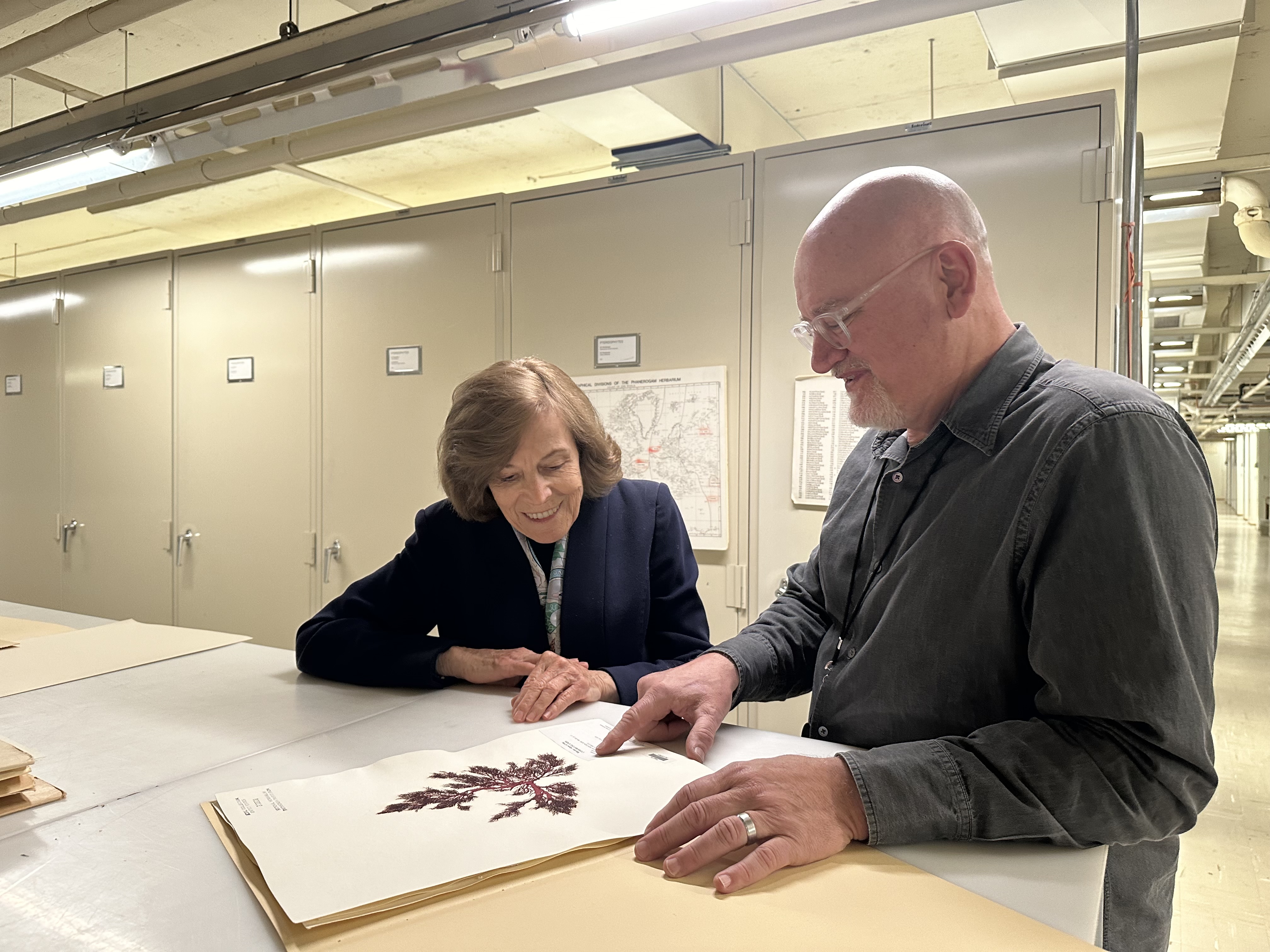
 
Earle and Barrett Brooks, a botanical researcher at the museum, examine one of Earle’s algae specimens in the National Herbarium.
Danielle Olson, NMNH


Going back to when I began exploring the ocean, we did not have the technologies that now enable us to go deeper and explore longer.
To have the kind of insights that we take for granted on land.
You can go camping in the desert or climb mountains.
In the ocean if you are going to study mountains you start at the top and you work your way down.
The deeper you go the less we know.

This is the most exciting time right now.
I am thrilled at what I was able to gather in my early years as an oceanographer, botanist, seaweed person, ecologist, whatever you want to call it — it has an enduring value.
We really need the physical evidence.

DO: Which algae are your favorite?

SE: My favorite ones are the living ones.
I feel that sense of wonder every time that I am privileged to get out there and down there.
You realize that you are looking at living history.
The creatures who are here peacefully changing rocks and water into a habitable planet for the likes of us.
They are still here; I can still salute them.

"If you don’t have knowledge of the past, it is hard to understand the present, let alone anticipate the future." — Sylvia Earle

DO: There are many women inspired to study the ocean due to your success.
How does that make you feel?


SE: I realize that there is a gender mismatch in terms of opportunity, but there are so many reasons why people will tell you that you can’t do something.
You’re too tall, you’re too short, you speak the wrong language, the color of your skin doesn’t suit the job we have in mind.
There are plenty of excuses for why you can say “I can’t do this.” Somehow, we must get over excuses and get on with it.
And I just did.
 
Earle (far right) and the rest of the all-female Tektite team learn how to use a rebreather in 1970.
NOAA Photo Library

I wanted to be a part of the team of aquanauts that lived underwater, but I couldn’t go with the team that I originally planned to because it was men and women living together underwater, which was not acceptable [at the time].
But instead of giving up I changed direction and instead we had a team of just women.
Nobody planned that in advance, but it evolved as a solution to what seemed to be a gender problem.
There are so many ways to go around, under or sometimes right through.

DO: What advice do you have for aspiring marine scientists?

SE: Go for it.
Don’t let anyone steal your dream.
Don’t be afraid to be first, somebody has to get out there.
One of the best reasons to go do something is because nobody has done it before.

Links:
 

Wednesday, February 26, 2025

ECMWF’s AI forecasts become operational


From ECMWF

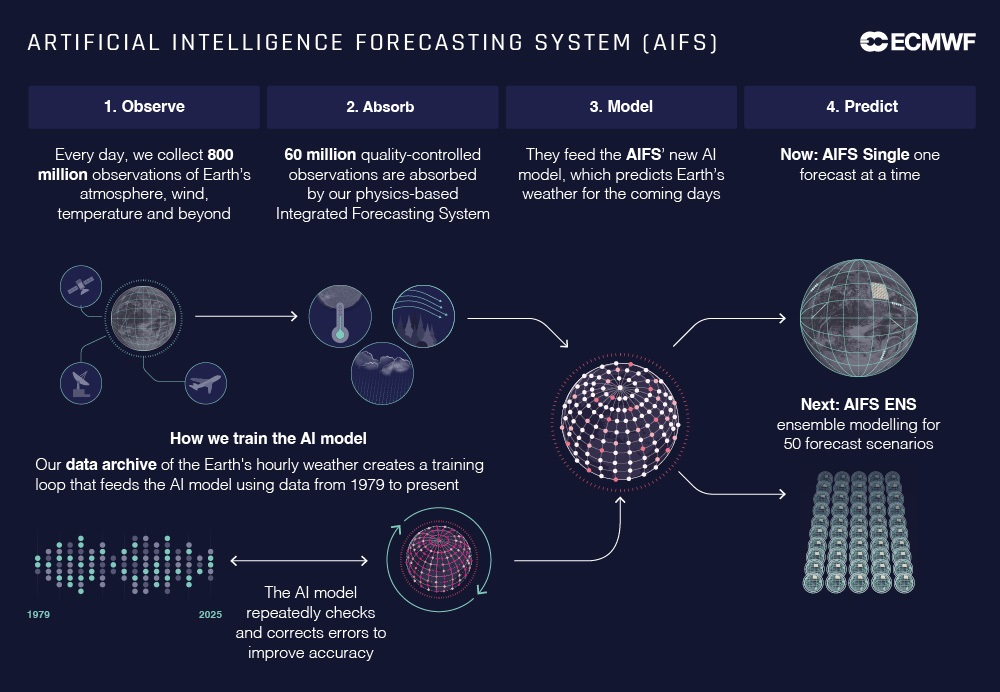
ECMWF has taken the Artificial Intelligence Forecasting System (AIFS) into operations today, 25 February 2025, to run side by side with its traditional physics-based Integrated Forecasting System (IFS) to advance numerical weather prediction.

The AIFS outperforms state-of-the-art physics-based models for many measures, including tropical cyclone tracks, with gains of up to 20%.

This high-accuracy model complements the portfolio of our physics-based models by leveraging the opportunities made available by machine learning (ML) and artificial intelligence (AI).
These include increased speed and a reduction of approximately 1,000 times in energy use for making a forecast.


First operational open AI model

The AIFS is the first fully operational weather prediction open model using machine learning with the widest range of parameters.
It includes vital fields for users, such as wind and temperature, and details on precipitation types from snow to rain. The AIFS has a grid spacing of currently 28 km.

The AIFS has been designed holistically with all users in mind. For example, in the renewable energy sector it will help with predictions of quantities such as surface solar radiation levels or wind speeds at turbine levels, so that operations can be maximised.

The availability of the AIFS in conjunction with our other services will positively impact how national weather services in our 35 Member and Co-operating States and beyond will be able to make their predictions.

It could potentially help industries where forecasts for the medium range can affect decision-making, such as the energy sector for pricing forecasts, as well as the insurance, security and shipping sectors.

ECMWF’s Director-General, Florence Rabier, said: 
“This milestone will transform weather science and predictions. It showcases our dedication to delivering a machine learning forecasting model that pushes the boundaries of efficiency and accuracy, and it underscores our commitment to harnessing the power of machine learning for the weather forecasting community. It is not only us who are innovating as it is important to remember that, with ECMWF, 35 nations are working together to advance weather science to improve global predictions. This is to help national meteorological agencies in their work to contribute to a safe and thriving society.”
 
An AI forecast for Europe issued by ECMWF on Monday 
predicts temperature and winds on March 11  
© ECMWF

How does the model work?


The AIFS uses the same initial conditions for its forecasts as the IFS.
These are based on the combination of a previous short-term forecast with around 60 million quality-controlled observations from satellites as well as many other streams, including from planes, boats, sea buoys and many other Earth-based measurement stations.

Every six hours, these initial conditions feed into the AIFS.
The machine learning model, trained on how the weather has evolved in the past, assesses how the initial conditions will influence the weather for the coming days.

By contrast, the IFS uses physics-based capabilities to arrive at a forecast with a grid-spacing of 9 km over the globe, integrating the laws of physics in its computer code.

The first operational version is called AIFS Single.
It runs a single forecast at a time, known as a deterministic forecast.
However, ECMWF is pushing this model to create a collection of 50 different forecasts with slight variations at any given time to provide the full range of possible scenarios.
This is known as ensemble modelling, a technique developed and implemented by ECMWF more than thirty years ago.
 
The ECMWF ‘weather room’ where experts study temperature extreme forecasts
 
Future plans

The launch of AIFS Single as an operational service is only the beginning.
The next steps will be making ensemble forecasts available and introducing experimental data-driven sub-seasonal (extended-range) forecasting.
The potential to hybridise data-driven and physics-based forecasts will also be a field of research over the coming years.

ECMWF’s Director of Forecasts and Services, Florian Pappenberger, added: “We see the AIFS and IFS as complementary, and part of providing a range of products to our user community, who decide what best suits their needs. ECMWF's AIFS was an experimental model for some months whilst we enhanced its capabilities by interacting with our Member States and users to refine it. Making such a system operational means that it is openly available and has 24/7 support for our meteorological community. As always, we have to ramp up this service to full maturity, and we look forward to engaging directly with our users to ensure all needs are covered where possible."

More information on the implementation of the AIFS operational model is available, and the model has also been presented in a webinar.
In addition, a series of AIFS blog posts can be accessed on our website.
 

Links :


Tuesday, February 25, 2025

Elon Musk is coming for our weather service


NOAA Ship Thomas Jefferson helps map the ocean floor to find hazards to shipping. 
| Smiley N.
Pool/Houston Chronicle via Getty Images


From VOX by Umair Irfan 

Job cuts, ideology, and a sharpie: Trump’s beef with an important scientific agency, explained.

The weather forecasts you see on TV or the severe storm alerts you get from your apps are powered by a federal science agency that’s in line for some of the most drastic cuts proposed by the Trump administration so far.

The National Oceanic and Atmospheric Administration (NOAA) employs about 12,000 staffers around the world, more than half of which are scientists and engineers.
NOAA operates 18 satellites and 15 ships and has a budget of $6.8 billion.
Their job is to study the skies, the seas, the fish, tracking how they’re changing and predicting what will happen to them.
NOAA’s work is essential for aviation, fishing, climate research, and offshore oil and gas exploration, particularly when it comes to modeling weather.

“You and your family and friends depend upon NOAA people even if you are unaware of what they do,” Jane Lubchenco, who led NOAA under President Barack Obama, wrote to Vox in an email.

Staffers from Elon Musk’s Department of Government Efficiency (DOGE) have been targeting probationary employees for job cuts across the federal government.
There are around 216,000 workers with this status, close to 10 percent of the total federal workforce.
Thousands of workers have already been fired across the federal government across divisions like the National Park Service and the Department of Energy.
About 75,000 staffers accepted deferred resignation offers.

But the potential cuts at NOAA go beyond that.
CBS News reported that NOAA employees were told to prepare for staffing to halve and for budgets to shrink by 30 percent.
One source inside the agency who asked to remain anonymous as they were not authorized to speak to the press told Vox that some weather offices at NOAA would be eliminated entirely.

“There’s going to be some interruptions and declines in the quality of service because we’ll have offices that are understaffed.
That’s a big risk for the weather service,” said Timothy Gallaudet, who served as acting administrator for NOAA during President Donald Trump’s first term.
“Our weather satellites, they’re vital for public safety, and any interruption to their maintenance and operation could be a problem too.”

Though it performs valuable jobs, NOAA is at the intersection of the broader push to shrink the government, an ideological fight over climate change, and possibly a personal grievance with the president himself.

The cuts could have far-reaching consequences for the US economy and the safety of Americans as extreme weather lands on increasingly populated areas.
“NOAA does great things that are affecting every American, every day, in a positive way,” Gallaudet said. With the drastic cuts some in the Trump administration want at the agency, “everything would slow down and potentially stop.”

Why the main climate and weather agency is in line for deep cuts

While NASA looks out to the stars, NOAA keeps an eye here on Earth.
But unlike NASA, NOAA is not a stand-alone agency.
It’s under the umbrella of the Department of Commerce, currently led by Howard Lutnick, former CEO of financial services firm Cantor Fitzgerald, who was confirmed on February 18.

The Commerce Department’s mission is to facilitate trade and economic growth in the US, so it may seem odd that it runs a science agency, particularly one that accounts for 60 percent of its budget.
However, historically NOAA’s research was performed with commerce in mind, particularly the fishing industry and maritime trade.
Even today, NOAA’s work mapping the sea floor and ocean currents in real time around ports ensures safe travels for shipping, which contributes $5.4 trillion to the US economy each year.
The agency’s management of fisheries supports the nearly $10 billion fishing sector.
NOAA’s forecasting work through the National Weather Service is essential for farmers, event planners, and for generating life-saving alerts ahead of extreme weather events.
NOAA also conducts basic science research around climate change.


One of NOAA’s hurricane hunter aircraft displays several stickers commemorating the hurricanes it has flown into. 
Rhona Wise/AFP via Getty Images

These functions have drawn the ire of some within the Trump administration.
Project 2025, the conservative policy agenda produced by the Heritage Foundation, specifically calls for climate change to be systematically removed from government policymaking.
In Project 2025 training videos obtained by ProPublica, an official from Trump’s first term says a future conservative president “will have to eradicate climate change references from absolutely everywhere.” 
 
 It makes sense then that NOAA would be a ripe target.
Project 2025 calls for NOAA to “be dismantled and many of its functions eliminated, sent to other agencies, privatized, or placed under the control of states and territories.” It describes NOAA’s six main offices acting as “one of the main drivers of the climate change alarm industry and, as such, is harmful to future US prosperity.” As for the National Weather Service, it should “fully commercialize its forecasting operations.”

Across the government, many of the specific objectives laid out in Project 2025 are already getting checked off the list.
However, during his confirmation hearing, Lutnick said he disagreed with the Project 2025 proposal to dismantle NOAA.

Trump also had a direct run-in with NOAA during his first term.
In 2019, Hurricane Dorian reached Category 5 strength and was heading toward the Gulf Coast.
Trump posted on Twitter that Alabama was one of the states most likely to be hit, but the National Weather Service’s Birmingham office responded that there would be no hurricane impacts on the state.
 

Then, during an Oval Office briefing on September 4, 2019, Trump presented a National Weather Service map of Hurricane Dorian’s path with what looked like a loop drawn on in marker to encompass southern Alabama.
The episode, dubbed Sharpiegate, led to some in-fighting within NOAA as career staff pushed back against political appointees who wanted the agency to confirm Trump’s statements.
NOAA’s acting chief scientist at the time, Craig McLean, was forced out of his post.

McLean told Vox the affair was part of a broader political effort to make science bend to Trump’s agenda.
“When the Trump people first arrived [during the first term], they were pressing me to change the direction of the climate program,” McLean said.
“The frustration was that the Trump people couldn’t get that done. The climate program survived and continued to assert scientific truths that are evident. But now I’m expecting them to just come in with a blunderbuss and a sledgehammer and start whacking programs. So that’s what concerns me. Climate is a big target.”

NOAA does have room for improvement

Former NOAA officials said there are some long-running friction points at the agency that deserve scrutiny and could benefit from some strategic reorganization, cuts, and privatization.

The big issue is simply that NOAA is under the wrong department.
“The political appointees in the Department of Commerce did not have a good appreciation for what NOAA does,” Gallaudet said.
“That was the biggest pain point, to be honest with you. They really just didn’t understand us well. Whenever we had direct access to the White House, that’s when we got our initiatives forward.”

It’s unlikely that NOAA will get moved out of the Commerce Department anytime soon, but having top political officials who grasp NOAA’s mission and its value to the American public could smooth over the bureaucratic wrangling.

NOAA could also benefit from teaming up with the private sector.
Private weather forecasting is now a $10 billion industry in the United States, but fully commercializing the National Weather Service is something that some of these companies oppose.
AccuWeather, a company providing weather forecasting services, specifically came out against the Project 2025 proposal and said it could not replace everything NOAA does.
“The authors of ‘Project 2025’ used us as an example of forecasts and warnings provided by private sector companies without the knowledge or permission of AccuWeather,” wrote AccuWeather CEO Steven R. Smith in a statement last year.


A meteorologist monitors weather activity on a computer screen at the NOAA Center for Weather and Climate Prediction headquarters in College Park, Maryland, on December 5, 2024. 
Michael A.
McCoy/Bloomberg via Getty Images


But by working with companies like AccuWeather, NOAA can expand the reach of its forecasts and get important alerts into the hands of more people likely to be affected by severe weather and tailored to businesses that have the most at stake.
Gallaudet noted that NOAA is constantly amassing gobs of weather metrics that inform local meteorologists, app developers, and farmers, but this collection is getting unwieldy.
Private companies can help the agency automate the data collection and optimize its analysis software.
Machine learning tools developed by tech companies could also help NOAA improve its forecasts.

Another problem is that NOAA’s wide-ranging research portfolio unwittingly overlaps with science projects at other agencies, like NASA, the Department of Energy, and the US Geological Survey (USGS), creating unnecessary redundancies.

“I went on a dive trip off North Carolina to some shipwrecks when I was at NOAA — unofficially, it was my recreational event — and I met a USGS biologist diving with me.
It turns out he worked on sturgeon,” Gallaudet said.
“We had two [sturgeon] labs at NOAA. Our sturgeon scientists had never spoken with USGS sturgeon scientists. There’s not many sturgeon in the country! You’d think our scientists would collaborate and be more efficient, but no.”

On the other hand, there are research areas where NOAA could still invest more, particularly in social science.
While meteorologists are extending their lead time on weather predictions, how people parse and act on this information is emerging as a limitation.
An early tornado warning doesn’t help much if recipients don’t immediately seek shelter, or if they try to squeeze in a last-minute grocery run.
Getting people to heed warnings and take precautions is a critical challenge.

“The people at the Department of Commerce, both Democrat and Republican administrations, told us NOAA doesn’t do social science, which showed their gross ignorance and I would say callous rejection of the importance of the mission,” McLean said.
“During my tenure we worked very hard to open the gate and start spending in the social sciences to understand how people are responding to these forecasts and the tools that we use to make the forecast.”

And staying ahead of the practical impacts of climate change needs to be a high priority for the agency.
For instance, as average temperatures rise, fish stocks are migrating toward the poles, forcing the fishers to adapt.
“Today’s Maine lobster will be Canadian lobster tomorrow,” McLean said.
As weather reaches greater extremes and more people and property are in harm’s way, disasters are becoming extraordinarily more expensive.
It’s prudent to invest in the tools to monitor and predict these events, and dismantling them will leave the country vulnerable to more costly catastrophes in the future.
 
Links :

Monday, February 24, 2025

How Britain’s secret decoy ships outfoxed German U-Boats during World War I

Diver Chris de Putron inspects the wreck of the German submarine UC-18, 
which sank off the Channel Islands in February 1917.
© Karl Taylor


From Smithsonian by Sean Kingsley


Divers recently discovered the wreck of a German submarine and the Royal Navy Q-ship that sank it in February 1917

World War I was raging off the British Isles when the German submarine UC-18 surfaced to attack easy prey on the chilly morning of February 19, 1917.
Its target, the Lady Olive, was about eight miles off the west coast of Guernsey in the Channel Islands, or so the old story goes.
A 200-foot-long coal trader, the Lady Olive was an old, accident-prone vessel—nothing special.

This sitting duck would be another victim in the submarine’s reign of terror.
Since early November 1916, UC-18 had sunk 33 ships off the coast of northern France and southern England.
The type UC II class of submarine could operate independently 9,430 nautical miles from base; its role was to starve Britain of food and war supplies and intimidate the Allied power into submission.

“Fully loaded, these submarines put to sea with 7 torpedoes, 18 mines and 133 rounds for the 88-millimeter deck gun,” says Lawrence Sondhaus, a historian at the University of Indianapolis and the author of The Great War at Sea: A Naval History of the First World War.
“In designing it, the Germans packed a lot of destructive potential into a small warship.”
 
 
A UC class German submarine and its crew Courtesy of Karl Taylor

After firing a torpedo into the Lady Olive, UC-18 surfaced to finish off the wounded ship.
Then mayhem broke out.
A decoy British Q-ship adapted to lure German submarines to their demise, the Lady Olive was equipped with five guns hidden below its deck.
The trader started firing at the submarine.
When the smoke lifted, both vessels had vanished.

The truth behind what happened that fateful day remained a mystery for decades.
The Lady Olive certainly sank: All of its crew members escaped in lifeboats, singing psalms to stave off hypothermia, and were saved after 36 hours at sea.
Though these survivors testified that the submarine had gone down, too, some experts remained skeptical, as its wreck was never found.
Could UC-18 and its 28-man crew have somehow escaped the encounter?
If not, where was the vessel’s final resting place?

extract from the SHOM wreck database in the GeoGarage platform (Google Earth view)
 
wreck 23206 (UC18) in the UKHO wreck database

After four years of historical research supported by deep diving, a team led by filmmaker Karl Taylor has finally solved the mystery, locating the wreckage of both ships.
“Having dived in the Channel Islands since my 20s,” says Taylor, “it was one of those legends we all used to hear about.
The history books agreed there had been a battle between a U-boat and a Q-ship and that they sunk each other.
Nearly all serious local divers dreamed about finding them.
It was the one that got away.”

Taylor chronicled the search in a documentary titled The Hunt for Lady Olive & the German Submarine, which premiered on the BBC last year and is now available to rent or buy in the United States.


The Hunt for Lady Olive & The German Submarine | Trailer | Coming Soon
 
Q-ships, the Royal Navy’s secret weapon during World War I

By the time World War I began in July 1914, the world’s leading 16 navies had a total of 400 submarines.
Britain, however, was certain the war would be won on land.
To John Fisher, head of the Royal Navy, Germany’s 28 U-boats were little more than “toys” and “playthings.” 
But Germany itself felt differently.

After the Royal Navy dotted the English Channel with mines and declared the whole North Sea a war zone in November 1914, Germany responded with a U-boat blockade of Britain.
London had no answer to these hidden killers of the deep.
By the fall of 1915, U-boats were sinking an average of 100,000 tons of British shipping a month, at twice the rate it took to build replacement vessels, according to Deborah Lake’s Smoke and Mirrors: Q-Ships Against the U-Boats in the First World War.

“We will frighten the British flag off the face of the waters,” Germany’s kaiser, Wilhelm II, pledged, “and starve the British people until they, who have refused peace, will kneel and plead for it.” 
John Jellicoe, admiral of the British Grand Fleet, privately admitted that defeat and unfavorable terms of peace now seemed inevitable.
 
 
The Yorkshire Coast, sister ship to the Lady Olive Courtesy of Karl Taylor

In addition to deploying hydrophones (underwater devices used to detect the sound of U-boats), the Navy introduced Q-ships as a secret weapon in the war of “Hush and Camouflage, Propaganda and Conscription,” as Captain Harold Auten described it in a 1919 book.
British Navy personnel stationed in the Indian Ocean and the Red Sea had seen how fast Arab dhows secretly armed with a three-pounder gun and a machine gun successfully defeated pirates and slave raiders.
They adapted this idea for use in World War I.

From small schooners to 3,000-ton steamers, Q-ships looked like everyday traders.
They were designed to engage in a deadly game of cat and mouse, luring in surfaced U-boats as British crews pretended to escape in “panic parties” before a German submarine commander blew up their ship.
During the theatrical flight, a sailor might run for a lifeboat with his pet black cat under his arm.
A steward would rush into the captain’s cabin and run out with top-secret baggage.

Some decoy ships were fitted with explosive-filled tin canisters, which were fired when a German shell “fell anywhere near … giving the impression of a direct hit,” according to Auten.
“Panic steam pipes” were laid around engine room hatchways to create a similar effect, and tubs filled with dried seaweed were lit on fire to make it seem as though the ship were ablaze.

The panic party was a dangerous gamble designed to support the illusion that a ship had been abandoned.
But the vessel’s real fighting force stayed hidden away, ready to go on the offensive when a submarine neared the trader.
“They had to be taught to sit down or lie at their stations for hours on end, without giving the slightest indication that there was anybody at all on board the ship,” Auten wrote.
“Everything depended upon concealment.”
 
View of a hidden gun on a British Q-ship Public domain via Wikimedia Commons

As the enemy U-boat approached, the remaining crew of the beleaguered “trader” dropped the newly hinged sides of the ship and fired machine guns hidden among deck cargo and hen coops.
In place of the red merchant marine flag, the Q-ship hoisted the white ensign of the Royal Navy, prompting the submarine to try and flee what Germany referred to as a “U-Boot-Falle,” or a “U-boat trap.”

Searching for the wrecks of UC-18 and the Lady Olive


On February 1, 1917, Germany resumed unrestricted submarine warfare—a strategy it had suspended in response to outcry over the 1915 sinking of the Lusitania, a British ship that was carrying both Allied munitions and passengers from the neutral U.S.
For Q-ships like the Lady Olive, whose crew pocketed double pay to account for the great risks they took, the reversal marked the most dangerous turn in the tide of the war at sea.

“U-boat commanders were no longer restricted by ‘prize rules’ and could sink an enemy merchantman on sight,” says Sondhaus.
“The Q-ship ruse worked only when the U-boats were constrained by having to surface, properly identify the target and allow the crew to abandon ship.” 
Overnight, the decoy ships’ tactics had to change.
Now, the only way to convince a U-boat commander to surface was to deliberately take a torpedo strike and play dead.
 
 
The remains of UC-18's periscope © Karl Taylor

“Britain was being starved and was on the verge of surrender, as 90 percent of its food, ammunition and raw materials came from overseas,” says Tomas Termote, who served as the Taylor team’s maritime archaeologist.
“The UC class of submarine was the most effective weapon at sea, besides the sea mine, to destroy Allied shipping. Germany concentrated more and more effort in its U-boat fleets as the final weapon to defeat Great Britain.”

Taylor started researching the Lady Olive and UC-18 because “for divers, the idea of discovering a missing U-boat is about as fascinating as it gets.” 
He adds, “As we dug deeper into the story, we realized there was a lot of contention over what may or may not have happened, and it felt that if the crew of the Lady Olive did sink UC-18, they would not have felt vindicated in their success as it was questioned by historians for decades.
This project was an opportunity to discover the truth.”

That truth, however, was “obscured by UC-18’s vanishing act; by another warship, HMS Medea, claiming it sank the submarine; and by the crews of Q-ships sometimes reporting a kill to claim the Admiralty’s bounty of £1,000” (about $73,000 today), says Guernsey maritime historian John Paul Fallaize.
 
Remains of UC-18's conning tower © Karl Taylor

If Taylor’s team could confirm the old story that the two vessels wiped each other out, it would make for a unique history, the only known “incident where both a U-boat and Q-ship sank during a brief naval battle,” says Termote.

The more the team researched in the English and French archives and dived, though, the more they doubted the submarine would ever be found.
“All we knew for sure was that the Lady Olive sank ‘somewhere,’ due to the undeniable accounts of the crew’s rescue,” says Taylor.

In Cornwall, Taylor tracked down the great-niece of James Simpson, a wireless operator on the Lady Olive.
She had inherited her great-uncle’s wartime diary, which held a trove of details on the battle.

When the German submarine caught up to the Lady Olive early on February 19, 1917, it fired two shots, Simpson recounted in his diary.
One struck the engine room, while the other whistled over the ship.
Then the U-boat “got the greatest surprise,” Simpson continued, 
“and down went ports and she got a salvo into her. Chap in conning tower blown to bits, also man on gun. Conning tower almost blown to bits. She then [sank], being holed in four or five places.”

As Fallaize explains, “The problem for UC-18 was that the Lady Olive was unusually strongly armed with one four-inch gun and another four guns of 12-pound caliber—more heavily than most decoy ships’ three guns.”
 
James Simpson, a sailor whose diary provided vital insights on the encounter between the Lady Olive and UC-18
Courtesy of Karl Taylor

Re-energized by the diary, the team’s underwater surveys focused on the historical coordinates of the battle.
“We did find wreckage there,” says Taylor, “but it turned out to be a different ship called the Dromore.
When we surveyed even farther out, there was nothing not already known to divers.”

The old wartime tale wasn’t stacking up, and the growing evidence worried Taylor.
Logbooks indicated that the French destroyer Dunois and the fishing boat Sirius rescued the crew of the Lady Olive near the French archipelago of Sept-ÃŽles, around 50 miles southwest of Guernsey.
Given that location, the Roches-Douvres Lighthouse on the French coast, whose beam had a radius of 20 nautical miles, should have been visible to survivors and rescuers.
Since none of them had mentioned the key landmark, Taylor suspected the battle must have taken place even farther west in the English Channel, beyond the sight of land.

After simulating the likely southward movements of the Lady Olive’s lifeboats, the dive team pushed increasingly west.
With a vast deep-water area to search, team member Richard Keen, a legendary diver who previously discovered several Roman wrecks off the coast of Guernsey, decided to check with local fishermen to see if any had snagged trawler gear on an underwater obstruction.

“Fishermen have fished every inch of the seabed around these islands with nets, dredges, crab pots and long lines,” says Keen, “and have all lost expensive gear on wrecks.
They record and pass on the information so their friends don’t have the same misfortune.
All you have to do is find the right fisherman.”

With a series of new spots on the seabed to investigate, some in French waters, the team headed 40 miles west of the traditional battle zone.
Because of the depth and challenging logistics involved, Taylor decided to go low-tech by dropping a camera onto a possible wreck target rather than deploying human divers.
“This is going to be a bit hit and miss,” he says in the documentary, “and there’s a very real risk of snagging this and losing the lot.”
 
Diver Nathan Martel inspects the stern of the wreck of UC-18. 
© Karl Taylor

The first two camera drops revealed nothing.
But on the third drop, the steel plates of what looked like a submarine flashed into view.
At another fisherman’s snag a few miles to the north, the team’s equipment got caught on the seabed.
Video footage recovered from the camera showed something long and tubular in the shadows—a U-boat.

Taylor rushed the data to Termote in Germany.
The maritime archaeologist identified shell impact holes in the upper starboard of the hull’s ballast tank and significant battle damage to the base of the submarine’s conning tower.
He also spotted a stamp on one of the propellers of the kind used by the Imperial German Navy.
“You can see that the metal is bent inward,” Termote says.
“This is a kind of damage that could be fatal to a U-boat, stopping her from submerging anymore.”

Just a few miles away from the wreck of the submarine, the team made the deepest dive of the project, discovering an upside-down ship of the correct era and size, with two boilers and plating that matched the Lady Olive’s.
(Q-ships often turned over when sinking because the added weight of their secret guns made them top-heavy.) 
 

Though many clues still lie buried under tons of wreckage, including the telltale guns, Taylor and his colleagues are confident that they have discovered the final resting place of the Lady Olive and UC-18.
 

Divers from Guernsey have discovered a missing German U-Boat at a depth of over 70 meters.
The missing U-boat ‘UC-18' was lost in February 1917 after a famous battle with a secret Royal Navy ‘Q’ Ship which was also sunk in the altercation.
The project will feature in a BBC documentary The Hunt for Lady Olive and the German Submarine
 
The legacy of the British Q-ships

During World War I, more than 200 Q-ships—and perhaps as many as 400—roamed the seas.
Nobody knows for sure because the experiment was a secret, even to some members of Britain’s Board of Admiralty.
By the war’s end in November 1918, these mysterious decoys had fought around 70 engagements, sinking no more than 11 U-boats, according to Smoke and Mirrors.
Comparatively, U-boats destroyed 44 Q-ships.
Ultimately, it was improved sea mines and convoys, which provided safety in numbers, that defeated Germany’s submarine warfare.

The success of the Q-ship program should not be judged by submarine sinkings, but in how it disrupted the rules of war, Auten argued in his book.
German U-boats were forced to fire, lose thousands of shells and waste time rearming back in port.
In the eyes of the British public, each member of the Q-ships’ crews was “another St. George or Beowulf,” wrote Lake in Smoke and Mirrors.
“Every man was a hero who fought sea dragons.”
 
Remains of a boiler in what is believed to be the wreck of the Lady Olive © Karl Taylor

Though the Q-ship idea was ingenious, says Sondhaus, “they probably did more harm than good.” 
Led by “eager and aggressive” young lieutenants, U-boat crews operated under the German tradition of Auftragstaktik, “which allowed for great flexibility in accomplishing a mission,” Sondhaus adds.
“No one was ever reprimanded for being overzealous. … Countless merchantmen were sunk on the assumption that they might be Q-ships, without proper protocols being followed.”

Now that the legend has been confirmed and the wrecks discovered, French authorities have designated UC-18 a no-dive war grave.
“I hope that the sites remain undisturbed,” says Taylor, “but all wrecks eventually deteriorate over time, and it will likely suffer further damage from trawlers in the future.
Currently, the submarine is in excellent condition given its age, one of the best preserved underwater.”

Guernsey, meanwhile, continues to hold rich pickings for wreck hunters.
As Keen says, “A great deal of our sunken history is yet to be found, much of it in deeper water.”
 
Links :

Sunday, February 23, 2025

Slocum and I, a boat in the garden : animation movie

In the early 1950s, on the banks of the River Marne, François, a young 11-year-old boy, is intrigued to discover that his parents are building a boat in their little garden, a replica of the famous sailor Joshua Slocum’s sailboat. 
Thus begins the family’s grand odyssey, a collective venture to construct a boat that would carry them away – somewhere between reality and reverie. 
As the years go by, in post-war France, François drifts from adolescence to adulthood. 
While the boat is being built, and with a tender and poetic look at his mother and father, the young boy embarks on his own adventure, one that will take him down his own passionate route of the sea and drawing.