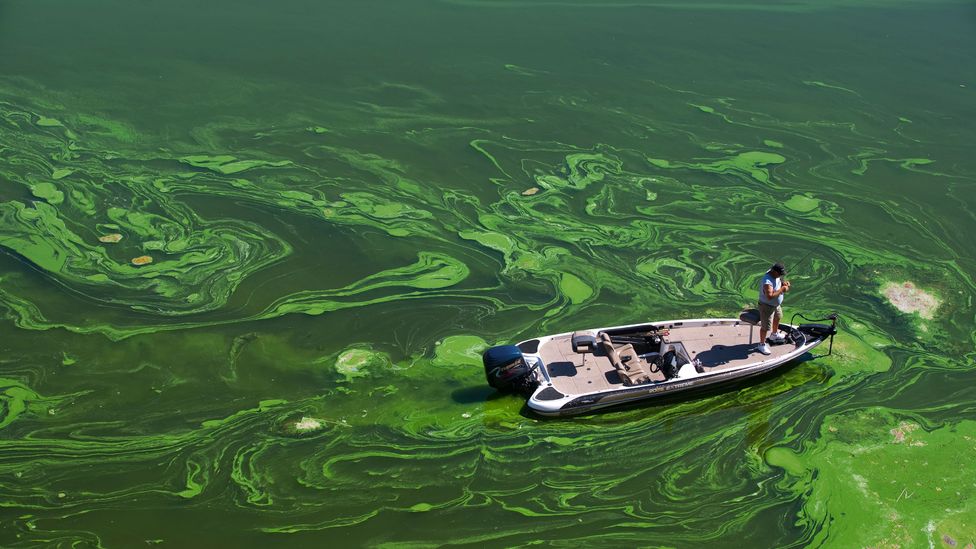
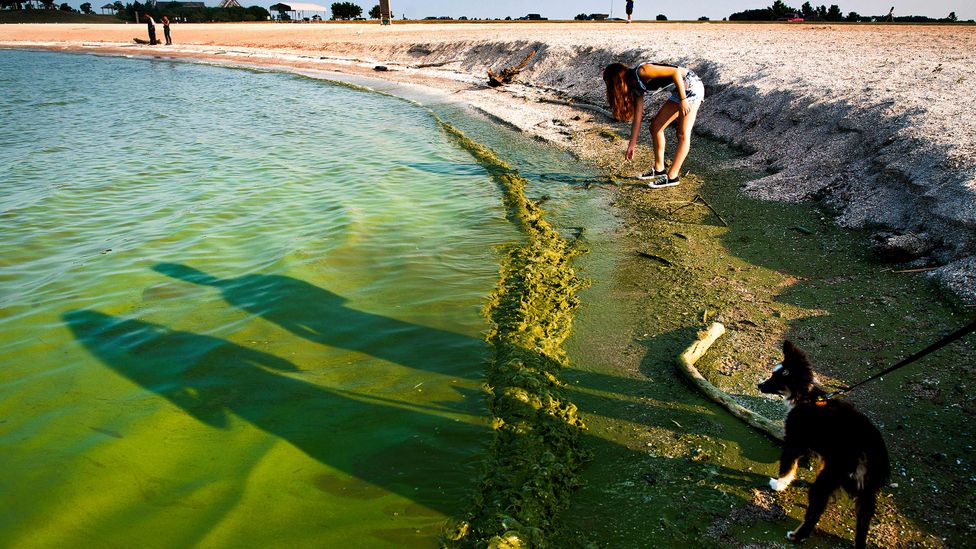
(Image credit: David-McNew / Getty Images)
From BBC by Tim Smedley, author of The Last Drop: Solving the World’s Water Crisis, to be published by Picador, 29 June 2023.
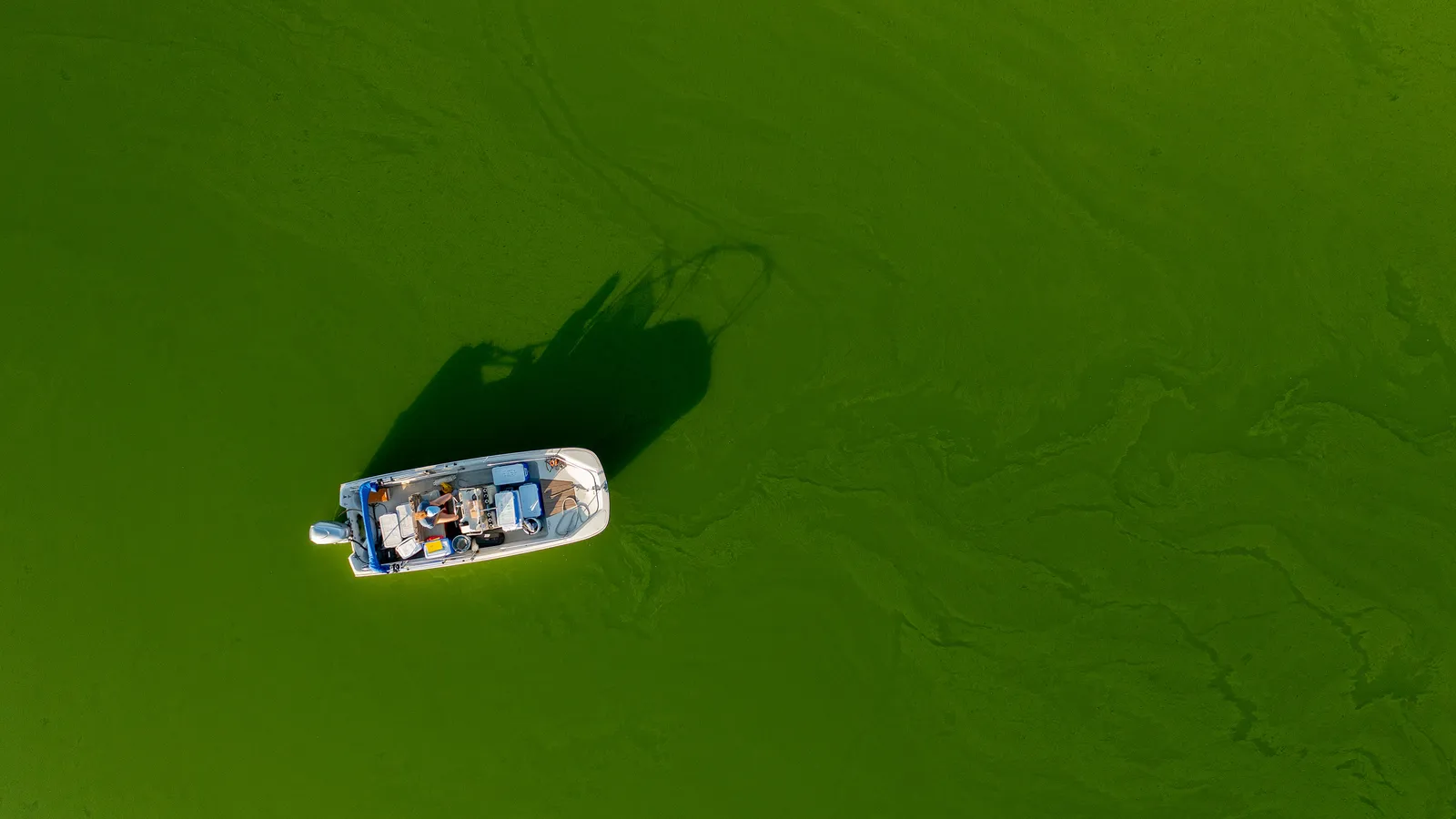
Rising temperatures and pollution have led to an explosive growth of harmful algal blooms, contaminating our drinking water and harming human health.It is the "smell of decay and death", says Beth Stauffer, from the University of Louisiana.
"It has a physical presence.
This layer of very striking greens and blueish greens…when you put your paddle in it, you can feel it."
She's describing the harmful algal blooms (HABs) that used to be more associated with marine environments.
But in recent years they've been moving further inland and affecting freshwater systems, too.
And scientists such as Stauffer are trying to find out why.
HABs occur when certain kinds of algae grow very quickly due to increased nutrients in the water – typically when artificial nitrogen and phosphorus applied to farmers' fields wash out in the rain and enter waterways.
The algae receive a meal on a scale they would never get naturally, and a bloom is formed.
Sometimes this is harmless.
But at scale, many types of algae can turn toxic and harmful to humans and animals.
And this scale can be extraordinary.
The explosive growth of algal blooms is linked to
rising temperatures and rising pollution.
These green waves are both a warning sign and a symptom of a changing climate.
As farming fertiliser and a tsunami of human sewage hit our warming waterways, we are in danger of turning our very drinking water toxic.
In the ocean, a coastwide bloom of
Pseudo-nitzschia algae in spring 2015 resulted in an outbreak of the neurotoxin, domoic acid, along the entire US west coast, spanning four states.
Elevated toxins were found in marine mammals and fisheries, with over 1,950kg (4,300lb) of clams lost in just one day and over 200 sea lions stranded with neurotoxin poisoning.
A bloom in the Gulf of Mexico in 2017 was
recorded to cover 8,776 sq miles (22,720 sq km).Typically these giant blooms occur near deltas, where rivers – draining huge areas of land and fertiliser – meet the sea.
But inland rivers and lakes are increasingly getting swamped before they even reach the sea.
And their waters endanger the human populations that border them.
People and animals exposed to algal toxins by drinking or swimming can suffer rashes, fevers,
even liver and kidney damage.
Farming fertiliser and sewage pollution is turning drinking water toxic
(Credit: Yuliia Zozulia / Getty Images)
According to
an overview of HABs by the binational United States and Canada Great Lakes organisation The International Joint Commission, only 12 published accounts of algal outbreaks were recorded in Canada and the US in the 1980s and just 19 in the 1990s.
By the mid-2000s, however, reports of HABs suddenly began appearing in unlikely landlocked states.
By 2021,
nearly 1,700 HAB-related warnings and public health advisories were issued within the US alone.
HABs are now a
major environmental problem in all 50 states.
These toxins may also be entering the food chain.
In August 2022,
over 60 California sea lions showing signs of domoic acid intoxication – including
seizures, disorientation and loss of muscle control – had to be saved following an HAB incident.
Stauffer confirms that this now occurs annually on the western and eastern coasts of the US.
"Sea lions aren't feeding on little microscopic [organisms], they're feeding on fish, on crustaceans," she says, just like we do.
Sea lions commonly feed on fish such as anchovies.
During the 2015 incident, anchovies caught in fishing nets were found to have very high levels neurotoxins from the algal blooms.
This is far from a US-only problem.
Jessica Richardson, a researcher at the Centre for Ecology & Hydrology, Lancaster Environment Centre in the UK, has
described blooms of cyanobacteria as a "threat to global water security" that is expected to increase due to a chemical and climate cocktail of "nutrient enrichment, increasing temperature and extreme precipitation in combination with prolonged drought".
In short, more sewage and fertiliser being flushed into warmer waters by heavy rain hitting parched ground.
As in the US, bay areas in China such as Zhanjiang Bay rarely saw HABs before the 1980s but have
occurred “periodically and frequently” since the 2000s.
Norwegian fish farms were
devastated by a toxic algal bloom in 2019 that killed millions of salmon.
In Scotland, HABs were relatively unheard of until 2013 when a large bloom off the Shetland Islands saw
70 people report shellfish toxicity symptoms, with the number affected believed to be substantially higher.
HABs now
result in the loss of 15% of turnover to the Scottish shellfish industry annually.
England's largest and most famous lake, Windermere, has also started turning a troubling shade of blueish-green.
In August, local campaigner Matt Staniek went viral with a
short video scooping green gunk from the lake's surface, stating "I got a cyanobacteria bloom tested as I felt this wasn't being taken seriously enough.
It exceeded World Health Organization guidelines… Windermere is not safe."
SENSORY OVERLOAD
From the microplastics sprayed on farmland to the noxious odours released by sewage plants and the noise harming marine life, pollutants are seeping into every aspect of our existence.
Sensory Overload explores the impact of pollution on all our senses and the long-term harm it is inflicting on humans and the natural world.
Staniek, a 20-something zoologist who grew up in Windermere village, says that algal blooms would appear occasionally when he was a child, but "it has been getting progressively worse", noting that the annual average temperature of the lake has
increased by 1.7C (3F) in the last 50 years".
He describes the explosion of blooms as "the sign of a dying lake".
Unlike in the US, however, Staniek believes the nutrient loads feeding the blooms aren't coming primarily from pesticides, but from local sewage plants.
In 2021, the United Utilities Staveley sewage works, near Windermere,
spilled untreated sewage into a nearby stream 80 times for a total of 1,172 hours, according to an interactive map by The Rivers Trust which documents sewage spills.
This was not a one off; the United Utilities plant at Grasmere spilled 90 times for a total of 1,348 hours.
The UK’s ageing
sewage network is struggling to cope with intense rainfall, a growing population and
an historic lack of investment.
The map reveals that the whole of England and Wales is in a similar, sorry, sewage-drenched state.
Other water bodies, such as the River Wye – also a tourist hotspot – are
"facing ecological disaster" due to once unheard of, but now annual, algal blooms, blocking out the sunlight and killing everything below.
Harmful algal blooms are a major environmental problem in all 50 US states
(Credit: Alamy)
The Windermere algal bloom peaked this summer on 13 August, photographed by satellite covering half the lake and reaching from bank to bank.
"A video taken from 14 [August], which I put up on social media, shows
a little girl swimming in amongst this blue-green algae.
It's such an incredible threat," says Staniek, adding that several people have contacted him to say they became ill, mostly with vomiting and diarrhoea, after swimming in the water.
Great Lakes, great bloomsThe blooms on the American Great Lake, Lake Erie, however, are arguably the world's worst, known to
cover an area the size of New York City. In 2014, a major HAB on Lake Erie, the world's 11th largest freshwater lake, prompted the city of
Toledo, Ohio, to issue
a "do not drink" order for tap water that affected nearly 500,000 people for three days.
Residents couldn't even use the water to brush their teeth.
More than
100 fell sick, becoming the country's first recorded drinking water–associated public health outbreak caused by harmful algal blooms.
TOP FOUR 'MOST UNWANTED' TOXIC ALGAE
Microcystis aeruginosa: the primary freshwater cyanobacteria "blue-green" algae species.
Produces microcystin, a toxin that
mostly impacts liver function in mammals, and is an issue for taste and odour in drinking water.
Karenia brevis: mostly blooms in coastal regions,
producing the neurotoxin brevetoxin.
Also aerosolises in crashing waves and causes respiratory illness in humans.
Pseudo-nitzschia:
produces domoic acid which causes amnesiac shellfish poisoning in humans that consume contaminated shellfish and neurological symptoms in marine mammals.
Alexandrium: a genus of the dinoflagellate
species most harmful to humans, found globally from the Gulf of Maine to Japan and Philippines
Richard Stumpf leads The National Oceanic and Atmospheric Administration (NOAA)'s harmful algal blooms research team and has worked on the Great Lakes for over 15 years.
The first bloom he saw on Lake Erie in the 1990s was believed to be "an anomaly".
The subsequent 2003 bloom on Lake Erie was the first "really large, noticeable one," he says.
Since then, NOAA's Great Lakes lab has recorded HABs getting bigger ever year (except for 2022 due to
historically low rainfall causing less runoff from fields).
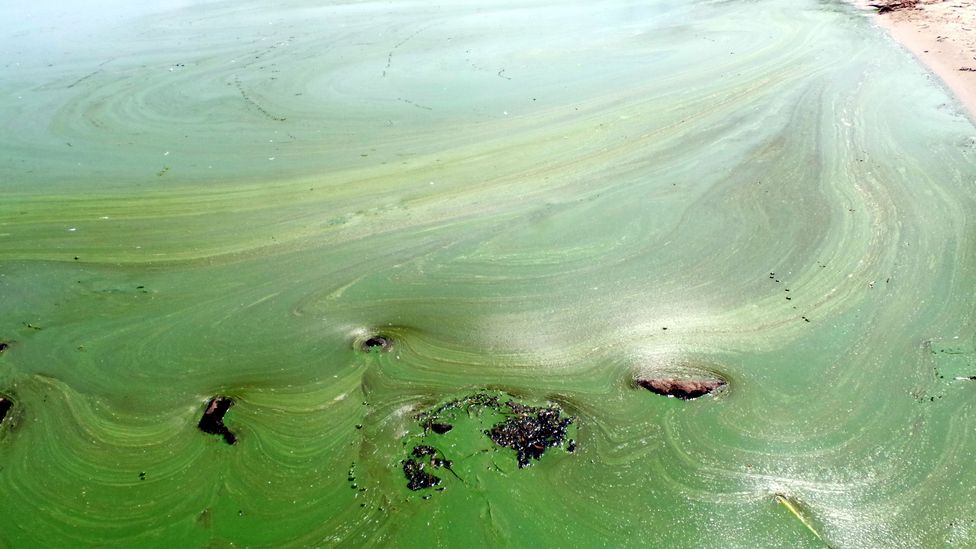
"When the wind stops, it's gross," he says.
"There's no other way to describe it.
You get this layer of what looks like thick, green paint on the surface." In the thickest blooms, he's heard charter boat captains say their engines have trouble turning the propellers due to the density of algae.
The smell of sulphur and decay, especially if the bloom becomes trapped in enclosed marinas, can become "overpowering".
Cyanobacteria start blooming in Lake Erie when water temperatures rise above 20C (68F).
In the mid-2000s, this only happened in the peak summer months, July and August.
But now, says Stumpf, the cyanobacteria season begins from early May and can last till November,
due to global warming.
The great US HABs are therefore caused by a perfect storm of warmer temperatures, fertiliser use, and an increase in heavy rainfall events which flushes the fertiliser out and into waterways.
The intensive use of commercial fertiliser in the US was 46.2lb per acre per year in 1960; by the year 2004 this was
up to 146lb, an increase of 215%.
While
a recent study by Northwestern University finds that rainfall, especially in the Eastern US, has intensified in the first two decades of the 21st Century, with researchers explaining: "What we found is pretty simple: When it rains now, it rains more."
Harmful algal blooms give off "the smell of decay and death" – Beth Stauffer
A BBC report found that the seven main water companies in England and Wales discharged untreated sewage into rivers and the sea
more than 3,000 times between 2017 and 2021.
"Why is that happening?" asks Staniek.
The longer this goes on, he points out, the more phosphorus is stored up in the sediment of lakes like Windermere.
A petition to name Windermere a Special Area of Conservation with a legal mandate to reduce nutrient levels
now has over 150,000 signatures.
At a national scale, the chair of the Environmental Audit Committee, a cross party parliamentary group,
has said that water companies have turned "a blind eye" to unpermitted sewage discharges, and urged both regulators and water companies to "get a grip".
In 2014, a major algal bloom on Lake Erie prompted the city of Toledo, Ohio, to order residents to avoid drinking tap water for three days (Credit: Ty Wright / Getty Images) There is work that can be done with communities, farmers and landowners, too.
Staniek has set up the
Windermere Lake Recovery CIC (Community Interest Company) to advise on nature-based solutions and river restoration.
Floodplains in particular are crucial to both filter nutrients and recharge groundwater aquifers – natural services that we now desperately need.
Staniek is working with a local landowner to re-naturalise a river, adding sediment traps and nutrient traps, "which will then hold water back after peak flood events and allow it to be absorbed and not just flow directly into Windermere," says Staniek.
He's also planting a riparian "buffer" strip of trees, soft brush and reeds to "absorb the phosphorus that can potentially come off that landscape".
The US Natural Resources Defense Council, an environmental non-profit, is calling for a wider adoption of such practices, partnering with states to financially reward farmers who plant cover crops, properly apply compost and manure, and follow
fertiliser best practices, including regular soil testing and using
fewer chemicals.
There are also lessons for city-dwellers.
The single largest irrigated crop grown in the US is "lawn", much of which is treated using chemical fertilisers: by ditching the gardening chemicals, installing green roofs, planting trees, and growing gardens or parks with rain-absorbing plants, urban residents can capture rainwater before it collects urban pollutants such as lawn fertiliser and flows into waterways.
On a grander scale, municipal canals and reservoirs can even be shielded from the sun
using floating solar panels: helping to produce clean energy, reduce water loss, and prevent algal blooms (which need sunlight in order to form).
(Read more about
the floating solar panels that track the Sun).
"There will always be some of these blooms," says Stumpf.
"The world is getting warmer which means that blooms may last longer." But, he says, it ultimately comes down to the pollution and nutrients we release into the water.
It's the choices we make as to "how we use the land", he says.
And we do have control over them.
Links :

 UKHO said in response to feedback it will delay ending production of paper charts (UKHO)