American model forecast on Christmas Eve, showing snow and mixed precipitation in the Washington region and to the north after an earlier period of rain as an Arctic front passes. (Pivotal Weather)
The National Oceanic and Atmospheric Administration announced Monday that a major upgrade has been applied to the American Global Forecast System model, one of the main computer models used to predict weather across North America and the world.
.@NOAA’s flagship weather model is undergoing a major #upgrade today to improve weather forecasts for hurricanes, snowfall, and heavy rain. (1 of 2) pic.twitter.com/SjLfxV3rz8
The newly minted upgrade, which went live at 8 a.m. Eastern time, is the latest in improvements designed to make for more accurate forecasts as far out as about two weeks into the future.
NOAA says it will lead to better predictions of hurricanes and other extreme events, ocean waves and weather systems high in the atmosphere.
The upgrade focuses on addressing the underlying physics of the model and how it handles various features of the atmosphere. It’s known as version 16.0 of the model frequently referred to by forecasters as simply the GFS or the “American” model.
The upgraded GFS model now has double the vertical resolution and for the first time is coupled with a global wave model to extend wave forecasts out from 10 to 16 days.
The upgrade piggybacks off the launch of the GFS FV3 model, or Finite-Volume Cubed-Sphere Dynamical Core, a souped-up version of the previous GFS model that debuted in summer of 2019. Its release was delayed while model biases were addressed, including a tendency for model depictions to skew too cold and snowy. After changes, the FV3 was released, fully replacing the legacy GFS model in September.
The latest upgrade focuses on addressing some additional biases. The upgrade also adjusts how initial conditions, or current weather information, are ingested into and processed by the model, while integrating more sources of data from weather satellites and ordinary aircraft.
Furthermore, the model’s resolution in the vertical will nearly double. The atmosphere will now be simulated as having 127 vertical slices, rather than just 64.
“When we announced our upgrade to the GFS in 2019, we described it as replacing the engine of a car,” Louis Uccellini, director of NOAA’s National Weather Service, said in a phone conference Monday. “With today’s upgrade, we’re adding more horsepower and more upgrades to the entire car as we move forward.”
The American GFS model simulates temperature anomalies in the stratospheric polar vortex in late December. (WeatherBell)
The upgrade “brings together the day-to-day reliability and speed required” in an operational weather model, Uccellini said.
Software engineers reconfigured existing NOAA infrastructure to allow for more computationally demanding model simulations to be run.
The physical computers themselves are located in Reston, Va., and Orlando.
Version 16.0 of the GFS also absorbs a global ocean wave model known as Wavewatch III, which should allow for better marine forecasts, particularly with regard to water waves driven by wind.
Wave forecasts will now stretch to 16 days out rather than just over one week into the future.
“This implementation is the first time it allowed us to couple the GFS to the global wave model,” said Vijay Tallapragada, chief of the Modeling and Data Assimilation Branch at NOAA’s Environmental Modeling Center.
Tallapragada explained that the highest altitude simulated by the new GFS will jump to 80 kilometers (50 miles) up from 55 kilometers (34 miles), effectively raising the ceiling of the model. The additional layers added to the model will allow for improvement in two key areas — the near-surface “boundary layer,” and the stratosphere, the second layer of earth’s atmosphere.
Most weather occurs in the troposphere, or the part of the atmosphere in contact with the ground. In the stratosphere, temperature increases with height due to the absorption of ultraviolet solar radiation.
Increased resolution in the stratosphere will allow for better prediction of sudden stratospheric warming events, which are known to have major implications on weather systems closer to the surface. In early January, a sudden stratospheric warming event spurred the disruption of the polar vortex, which, through a chain reaction of events, unleashed an outbreak of bitter Arctic air that wrought havoc in Texas in mid-February.
A look at the American model's simulation for how much snow was expected to fall in the Rockies during mid-March. (WeatherBell)
Tallapragada said that users can expect significant improvements in forecasting high-end events such as heavy precipitation or tropical cyclones.
He said that Version 16, when run in parallel with the previous iteration of the GFS model, resulted in “more well-accurate timing and magnitude of the snow in Colorado” that struck early last week.
NOAA has been experimenting with aspects of Version 16, running it internally since 2018. When it comes to tropical storms and hurricanes, they say the results are promising.
“We found about a 10 to 15 percent improvement in the track and intensity forecasts in the Atlantic Basin, especially at longer lead times,” Tallapragada said.
American (GFS) model shows a wintry mix from the D.C. south during a mid-February event.
(Pivotal Weather)
Programmers and meteorologists also noted that the tweaked GFS can signal trouble areas at risk for brewing a tropical storm or hurricane about 36 hours further in advance.
Despite what NOAA touts as an impressive step in the future of weather forecasting, some meteorologists still believe the United States lags behind Europe in its ability to produce a good model.
The European Center for Medium Range Weather Forecasting, or ECMWF, has a model that is generally considered better than the GFS.
“We have been running the GFS v16 maps in parallel on our models page for the past few months, and I’ve honestly not seen much to impress me,” wrote Matt Rogers, a meteorologist at Commodity Weather Group.
“The model is still quite volatile from run-to-run with significant changes that lack consistency.
While it may have a decimal improvement in skill score, it will likely continue to verify as a weaker model against the European and all the various ensemble guidance.”
Roughly two weeks ago, a massive iceberg calved from the Antarctic Ice Sheet.
As the only research vessel nearby, the Polarstern took the opportunity to enter the area between the iceberg and the Brunt Ice Shelf.
The first images from the seafloor reveal an amazing level of biodiversity in a region that was covered by thick ice for decades. The sediment samples gathered are expected to provide more detailed insights into the ecosystem, while a geochemical analysis of the water samples collected will allow conclusions to be drawn regarding the nutrient content and ocean currents.
Polarstern in the gap between iceberg A74 (right) and Brunt Ice Shelf (left). Scientists named the smallest part between the two ice masses "foxhole" - its entrance is located directly behind Polarstern. (Photo: Alfred-Wegener-Institut / Ralph Timmermann)
People around the world are fascinated by satellite images of the massive iceberg dubbed A74, which calved from the Brunt Ice Shelf in the Antarctic on 26 February 2021; with an area of 1270 square kilometres, the iceberg is twice the size of Berlin.
Helicopter flight along the ice edge of A74 (Photo: Alfred-Wegener-Institut / Tim Kalvelage)
View of the gap between iceberg A74 (on the right) and the Brunt Ice Shelf, where new ice has formed. (Photo: Alfred-Wegener-Institut / Tim Kalvelage)
Brunt Ice Shelf (Photo: Alfred-Wegener-Institut / Tim Kalvelage)
RV Polarstern in front of A74 (Photo: Alfred-Wegener-Institut / Tim Kalvelage)
The German research icebreaker Polarstern is the only research vessel on site, and has succeeded in penetrating the gap between the iceberg and the shelf edge, to explore the seafloor that has been covered by hundreds of metres of ice for decades. Experts from the Alfred Wegener Institute, Helmholtz Centre for Polar and Marine Research (AWI) and their international partners arrived on scene shortly after the calving event. The scientists on board are thrilled with the once-in-a-lifetime photographs and sediment samples from the seafloor, not to mention the geochemical measurements of the water column above it. Gale-force winds had initially kept the Polarstern from reaching the region, but on the weekend (13/14 March 2021), more favourable weather conditions led the captain to give a green light for making a circuit of the iceberg and exploring the surrounding area.
Polarstern in the smallest gap called "foxhole" between iceberg A74 (right) and Brunt Ice Shelf (left). Look to direction out of the foxhole, in which Polarstern manoevered after station work.
(Photo: Alfred-Wegener-Institut / Ralph Timmermann)
German Federal Research Minister Anja Karliczek underlines the importance of this mission, which is made possible through the institutional funding of the AWI by the Federal Ministry of Education and Research, as follows: “It is a unique opportunity offered to researchers on board Polarstern to explore the Antarctic Ice Sheet. I am grateful to the crew of the Polarstern for taking on the associated hardships and also risks. Polar research makes a decisive contribution to better understanding and foreseeing climate change and its consequences for our earth.
Giant iceberg A74 calved from Brunt ice shelf (eastern Weddell Sea) two weeks before scientists from the Alfred Wegener Institute and international colleagues arrived in the area with RV Polarstern. (Photo: Alfred-Wegener-Institut / Christian R. Rohleder, DWD)
We need this knowledge in order to be able to take effective countermeasures against climate change. The effects of climate change in Antarctica, among others, are worrying. "
This on-site research is essential to understanding the processes that massive calving events set in motion.
The sun came out behind the ice shelf and illuminated the eastern break-off edge of the iceberg.
(Photo: Alfred-Wegener-Institut / Ralph Timmermann)
Though doing so offers vital snapshots, it’s rarely possible to be nearby when a region becomes ice-free and first comes in contact with sunlight. Icebergs of this size only calve roughly once every 10 years in the Antarctic. Their smaller counterparts break free more frequently: snow falls and is compressed into thick layers of ice, which slowly slide along the continent toward the sea.
TerraSAR-X satellite image: Polarstern in the gap between Brunt Ice Shelf and Iceberg A74, Weddell Sea, Antarctica.
Localization with the GeoGarage platform (NGA nautical chart)
Tongues of ice, referred to as ice shelves, float on the ocean instead of resting on dry land, and finally calve when the force of inland ice makes their connection to the glaciers unstable.
Life on Antactic seafloor (Photo: Alfred-Wegener-Institut / OFOBS-Team PS124)
To date, climate change has especially warmed West Antarctica; the global temperature rise hasn’t yet affected East Antarctica, i.e., the Polarstern’s current research region.
Life on Antactic seafloor, where giant iceberg A74 calved from Brunt ice shelf (eastern Weddell Sea) two weeks before scientists from the Alfred Wegener Institute and international colleagues arrived in the area with RV Polarstern.
Pictures taken with OFOBS (Ocean Floor Observation and Bathymetry System).
A 10 cm diameter sea anemone uses a small stone as a substrate.
Various shrimp and small fish may form part of the diet of this under ice animal.
A sponge of almost 30 cm diameter is affixed to a small seafloor stone. Soft corals and other filter feeders are also using the stones as substrates on which to grow.
However, climate models predict that, in the course of this century, the air temperature will also rise over the East Antarctic Weddell Sea, negatively affecting the sea ice. In turn, such changes could produce fundamental transformations of the hydrography: to date, a stable front has kept comparatively warm water from reaching the ice shelf. If there is less and thinner sea ice, and therefore less salt is released into the water column, that front could become unstable, and the warmer water it lets through could melt the shelf from below. In addition, a warmer atmosphere could mean that icebergs calve more frequently. The Antarctic is currently losing ice mass at a higher rate than before 2000, as the AWI experts have observed.
In order to create simulations, researchers need data from the regions in question – and gathered not just once, but consistently over extended timeframes.
Accordingly, the Alfred Wegener Institute has conducted regular Polarstern expeditions to the Antarctic Weddell Sea since the 1980s. In this regard, the seafloor, ocean, ice and atmosphere are investigated – with different focus areas, depending on the respective expedition. “It’s extremely fortunate that we were able to respond flexibly and explore the calving event at the Brunt Ice Shelf in such detail,” says Dr Hartmut Hellmer, a physical oceanographer at the AWI and head of the expedition. The planned region lies in the southeast Weddell Sea, so it was already close by. “That being said, I’m even happier that we successfully replaced a number of moorings, which will continue to record elementary data on temperature, salinity, and ocean current directions and speeds once we’ve left. This data forms the basis for our simulations of how the ice sheet will respond to climate change. As a result, we can say with a higher degree of certainty how quickly the sea level will rise in the future – and provide the political community and society at large with sound data for making decisions on necessary climate change adaptation measures,” Hellmer explains.
The experts found that, despite being permanently covered with ice for decades, the seafloor is home to impressive biodiversity. The deep-sea research team observed numerous organisms that had settled on stones of various sizes, surrounded by a silty landscape. The stones hail from the Antarctic continent and are transported to the ocean by glaciers. The majority of the organisms on them are filterers. Whether they chiefly feed on algal remains, or on organic particles transported with the ice, remains unclear. The experts also found a number of non-sessile species like sea cucumbers, sea stars, various molluscs, at least five fish species and two squid species.
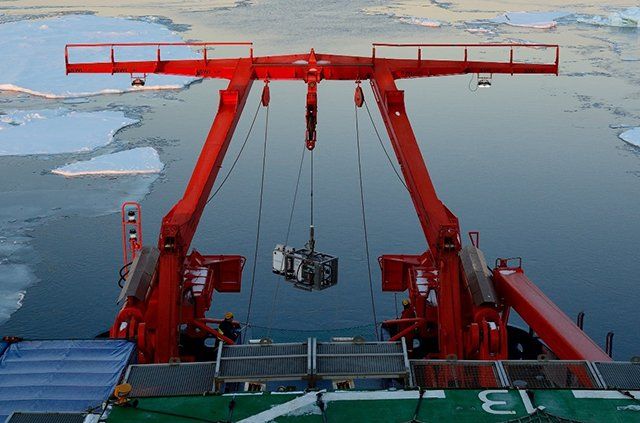
The OFOBS (Ocean Floor Observation and Bathymetry System) shortly before deployment on board RV Polarstern.
(Photo: Alfred-Wegener-Institut / Tim Kalvelage)
The OFOBS is lowered over the stern of the ship
The deep-sea team photographed and filmed this surprisingly species-rich ecosystem for the first time using the OFOBS (Ocean Floor Observation and Bathymetry System). Since the camera platform is towed below the ship on a long cable, the researchers had to wait for the calving event before they could explore the previously unreachable seafloor. In the future, new technologies like autonomous underwater robots will be used to investigate such habitats.
When Beatriz Jimenez closes her eyes, she sees her daughter and two young grandchildren and they are alive. Jimenez's family left the small seaside town of Cabarién, on Cuba's north coast, on March 4, aboard a packed smuggler's boat.
The boat had come from Florida and picked up a group of Cubans desperate to reach the US, according to a statement from the Cuban foreign ministry. The smuggling run violated both US and Cuban laws and put the passengers' lives at risk. Although the communist-run island is only 90 nautical miles from the US, the weather in the Florida Straits is treacherous, particularly in the spring when "Easter winds," as Cubans call seasonal abrupt shifts in weather, can transform the sea into a frothing monster. Jimenez said her daughter Lisbethy took the trip because she had been apart from her husband in Florida for more than a year, after the pandemic forced Cuba to cut most international flights. Lisbethy had been afraid to leave her daughter Kenna Mariana, 6 years old, and Luis Nesto, 4, behind in Cuba and risk a lengthy separation. "My daughter is a good mother. She wouldn't have done this if everything wasn't safe. She wouldn't have put them through this. Her children are everything to her," Jimenez told CNN from the small room full of toys that her daughter had shared with the children
Jimenez holds a picture of her grandchildren Kenna Mariana, 6, and Luis Nesto, 4.
According to the Cuban foreign ministry statement, the smugglers made the migrants switch boats once they reached Bahamian waters, likely to try and confuse any Coast Guard ships that could be in pursuit. As the second boat sped north, it lost control and capsized. It is not clear how many people were aboard. Some 14 hours later, a Royal Bahamian Defence ship found 12 survivors and one dead body, according to a Bahamian government statement. Lisbethy and her children were not among them. Jimenez said relatives in Florida, who had contacted survivors in the Bahamas, later told her the smugglers had not brought life vests for any of the passengers. As Cuba's economic crisis worsens, US Coast Guard officials say they are seeing more Cubans attempting the dangerous journey by boat.
Since October 1, the Coast Guard has intercepted 90 Cubans at sea, according to spokesman Brandon Murray. That number already surpasses the 49 Cuban migrants the previous fiscal year and does not account for many migrants who may arrive in third countries like the Bahamas or who successfully reach the US. In February, a small boat carrying eight Cubans, including two pregnant women, capsized as it reached the Florida coast after 16 days at sea. The same month, the US Coast guard rescued three Cubans who had been living mostly off coconuts after being stranded on a deserted island in the Bahamas for 33 days.
While so far the numbers of Cuban migrants taking to the seas are far less than the rafters crisis of the 1990's, when thousands of people attempted the dangerous crossing by boat, the increase is raising alarms. "The Coast Guard does not recommend anyone taking to the seas in vessels that are not seaworthy. The vessels are often overloaded, the seas are unpredictable and the risk of loss of life is too great," the US Coast Guard said in a statement provided to CNN. Most Cubans caught entering the US now are returned to the island, after President Obama, in his final days in office in 2017, canceled the "Wet Foot, Dry Foot' policy that allowed those who reached the country to remain. According to figures released by the Coast Guard. 5,396 Cubans were interdicted in the fiscal year of 2016. That number dropped to 1,468 the next fiscal year, following Obama's policy change, and since then has stayed in the hundreds.
But a worsening economic climate could push more Cubans to make the desperate voyage, despite having lost their preferential status. In 2020, the economy shrank by 11%, according to Cuban government figures, as the island's tourism industry was almost entirely shut down by the pandemic. That followed a series of punishing sanctions by the Trump administration -- the toughest in decades -- that included returning Cuba to the list of countries that support terrorism, limiting US citizens' ability to travel to the island and cutting off channels for Cuban-Americans to send remittances to relatives there. "Remittances basically determine who can eat and who can't," said Ernesto Gonzalez, whose remittances company Vacuba was impacted by the Trump sanctions. Gonzalez said he is urging the Biden administration to restore the money transfer services before Cubans face a humanitarian crisis.
Desperate circumstances
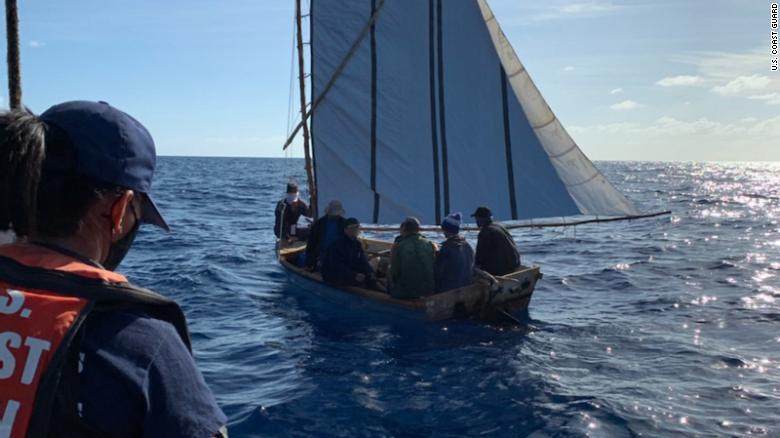
Coast Guard Station Islamorada law enforcement crew interdicts a migrant boat with 7 migrants, Islamorada, Florida, March 2, 2021.
The migrants were repatriated to Cuba. Increasingly Cubans wait in hours-long lines to buy food, which they must pay for in US dollars at many Cuban government-run stores. Without tourists, restaurants and home rentals opened by Cuban entrepreneurs sit empty. Many Cubans compare the ongoing crisis to the dark years the island experienced following the collapse of their ally the Soviet Union in 1991, when tens of thousands of Cubans fled to the US by boat and raft. The Biden administration has said it is studying potential changes to its Cuba policy, including determining how scores of US diplomats working at the US Embassy became ill. The mysterious health incidents led the State Department in 2017 to pull most of their diplomats from the island and shut down embassy services through which Cubans could receive US visas. According to a State Department report, as of November 2020, more than 78,000 Cubans were on a waiting list for immigrant visas. Beatriz Jimenez said her daughter had hoped to apply for a visa to reunite with her husband in the US but as the embassy closure and disruption caused by the pandemic dragged on, she could not wait any longer. As Jimenez held a vigil with neighbors and relatives for her missing family, she prayed for word of their rescue. "They are alive. I know it because I believe in God. I know it will be a miracle," she said. "I am desperate but clinging to the idea that we will have an answer." But ten days after their disappearance, the Cuban government announced it was suspending the search operation. Jimenez still does not know what became of her daughter and grandchildren. The children and their mother had vanished into the sea.
Today had a very different feel. Today was the first day that the America’s Cup could be won. Today was the chance for the Italians to redress the balance after a day in which they had lost two races after winning the starts and maintaining their advantage for the first few legs.
Today was the day that Emirates Team New Zealand could take another step towards winning the Cup. Emirates Team New Zealand entered cleanly across Luna Rossa Prada Pirelli who took their time to gybe around and head out to the right-hand side of the pre-start zone.
The Kiwis were first to get there, gybing around while the Italians tacked before diving back down to the Kiwis.
Plenty of weaving followed as both boats tried to slow down on their approach to the start line.
With the greater wind speeds the pre-start zone was feeling smaller.
The start was even, both on starboard but a big big gap between the two as they charged out to the left-hand boundary at 30 knots. A critical tack was coming – could Luna Rossa get up to the Kiwis and cast dirty air on them?
The Italians’ height mode was working as they eventually forced the Kiwis to tack off while they headed for the right-hand lay line for the top gate who had to put in two tacks to get around the top gate plus.
As they came together the Kiwis dipped the Italians’ transom to take the right hand mark of Gate 1, while Luna Rossa took the left hand mark, leading by just a second.
As the pair split on the downwind leg the Kiwis seemed to get a better gust of breeze and manged to cross in front of the Italians when they came back together a lead change followed.
Now they had swapped sides, gone to the full width of the course and were about to come back at each other for another cross.
This time it was the Italians who were in front, another lead change. By the bottom gate a perfectly executed gybe by the Italians protected their position and forced the Kiwis to follow them through Gate 2.
As the second beat continued the battle remained close but by the top at Gate 3 the Italians had protected their lead once again.
The same was true of Leg 4 with yet more close racing. At the bottom Luna Rossa LR rounded the right-hand mark of Gate 4 and were 3 seconds ahead as Emirates Team New Zealand took the left-hand mark.
The Italians had released their cover on the Kiwis, although they retained the starboard tack advantage.
When they came back together Luna Rossa was still ahead.
But the big change came towards the top of Leg 5 when the pair came together once again.
Now it was the turn of the Kiwis to come back in on starboard.
But Luna Rossa were just ahead as they crossed and tacked in front of the Kiwis forcing the defenders to tack back to the right-hand side of the course. Was this another risk?
The Italians would be on port tack when they came back.
But there was trouble in store as the breeze shifted right, benefitting the Kiwis. By the time the pair came back for Gate 5 Team New Zealand had taken the lead, rounding the left-hand mark ahead by 18 seconds.
One leg to the finish with a distance of 400 m between the pair, this was a big distance to make up for the Italians with so little runway left.As Emirates Team New Zealand came into the finish they had taken Race 9 by 29 seconds in the closing stages of the race. A dramatic and closely fought race to place Emirates Team New Zealand within just one win to take the 36th America’s Cup.
Max Sirena, Skipper & Team Director: "Possibly one of the best races we have seen in the last 15 years of the America's Cup. The guys did really well controlling at the start, we kept them behind for four legs without ever giving up. After all, we are in the final against a very strong team and I am very proud of the guys on the water and the whole team, because today they raced an amazing race. Obviously we are very disappointed with the outcome, but we are still alive and tomorrow we will go on the water to fight and we will give everything. It's not over yet."
Francesco Bruni, Helmsman: "It's a hard one to digest. We raced flawlessly until they overtook us: we had to decide whether to defend the left or go right, and in hindsight it probably was the wrong choice. It was very hard to keep them behind, they definitely had an extra gear because whenever we tried to stretch our lead we couldn't shake them off and as soon as we gave them some space they just set off. We don't feel too much remorse because the race was conducted very well, but we don't plan to give up and we will continue to do what we need to do, analyzing where we can improve to get back on the water geared up to go win."
Vasco Vascotto, Afterguard: "The race was really difficult with tricky wind conditions. I believe the boys raced incredibly well, and Team New Zealand was forced to adapt to our choices. We led the game, and gave a great show of match racing, not only at the start but also throughout the course. This is our mindset, and tomorrow we will keep on racing with this same attitude."
 American model forecast on Christmas Eve, showing snow and mixed precipitation in the Washington region and to the north after an earlier period of rain as an Arctic front passes. (Pivotal Weather)