
Wednesday, July 4, 2018


Tuesday, July 3, 2018
Diverse geography of Britain’s 82 largest islands revealed

From Sheffield Univ.
A University of Sheffield academic has worked with Ordnance Survey to showcase the diverse geography and unique characteristics of Britain’s largest islands.
Great Britain is an island in its own right, but aside from the mainland there are hundreds of islands around the British coast, with many uninhabited.

Biggest Scottish islands with the GeoGarage platform
Professor Alasdair Rae from the University of Sheffield’s Department of Urban Studies and Planning worked with Ordnance Survey’s GeoDataViz team to explore the 82 English, Scottish and Welsh islands that are larger than 5km2.
Scotland – whose Parliament recently passed the Islands Bill to offer greater protection and powers to its island communities – boasts the most islands with 71, while Wales has just two entries and England nine.
The team used Ordnance Survey’s Boundary-Line data to define the area and length of coastline for each island, with some interesting results.
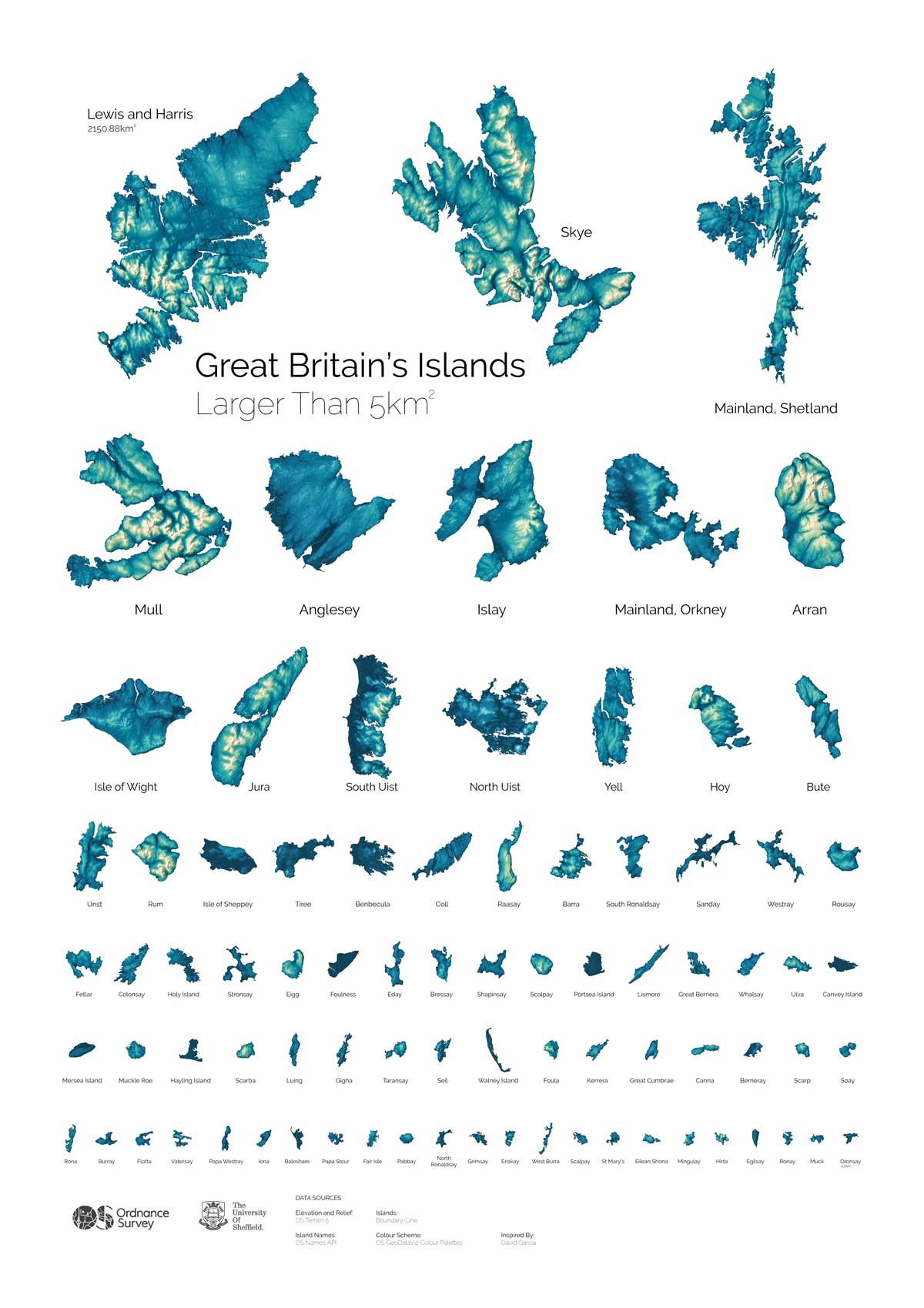
Britain’s largest islands - 82 of them over 5km2,
Scotland boasts the vast majority with 71, not surprising when you consider the Outer Hebrides, Shetland and Orkney and other beautiful islands off the coast.
Scotland boasts the vast majority with 71, not surprising when you consider the Outer Hebrides, Shetland and Orkney and other beautiful islands off the coast.
Wales had just 2 entries and England 9
Lewis and Harris topped the tables for being the largest island by area – around 1.4 times the size of Greater London – and boasts the longest coastline, but not all islands had such a correlation.
North Uist was the 12th largest island, but has the fifth longest coastline.
Conversely, Arran was the eighth largest island but has the 18th longest coastline.
Adding in data from AddressBase, the GeoDataViz team compiled the number of residential addresses on each island and realised that having the largest area does of course not equate to having the most addresses.
Mull is the fourth largest island, but 18th when you look at addresses.
Portsea Island, which contains most of the city of Portsmouth, tops the table for most residential addresses, but is 38th in the list of islands by area.
Harta, Mingulay, Pabbay, Scarp and Taransay have no permanent residents.
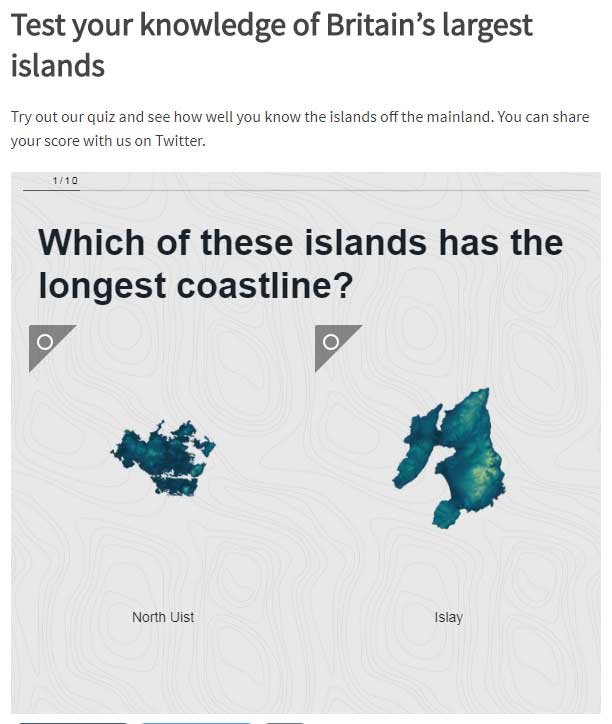
The team has produced an ‘Islands Off Great Britain’ poster and a quiz where people can test their knowledge of the islands.
Professor Rae said: "Ordnance Survey was founded in 1791 and has been a global leader in geographic data for over 225 years.
In 2010, it released a huge tranche of its archives as open data, so that scientists, planners, architects, geographers and others could benefit through enhanced access to some of the best spatial data in the world.
“It's not always obvious how much data is out there, or what it shows, so our 'Islands Off Great Britain' project is a way to highlight the kinds of data available to users, and also learn something about the geography of Great Britain.”
He added: "It was great to be involved in this project with Ordnance Survey since it enabled me to work with one of our MSc in Applied GIS graduates, Joe Harrison, and renowned cartographer and geovisualization expert Charley Glynn. Working with these Ordnance Survey experts, it was great to tap into the treasure trove of data they hold to try and tell a simple story about Great Britain's islands, in a way that might draw people's attention to the underlying data."
Facts and figures
Top 5 islands by area1. Lewis and Harris
2. Skye
3. Mainland, Shetland
4. Mull
5. Anglesey
Top 5 islands by length of coastline
1. Lewis and Harris
2. Mainland, Shetland
3. Skye
4. Mull
5. North Uist
Top 5 islands by residential addresses
1. Portsea Island
2. Isle of Wight
3. Anglesey
4. Isle of Sheppey
5. Canvey Island
Links :
British Isles & misc. layer update in the GeoGarage platform

see GeoGarage news
 update based on original nautical raster charts material from UKHO
Links :
- Direction Mag : Britain ready to lead the world on G7 Healthy Oceans commitments
- Hydro : United Kingdom Ready to Lead the World on G7 Healthy Oceans Commitments
Monday, July 2, 2018
Why the naked hermit of Japan has had to leave his island after 29 years
Masafumi Nagasaki is an 82 year old Japanese man who has lived
completely alone as a castaway for the last 29 years on Sotobanari
desert island (Iriomote Okinawa, Japan)
This voluntary Robinson Crusoe with his bright pink turban has spent all this time living completely naked and surviving by himself.
He has become the voluntary castaway who has lived the longest time on a desert island.
The only wish of this survivor was to die on his desert island.
But sadly the Japanese Authorities forced him to return to civilization last month :(
Fortunately we lived with him for 5 unforgettable days before he was kicked out, and were able to share his life and carry out this fascinating interview.
This voluntary Robinson Crusoe with his bright pink turban has spent all this time living completely naked and surviving by himself.
He has become the voluntary castaway who has lived the longest time on a desert island.
The only wish of this survivor was to die on his desert island.
But sadly the Japanese Authorities forced him to return to civilization last month :(
Fortunately we lived with him for 5 unforgettable days before he was kicked out, and were able to share his life and carry out this fascinating interview.
From Gizmodo by Jennings Brown
For nearly 30 years, Masafumi Nagasaki lived a life many of us extremely logged-on folks can only dream of.


Sotobanari island with the GeoGarage platform (NGA chart)
A life completely void of commuting, the internet, and screens.
He had the entire island of Sotobanari to himself—foraging, raking debris from the shore, and watching baby turtles hatch from their eggs and scurry to the ocean.
“Finding a place to die is an important thing to do,” Nagasaki told Reuters in 2012, “and I’ve decided here is the place for me.”
After abandoning conventional society (and clothing) in 1989, his only contact with civilization came during periodic trips to buy food and drinking water at a settlement an hour away by boat.
That is, until this April, when filmmaker Alvaro Cerezo says authorities forced Nagasaki “to go to a hospital with no hope of returning to his island.”
Cerezo, who spent five-days filming Nagasaki in 2014 for the above video, told news.com.au, “He was kicked out of the island, someone saw him on the island and it seems like he was weak.”
“They called the police and they took him back to civilisation and that’s it,” Cerezo continued.
“He couldn’t even fight back because he was weak. They won’t allow him to return.”
Nagaski told the filmmaker that decades ago he had often told his coworkers of his desire to escape, but he finally made the decision to go off the grid when he was flying from Fukuoka to Asake, and was disgusted by the pollution he saw spewing from the aircraft.
That’s when he realized he wanted to leave society behind.
He first moved to the island of Iriomote, but was disappointed by the presence of cars and tourists.
Then a fisherman suggested he try the deserted island of Sotobanari, and took him there.
Nagasaki fell in love and the fisherman left him on the island with a tent.
Nagasaki struggled at first, having no wilderness experience, but quickly learned survival skills. According to Cerezo’s blog, Nagasaki eventually “began to have empathy with the animals and to reject meat and fish.
That was when, for the first time in his life he felt the significance of happiness.”
Once a month, Nagasaki would go to a nearby island to buy food and water, using money that his sister sent him.
But he would only stay for a couple of hours.
According to Cerezo, Japanese authorities have been attempting to civilize Nagasaki for a while, offering to buy him a house and provide care.
“I don’t want to move from here. I will protect this island. I’d never be able to find a paradise like this,” Nagasaki told Cerezo in the documentary.
“Nothing sad can happen here. Once I saw a dead bird in the jungle. Then I felt pity—only that.”
On his island, Nagasaki was free of want.
He only had one desire.
“I’ve already told my family I will die here. My wish is to die here without bothering anyone,” he said in the film.
“I will die soon, probably in a few years. I want to be killed by a typhoon—so nobody can try to save me.”
Links :
Sunday, July 1, 2018
Golden Globe Race
Finish of the 1968 Sunday Times Golden Globe Single-handed Race around the world.
Sir Robin Knox-Johnston was the only one to finish of 9 starters and completed the voyage in 312 days.
He was in his 32 foot ketch Suhali.
The Sunday Times Golden Globe Race was a non-stop, single-handed, round-the-world yacht race,
held in 1968–1969, and was the first round-the-world yacht race.
The
race was controversial due to the failure of most competitors to finish
the race and because of the suicide of one entrant; however, it ultimately led to the founding of the BOC Challenge and Vendée Globe round-the-world races, both of which continue to be successful and popular.
The race was sponsored by the British Sunday Times
newspaper and was designed to capitalise on a number of individual
round-the-world voyages which were already being planned by various
sailors; for this reason, there were no qualification requirements, and
competitors were offered the opportunity to join and permitted to start
at any time between 1 June and 31 October 1968.
The Golden Globe trophy was offered to the first person to complete an unassisted, non-stop single-handed circumnavigation of the world via the great capes, and a separate £5,000 prize was offered for the fastest single-handed circumnavigation.
Nine sailors started the race; four retired before leaving the Atlantic Ocean.
Of the five remaining, Chay Blyth, who had set off with absolutely no sailing experience, sailed past the Cape of Good Hope before retiring;
Nigel Tetley sank with 1,100 nautical miles (2,000 km) to go while leading;
Donald Crowhurst,
who, in desperation, attempted to fake a round-the-world voyage to
avoid financial ruin, began to show signs of mental illness, and then
committed suicide;
and Bernard Moitessier,
who rejected the philosophy behind a commercialised competition,
abandoned the race while in a strong position to win and kept sailing
non-stop until he reached Tahiti after circling the globe one and a half times.
Robin Knox-Johnston
was the only entrant to complete the race, becoming the first person to
sail single-handed and non-stop around the world. He was awarded both
prizes, and later donated the £5,000 to a fund supporting Crowhurst's
family.
The Golden Globe Race is back in 2018,
Following in the footsteps of Robin Knox Johnston in Suhaili , the winner of the original 1968 Sunday Times Golden Globe.
Race founder Don McIntyre explains.
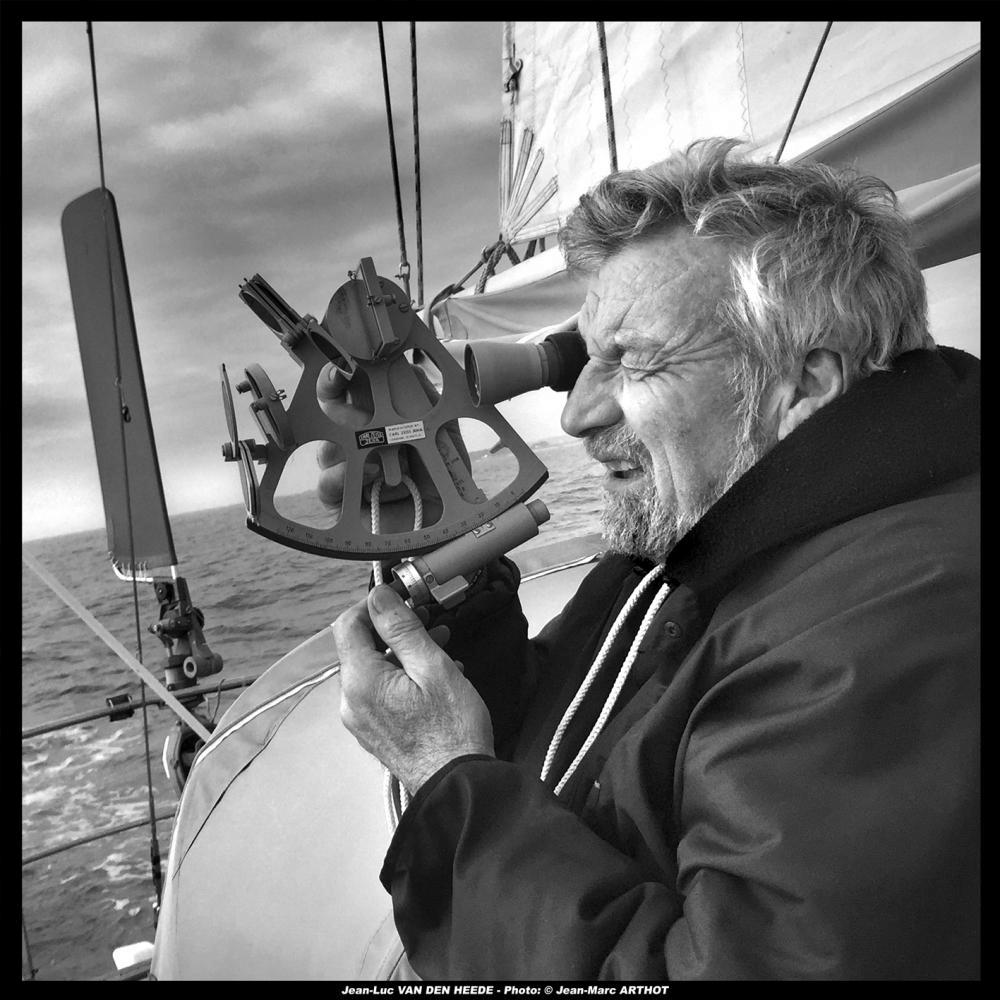
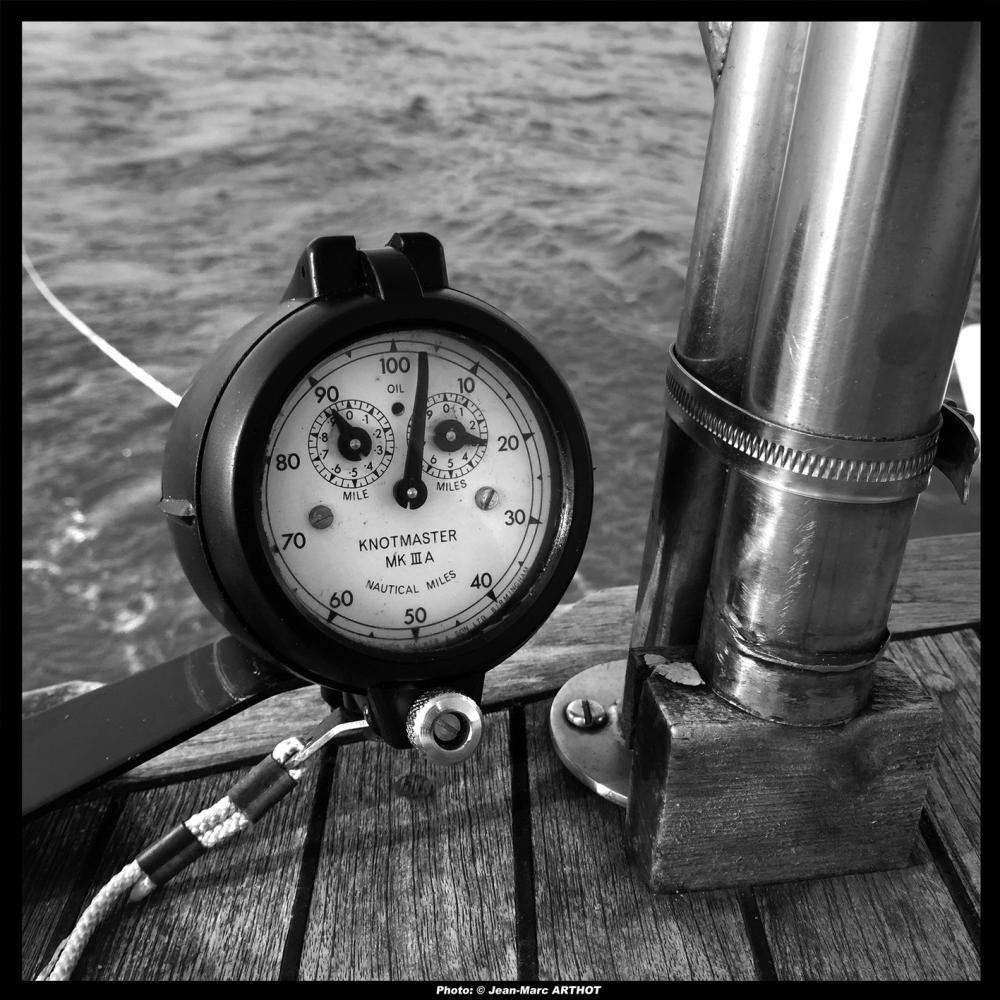
No satellites, no electric autopilots, no high-tech, sailing 32-36ft production yachts designed before 1988.
A race back to the Golden Age of Solo sailing.
Links :
Subscribe to:
Posts (Atom)