4850 CAPE ST FRANCIS TO BACCALIEU ISLAND AND HEART'S CONTENT
So 688charts (1658 including sub-charts) are available in the Canada CHS layer. (see coverage)
Note : don't forget to visit 'Notices to Mariners' published monthly and available from the Canadian Coast Guard both online or through a free hardcopy subscription service. This essential publication provides the latest information on changes to the aids to navigation system, as well as updates from CHS regarding CHS charts and publications. See also written Notices to Shipping and Navarea warnings : NOTSHIP
National Geographic Explorer-in-Residence Enric Sala dives deep into the waters of one of the most pristine places on Earth — the Pitcairn Islands — only to discover its delicate ecosystem is not as unspoiled as it may seem.
Nadine Christian is considered the first novelist from her island home’s 223 years of civilized existence.“Remembering Love” by all accounts is a fine piece of work.
However, in fairness to Christian anything good that happens within her remote spec of volcanic rock called Pitcairn Island will always be prefaced by its notorious past.
Historians and lovers of true adventure on the high seas hear the words “Pitcairn Island” and instinctively think of Lt. William Bligh, Fletcher Christian and Mutiny on the Bounty in 1789.
From the mutiny, thoughts unconsciously turn to bleak isolation of the insurgents’ abysmal resting place — Pitcairn Island.
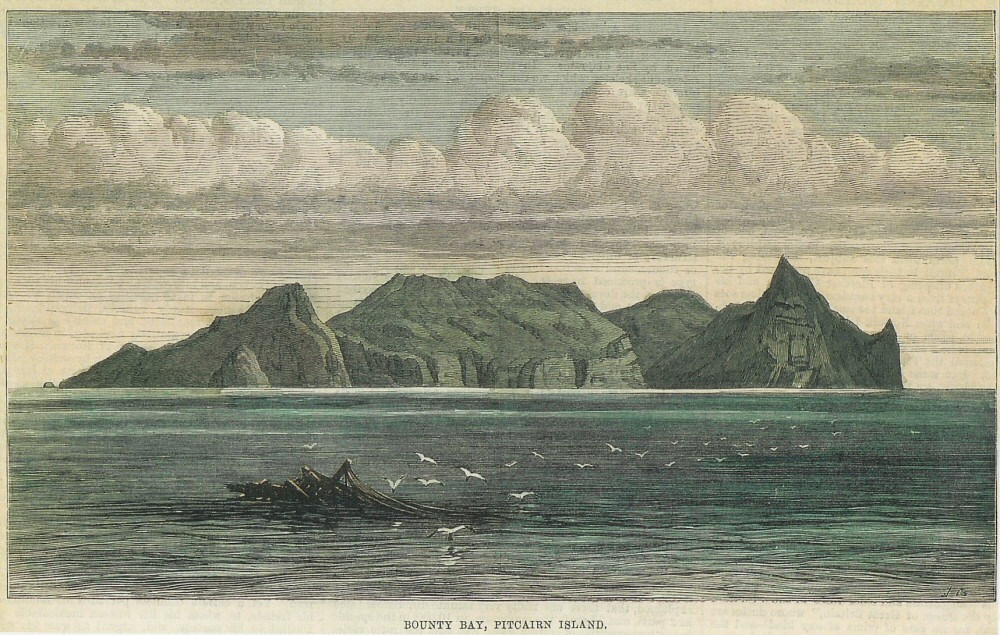
An early drawing of Pitcairn Island – from the collection of Maurice Allward.
Pitcairn is a small, but distinctive, island in the heart of the southern South Pacific.
It is more than 3,300 nautical miles from New Zealand and 1,400 nautical miles from Tahiti, and with a population of about 60, it represents one of the most remote and inaccessible jurisdictions on Earth. Still, its tropical beauty and haunting features and sad reminders of the past like “Christian’s Cave” continue to make for an appealing adventure.
You cannot fly into Pitcairn because its 2.5 square miles of land mass are mostly mountainous.
From neighboring New Zealand, it is 10 days by yacht.
Because of strong ocean currents and jagged volcanic minefields, a yacht or small ship cannot land there.
Islanders send long boats out to meet visitors and supply ships.
Bénard, Robert, b. 1734. “Carte et vues de l’Isle Pitcairn.” Copperplate map (and views), with added color, 10 × 25 cm. on sheet 25 × 30 cm. From John Hawkesworth’s Relation de voyages entrepris par ordre . . . et successivement exécutés par le commodore Byron, le capitaine Carteret, le capitaine Wallis et le capitaine Cook . . . (Paris, 1774). [Historic Maps Collection] We continued our course westward till the evening of Thursday the 2d of July [1767], when we discovered land to the northward of us. Upon approaching it the next day, it appeared like a great rock rising out of the sea: it was not more than five miles in circumference, and seemed to be uninhabited; it was, however, covered with trees, and we saw a small stream of fresh water running down one side of it. I would have landed upon it, but the surf, which at this season broke upon it with great violence, rendered it impossible. . . . [I]t having been discovered by a young gentleman, son to Major Pitcairn of the marines, who was unfortunately lost in the Aurora, we called it Pitcairn’s Island. [Hawkesworth, vol. 1, p. 561] The mutineers of the HMS Bounty would find this information about a remote, uninhabited (but inhabitable) island useful when they sought a place to hide from the British Admiralty in 1779.
However, in January 1790, no island could have been a more perfect haven than Pitcairn for the mutineers of the Bounty.
The island was misplaced on British charts, and it was here that Christian and eight other dissenters, plus 24 Tahitian men and women settled.
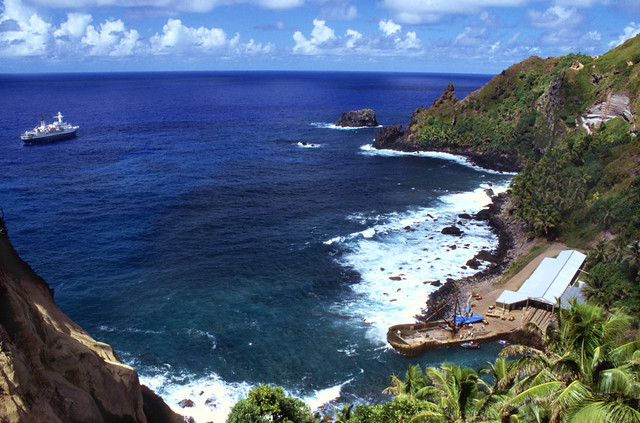
The ship was burned in what is known today as Bounty Bay and its remains are still visible.
After nearly two years of being isolated on the island, most of the mutineers, including Fletcher Christian were murdered.
Some accounts say Christian committed suicide, while others believe he somehow escaped Pitcairn and returned to England, hiding out for the remainder of his life. John Adams, the last survivor of the seized ship, insisted Christian was killed by the Tahitians.
The cave Christian lived in remains a focal point of the island.
It rises some 250 feet and provides a spectacular view of the vast blue Pacific.
It is not much more than a small indentation, but it is where Christian often sat, scanning the ocean hoping not to be discovered by a distant British ship.
All of the inhabitants of Pitcairn Island are descendants, or married to descendants, of the original mutineers including Nadine Christian.
She is the wife of a descendant of Fletcher Christian and the author of “Remembering Love,” an excellent first novel.
Two years ago I wrote about Caroline Alexander’s fine book, “The Bounty.”
Through the wonder of the Internet, the review was picked up by resident Sue O’Keefe who has since become an occasional pen pal, and through her, I met Nadine Christian.
The book has a strong focal point — a young girl returning to her Pitcairn Island home to rediscover her roots, linking pieces of her past together and, yes, finding love.
The story is woven with skillful dialogue, easy transition and credible island scenes that are the essence of Pitcairn’s beauty, mystery and magnetism.
Its pages, worth any book lover’s time, represent seeds of a promising dramatist.
Christian’s style has a way of carrying one off to the South Seas without exorbitant fare or throttling red tape.
Nadine went to Pitcairn from New Zealand in 2002.
She met and married into the Christian family, and as a result, explains, “I live with my husband, five children, four goats, two cats and 30 chickens.”
She is 40 and filled with energy to write novels, perhaps based loosely on Pitcairn’s past.
“I love it here,” Christian said.
“I enjoy the beauty, the stillness, the hard work and total unpredictability of each new day. It isn’t a 9-to-5 existence. It’s more like 24/7. It can be a bit claustrophobic at times, but the Internet and phone system opens you up to the world.
It’s like any small community. People niggle at times, but it’s never serious. I could have an argument with John Smith today, and tomorrow he may hear I’m out of milk and he’ll bring me a carton to tide me over. Yes, we do have our differences of opinion now and then, but in the end, we depend on helping each other.”
There was no happy ending for the majority of the 18 original mutineers.
Some were murdered. Some returned to England and hanged for their crime.
Some were pardoned, but forever lived in the shadows of a shameful past.
For Nadine Christian, however, happy and inspiring endings now and then can make for a fine calling card.
Three types of critically endangered but commercially valuable shark have been given added protection at the Cites (Convention on International Trade in Endangered Species) meeting in Bangkok.
Shark fins drying in the sun in Kaohsiung before processing. 30 percent of the world’s shark species are threatened or near threatened with extinction.
Photo Credit: Shawn Heinrichs for the Pew Environment Group
The body, which regulates trade in flora and fauna, voted by a two-thirds majority to upgrade the sharks' status.
Campaigners hailed the move as historic and said the vote represented a major breakthrough for marine conservation.
The decisions can still be overturned by a vote on the final day of this meeting later this week.
The oceanic whitetip, three varieties of hammerheads and the porbeagle are all said to be seriously threatened by overfishing.
Their numbers have declined dramatically in recent years, as the trade in shark fins for soup has grown.
Manta rays are killed for their gill plates which are used in Chinese medicine.
Shark supporters have been attempting to get Cites to protect these species since 1994.
But there has long been strong opposition to the move from China and Japan.
But a number of factors have changed the arithmetic.
Experts say the critical factor has been a shift in South American nations, who've come to understand that sharks are more valuable alive than dead.
"They've come to realise, particularly for those with hammerhead stocks, the tourist value of these species and the long term future that will be protected by a Cites listing," said Dr Colman O'Criodain from WWF International.
The oceanic whitetip was once a widespread large shark species, but its numbers show a drastic decline. It appears as bycatch in pelagic (open sea) fisheries, but its large fins are highly prized, used in shark's fin soup and in traditional medicine
Hammerhead sharks are known for their distinctive head shape which may have evolved in part to enhance vision. The great and scalloped varieties are endangered; the smooth hammerhead is considered vulnerable. All have been given added protection
Porbeagles are found in cold and temperate waters of the North Atlantic and Southern Hemisphere. Targeted commercial fishing and unintentional catches pose the biggest threat to this shark, which has a low reproductive rate
Thousands of sharks fins are laid out on roofs in Hong Kong for airing and sorting.
While the vote to upgrade these shark species to Appendix 2 does not ban the trade, it regulates it. Both exporting and importing countries must issue licences.
If a nation takes too many of these species, they can be hit with sanctions on the range of animal and plant products that are governed by Cites.
As the votes went on there were smatterings of applause in the hall and some high fives among campaigners.
"It is really significant for Cites to come of age like this," Dr Susan Lieberman told BBC News.
"To say we can deal with these species, we can manage the international trade and lets not be afraid of marine species."
The extension of the authority of Cites into the international trade in fish has long worried China and Japan and the Asian nations were strongly against these proposals.
But many West African countries, who have seen their native shark fisheries destroyed by large offshore operations, voted in favour of the restrictions.
Another factor was money.
Especially cash from the European Union.
The head of delegation told the meeting that extra money would be made available to help poorer countries change their fishing practices.
"If there's a need for it the funding will be available," Feargal O'Coigligh told the meeting.
The amendments can still be overturned in the final session of this meeting.
And this realisation is tempering the celebrations.
"Cites is ready to come of age for marine species, " said Dr O'Criodain.
"As long as we hold these results in plenary. Maybe warm champagne is the right note."
Links :
The Guardian : Five shark species win protection against finning trade
Two years after the earthquake and tsunami that devastated Japan, researchers in the US and Canada are concerned about the possible damage that could be caused by invasive species that have found their way to North America on debris resulting from the 2011 disaster.
According to UPI, experts in the northwest US and Canada are having difficulty determining whether or not marine life washing ashore on the debris will be a threat to the environment and/or living things native to the region – or for how long they could pose a threat.
“Ecologists have a terrible track record of predicting what introduced species will survive and where. But once things are here, they are a threat,” John Chapman, an invasive species expert working at the Oregon State University (OSU) Hatfield Marine Science Center, told Lori Tobias of The Oregonian on Thursday. “They could explode at any time. It’s just like roulette. Each time something lands here, we pull the trigger. We’re getting more and more every year.”
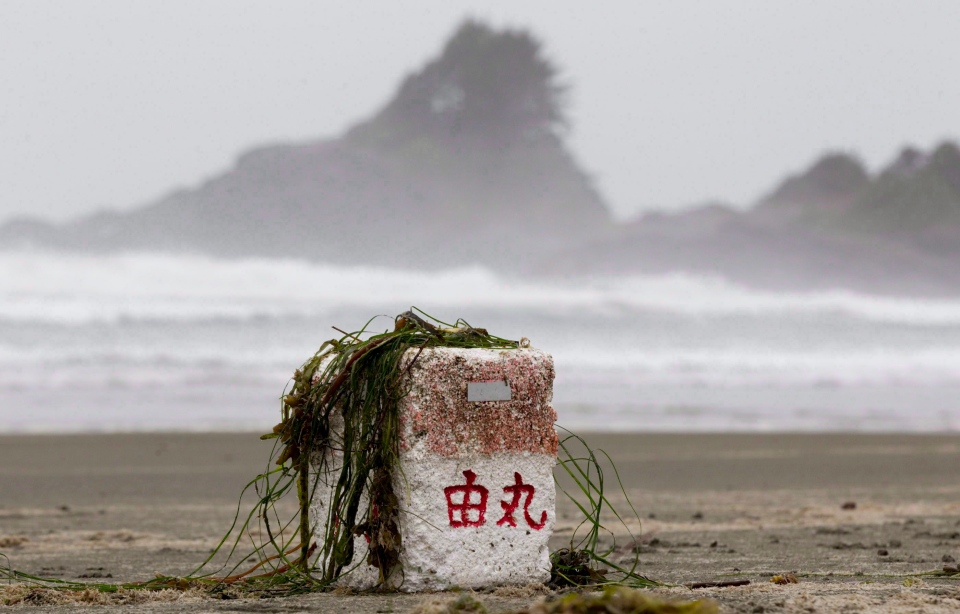
In this photo released by NOAA, a boat lost in the Japanese tsunami of 2011 sits onshore on a remote Canadian island. The boat was discovered Aug. 9, 2012. Credit : Kevin Head
Chapman and his OSU colleagues have been tracking and studying the debris since shortly after it began arriving on nearby beaches. That includes a dock that arrived on Agate Beach in Lincoln County, Oregon last summer following roughly 450 days adrift in the Pacific Ocean. Chapman explained the debris and the organisms they have found living on it have been extremely unpredictable.
“It’s been a constant surprise,” he told The Oregonian. “There was a huge diversity of organisms. There are multiple generations. They were carrying on with life like fleas on a dog’s back. The other thing that was maybe even a bigger surprise is that lots of things settled on the debris after the tsunami. We know that because it was on top of the things that were there at the time of the tsunami.”
For now, Chapman and his colleagues have to measure the debris as it washes in, keeping careful track of the types of species they harbor. He called it a “giant… terrible experiment that should have never happened,” adding, “I can’t see the dock and debris and know what happened in Japan and not feel an enormous amount of responsibility for pulling everything good out of it I possibly can.”
Experts in Canada are faced with a similar situation, according to CTV British Columbia reports published Saturday.
“Items like home cleaning supplies and kids’ toys are now littering West Coast shorelines,” they explained. However it is the “small organisms attached to the debris” that are concerning scientists. “Foreign plants and animals could devastate local ecosystems, researchers say, and as coastal communities… start to see more debris there is growing concern they won’t be able to clean it up fast enough.”
This floating dock washed ashore near Newport. Ore. on June 5
with Wakame, a known invasive seaweed, exotic mussels (Mytilus edulis or M. galloprovicialis) and barnacles clinging to the "tsunami dock"
Dolf DeJong, vice president of conservation and education at the Vancouver Aquarium, told reporters invasive species were “a legitimate threat” to the province’s ecosystem.
DeJong warned, depending on exactly which organisms managed to survive and how many there are on any given piece of debris, they could adversely impact the region’s biodiversity, damage the oceans, and even have a negative fiscal influence by harming populations of economically-important life forms like shellfish.
“Canadian researchers say they haven’t had the chance to study the problem as closely because they haven’t had access to such a large item with so many organisms on it,” CTV said, adding that DeJong is urging anyone who spots a foreign object that has washed ashore to contact the aquarium or another expert so they “can determine whether it harbors invasive species.”
Links :
HuffingtonPost : Japan tsunami debris spreads in U.S. 2 years after earthquake
LifeScience : 2 years on, Japan tsunami debris still washing ashore
An enthused Steve Backshall watches from his canoe as Orca Dolphins jump and dive in the sea infront of him off the Canadian coast - a process known as breaching.