From The Shipping Brief
Saudi Arabia’s Red Sea moment has arrived
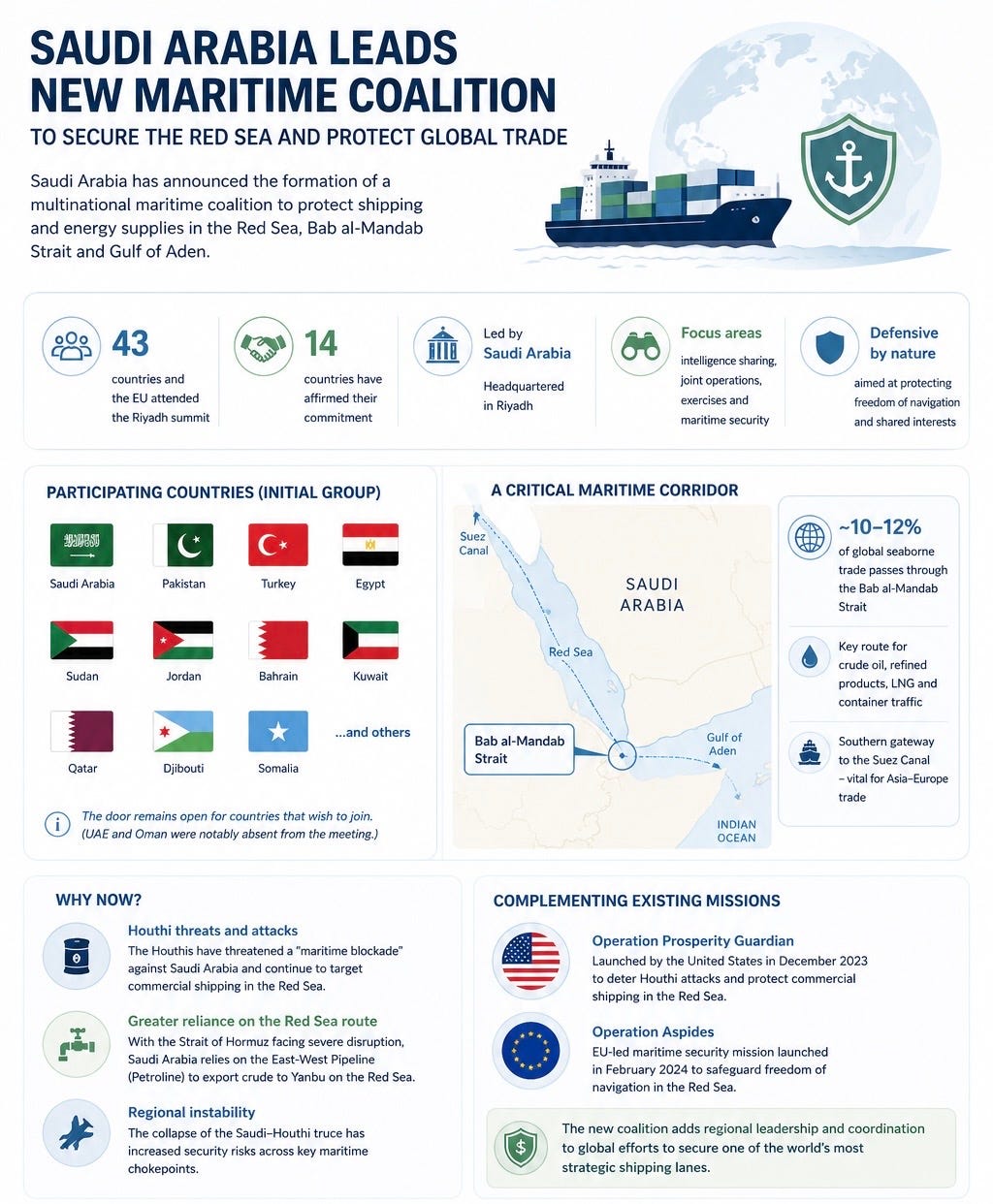
Saudi Arabia has announced the formation of a new multinational maritime coalition aimed at protecting commercial shipping routes across the Red Sea, the Bab al-Mandab Strait and the Gulf of Aden, some of the most strategically important waterways in global trade.
The initiative reflects growing concerns over the vulnerability of maritime corridors that connect Asia, the Middle East and Europe.
The Red Sea route is a critical artery for energy shipments, container trade and supply chains, with thousands of vessels passing through the region each year to access the Suez Canal and wider international markets.
The announcement follows a summit held in Riyadh attended by representatives from 43 countries and the European Union.
The announcement follows a summit held in Riyadh attended by representatives from 43 countries and the European Union.
Fourteen countries have so far committed to participating in the Saudi-led framework, including Egypt, Pakistan, Turkey and Sudan.
The coalition is expected to focus on three core areas: intelligence sharing, coordinated naval operations and maintaining freedom of navigation.
The coalition is expected to focus on three core areas: intelligence sharing, coordinated naval operations and maintaining freedom of navigation.
While details of the operational structure remain limited, the initiative suggests a greater willingness among regional powers to take a more active role in maritime security.
Why the Red Sea has become a strategic flashpoint
The formation of the coalition comes amid a period of heightened instability around key maritime chokepoints in the Middle East.
Since late 2023, attacks by Yemen’s Houthi movement on commercial vessels in and around the Red Sea have disrupted one of the world’s busiest shipping routes.
Several major shipping companies have diverted vessels away from the Bab al-Mandab Strait, opting instead for longer routes around the Cape of Good Hope to reduce security risks.
The Bab al-Mandab Strait, located between Yemen and Djibouti and Eritrea, is a narrow maritime passage connecting the Red Sea with the Gulf of Aden.
The Bab al-Mandab Strait, located between Yemen and Djibouti and Eritrea, is a narrow maritime passage connecting the Red Sea with the Gulf of Aden.
Its strategic importance comes from its role as a gateway between the Indian Ocean and the Suez Canal, through which a significant share of global trade normally passes.
At the same time, wider regional tensions — particularly concerns surrounding Iran and the security of the Strait of Hormuz — have added further pressure on Middle Eastern energy routes.
The Strait of Hormuz remains the world’s most important oil transit chokepoint, with a significant proportion of global crude and liquefied natural gas exports passing through it.
At the same time, wider regional tensions — particularly concerns surrounding Iran and the security of the Strait of Hormuz — have added further pressure on Middle Eastern energy routes.
The Strait of Hormuz remains the world’s most important oil transit chokepoint, with a significant proportion of global crude and liquefied natural gas exports passing through it.
Any prolonged disruption in the area could have major implications for energy markets.
Saudi Arabia’s energy security calculations
For Saudi Arabia, maritime security in the Red Sea has a direct connection to national energy strategy.
The kingdom has invested heavily in diversifying its export routes through the East-West Pipeline, also known as Petroline, which transports crude oil from fields in the east of the country to the Red Sea port of Yanbu.
This infrastructure provides Saudi Arabia with an alternative pathway for exporting crude without relying entirely on the Strait of Hormuz.
As geopolitical risks increase in the Gulf, the Red Sea has become increasingly important to Saudi Aramco’s ability to maintain reliable access to international markets.
Protecting shipping lanes in the region therefore serves not only broader international trade interests but also Saudi Arabia’s own economic and energy security objectives.
Protecting shipping lanes in the region therefore serves not only broader international trade interests but also Saudi Arabia’s own economic and energy security objectives.
A new layer in regional maritime security
The Saudi-led coalition adds another dimension to existing international efforts to secure Red Sea shipping.
The United States launched Operation Prosperity Guardian in late 2023 to coordinate maritime protection efforts in response to attacks on commercial vessels.
The European Union also established Operation Aspides, a defensive naval mission designed to help protect merchant shipping and ensure freedom of navigation.
The emergence of a Saudi-led initiative suggests a broader shift toward regional ownership of maritime security.
The emergence of a Saudi-led initiative suggests a broader shift toward regional ownership of maritime security.
While international naval deployments remain important, Gulf and Red Sea states are increasingly seeking a stronger role in managing risks in their surrounding waters.
What this means for global trade
The security of the Red Sea is closely linked to the stability of global supply chains.
What this means for global trade
The security of the Red Sea is closely linked to the stability of global supply chains.
Disruptions in this corridor can increase shipping costs, extend delivery times and create additional pressure on energy markets.
The creation of a new multinational coalition does not immediately eliminate the risks facing commercial shipping, but it represents an important step toward improving coordination between regional and international actors.
As geopolitical competition intensifies across the Middle East, control and security of maritime chokepoints will remain a central factor shaping energy flows, trade routes and regional influence.
Links :
The creation of a new multinational coalition does not immediately eliminate the risks facing commercial shipping, but it represents an important step toward improving coordination between regional and international actors.
As geopolitical competition intensifies across the Middle East, control and security of maritime chokepoints will remain a central factor shaping energy flows, trade routes and regional influence.
Links :

No comments:
Post a Comment