
IMAGE © Vincent Thian/AP/SIPADATE
From Le Grand Continent by Nadège Rolland (translated from French)
In China, the study of geopolitics was long banned.
Since Xi came to power, it has experienced a renaissance through maps.
Nadège Rolland, a researcher specializing in Chinese strategy, has authored an in-depth study on the cartographic representations of the new empire.
In China, the study of geopolitics was long banned.
Since Xi came to power, it has experienced a renaissance through maps.
Nadège Rolland, a researcher specializing in Chinese strategy, has authored an in-depth study on the cartographic representations of the new empire.
The 2023 edition of the “standard” map of the borders of the People’s Republic of China, which includes the disputed land and maritime areas with India, Malaysia, the Philippines, Russia, Vietnam, and Taiwan, starkly highlighted the Chinese government’s tendency to instrumentalize the representation of space and its desire to shape reality rather than reflect it 1.
We recall similar precedents, such as the now-famous “nine-dash line” encompassing the South China Sea, which appeared as an attachment to its note verbale addressed to the UN in May 2009; its adoption in 2021 of the Land Boundary Law; and the recent renaming of villages in Xinjiang and along the borders with Russia and India.
These various examples link contemporary Chinese maps to the so-called “maps of national humiliation,” produced during the 1920s and 1930s, which depict the territories that once belonged to the Qing Empire as phantom limbs following an amputation.
The abrupt transition from empire to nation-state, triggered by Western invasions in the 19th century, was in fact accompanied by a dismemberment of the Chinese “geo-body”—which current leaders intend to repair while simultaneously declaring their desire to wash away the centuries-old affront. 2
Thus, contemporary Chinese territorial claims result, at least in part, from the irreconcilable boundaries of the former imperial domain and the modern sovereign state.
The abrupt transition from empire to nation-state, triggered by Western invasions in the 19th century, was in fact accompanied by a dismemberment of the Chinese “geo-body”—which current leaders intend to repair while simultaneously declaring their desire to wash away the centuries-old affront. 2
Thus, contemporary Chinese territorial claims result, at least in part, from the irreconcilable boundaries of the former imperial domain and the modern sovereign state.

« Carte de l’humiliation nationale chinoise » (1927).
Source : William A.
Callahan, “The cartography of national humiliation and the emergence of China’s geobody” Public Culture 21(1) 2009.
While the “national humiliation” maps speak volumes about China’s past wounds, the map created by geophysicist Hao Xiaoguang—made public in 2014 and adopted by the Central Military Commission in 2019—instead outlines a vision of China’s future and the place it hopes to occupy on the international stage.
Hao’s vertical projection places China, the Indian Ocean, and the Himalayan plateau at the center of a vast space bounded to the north and south by the poles, to the west by the African continent, and to the east by the Pacific and Oceania.
The Atlantic Ocean and the American continent, split in two and compressed by the projection, are relegated to the edges of the map.
Hao’s vertical projection places China, the Indian Ocean, and the Himalayan plateau at the center of a vast space bounded to the north and south by the poles, to the west by the African continent, and to the east by the Pacific and Oceania.
Contemporary Chinese territorial claims stem from the irreconcilable boundaries of the former imperial domain and the modern sovereign state.
NADÈGE ROLLAND
The Atlantic Ocean and the American continent, split in two and compressed by the projection, are relegated to the edges of the map.

Projection de Hao Xiaoguang, 2014.
The decade Hao spent working on the creation of this new world map—which dethrones the East-West axis and eliminates the centrality of the transatlantic—coincided with a period of intense internal reflection during which Chinese strategic planners and academic experts set out to dissect the multiple dimensions of power.
It was during this same period that China collectively became aware of its meteoric rise, marked by uninterrupted double-digit growth accelerated by its integration into the international system and its entry into the World Trade Organization in 2001—and its ascension to the position of the world’s second-largest economy, overtaking Japan in 2011.
At this rate, it would soon surpass the United States.
It was during this same period that China collectively became aware of its meteoric rise, marked by uninterrupted double-digit growth accelerated by its integration into the international system and its entry into the World Trade Organization in 2001—and its ascension to the position of the world’s second-largest economy, overtaking Japan in 2011.
At this rate, it would soon surpass the United States.
What kind of great power would it then become?
In an effort to provide answers to these questions, numerous internal research studies during this period focused on analyzing the concepts of maritime and naval power, the notion of soft power, and the historical cycles of the rise and decline of great powers, while also attempting to determine China’s geopolitical nature and define the “core interests” of the Chinese nation.
Developed within strategic circles, this line of thinking accompanied and supported the ruling bodies of the party-state, which, increasingly confident in the country’s upward trajectory, began to show the first signs of publicly asserting its identity as an emerging global power.
Perhaps inspired by the study session on the rise of great powers in which all members of the Chinese Communist Party’s Political Bureau had participated a few months earlier, the Hu Jintao government launched the concept of “peaceful emergence” in late 2003, which was quickly replaced by that of “peaceful development”—Chinese propagandists having, upon reflection, deemed the term “emergence” too aggressive.
Developed within strategic circles, this line of thinking accompanied and supported the ruling bodies of the party-state, which, increasingly confident in the country’s upward trajectory, began to show the first signs of publicly asserting its identity as an emerging global power.
Perhaps inspired by the study session on the rise of great powers in which all members of the Chinese Communist Party’s Political Bureau had participated a few months earlier, the Hu Jintao government launched the concept of “peaceful emergence” in late 2003, which was quickly replaced by that of “peaceful development”—Chinese propagandists having, upon reflection, deemed the term “emergence” too aggressive.
Then, in 2005, the General Secretary finally announced his desire to see the emergence of a “harmonious world,” thus setting forth the first outline of a truly global vision.
In addition to adopting a rhetoric that blended power with global horizons, Hu Jintao also ordered the People’s Liberation Army (PLA) to accelerate the development of its projection capabilities far beyond the mere national perimeter, listing in late December 2003 “new historic missions” focused on defending China’s economic development and national maritime interests, including in space and cyberspace.
Gradually coming to realize their nation’s growing strength, the Chinese elites nevertheless remained divided for some time yet on the course of action to take and the strategy to adopt.
In addition to adopting a rhetoric that blended power with global horizons, Hu Jintao also ordered the People’s Liberation Army (PLA) to accelerate the development of its projection capabilities far beyond the mere national perimeter, listing in late December 2003 “new historic missions” focused on defending China’s economic development and national maritime interests, including in space and cyberspace.
Officially banned in the People’s Republic until the late 1980s, the discipline of geopolitics has since regained influence in Chinese strategic thinking.At the center and at the top of the world: maps to establish China’s geopolitical nature
NADÈGE ROLLAND
Gradually coming to realize their nation’s growing strength, the Chinese elites nevertheless remained divided for some time yet on the course of action to take and the strategy to adopt.
Then, in 2005, the General Secretary finally announced his desire to see the emergence of a “harmonious world,” thus setting forth the first outline of a truly global vision.
In addition to adopting a rhetoric that blended power with global horizons, Hu Jintao also ordered the People’s Liberation Army (PLA) to accelerate the development of its projection capabilities far beyond the mere national perimeter, listing in late December 2003 “new historic missions” focused on defending China’s economic development and national maritime interests, including in space and cyberspace.
Officially banned in the People’s Republic until the late 1980s, the discipline of geopolitics has since regained influence in Chinese strategic thinking.
NADÈGE ROLLAND
At the center and at the top of the world: maps to establish China’s geopolitical nature
Gradually coming to realize their nation’s growing strength, the Chinese elites nevertheless remained divided for some time yet on the course of action to take and the strategy to adopt.
In addition to adopting a rhetoric that blended power with global horizons, Hu Jintao also ordered the People’s Liberation Army (PLA) to accelerate the development of its projection capabilities far beyond the mere national perimeter, listing in late December 2003 “new historic missions” focused on defending China’s economic development and national maritime interests, including in space and cyberspace.
Officially banned in the People’s Republic until the late 1980s, the discipline of geopolitics has since regained influence in Chinese strategic thinking.
NADÈGE ROLLAND
At the center and at the top of the world: maps to establish China’s geopolitical nature
Gradually coming to realize their nation’s growing strength, the Chinese elites nevertheless remained divided for some time yet on the course of action to take and the strategy to adopt.
While civilian intellectuals largely remained committed to the principle of strategic prudence and “keeping a low profile” articulated by Deng Xiaoping in the early 1990s, military circles adopted a more nationalist stance and advocated a maximalist vision of China’s role on the international stage.
Following the 2008 financial crisis, several Chinese military officers notably campaigned publicly for China to become a dominant global power.
Their work, inspired by an organicist and bellicose vision reminiscent of the geopolitics of Ratzel and Haushofer, described China’s need to acquire “living space,” maintain unimpeded access to natural resources, and the state’s necessary struggle for survival within an existing order considered fundamentally unjust 3.
Xi Jinping’s rise to power in the fall of 2012 marked the end of the debate and a noticeable alignment of the civilian and military spheres behind the goal of positioning China at the center of the world and at the top of the hierarchy of major powers.
Evident in Hao Xiaoguang’s vertical map, this desire for a central position on the global stage has also become more apparent in China’s conduct of international affairs since Xi assumed political leadership of the Chinese Communist Party.
The internal deliberations on China’s (re)positioning at the center and at the top of the world that took place during the first decade of the 21st century were accompanied by a line of thinking that closely linked power and space.
Officially banned in the People’s Republic until the late 1980s, the discipline of geopolitics has since regained influence over Chinese strategic thinking.
Traces of this can be found, in particular, in studies on China’s interest in developing its control over maritime spaces and eventually becoming an “oceanic superpower,” or in works that define China as a “composite continental-maritime ” (陆海复合国家 luhai fuhe guojia) and seek to assess the geostrategic risks faced by such a hybrid power when it decides to develop its naval capabilities.
Following the 2008 financial crisis, several Chinese military officers notably campaigned publicly for China to become a dominant global power.
Their work, inspired by an organicist and bellicose vision reminiscent of the geopolitics of Ratzel and Haushofer, described China’s need to acquire “living space,” maintain unimpeded access to natural resources, and the state’s necessary struggle for survival within an existing order considered fundamentally unjust 3.
Xi Jinping’s rise to power in the fall of 2012 marked the end of the debate and a noticeable alignment of the civilian and military spheres behind the goal of positioning China at the center of the world and at the top of the hierarchy of major powers.
Evident in Hao Xiaoguang’s vertical map, this desire for a central position on the global stage has also become more apparent in China’s conduct of international affairs since Xi assumed political leadership of the Chinese Communist Party.
The internal deliberations on China’s (re)positioning at the center and at the top of the world that took place during the first decade of the 21st century were accompanied by a line of thinking that closely linked power and space.
Officially banned in the People’s Republic until the late 1980s, the discipline of geopolitics has since regained influence over Chinese strategic thinking.
Traces of this can be found, in particular, in studies on China’s interest in developing its control over maritime spaces and eventually becoming an “oceanic superpower,” or in works that define China as a “composite continental-maritime ” (陆海复合国家 luhai fuhe guojia) and seek to assess the geostrategic risks faced by such a hybrid power when it decides to develop its naval capabilities.
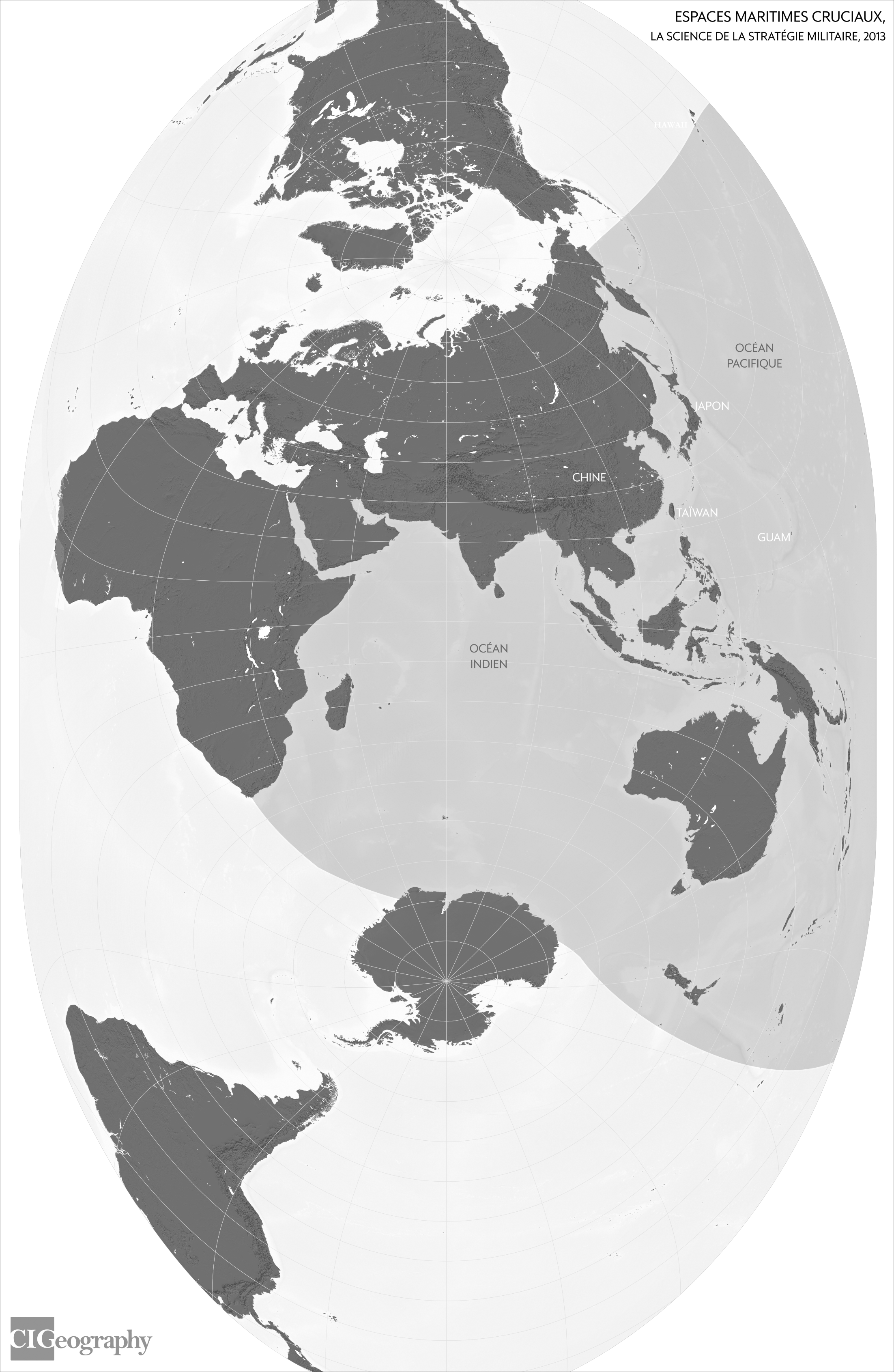
China’s strategic space according to the doctrinal work *The Science of Military Strategy* (2013).
Map by Louis Martin-Vézian, CIGeography, 2024
Map by Louis Martin-Vézian, CIGeography, 2024
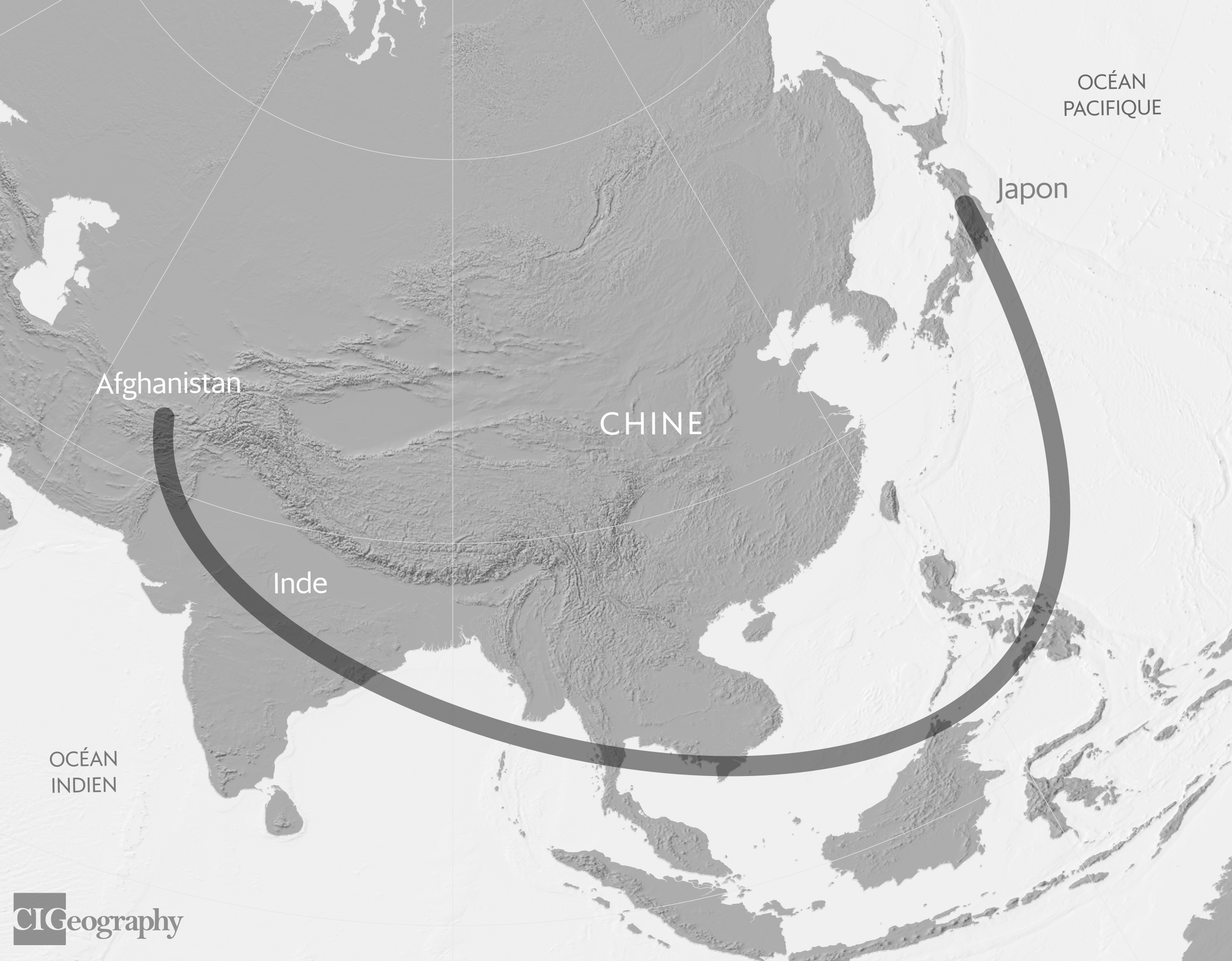
Geographic representation of the “C-shaped encirclement.” Map by Louis Martin-Vézian, CIGeography, 2024
Geopolitical principles also serve as a framework for interpreting the logic behind U.S.
grand strategy, from the first Cold War against the USSR to the second, which, according to Chinese experts, was already taking shape against Beijing following the Soviet collapse.
This deterministic framework, which infers a desire on the part of the United States to contain any rival power as soon as it emerges in Eurasia, leads to the interpretation of any action coming from the West as hostile and leaves little room for conciliation or accommodation — resulting in a security dilemma that gestures of reassurance or appeasement can hardly resolve.
This geopolitical perspective also shapes a conception of space that is both expansive and contested.
Expansion and contraction play out across a multidimensional terrain—land, sea, air, outer space, and cyberspace; tangible and intangible.
Expansion beyond national borders is presented as the natural result of the state’s growing power, just as it is seen as necessary for its survival and sustainable prosperity.
Consequently, space becomes a site of confrontation, as expansion must occur at the expense of territories under foreign sovereign jurisdiction or within de facto undivided global spaces dominated by advanced nations that deny the same privileges to “lagging countries.” 4
From this interplay between expansionist desire and external constraints arises the definition of Chinese strategic space (战略空间 zhanlüe kongjian), justified both for defensive reasons—the formation of a strategic depth zone enabling resistance to potential external aggression—and offensive reasons—the establishment of a sphere of influence beyond national borders to ensure the state’s survival.
The Imaginary Pincer Movement: The Fear of Encirclement as a Strategic Framework
At a time when Hu Jintao was describing China as an emerging power and promoting the vision of a harmonious world, his advisors were watching with concern a number of developments that they attributed to the United States’ desire to constrain the strategic space of its rivals.
The color revolutions in Georgia (November 2003), Ukraine (November 2004), and Kyrgyzstan (March 2005), the accession of seven former Warsaw Pact signatories to NATO (March 2004), and the decision at the Istanbul Summit to strengthen the Atlantic Alliance’s presence in Afghanistan, were, in their view, part of the same logic of ideological and military encirclement aimed at containing Russia’s western and southeastern flanks.
China’s strategic space, a collateral victim of these maneuvers given its geographical proximity to Russia, was, they believed, also the primary target.
From their perspective, while Western powers were striving to transform the Chinese political system through their “peaceful evolution” strategy, they were also methodically building a military encirclement in the shape of an inverted C, with Guam at its epicenter.
The “pivot to Asia” policy adopted by the Obama administration in 2011, or the vision of a “free and open” Indo-Pacific region championed by the Trump and Biden administrations since 2017, were merely the most recent demonstrations of the U.S.
determination—already affirmed in the 2001 Quadrennial Defense Review—to prevent any strategic competitor from gaining a foothold on the Eurasian continent.

The fantasy of encirclement, depicted as the U.S.
“pincer movement” around China.
Map by Louis Martin-Vézian, CIGeography, 2024
“pincer movement” around China.
Map by Louis Martin-Vézian, CIGeography, 2024
The fortress complex and the portrayal of a Chinese strategic space under pressure on multiple fronts go hand in hand with an attempt to develop a framework for expansion justified by the need to break through enemy encirclement and define a strategic direction for the country in line with its material capabilities and national interests.
Mapping the Chinese strategic space reveals that contemporary China has never truly conceived of itself as a regional power, NADÈGE ROLLAND
The Heart Grows in the Peripheries: A Conceptual Grammar of Expansion
Developed over the decade mentioned above, three key concepts that are now part of this new grammar of expansion were eventually incorporated into the official canon beginning in 2013.
Developed over the decade mentioned above, three key concepts that are now part of this new grammar of expansion were eventually incorporated into the official canon beginning in 2013.
They are essential to understanding China’s grand strategy.
The first is that of “new strategic frontiers” (战略新疆域 zhanlüe xin jiangyu), which includes the polar regions, outer space, and the seabed.
As terra nullius untouched by human presence, these new frontiers are seen as offering China the opportunity to shape the governance rules governing them, thereby perhaps achieving a form of symbolic claim to these uninhabitable territories.
The first is that of “new strategic frontiers” (战略新疆域 zhanlüe xin jiangyu), which includes the polar regions, outer space, and the seabed.
As terra nullius untouched by human presence, these new frontiers are seen as offering China the opportunity to shape the governance rules governing them, thereby perhaps achieving a form of symbolic claim to these uninhabitable territories.
The second confirms key strategic directions: maritime expansion into the South Pacific and the Indian Ocean; the “Western Advance” (西进 xijin), which envisions continental expansion toward Central and South Asia and beyond, toward the Middle East (“Western Asia” in Chinese); and finally, the development of an outer belt encompassing Latin America, Africa, and Europe, in order to break through the U.S. encirclement focused on the Indo-Pacific.
Finally, the third strategy centers on the concept of the “periphery” (周边 zhoubian), which introduces the idea of “distant neighbors”—that is, countries connected to China not by a shared border, but through their economic, security, and cultural/ideological ties with it.
The “minor” periphery comprises the four subregions in which China’s neighbors are located (Northeast, Southeast, South, and Central Asia), while the “major” periphery includes the regions connected to each end of the minor periphery (the Middle East and Africa, as well as the South Pacific).
China is, of course, the center of this “periphery,” which is visualized as a series of concentric circles.

From the Core to the Periphery: The Concentric Circles of China’s Strategic Space.
Maps by Louis Martin-Vézian, CIGeography, 2024
While the concept of the periphery was officially adopted by Chinese diplomacy as early as October 2013, the cardinal directions of China’s strategic space are reflected in the rollout of the so-called “New Silk Roads” initiative launched by Xi Jinping in the fall of 2013, which takes shape along two major axes—one maritime, the other continental—and encompasses all the countries of the so-called “Global South.”
How Xi Jinping Has Reinvigorated the Geostrategic Arena
Over the course of a decade, the geopolitical framework—initially purely theoretical—has given rise to the development of a geostrategy applied on a global scale.
Mapping China’s strategic space reveals that modern China has never truly viewed itself as a regional power, but instead developed a global vision at a very early stage, driven both by its expansionist ambitions and its fear of encirclement.
The sketching of this mental map with gigantic contours coincided with a period of meteoric rise for the country.
As China’s economic growth is now slowing, some Chinese strategic thinkers are now warning against the possibility of excessive expansion that would strain China’s capabilities and resources disproportionately.
The sketching of this mental map with gigantic contours coincided with a period of meteoric rise for the country.
As China’s economic growth is now slowing, some Chinese strategic thinkers are now warning against the possibility of excessive expansion that would strain China’s capabilities and resources disproportionately.
This call for caution, however, does not seem to have been heeded by the General Secretary of the CCP, who continues to present the great rejuvenation of the Chinese nation as his primary goal by 2049 and to view the world as undergoing “upheavals the likes of which we have not seen in a century”—an official formulation that implies a shift in the global balance of power in China’s favor.
How, in this context, can China fulfill its “manifest destiny,” at a time when, according to Xi Jinping, “Western countries, led by the United States, have launched a campaign of absolute containment, encirclement, and suppression against our country, posing serious and unprecedented challenges to our development”? A reduction of the boundaries of the mental map of China’s strategic space to the “minor periphery” does not appear to be on the agenda, given the Chinese government’s launch of four “global initiatives” (security, development, civilization, and governance).
What is more likely to emerge is the maintenance of a global vision—now underpinned not only by the primacy of economic or military power but also by the development of political and ideological influence and a reshaping of international rules and norms aligned with the preferences of the Chinese leadership.
The intangible space would then become the true new frontier to be conquered in order to ensure the survival of the state and the preservation of China’s strategic space.
How, in this context, can China fulfill its “manifest destiny,” at a time when, according to Xi Jinping, “Western countries, led by the United States, have launched a campaign of absolute containment, encirclement, and suppression against our country, posing serious and unprecedented challenges to our development”? A reduction of the boundaries of the mental map of China’s strategic space to the “minor periphery” does not appear to be on the agenda, given the Chinese government’s launch of four “global initiatives” (security, development, civilization, and governance).
What is more likely to emerge is the maintenance of a global vision—now underpinned not only by the primacy of economic or military power but also by the development of political and ideological influence and a reshaping of international rules and norms aligned with the preferences of the Chinese leadership.
The intangible space would then become the true new frontier to be conquered in order to ensure the survival of the state and the preservation of China’s strategic space.
Sources :
- Emmanuel Dubois de Prisque, “Cartography in China: From the ‘Chinese Dream’ to Geopolitical Reality,” Outre Terre 38(1), 2014.
- William A. Callahan, “The Cartography of National Humiliation and the Emergence of China’s Geobody,” Public Culture 21(1), 2009.
- Christopher Hughes, “Reclassifying Chinese Nationalism: The Geopolitik Turn,” Journal of Contemporary China 20(71), 2011.
- Shou Xiaosong (ed.), Science of Military Strategy, Beijing, Military Science Press, 2013, p. 244.

No comments:
Post a Comment