Saturday, August 1, 2026

Friday, July 31, 2026
New Zealand’s ‘rocket man’ takes on Elon Musk and Jeff Bezos

Peter Beck founded Rocket Lab in 2006 with the goal of launching lightweight rockets more cheaply © Rocket Lab
From FT by Nic Fildes in Auckland
Peter Beck’s Rocket Lab builds out internet satellite business to rival Starlink and Amazon Leo
After successfully launching New Zealand’s first rocket into space, billionaire Sir Peter Beck is setting his sights on taking on Elon Musk and Jeff Bezos in the internet satellite business.
Last month, the Rocket Lab founder signed the biggest cheque of his life, agreeing to pay $8bn for US-listed satellite communications provider Iridium.
The deal adds a valuable network and spectrum — often called the “lifeblood of the mobile industry” — to the New Zealand-founded business, which makes and launches rockets and other space components.
“It’s a big swing for Rocket Lab to go and buy something like that, but at the end of the day it’s a positive cash-generating business that’s well established,” Beck told the FT.

A test of Rocket Lab’s Archimedes vacuum engine © Rocket Lab
It made its first successful launch in 2009, and by 2017 its orbital Electron rockets had emerged as a competitor to SpaceX’s Falcon 9 for satellite launches.
“When you compare us to Jeff and Elon, we are definitely the plucky upstart,” said Beck.
“You don’t hear me talking about mining asteroids orbiting Mars,” referring to Musk’s vision for space mining.
The Iridium deal fulfils Beck’s long-held ambition to expand into satellite services.
The Iridium deal fulfils Beck’s long-held ambition to expand into satellite services.
It also puts Rocket Lab into further competition with Musk and Bezos, who have expanded their Starlink and Amazon Leo satellite networks.
SpaceX bought EchoStar’s spectrum for $17bn last year and Amazon acquired Globalstar for $11.6bn in April.
By purchasing Iridium’s network and spectrum over building their own, “we’ve short-cut that by 10 to 20 years”, said Beck.
By purchasing Iridium’s network and spectrum over building their own, “we’ve short-cut that by 10 to 20 years”, said Beck.
He added that Iridium would benefit from Rocket Lab’s launch infrastructure to reduce the cost and risk of launching a new constellation in the future.
“Whoever has the rocket has the keys to space,” he said.
“Whoever has the rocket has the keys to space,” he said.

The acquisition of Iridium gives Rocket Lab a valuable satellite network © Justin Ide/Bloomberg
Beck’s sale of 5mn shares for $465mn has added to the pressure.
The chief executive said Iridium, which unlike Rocket Lab is already profitable, would add a strong customer base and “an incredibly defensible high-value niche” in areas such as maritime communications. Beck said Rocket Lab would look to expand those services.
Luke Pearce, an analyst at CCS Insight, said the acquisition would accelerate competition in the booming sector for low Earth orbit (LEO) satellite services. “This creates another credible LEO competitor alongside players such as SpaceX, Amazon Leo and AST SpaceMobile,” he said.
Rocket Lab has been an extraordinary success story for Beck and for New Zealand.
A far-flung sheep farm on the thinly populated east coast of the North Island is now a hotspot for rocket launches.
The country ranks third for the number of rockets launched, behind the US and China, as its remote location has proved ideal for firing projectiles into space without disrupting aviation and maritime traffic.
The country ranks third for the number of rockets launched, behind the US and China, as its remote location has proved ideal for firing projectiles into space without disrupting aviation and maritime traffic.
 Rocket Lab conducts most of its launches from a remote site in New Zealand’s Māhia Peninsula © Rocket Lab
In the three months to March, the company reported revenue of $200mn, up more than 60 per cent from a year earlier, and narrowed its net loss to $45mn from $60mn.
Valued at $40bn, Rocket Lab is by far the largest company to emerge from “the land of the long white cloud”, which has historically produced national champions from its dairy and white-goods sectors. Despite the recent fall, its shares are up nearly 600 per cent since its 2021 Nasdaq offering.
The listing minted more than 100 millionaires in New Zealand. Former employees have gone on to found some of the country’s most promising start-ups including ag-tech company Halter, automotive supply chain group Partly and local rival Dawn Aerospace.
Rocket Lab relocated its headquarters to California in 2013 and has become a key supplier to the US defence department, but it still launches most of its rockets from a remote site in the North Island’s Māhia Peninsula.
Its large manufacturing facility east of Auckland sits at the base of a sedate cul-de-sac where pūkeko swamp hens peck at the lawns. Inside the factory, 1,000 people assemble rockets under giant New Zealand and American flags.
 Rocket Lab relocated its headquarters to California in 2013 and has become a key US defence supplier © Rocket Lab
Beck credits his father for igniting his aerospace passion during his youth in Invercargill, on the tip of New Zealand’s South Island.
The engineer recalled how his father would point at the stars and say: “There could be someone standing there looking back at you.”
“That for me was bigger than anything in my brain,” Beck said, and gave him a “soft spot for the planetary stuff”.
Rocket Lab’s previous acquisitions include companies that supply wheels, cameras, robotics and other essential components used for missions to Mars, Venus and the Moon.
Iridium represents a new frontier for the company.
“You definitely make your own luck, but it was fortunate that all of those stars aligned,” Beck said of the deal.
“You definitely make your own luck, but it was fortunate that all of those stars aligned,” Beck said of the deal.
Links :
- PR Newswire : Iridium and SKYWAVE™, an ORBCOMM® company, Partner to Advance Global Industrial IoT for Heavy Equipment OEMs
- Mobile world : Iridium brings LEO to Skywave fleet management
- GlobeNewsWire : Rocket Lab to Acquire Iridium in Historic Deal, Creating A Fully Vertically Integrated Space Powerhouse Primed for Growth (YouTube)
Thursday, July 30, 2026

How tanker data revealed a $13 billion question about Venezuelan oil revenues
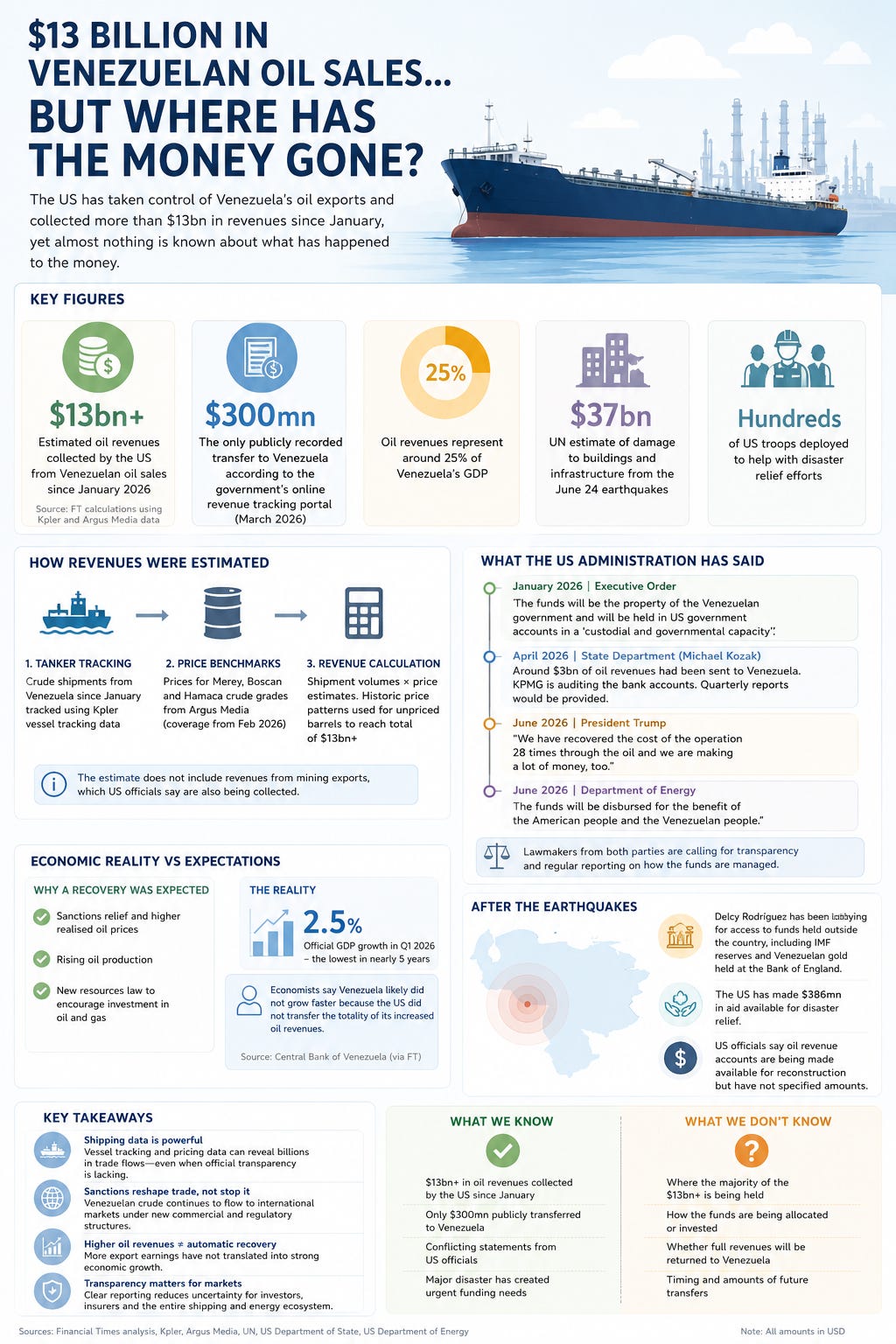
From The Shipping Brief
A recent Financial Times analysis estimated that the US administration has collected more than $13 billion in revenues from Venezuelan crude exports since January 2026.
Rather than relying on official financial disclosures, the analysis combined Kpler's tanker-tracking data with Argus Media's crude price assessments to estimate the value of exported cargoes.
Beyond the political implications, the article demonstrates how shipping data is increasingly being used to quantify commodity flows and estimate financial outcomes where official reporting is limited.
Beyond the political implications, the article demonstrates how shipping data is increasingly being used to quantify commodity flows and estimate financial outcomes where official reporting is limited.
The key figures
Several figures stand out from the analysis:
- More than $13 billion in estimated oil revenues generated from Venezuelan crude exports since January 2026.
- Approximately $300 million publicly recorded as transferred back to Venezuela through the government's online tracking portal.
- Oil accounts for around 25% of Venezuela's GDP, making export revenues a major contributor to the country's economy.
- Following the June earthquakes, the United Nations estimates reconstruction costs of approximately $37 billion, increasing the importance of access to these revenues.
Shipping data as a source of financial intelligence
One of the more interesting aspects of the Financial Times investigation is its methodology.
The revenue estimates were derived by combining tanker movements tracked by Kpler with price assessments from Argus Media for Venezuela's principal crude grades, including Merey, Boscan and Hamaca.
This approach illustrates how maritime data has become an increasingly valuable analytical tool.
Vessel movements provide visibility into export volumes, while commodity price assessments allow analysts to estimate the value of those exports with a reasonable degree of confidence.
As a result, shipping data is now used well beyond operational and logistics purposes. Investors, commodity traders, policymakers, sanctions specialists and journalists increasingly rely on vessel-tracking data to monitor trade flows and assess market developments.
As a result, shipping data is now used well beyond operational and logistics purposes. Investors, commodity traders, policymakers, sanctions specialists and journalists increasingly rely on vessel-tracking data to monitor trade flows and assess market developments.
This is Venezuela.
— Fabulero (@todorumba) July 29, 2026
Out in open waters -Bajo Barcelona- where ships anchor before coming in to load crude oil at the Eastern Cryogenic Complex (José)
There are 27 cargo ships visible to the naked eye!
Where is all that oil going? Where is all the money from those sales? pic.twitter.com/kd7aZe1UEI
The transparency gap
The article also highlights differing public statements regarding the management of Venezuelan oil revenues.
The January Executive Order described the United States as acting in a "custodial" capacity for the revenues.
The Department of Energy subsequently stated that the funds would benefit both Americans and Venezuelans.
President Trump later said the United States had recovered the costs of the operation "28 times" and was "making a lot of money" from Venezuelan oil.
At the same time, lawmakers from both Republican and Democratic parties have called for greater public reporting on how these revenues are being managed.
The differing statements, combined with limited public disclosure, have led to increased scrutiny of the administration of these funds.
Venezuela's economic performance
The article also considers the apparent disconnect between improving conditions in the oil sector and broader economic performance.
Despite:
- higher realised oil prices following sanctions relief;
- increasing oil production; and
- legislation intended to encourage foreign investment,
Economists cited by the Financial Times suggest that one possible explanation is that not all export proceeds have entered the Venezuelan economy.
While this is presented as one potential factor rather than a definitive conclusion, it offers a possible explanation for why stronger oil sector performance has not translated into faster economic growth.
A broader takeaway
The article provides another example of how maritime data is reshaping market transparency.
Where official reporting is incomplete or delayed, vessel-tracking data can provide an independent means of estimating export volumes and, when combined with pricing data, the value of commodity flows.
For those involved in shipping, energy or commodity markets, this reinforces the growing role of maritime intelligence.
Shipping data is no longer used solely to monitor vessels and cargoes; it has become an important source of insight into trade flows, commodity markets and the economic consequences of geopolitical events.
Links :
Wednesday, July 29, 2026
France had never seen a ‘fire cloud’ until this month’s record-smashing blazes

Photograph: Maximilien Lamy/Getty Images
From Wired by Brian Kahn
Firefighters in France are confronting a phenomenon never seen in the region before: fire clouds.
It’s a sign of the intensity of the blazes burning—and how climate change is upping the odds that they appear.
A wave of fires has swept over France and Spain, sending hundreds of thousands fleeing.
A wave of fires has swept over France and Spain, sending hundreds of thousands fleeing.
Firefighters on the front lines are facing what a spokesperson for the French firefighter association told AFP said was an “operational impossibility”—in other words, a “natural force beyond our control.”
As evidence of how out of control the wildfires in France are, look no further than the skies where the blazes have, in some cases, created their own weather.
As evidence of how out of control the wildfires in France are, look no further than the skies where the blazes have, in some cases, created their own weather.
To form a fire cloud—what meteorologists call a pyrocumulonimbus or the even more metal-sounding cumulonimbus flammagenitus—you first need heat, which fires have in spades.

image : Romain Perrocheau / AFP / Getty Images
But just as important are dry conditions near the ground and cool, relatively moist conditions aloft in the atmosphere.
As superheated smoke rises miles above the flames and into the cool atmosphere, water vapor condenses around the particles of ash to form water droplets.
(Yes water vapor and water droplets are two different things.) As the air keeps rising, those water droplets eventually become ice crystals.
At this point, the smoke and water droplets have created a cloud, but unfortunately one that’s unlikely to provide much relief in the form of rain.
At this point, the smoke and water droplets have created a cloud, but unfortunately one that’s unlikely to provide much relief in the form of rain.
Instead, these towering fire clouds can unleash lightning strikes that start more fires and generate powerful downdrafts that reach the ground to fan flames further.
At their worst, pyrocumulonimbus clouds can even spawn tornadoes.

Pyrocumulonimbus clouds have been documented in the US, Canada, and Australia, among a handful of other locations.
Pyrocumulonimbus clouds have been documented in the US, Canada, and Australia, among a handful of other locations.

But until now, there were no documented fire clouds in France.
While the country is no stranger to wildfires, the size and ferocity of this summer’s blazes is well outside the normal.
Last week was France’s single most destructive week for wildfires over the past 20 years, according to data from the European Forest Fire Information System.
Last week was France’s single most destructive week for wildfires over the past 20 years, according to data from the European Forest Fire Information System.
It more than doubled the previous record during that period, which coincides with accurate satellite data.
This isn’t an isolated bad week either. More than 220,000 acres have burned across the country so far, six times the annual average.
That’s 61,000 acres higher than the previous yearly record.

photo Stephan Rahmstorf
If that sounds like a familiar trend, well, it unfortunately is.
Burning fossil fuels has heated the planet up, making explosive wildfires more common and destructive around the world.
A 2024 study found the incidence of extreme fires globally more than doubled from 2003 to 2023.
Six of the seven most extreme years have happened since 2016.

photo : Patrice Gaulupeau
After a slight weekend reprieve as temperatures dipped, they’re expected to rocket back up above 104 degrees Fahrenheit (40 degrees Celsius) in France and 108 degrees Fahrenheit in Spain later this week.
That means firefighters will have to contend with more extreme fire weather—including the possibility of clouds created by the blazes themselves.
Links :
Subscribe to:
Posts (Atom)