A team of NYU scientists has captured on video a four-mile iceberg breaking away from a glacier in eastern Greenland.
This phenomenon, known as "calving", is a force behind the rise of global sea water levels.
“Global sea-level rise is both undeniable and consequential,” observes David Holland, a professor at NYU’s Courant Institute of Mathematics and NYU Abu Dhabi, who led the research team.
“By capturing how it unfolds, we can see, first-hand, its breath-taking significance.”
Holland’s research team has studied the waters off the coast of Greenland for more than a decade by measuring subtle changes in water temperature and wave formation.
Video Credit: Denise Holland, Logistics Coordinator/NYU’s Environmental Fluid Dynamics Laboratory (Video shot June 22, 2018- Real time length: 30 minutes)
Helheim glacier DGA nautical chart with the GeoGarage platform
ESA’s Aeolus mission scientist, Anne Grete Straume explains how winds are generated, how they affect our weather, and how Aeolus will measure the wind and how this information will be used to improve weather forecasts and climate models.
A new analysis of how air moves between two layers of Earth’s atmosphere reveals a deep system that could enable long-term weather forecasts and better climate models.
If you can predict the path of the jet stream, the upper atmosphere’s undulating river of wind, then you can predict weather – not just for a week or two, but for an entire season.
A new Stanford study moves toward that level of foresight by revealing a physical link between the speed and location of the jet stream and the strength of the polar vortex, a swirl of air that usually hovers over the Arctic.
“The jet stream sets everything,” said Aditi Sheshadri, lead author and assistant professor of Earth System Science in the School of Earth, Energy, & Environmental Sciences (Stanford Earth).
“Storms ride along it.
They interact with it.
If the jet stream shifts, the place where the storms are strongest will also shift.”
The research, published in the Journal of Atmospheric Sciences, identifies two distinct modes in how air flows within the jet stream and the layers of atmosphere that sandwich it.
Alex (IK MetOffice) explains the Polar Vortex.
The atmosphere’s deep system
In one mode, changes in wind speed and direction start close to the equator in the troposphere, the wet, stormy layer of atmosphere below the jet stream and closest to Earth’s surface.
Shifts of wind in this mode quickly propagate up through the jet stream and into the polar vortex in the dry, upper layer of atmosphere known as the stratosphere.
In the other mode, the strength of the stratosphere’s polar vortex influences the path and strength of the jet stream – and how it interacts with storms in the troposphere.
In this mode, the polar vortex sends a signal all the way down to the surface like a pulse.
A weaker vortex produces a weak jet stream that slips toward the equator; a stronger vortex intensifies the jet stream while drawing it poleward.
“These deep vertical structures haven’t been shown before,” Sheshadri said.
“It’s something fundamental about the system itself.” Her analysis could help explain the surface weather impacts of an event that occurred in early 2018, when the vortex weakened so much that it ripped in two – a phenomenon that scientists know can blast up to two months of extreme weather into western Europe.
Until now, understanding of these interactions has been based on observations and statistical modeling rather than knowledge of their physical foundation.
These modes could be key to predicting the long-term effects of certain environmental changes on Earth’s surface.
While air is thought to flow relatively independently within the troposphere and stratosphere in normal winters, depleted ozone, high levels of greenhouse gases, ocean warming, reduced snow cover, and other disturbances can rattle this independence, affecting both the vortex and jet stream in complex ways.
Greenhouse gas emissions, for example, can strengthen the vortex while simultaneously boosting waves that propagate up from the troposphere and weaken the vortex as they break.
“We don’t know which of these two effects of increasing greenhouse gases will win out,” Sheshadri said.
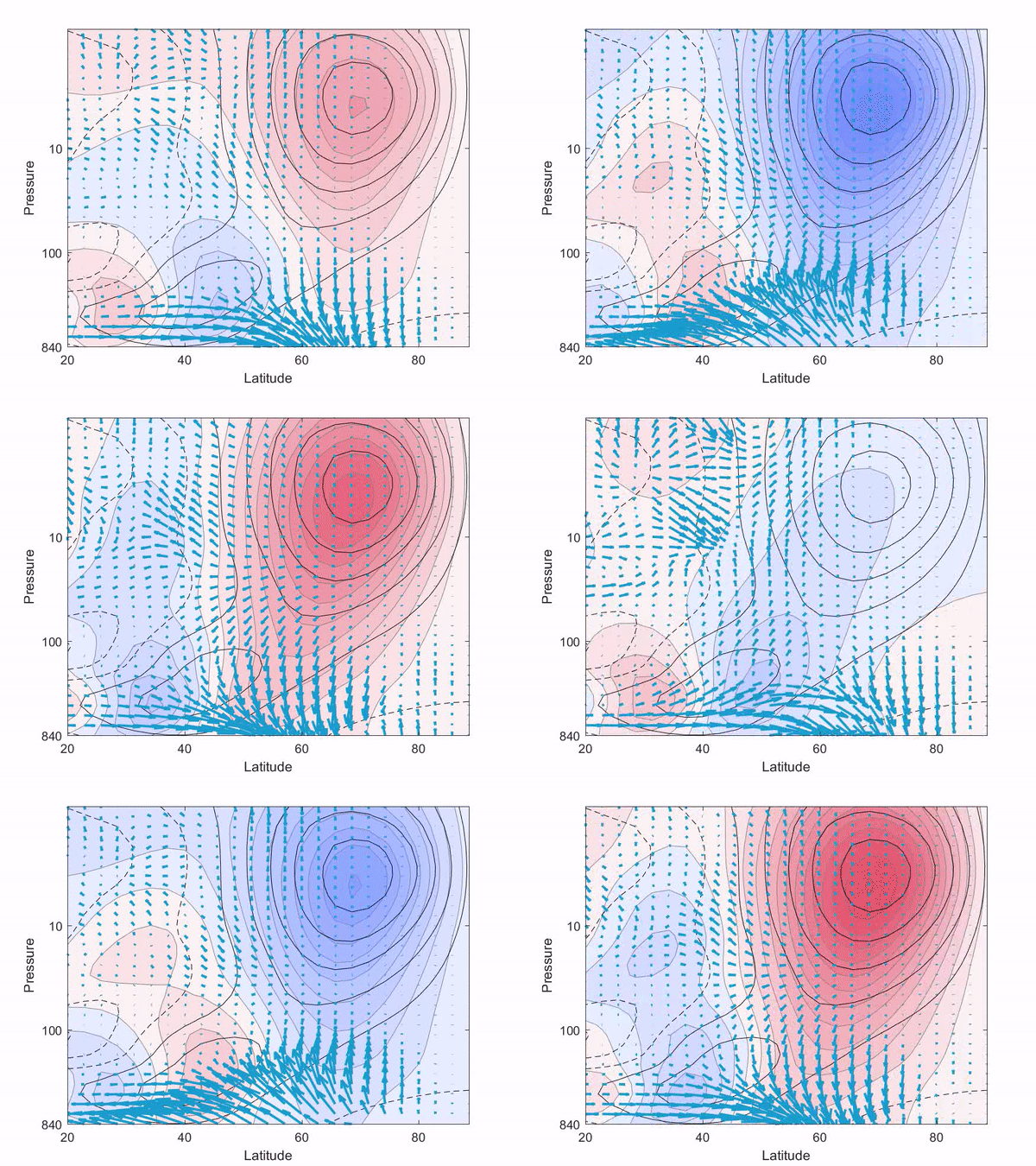
Changes in wind speed and direction that start in the troposphere close to the equator quickly propagate up toward the stratosphere and poles.
(Image credit: Aditi Sheshadri)
Building better climate models
To help find answers, Sheshadri’s team set out to understand the climate as a system that responds in a predictable way to known forces, despite internal dynamics that are a mix of random and systematic fluctuations.
They took a mathematical theorem used for nearly a century to predict seemingly random behavior in quantum mechanical systems and applied it to data representing Earth’s atmosphere in wintertime.
“We have 35 years of wind data,” Sheshadri said.
“Can we say something just from those observations about how the winds will change if, for instance, you increase carbon dioxide? That’s what got this whole thing started.”
Current climate models excel at showing temperature changes throughout the atmosphere’s layers over time and with varying levels of substances like ozone or carbon dioxide.
“We’re pretty certain about how the temperature structure of the atmosphere is going to change,” Sheshadri said.
“However, if you look at changes in things like wind or rain or snow – anything that’s a dynamical quantity – we really have very little idea of what’s going on.”
And yet, these are some of the most vivid metrics for a changing climate.
“No one feels the global mean temperature,” Sheshadri said.
“How many times over the next 10 years are we going to have to deal with floods or cold snaps in a particular region? That’s the sort of question this might help answer.”
By revealing the physical processes that underpin some of these dynamic variables, the method developed in this study could also help weed out flaws in climate models.
“The way that we currently do this is that you take a model and you run it forward,” checking the model’s predictions against observed data, Sheshadri explained.
But many models built upon the same historic data produce different predictions for the future, in part because they make different assumptions about how the troposphere and stratosphere interact and how the jet stream fluctuates.
Until now there has not been a way to check those assumptions against the atmosphere’s actual variability.
“We need to be sure the models are right, and for the right reasons,” Sheshadri said.
The new work provides a way to resolve that uncertainty – and to anticipate storms months into the future.
Global fish production is at record levels thanks to fish farming, says the UN FAO, but much is wasted and many species are worryingly overfished
One in three fish caught around the world never makes it to the plate, either being thrown back overboard or rotting before it can be eaten, according to the UN Food and Agriculture Organization.
Its biannual report on the state of the world’s fisheries, released on Monday, also shows that total fish production has reached a record high thanks to more fish farming, particularly in China, with over half the fish eaten in the world now coming from aquaculture.
In contrast, the amount of wild caught fish has barely changed since the late 1980s and a third of commercial fish species are overfished, the FAO says.
Fish farms will continue to expand and the FAO projects that almost 20% more fish will be eaten by 2030, helping sustain the growing global population.
However, farmed fish can harm wild populations because often their feed, made from wild fish such as sardines and anchovies, is caught at sea and they can cause pollution.
Fish are a crucial source of nutrition for billions of people around the globe, but overfishing is rife in some regions, with two-thirds of species overexploited in the Mediterranean and Black Seas and the Southeast Pacific.
Previous analyses that include estimates for illegal fishing indicate that wild fish stocks are declining faster than FAO data suggest and that half the world’s oceans are now industrially fished.
Guardian Graphic | Source: Food and Agriculture Organisation of the UN
“Since 1961 the annual global growth in fish consumption has been twice as high as population growth, demonstrating that the fisheries sector is crucial in meeting the FAO’s goal of a world without hunger and malnutrition,” said José Graziano da Silva, FAO director general.
Many challenges remain, he said, but recent initiatives to crack down on illegal fishing will mark “a turning point” in favour of long-term conservation.
The FAO reports that 35% of global catches are wasted.
About a quarter of these losses are bycatch or discards, mostly from trawlers, where unwanted fish are thrown back dead because they are too small or an unwanted species.
But most of the losses are due to a lack of knowledge or equipment, such as refrigeration or ice-makers, needed to keep fish fresh.
The FAO has worked with developing nations to cut losses, including the use of raised racks for fish drying, which resulted in a 50% cut in losses of fish from Lake Tanganyika in Africa.
Around the Indian Ocean, better facilities for handling the crab harvest cut losses by 40%.
Aquaculture now dominates the fish people eat, providing 53% of the total recorded by the FAO in 2016, the latest data available (excluding fish not used as human food).
Farming also dominates the fishing economy, providing two-thirds of the $362bn (£274bn) earned from sales at the dockside.
The FAO report sets out the huge scale of global fishing: it employs 60 million people and there are 4.6m fishing vessels on the planet.
This huge effort is worrying in many places, the FAO says, with too many boats chasing too few fish.
As a result, the number of species being overfished has trebled in the last 40 years.
The report also states that climate change will drive fish away from warm tropical waters, where nations are often especially reliant on seafood, towards more temperate regions.
A third of the world's fish stocks were overfished in 2015 Global trends in the state of the world's marine fish stocks, percentage
Guardian Graphic | Source: Food and Agriculture Organisation of the UN
Lasse Gustavsson, executive director of Oceana in Europe, said huge improvements were needed across the fishing industry. “Food waste on a hungry planet is outrageous,” he said.
“The fact that one-third of all fish caught goes to waste is a huge cause for concern for global food security."
On overfishing, particularly in the Mediterranean, he said: “We know the situation, we have the solutions: setting fish catch limits to scientific advice and stopping illegal and destructive fishing. All we’re missing is political action.”
Mediterranean overfishing and efforts to overcome the problem
Gustavsson added: “Aquaculture is far from being the magic bullet, as it is often unsustainable. Using 20m tonnes of fish like mackerel, sardines and anchovies to feed farmed fish instead of people is a blatant waste of food.”
Prof Daniel Pauly, at the Sea Around Us research initiative at the University of British Columbia, Canada, has been very critical of previous FAO reports, which he says significantly underestimated the total catch by failing to account for illegal fishing.
But he welcomed the new report for considering a much wider range of information: “The crisis of [overfishing] will be hard to solve. However, collaborations between different stakeholders may help turn around some of the negative trends. This is the best issue of [the FAO fisheries report] that I have ever read.”
 Helheim glacier DGA nautical chart with the GeoGarage platform
 Helheim glacier observed by NASA