This clip is a sequence from the MacGillivray Freeman classic "Adventures in Wild California"
Saturday, September 29, 2012
Friday, September 28, 2012
Genetically modified pet fish worries Florida environmentalists
GloFish's Electric Green Tetra may or may not have an unfair advantage in the wild.
From WP
Since Yorktown Technologies first sold its genetically modified pet — the GloFish — in 2003, the fluorescent fish, an altered variety of zebra fish, has become a popular aquarium item, with millions sold in various neon hues.
In February, Yorktown introduced the Electric Green Tetra, a genetically modified black tetra fish. Like its zebra fish cousin, the GM tetra is a small freshwater fish that includes genetic material from a fluorescent coral that makes it neon-bright. Under a black light, it glows in the dark.
The two GloFish are very different, however, in what environmentalists and some experts say is a crucial way: The heat-loving zebra fish is from southern Asia and can’t survive long in cooler U.S. waters; thus, the Food and Drug Administration has ruled that there would be little threat of invasion of U.S. waterways if it were released from home aquariums.
But the black tetra is native to South America and likely to be happy making a splash in the inland waterways of South Florida and Latin America.
In South Florida, the modified black tetras could upset an environment already burdened with 30 types of nonnative fish.
In South America, they could mean an undesirable interference in natural biodiversity.
“My worry is that they’ll be such a novelty that they will be imported back to [South America] and kids will let them go and they’ll start interbreeding with fish whose genomes are very similar,’’ said Barry Chernoff, a freshwater fish biologist and chair of the environmental studies program at Wesleyan University in Middletown, Conn.
“We would see the spreading of the fluorescent coral gene in the native fish.’’
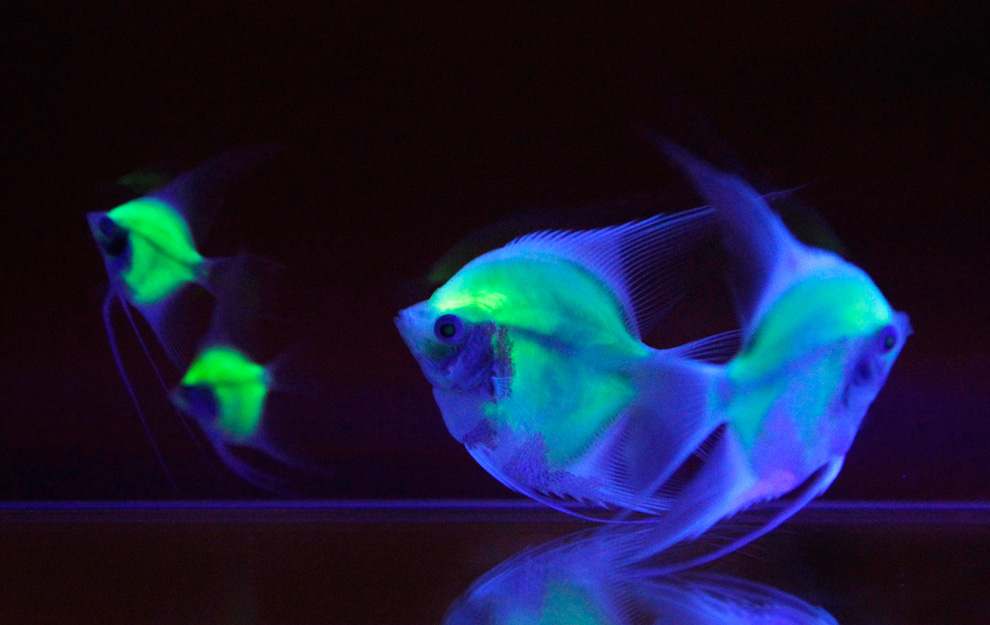
Genetically engineered angelfish (Pterophyllum) glow in a tank under a blacklight, at a fish farm in Pingtung, southern Taiwan on September 16, 2010.
The fish are the world's first fluorescent angelfish which were created by a joint project between Taiwan's Academia Sinica and Jy Lin, a private biotechnology company.
The breed is the largest fluorescent fish in the world which are able to mate and reproduce, said Yu-Ho Lin, Chairman of Jy Lin. The fish are expected to be sold at around $30 after certification. (REUTERS/Pichi Chuang)
Because pet fish are often let loose by owners who no longer want them, Chernoff and others say the threat is serious.
“The neotropical region contains the most diverse freshwater fish fauna and complex freshwater ecosystem in the world, with some 6,025 fish species so far recognized,’’ Gordon McGregor Reid, chair of the Wetlands International Freshwater Fish Specialist Group of the International Union for Conservation of Nature, said in an e-mail.
“We meddle with this at our peril.”
Yorktown’s chief executive, Alan Blake, said the company chose the black tetra to modify because it is nonaggressive and shows no tendency to be invasive.
“The black tetra has been sold for over 60 years and there has never been an ecological concern with it,’’ Blake said.
There have been reports of natural black tetras in Florida’s waters.
But Blake said there is no evidence that groups of them live there permanently; probably, he said, they are eaten by predators.
Blake pointed to research by Jeffrey Hill, who was part of the task force that reviewed Yorktown’s successful application to raise the GloFish tetra in Florida.
In a 2011 study, Hill found that largemouth bass and mosquito fish in Florida ate twice as many red GloFish as regular zebra fish when they were all put in tanks together.
“Florida is a predator-rich environment. [The GloFish] is considerably more vulnerable’’ than its non-modified counterparts, said Hill, a nonnative fish specialist at the University of Florida’s Tropical Aquaculture Laboratory.
That’ s not reassuring to environmentalists such as Chernoff.
“So their plan for not having these things take over the wild is predation by other species? Great,” he said.
Electric Green Tetra's swimming at night with blue LED.
Their DNA has been modified so they glo
An unfair advantage?
Breeding between escaped GloFish and native fish could weaken the progeny and negatively affect the native fish species in future generations, said Brian Zimmerman, aquarium curator at the Zoological Society of London.
The fluorescence in the GloFish may give them an unfair advantage or a disadvantage as they forage for food or in their roles as prey and predator, Zimmerman said.
The point is, nobody knows for sure. “GM fish have only been around for a few years, and I don’t think we know enough to say they are safe,” he said.
If GloFish tetras breed with wild black tetras, the fluorescent gene would be passed on for only a limited number of generations, said Eric Hallerman, a scientific adviser to Yorktown and chair of the Department of Fish and Wildlife Conservation at Virginia Tech in Blacksburg.
GloFish tetras reproduce at half the rate of regular black tetras, and the fry survive at 97 percent the rate of their natural peers, Hallerman said.
Furthermore, fluorescence takes energy and is a burden that makes the fish less fit, so it will be bred out, he said — eventually the trait “is going to disappear.’’
But some scientists disagree.
“There is no way of predicting any species’s fitness in the absence of environmental settings, because species do not behave as predicted by models,’’ Paulo Petry, a freshwater fish specialist in Latin America for the Nature Conservancy, said.
“I would opt for the precautionary principle and not allow the commercialization of these things in regions where there is even a remote chance of establishing a viable population,” he said.
GM fish are not allowed in Canada and much of Europe, and GloFish cannot be sold in California.
The FDA determined in 2003 that GloFish did not need to go through a full approval process, saying there was no evidence that the altered fish posed an increased risk to the environment and there was an absence of a clear risk to public health.
(Florida, which hosts a large ornamental fish industry, including the two fish farms that raise GloFish, requires approval before genetically modified fish can be raised there.)
“We think the feds should step in whether or not [GloFish] pose a threat. It shows the big holes in our regulatory system, in how we deal with genetically engineered animals,’’ said Eric Hoffman, food and technology campaigner at Friends of the Earth.
“If people look down into water and look at glowing fish, they might be pretty, but it’s a sign of genetic contamination and a type of pollution we don’t want,’’ Hoffman said.
Thursday, September 27, 2012
Protecting harbors and ships with a robotic tuna fish
The BIOSwimmer is an underwater robot designed in the shape of a robotic tuna fish for surveillance and patrols.
(Jane Baker, DHS S&T | Boston Engineering Corporation’s Advanced Systems Group)
From TechNewsDaily
Speedy tuna capable of swimming tirelessly in the Earth's oceans have inspired the U.S. Department of Homeland Security to fund a lookalike robot for underwater patrols.
The "BIOSwimmer" robot features faithfully replicated fins and a flexible tail to pull off quick maneuvers like the real-life fish.
Homeland Security made the choice to fund the robot made by the Boston Engineering Corporation in Waltham, Mass., with an eye toward missions such as exploring the flooded areas of ships, inspecting oil tankers or patrolling U.S. harbors to watch out for suspicious activity.
"It's called 'biomimetics,'" said David Taylor, program manager for the BIOSwimmer at the U.S. Department of Homeland Security.
"We're using nature as a basis for design and engineering a system that works exceedingly well."
Clips of tuna robotics project in Franklin W Olin College's Senior Capstone Program
in Engineering (SCOPE)
The robot, which is based on the tuna's sleek, flexible shape, would be able to squeeze into tight spaces such as the flooded bilges and tanks of ship interiors — not to mention fit in well with surrounding marine life.
Humans can control BIOSwimmer's activities through a laptop, but the unmanned underwater vehicle also carries its own computer for navigation, processing sensor data and communications with the home base.
BIOSwimmer represents just one of the new generation of robots that take their design inspiration from nature.
Animals such as flying cockroaches to slithering snakes have given rise to robotic imitators that try to harness nature's lessons for moving around during natural disasters or on battlefields.
Marine animals beyond tuna have much to teach human engineers.
Even squirmy starfish, worms and octopuses have inspired squishy, color-changing robots capable of both camouflage and squeezing into tight spaces.
Dive into the Great Barrier Reef with the first underwater imagery in Google Maps
From GoogleLatLon
Today we’re adding the very first underwater panoramic images to Google Maps, the next step in our quest to provide people with the most comprehensive, accurate and usable map of the world.
Links :
Today we’re adding the very first underwater panoramic images to Google Maps, the next step in our quest to provide people with the most comprehensive, accurate and usable map of the world.
With these vibrant and stunning photos you don’t have to be a scuba diver—or even know how to swim—to explore and experience six of the ocean’s most incredible living coral reefs.
Now, anyone can become the next virtual Jacques Cousteau and dive with sea turtles, fish and manta rays in Australia, the Philippines and Hawaii.
Starting today, you can use Google Maps to find a sea turtle swimming among a school of fish, follow a manta ray and experience the reef at sunset—just as I did on my first dive in the Great Barrier Reef last year.
You can also find out much more about this reef via the World Wonders Project, a website that brings modern and ancient world heritage sites online.
At Apo Island, a volcanic island and marine reserve in the Philippines, you can see an ancient boulder coral, which may be several hundred years old.
And in the middle of the Pacific, in Hawaii, you can join snorkelers in Oahu’s Hanauma Bay and drift over the vast coral reef at Maui's Molokini crater.
We’re partnering with The Catlin Seaview Survey, a major scientific study of the world’s reefs, to make these amazing images available to millions of people through the Street View feature of Google Maps.
The Catlin Seaview Survey used a specially designed underwater camera, the SVII, to capture these photos.
The Catlin Seaview Survey team on location on the Great Barrier Reef, encountering a manta ray (View Larger Map)
Whether you’re a marine biologist, an avid scuba diver or a landlocked landlubber, we encourage you to dive in and explore the ocean with Google Maps.
Check out our complete underwater collection, featuring a Google+ underwater Hangout from the Great Barrier Reef.
And you can always explore more imagery from around the world by visiting maps.google.com/help/maps/streetview/gallery.html#full_collection.
Explore more underwater images
- TheGuardian : Google Maps' virtual diving brings the Great Barrier Reef into view
- BBC : Google adds coral reef panoramas to Street View map
- TheTelegraph : Google offers virtual Great Barrier Reef tour
Wednesday, September 26, 2012
Mysterious underwater crop circles
From DiscoveryNews
A 39-year-old man quits his office job to pursue his dream as an underwater photographer.
He spends the next 30-odd years living la vida aqua, and then one day, he sees something quite remarkable: a circular pattern in the sand beneath the waves, a veritable work of art with valleys and ridges.
other picture (NHK)
But who or what could have made such a thing, so intricate, so far from shore, so ... well, underwater?
Amami-Ćshima (Japan)
The man, whose name is Yoji Ookata, shared the mystery marine art with friends and colleagues from the Japanese broadcaster NHK.
To their shock, they found that it is the work, not of a UFO, not of a hitherto undiscovered tribe of aquatic artisans, but a tiny puffer fish:
The unlikely artist – best known in Japan as a delicacy, albeit a potentially poisonous one – even takes small shells, cracks them, and lines the inner grooves of his sculpture as if decorating his piece.
Further observation revealed that this “mysterious circle” was not just there to make the ocean floor look pretty.
Tetraodontidae at work
Attracted by the grooves and ridges, female puffer fish would find their way along the dark seabed to the male puffer fish where they would mate and lay eggs in the center of the circle.
In fact, the scientists observed that the more ridges the circle contained, the more likely it was that the female would mate with the male.
The little sea shells weren’t just in vain either.
The observers believe that they serve as vital nutrients to the eggs as they hatch, and to the newborns.
I'll be honest.
When this story first started bouncing around the Twitterverse, I was skeptical:
Nobody had ever seen this behavior or these structures before?
Where is the video?
Who are the scientists?
Is there any kind of peer reviewed study being written?
Was this a hoax?
(I wasn't the only one to be dubious; although, inevitably some folks' skepticism had more to do with the this-has-nothing-to-do-with-UFOs explanation.)
My brother, who lives in Japan, checked the links in the original post and assured me that none of them said "Ha, you've been Rick Rolled" in Japanese.
I checked with a couple of researchers, who responded with the scientific equivalent of "WTF?" (in fact, one of them did actually type, "WTF").
But I haven't seen or heard anyone blow it up yet.
And if it is true - well, it would be fantastic and wonderful and impressive.
But then the natural world frequently astonishes and amazes, particularly when sex is involved.
As Jerry Coyne notes in his "Why Evolution Is Real" blog, "sexual selection is a marvelous thing."
It leads to behaviors like the singing of humpback whales, physical attributes like the plumage of birds-of-paradise; and the building of extraordinarily elaborate structures, like those constructed by the bower birds of Australia and New Guinea - and, it seems, by tiny fish off the coast of Japan.
Subscribe to:
Posts (Atom)