A fungus found on litter floating in the North Pacific Ocean can break down the most abundant type of plastic that ends up in the sea.
In lab experiments, Annika Vaksmaa at the Royal Netherlands Institute for Sea Research and her colleagues have shown that the white, thread-like fungus can successfully degrade one of the most pernicious plastics, polyethylene, providing the plastic has first been exposed to UV radiation, such as from sunlight.
UV radiation can induce chemical modifications in polyethylene that make the plastic more susceptible to attack by the fungal enzymes, says Vaksmaa.
The digestion process releases carbon dioxide, the emissions weight for weight are no greater than the small amount that humans release while breathing, the team found.
Vaksmaa believes that the fungus, known as Parengyodontium album, has great potential, but she is cautious about putting it to use in the wild.
“If we take a microbe and add it to a natural system, then we may ruin it while trying to do good,” she says. Instead, she suggests it may be best to gather the plastic first and bring it back to land to be digested by P. album that has been grown in bulk.
This could be achieved using well-established techniques, similar to those used in the brewing industry, she says.
The need for UV exposure means that P. album won’t work on plastic that sinks.
But given the diversity of marine fungi, Vaksmaa thinks it very probable that her team will find some deep-sea species that can do this.
“It’s great to see that microbes can help with mitigating relatively large problems. But dealing with it at its source is key, which means actually stopping plastic from ending up in nature in the first place,” she says.
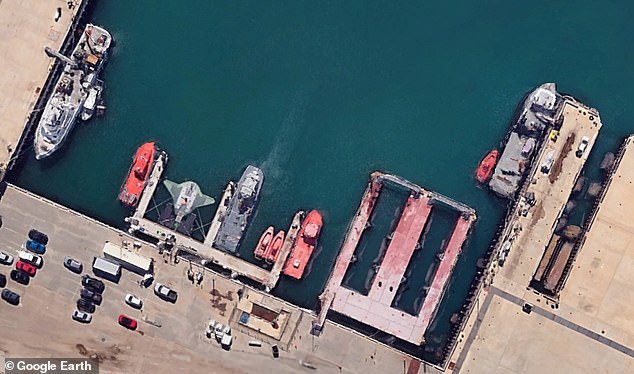
The satellite image currently remains visible to the public The vessel is docked at Port Hueneme naval base, California
A top-secret US submarine drone weapon dubbed the 'Manta Ray' has been spotted by hawk-eyed online users on Google Earth and remains visible to the public.
Vusialization with the GeoGarage platform (NOAA nautical raster chart)
Gmaps view of Manta ray UUV based in california, NS 34°9'13.304" W 119°12'31.185"
Satellite images showing the vessel docked at Port Hueneme naval base in California went viral on Sunday, before some social media users said the satellite images were removed, and replaced with what people believed were edited boats.
Someone managed to find the DARPA Manta Ray on google maps Coordinates 34°09'12"N 119°12'31"W pic.twitter.com/uMdDj2dMsO
As it stands, however, satellite images of the vessel can be seen on Google Earth.
The vessel - named after the sea creature due to its diamond-shaped body and wing-like fins - is used for underwater threat detection and was designed by Northrop Grumman Corporation.
The aerospace group's futuristic underwater drone is part of a US navy project to develop a new class of underwater drones which are capable of carrying out much longer missions.
The futuristic looking top-secret vessel is plainly visible on both Google Maps and Google Earth. Picture shows a satellite image of the 'Manta Ray'
The vessel is docked at Port Hueneme naval base in California
The unmanned, underwater craft, has been designed to move through the ocean without human supervision or the need to refuel, and it is also able to hibernate on the seabed in a 'low power mode'.
The ultimate goal is allowing soldiers to continue their mission on land without being interrupted to power, maintain and refuel an underwater machine.
Northrop Grumman also says that due to its modular design, it can be dismantled and transported in standard shipping containers for rapid deployment.
The military machine is the first in a new class of long duration, long range and payload-capable unmanned undersea vehicles, which carry out missions without the need of human interference.
Until recently, its pioneering design, which allows it to stay submerged for long periods of time, had been kept secret.
Pictured: The Manta Ray prototype completing full-scale testing off the coast of Southern California. The Manta Ray prototype uncrewed underwater vehicle (UUV) is designed for long-duration undersea missions
Manufacturer Northrop Grumman say they completed full-scale testing off the coast of Southern California in February and March.
Manta Ray was built through the U.S. Department of Defense's Defense Advanced Research Projects Agency (DARPA) program
But when the underwater vessel was released into the sea for testing, and captured on Google Earth over the weekend, internet users were quick to spot the top-secret US drone weapon.
Just last week, Northrop Grumman revealed more details on its robotic 'Manta Ray' submersible in some newly-released videos.
In these, footage shows a tour of the first test dive and a rundown on the project never-before-seen clips.
Northrop Grumman announced that it had completed full-scale, in-water testing off the coast of Southern California in February and March this year.
With the underwater vehicle undergoing recent testing, questions have been raised over the emergence of advanced sea drones in reshaping naval combat, as Ukrainian forces have been using smaller, more affordable technology to sink Russian ships.
DARPA program manager Dr. Kyle Woerner (right) talks with a member of the Northrop Grumman team while standing atop the Manta Ray vehicle.
The Manta Ray prototype completed full-scale testing off the coast of Southern California
Some defense analysts have speculated that the US navy ants to develop a drone capable of carrying out long missions to search the seas for Russian and Chinese submarines, according to The Telegraph.
This comes after it was first announced four years ago that a new class of 'extra-large Manta Ray' underwater drones would be built by Lockheed Martin after the Pentagon awarded the firm $12.3 million.
The leader in global security and aerospace had been awarded the contract to start the first phase of the Manta Ray program from the Defense Advanced Research Projects Agency (DARPA) - the U.S. Department of Defense's experimental research arm
By harnessing marine organisms' ability to sense even the most minute disturbances in their environments, DARPA said it could be able to preemptively discover even the smallest autonomous vehicles.
 67 nautical charts based on rasterized ENC

 Old map with minutes de sondes